Japan Tower Radar Market Size & Growth Rate
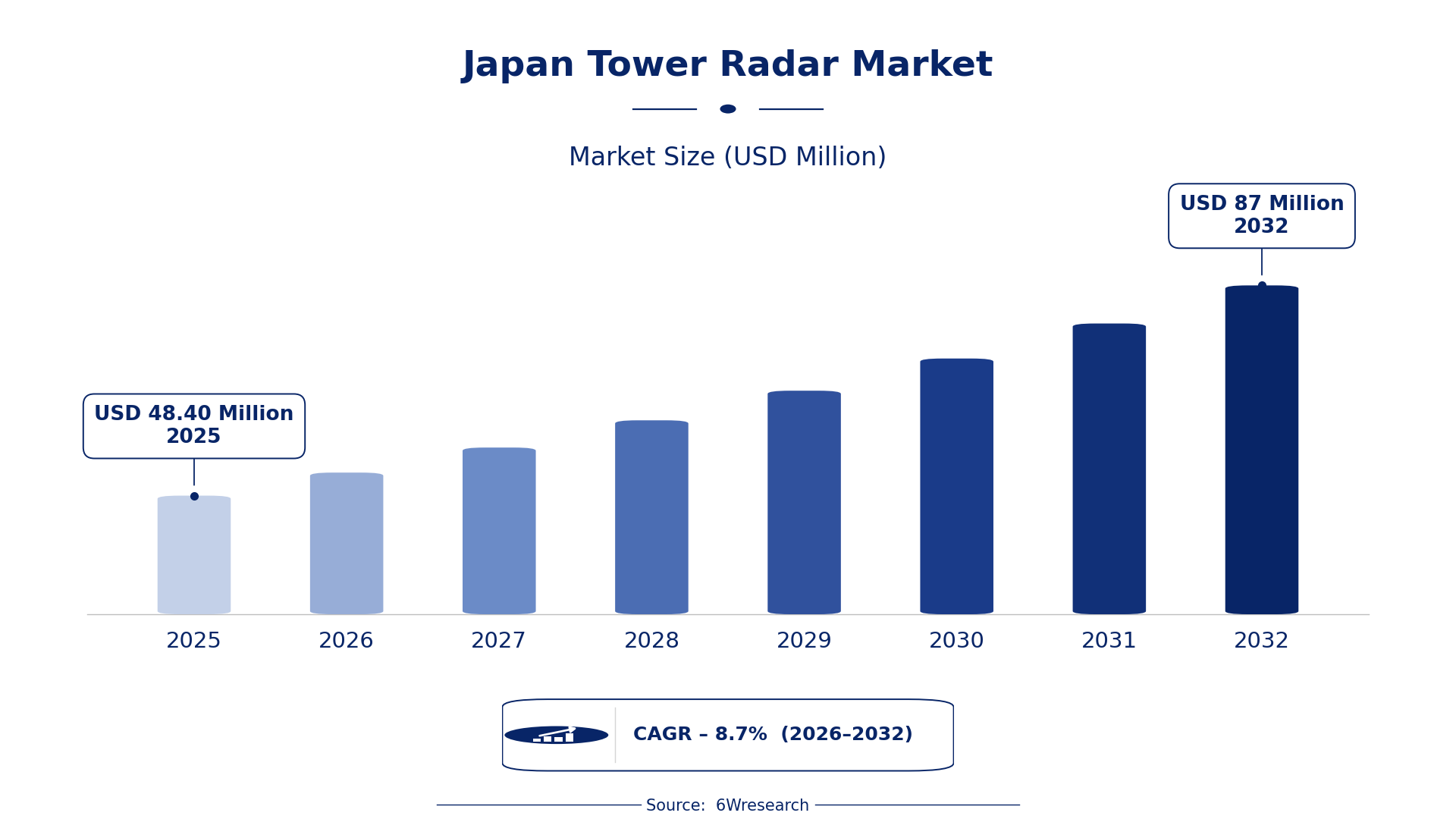
According to 6Wresearch internal database and industry insights, the Japan Tower Radar Market was valued at USD 48.40 Million in 2025 and is projected to reach USD 87 Million by 2032, growing at a CAGR of approximately 8.7% during 2026–2032.
Japan Tower Radar Market Highlights
| Report Metric | Details |
| Report Name | Japan Tower Radar Market (2026-2032) |
| Market Size 2025 | USD 48.40 Million |
| Market Size 2032 | USD 87 Million |
| Absolute Growth 2025–2032 | USD 38.60 Million |
| CAGR 2026–2032 | 8.7% |
| Peak Annual Growth | 9.5% in 2032 |
| Forecast Period | 2026–2032 |
| Historical Data | 2022–2025 |
| Base Year | 2025 |
| Leading Radar Type, 2025 | Primary Surveillance (43% share) |
| Leading Frequency Band, 2025 | L-Band (40% share) |
| Leading Detection Range, 2025 | Long-Range Aircraft (43% share) |
| Leading End User, 2025 | Air Traffic Control (46% share) |
| Fastest-Growing Radar Type | Secondary Surveillance (12.7% CAGR) |
| Fastest-Growing Frequency Band | S-Band (11.3% CAGR) |
| Fastest-Growing Detection Range | Transponder Detection (11.5% CAGR) |
| Fastest-Growing End User | Defense Airports (11.2% CAGR) |
| Growing Sector | air traffic management |
| Key End Users | air traffic control agencies, military operations, meteorological departments, government agencies |
Japan Tower Radar Market Year-wise Growth Rate and Key Drivers (2022–2032)
This graph illustrates the annual growth rates of the market from 2022 to 2032, highlighting a steady upward trajectory and projected market expansion over the forecast period.
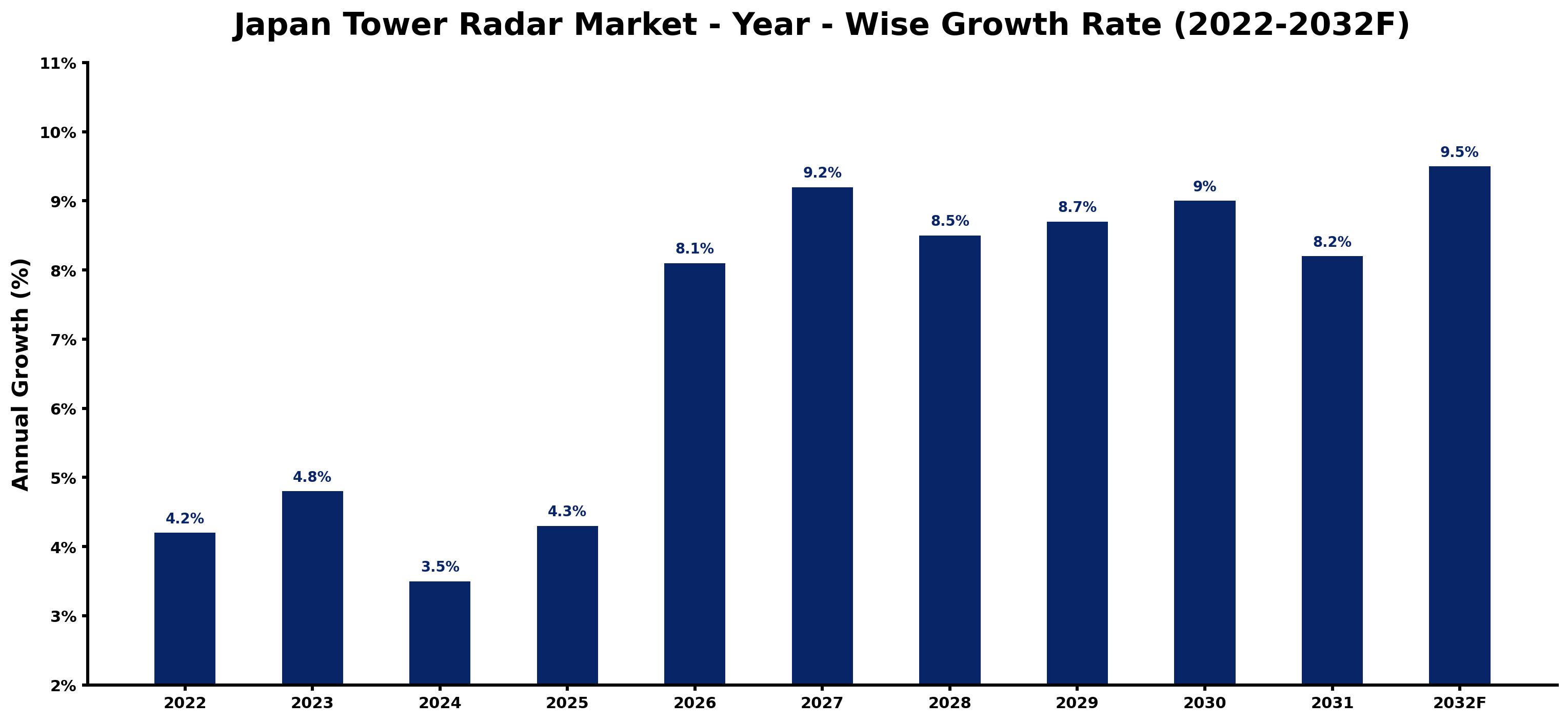
Each row of the following table gives one year's estimated growth and the event or demand shift that explains it.
| Year | Estimated Annual Growth (%) | Market Rationale |
| 2022 | 4.2 | The market showed steady growth, reflecting ongoing investments in radar technology. |
| 2023 | 4.8 | Growth accelerated due to increased air traffic and military operations in the region. |
| 2024 | 3.5 | Growth slowed as the market adjusted to previous high levels of demand. |
| 2025 | 4.3 | Demand rebounded with upgrades to air traffic systems and military improvements. |
| 2026 | 8.1 | Growth is expected to surge as new technologies are integrated into existing systems. |
| 2027 | 9.2 | Continued investment in air traffic safety will drive further market expansion. |
| 2028 | 8.5 | A slight slowdown is anticipated as saturation in some areas occurs. |
| 2029 | 8.7 | Demand is expected to increase again due to rising air traffic and military needs. |
| 2030 | 9.0 | The market will continue to grow as modernization efforts gain momentum. |
| 2031 | 8.2 | Growth is projected to decelerate slightly as the market stabilises after rapid expansions. |
| 2032 | 9.5 | Demand is expected to peak with investments in radar technology upgrades. |
Note: Market size estimations and growth projections presented in this report are based on 6Wresearch's proprietary forecasting methodology, utilizing the latest available industry data, government publications, and primary research inputs.
Japan Tower Radar Market Synopsis
Tower radar technology plays a crucial role in air traffic control, weather monitoring, and military applications. It functions by emitting radio waves to detect objects, thereby ensuring safety and situational awareness. The Japan Tower Radar Market is growing due to increasing air traffic and military operations, with over 100 operational systems. Government investments in radar technology upgrades are driving demand from the aviation sector and government agencies aiming for improved monitoring capabilities.
Market Dynamics Impact Analysis (2026–2032)
| Factor | Type | Impact | Primary Segment Affected |
| Increased air traffic management requirements drive demand for advanced radar systems. | Driver | High | Air Traffic Control |
| Rising military investments in surveillance technology create opportunities for radar upgrades. | Driver | High | Defense Airports |
| Growing need for weather monitoring systems presents a significant opportunity. | Opportunity | High | Weather Radar Towers |
| Expansion of air traffic infrastructure in urban areas opens new markets. | Opportunity | Medium | Air Traffic Control |
| High costs of advanced radar systems may limit some buyers' access. | Restraint | Medium | Primary Surveillance |
| Technological complexity can hinder quick adoption of new systems. | Restraint | Medium | 3D Tower Radar |
| Competition from alternative technologies may affect market share. | Challenge | High | Secondary Surveillance |
| Supply chain disruptions can delay project timelines and increase costs. | Challenge | Medium | Weather Radar Towers |
Evaluation of Drivers in Japan Tower Radar Market (2026–2032)
These are the developments adding the most demand over the forecast period.
| Drivers | Primary Segment Affected | Why It Matters (Evidence) |
| Increased air traffic necessitates advanced radar systems for safety. | Air Traffic Control | Japan's population of approximately 126 million creates high demand for air traffic management. |
| Military modernization drives demand for sophisticated surveillance technologies. | Defense Airports | Recent military initiatives have increased the need for advanced surveillance capabilities. |
| Weather monitoring systems are critical for disaster preparedness and safety. | Weather Radar Towers | The Japan Meteorological Agency operates 60 weather radar stations nationwide. |
| Technological advancements in radar systems improve operational capabilities. | 3D Tower Radar | Recent upgrades in technology have improved the effectiveness of radar operations. |
| Government investments in infrastructure support radar system upgrades. | Primary Surveillance | In 2023, Japan invested significantly in upgrading radar systems for improved air traffic safety. |
Orders continue to rise as the aviation sector grows, creating a need for better air traffic management. Recent military investments are driving demand for advanced surveillance systems, particularly at defence airports. Weather monitoring is essential for disaster preparedness, supported by numerous weather stations throughout the country. Technological advancements are improving operational capabilities, ensuring effective management in radar operations. Infrastructure upgrades are also supporting demand for primary surveillance systems, as safety becomes a top priority for air traffic control.
Evaluation of Restraints in Japan Tower Radar Market
Below are the constraints most often cited by buyers and suppliers, with the segment each affects.
| Market Restraint | Primary Segment Affected | Why It Matters (Evidence) |
| High costs of advanced radar systems limit access for some buyers. | Primary Surveillance | The average investment in radar technology can exceed millions of dollars, restricting smaller operators. |
| Technological complexity can hinder quick adoption of new systems. | 3D Tower Radar | Many users require extensive training and integration time, delaying implementation. |
| Competition from alternative technologies may affect market share. | Secondary Surveillance | Emerging technologies like satellite-based systems are gaining traction in the market. |
| Supply chain disruptions can delay project timelines and increase costs. | Weather Radar Towers | Global supply chain issues have led to longer lead times for radar components. |
| Limited availability of skilled technicians impacts installation and maintenance. | Air Traffic Control | The demand for qualified personnel exceeds supply, affecting operational efficiency. |
Japan Tower Radar Market Challenges
Over 100 operational tower radar systems in Japan create supply challenges for clinics, as any disruption in maintenance can lead to delays in air traffic management. Suppliers struggle with outdated technology, limiting their ability to upgrade systems, which can delay safety improvements for hospitals. High costs associated with advanced radar technology burden producers, requiring an estimated 30% increase in funding for necessary upgrades. Intense competition among suppliers results in price wars, which can compromise quality and reliability for importers, ultimately affecting operational efficiency.
Trends in the Japan Tower Radar Market
These developments are changing demand patterns in the Japan Tower Radar Market.
- Shift in Air Traffic Control Technology: The Tokyo region is adopting more integrated air traffic control systems, improving efficiency. With over 100 operational systems, this shift enhances safety and management capabilities.
- Emergence of Multi-Band Radar Systems: Multi-band radar systems are gaining traction for their versatility in applications. The Japan Civil Aviation Bureau is promoting these systems, which are essential for modern air traffic control.
- Increased Focus on Weather Monitoring: Meteorological departments are prioritising advanced weather radar systems for disaster preparedness. The Tokyo Metropolitan Government has initiatives to improve weather monitoring capabilities, essential for public safety.
- Adoption of 3D Radar Technology: 3D radar technology is becoming essential for comprehensive air traffic management. The Japan Aerospace Exploration Agency is collaborating on advancements, ensuring improved situational awareness.
Investment Opportunities in the Japan Tower Radar Market
The openings below show where demand in the Japan Tower Radar Market is visible and how suppliers can enter.
- Partnerships for Radar System Upgrades: Local partnerships are essential for upgrading radar systems in Japan's airports. With over 100 operational systems, collaboration can streamline the upgrade process and enhance safety.
- Investment in Weather Monitoring Infrastructure: Investing in weather radar systems is crucial for disaster preparedness. Meteorological departments need advanced systems to improve forecasting accuracy and response times.
- Supply of Advanced Surveillance Technologies: Defence airports are in search of advanced surveillance technologies for military operations. Suppliers can explore joint ventures to enhance capabilities and ensure compliance with standards.
- Expansion of Air Traffic Control Facilities: Air traffic control facilities are expanding to manage increased air traffic. Investment in these facilities is vital for maintaining safety and efficiency in operations.
Government Initiatives in the Japan Tower Radar Market
The Electrical Appliance and Material Safety Act ensures adherence to safety standards for radar systems. This act requires rigorous testing and certification for radar equipment, benefiting buyers by guaranteeing reliable operations. The Industrial Standardization Act regulates JIS standards for radar systems, promoting quality and consistency in production, which is crucial for operational efficiency.
The GX Basic Policy supports investments in air traffic management systems. This policy facilitates funding for radar technology upgrades, ensuring that air traffic control systems meet contemporary safety standards and operational requirements. The Japan Civil Aviation Bureau's initiatives aid in the adoption of advanced radar technologies, benefiting air traffic control operations.
Future Insight of the Japan Tower Radar Market
The introduction of new weather monitoring facilities will enhance data accuracy by 2032, benefiting both buyers and suppliers. Ongoing updates to the Air Traffic Management System will strengthen safety protocols, ensuring improved service delivery. Collaborations with the Japan Aerospace Exploration Agency will drive advancements in radar technology, promoting progress. Increased investment in disaster preparedness initiatives will elevate the importance of meteorological radar systems in protecting communities.
Market Segmentation Analysis
Japan Tower Radar Market report covers a detailed analysis of the following market segments:
By Radar Type – Primary Surveillance Leads, Secondary Surveillance Expected to Grow Fastest
According to Saurav Kr Singh, Senior Research Analyst at 6Wresearch, Primary Surveillance held 43% of the Japan Tower Radar Market by radar type in 2025. Primary Surveillance systems hold the largest share in Japan as they are essential for air traffic control and military operations. The high volume of air traffic in the Tokyo region necessitates these radars for effective management. Over 2026–2032, Secondary Surveillance is expected to post the fastest growth, at a CAGR of 12.7%. Secondary Surveillance is rapidly growing due to its importance in identifying aircraft transponders, which enhances air traffic safety. The increasing number of aircraft in Japan's airspace significantly drives this demand. Suppliers should prioritise advancements in Secondary Surveillance technologies to meet the rising safety requirements in air traffic management.
By Frequency Band – L-Band Leads, S-Band Expected to Grow Fastest
L-Band took 40% of frequency band revenue in 2025, more than any other category. L-Band radars dominate the market as they are primarily used for long-range surveillance applications, crucial for monitoring aircraft over extensive distances. This is particularly important given Japan's busy air traffic network. The quickest growth will come from S-Band, forecast to expand at a CAGR of 11.3% between 2026 and 2032. S-Band radars are experiencing the fastest growth due to their common application in weather radar systems, which are vital for disaster preparedness in Japan's coastal regions. The increased focus on weather monitoring is propelling this trend. Buyers should consider S-Band solutions to improve their weather monitoring and disaster response capabilities.
By Detection Range – Long-Range Aircraft Leads, Transponder Detection Expected to Grow Fastest
In 2025, Long-Range Aircraft led the detection range split with a 43% share. Long-Range Aircraft detection systems lead the market as they are necessary for tracking aircraft at great distances, ensuring safety in Japan's busy airspace. This is particularly relevant given the high volume of air traffic in regions like Tokyo. Transponder Detection is projected to grow fastest, at a CAGR of 11.5% during 2026–2032. Transponder Detection is the fastest-growing segment because it is vital for air traffic safety, especially with the rising number of aircraft operating in Japanese airspace. This demand is expected to continue as air traffic increases. Suppliers should prioritise the development of Transponder Detection technologies to align with the growing safety requirements of air traffic management.
By End User – Air Traffic Control Leads, Defense Airports Expected to Grow Fastest
With 46% of end user revenue in 2025, Air Traffic Control was the largest category. Air Traffic Control is the leading end user of tower radar systems, being the main application for managing aircraft movements in Japan's crowded airports. The existing regulatory framework and safety standards reinforce this segment's prominence. Defense Airports are set to record the highest CAGR in this split, 11.2% over 2026–2032. Defense Airports are showing the fastest growth due to their essential role in military air traffic management, particularly as Japan enhances its defense capabilities. This trend is likely to accelerate with the expansion of military operations. Suppliers should target the Defense Airports segment to capitalise on the increasing investments in military air traffic management.
Key Attractiveness of the Report
- 10 Years of Market Numbers
- Historical Data Starting from 2022 to 2025
- Base Year 2025
- Forecast Data until 2032
- Key Performance Indicators Impacting the Market
- Major Upcoming Developments and Projects
Key Highlights of the Report:
- Japan Tower Radar Market Outlook
- Market Size of Japan Tower Radar Market, 2025
- Forecast of Japan Tower Radar Market, 2032
- Historical Data and Forecast of Japan Tower Radar Revenues & Volume for the Period 2022-2032F
- Japan Tower Radar Market Trend Evolution
- Japan Tower Radar Market Drivers and Challenges
- Japan Tower Radar Price Trends
- Japan Tower Radar Porter's Five Forces
- Japan Tower Radar Industry Life Cycle
- Historical Data and Forecast of Japan Tower Radar Market Revenues & Volume By Radar Type for the Period 2022-2032F
- Historical Data and Forecast of Japan Tower Radar Market Revenues & Volume By Primary Surveillance for the Period 2022-2032F
- Historical Data and Forecast of Japan Tower Radar Market Revenues & Volume By Secondary Surveillance for the Period 2022-2032F
- Historical Data and Forecast of Japan Tower Radar Market Revenues & Volume By Weather Radar Towers for the Period 2022-2032F
- Historical Data and Forecast of Japan Tower Radar Market Revenues & Volume By 3D Tower Radar for the Period 2022-2032F
- Historical Data and Forecast of Japan Tower Radar Market Revenues & Volume By Frequency Band for the Period 2022-2032F
- Historical Data and Forecast of Japan Tower Radar Market Revenues & Volume By L-Band for the Period 2022-2032F
- Historical Data and Forecast of Japan Tower Radar Market Revenues & Volume By S-Band for the Period 2022-2032F
- Historical Data and Forecast of Japan Tower Radar Market Revenues & Volume By X-Band for the Period 2022-2032F
- Historical Data and Forecast of Japan Tower Radar Market Revenues & Volume By Multi-Band for the Period 2022-2032F
- Historical Data and Forecast of Japan Tower Radar Market Revenues & Volume By Detection Range for the Period 2022-2032F
- Historical Data and Forecast of Japan Tower Radar Market Revenues & Volume By Long-Range Aircraft for the Period 2022-2032F
- Historical Data and Forecast of Japan Tower Radar Market Revenues & Volume By Transponder Detection for the Period 2022-2032F
- Historical Data and Forecast of Japan Tower Radar Market Revenues & Volume By Weather Monitoring for the Period 2022-2032F
- Historical Data and Forecast of Japan Tower Radar Market Revenues & Volume By Civil + Military for the Period 2022-2032F
- Historical Data and Forecast of Japan Tower Radar Market Revenues & Volume By End User for the Period 2022-2032F
- Historical Data and Forecast of Japan Tower Radar Market Revenues & Volume By Air Traffic Control for the Period 2022-2032F
- Historical Data and Forecast of Japan Tower Radar Market Revenues & Volume By Defense Airports for the Period 2022-2032F
- Historical Data and Forecast of Japan Tower Radar Market Revenues & Volume By Meteorological Depts for the Period 2022-2032F
- Historical Data and Forecast of Japan Tower Radar Market Revenues & Volume By Government Agencies for the Period 2022-2032F
- Japan Tower Radar Import Export Trade Statistics
- Market Opportunity Assessment By Radar Type
- Market Opportunity Assessment By Frequency Band
- Market Opportunity Assessment By Detection Range
- Market Opportunity Assessment By End User
- Japan Tower Radar Top Companies Market Share
- Japan Tower Radar Competitive Benchmarking By Technical and Operational Parameters
- Japan Tower Radar Company Profiles
- Japan Tower Radar Key Strategic Recommendations
Market Covered
This report examines the market across the segments below.
By Radar Type
- Primary Surveillance
- Secondary Surveillance
- Weather Radar Towers
- 3D Tower Radar
By Frequency Band
- L-Band
- S-Band
- X-Band
- Multi-Band
By Detection Range
- Long-Range Aircraft
- Transponder Detection
- Weather Monitoring
- Civil + Military
By End User
- Air Traffic Control
- Defense Airports
- Meteorological Depts
- Government Agencies































