Japan Toxic Bait Products Market Size & Growth Rate
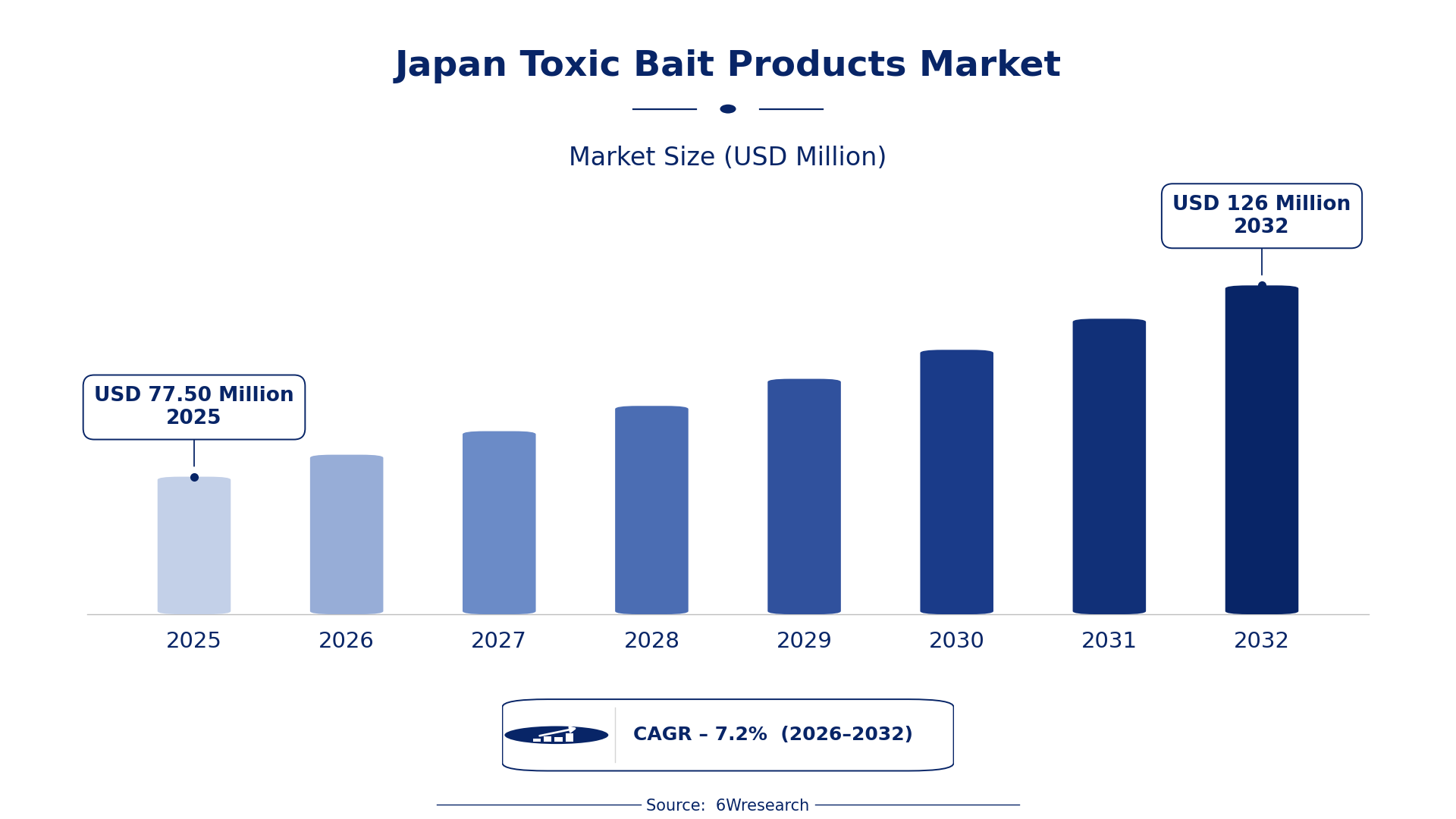
According to 6Wresearch internal database and industry insights, the Japan Toxic Bait Products Market was valued at USD 77.50 Million in 2025 and is projected to reach USD 126 Million by 2032, growing at a CAGR of approximately 7.2% during 2026–2032.
Japan Toxic Bait Products Market Highlights
| Report Metric | Details |
| Report Name | Japan Toxic Bait Products Market (2026-2032) |
| Market Size 2025 | USD 77.50 Million |
| Market Size 2032 | USD 126 Million |
| Absolute Growth 2025–2032 | USD 48.50 Million |
| CAGR 2026–2032 | 7.2% |
| Peak Annual Growth | 8.6% in 2026 |
| Forecast Period | 2026–2032 |
| Historical Data | 2022–2025 |
| Base Year | 2025 |
| Leading Bait Type, 2025 | Rodent Baits (43% share) |
| Leading Active Ingredient, 2025 | Bromadiolone (47% share) |
| Leading Target Pest, 2025 | Rats & Mice (40% share) |
| Leading End User, 2025 | Pest Control Agencies (39% share) |
| Fastest-Growing Bait Type | Insect Baits (9.8% CAGR) |
| Fastest-Growing Active Ingredient | Fipronil/Gel Form (9.4% CAGR) |
| Fastest-Growing Target Pest | Ants (10.2% CAGR) |
| Fastest-Growing End User | Restaurants/Hotels (9.2% CAGR) |
| Growing Sector | Pest Control Services |
| Key End Users | Pest Control Agencies, Restaurants, Agricultural Users |
Japan Toxic Bait Products Market Year-wise Growth Rate and Key Drivers (2022–2032)
This graph illustrates the annual growth rates of the market from 2022 to 2032, highlighting a steady upward trajectory and projected market expansion over the forecast period.
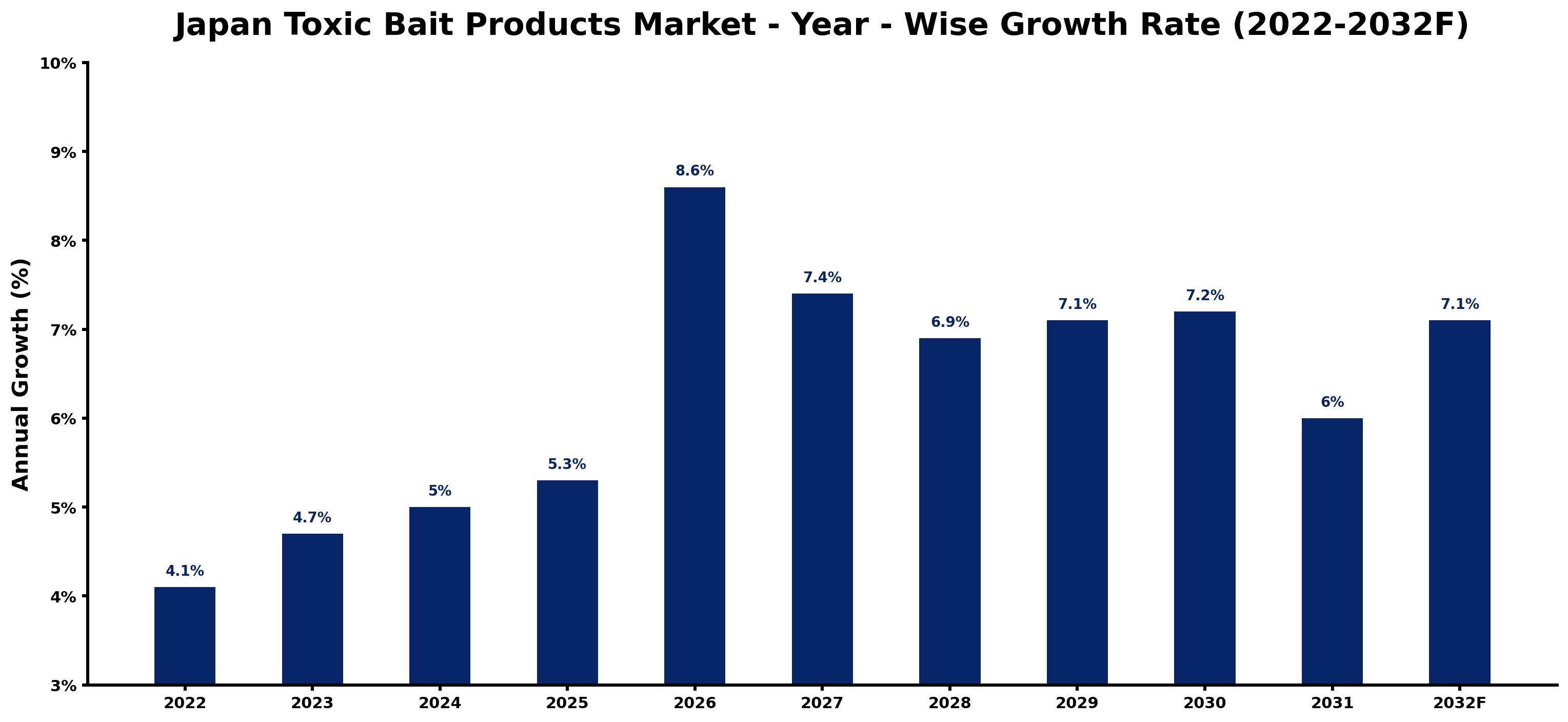
Below, each year's estimated growth is shown next to the factor that most influenced it.
| Year | Estimated Annual Growth (%) | Market Rationale |
| 2022 | 4.1 | The market experienced steady demand from pest control agencies and households. |
| 2023 | 4.7 | Growth accelerated due to increased awareness of pest management solutions. |
| 2024 | 5.0 | Demand continued to rise as urban pest control needs expanded. |
| 2025 | 5.3 | The market saw heightened activity driven by urbanisation and pest infestations. |
| 2026 | 8.6 | A surge in growth is anticipated as new pest control technologies gain traction. |
| 2027 | 7.4 | Growth is projected to slow slightly as the market adjusts to previous high rates. |
| 2028 | 6.9 | Demand is anticipated to remain strong, but growth will moderate as the market stabilises. |
| 2029 | 7.1 | The market is expected to pick up pace again, driven by seasonal pest issues. |
| 2030 | 7.2 | Growth will continue as pest control services become more widely adopted. |
| 2031 | 6.0 | A slowdown is projected as market saturation begins to take effect. |
| 2032 | 7.1 | Demand is expected to rise again due to ongoing pest management needs. |
Note: Market size estimations and growth projections presented in this report are based on 6Wresearch's proprietary forecasting methodology, utilizing the latest available industry data, government publications, and primary research inputs.
Japan Toxic Bait Products Market Synopsis
Toxic bait products are chemical formulations that eliminate pests such as rodents and insects, commonly used in residential, commercial, and agricultural settings. The Japan Toxic Bait Products Market is growing due to urbanisation, increased awareness of pest management, and active involvement from pest control agencies. The Tokyo metropolitan area, with its high concentration of pest control agencies, serves as a major demand source. Stricter regulations on toxic baits implemented in 2023 have further stimulated the market, improving safety and efficacy in pest management practices.
Market Dynamics Impact Analysis (2026–2032)
| Factor | Type | Impact | Primary Segment Affected |
| Rising urbanisation increases pest populations, driving demand for pest control solutions. | Driver | High | Rodent Baits |
| Growing awareness of pest management practices leads to higher adoption of toxic baits. | Driver | High | Insect Baits |
| The agricultural sector's need for pest control solutions creates opportunities for suppliers. | Opportunity | High | Grain-Based Baits |
| Pest control agencies are expanding their services, increasing demand for effective bait products. | Opportunity | High | Termite Baits |
| Stricter regulations on toxic bait usage may limit product availability and application methods. | Restraint | High | Bromadiolone |
| Consumer preference for eco-friendly alternatives may restrain growth of traditional toxic baits. | Restraint | Medium | Fipronil/Gel Form |
| Supply chain disruptions can delay product availability for pest control agencies. | Challenge | High | Pest Control Agencies |
| High competition among suppliers may lead to price wars, affecting profitability. | Challenge | Medium | Restaurants/Hotels |
Evaluation of Drivers in Japan Toxic Bait Products Market (2026–2032)
Below are the drivers that matter most for revenue growth, with supporting evidence.
| Drivers | Primary Segment Affected | Why It Matters (Evidence) |
| Increased urbanisation leads to higher rodent populations, boosting demand for rodent baits. | Rodent Baits | Japan's population density, particularly in urban areas, creates ideal conditions for rodent infestations. |
| Heightened awareness of pest management practices results in more households seeking pest control solutions. | Insect Baits | The average household spends approximately ¥10,000 annually on pest control services. |
| The agricultural sector's focus on crop protection drives demand for toxic baits in rural areas. | Grain-Based Baits | Agricultural users account for a large portion of the demand for pest control solutions. |
| Pest control agencies are expanding their service offerings, leading to increased purchases of bait products. | Termite Baits | The Pest Control Association of Japan reported a 5% increase in service adoption in urban areas. |
| The introduction of new pest control technologies improves the effectiveness of toxic baits. | Bromadiolone | Bromadiolone is widely used due to its effectiveness against rodent populations. |
The strongest pull on demand comes from increased urbanisation, which drives rodent populations and boosts sales of rodent baits. Urban households are becoming more aware of pest management practices, leading to higher spending on insect baits. The agricultural sector's need for effective crop protection drives demand for grain-based baits, particularly in rural regions. New technologies improve the effectiveness of toxic baits, stimulating market growth.
Evaluation of Restraints in Japan Toxic Bait Products Market
The key brakes on demand, and where they bite hardest, are shown below.
| Market Restraint | Primary Segment Affected | Why It Matters (Evidence) |
| Stricter regulations on toxic bait usage may limit product availability. | Bromadiolone | In 2023, Japan implemented stricter regulations on the use of certain toxic baits to ensure safety. |
| Consumer preference for eco-friendly alternatives may restrain traditional toxic bait sales. | Fipronil/Gel Form | Growing environmental concerns are pushing consumers towards greener pest control options. |
| Supply chain disruptions can affect the timely availability of products for pest control agencies. | Pest Control Agencies | Global supply chain issues have impacted the availability of essential pest control products. |
| High competition among suppliers can lead to price wars, affecting profitability. | Restaurants/Hotels | Increased competition in urban pest control markets pressures pricing strategies. |
| Limited awareness of new pest control technologies may hinder adoption rates. | Insect Baits | Some consumers remain unaware of advancements in pest control solutions, affecting sales. |
Japan Toxic Bait Products Market Challenges
Stricter regulations on toxic bait usage in Japan have increased compliance costs for producers, leading to higher prices for buyers, with urban households spending approximately ¥10,000 annually on pest control services. Limited availability of compliant products disrupts supply chains, causing delays in pest control solutions for urban residents. The agricultural sector faces challenges in sourcing effective baits due to regulatory changes, impacting crop protection efforts in rural areas. A shortage of trained professionals in pest management hampers the ability of pest control agencies to meet rising demand, particularly in densely populated regions.
Trends in the Japan Toxic Bait Products Market
The trends below show where the Japan Toxic Bait Products Market is heading.
- Shift in Pest Control Practices in Tokyo: Tokyo has seen a shift towards integrated pest management practices, with a 5% increase in service adoption reported by the Pest Control Association of Japan in 2023. This trend reflects a growing preference for sustainable pest control methods, influencing suppliers to adapt their offerings.
- Restaurants Prioritising Integrated Pest Management: Restaurants in urban areas are increasingly adopting integrated pest management strategies, driven by a 9.2% CAGR in pest control services. This shift is crucial for maintaining food safety and compliance with health regulations.
- Rise in Demand for Eco-Friendly Baits: Consumer demand for eco-friendly pest control solutions is rising, with a notable increase in sales of green alternatives. In 2023, the Pest Control Association of Japan reported a rise in inquiries about sustainable bait options.
- Increased Use of Technology in Pest Management: The pest control industry is embracing technology, with pest control agencies investing in advanced monitoring systems. This trend is highlighted by the Tokyo Metropolitan Government's initiatives to improve pest management effectiveness.
Investment Opportunities in the Japan Toxic Bait Products Market
The following areas offer the clearest openings for investors and suppliers in the Japan Toxic Bait Products Market.
- Pest Control Agencies Seeking Effective Solutions: Pest control agencies are in need of effective toxic bait products, particularly in urban areas. With the market projected to reach USD 126 million by 2032, suppliers can enter through partnerships with local agencies.
- Agricultural Users Demanding Pest Control Products: Agricultural users are increasingly requiring pest control solutions to protect crops. With strong demand from the agricultural sector, suppliers can establish joint ventures to meet this need effectively.
- Restaurants Investing in Pest Management: Restaurants are prioritising pest management services, creating opportunities for suppliers. With the market expanding, establishing local partnerships can facilitate entry into this growing sector.
- Urban Areas Needing Innovative Pest Solutions: Urban areas are experiencing increased pest populations, necessitating innovative pest control solutions. Suppliers can capitalise on this trend by obtaining necessary certifications to offer compliant products.
Government Initiatives in the Japan Toxic Bait Products Market
The Food Recycling Law, enacted in 2000, mandates food businesses to reduce waste and recycle it into feed, fertiliser, and energy. This law impacts toxic bait products by promoting sustainable practices in waste management, encouraging the use of safer pest control products. The Building Energy Efficiency Act, amended in 2022, requires new buildings to meet energy standards, indirectly affecting pest control measures during construction.
The Ministry of Health, Labour and Welfare oversees the implementation of pest control regulations, approving products and practices that comply with safety standards. In 2023, the ministry launched a campaign to promote integrated pest management, funding initiatives that improve pest control effectiveness and safety. This support is vital for pest control agencies seeking to adopt compliant practices.
Future Insight of the Japan Toxic Bait Products Market
New integrated pest management programmes will launch by 2032, focusing on sustainable practices and improved safety standards. The Tokyo Metropolitan Government's initiatives to reduce pest populations will enhance urban living conditions. Technological advancements will lead to the development of more effective bait formulations, improving pest elimination efficiency. By 2032, the Pest Control Association of Japan's updated guidelines will raise industry standards, benefiting both residential and commercial buyers, with pest control service adoption in urban areas projected to increase by 5%.
Market Segmentation Analysis
Japan Toxic Bait Products Market report covers a detailed analysis of the following market segments:
By Bait Type – Rodent Baits Lead, Insect Baits Expected to Grow Fastest
According to Saurav Kr Singh, Senior Research Analyst at 6Wresearch, Rodent Baits held 43% of the Japan Toxic Bait Products Market by bait type in 2025. Rodent baits hold the largest share as they are essential for controlling rodent populations in urban areas, where demand is high. For instance, the Tokyo metropolitan area has a dense concentration of pest control agencies that rely on these products. Over 2026–2032, Insect Baits are expected to post the fastest growth, at a CAGR of 9.8%. Insect baits are experiencing rapid growth due to an increasing need for pest management in homes and businesses, particularly during the summer months. The Pest Control Association of Japan reported a 5% rise in service adoption in urban areas, indicating heightened demand. Suppliers should focus on expanding their insect bait offerings to meet the growing urban demand.
By Active Ingredient – Bromadiolone Leads, Fipronil/Gel Form Expected to Grow Fastest
In 2025, Bromadiolone led the active ingredient split with a 47% share. Bromadiolone is the leading active ingredient due to its proven effectiveness against rodents, making it a preferred choice among pest control professionals. Its widespread use in urban settings underscores its importance in the market. Fipronil/Gel Form is projected to grow fastest, at a CAGR of 9.4% during 2026–2032. Fipronil-based products, particularly in gel form, are gaining traction for their effectiveness in managing cockroach populations in urban environments. This trend is likely to accelerate as urban pest control needs increase. Suppliers may benefit from investing in Fipronil formulations to capture the growing market segment.
By Target Pest – Rats & Mice Leads, Ants Expected to Grow Fastest
With 40% of target pest revenue in 2025, Rats & Mice was the largest category. Rats and mice are the primary targets for rodent bait products, reflecting the high demand for effective solutions in urban pest control. Their prevalence in cities like Tokyo drives the market for these specific products. The quickest growth will come from Ants, forecast to expand at a CAGR of 10.2% between 2026 and 2032. Ants are rapidly becoming a focus for pest control efforts, particularly in residential areas during warmer months. The increased attention on ant management is a response to rising infestations in urban settings. Suppliers should adapt their strategies to include targeted solutions for ant control to capitalise on this growth.
By End User – Pest Control Agencies Lead, Restaurants/Hotels Expected to Grow Fastest
Pest Control Agencies accounted for 39% of the market by end user in 2025. Pest control agencies represent the largest user group for toxic bait products, as they require effective solutions to address various pest issues. Their significant presence in urban centres, especially in the Tokyo metropolitan area, guarantees a steady demand for these products. Restaurants/Hotels are set to record the highest CAGR in this split, 9.2% over 2026–2032. The restaurant and hotel sector is experiencing rapid growth due to stricter health regulations and the necessity for effective pest management in food service. This industry's focus on maintaining high hygiene standards is driving an increased need for toxic bait products. Suppliers should prioritise tailored strategies for the food service sector to take advantage of this growing market.
Key Attractiveness of the Report
- 10 Years of Market Numbers
- Historical Data Starting from 2022 to 2025
- Base Year 2025
- Forecast Data until 2032
- Key Performance Indicators Impacting the Market
- Major Upcoming Developments and Projects
Key Highlights of the Report:
- Japan Toxic Bait Products Market Outlook
- Market Size of Japan Toxic Bait Products Market, 2025
- Forecast of Japan Toxic Bait Products Market, 2032
- Historical Data and Forecast of Japan Toxic Bait Products Revenues & Volume for the Period 2022-2032F
- Japan Toxic Bait Products Market Trend Evolution
- Japan Toxic Bait Products Market Drivers and Challenges
- Japan Toxic Bait Products Price Trends
- Japan Toxic Bait Products Porter's Five Forces
- Japan Toxic Bait Products Industry Life Cycle
- Historical Data and Forecast of Japan Toxic Bait Products Market Revenues & Volume By Bait Type for the Period 2022-2032F
- Historical Data and Forecast of Japan Toxic Bait Products Market Revenues & Volume By Rodent Baits for the Period 2022-2032F
- Historical Data and Forecast of Japan Toxic Bait Products Market Revenues & Volume By Insect Baits for the Period 2022-2032F
- Historical Data and Forecast of Japan Toxic Bait Products Market Revenues & Volume By Termite Baits for the Period 2022-2032F
- Historical Data and Forecast of Japan Toxic Bait Products Market Revenues & Volume By Grain-Based Baits for the Period 2022-2032F
- Historical Data and Forecast of Japan Toxic Bait Products Market Revenues & Volume By Active Ingredient for the Period 2022-2032F
- Historical Data and Forecast of Japan Toxic Bait Products Market Revenues & Volume By Bromadiolone for the Period 2022-2032F
- Historical Data and Forecast of Japan Toxic Bait Products Market Revenues & Volume By Fipronil/Gel Form for the Period 2022-2032F
- Historical Data and Forecast of Japan Toxic Bait Products Market Revenues & Volume By Hexaflumuron for the Period 2022-2032F
- Historical Data and Forecast of Japan Toxic Bait Products Market Revenues & Volume By Warfarin/Anticoagulant for the Period 2022-2032F
- Historical Data and Forecast of Japan Toxic Bait Products Market Revenues & Volume By Target Pest for the Period 2022-2032F
- Historical Data and Forecast of Japan Toxic Bait Products Market Revenues & Volume By Rats & Mice for the Period 2022-2032F
- Historical Data and Forecast of Japan Toxic Bait Products Market Revenues & Volume By Ants, Roaches for the Period 2022-2032F
- Historical Data and Forecast of Japan Toxic Bait Products Market Revenues & Volume By Termite Colonies for the Period 2022-2032F
- Historical Data and Forecast of Japan Toxic Bait Products Market Revenues & Volume By Outdoor Rodents for the Period 2022-2032F
- Historical Data and Forecast of Japan Toxic Bait Products Market Revenues & Volume By End User for the Period 2022-2032F
- Historical Data and Forecast of Japan Toxic Bait Products Market Revenues & Volume By Pest Control Agencies for the Period 2022-2032F
- Historical Data and Forecast of Japan Toxic Bait Products Market Revenues & Volume By Restaurants/Hotels for the Period 2022-2032F
- Historical Data and Forecast of Japan Toxic Bait Products Market Revenues & Volume By Construction Sites for the Period 2022-2032F
- Historical Data and Forecast of Japan Toxic Bait Products Market Revenues & Volume By Agricultural Users for the Period 2022-2032F
- Japan Toxic Bait Products Import Export Trade Statistics
- Market Opportunity Assessment By Bait Type
- Market Opportunity Assessment By Active Ingredient
- Market Opportunity Assessment By Target Pest
- Market Opportunity Assessment By End User
- Japan Toxic Bait Products Top Companies Market Share
- Japan Toxic Bait Products Competitive Benchmarking By Technical and Operational Parameters
- Japan Toxic Bait Products Company Profiles
- Japan Toxic Bait Products Key Strategic Recommendations
Market Covered
The report covers the following segments.
By Bait Type
- Rodent Baits
- Insect Baits
- Termite Baits
- Grain-Based Baits
By Active Ingredient
- Bromadiolone
- Fipronil/Gel Form
- Hexaflumuron
- Warfarin/Anticoagulant
By Target Pest
- Rats & Mice
- Ants
- Roaches
- Termite Colonies
- Outdoor Rodents
By End User
- Pest Control Agencies
- Restaurants/Hotels
- Construction Sites
- Agricultural Users































