Japan Toxicology Therapeutics Market Size & Growth Rate
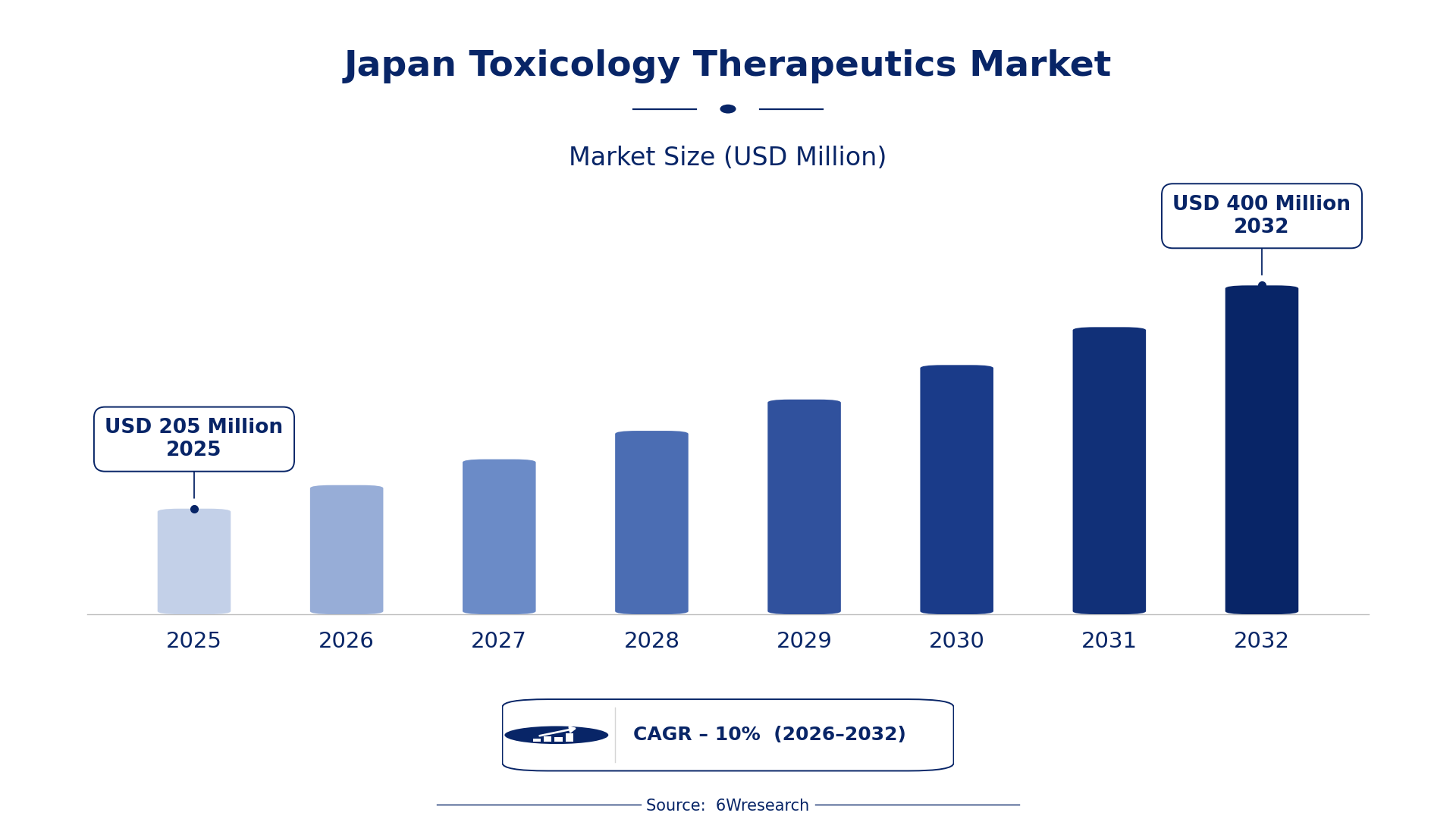
According to 6Wresearch internal database and industry insights, the Japan Toxicology Therapeutics Market was valued at USD 205 Million in 2025 and is projected to reach USD 400 Million by 2032, growing at a CAGR of approximately 10% during 2026–2032.
Japan Toxicology Therapeutics Market Highlights
| Report Metric | Details |
| Report Name | Japan Toxicology Therapeutics Market (2026-2032) |
| Market Size 2025 | USD 205 Million |
| Market Size 2032 | USD 400 Million |
| Absolute Growth 2025–2032 | USD 195 Million |
| CAGR 2026–2032 | 10% |
| Peak Annual Growth | 11.2% in 2027 |
| Forecast Period | 2026–2032 |
| Historical Data | 2022–2025 |
| Base Year | 2025 |
| Leading Drug Type, 2025 | Chelating Agents (46% share) |
| Leading Target Condition, 2025 | Heavy Metal Poisoning (42% share) |
| Leading Delivery Method, 2025 | Intravenous/Oral (43% share) |
| Leading End User, 2025 | Emergency Care Units (37% share) |
| Fastest-Growing Drug Type | Antidotes (13.5% CAGR) |
| Fastest-Growing Target Condition | Specific Toxin Blocks (12.7% CAGR) |
| Fastest-Growing Delivery Method | Injection (14.0% CAGR) |
| Fastest-Growing End User | Critical Care Units (12.4% CAGR) |
| Growing Sector | Critical Care Units |
| Key End Users | Emergency Care Units, Critical Care Units, Rural Hospitals, Pharmacies |
Japan Toxicology Therapeutics Market Year-wise Growth Rate and Key Drivers (2022–2032)
This graph illustrates the annual growth rates of the market from 2022 to 2032, highlighting a steady upward trajectory and projected market expansion over the forecast period.
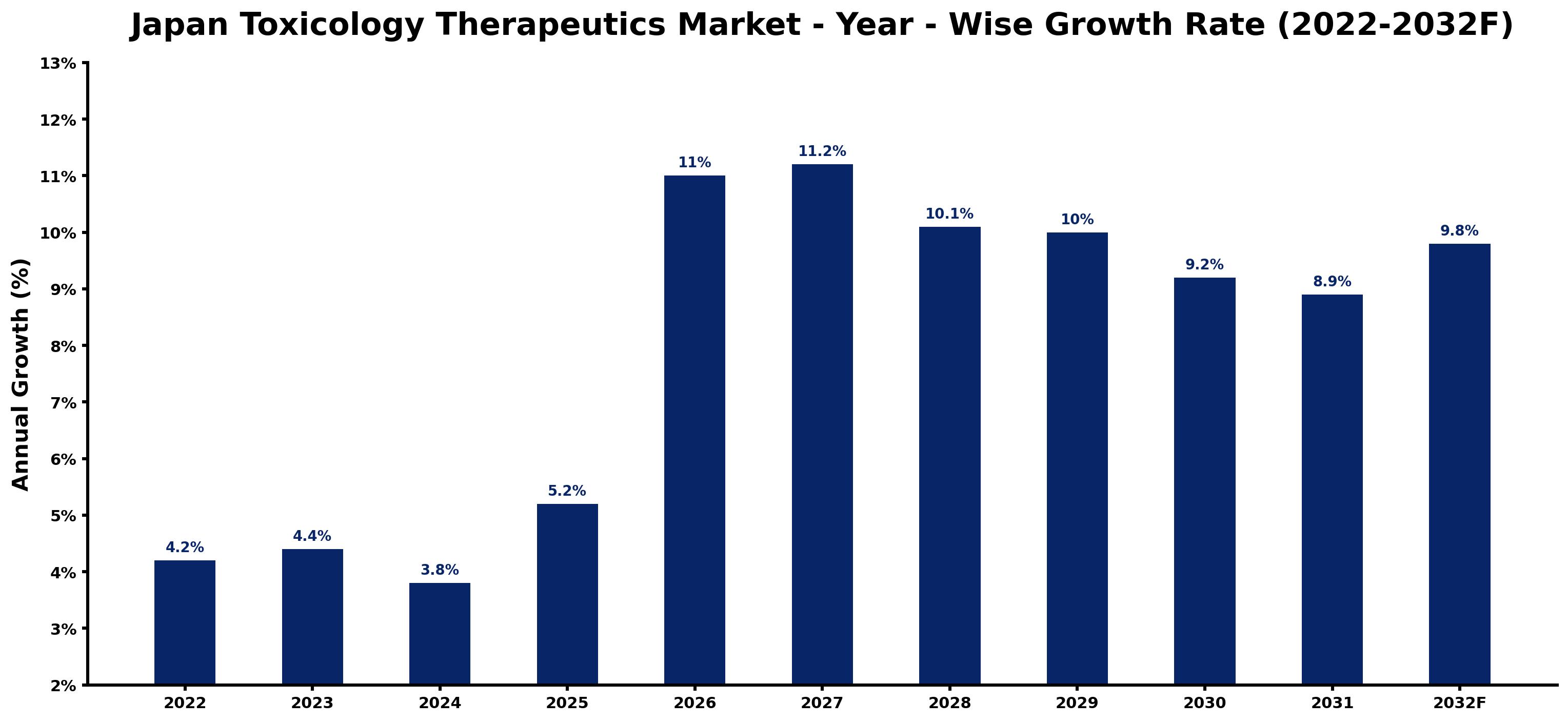
The yearly estimates that follow link every growth rate to its principal driver, so readers can see why the pace changed in each period.
| Year | Estimated Annual Growth (%) | Market Rationale |
| 2022 | 4.2 | The market experienced steady growth, reflecting established demand for toxicology therapeutics. |
| 2023 | 4.4 | Growth accelerated due to increased awareness of heavy metal poisoning cases in healthcare. |
| 2024 | 3.8 | The growth rate slowed slightly as market saturation began to impact new investments. |
| 2025 | 5.2 | A resurgence in growth occurred, driven by rising drug overdose cases and emergency care needs. |
| 2026 | 11.0 | Demand is expected to surge as healthcare facilities expand their toxicology treatment capabilities. |
| 2027 | 11.2 | The market is projected to peak with heightened focus on antidote availability amidst rising poisoning incidents. |
| 2028 | 10.1 | Growth is anticipated to slow as the market stabilises after reaching peak levels in the previous year. |
| 2029 | 10.0 | A slight slowdown is expected as the focus shifts to improving treatment protocols. |
| 2030 | 9.2 | The market will maintain positive growth, driven by ongoing training initiatives for emergency responders. |
| 2031 | 8.9 | Growth is projected to continue decelerating as competition intensifies among suppliers of therapeutics. |
| 2032 | 9.8 | The market is expected to grow faster again, driven by advancements in treatment technologies. |
Note: Market size estimations and growth projections presented in this report are based on 6Wresearch's proprietary forecasting methodology, utilizing the latest available industry data, government publications, and primary research inputs.
Japan Toxicology Therapeutics Market Synopsis
Toxicology therapeutics encompass treatments for toxic exposures, primarily involving chelating agents and antidotes. In Japan, over 1,500 cases of heavy metal poisoning were reported in 2023, underscoring the urgent need for effective treatments. The Japan Toxicology Therapeutics Market is growing due to rising drug overdose incidents, increased investment in emergency care units, and the implementation of training programmes for responders, which improve treatment availability and effectiveness.
Market Dynamics Impact Analysis (2026–2032)
| Factor | Type | Impact | Primary Segment Affected |
| Rising drug overdose cases drive demand for antidotes and treatment protocols. | Driver | High | Antidotes |
| Increased focus on emergency care unit capabilities enhances therapeutic availability. | Driver | High | Emergency Care Units |
| Growing awareness of heavy metal poisoning creates new treatment opportunities. | Opportunity | High | Heavy Metal Poisoning |
| Investment in training for emergency responders enhances treatment effectiveness. | Opportunity | Medium | Emergency Care Units |
| Limited access to advanced detoxifying agents in rural hospitals constrains treatment options. | Restraint | High | Detoxifying Agents |
| Stringent quality standards for antidotes can limit supplier participation. | Restraint | Medium | Antidotes |
| Cost pressures from regulatory compliance can affect pricing strategies. | Challenge | High | Chelating Agents |
| Capacity limitations in critical care units can delay patient treatment. | Challenge | Medium | Critical Care Units |
Evaluation of Drivers in Japan Toxicology Therapeutics Market (2026–2032)
Key forces behind demand, with the segment each one moves most, are listed below.
| Drivers | Primary Segment Affected | Why It Matters (Evidence) |
| Increased drug overdose cases require more antidotes, with around 10,000 cases reported in 2023. | Antidotes | This drives hospitals to stock more antidotes for immediate response. |
| Rising cases of heavy metal poisoning necessitate more chelating agents for treatment, with over 1,500 cases reported in 2023. | Chelating Agents | This leads hospitals to increase their stock of these agents. |
| Healthcare facilities are investing in training programmes for emergency responders, with the Ministry of Health launching initiatives in 2023. | Emergency Care Units | This aims to improve treatment protocols and response times. |
| The growing number of emergency care units in urban areas increases treatment availability, particularly in Tokyo. | Emergency Care Units | This region sees increased demand for therapeutics due to its high concentration of units. |
| Compliance with JIS standard 15001 ensures quality in antidote production, compelling manufacturers to improve processes. | Antidotes | This pushes manufacturers to refine their production methods to meet regulatory requirements. |
Volumes increase due to a rise in drug overdose cases, prompting hospitals to stock more antidotes for immediate response. The surge in heavy metal poisoning cases necessitates additional chelating agents, leading hospitals to bolster their inventories. The expanding number of emergency care units in urban areas boosts treatment availability, particularly in Tokyo, which drives demand for therapeutics.
Evaluation of Restraints in Japan Toxicology Therapeutics Market
These restraints slow adoption and weigh on supplier margins.
| Market Restraint | Primary Segment Affected | Why It Matters (Evidence) |
| Limited access to advanced detoxifying agents affects treatment efficacy for heavy metal poisoning. | Chelating Agents | Approximately 70% of rural hospitals lack access to essential detoxifying agents. |
| Strict regulatory standards complicate compliance for suppliers, delaying product availability. | Antidotes | Regulatory requirements impose burdens on manufacturers, affecting supply chains. |
| Skills shortages among emergency responders hinder effective toxicology treatment. | Emergency Care Units | Recent training initiatives highlight the need for more qualified personnel in this field. |
| Rising costs associated with enhancing treatment protocols strain budgets for healthcare facilities. | Critical Care Units | Healthcare facilities face financial pressures, especially in rural areas with limited resources. |
| Market saturation limits new investments in toxicology therapeutics. | Antivenoms | The established market presence makes it challenging for new entrants to gain traction. |
Japan Toxicology Therapeutics Market Challenges
Hospitals face limited access to advanced detoxifying agents, which undermines treatment for over 1,500 heavy metal poisoning cases reported in 2023. Regulatory standards, such as JIS standard 15001, impose strict quality requirements on antidotes, complicating compliance for suppliers and delaying product availability. Skills shortages among emergency responders impede effective toxicology treatment, as highlighted by a recent government programme aimed at improving training. Rising costs associated with toxicology treatment protocols, with ¥500 million allocated in 2023, strain budgets for healthcare facilities, particularly in rural areas where 70% lack essential resources.
Trends in the Japan Toxicology Therapeutics Market
The shifts below are changing how Japan Toxicology Therapeutics Market products are bought and supplied.
- Shift from Traditional to Advanced Treatment Protocols: Japan is moving from conventional treatment methods to more advanced protocols for toxicology therapeutics. The Ministry of Health's 2023 initiative aims to improve training for emergency responders, which enhances treatment effectiveness and patient outcomes.
- Transition from Over-the-Counter to Prescription-Based Detoxifying Agents: A growing trend towards prescription-based detoxifying agents is emerging in Japan, driven by the need for more controlled and effective treatments. This shift is evidenced by the increased regulatory focus on quality standards in clinical settings.
- Emergence of Integrated Training Programmes for Emergency Responders: Integrated training programmes for emergency responders are becoming widespread, particularly in urban areas like Tokyo. This approach is expected to improve response times and treatment efficacy in acute poisoning cases.
- Prioritisation of Quality Standards in Antidote Production: Quality standards in antidote production are being prioritised, as seen with adherence to the Chemical Substances Control Law. This ensures that products meet safety and efficacy requirements, benefiting healthcare providers and patients alike.
Investment Opportunities in the Japan Toxicology Therapeutics Market
The following areas offer the clearest openings for investors and suppliers in the Japan Toxicology Therapeutics Market.
- Supply of Advanced Chelating Agents: With over 1,500 cases of heavy metal poisoning reported in 2023, there is a pressing need for advanced chelating agents. Suppliers can target hospitals and emergency care units to meet this demand, particularly in urban centres like Tokyo.
- Investment in Emergency Care Unit Infrastructure: Now is an opportune time to invest in the infrastructure of emergency care units, especially in regions with high poisoning cases. The Tokyo area, with its concentration of emergency units, presents opportunities for development.
- Development of Innovative Antidotes: The rising number of drug overdose cases creates a demand for innovative antidotes. Targeting emergency care facilities will be essential, as they are the primary users of these therapeutics.
- Expansion of Training Programmes for Healthcare Providers: There is a growing need for training programmes for healthcare providers in toxicology treatment. Collaborating with educational institutions can help enhance the skills of emergency responders across Japan.
Government Initiatives in the Japan Toxicology Therapeutics Market
The Chemical Substances Control Law (1973) requires evaluation and control of new and existing chemical substances in manufacture and import. This measure ensures that toxicology therapeutics meet safety and efficacy standards, benefiting both producers and healthcare facilities by maintaining product quality.
The Ministry of Health oversees the implementation of training programmes for emergency responders, focusing on toxicology treatment protocols. These initiatives aim to improve the preparedness and response capabilities of healthcare providers, ensuring better patient outcomes in critical situations.
Future Insight of the Japan Toxicology Therapeutics Market
A policy-driven shift will reshape toxicology treatment protocols by 2032, prompting a commercial response from suppliers. Emergency care units will implement advanced training programmes for responders, enhancing treatment effectiveness. New standards will ensure improved quality control for therapeutics, addressing the needs of over 10,000 drug overdose cases reported in 2023. Buyers will gain better access to effective therapeutics, while suppliers will align their offerings with regulatory demands.
Market Segmentation Analysis
Japan Toxicology Therapeutics Market report covers a detailed analysis of the following market segments:
By Drug Type – Chelating Agents Lead, Antidotes Expected to Grow Fastest
According to Saurav Kr Singh, Senior Research Analyst at 6Wresearch, Chelating Agents accounted for 46% of the market by drug type in 2025. Chelating agents hold the largest share as they are essential for treating heavy metal poisoning, a prevalent issue in Japan with over 1,500 reported cases in 2023. Their widespread use in hospitals and emergency care facilities underscores their importance in toxicology therapeutics. The quickest growth will come from Antidotes, forecast to expand at a CAGR of 13.5% between 2026 and 2032. Antidotes are experiencing rapid growth due to the increasing number of drug overdose cases, which reached around 10,000 in 2023. This surge in demand highlights the critical need for specific treatments in emergency situations. Suppliers should focus on expanding antidote availability to meet the rising demand from healthcare providers.
By Target Condition – Heavy Metal Poisoning Leads, Specific Toxin Blocks Expected to Grow Fastest
With 42% of target condition revenue in 2025, Heavy Metal Poisoning was the largest category. Heavy metal poisoning is the primary condition treated with toxicology therapeutics, reflecting its prevalence in Japan. The over 1,500 reported cases in 2023 highlight the urgent need for effective interventions in this area. Specific Toxin Blocks are set to record the highest CAGR in this split, 12.7% over 2026–2032. Specific toxin blocks are experiencing rapid growth as they provide targeted solutions for various poisons, aligning with the increasing complexity of poisoning cases. The need for tailored treatments in emergency settings is a significant factor driving this surge. Suppliers should focus on developing and promoting specific toxin blocks to meet the growing demand in healthcare settings.
By Delivery Method – Intravenous/Oral Leads, Injection Expected to Grow Fastest
The largest delivery method category in 2025 was Intravenous/Oral, at 43% of revenue. Intravenous and oral delivery methods are prevalent in the market due to their proven effectiveness in delivering rapid therapeutic action during emergencies. These methods are widely adopted in emergency care units, ensuring timely interventions for patients. Injection is projected to grow fastest, at a CAGR of 14.0% during 2026–2032. Injection methods are experiencing rapid growth as they provide immediate therapeutic effects essential for acute poisoning situations. The increasing urgency for rapid response in emergency care is a primary driver of this segment's expansion. Suppliers should prioritise the development of injection-based delivery systems to meet the urgent demands of emergency medical services.
By End User – Emergency Care Units Lead, Critical Care Units Expected to Grow Fastest
Emergency Care Units held 37% of the Japan Toxicology Therapeutics Market by end user in 2025. Emergency care units are the leading users of toxicology therapeutics, as they play a vital role in managing acute poisoning situations. Their high concentration in urban areas, particularly in Tokyo, ensures they are well-equipped to handle these critical cases. Over 2026–2032, Critical Care Units are expected to post the fastest growth, at a CAGR of 12.4%. Critical care units are witnessing rapid expansion due to their essential role in managing severe poisoning cases that require intensive monitoring. The average patient turnover of about three days in these units necessitates a continuous supply of advanced therapeutic options. Suppliers must prioritise partnerships with critical care units to ensure timely access to necessary toxicology therapeutics.
Key Attractiveness of the Report
- 10 Years of Market Numbers
- Historical Data Starting from 2022 to 2025
- Base Year 2025
- Forecast Data until 2032
- Key Performance Indicators Impacting the Market
- Major Upcoming Developments and Projects
Key Highlights of the Report:
- Japan Toxicology Therapeutics Market Outlook
- Market Size of Japan Toxicology Therapeutics Market, 2025
- Forecast of Japan Toxicology Therapeutics Market, 2032
- Historical Data and Forecast of Japan Toxicology Therapeutics Revenues & Volume for the Period 2022-2032F
- Japan Toxicology Therapeutics Market Trend Evolution
- Japan Toxicology Therapeutics Market Drivers and Challenges
- Japan Toxicology Therapeutics Price Trends
- Japan Toxicology Therapeutics Porter's Five Forces
- Japan Toxicology Therapeutics Industry Life Cycle
- Historical Data and Forecast of Japan Toxicology Therapeutics Market Revenues & Volume By Drug Type for the Period 2022-2032F
- Historical Data and Forecast of Japan Toxicology Therapeutics Market Revenues & Volume By Chelating Agents for the Period 2022-2032F
- Historical Data and Forecast of Japan Toxicology Therapeutics Market Revenues & Volume By Antidotes for the Period 2022-2032F
- Historical Data and Forecast of Japan Toxicology Therapeutics Market Revenues & Volume By Antivenoms for the Period 2022-2032F
- Historical Data and Forecast of Japan Toxicology Therapeutics Market Revenues & Volume By Detoxifying Agents for the Period 2022-2032F
- Historical Data and Forecast of Japan Toxicology Therapeutics Market Revenues & Volume By Target Condition for the Period 2022-2032F
- Historical Data and Forecast of Japan Toxicology Therapeutics Market Revenues & Volume By Heavy Metal Poisoning for the Period 2022-2032F
- Historical Data and Forecast of Japan Toxicology Therapeutics Market Revenues & Volume By Specific Toxin Blocks for the Period 2022-2032F
- Historical Data and Forecast of Japan Toxicology Therapeutics Market Revenues & Volume By Snake/Insect Bites for the Period 2022-2032F
- Historical Data and Forecast of Japan Toxicology Therapeutics Market Revenues & Volume By Drug Overdose Treatment for the Period 2022-2032F
- Historical Data and Forecast of Japan Toxicology Therapeutics Market Revenues & Volume By Delivery Method for the Period 2022-2032F
- Historical Data and Forecast of Japan Toxicology Therapeutics Market Revenues & Volume By Intravenous/Oral for the Period 2022-2032F
- Historical Data and Forecast of Japan Toxicology Therapeutics Market Revenues & Volume By Injection for the Period 2022-2032F
- Historical Data and Forecast of Japan Toxicology Therapeutics Market Revenues & Volume By IV Infusion for the Period 2022-2032F
- Historical Data and Forecast of Japan Toxicology Therapeutics Market Revenues & Volume By Oral/Tablets for the Period 2022-2032F
- Historical Data and Forecast of Japan Toxicology Therapeutics Market Revenues & Volume By End User for the Period 2022-2032F
- Historical Data and Forecast of Japan Toxicology Therapeutics Market Revenues & Volume By Emergency Care Units for the Period 2022-2032F
- Historical Data and Forecast of Japan Toxicology Therapeutics Market Revenues & Volume By Critical Care Units for the Period 2022-2032F
- Historical Data and Forecast of Japan Toxicology Therapeutics Market Revenues & Volume By Rural Hospitals for the Period 2022-2032F
- Historical Data and Forecast of Japan Toxicology Therapeutics Market Revenues & Volume By Pharmacies for the Period 2022-2032F
- Japan Toxicology Therapeutics Import Export Trade Statistics
- Market Opportunity Assessment By Drug Type
- Market Opportunity Assessment By Target Condition
- Market Opportunity Assessment By Delivery Method
- Market Opportunity Assessment By End User
- Japan Toxicology Therapeutics Top Companies Market Share
- Japan Toxicology Therapeutics Competitive Benchmarking By Technical and Operational Parameters
- Japan Toxicology Therapeutics Company Profiles
- Japan Toxicology Therapeutics Key Strategic Recommendations
Market Covered
The study includes the following segmentation.
By Drug Type
- Chelating Agents
- Antidotes
- Antivenoms
- Detoxifying Agents
By Target Condition
- Heavy Metal Poisoning
- Specific Toxin Blocks
- Snake/Insect Bites
- Drug Overdose Treatment
By Delivery Method
- Intravenous/Oral
- Injection
- IV Infusion
- Oral/Tablets
By End User
- Emergency Care Units
- Critical Care Units
- Rural Hospitals
- Pharmacies































