Japan Trace Element Fertilizers Market Size & Growth Rate
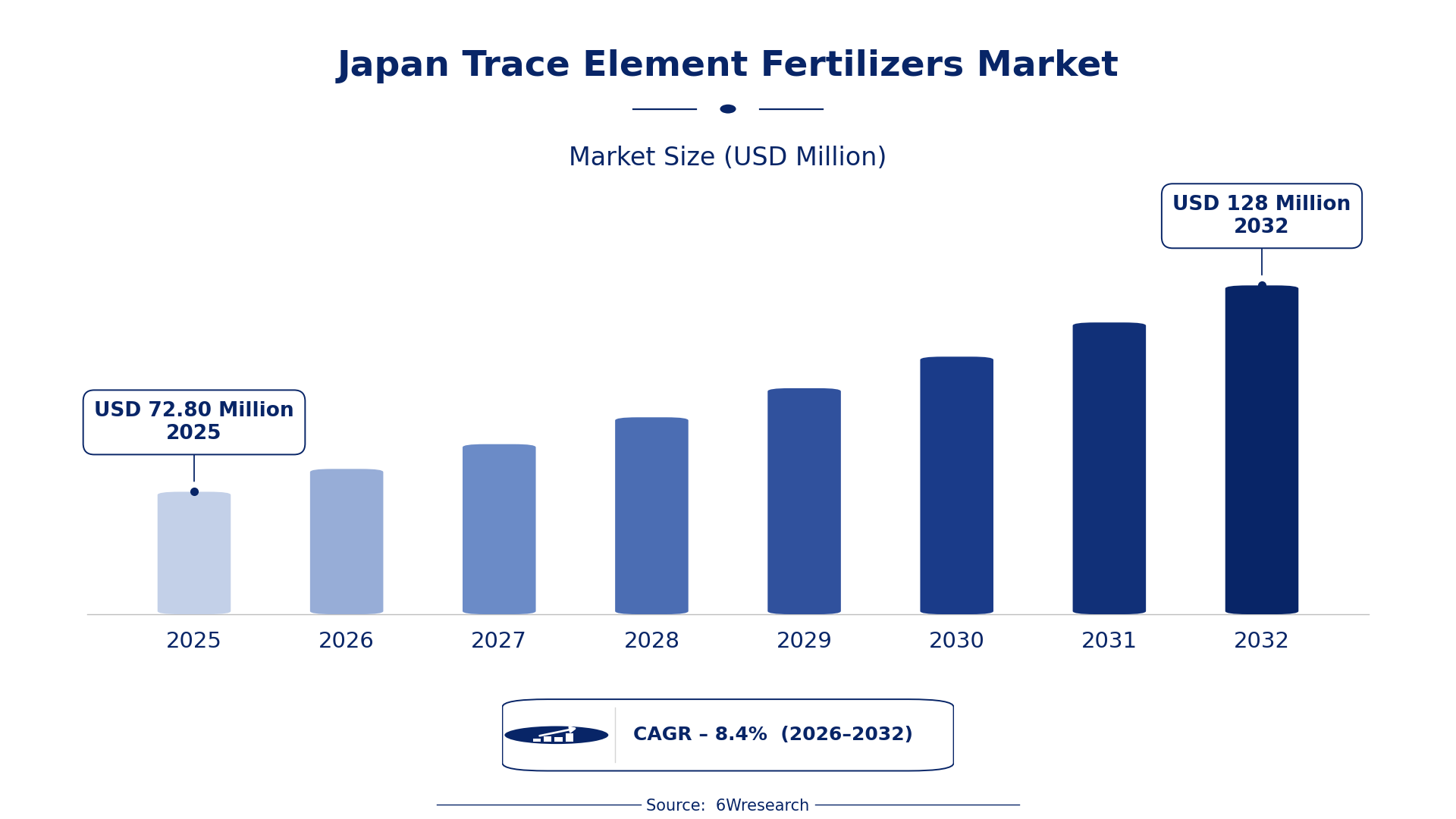
According to 6Wresearch internal database and industry insights, the Japan Trace Element Fertilizers Market was valued at USD 72.80 Million in 2025 and is projected to reach USD 128 Million by 2032, growing at a CAGR of approximately 8.4% during 2026–2032.
Japan Trace Element Fertilizers Market Highlights
| Report Metric | Details |
| Report Name | Japan Trace Element Fertilizers Market (2026-2032) |
| Market Size 2025 | USD 72.80 Million |
| Market Size 2032 | USD 128 Million |
| Absolute Growth 2025–2032 | USD 55.20 Million |
| CAGR 2026–2032 | 8.4% |
| Peak Annual Growth | 9.6% in 2030 |
| Forecast Period | 2026–2032 |
| Historical Data | 2022–2025 |
| Base Year | 2025 |
| Leading Trace Element Fertilizers, 2025 | Chelated Micronutrients (36% share) |
| Leading Product Type, 2025 | Powdered Form (45% share) |
| Leading Nutrient, 2025 | Fe (24% share) |
| Leading Distribution Channel, 2025 | Agro Distributors (36% share) |
| Leading End User Industry, 2025 | Crop Producers (39% share) |
| Fastest-Growing Trace Element Fertilizers | Foliar Sprays (10.7% CAGR) |
| Fastest-Growing Product Type | Liquid Micronutrients (11.6% CAGR) |
| Fastest-Growing Nutrient | Zn (11.5% CAGR) |
| Fastest-Growing Distribution Channel | Farm Retail (11.0% CAGR) |
| Fastest-Growing End User Industry | High Value Crops (11.1% CAGR) |
| Growing Sector | Horticulture |
| Key End Users | Crop Producers, Horticulturists, Agricultural Wholesalers, Farm Retailers |
Japan Trace Element Fertilizers Market Year-wise Growth Rate and Key Drivers (2022–2032)
This graph illustrates the annual growth rates of the market from 2022 to 2032, highlighting a steady upward trajectory and projected market expansion over the forecast period.
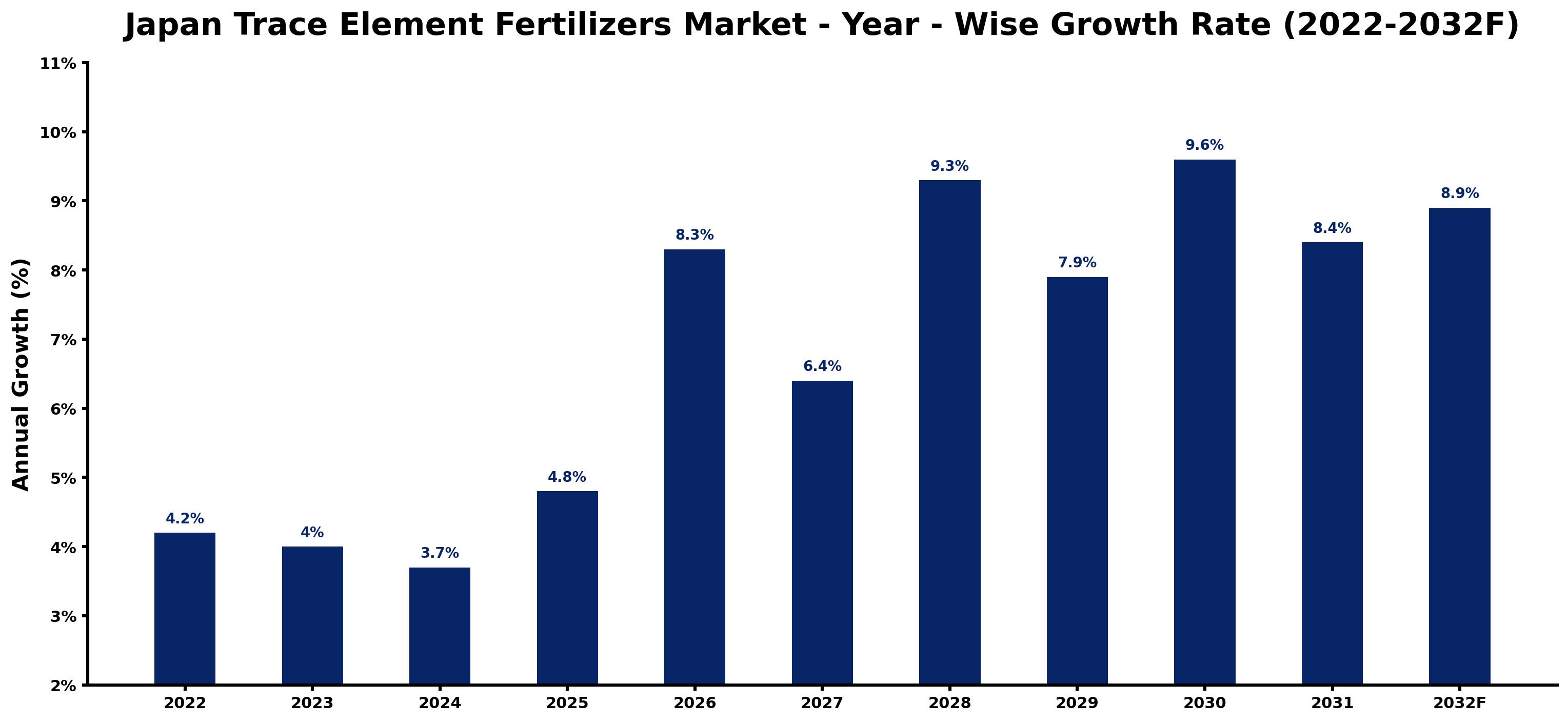
Each row of the following table gives one year's estimated growth and the event or demand shift that explains it.
| Year | Estimated Annual Growth (%) | Market Rationale |
| 2022 | 4.2 | The market showed stable growth, reflecting consistent agricultural practices. |
| 2023 | 4.0 | Growth slowed slightly as farmers adjusted to changing nutrient demands. |
| 2024 | 3.7 | The market continued to grow, influenced by rising awareness of micronutrient benefits. |
| 2025 | 4.8 | Demand surged as crop producers increased investments in quality fertilizers. |
| 2026 | 8.3 | Growth is expected to accelerate due to rising adoption of advanced fertilization techniques. |
| 2027 | 6.4 | The market is projected to experience a slowdown as supply chain challenges emerge. |
| 2028 | 9.3 | Demand will increase again, driven by the popularity of foliar sprays. |
| 2029 | 7.9 | A slowdown is expected as market saturation begins to affect growth rates. |
| 2030 | 9.6 | The market is projected to peak with heightened interest in sustainable farming practices. |
| 2031 | 8.4 | Growth is expected to slow as the market adjusts to previous peaks in demand. |
| 2032 | 8.9 | Demand is expected to rise again as organic farming gains traction. |
Note: Market size estimations and growth projections presented in this report are based on 6Wresearch's proprietary forecasting methodology, utilizing the latest available industry data, government publications, and primary research inputs.
Japan Trace Element Fertilizers Market Synopsis
Trace Element Fertilizers are specialised products containing essential micronutrients like iron, zinc, and copper, produced through chemical processes for optimal plant absorption. These fertilizers improve crop yield and quality, particularly in high-value horticultural crops. The Japan Trace Element Fertilizers Market is expanding due to rising demand from domestic crop producers and horticulturists, alongside government support for sustainable farming practices. The use of chelated micronutrients has increased by 15% among horticulturists in 2023, indicating a strong shift towards nutrient-rich agricultural practices.
Market Dynamics Impact Analysis (2026–2032)
| Factor | Type | Impact | Primary Segment Affected |
| Growing adoption of sustainable farming practices | Driver | High | Chelated Micronutrients |
| Increased demand for high-value crops | Driver | High | Foliar Sprays |
| Expansion of agricultural wholesalers | Opportunity | Medium | Agricultural Wholesalers |
| Rising interest in organic farming | Opportunity | High | Crop Producers |
| Aging farming population affecting adoption rates | Restraint | High | Liquid Micronutrients |
| Limited awareness of micronutrient benefits among farmers | Restraint | Medium | Soil Amendment Pellets |
| High costs associated with advanced fertilizers | Challenge | High | Powdered Form |
| Supply chain disruptions impacting availability | Challenge | Medium | Granulated Form |
Evaluation of Drivers in Japan Trace Element Fertilizers Market (2026–2032)
The factors lifting demand, and the evidence behind each, are summarised below.
| Drivers | Primary Segment Affected | Why It Matters (Evidence) |
| Increased awareness of micronutrient benefits | Chelated Micronutrients | Awareness of micronutrient benefits has led to a 15% increase in purchases among horticulturists. |
| Rising production of high-value crops | Foliar Sprays | Regions like Tokyo and Hokkaido are driving demand for effective nutrient solutions. |
| Support for agricultural innovation | Liquid Micronutrients | Government funding for agricultural innovation encourages the adoption of efficient fertilizers. |
| Growing popularity of sustainable farming | Soil Amendment Pellets | The promotion of sustainable practices is increasing the demand for long-term soil improvement solutions. |
| Expansion of distribution channels | Agricultural Wholesalers | Agricultural wholesalers accounted for 40% of fertilizer distribution, facilitating access for farmers. |
A wider customer base explains much of the growth, as awareness of micronutrient benefits has risen significantly. The use of chelated micronutrients has increased by 15% among horticulturists in 2023, indicating a shift towards nutrient-rich practices. Regions like Tokyo and Hokkaido are key for high-value crops, driving the need for effective nutrient solutions. Agricultural wholesalers accounted for 40% of fertilizer distribution, improving access for farmers across Japan.
Evaluation of Restraints in Japan Trace Element Fertilizers Market
The table below lists the restraints and the evidence behind each.
| Market Restraint | Primary Segment Affected | Why It Matters (Evidence) |
| Aging farming population limiting adoption of new practices | Liquid Micronutrients | The average age of farmers in Japan is around 67, which affects their willingness to adopt advanced fertilizers. |
| Limited farmer awareness of micronutrient advantages | Soil Amendment Pellets | Many farmers remain unaware of the benefits of micronutrients, hindering wider adoption. |
| High costs associated with advanced fertilizers | Powdered Form | The rising costs of specialized fertilizers deter some farmers from making purchases. |
| Supply chain disruptions affecting availability | Granulated Form | Recent supply chain issues have led to delays in fertilizer availability for farmers. |
| Market saturation impacting growth rates | Foliar Sprays | As the market matures, growth rates are beginning to stabilise due to saturation. |
Japan Trace Element Fertilizers Market Challenges
Producers in the trace element fertilizers market face intense competition, as approximately 1.3 million agricultural producers vie for limited resources, which compresses profit margins and restricts investment in innovation. This competition arises from a saturated domestic market, leading to reduced profitability for many. Technological limitations hinder the adoption of advanced fertilizer application methods, delaying efficiency improvements for producers reliant on traditional practices. Consequently, crop yields may stagnate, impacting buyers seeking higher-quality produce. Rising raw material costs, influenced by global supply chain disruptions, inflate prices for producers, forcing them to reconsider their purchasing strategies.
Trends in the Japan Trace Element Fertilizers Market
These developments are changing demand patterns in the Japan Trace Element Fertilizers Market.
- Shift towards Foliar Sprays: The Horticultural Society of Japan promotes foliar sprays, which now hold a 30% market share in the trace element segment. This trend reflects a growing preference for immediate nutrient absorption in high-value crops.
- Growing focus on Sustainable Farming: Crop producers are increasingly adopting sustainable farming practices, with the government promoting the use of micronutrients. This shift aligns with Japan's target to increase organic farming area to 3% by 2025.
- Rise of Liquid Micronutrients: Liquid micronutrients are gaining popularity due to their quick action, especially in high-value crops. Their use is expected to grow as farmers seek efficient nutrient delivery methods.
- Expansion of Agricultural Wholesalers: Agricultural wholesalers are becoming key players in fertilizer distribution, accounting for 40% of the market. This growth facilitates better access to trace element fertilizers for farmers.
Investment Opportunities in the Japan Trace Element Fertilizers Market
Where to invest in the Japan Trace Element Fertilizers Market: the main openings are set out below.
- Partner with Agricultural Wholesalers: The agricultural wholesaler sector is expanding, presenting opportunities for partnerships. With a 40% share of distribution, they are essential for reaching farmers across Japan.
- Invest in Liquid Micronutrients: With a growing preference for quick-acting fertilizers, liquid micronutrients are in high demand. Crop producers are increasingly seeking these solutions for high-value crops.
- Focus on Organic Fertilizer Solutions: As organic farming gains traction, there is a need for organic trace element fertilizers. The Japanese government aims to increase organic farming area to 3% by 2025.
- Utilise E-Commerce Channels: E-commerce is emerging as a growing channel for purchasing fertilizers. Farmers are increasingly turning to online platforms for convenience and access to a wider range of products.
Government Initiatives in the Japan Trace Element Fertilizers Market
The Food Sanitation Act amendment of 2018 introduced a positive list system for synthetic resins, enhancing safety in food-related products. This measure complements existing regulations by ensuring that fertilizers meet stringent safety standards, ultimately protecting consumers and promoting confidence in agricultural outputs. The Agricultural and Rural Affairs Agency oversees these regulations, requiring producers to adhere to quality checks and certifications, which can enhance marketability and consumer trust.
Crop producers benefit from the government's allocation of 500 million yen for agricultural innovation programs focusing on micronutrient efficiency. This funding supports research and development, enabling farmers to access improved fertilizer options that enhance crop quality and yield. The agency also facilitates training and resources to help farmers implement these innovations effectively, ensuring they can meet the growing demand for high-quality produce.
Future Insight of the Japan Trace Element Fertilizers Market
A policy-driven shift towards sustainable farming will reshape the market by 2032, prompting suppliers to innovate their product offerings. The government's allocation of 500 million yen for agricultural innovation programs will enhance micronutrient efficiency, improving product effectiveness for producers. Compliance with ISO 22000 standards will ensure trace element fertilizers meet rigorous safety criteria, boosting buyer confidence. The anticipated increase in organic farming area to 3% by 2025 will encourage suppliers to adapt their formulations, creating new market opportunities.
Market Segmentation Analysis
Japan Trace Element Fertilizers Market report covers a detailed analysis of the following market segments:
By Trace Element Fertilizers – Chelated Micronutrients Lead, Foliar Sprays Expected to Grow Fastest
According to Saurav Kr Singh, Senior Research Analyst at 6Wresearch, Chelated Micronutrients held 36% of the Japan Trace Element Fertilizers Market by trace element fertilizers in 2025. Chelated micronutrients dominate the market because they are essential for improving nutrient uptake in plants, especially in high-value crops cultivated in regions like Tokyo and Hokkaido. Their recognised effectiveness among domestic crop producers solidifies their position as a fundamental component in Japan's agricultural practices. Foliar Sprays are projected to grow fastest, at a CAGR of 10.7% during 2026–2032. Foliar sprays are experiencing rapid growth due to their capacity to provide nutrients directly to plant leaves, which is particularly advantageous for high-value crops. The notable 15% increase in usage among horticulturists in 2023 highlights a clear trend towards this efficient application method. This trend suggests that suppliers should focus on developing foliar spray products to align with the evolving preferences of farmers.
By Product Type – Powdered Form Leads, Liquid Micronutrients Expected to Grow Fastest
The largest product type category in 2025 was Powdered Form, at 45% of revenue. Powdered form is the leading product type as it is commonly mixed with soil or water, making it versatile for various applications in crop production. Its established presence in the market ensures a steady demand from farmers across Japan. Liquid Micronutrients are set to record the highest CAGR in this split, 11.6% over 2026–2032. Liquid micronutrients are experiencing the fastest growth due to their quick nutrient delivery, which is essential for high-value crops that require immediate nutrient availability. This trend is likely to continue as farmers seek efficient solutions for crop management. Suppliers should consider expanding their liquid micronutrient offerings to cater to the increasing demand for rapid nutrient solutions.
By Nutrient – Fe Leads, Zn Expected to Grow Fastest
With 24% of nutrient revenue in 2025, Fe was the largest category. Iron is the dominant nutrient in the market as it is essential for chlorophyll production in plants, making it vital for crop health and yield. Its critical role in agricultural productivity ensures a consistent demand from farmers across Japan. The quickest growth will come from Zn, forecast to expand at a CAGR of 11.5% between 2026 and 2032. Zinc is the fastest-growing nutrient segment, driven by its importance for enzyme function and overall plant growth, particularly in high-value crops. This increasing recognition of zinc's benefits suggests that its usage will continue to rise among farmers. Suppliers should focus on promoting zinc-based products to capitalise on the growing awareness of its benefits in crop production.
By Distribution Channel – Agro Distributors Lead, Farm Retail Expected to Grow Fastest
Agro Distributors accounted for 36% of the market by distribution channel in 2025. Agro distributors hold the leading position in the distribution channel as they are vital for supplying fertilizers directly to farmers, ensuring both accessibility and timely delivery. Their established networks and strong relationships with farmers make them an indispensable part of the supply chain. Over 2026–2032, Farm Retail is expected to post the fastest growth, at a CAGR of 11.0%. Farm retail is the fastest-growing distribution channel, acting as the primary point of sale for local farmers who seek immediate access to fertilizers. This shift indicates a growing preference for more convenient purchasing options among farmers. Suppliers should enhance partnerships with farm retail outlets to improve product availability and cater to the needs of local farmers.
By End User Industry – Crop Producers Lead, High Value Crops Expected to Grow Fastest
Crop Producers took 39% of end user industry revenue in 2025, more than any other category. Crop producers represent the largest end-user group of trace element fertilizers, relying on these products to boost crop yield and quality. Their significant presence in Japan's agricultural sector ensures a consistent demand for trace element fertilizers. High Value Crops are projected to grow fastest, at a CAGR of 11.1% during 2026–2032. High-value crops are the fastest-growing end-user segment, motivated by their increased nutrient requirements and the rising emphasis on quality produce. This shift points to a trend towards more specialised agricultural practices among farmers. Suppliers should customise their products to meet the specific needs of high-value crop producers to capitalise on this expanding market segment.
Key Attractiveness of the Report
- 10 Years of Market Numbers
- Historical Data Starting from 2022 to 2025
- Base Year 2025
- Forecast Data until 2032
- Key Performance Indicators Impacting the Market
- Major Upcoming Developments and Projects
Key Highlights of the Report:
- Japan Trace Element Fertilizers Market Outlook
- Market Size of Japan Trace Element Fertilizers Market, 2025
- Forecast of Japan Trace Element Fertilizers Market, 2032
- Historical Data and Forecast of Japan Trace Element Fertilizers Revenues & Volume for the Period 2022-2032F
- Japan Trace Element Fertilizers Market Trend Evolution
- Japan Trace Element Fertilizers Market Drivers and Challenges
- Japan Trace Element Fertilizers Price Trends
- Japan Trace Element Fertilizers Porter's Five Forces
- Japan Trace Element Fertilizers Industry Life Cycle
- Historical Data and Forecast of Japan Trace Element Fertilizers Market Revenues & Volume By Trace Element Fertilizers for the Period 2022-2032F
- Historical Data and Forecast of Japan Trace Element Fertilizers Market Revenues & Volume By Chelated Micronutrients for the Period 2022-2032F
- Historical Data and Forecast of Japan Trace Element Fertilizers Market Revenues & Volume By Foliar Sprays for the Period 2022-2032F
- Historical Data and Forecast of Japan Trace Element Fertilizers Market Revenues & Volume By Soil Amendment Pellets for the Period 2022-2032F
- Historical Data and Forecast of Japan Trace Element Fertilizers Market Revenues & Volume By Soluble Packets for the Period 2022-2032F
- Historical Data and Forecast of Japan Trace Element Fertilizers Market Revenues & Volume By Product Type for the Period 2022-2032F
- Historical Data and Forecast of Japan Trace Element Fertilizers Market Revenues & Volume By Powdered Form for the Period 2022-2032F
- Historical Data and Forecast of Japan Trace Element Fertilizers Market Revenues & Volume By Liquid Micronutrients for the Period 2022-2032F
- Historical Data and Forecast of Japan Trace Element Fertilizers Market Revenues & Volume By Granulated Form for the Period 2022-2032F
- Historical Data and Forecast of Japan Trace Element Fertilizers Market Revenues & Volume By Sachet Form for the Period 2022-2032F
- Historical Data and Forecast of Japan Trace Element Fertilizers Market Revenues & Volume By Nutrient for the Period 2022-2032F
- Historical Data and Forecast of Japan Trace Element Fertilizers Market Revenues & Volume By Fe, Zn, Cu for the Period 2022-2032F
- Historical Data and Forecast of Japan Trace Element Fertilizers Market Revenues & Volume By Mn, B for the Period 2022-2032F
- Historical Data and Forecast of Japan Trace Element Fertilizers Market Revenues & Volume By Mo, Se for the Period 2022-2032F
- Historical Data and Forecast of Japan Trace Element Fertilizers Market Revenues & Volume By Mg, Co for the Period 2022-2032F
- Historical Data and Forecast of Japan Trace Element Fertilizers Market Revenues & Volume By Distribution Channel for the Period 2022-2032F
- Historical Data and Forecast of Japan Trace Element Fertilizers Market Revenues & Volume By Agro Distributors for the Period 2022-2032F
- Historical Data and Forecast of Japan Trace Element Fertilizers Market Revenues & Volume By Farm Retail for the Period 2022-2032F
- Historical Data and Forecast of Japan Trace Element Fertilizers Market Revenues & Volume By Agricultural Wholesalers for the Period 2022-2032F
- Historical Data and Forecast of Japan Trace Element Fertilizers Market Revenues & Volume By E-Commerce for the Period 2022-2032F
- Historical Data and Forecast of Japan Trace Element Fertilizers Market Revenues & Volume By End User Industry for the Period 2022-2032F
- Historical Data and Forecast of Japan Trace Element Fertilizers Market Revenues & Volume By Crop Producers for the Period 2022-2032F
- Historical Data and Forecast of Japan Trace Element Fertilizers Market Revenues & Volume By High Value Crops for the Period 2022-2032F
- Historical Data and Forecast of Japan Trace Element Fertilizers Market Revenues & Volume By Horticulture for the Period 2022-2032F
- Historical Data and Forecast of Japan Trace Element Fertilizers Market Revenues & Volume By Supplemented Cropping for the Period 2022-2032F
- Japan Trace Element Fertilizers Import Export Trade Statistics
- Market Opportunity Assessment By Trace Element Fertilizers
- Market Opportunity Assessment By Product Type
- Market Opportunity Assessment By Nutrient
- Market Opportunity Assessment By Distribution Channel
- Market Opportunity Assessment By End User Industry
- Japan Trace Element Fertilizers Top Companies Market Share
- Japan Trace Element Fertilizers Competitive Benchmarking By Technical and Operational Parameters
- Japan Trace Element Fertilizers Company Profiles
- Japan Trace Element Fertilizers Key Strategic Recommendations
Market Covered
Coverage by segment is as follows.
By Trace Element Fertilizers
- Chelated Micronutrients
- Foliar Sprays
- Soil Amendment Pellets
- Soluble Packets
By Product Type
- Powdered Form
- Liquid Micronutrients
- Granulated Form
- Sachet Form
By Nutrient
- Fe
- Zn
- Cu
- Mn
- B
- Mo
- Se
- Mg
- Co
By Distribution Channel
- Agro Distributors
- Farm Retail
- Agricultural Wholesalers
- E-Commerce
By End User Industry
- Crop Producers
- High Value Crops
- Horticulture
- Supplemented Cropping































