Japan Track Geometry Equipment Market Size & Growth Rate
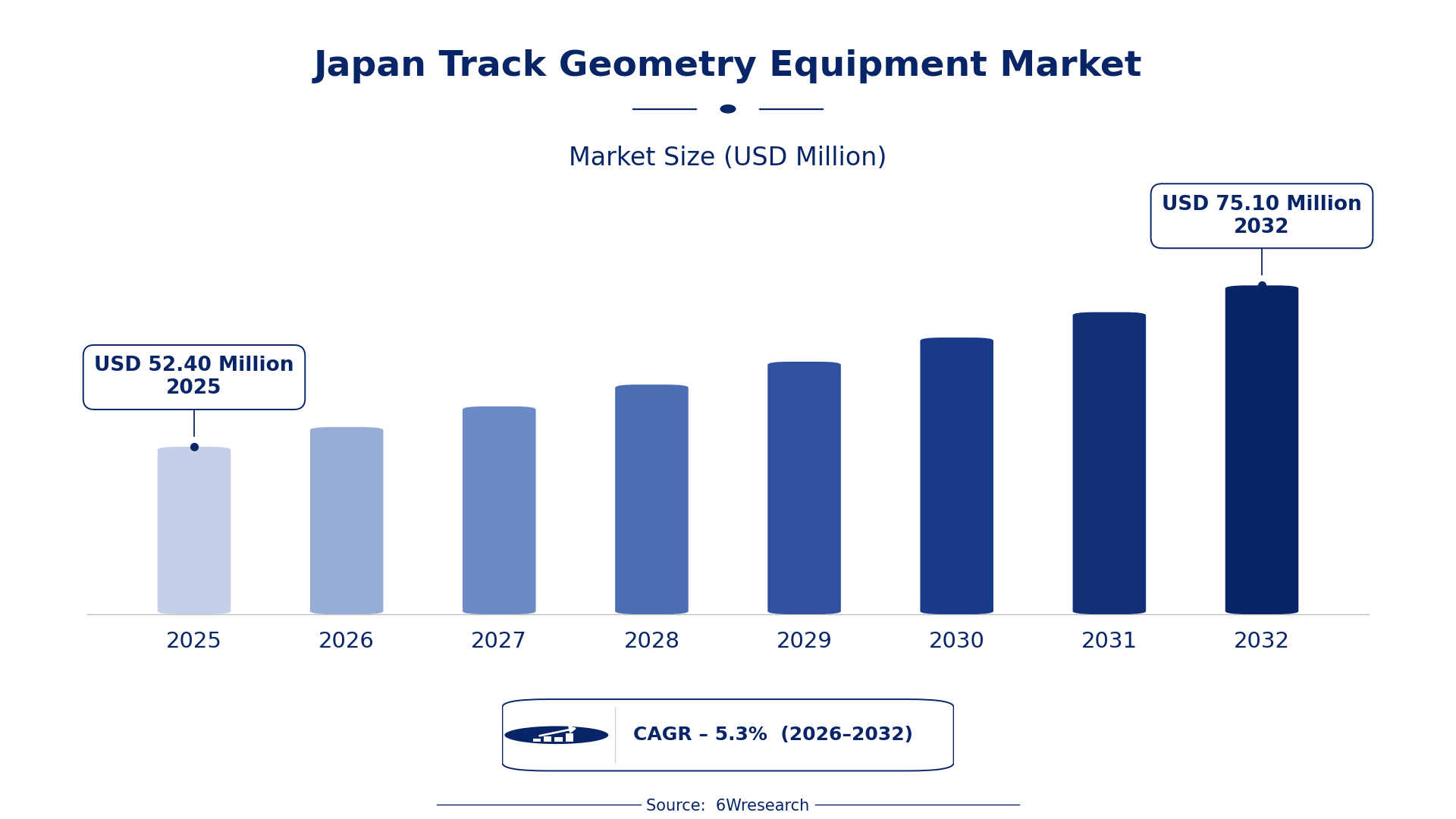
According to 6Wresearch internal database and industry insights, the Japan Track Geometry Equipment Market was valued at USD 52.40 Million in 2025 and is projected to reach USD 75.10 Million by 2032, growing at a CAGR of approximately 5.3% during 2026–2032.
Japan Track Geometry Equipment Market Highlights
| Report Metric | Details |
| Report Name | Japan Track Geometry Equipment Market (2026-2032) |
| Market Size 2025 | USD 52.40 Million |
| Market Size 2032 | USD 75.10 Million |
| Absolute Growth 2025–2032 | USD 22.70 Million |
| CAGR 2026–2032 | 5.3% |
| Peak Annual Growth | 6.4% in 2028 |
| Forecast Period | 2026–2032 |
| Historical Data | 2022–2025 |
| Base Year | 2025 |
| Leading Track Geometry Equipment, 2025 | Dynamic Track Testing Rigs (43% share) |
| Leading Machine Type, 2025 | 3D Track Profilers (53% share) |
| Leading Measurement Tech, 2025 | Laser/Optical Sensors (41% share) |
| Leading Distribution Channel, 2025 | Railway Equipment Suppliers (38% share) |
| Leading End User Industry, 2025 | Rail Infrastructure (40% share) |
| Fastest-Growing Machine Type | High-Speed Carriers (7.4% CAGR) |
| Fastest-Growing Measurement Tech | Real-Time Sensors (7.2% CAGR) |
| Fastest-Growing Distribution Channel | Track Maintenance OEMs (6.4% CAGR) |
| Fastest-Growing End User Industry | Train Operators (7.0% CAGR) |
| Growing Sector | Rail Infrastructure |
| Key End Users | Rail Operators, Railway Contractors, Rail Administrators, Train Operators |
Japan Track Geometry Equipment Market Year-wise Growth Rate and Key Drivers (2022–2032)
This graph illustrates the annual growth rates of the market from 2022 to 2032, highlighting a steady upward trajectory and projected market expansion over the forecast period.
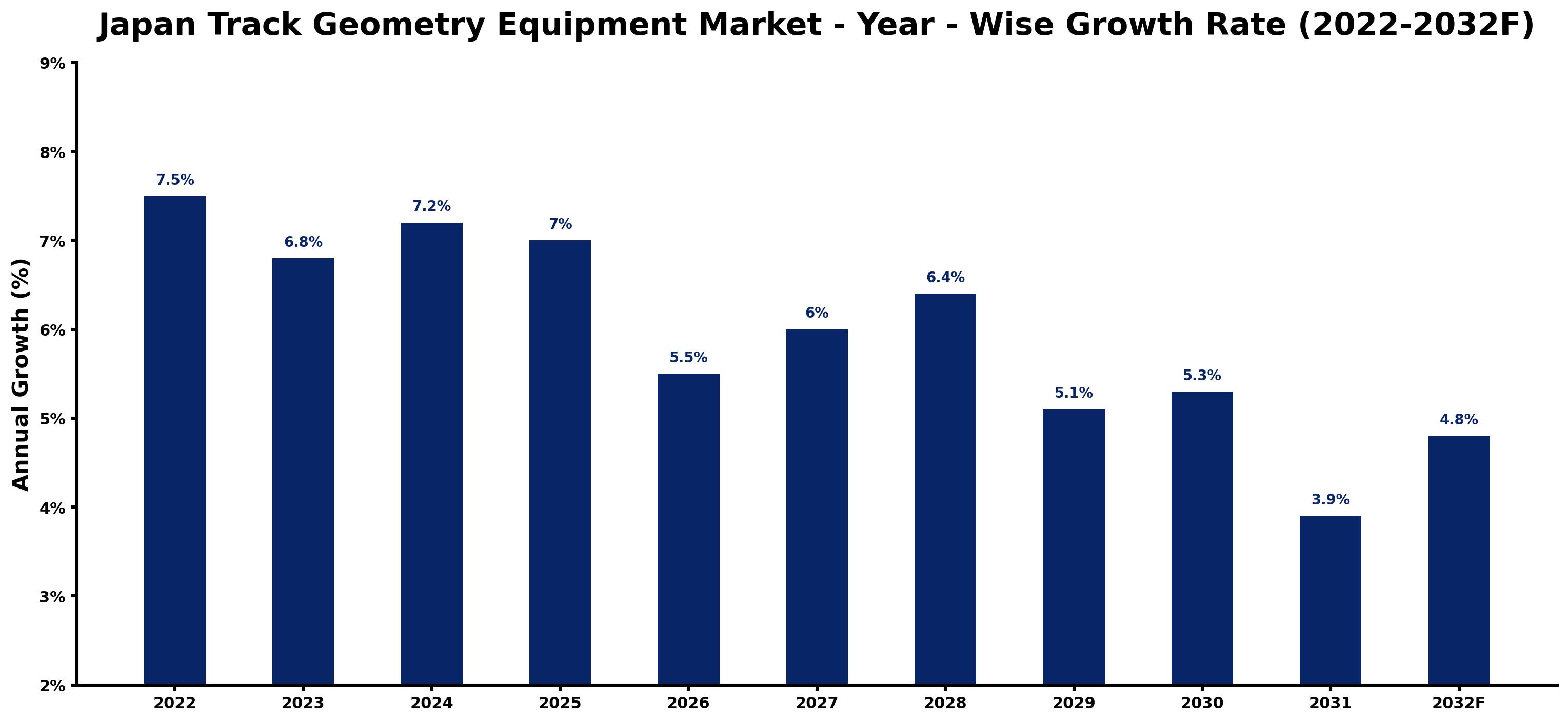
The table below sets out the estimated growth rate for each year and the main factor behind it.
| Year | Estimated Annual Growth (%) | Market Rationale |
| 2022 | 7.5 | The market exhibited strong demand due to ongoing infrastructure projects. |
| 2023 | 6.8 | Growth slowed as some projects reached completion, yet demand remained positive. |
| 2024 | 7.2 | Increased investment in rail safety measures boosted demand for equipment. |
| 2025 | 7.0 | Demand was sustained by regular maintenance requirements across the rail network. |
| 2026 | 5.5 | The market is expected to experience a slowdown as growth rates normalise after peaks. |
| 2027 | 6.0 | Demand will rise again as rail operators focus on modernising their fleets. |
| 2028 | 6.4 | A surge in infrastructure funding is projected to lead to peak growth in equipment purchases. |
| 2029 | 5.1 | Growth is expected to slow as operators adjust to previous investments in technology. |
| 2030 | 5.3 | Demand will increase as rail infrastructure improvements continue to be prioritised. |
| 2031 | 3.9 | A slight slowdown is expected as the market begins stabilising after rapid growth. |
| 2032 | 4.8 | Growth is projected to pick up again as new projects are initiated across the country. |
Note: Market size estimations and growth projections presented in this report are based on 6Wresearch's proprietary forecasting methodology, utilizing the latest available industry data, government publications, and primary research inputs.
Japan Track Geometry Equipment Market Synopsis
Track Geometry Equipment is a specialized technology used to assess and maintain railway conditions, ensuring safety and optimizing train performance. The Japan Track Geometry Equipment Market is expanding as domestic rail operators focus on infrastructure maintenance and safety upgrades. With over 27,000 kilometers of railway track requiring regular assessments, demand for advanced measurement technologies is increasing, particularly as the average age of tracks exceeds 30 years. The allocation of ¥100 billion for railway improvements in 2023 further fuels this market expansion, reflecting the commitment to improve rail safety and operational efficiency.
Market Dynamics Impact Analysis (2026–2032)
| Factor | Type | Impact | Primary Segment Affected |
| Increased focus on rail safety standards | Driver | High | Dynamic Track Testing Rigs |
| Growing investment in railway infrastructure | Driver | High | Dynamic Track Testing Rigs |
| Demand for modernisation of aging rail systems | Opportunity | High | 3D Track Profilers |
| Expansion of urban rail systems requiring precise measurements | Opportunity | High | Laser/Optical Sensors |
| High costs associated with advanced measurement technologies | Restraint | Medium | Horizontal Geometry Tools |
| Compliance with stringent safety regulations | Restraint | Medium | Rail Profile Measurers |
| Limited availability of skilled technicians for equipment operation | Challenge | High | Dynamic Track Testing Rigs |
| Rising costs of raw materials affecting equipment pricing | Challenge | Medium | Track Gauging Sets |
Evaluation of Drivers in Japan Track Geometry Equipment Market (2026–2032)
Below are the drivers that matter most for revenue growth, with supporting evidence.
| Drivers | Primary Segment Affected | Why It Matters (Evidence) |
| Ongoing infrastructure projects | Dynamic Track Testing Rigs | Japan's extensive railway network requires regular maintenance, driving demand for track geometry equipment, with over 27,000 kilometers of track needing assessments. |
| Adoption of advanced measurement technologies | Laser/Optical Sensors | The increasing use of laser-based measurement technologies for inspections leads to more purchases by rail operators aiming to improve safety. |
| Focus on safety and performance optimization | Dynamic Track Testing Rigs | Rail operators are investing in dynamic testing rigs to ensure safety checks, especially in urban rail systems, where safety is paramount. |
| Government funding for rail infrastructure improvements | 3D Track Profilers | The allocation of ¥100 billion in 2023 for railway enhancements encourages operators to invest in advanced profiling technologies. |
| Aging railway infrastructure requiring upgrades | Rail Profile Measurers | With the average age of railway tracks exceeding 30 years, there is a pressing need for precise profiling equipment to ensure safety. |
Volumes grow on the back of ongoing infrastructure projects that necessitate regular maintenance of Japan's extensive railway network. The adoption of advanced measurement technologies, particularly laser-based systems, is on the rise as rail operators seek to improve safety and performance. In urban areas, dynamic track testing rigs are increasingly used to conduct safety checks, reflecting a focus on operational integrity. The allocation of ¥100 billion for railway improvements in 2023 encourages investments in 3D track profilers. The aging railway infrastructure drives demand for rail profile measurers to ensure safety and compliance with standards.
Evaluation of Restraints in Japan Track Geometry Equipment Market
The table below lists the restraints and the evidence behind each.
| Market Restraint | Primary Segment Affected | Why It Matters (Evidence) |
| High costs associated with advanced measurement technologies | Horizontal Geometry Tools | The expense of acquiring and maintaining advanced measurement technologies can deter smaller rail operators from investing in necessary equipment. |
| Compliance with stringent safety regulations | Rail Profile Measurers | Rail operators face challenges in meeting rigorous safety standards, which can limit their operational flexibility and increase costs. |
| Limited availability of skilled technicians for equipment operation | Dynamic Track Testing Rigs | A shortage of qualified personnel to operate and maintain complex track geometry equipment can hinder effective deployment. |
| Rising costs of raw materials affecting equipment pricing | Track Gauging Sets | Fluctuations in raw material prices can lead to increased costs for track gauging sets, impacting overall market pricing. |
| Inconsistent demand from smaller rail operators | Trolley Units | Smaller rail operators may not consistently invest in track geometry equipment, leading to fluctuating demand patterns. |
Japan Track Geometry Equipment Market Challenges
Rail operators face challenges with outdated inspection technology, as many systems exceed 30 years in age, which increases the likelihood of safety incidents. Suppliers must navigate stringent regulations from the Ministry of Land, Infrastructure, Transport and Tourism, mandating annual inspections, which can delay maintenance schedules and strain resources. Rising costs in precision engineering have inflated prices for track geometry equipment, which forces operators to reallocate budgets, potentially compromising safety. Buyers struggle to implement advanced technologies, as transitioning to laser-based systems requires significant investment, which delays essential upgrades and maintenance.
Trends in the Japan Track Geometry Equipment Market
Below are the shifts with the largest effect on the Japan Track Geometry Equipment Market.
- Shift towards Advanced Measurement Technologies: Japan is increasingly adopting laser-based measurement technologies for track inspections, reflecting a shift in industry standards. In 2023, approximately 60% of rail operators reported using these technologies, improving safety and efficiency.
- Transition from Traditional to Dynamic Testing: Dynamic testing rigs are becoming the preferred choice for urban rail systems, with 75% of new installations incorporating this technology since 2022. This shift is driven by the need for real-time data to ensure safety.
- Emergence of Real-Time Monitoring Solutions: Real-time sensors are gaining traction among rail operators, with a reported 40% increase in adoption since 2022. This trend allows for continuous monitoring of track conditions, improving safety and operational efficiency.
- Prioritisation of Safety Compliance: Rail operators are placing greater emphasis on compliance with safety standards, driven by government mandates. In 2023, 90% of operators reported increased investments in safety-related equipment.
Investment Opportunities in the Japan Track Geometry Equipment Market
Investors looking at the Japan Track Geometry Equipment Market should consider the following areas.
- Rail Infrastructure Operators Seeking Upgrades: Rail infrastructure operators are increasingly looking to modernise their equipment, with a projected gap of ¥50 billion in investment needs. Collaborating with local suppliers can facilitate entry into this market.
- Growing Demand for Precision Measurement: With the average age of railway tracks over 30 years, there is a pressing need for modern measurement technologies. Rail contractors are expected to invest heavily in upgrading their equipment by 2025.
- Timing for Enhanced Safety Solutions: The recent allocation of ¥100 billion for railway improvements creates a timely opportunity for suppliers of advanced track geometry equipment to enter the market.
- Entry through Partnerships with Local Suppliers: Forming joint ventures with local suppliers can ease market entry for foreign manufacturers looking to supply advanced track geometry equipment.
Government Initiatives in the Japan Track Geometry Equipment Market
The Act on Japanese Industrial Standards, amended in 2019, mandates compliance with specific quality standards for railway equipment. This law strengthens previous regulations by ensuring that all track geometry equipment meets stringent safety and performance criteria, benefiting both producers and buyers.
The Ministry of Land, Infrastructure, Transport and Tourism oversees the approval of new railway technologies and funds safety improvement projects. In 2023, the ministry allocated ¥100 billion to improve railway infrastructure, directly impacting the demand for advanced track geometry equipment.
Future Insight of the Japan Track Geometry Equipment Market
New dynamic testing rigs will improve urban rail safety checks, enabling faster and more accurate assessments of track conditions. The Japanese Railway Engineering Association will introduce updated standards that promote best practices, improving operational efficiency. By 2032, the commitment to allocate ¥100 billion for railway infrastructure will support the adoption of advanced technologies across the network. Laser-based measurement technologies will become standard, facilitating quicker inspections and minimising maintenance downtime.
Market Segmentation Analysis
Japan Track Geometry Equipment Market report covers a detailed analysis of the following market segments:
By Track Geometry Equipment – Dynamic Track Testing Rigs Lead and Record the Fastest Growth
According to Saurav Kr Singh, Senior Research Analyst at 6Wresearch, Dynamic Track Testing Rigs took 43% of track geometry equipment revenue in 2025, more than any other category. Dynamic Track Testing Rigs hold the largest share due to their critical role in real-time track condition assessment, essential for ensuring safety and performance. Their extensive application across Japan's railway network, which includes over 27,000 kilometers of track, highlights their importance in maintaining optimal conditions. Its lead should widen, with a projected CAGR of 6.6% during 2026–2032, the highest in this split. The growth of Dynamic Track Testing Rigs will continue as their necessity for regular assessments becomes more pronounced, particularly with the average age of railway tracks exceeding 30 years. This trend is further supported by the government's allocation of ¥100 billion for railway infrastructure improvements, ensuring sustained demand. Suppliers must prioritise advancements in dynamic testing technologies to meet the increasing market requirements.
By Machine Type – 3D Track Profilers Lead, High-Speed Carriers Expected to Grow Fastest
3D Track Profilers accounted for 53% of the market by machine type in 2025. 3D Track Profilers dominate the market due to their advanced technology that provides detailed profiling of track conditions, which is essential for maintenance. Their precision is critical for ensuring the safety and efficiency of Japan's railway operations. High-Speed Carriers are projected to grow fastest, at a CAGR of 7.4% during 2026–2032. High-Speed Carriers are experiencing rapid growth as they facilitate quick data collection, which is increasingly necessary for timely maintenance decisions. This trend reflects the industry's shift towards more efficient monitoring practices to maintain safety standards. Buyers will benefit from investing in advanced profiling technologies to improve maintenance efficiency.
By Measurement Tech – Laser/Optical Sensors Lead, Real-Time Sensors Expected to Grow Fastest
Laser/Optical Sensors held 41% of the Japan Track Geometry Equipment Market by measurement tech in 2025. Laser/Optical Sensors lead the market because they are vital for providing accurate measurements essential for track assessments, which directly impact safety and performance. Their widespread use among various railway operators illustrates their crucial role in maintaining track integrity throughout Japan. Real-Time Sensors are set to record the highest CAGR in this split, 7.2% over 2026–2032. Real-Time Sensors are witnessing rapid growth as they enable continuous monitoring of track conditions, which is essential for proactive maintenance strategies. This trend reflects the industry's increasing focus on enhancing safety protocols through real-time data collection. Suppliers should concentrate on developing real-time monitoring technologies to align with market trends.
By Distribution Channel – Railway Equipment Suppliers Lead, Track Maintenance OEMs Expected to Grow Fastest
The largest distribution channel category in 2025 was Railway Equipment Suppliers, at 38% of revenue. Railway Equipment Suppliers hold the largest share as they provide essential equipment necessary for the maintenance of Japan's extensive railway network. Their role is critical in ensuring that operators have access to the tools needed for effective track management. The quickest growth will come from Track Maintenance OEMs, forecast to expand at a CAGR of 6.4% between 2026 and 2032. Track Maintenance OEMs are the fastest-growing segment as they manufacture specialised equipment tailored for maintenance needs, reflecting the industry's focus on improving operational efficiency. This growth is driven by the increasing demand for advanced maintenance solutions. Buyers should consider sourcing from OEMs to ensure they have the latest maintenance technologies.
By End User Industry – Rail Infrastructure Leads, Train Operators Expected to Grow Fastest
In 2025, Rail Infrastructure led the end user industry split with a 40% share. Rail Infrastructure is the leading end user as it is critical for the operational efficiency of the railway system, necessitating regular maintenance and assessments. The focus on maintaining infrastructure is paramount given the extensive network and the need for safety compliance. Over 2026–2032, Train Operators are expected to post the fastest growth, at a CAGR of 7.0%. Train Operators are experiencing the fastest growth as they require accurate track data for safety and operational efficiency, particularly with the increasing frequency of inspections mandated by the government. This trend underscores the importance of reliable data in ensuring safe train operations. Suppliers should tailor their offerings to meet the specific needs of train operators for accurate data collection.
Key Attractiveness of the Report
- 10 Years of Market Numbers
- Historical Data Starting from 2022 to 2025
- Base Year 2025
- Forecast Data until 2032
- Key Performance Indicators Impacting the Market
- Major Upcoming Developments and Projects
Key Highlights of the Report:
- Japan Track Geometry Equipment Market Outlook
- Market Size of Japan Track Geometry Equipment Market, 2025
- Forecast of Japan Track Geometry Equipment Market, 2032
- Historical Data and Forecast of Japan Track Geometry Equipment Revenues & Volume for the Period 2022-2032F
- Japan Track Geometry Equipment Market Trend Evolution
- Japan Track Geometry Equipment Market Drivers and Challenges
- Japan Track Geometry Equipment Price Trends
- Japan Track Geometry Equipment Porter's Five Forces
- Japan Track Geometry Equipment Industry Life Cycle
- Historical Data and Forecast of Japan Track Geometry Equipment Market Revenues & Volume By Track Geometry Equipment for the Period 2022-2032F
- Historical Data and Forecast of Japan Track Geometry Equipment Market Revenues & Volume By Rail Profile Measurers for the Period 2022-2032F
- Historical Data and Forecast of Japan Track Geometry Equipment Market Revenues & Volume By Horizontal Geometry Tools for the Period 2022-2032F
- Historical Data and Forecast of Japan Track Geometry Equipment Market Revenues & Volume By Ballast Measurement Units for the Period 2022-2032F
- Historical Data and Forecast of Japan Track Geometry Equipment Market Revenues & Volume By Dynamic Track Testing Rigs for the Period 2022-2032F
- Historical Data and Forecast of Japan Track Geometry Equipment Market Revenues & Volume By Machine Type for the Period 2022-2032F
- Historical Data and Forecast of Japan Track Geometry Equipment Market Revenues & Volume By Trolley Units for the Period 2022-2032F
- Historical Data and Forecast of Japan Track Geometry Equipment Market Revenues & Volume By Track Gauging Sets for the Period 2022-2032F
- Historical Data and Forecast of Japan Track Geometry Equipment Market Revenues & Volume By 3D Track Profilers for the Period 2022-2032F
- Historical Data and Forecast of Japan Track Geometry Equipment Market Revenues & Volume By High-Speed Carriers for the Period 2022-2032F
- Historical Data and Forecast of Japan Track Geometry Equipment Market Revenues & Volume By Measurement Tech for the Period 2022-2032F
- Historical Data and Forecast of Japan Track Geometry Equipment Market Revenues & Volume By Laser/Optical Sensors for the Period 2022-2032F
- Historical Data and Forecast of Japan Track Geometry Equipment Market Revenues & Volume By Mechanical Laser for the Period 2022-2032F
- Historical Data and Forecast of Japan Track Geometry Equipment Market Revenues & Volume By Radar/IMU Combined for the Period 2022-2032F
- Historical Data and Forecast of Japan Track Geometry Equipment Market Revenues & Volume By Real-Time Sensors for the Period 2022-2032F
- Historical Data and Forecast of Japan Track Geometry Equipment Market Revenues & Volume By Distribution Channel for the Period 2022-2032F
- Historical Data and Forecast of Japan Track Geometry Equipment Market Revenues & Volume By Railway Equipment Suppliers for the Period 2022-2032F
- Historical Data and Forecast of Japan Track Geometry Equipment Market Revenues & Volume By Track Maintenance OEMs for the Period 2022-2032F
- Historical Data and Forecast of Japan Track Geometry Equipment Market Revenues & Volume By Engineering Vendors for the Period 2022-2032F
- Historical Data and Forecast of Japan Track Geometry Equipment Market Revenues & Volume By Rail OEMs for the Period 2022-2032F
- Historical Data and Forecast of Japan Track Geometry Equipment Market Revenues & Volume By End User Industry for the Period 2022-2032F
- Historical Data and Forecast of Japan Track Geometry Equipment Market Revenues & Volume By Rail Administrators for the Period 2022-2032F
- Historical Data and Forecast of Japan Track Geometry Equipment Market Revenues & Volume By Railway Contractors for the Period 2022-2032F
- Historical Data and Forecast of Japan Track Geometry Equipment Market Revenues & Volume By Rail Infrastructure for the Period 2022-2032F
- Historical Data and Forecast of Japan Track Geometry Equipment Market Revenues & Volume By Train Operators for the Period 2022-2032F
- Japan Track Geometry Equipment Import Export Trade Statistics
- Market Opportunity Assessment By Track Geometry Equipment
- Market Opportunity Assessment By Machine Type
- Market Opportunity Assessment By Measurement Tech
- Market Opportunity Assessment By Distribution Channel
- Market Opportunity Assessment By End User Industry
- Japan Track Geometry Equipment Top Companies Market Share
- Japan Track Geometry Equipment Competitive Benchmarking By Technical and Operational Parameters
- Japan Track Geometry Equipment Company Profiles
- Japan Track Geometry Equipment Key Strategic Recommendations
Market Covered
The study includes the following segmentation.
By Track Geometry Equipment
- Rail Profile Measurers
- Horizontal Geometry Tools
- Ballast Measurement Units
- Dynamic Track Testing Rigs
By Machine Type
- Trolley Units
- Track Gauging Sets
- 3D Track Profilers
- High-Speed Carriers
By Measurement Tech
- Laser/Optical Sensors
- Mechanical Laser
- Radar/IMU Combined
- Real-Time Sensors
By Distribution Channel
- Railway Equipment Suppliers
- Track Maintenance OEMs
- Engineering Vendors
- Rail OEMs
By End User Industry
- Rail Administrators
- Railway Contractors
- Rail Infrastructure
- Train Operators































