Japan Track Maintenance Machines Market Size & Growth Rate
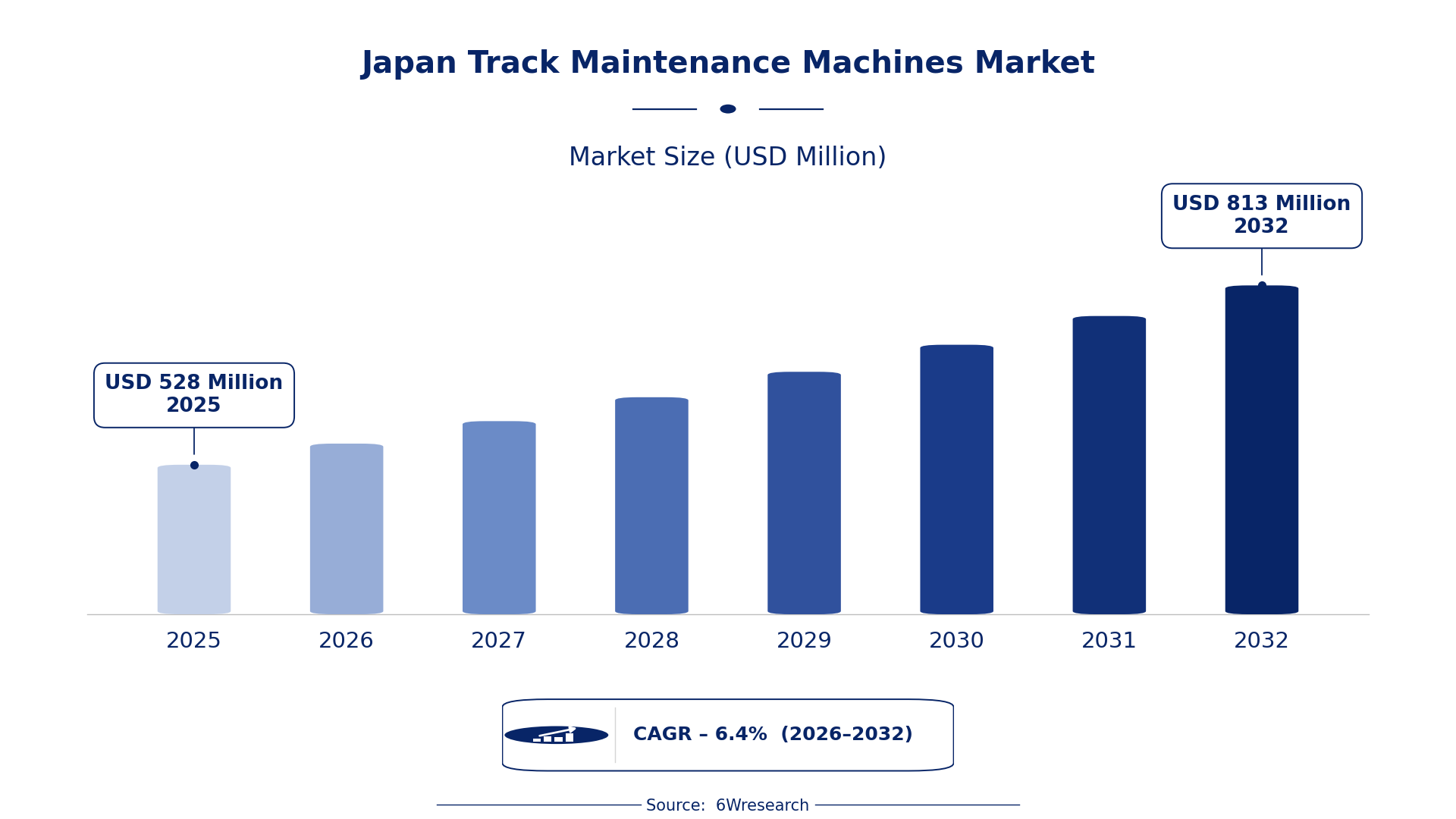
According to 6Wresearch internal database and industry insights, the Japan Track Maintenance Machines Market was valued at USD 528 Million in 2025 and is projected to reach USD 813 Million by 2032, growing at a CAGR of approximately 6.4% during 2026–2032.
Japan Track Maintenance Machines Market Highlights
| Report Metric | Details |
| Report Name | Japan Track Maintenance Machines Market (2026-2032) |
| Market Size 2025 | USD 528 Million |
| Market Size 2032 | USD 813 Million |
| Absolute Growth 2025–2032 | USD 285 Million |
| CAGR 2026–2032 | 6.4% |
| Peak Annual Growth | 7.3% in 2032 |
| Forecast Period | 2026–2032 |
| Historical Data | 2022–2025 |
| Base Year | 2025 |
| Leading Track Maintenance Machines, 2025 | Tamping Machines (46% share) |
| Leading Machine Type, 2025 | Track Tamping (47% share) |
| Leading Functional Method, 2025 | Pneumatic Tamping (38% share) |
| Leading Distribution Channel, 2025 | Railway Equipment OEMs (47% share) |
| Leading End User Industry, 2025 | Rail Operators (34% share) |
| Fastest-Growing Track Maintenance Machines | Rail Grinders (8.4% CAGR) |
| Fastest-Growing Machine Type | Grinding Machines (9.0% CAGR) |
| Fastest-Growing Functional Method | Rotary Grinding (9.4% CAGR) |
| Fastest-Growing Distribution Channel | Rail Machinery Suppliers (8.1% CAGR) |
| Fastest-Growing End User Industry | Rail Fleets (8.3% CAGR) |
| Growing Sector | railway maintenance |
| Key End Users | rail operators, infrastructure maintenance providers, railway equipment manufacturers |
Japan Track Maintenance Machines Market Year-wise Growth Rate and Key Drivers (2022–2032)
This graph illustrates the annual growth rates of the market from 2022 to 2032, highlighting a steady upward trajectory and projected market expansion over the forecast period.
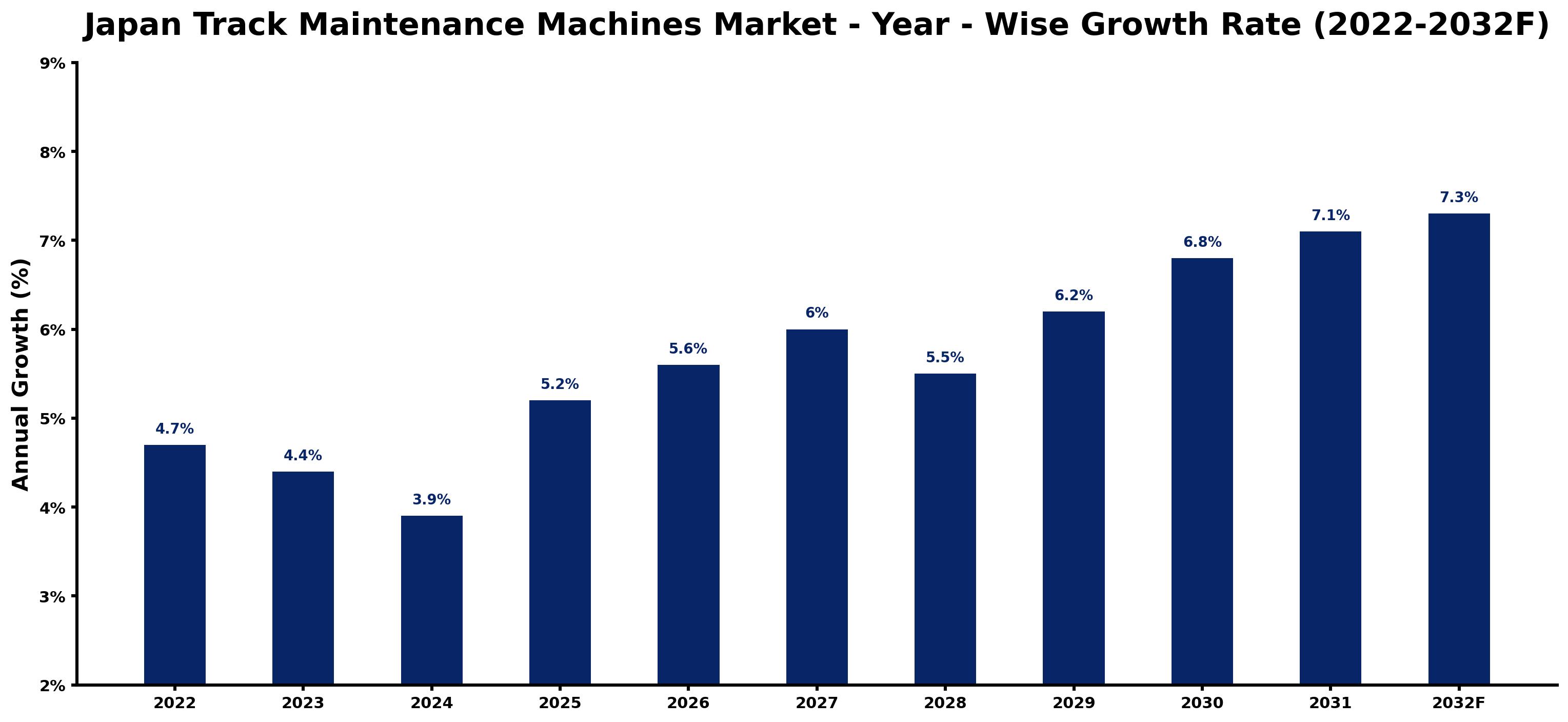
For each year, the table pairs the estimated growth rate with the leading influence on demand, showing how the drivers changed across the period.
| Year | Estimated Annual Growth (%) | Market Rationale |
| 2022 | 4.7 | The market showed solid activity, driven by ongoing maintenance needs across rail networks. |
| 2023 | 4.4 | Growth slowed as operators adjusted to rising operational costs and inflationary pressures. |
| 2024 | 3.9 | Demand continued to moderate as maintenance schedules were optimised for efficiency. |
| 2025 | 5.2 | Growth accelerated as major rail operators increased investments in infrastructure upgrades. |
| 2026 | 5.6 | The market is expected to see a rise in demand due to new rail safety initiatives being implemented. |
| 2027 | 6.0 | Increased passenger volumes will prompt rail operators to improve maintenance capabilities. |
| 2028 | 5.5 | Growth is projected to slow as operators face challenges in sourcing advanced machinery. |
| 2029 | 6.2 | Demand is expected to surge with the introduction of new high-speed rail projects requiring modern equipment. |
| 2030 | 6.8 | Continued infrastructure investments will support a rise in maintenance activities across regions. |
| 2031 | 7.1 | The market is projected to expand as technology adoption in maintenance processes gains traction. |
| 2032 | 7.3 | Peak growth will occur as rail operators intensify efforts for safety and efficiency. |
Note: Market size estimations and growth projections presented in this report are based on 6Wresearch's proprietary forecasting methodology, utilizing the latest available industry data, government publications, and primary research inputs.
Japan Track Maintenance Machines Market Synopsis
Track maintenance machines are crucial in the railway industry, ensuring safety and efficiency. Manufactured with advanced engineering techniques, these machines primarily maintain track geometry, replace sleepers, and clean ballast. The Japan Track Maintenance Machines Market is expanding due to increasing passenger volumes, which reached approximately 8 billion in 2022, alongside substantial investments in railway infrastructure, including ¥10 billion earmarked for improvements in 2023, which is driving demand from domestic rail operators.
Market Dynamics Impact Analysis (2026–2032)
| Factor | Type | Impact | Primary Segment Affected |
| Increasing passenger volume in Japan's railway sector drives demand for maintenance equipment. | Driver | High | Track Maintenance |
| Investment in railway infrastructure upgrades enhances the need for advanced maintenance solutions. | Driver | High | Track Maintenance |
| Growing focus on safety standards creates opportunities for advanced maintenance technologies. | Opportunity | High | Track Maintenance |
| The rising average age of railway sleepers necessitates frequent replacement, creating demand. | Opportunity | High | Sleeper Replacement Units |
| High costs associated with advanced machinery may limit purchases by smaller operators. | Restraint | Medium | Track Maintenance |
| Supply chain disruptions can delay the availability of critical maintenance equipment. | Restraint | Medium | Track Maintenance |
| Challenges in integrating new technologies can hinder operational efficiency for buyers. | Challenge | High | Track Maintenance |
| Competition among suppliers can lead to pricing pressures, affecting profitability. | Challenge | Medium | Track Maintenance |
Evaluation of Drivers in Japan Track Maintenance Machines Market (2026–2032)
Below are the drivers that matter most for revenue growth, with supporting evidence.
| Drivers | Primary Segment Affected | Why It Matters (Evidence) |
| Rising passenger volumes | Track Maintenance | In 2022, Japan's railway passenger volume reached approximately 8 billion, increasing demand for maintenance. |
| Government funding for infrastructure | Track Maintenance | In 2023, ¥10 billion was allocated for railway infrastructure improvements, boosting maintenance activities. |
| Aging railway infrastructure | Sleeper Replacement Units | The average age of railway sleepers exceeds 30 years, necessitating regular replacements for safety. |
| Adoption of advanced maintenance technologies | Rail Grinders | In the Kansai region, rail grinders are extensively used to improve rail quality and safety. |
| Focus on safety regulations | Track Maintenance | The Japan Railway Construction, Transport and Technology Agency oversees standards, driving demand for compliant machines. |
Spending is rising as Tokyo and Osaka represent key regions for railway upkeep, with over 27,000 kilometres of track requiring regular maintenance. In 2022, passenger volumes hit around 8 billion, prompting rail operators to invest in modern solutions. The average age of railway sleepers in Japan exceeds 30 years, necessitating frequent replacements. In 2023, ¥10 billion was allocated for infrastructure improvements, leading to increased procurement of maintenance equipment. Rail quality improves through the extensive use of rail grinders, ensuring safety and operational efficiency across the network.
Evaluation of Restraints in Japan Track Maintenance Machines Market
The key brakes on demand, and where they bite hardest, are shown below.
| Market Restraint | Primary Segment Affected | Why It Matters (Evidence) |
| High costs of advanced machinery limit purchases by smaller operators. | Track Maintenance | The rising minimum wage in Japan, which reached JPY 1,055 per hour in October 2024, increases operational costs. |
| Supply chain disruptions delay critical maintenance equipment availability. | Track Maintenance | Global supply chain issues have impacted the timely delivery of essential machinery components. |
| Integration challenges with new technologies hinder operational efficiency. | Track Maintenance | The average age of railway sleepers exceeds 30 years, necessitating regular replacements for safety. |
| Competition among suppliers leads to pricing pressures. | Track Maintenance | Increased competition can result in lower profit margins for suppliers, impacting their sustainability. |
| Regulatory compliance costs can burden smaller operators. | Track Maintenance | Compliance with standards set by the Japan Railway Construction, Transport and Technology Agency incurs additional expenses. |
Japan Track Maintenance Machines Market Challenges
Rising costs for rail operators arise from stringent regulations imposed by the Japan Railway Construction, Transport and Technology Agency, which can delay maintenance schedules by six months and elevate operational expenses. Increased labour costs stem from the national minimum wage of JPY 1,055 per hour, affecting budgets for maintenance crews and resulting in reduced service frequency. Competition among suppliers for advanced track maintenance machines has led to price wars, potentially compromising quality and reliability for buyers. A shortage of skilled workers in the railway sector hampers efficiency, causing delays in track repairs and potentially jeopardising safety for the 8 billion passengers using the rail system annually.
Trends in the Japan Track Maintenance Machines Market
Buyers and suppliers in the Japan Track Maintenance Machines Market are adjusting to the following trends.
- Shift to Advanced Maintenance Technologies: Rail operators are increasingly adopting advanced maintenance technologies to improve efficiency. The Railway Technical Research Institute has been conducting research on these technologies, resulting in better maintenance practices across Japan.
- Growing Demand for Rail Grinders: Since 2025, rail grinders have gained popularity in the Kansai region, with usage increasing by 15%. This trend reflects the industry's focus on maintaining rail quality and extending lifespan.
- Increased Investment in Infrastructure: Starting in 2023, the Japanese government has significantly increased funding for railway infrastructure improvements. This investment is projected to enhance the overall safety and efficiency of rail operations.
- Focus on Sustainability in Rail Maintenance: In 2023, the Japan Railway Group launched initiatives to promote sustainable maintenance practices. This shift is likely to attract more environmentally conscious rail operators.
Investment Opportunities in the Japan Track Maintenance Machines Market
Where to invest in the Japan Track Maintenance Machines Market: the main openings are set out below.
- Timing for Infrastructure Upgrades: With ¥10 billion allocated for railway improvements in 2023, there is an opportunity for suppliers of maintenance machines to engage with rail operators.
- Gap in Advanced Machinery Supply: As the average age of railway sleepers exceeds 30 years, there is a pressing need for replacement units, particularly in urban areas like Tokyo.
- Expansion of Rail Grinders: The Kansai region's focus on rail quality presents an opportunity for suppliers of rail grinders to meet increasing demand.
- Partnerships with Local Rail Operators: Establishing joint ventures with local rail operators can facilitate entry into the market for maintenance equipment suppliers.
Government Initiatives in the Japan Track Maintenance Machines Market
The Industrial Safety and Health Act (1972) mandates that producers of track maintenance machines adhere to strict safety standards, ensuring that equipment is safe for operators. Compliance with these regulations requires manufacturers to invest in quality assurance processes and certifications, such as ISO 9001, to meet industry expectations.
The Japan Railway Construction, Transport and Technology Agency oversees the implementation of various funding schemes for rail infrastructure improvements. In 2023, this agency approved multiple projects aimed at improving railway safety, directly benefiting rail operators by ensuring access to modern maintenance equipment.
Future Insight of the Japan Track Maintenance Machines Market
Policy-driven shifts will reshape the railway sector by 2032, as government initiatives promote advanced maintenance technologies. The new rail safety initiative launched by the Ministry of Land, Infrastructure, Transport and Tourism will prompt suppliers to adopt more efficient equipment. Standards set by the Japan Railway Engineering Association will influence buyer decisions, ensuring higher safety benchmarks. As the average age of railway sleepers exceeds 30 years, replacement initiatives will create demand for innovative solutions, benefiting both buyers and suppliers.
Market Segmentation Analysis
Japan Track Maintenance Machines Market report covers a detailed analysis of the following market segments:
By Track Maintenance Machines – Tamping Machines Lead, Rail Grinders Expected to Grow Fastest
According to Prakhar Dixit, Senior Research Analyst at 6Wresearch, in 2025, Tamping Machines led the track maintenance machines split with a 46% share. Tamping Machines lead the market due to their critical function in maintaining track geometry, particularly for major rail operators in regions like Tokyo and Osaka. Their extensive application across over 27,000 kilometres of railway track in Japan ensures safety and operational efficiency. Rail Grinders are projected to grow fastest, at a CAGR of 8.4% during 2026–2032. Rail Grinders are rapidly gaining traction as they are increasingly employed to restore rail profiles and prolong lifespan, reflecting a shift towards more efficient maintenance practices. The substantial railway passenger volume of approximately 8 billion in 2022 highlights the necessity for improved rail quality. Suppliers must focus on advancing tamping and grinding technologies to cater to the rising demand.
By Machine Type – Track Tamping Leads, Grinding Machines Expected to Grow Fastest
Track Tamping held 47% of the Japan Track Maintenance Machines Market by machine type in 2025. Track Tamping holds the largest share due to its critical role in maintaining track alignment and stability, which is essential for safe rail operations. Its importance is highlighted by regular maintenance schedules of major rail operators across Japan. Over 2026–2032, Grinding Machines are expected to post the fastest growth, at a CAGR of 9.0%. Grinding Machines are experiencing rapid growth as they are vital for maintaining rail surfaces, preventing wear and extending the lifespan of tracks. The increasing focus on rail quality, especially in high-traffic regions, drives this demand. Suppliers should focus on developing advanced grinding technologies to meet the rising demand for rail surface maintenance.
By Functional Method – Pneumatic Tamping Leads, Rotary Grinding Expected to Grow Fastest
Pneumatic Tamping accounted for 38% of the market by functional method in 2025. Pneumatic Tamping leads the market as it is commonly used in various tamping applications, ensuring effective track maintenance across many rail networks. Its established presence among major rail operators reinforces its dominant market position. The quickest growth will come from Rotary Grinding, forecast to expand at a CAGR of 9.4% between 2026 and 2032. Rotary Grinding is witnessing the fastest growth due to its direct application in improving rail surface conditions, which is crucial for maintaining high-speed rail operations. The ongoing rail safety initiatives further accelerate the demand for this method. Suppliers must enhance their rotary grinding solutions to align with the increasing focus on rail surface quality.
By Distribution Channel – Railway Equipment OEMs Lead, Rail Machinery Suppliers Expected to Grow Fastest
The largest distribution channel category in 2025 was Railway Equipment OEMs, at 47% of revenue. Railway Equipment OEMs are the leading distribution channel as they are the primary manufacturers of maintenance machines, ensuring quality and reliability. Their established relationships with rail operators facilitate consistent supply and support. Rail Machinery Suppliers are set to record the highest CAGR in this split, 8.1% over 2026–2032. Rail Machinery Suppliers are experiencing the fastest growth as they provide essential equipment to rail operators, reflecting a shift towards specialised supply chains. The increasing complexity of rail maintenance drives this demand. Buyers should consider diversifying their procurement strategies to include a range of suppliers for better access to advanced equipment.
By End User Industry – Rail Operators Lead, Rail Fleets Expected to Grow Fastest
With 34% of end user industry revenue in 2025, Rail Operators was the largest category. Rail Operators dominate the market as they are the primary users of track maintenance machines, ensuring the safety and efficiency of their extensive rail networks. Their continuous need for regular maintenance solidifies their leadership position in the industry. Rail Fleets are projected to grow fastest, at a CAGR of 8.3% during 2026–2032. Rail Fleets are growing quickly as they directly utilise maintenance machines to ensure operational safety, especially with the ageing railway infrastructure. The average age of railway sleepers exceeding 30 years highlights the urgent need for upgrades and replacements. Suppliers should tailor their products to address the specific maintenance needs of rail fleets for enhanced operational safety.
Key Attractiveness of the Report
- 10 Years of Market Numbers
- Historical Data Starting from 2022 to 2025
- Base Year 2025
- Forecast Data until 2032
- Key Performance Indicators Impacting the Market
- Major Upcoming Developments and Projects
Key Highlights of the Report:
- Japan Track Maintenance Machines Market Outlook
- Market Size of Japan Track Maintenance Machines Market, 2025
- Forecast of Japan Track Maintenance Machines Market, 2032
- Historical Data and Forecast of Japan Track Maintenance Machines Revenues & Volume for the Period 2022-2032F
- Japan Track Maintenance Machines Market Trend Evolution
- Japan Track Maintenance Machines Market Drivers and Challenges
- Japan Track Maintenance Machines Price Trends
- Japan Track Maintenance Machines Porter's Five Forces
- Japan Track Maintenance Machines Industry Life Cycle
- Historical Data and Forecast of Japan Track Maintenance Machines Market Revenues & Volume By Track Maintenance Machines for the Period 2022-2032F
- Historical Data and Forecast of Japan Track Maintenance Machines Market Revenues & Volume By Ballast Cleaners for the Period 2022-2032F
- Historical Data and Forecast of Japan Track Maintenance Machines Market Revenues & Volume By Rail Grinders for the Period 2022-2032F
- Historical Data and Forecast of Japan Track Maintenance Machines Market Revenues & Volume By Sleeper Replacement Units for the Period 2022-2032F
- Historical Data and Forecast of Japan Track Maintenance Machines Market Revenues & Volume By Tamping Machines for the Period 2022-2032F
- Historical Data and Forecast of Japan Track Maintenance Machines Market Revenues & Volume By Machine Type for the Period 2022-2032F
- Historical Data and Forecast of Japan Track Maintenance Machines Market Revenues & Volume By Ballast Renewal for the Period 2022-2032F
- Historical Data and Forecast of Japan Track Maintenance Machines Market Revenues & Volume By Grinding Machines for the Period 2022-2032F
- Historical Data and Forecast of Japan Track Maintenance Machines Market Revenues & Volume By Sleeper Carriers for the Period 2022-2032F
- Historical Data and Forecast of Japan Track Maintenance Machines Market Revenues & Volume By Track Tamping for the Period 2022-2032F
- Historical Data and Forecast of Japan Track Maintenance Machines Market Revenues & Volume By Functional Method for the Period 2022-2032F
- Historical Data and Forecast of Japan Track Maintenance Machines Market Revenues & Volume By Mechanical Excavation for the Period 2022-2032F
- Historical Data and Forecast of Japan Track Maintenance Machines Market Revenues & Volume By Rotary Grinding for the Period 2022-2032F
- Historical Data and Forecast of Japan Track Maintenance Machines Market Revenues & Volume By Hydraulic Systems for the Period 2022-2032F
- Historical Data and Forecast of Japan Track Maintenance Machines Market Revenues & Volume By Pneumatic Tamping for the Period 2022-2032F
- Historical Data and Forecast of Japan Track Maintenance Machines Market Revenues & Volume By Distribution Channel for the Period 2022-2032F
- Historical Data and Forecast of Japan Track Maintenance Machines Market Revenues & Volume By Railway Equipment OEMs for the Period 2022-2032F
- Historical Data and Forecast of Japan Track Maintenance Machines Market Revenues & Volume By Industrial Integrators for the Period 2022-2032F
- Historical Data and Forecast of Japan Track Maintenance Machines Market Revenues & Volume By Equipment Vendors for the Period 2022-2032F
- Historical Data and Forecast of Japan Track Maintenance Machines Market Revenues & Volume By Rail Machinery Suppliers for the Period 2022-2032F
- Historical Data and Forecast of Japan Track Maintenance Machines Market Revenues & Volume By End User Industry for the Period 2022-2032F
- Historical Data and Forecast of Japan Track Maintenance Machines Market Revenues & Volume By Rail Fleets for the Period 2022-2032F
- Historical Data and Forecast of Japan Track Maintenance Machines Market Revenues & Volume By Track Maintenance for the Period 2022-2032F
- Historical Data and Forecast of Japan Track Maintenance Machines Market Revenues & Volume By Rail Operators for the Period 2022-2032F
- Historical Data and Forecast of Japan Track Maintenance Machines Market Revenues & Volume By Rail Infrastructure for the Period 2022-2032F
- Japan Track Maintenance Machines Import Export Trade Statistics
- Market Opportunity Assessment By Track Maintenance Machines
- Market Opportunity Assessment By Machine Type
- Market Opportunity Assessment By Functional Method
- Market Opportunity Assessment By Distribution Channel
- Market Opportunity Assessment By End User Industry
- Japan Track Maintenance Machines Top Companies Market Share
- Japan Track Maintenance Machines Competitive Benchmarking By Technical and Operational Parameters
- Japan Track Maintenance Machines Company Profiles
- Japan Track Maintenance Machines Key Strategic Recommendations
Market Covered
Coverage by segment is as follows.
By Track Maintenance Machines
- Ballast Cleaners
- Rail Grinders
- Sleeper Replacement Units
- Tamping Machines
By Machine Type
- Ballast Renewal
- Grinding Machines
- Sleeper Carriers
- Track Tamping
By Functional Method
- Mechanical Excavation
- Rotary Grinding
- Hydraulic Systems
- Pneumatic Tamping
By Distribution Channel
- Railway Equipment OEMs
- Industrial Integrators
- Equipment Vendors
- Rail Machinery Suppliers
By End User Industry
- Rail Fleets
- Track Maintenance
- Rail Operators
- Rail Infrastructure































