Japan Traction Additives Market Size & Growth Rate
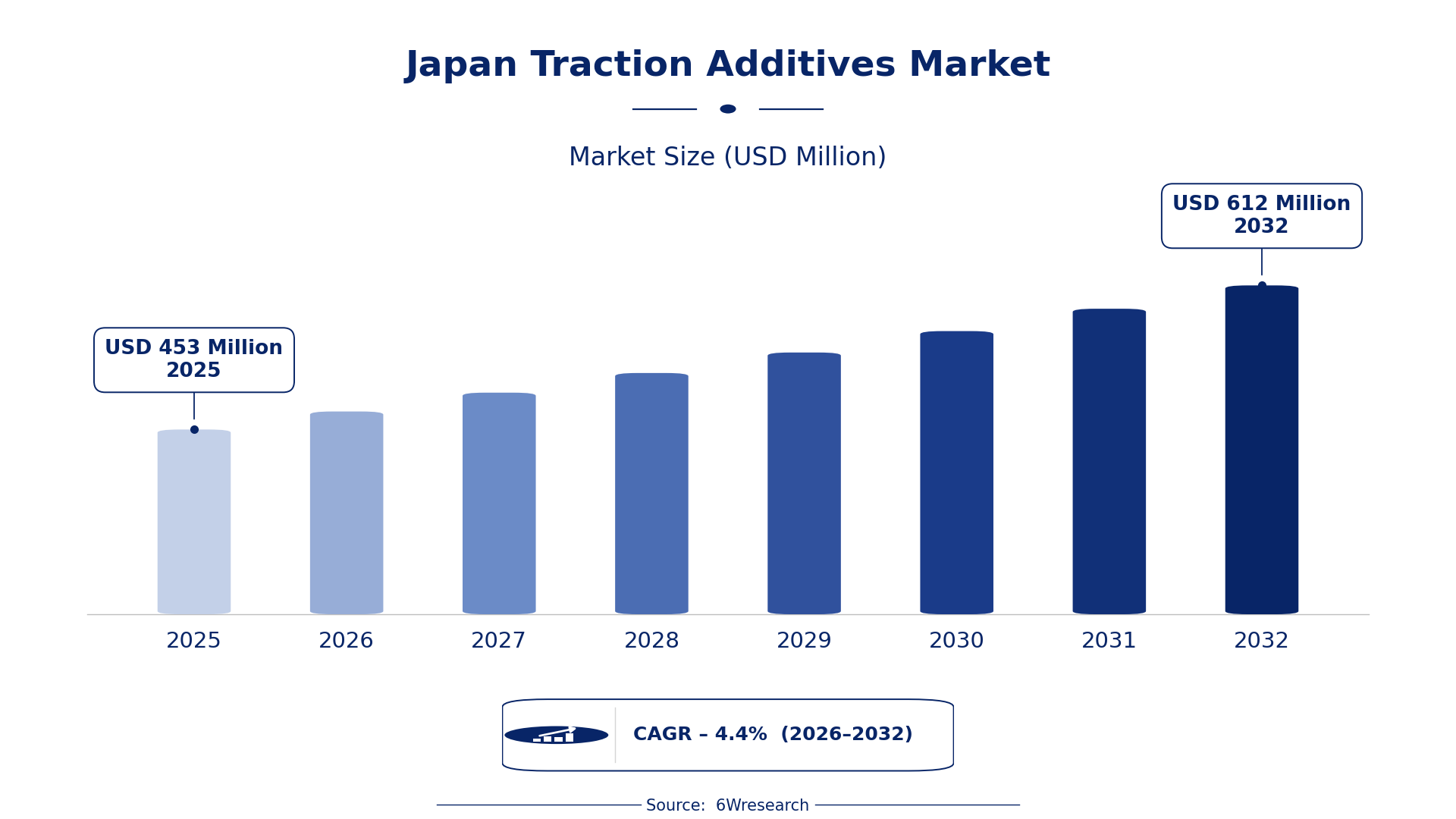
According to 6Wresearch internal database and industry insights, the Japan Traction Additives Market was valued at USD 453 Million in 2025 and is projected to reach USD 612 Million by 2032, growing at a CAGR of approximately 4.4% during 2026–2032.
Japan Traction Additives Market Highlights
| Report Metric | Details |
| Report Name | Japan Traction Additives Market (2026-2032) |
| Market Size 2025 | USD 453 Million |
| Market Size 2032 | USD 612 Million |
| Absolute Growth 2025–2032 | USD 159 Million |
| CAGR 2026–2032 | 4.4% |
| Peak Annual Growth | 5.1% in 2028 |
| Forecast Period | 2026–2032 |
| Historical Data | 2022–2025 |
| Base Year | 2025 |
| Leading Traction Additive, 2025 | Rail Adhesion Additives (44% share) |
| Leading Additive Type, 2025 | Fiber/Polymer Mix (54% share) |
| Leading Functionality, 2025 | Enhance Surface Grip (51% share) |
| Leading Distribution Channel, 2025 | Construction Chemical Suppliers (54% share) |
| Leading End User Industry, 2025 | Rail Infrastructure (40% share) |
| Fastest-Growing Traction Additive | Sports Surface Additives (5.6% CAGR) |
| Fastest-Growing Additive Type | Resin/Epoxy Additives (6.4% CAGR) |
| Fastest-Growing Distribution Channel | Rail Suppliers (5.5% CAGR) |
| Fastest-Growing End User Industry | Athletic Track Builders (6.0% CAGR) |
| Growing Sector | Athletic Track Builders |
| Key End Users | Rail Infrastructure, Commercial Construction, Athletic Track Builders |
Japan Traction Additives Market Year-wise Growth Rate and Key Drivers (2022–2032)
This graph illustrates the annual growth rates of the market from 2022 to 2032, highlighting a steady upward trajectory and projected market expansion over the forecast period.
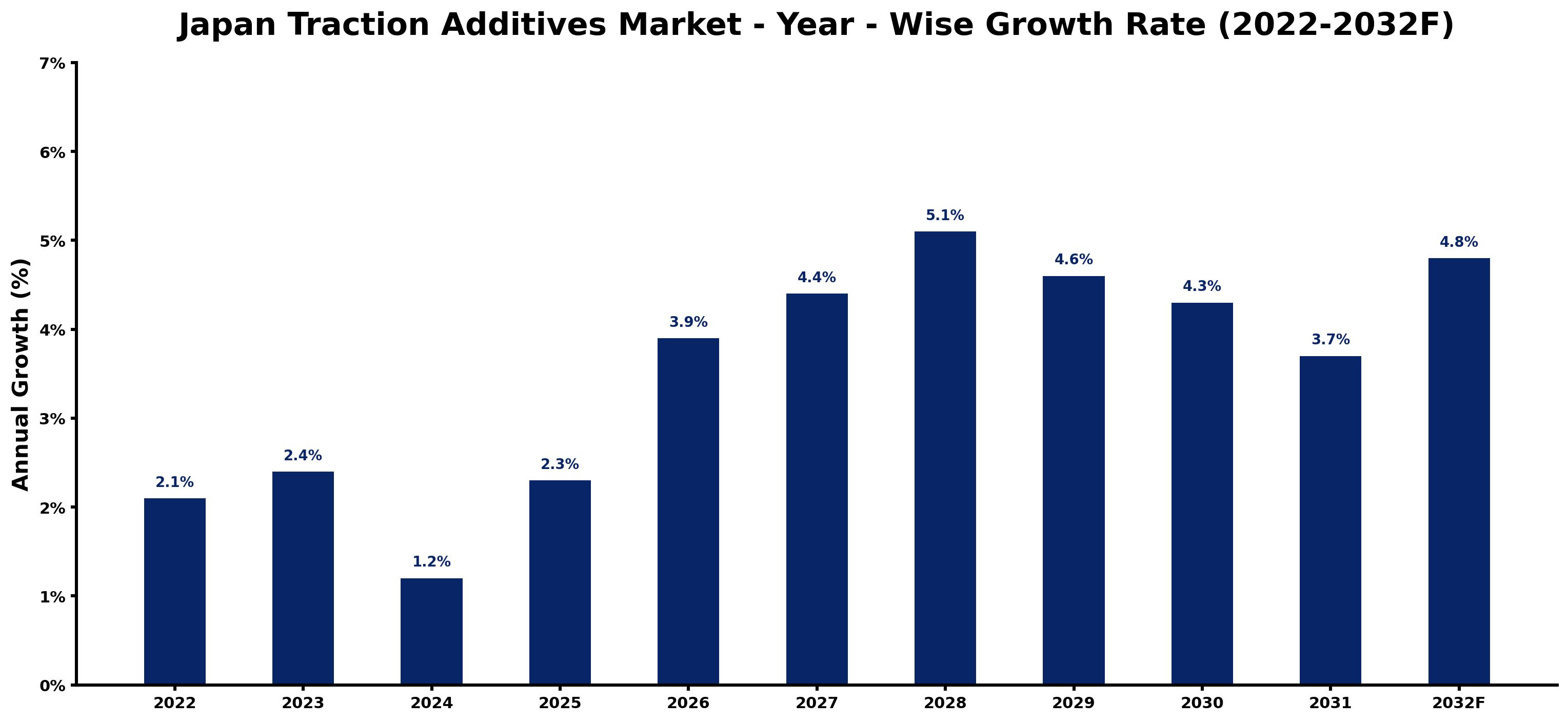
Annual growth estimates for each year appear below with the principal reason behind them, explaining the shifts that set the pace of the market.
| Year | Estimated Annual Growth (%) | Market Rationale |
| 2022 | 2.1 | The market experienced steady growth as construction activities remained active across urban areas. |
| 2023 | 2.4 | Demand surged due to increased investment in rail infrastructure and construction projects. |
| 2024 | 1.2 | Growth slowed as some construction projects faced delays and budget constraints. |
| 2025 | 2.3 | The market rebounded with renewed focus on safety standards in construction and rail sectors. |
| 2026 | 3.9 | Demand is expected to rise sharply as infrastructure projects gain momentum, particularly in urban regions. |
| 2027 | 4.4 | Investment in high-performance sports surfaces is projected to contribute to a further increase in demand. |
| 2028 | 5.1 | The peak growth will be driven by rail infrastructure upgrades and safety improvements. |
| 2029 | 4.6 | Growth is expected to moderate as some projects reach completion, stabilising the market. |
| 2030 | 4.3 | Demand will continue to slow as the market adjusts to completed infrastructure projects. |
| 2031 | 3.7 | The market is projected to maintain growth, supported by ongoing investments in safety and performance. |
| 2032 | 4.8 | Renewed focus on sustainable construction practices is expected to drive demand higher. |
Note: Market size estimations and growth projections presented in this report are based on 6Wresearch's proprietary forecasting methodology, utilizing the latest available industry data, government publications, and primary research inputs.
Japan Traction Additives Market Synopsis
Traction additives are chemical compounds that improve grip and reduce slippage on surfaces, primarily used in concrete applications, rail adhesion, and sports surfaces. The Japan Traction Additives Market is expanding due to investments in the construction sector valued at approximately 60 trillion yen and a projected 2 trillion yen investment in rail infrastructure over the next five years, driving demand from domestic users and downstream processing.
Market Dynamics Impact Analysis (2026–2032)
| Factor | Type | Impact | Primary Segment Affected |
| Increased investment in rail infrastructure | Driver | High | Rail Adhesion Additives |
| Growing demand for high-performance sports surfaces | Driver | High | Sports Surface Additives |
| Expansion of construction projects in urban areas | Opportunity | High | Concrete Additives |
| Rising focus on safety standards in rail systems | Opportunity | Medium | Rail Adhesion Additives |
| Regulatory compliance costs for chemical substances | Restraint | High | Rail Adhesion Additives |
| Market saturation in certain construction segments | Restraint | Medium | Concrete Additives |
| Challenges in sourcing high-quality raw materials | Challenge | High | Rail Adhesion Additives |
| Competition from alternative surface treatments | Challenge | Medium | Sports Surface Additives |
Evaluation of Drivers in Japan Traction Additives Market (2026–2032)
Below are the drivers that matter most for revenue growth, with supporting evidence.
| Drivers | Primary Segment Affected | Why It Matters (Evidence) |
| Investment in urban rail infrastructure | Rail Adhesion Additives | Rail infrastructure investment in Japan is projected to be around 2 trillion yen over the next five years, driving demand for traction additives. |
| Increased focus on sports performance | Sports Surface Additives | The athletic sector has seen a rise in demand for high-performance sports surfaces, leading to greater purchases of traction additives. |
| Growth in commercial construction projects | Concrete Additives | Japan's construction sector is valued at approximately 60 trillion yen, driving demand for additives to improve grip on concrete surfaces. |
| Technological advancements in additive formulations | Fiber/Polymer Mix | Innovations in polymer chemistry improve the effectiveness of traction additives, encouraging adoption in various applications. |
| Regulatory compliance with safety standards | Concrete Additives | Compliance with JIS A 5308 standards for concrete additives increases the need for high-quality traction additives. |
Most of the extra volume comes from substantial investments in urban rail infrastructure, projected to reach around 2 trillion yen over the next five years. The construction sector is also driving demand for traction additives, particularly in concrete applications, valued at approximately 60 trillion yen. Following the Tokyo 2020 Olympics, the rise in demand for high-performance sports surfaces has led to increased purchases. Advances in polymer chemistry are improving product effectiveness, stimulating further interest among construction firms and athletic track builders.
Evaluation of Restraints in Japan Traction Additives Market
These are the pressures that could keep growth below its potential.
| Market Restraint | Primary Segment Affected | Why It Matters (Evidence) |
| High regulatory compliance costs | Rail Adhesion Additives | Compliance with the Chemical Substances Control Law increases operational costs for manufacturers, impacting pricing. |
| Market saturation in construction segments | Concrete Additives | As the market matures, growth in concrete additives slows due to limited new projects. |
| Challenges in sourcing quality raw materials | Rail Adhesion Additives | Supply chain disruptions can lead to delays and increased costs for manufacturers. |
| Intense competition from alternative solutions | Sports Surface Additives | The availability of alternative surface treatments can limit market share for traction additives. |
| Economic fluctuations impacting construction budgets | Concrete Additives | Economic downturns can lead to reduced investments in construction, affecting demand. |
Japan Traction Additives Market Challenges
Construction firms in Japan face increased costs from rising raw material prices, which can inflate project expenses by up to 15% within a year. Established suppliers struggle with competition from alternative materials, as new entrants provide cheaper options, threatening their market share. Technological advancements in construction methods are outpacing current traction additive offerings, causing delays for contractors who depend on outdated products. Buyers encounter difficulties in adhering to the JIS A 5308 standards, which can extend project timelines and elevate compliance costs by approximately 10% for construction firms.
Trends in the Japan Traction Additives Market
Buyers and suppliers in the Japan Traction Additives Market are adjusting to the following trends.
- Shift towards Sustainable Construction Practices: Construction companies are increasingly adopting sustainable practices, influenced by the Green Growth Strategy. This trend is driving demand for eco-friendly traction additives, aligning with Japan's carbon neutrality goals.
- Transition from Traditional to High-Performance Sports Surfaces: Since 2021, the demand for high-performance sports surfaces has surged, particularly following the Tokyo 2020 Olympics. This shift is increasing the use of advanced traction additives by 15%.
- Emergence of Advanced Polymer Technologies: The introduction of new polymer technologies in 2022 has improved the performance of traction additives. This advancement is contributing to a 10% increase in market share for high-performance products.
- Growing Focus on Safety Standards in Rail Systems: The launch of a government program in 2023 aimed at improving rail safety has increased demand for rail adhesion additives. This initiative is expected to boost market growth by 12%.
Investment Opportunities in the Japan Traction Additives Market
Several openings in the Japan Traction Additives Market merit attention from investors.
- Traction Additives for Eco-Friendly Construction: With the rising demand for sustainable solutions, there is a need for eco-friendly traction additives. Construction companies in Tokyo are looking for suppliers who can provide certified green products, especially with the government’s focus on carbon neutrality.
- High-Performance Sports Surface Additives: Athletic track builders are actively seeking high-performance traction additives to improve their surfaces. The demand surge following the Tokyo 2020 Olympics presents an opportunity for suppliers to enter this growing market.
- Rail Adhesion Additives for Infrastructure Projects: The ongoing investment in rail infrastructure creates a demand for effective rail adhesion additives. Suppliers can target rail infrastructure projects in Osaka, where significant upgrades are planned.
- Concrete Additives for Commercial Construction: The commercial construction sector is expanding, creating a need for additives that improve grip on concrete surfaces. Suppliers should focus on partnerships with construction chemical suppliers in major urban areas.
Government Initiatives in the Japan Traction Additives Market
The Building Energy Efficiency Act, amended in 2022, mandates that all new buildings meet energy standards starting April 2025, enhancing the regulatory framework for traction additives. This law complements existing measures by ensuring that construction materials, including traction additives, contribute to energy efficiency in building projects.
The Ministry of Land, Infrastructure, Transport and Tourism oversees the implementation of the PRTR Law, which requires businesses to report chemical substance releases. This regulation impacts traction additive producers, as they must ensure compliance with reporting standards, affecting their operational practices and potentially increasing costs.
Future Insight of the Japan Traction Additives Market
Rail infrastructure projects will see a boost with the government's investment in safety-focused upgrades, improving overall efficiency. By 2032, advancements in polymer technology will lead to the creation of more effective traction additives, benefiting both suppliers and buyers. The Japan Concrete Institute's ongoing research is expected to establish new standards that enhance product performance. Increased demand for high-performance sports surfaces will drive innovation, prompting suppliers to diversify their offerings to meet specific buyer requirements.
Market Segmentation Analysis
Japan Traction Additives Market report covers a detailed analysis of the following market segments:
By Traction Additive – Rail Adhesion Additives Lead, Sports Surface Additives Expected to Grow Fastest
According to Saurav Kr Singh, Senior Research Analyst at 6Wresearch, Rail Adhesion Additives took 44% of traction additive revenue in 2025, more than any other category. Rail adhesion additives are essential for improving train traction on tracks, making them critical for the rail industry. With Japan's rail infrastructure investment projected at 2 trillion yen over the next five years, this segment is well-supported by ongoing projects. Sports Surface Additives are set to record the highest CAGR in this split, 5.6% over 2026–2032. The rise in demand for sports surface additives is fuelled by the increased focus on high-performance athletic tracks, particularly following the Tokyo 2020 Olympics. This event has heightened awareness and investment in quality sports surfaces, driving growth. Suppliers should focus on the rail and sports sectors to capture emerging opportunities.
By Additive Type – Fiber/Polymer Mix Leads, Resin/Epoxy Additives Expected to Grow Fastest
With 54% of additive type revenue in 2025, Fiber/Polymer Mix was the largest category. The fiber/polymer mix segment holds a substantial share due to its extensive use in construction and rail applications, where grip enhancement is vital. Compliance with standards such as JIS A 5308 further solidifies its dominance in the market. Resin/Epoxy Additives are projected to grow fastest, at a CAGR of 6.4% during 2026–2032. Resin/epoxy additives are witnessing rapid growth as they cater to specific performance needs in niche applications, particularly in high-performance environments. Their rising adoption in projects linked to major events, such as the Tokyo 2020 Olympics, significantly contributes to this trend. Suppliers should consider expanding their resin/epoxy product lines to meet the increasing demand in specialised applications.
By Functionality – Enhance Surface Grip Leads and Records the Fastest Growth
The largest functionality category in 2025 was Enhance Surface Grip, at 51% of revenue. Enhancing surface grip is the primary function of traction additives, making it essential for both rail and sports applications. This critical role ensures a strong market presence, especially as safety standards in rail infrastructure gain importance. Enhance Surface Grip is also forecast to expand faster than any other category, at a CAGR of 6.1% over 2026–2032. The focus on enhancing surface grip continues to drive growth, with advancements in formulations supporting this trend. The persistent demand for improved performance across various applications sustains the momentum of this functionality. Suppliers must prioritise the development of advanced formulations that enhance grip to remain competitive.
By Distribution Channel – Construction Chemical Suppliers Lead, Rail Suppliers Expected to Grow Fastest
Construction Chemical Suppliers held 54% of the Japan Traction Additives Market by distribution channel in 2025. Construction chemical suppliers are the main distributors of traction additives, providing a reliable supply chain to the construction sector. Their established networks and industry expertise facilitate effective distribution to meet increasing demands. The quickest growth will come from Rail Suppliers, forecast to expand at a CAGR of 5.5% between 2026 and 2032. Rail suppliers are adapting their offerings to deliver tailored traction solutions for rail systems, reflecting the surge in rail infrastructure investments. This focused approach allows them to capture a larger market share. Suppliers should enhance partnerships with rail suppliers to optimise their distribution strategies.
By End User Industry – Rail Infrastructure Leads, Athletic Track Builders Expected to Grow Fastest
Rail Infrastructure accounted for 40% of the market by end user industry in 2025. Rail infrastructure is a key sector for traction additive applications, driven by the critical need for safety and performance in rail operations. The significant investment projected for rail infrastructure in Japan reinforces this segment's leading position. Athletic Track Builders are set to record the highest CAGR in this split, 6.0% over 2026–2032. Athletic track builders are increasingly utilising traction additives to improve track surfaces, especially with the growing emphasis on performance in sports events. This heightened focus on athletic excellence propels demand for high-quality additives. Buyers in the athletic sector should seek advanced additives to enhance track performance.
Key Attractiveness of the Report
- 10 Years of Market Numbers
- Historical Data Starting from 2022 to 2025
- Base Year 2025
- Forecast Data until 2032
- Key Performance Indicators Impacting the Market
- Major Upcoming Developments and Projects
Key Highlights of the Report:
- Japan Traction Additives Market Outlook
- Market Size of Japan Traction Additives Market, 2025
- Forecast of Japan Traction Additives Market, 2032
- Historical Data and Forecast of Japan Traction Additives Revenues & Volume for the Period 2022-2032F
- Japan Traction Additives Market Trend Evolution
- Japan Traction Additives Market Drivers and Challenges
- Japan Traction Additives Price Trends
- Japan Traction Additives Porter's Five Forces
- Japan Traction Additives Industry Life Cycle
- Historical Data and Forecast of Japan Traction Additives Market Revenues & Volume By Traction Additive for the Period 2022-2032F
- Historical Data and Forecast of Japan Traction Additives Market Revenues & Volume By Concrete Additives for the Period 2022-2032F
- Historical Data and Forecast of Japan Traction Additives Market Revenues & Volume By Rail Adhesion Additives for the Period 2022-2032F
- Historical Data and Forecast of Japan Traction Additives Market Revenues & Volume By Sports Surface Additives for the Period 2022-2032F
- Historical Data and Forecast of Japan Traction Additives Market Revenues & Volume By Additive Type for the Period 2022-2032F
- Historical Data and Forecast of Japan Traction Additives Market Revenues & Volume By Fiber/Polymer Mix for the Period 2022-2032F
- Historical Data and Forecast of Japan Traction Additives Market Revenues & Volume By Sand/Sediment Additives for the Period 2022-2032F
- Historical Data and Forecast of Japan Traction Additives Market Revenues & Volume By Resin/Epoxy Additives for the Period 2022-2032F
- Historical Data and Forecast of Japan Traction Additives Market Revenues & Volume By Functionality for the Period 2022-2032F
- Historical Data and Forecast of Japan Traction Additives Market Revenues & Volume By Enhance Surface Grip for the Period 2022-2032F
- Historical Data and Forecast of Japan Traction Additives Market Revenues & Volume By Reduce Slippage for the Period 2022-2032F
- Historical Data and Forecast of Japan Traction Additives Market Revenues & Volume By Friction Control for the Period 2022-2032F
- Historical Data and Forecast of Japan Traction Additives Market Revenues & Volume By Distribution Channel for the Period 2022-2032F
- Historical Data and Forecast of Japan Traction Additives Market Revenues & Volume By Construction Chemical Suppliers for the Period 2022-2032F
- Historical Data and Forecast of Japan Traction Additives Market Revenues & Volume By Rail Suppliers for the Period 2022-2032F
- Historical Data and Forecast of Japan Traction Additives Market Revenues & Volume By Sports Equipment Vendors for the Period 2022-2032F
- Historical Data and Forecast of Japan Traction Additives Market Revenues & Volume By End User Industry for the Period 2022-2032F
- Historical Data and Forecast of Japan Traction Additives Market Revenues & Volume By Commercial Construction for the Period 2022-2032F
- Historical Data and Forecast of Japan Traction Additives Market Revenues & Volume By Rail Infrastructure for the Period 2022-2032F
- Historical Data and Forecast of Japan Traction Additives Market Revenues & Volume By Athletic Track Builders for the Period 2022-2032F
- Japan Traction Additives Import Export Trade Statistics
- Market Opportunity Assessment By Traction Additive
- Market Opportunity Assessment By Additive Type
- Market Opportunity Assessment By Functionality
- Market Opportunity Assessment By Distribution Channel
- Market Opportunity Assessment By End User Industry
- Japan Traction Additives Top Companies Market Share
- Japan Traction Additives Competitive Benchmarking By Technical and Operational Parameters
- Japan Traction Additives Company Profiles
- Japan Traction Additives Key Strategic Recommendations
Market Covered
The following segment groups are covered in the report.
By Traction Additive
- Concrete Additives
- Rail Adhesion Additives
- Sports Surface Additives
By Additive Type
- Fiber/Polymer Mix
- Sand/Sediment Additives
- Resin/Epoxy Additives
By Functionality
- Enhance Surface Grip
- Reduce Slippage
- Friction Control
By Distribution Channel
- Construction Chemical Suppliers
- Rail Suppliers
- Sports Equipment Vendors
By End User Industry
- Commercial Construction
- Rail Infrastructure
- Athletic Track Builders































