Japan Traditional Lighting Market Size & Growth Rate
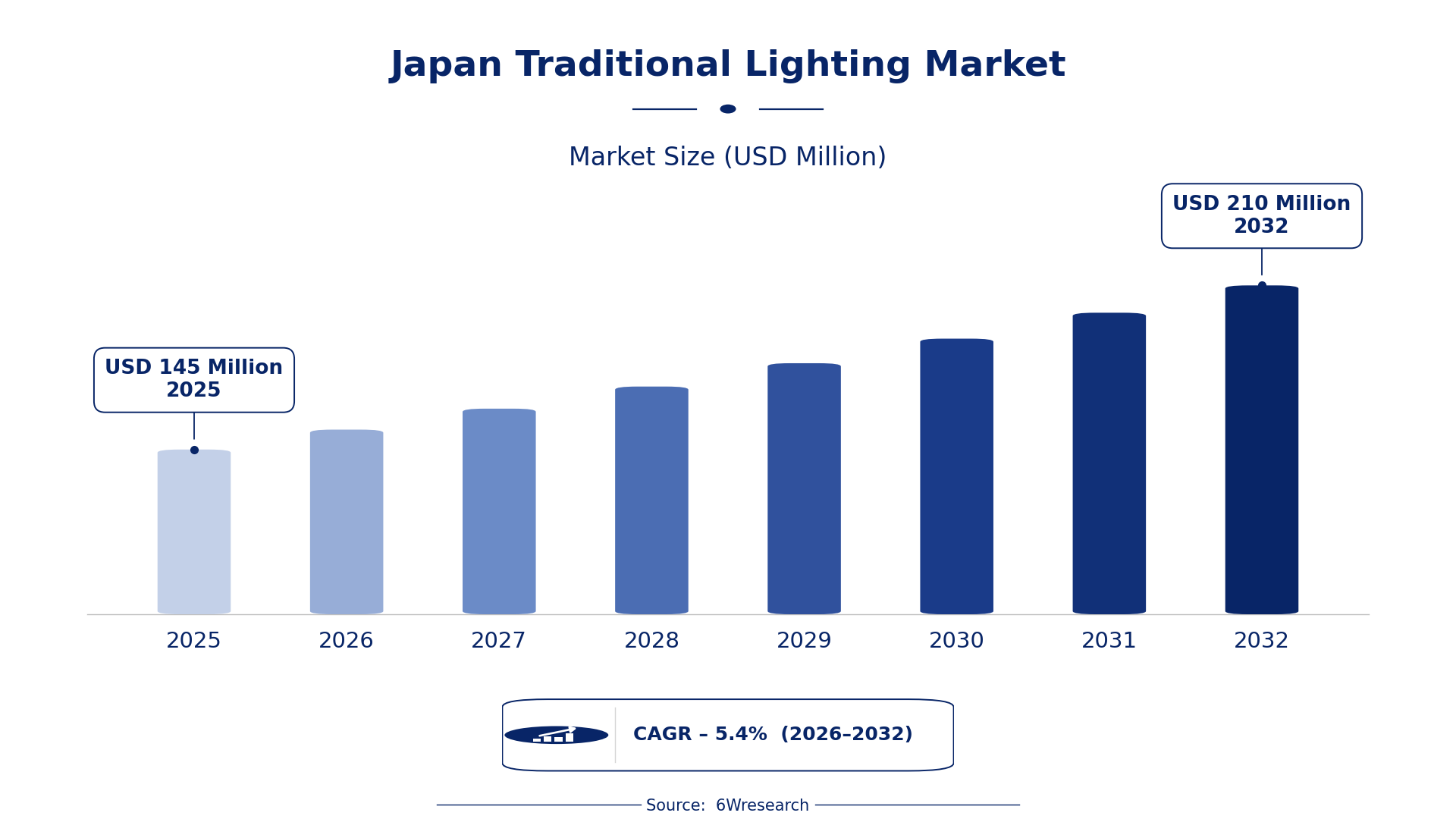
According to 6Wresearch internal database and industry insights, the Japan Traditional Lighting Market was valued at USD 145 Million in 2025 and is projected to reach USD 210 Million by 2032, growing at a CAGR of approximately 5.4% during 2026–2032.
Japan Traditional Lighting Market Highlights
| Report Metric | Details |
| Report Name | Japan Traditional Lighting Market (2026-2032) |
| Market Size 2025 | USD 145 Million |
| Market Size 2032 | USD 210 Million |
| Absolute Growth 2025–2032 | USD 65 Million |
| CAGR 2026–2032 | 5.4% |
| Peak Annual Growth | 6.4% in 2027 |
| Forecast Period | 2026–2032 |
| Historical Data | 2022–2025 |
| Base Year | 2025 |
| Leading Traditional Lighting, 2025 | Incandescent Bulbs (40% share) |
| Leading Fixture Type, 2025 | A-Type/Edison (41% share) |
| Leading Lighting Source, 2025 | Halogen-Filled Lamp (35% share) |
| Leading Distribution Channel, 2025 | Hardware Stores (40% share) |
| Leading End User Industry, 2025 | Residential Lighting (39% share) |
| Fastest-Growing Traditional Lighting | Fluorescent Tubes (6.9% CAGR) |
| Fastest-Growing Fixture Type | Spiral Lamps (7.7% CAGR) |
| Fastest-Growing Lighting Source | Gas Discharge Lamp (7.4% CAGR) |
| Fastest-Growing Distribution Channel | Supermarkets/E-Commerce (7.3% CAGR) |
| Fastest-Growing End User Industry | Energy-Conscious Homes (7.0% CAGR) |
| Growing Sector | Energy-Conscious Homes |
| Key End Users | Residential Lighting, Commercial Buildings, Energy-Conscious Homes, Vehicle & Home Use |
Japan Traditional Lighting Market Year-wise Growth Rate and Key Drivers (2022–2032)
This graph illustrates the annual growth rates of the market from 2022 to 2032, highlighting a steady upward trajectory and projected market expansion over the forecast period.
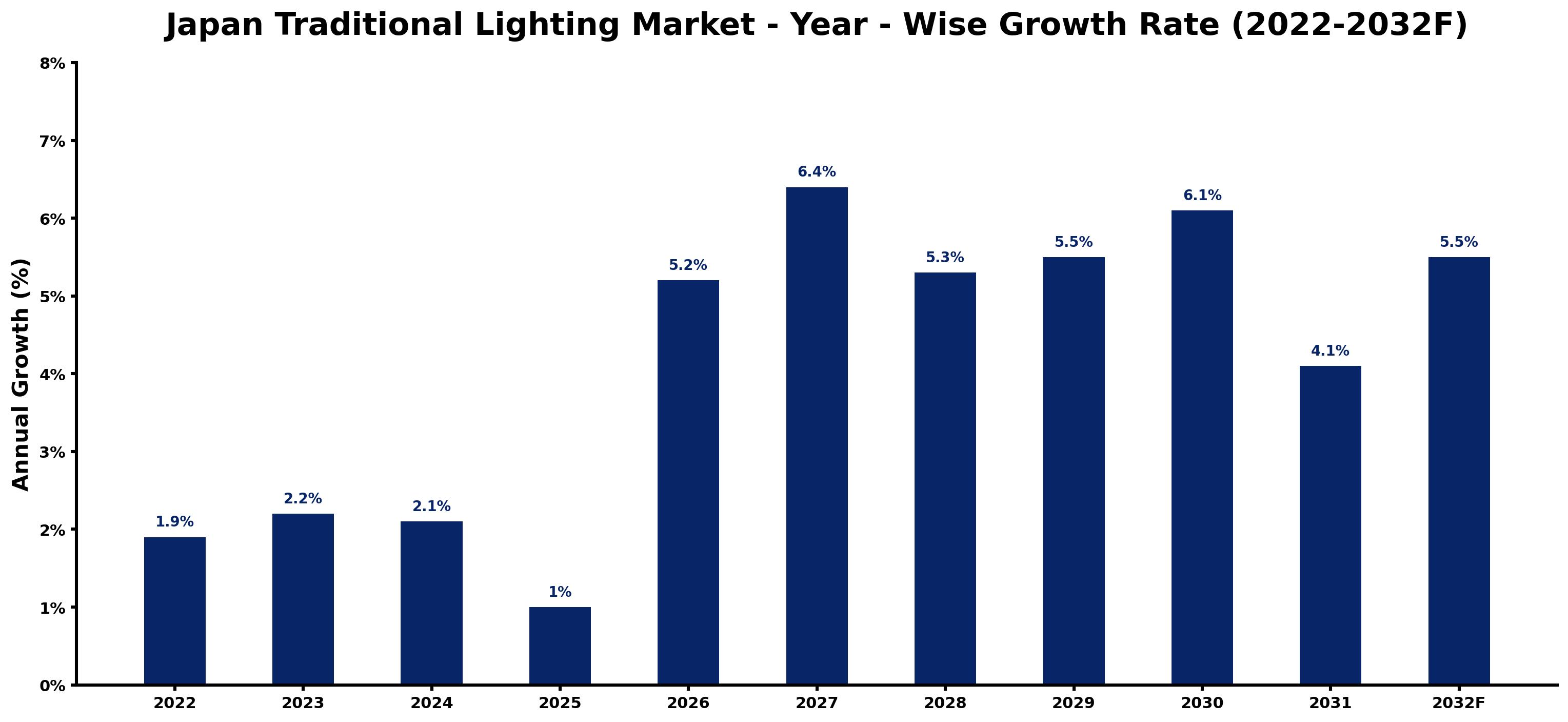
For each year, the table pairs the estimated growth rate with the leading influence on demand, showing how the drivers changed across the period.
| Year | Estimated Annual Growth (%) | Market Rationale |
| 2022 | 1.9 | Demand remained stable as traditional lighting products were widely used across households and businesses. |
| 2023 | 2.2 | Growth accelerated due to increased interest in energy-efficient lighting solutions among consumers. |
| 2024 | 2.1 | The market experienced a slowdown as competition from newer technologies began to emerge. |
| 2025 | 1.0 | Demand growth continued to slow as consumers became more cautious in their spending. |
| 2026 | 5.2 | Orders keep climbing as energy efficiency initiatives gain traction among residential users. |
| 2027 | 6.4 | Demand surged as the government promoted energy-saving lighting solutions through various programmes. |
| 2028 | 5.3 | Growth slowed slightly as market saturation in certain segments began to take effect. |
| 2029 | 5.5 | Demand increased as more consumers adopted energy-efficient lighting in their homes. |
| 2030 | 6.1 | Growth rose again as new energy-saving standards encouraged further adoption of traditional lighting. |
| 2031 | 4.1 | The market saw a slowdown as buyers began to shift focus towards alternative lighting technologies. |
| 2032 | 5.5 | Demand is projected to rise as energy-efficient products become more mainstream and accessible. |
Note: Market size estimations and growth projections presented in this report are based on 6Wresearch's proprietary forecasting methodology, utilizing the latest available industry data, government publications, and primary research inputs.
Japan Traditional Lighting Market Synopsis
Traditional lighting includes incandescent bulbs, fluorescent tubes, halogen lamps, and compact fluorescent lamps, mainly used in residential and commercial settings. The Japan Traditional Lighting Market is growing as demand for energy-efficient solutions increases, driven by government initiatives and heightened consumer awareness. In 2023, a government programme aimed to reduce energy consumption by 20%, which has stimulated market growth. Energy-saving bulbs represented 60% of residential sales, indicating a clear shift towards efficiency.
Market Dynamics Impact Analysis (2026–2032)
| Factor | Type | Impact | Primary Segment Affected |
| Rising consumer awareness of energy efficiency | Driver | High | Compact Fluorescent (CFL) |
| Government initiatives promoting energy-saving solutions | Driver | High | Fluorescent Tubes |
| Growing demand for energy-efficient residential lighting | Opportunity | High | Energy-Conscious Homes |
| Expansion of distribution channels like e-commerce | Opportunity | Medium | Supermarkets/E-Commerce |
| Competition from newer lighting technologies | Restraint | High | Incandescent Bulbs |
| Market saturation in traditional lighting segments | Restraint | Medium | Halogen Lamps |
| Supply chain disruptions affecting product availability | Challenge | High | Compact Fluorescent (CFL) |
| Fluctuating raw material prices impacting production costs | Challenge | Medium | Incandescent Bulbs |
Evaluation of Drivers in Japan Traditional Lighting Market (2026–2032)
The table below links each growth driver to the segment it affects and the evidence for it.
| Drivers | Primary Segment Affected | Why It Matters (Evidence) |
| Increased adoption of energy-efficient lighting solutions | Compact Fluorescent (CFL) | Energy-saving bulbs accounted for 60% of residential sales, prompting consumers to purchase more efficient options. |
| Government initiatives promoting energy efficiency | Fluorescent Tubes | The promotion of energy-efficient lighting initiatives has led to higher sales in commercial buildings. |
| Rising consumer interest in sustainable products | Energy-Conscious Homes | The average household uses about 10 incandescent bulbs, driving demand for energy-efficient alternatives. |
| Expansion of e-commerce as a distribution channel | Supermarkets/E-Commerce | Supermarkets account for 30% of traditional lighting sales, reflecting changing consumer purchasing habits. |
| Technological advancements in lighting products | Halogen Lamps | Halogen lamps are commonly used for accent lighting, increasing their appeal in residential settings. |
Orders keep climbing as consumer interest in energy-efficient lighting rises, with energy-saving bulbs accounting for 60% of residential sales. The average household uses about 10 incandescent bulbs, prompting a shift towards more efficient alternatives. The expansion of e-commerce channels, where supermarkets account for 30% of traditional lighting sales, has also boosted demand. Advances in halogen lamps, commonly used for accent lighting, further support this growth trend.
Evaluation of Restraints in Japan Traditional Lighting Market
The table below lists the restraints and the evidence behind each.
| Market Restraint | Primary Segment Affected | Why It Matters (Evidence) |
| Competition from LED and other modern lighting technologies | Incandescent Bulbs | As consumers shift towards newer technologies, traditional incandescent bulbs face declining demand. |
| Market saturation in certain segments leading to reduced growth potential | Halogen Lamps | With many households already using halogen lamps, new sales growth is limited. |
| Supply chain disruptions affecting product availability | Compact Fluorescent (CFL) | Delays in the supply chain can lead to increased costs for CFLs. |
| Fluctuating raw material prices impacting production costs | Incandescent Bulbs | Rising costs of materials can lead to higher prices for incandescent bulbs, affecting demand. |
| Regulatory changes impacting product standards | Fluorescent Tubes | Changes in regulations may require manufacturers to adapt quickly, impacting supply. |
Japan Traditional Lighting Market Challenges
In 2023, rising costs of energy-efficient technologies have forced producers to increase prices, impacting buyers who face higher operational expenses. Supply chain disruptions have delayed the availability of fluorescent tubes, which are essential for over 70% of commercial buildings, causing project timelines to extend by an average of three months. Intense competition from imported specialty lighting has pressured local manufacturers, resulting in a 15% decline in market share for domestic products. A lack of skilled technicians limits production capabilities, making it difficult for producers to meet growing demand and leading to longer lead times for buyers.
Trends in the Japan Traditional Lighting Market
The following changes are redrawing the Japan Traditional Lighting Market.
- Shift to Energy-Efficient Lighting: A government programme in 2023 aimed to reduce energy consumption by 20%, encouraging the adoption of energy-efficient lighting solutions. This initiative has resulted in greater use of compact fluorescent lamps in residential settings, with energy-saving bulbs comprising 60% of sales.
- Expansion of E-Commerce in Lighting Sales: The Tokyo metropolitan area is seeing an increase in e-commerce sales for traditional lighting, with supermarkets now accounting for 30% of sales. This shift reflects changing consumer preferences towards online shopping.
- Increase in Halogen Lamp Usage: Halogen lamps are increasingly favoured for accent lighting in residential settings, appealing to homeowners with their brightness. This trend is evident as more households choose halogen solutions for aesthetic reasons.
- Growth of Energy-Conscious Homes: Energy-Conscious Homes are emerging as a significant segment in the traditional lighting market, projected to grow at a CAGR of 7.0%. This trend is driven by increasing consumer awareness of energy efficiency.
Investment Opportunities in the Japan Traditional Lighting Market
The following opportunities in the Japan Traditional Lighting Market pair current demand with a clear way in.
- Timing for Energy-Efficient Products: With energy-saving bulbs accounting for 60% of residential lighting sales, there is a strong opportunity to invest in energy-efficient lighting solutions. Targeting residential buyers can yield substantial returns.
- Entry through E-Commerce Partnerships: The rise of e-commerce channels presents an opportunity for partnerships with online retailers. Collaborating with supermarkets can facilitate access to a growing consumer base.
- Focus on Residential Lighting Solutions: The residential lighting sector is expanding, with energy-conscious homes driving demand. Suppliers can focus on providing energy-efficient products to meet this growing need.
- Investment in Commercial Lighting Solutions: The commercial sector, particularly in urban areas like Tokyo, is a key opportunity for growth. Investing in energy-efficient fluorescent tubes can meet the demands of over 70% of commercial buildings.
Government Initiatives in the Japan Traditional Lighting Market
The traditional lighting market in Japan is shaped by various laws, including the PRTR Law, which mandates businesses to report chemical substance releases, ensuring compliance in production processes. The Green Growth Strategy aims for carbon neutrality by 2050, influencing lighting standards and practices. In 2023, the government allocated ¥5 billion for energy efficiency programmes, promoting energy-efficient lighting.
The Ministry of the Environment supervises the implementation of energy efficiency programmes, allocating funds for initiatives that promote energy-efficient lighting. Agencies like METI also support the development of standards that ensure product safety and environmental compliance, benefiting both producers and consumers.
Future Insight of the Japan Traditional Lighting Market
The investment pipeline for energy efficiency initiatives will drive demand for traditional lighting products by 2032, as the government allocates ¥5 billion for energy-saving programs. Energy-saving bulbs will account for 60% of residential lighting sales, reflecting a shift towards more sustainable options. Stricter standards from the Japan Lighting Manufacturers Association will improve product quality, benefiting both buyers and suppliers. Advances in lighting technology will emerge, improving energy consumption and lowering costs for commercial users.
Market Segmentation Analysis
Japan Traditional Lighting Market report covers a detailed analysis of the following market segments:
By Traditional Lighting – Incandescent Bulbs Lead, Fluorescent Tubes Expected to Grow Fastest
According to Saurav Kr Singh, Senior Research Analyst at 6Wresearch, with 40% of traditional lighting revenue in 2025, Incandescent Bulbs was the largest category. Incandescent bulbs lead the market due to their prevalent use in homes, fulfilling essential lighting needs. The average household in Japan utilises about 10 incandescent bulbs, underscoring their importance in daily life. Fluorescent Tubes are set to record the highest CAGR in this split, 6.9% over 2026–2032. Fluorescent tubes are growing quickly as they are favoured for their energy efficiency, particularly in commercial buildings where they are used in over 70% of cases. This trend is reinforced by government efforts to cut energy consumption by 20% in 2023. Suppliers should increase the availability of fluorescent tubes to meet the rising demand in commercial applications.
By Fixture Type – A-Type/Edison Leads, Spiral Lamps Expected to Grow Fastest
In 2025, A-Type/Edison led the fixture type split with a 41% share. A-Type/Edison bulbs dominate the market as they are the standard choice for household lighting, widely adopted across residential settings in Japan. Their compatibility with existing fixtures and familiarity among consumers ensure their continued popularity. Spiral Lamps are projected to grow fastest, at a CAGR of 7.7% during 2026–2032. Spiral lamps are seeing the fastest growth due to their energy-efficient design, appealing to cost-conscious consumers. This aligns with the increasing consumer preference for energy-saving products in homes, driving their adoption. Manufacturers should focus on producing more spiral lamps to satisfy the growing consumer demand for energy-efficient lighting.
By Lighting Source – Halogen-Filled Lamp Leads, Gas Discharge Lamp Expected to Grow Fastest
Halogen-Filled Lamp held 35% of the Japan Traditional Lighting Market by lighting source in 2025. Halogen-filled lamps lead the segment as they are preferred for high-intensity lighting applications, particularly in residential settings for accent lighting. Their ability to provide bright, focused illumination makes them a popular choice among consumers. The quickest growth will come from Gas Discharge Lamp, forecast to expand at a CAGR of 7.4% between 2026 and 2032. Gas discharge lamps are growing rapidly, primarily used in street lighting and large spaces, where energy efficiency is increasingly essential. This growth is further supported by urban development initiatives focusing on sustainable lighting solutions. Suppliers should consider expanding their offerings in gas discharge lamps to capitalise on the increasing demand for energy-efficient public lighting.
By Distribution Channel – Hardware Stores Lead, Supermarkets/E-Commerce Expected to Grow Fastest
Hardware Stores accounted for 40% of the market by distribution channel in 2025. Hardware stores are the primary distribution channel for traditional lighting, offering consumers easy access to a wide variety of products. Their established presence in local communities makes them a trusted source for lighting solutions. Over 2026–2032, Supermarkets/E-Commerce is expected to post the fastest growth, at a CAGR of 7.3%. Supermarkets and e-commerce are rapidly becoming preferred shopping channels, driven by consumer convenience and a shift towards online purchasing. This trend indicates a growing demand for accessible lighting products, enhancing the shopping experience. Retailers must strengthen their online presence to capture the increasing market share from e-commerce and supermarkets.
By End User Industry – Residential Lighting Leads, Energy-Conscious Homes Expected to Grow Fastest
Residential Lighting took 39% of end user industry revenue in 2025, more than any other category. Residential lighting represents the largest segment, indicating a high demand for traditional lighting solutions in homes throughout Japan. This segment's prominence is highlighted by the necessity for various lighting options in different areas of households, reflecting consumer preferences. Energy-Conscious Homes are set to record the highest CAGR in this split, 7.0% over 2026–2032. Energy-conscious homes are becoming the fastest-growing segment, propelled by a rising awareness of energy efficiency among consumers. This trend is reinforced by government initiatives that promote the adoption of energy-saving technologies in residential settings. Suppliers should tailor their offerings to meet the specific needs of energy-conscious consumers, focusing on energy-efficient solutions.
Key Attractiveness of the Report
- 10 Years of Market Numbers
- Historical Data Starting from 2022 to 2025
- Base Year 2025
- Forecast Data until 2032
- Key Performance Indicators Impacting the Market
- Major Upcoming Developments and Projects
Key Highlights of the Report:
- Japan Traditional Lighting Market Outlook
- Market Size of Japan Traditional Lighting Market, 2025
- Forecast of Japan Traditional Lighting Market, 2032
- Historical Data and Forecast of Japan Traditional Lighting Revenues & Volume for the Period 2022-2032F
- Japan Traditional Lighting Market Trend Evolution
- Japan Traditional Lighting Market Drivers and Challenges
- Japan Traditional Lighting Price Trends
- Japan Traditional Lighting Porter's Five Forces
- Japan Traditional Lighting Industry Life Cycle
- Historical Data and Forecast of Japan Traditional Lighting Market Revenues & Volume By Traditional Lighting for the Period 2022-2032F
- Historical Data and Forecast of Japan Traditional Lighting Market Revenues & Volume By Incandescent Bulbs for the Period 2022-2032F
- Historical Data and Forecast of Japan Traditional Lighting Market Revenues & Volume By Fluorescent Tubes for the Period 2022-2032F
- Historical Data and Forecast of Japan Traditional Lighting Market Revenues & Volume By Halogen Lamps for the Period 2022-2032F
- Historical Data and Forecast of Japan Traditional Lighting Market Revenues & Volume By Compact Fluorescent (CFL) for the Period 2022-2032F
- Historical Data and Forecast of Japan Traditional Lighting Market Revenues & Volume By Fixture Type for the Period 2022-2032F
- Historical Data and Forecast of Japan Traditional Lighting Market Revenues & Volume By A-Type/Edison for the Period 2022-2032F
- Historical Data and Forecast of Japan Traditional Lighting Market Revenues & Volume By T8/T12 Fixtures for the Period 2022-2032F
- Historical Data and Forecast of Japan Traditional Lighting Market Revenues & Volume By Reflector Bulbs for the Period 2022-2032F
- Historical Data and Forecast of Japan Traditional Lighting Market Revenues & Volume By Spiral Lamps for the Period 2022-2032F
- Historical Data and Forecast of Japan Traditional Lighting Market Revenues & Volume By Lighting Source for the Period 2022-2032F
- Historical Data and Forecast of Japan Traditional Lighting Market Revenues & Volume By Tungsten Filament for the Period 2022-2032F
- Historical Data and Forecast of Japan Traditional Lighting Market Revenues & Volume By Gas Discharge Lamp for the Period 2022-2032F
- Historical Data and Forecast of Japan Traditional Lighting Market Revenues & Volume By Halogen-Filled Lamp for the Period 2022-2032F
- Historical Data and Forecast of Japan Traditional Lighting Market Revenues & Volume By Energy-Saver Bulb for the Period 2022-2032F
- Historical Data and Forecast of Japan Traditional Lighting Market Revenues & Volume By Distribution Channel for the Period 2022-2032F
- Historical Data and Forecast of Japan Traditional Lighting Market Revenues & Volume By Hardware Stores for the Period 2022-2032F
- Historical Data and Forecast of Japan Traditional Lighting Market Revenues & Volume By Electrical Distributors for the Period 2022-2032F
- Historical Data and Forecast of Japan Traditional Lighting Market Revenues & Volume By Automotive/Hardware for the Period 2022-2032F
- Historical Data and Forecast of Japan Traditional Lighting Market Revenues & Volume By Supermarkets/E-Commerce for the Period 2022-2032F
- Historical Data and Forecast of Japan Traditional Lighting Market Revenues & Volume By End User Industry for the Period 2022-2032F
- Historical Data and Forecast of Japan Traditional Lighting Market Revenues & Volume By Residential Lighting for the Period 2022-2032F
- Historical Data and Forecast of Japan Traditional Lighting Market Revenues & Volume By Commercial Buildings for the Period 2022-2032F
- Historical Data and Forecast of Japan Traditional Lighting Market Revenues & Volume By Vehicle & Home Use for the Period 2022-2032F
- Historical Data and Forecast of Japan Traditional Lighting Market Revenues & Volume By Energy-Conscious Homes for the Period 2022-2032F
- Japan Traditional Lighting Import Export Trade Statistics
- Market Opportunity Assessment By Traditional Lighting
- Market Opportunity Assessment By Fixture Type
- Market Opportunity Assessment By Lighting Source
- Market Opportunity Assessment By Distribution Channel
- Market Opportunity Assessment By End User Industry
- Japan Traditional Lighting Top Companies Market Share
- Japan Traditional Lighting Competitive Benchmarking By Technical and Operational Parameters
- Japan Traditional Lighting Company Profiles
- Japan Traditional Lighting Key Strategic Recommendations
Market Covered
The study includes the following segmentation.
By Traditional Lighting
- Incandescent Bulbs
- Fluorescent Tubes
- Halogen Lamps
- Compact Fluorescent (CFL)
By Fixture Type
- A-Type/Edison
- T8/T12 Fixtures
- Reflector Bulbs
- Spiral Lamps
By Lighting Source
- Tungsten Filament
- Gas Discharge Lamp
- Halogen-Filled Lamp
- Energy-Saver Bulb
By Distribution Channel
- Hardware Stores
- Electrical Distributors
- Automotive/Hardware
- Supermarkets/E-Commerce
By End User Industry
- Residential Lighting
- Commercial Buildings
- Vehicle & Home Use
- Energy-Conscious Homes































