Japan Traditional Medicine Market Size & Growth Rate
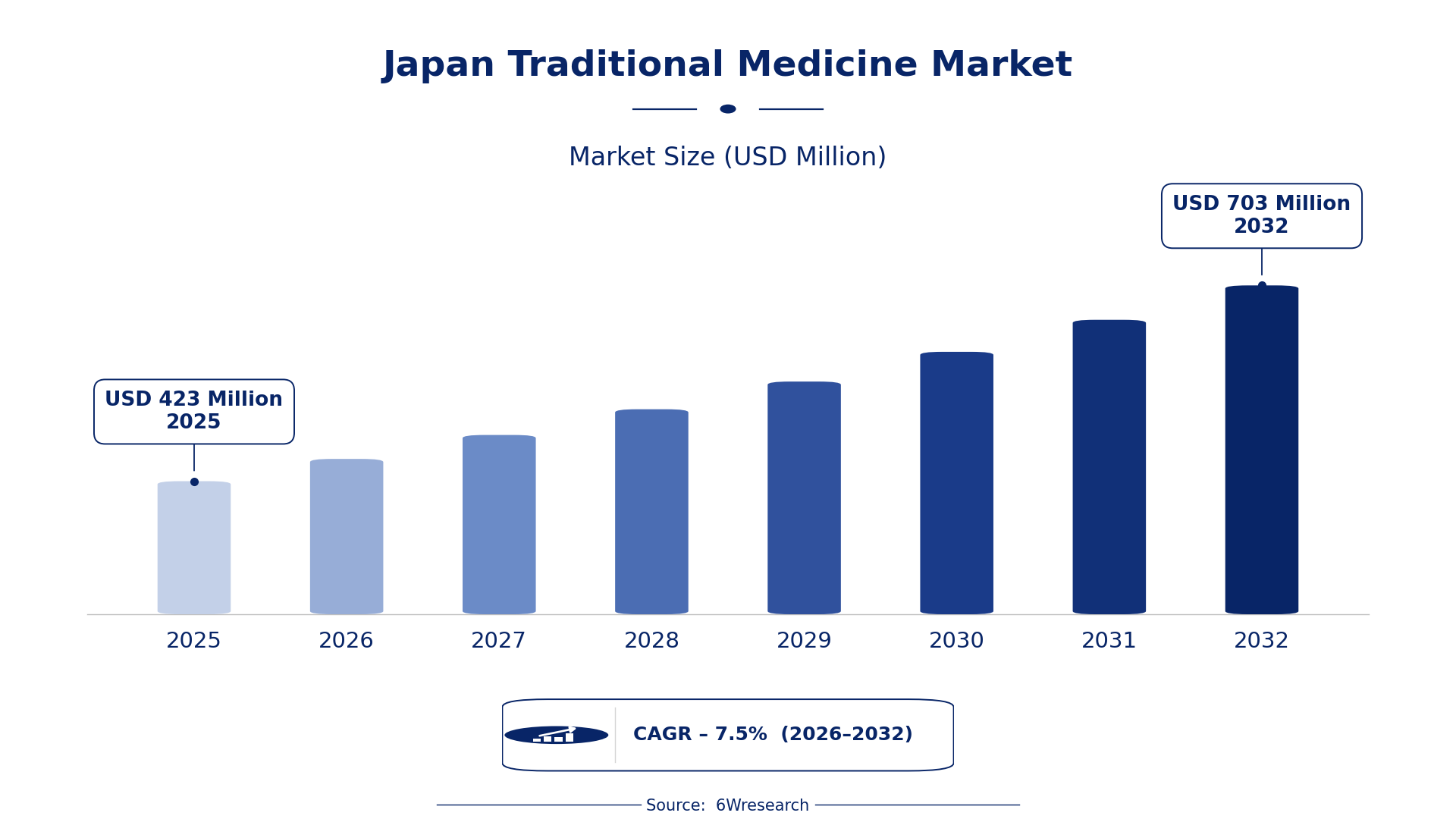
According to 6Wresearch internal database and industry insights, the Japan Traditional Medicine Market was valued at USD 423 Million in 2025 and is projected to reach USD 703 Million by 2032, growing at a CAGR of approximately 7.5% during 2026–2032.
Japan Traditional Medicine Market Highlights
| Report Metric | Details |
| Report Name | Japan Traditional Medicine Market (2026-2032) |
| Market Size 2025 | USD 423 Million |
| Market Size 2032 | USD 703 Million |
| Absolute Growth 2025–2032 | USD 280 Million |
| CAGR 2026–2032 | 7.5% |
| Peak Annual Growth | 8.1% in 2026 |
| Forecast Period | 2026–2032 |
| Historical Data | 2022–2025 |
| Base Year | 2025 |
| Leading Traditional Medicine, 2025 | Traditional TCM Products (52% share) |
| Leading Product Type, 2025 | Herbal Tablets (44% share) |
| Leading Form, 2025 | Standardized Extracts (44% share) |
| Leading Distribution Channel, 2025 | TCM Clinics (46% share) |
| Leading End User Industry, 2025 | Wellness Consumers (36% share) |
| Fastest-Growing Traditional Medicine | Ayurvedic Formulations (9.6% CAGR) |
| Fastest-Growing Product Type | Tonic Drinks (10.6% CAGR) |
| Fastest-Growing Distribution Channel | Health Stores (9.3% CAGR) |
| Fastest-Growing End User Industry | Preventive Health Users (10.0% CAGR) |
| Growing Sector | Preventive Health |
| Key End Users | Wellness Consumers, Holistic Practitioners, Preventive Health Users |
Japan Traditional Medicine Market Year-wise Growth Rate and Key Drivers (2022–2032)
This graph illustrates the annual growth rates of the market from 2022 to 2032, highlighting a steady upward trajectory and projected market expansion over the forecast period.
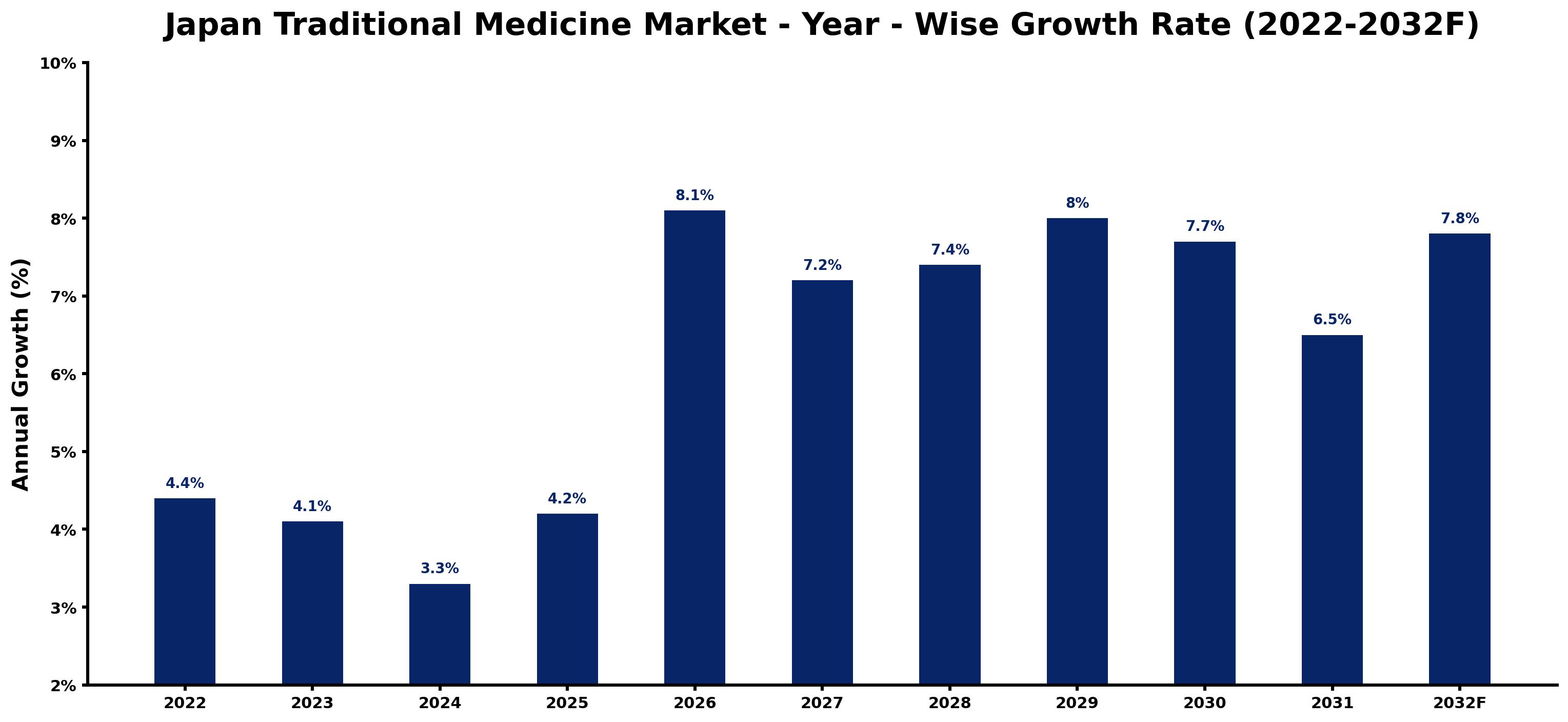
Each row of the following table gives one year's estimated growth and the event or demand shift that explains it.
| Year | Estimated Annual Growth (%) | Market Rationale |
| 2022 | 4.4 | The market experienced steady growth as consumers increasingly sought alternative health solutions. |
| 2023 | 4.1 | Competition intensified among traditional medicine providers and wellness products, slowing growth. |
| 2024 | 3.3 | Consumer preferences shifted towards more holistic approaches, affecting growth rates. |
| 2025 | 4.2 | Awareness of preventive health measures among consumers contributed to accelerated growth. |
| 2026 | 8.1 | The market is expected to peak with a surge in demand for herbal supplements and holistic treatments. |
| 2027 | 7.2 | Market saturation is projected to slightly slow growth as new product introductions become challenging. |
| 2028 | 7.4 | Health-conscious consumers are expected to drive demand for natural remedies again. |
| 2029 | 8.0 | Interest in Ayurvedic formulations will maintain market momentum. |
| 2030 | 7.7 | Regulatory scrutiny on herbal products is projected to slow growth. |
| 2031 | 6.5 | A focus on preventive health and wellness will continue to expand the market. |
| 2032 | 7.8 | Consumer acceptance of new herbal products is expected to accelerate growth. |
Note: Market size estimations and growth projections presented in this report are based on 6Wresearch's proprietary forecasting methodology, utilizing the latest available industry data, government publications, and primary research inputs.
Japan Traditional Medicine Market Synopsis
Traditional medicine in Japan encompasses a variety of practices, including herbal remedies and holistic approaches, rooted in historical methods such as Traditional Chinese Medicine and Ayurveda. The Japan Traditional Medicine Market is experiencing growth driven by rising demand from health-conscious consumers and an increasing focus on preventive health measures. With around 30 million wellness consumers and a growing interest in herbal supplements, the market is set to expand as more individuals turn to natural health solutions.
Market Dynamics Impact Analysis (2026–2032)
| Factor | Type | Impact | Primary Segment Affected |
| Aging population driving demand for preventive health solutions | Driver | High | Herbal Supplements |
| Growing interest in holistic health practices among consumers | Driver | High | Ayurvedic Formulations |
| Increased investment in herbal education and research | Opportunity | High | Traditional TCM Products |
| Expansion of health stores offering herbal products | Opportunity | Medium | Health Stores |
| Regulatory challenges affecting product approvals | Restraint | High | Standardized Extracts |
| Limited awareness of traditional medicine benefits in urban areas | Restraint | Medium | Homeopathic Remedies |
| High competition among traditional medicine providers | Challenge | High | TCM Clinics |
| Rising costs of herbal product sourcing and production | Challenge | Medium | Ayurvedic Formulations |
Evaluation of Drivers in Japan Traditional Medicine Market (2026–2032)
Below are the drivers that matter most for revenue growth, with supporting evidence.
| Drivers | Primary Segment Affected | Why It Matters (Evidence) |
| Increasing health awareness among consumers | Herbal Supplements | Approximately 30 million wellness consumers in Japan are seeking preventive health solutions. |
| Popularity of holistic health practices | Ayurvedic Formulations | 15% of health-conscious individuals are adopting holistic practices for wellness. |
| Rising demand for herbal education | Traditional TCM Products | In 2023, a programme promoting herbal medicine education was launched. |
| Growth of health stores | Health Stores | Health stores reported a 20% increase in herbal product sales over the last year. |
| Regulatory standards for quality assurance | Standardized Extracts | Standardized extracts are regulated under JIS standards, ensuring product consistency. |
Most of the extra volume comes from a growing population of wellness consumers, estimated at 30 million, who are increasingly seeking preventive health solutions. The popularity of holistic health practices is reflected in the adoption of various traditional methods. Health stores have reported a 20% increase in herbal product sales, indicating a shift in consumer preferences. Standardized extracts, regulated under JIS standards, ensure quality, building consumer trust and influencing purchasing decisions.
Evaluation of Restraints in Japan Traditional Medicine Market
The table below lists the restraints and the evidence behind each.
| Market Restraint | Primary Segment Affected | Why It Matters (Evidence) |
| Regulatory challenges in product approvals | Standardized Extracts | Strict regulations can delay the introduction of new herbal products, affecting market growth. |
| Limited consumer awareness in urban areas | Homeopathic Remedies | Urban consumers may not fully understand the benefits of homeopathic treatments, limiting demand. |
| High competition among traditional medicine providers | TCM Clinics | Intense competition can lead to price wars, impacting profitability for providers. |
| Rising costs of sourcing herbal ingredients | Ayurvedic Formulations | Increased sourcing costs can affect pricing strategies and profit margins. |
| Inconsistent quality of herbal products | Herbal Supplements | Variability in product quality can undermine consumer confidence and purchasing decisions. |
Japan Traditional Medicine Market Challenges
In Japan, the limited availability of herbal supplements results in delays for buyers seeking effective treatments, affecting their health management. Competition among over 1,000 TCM clinics leads to aggressive pricing, which can compress profit margins for producers, hindering their ability to invest in quality improvements. Many producers continue to rely on traditional production methods, causing slower output and higher costs for buyers. Adhering to JIS standards necessitates additional investment, delaying product launches and restricting market opportunities for suppliers, ultimately impacting the variety of options available to consumers.
Trends in the Japan Traditional Medicine Market
Buyers and suppliers in the Japan Traditional Medicine Market are adjusting to the following trends.
- Increase in Preventive Health Focus: The trend towards preventive health has gained momentum, with a rise in consumers seeking herbal supplements. Health stores reported a 20% rise in herbal product sales in 2023, indicating a shift in consumer behaviour towards preventive measures.
- Growth of Ayurvedic Practices: Ayurvedic formulations are becoming increasingly popular, particularly among health-conscious individuals. Approximately 15% of this demographic is now embracing Ayurvedic practices, reflecting a broader acceptance of alternative health solutions.
- Standardized Extracts Becoming Preferred: Standardized extracts are becoming the preferred choice for consumers due to their consistent potency. This trend is supported by regulations under JIS standards, ensuring quality assurance for herbal products.
- Expansion of Health Stores: Health stores are expanding their offerings of herbal products, responding to rising consumer demand. In 2023, these stores experienced a 20% increase in sales, highlighting their role in the traditional medicine market.
Investment Opportunities in the Japan Traditional Medicine Market
The opportunities below stand out in the Japan Traditional Medicine Market for new entrants and existing suppliers.
- Tokyo as a Hub for Traditional Medicine: Tokyo is establishing itself as a key hub for traditional medicine, with over 1,000 TCM clinics. This creates opportunities for partnerships with local practitioners to broaden product offerings.
- Joint Ventures for Herbal Product Development: Investing in joint ventures for herbal product development can ease market entry. Collaborating with Ayurvedic pharmacies can grant access to a growing consumer base.
- Supplying Organic Extracts: The demand for organic extracts is on the rise, as health-conscious consumers seek quality products. Suppliers can focus on wellness consumers in urban areas to satisfy this increasing need.
- Health Stores Seeking New Products: Health stores are actively searching for new herbal products to fulfil consumer demand. Engaging with these stores can pave the way for market entry.
Government Initiatives in the Japan Traditional Medicine Market
The Medical Care Act of 1948 establishes standards for hospitals and clinics, impacting traditional medicine providers by ensuring they meet specific facility and staffing requirements. This regulation helps maintain quality in healthcare services, including traditional medicine practices. Furthermore, Japan has about 8,100 hospitals as of 2023, which supports the infrastructure for traditional medicine providers.
The Next-Generation Medical Infrastructure Act, which funds research projects to support the development of traditional medicine, is administered by the Pharmaceuticals and Medical Devices Agency (PMDA). This initiative aims to improve the quality and accessibility of traditional medicine products, benefiting both producers and consumers.
Future Insight of the Japan Traditional Medicine Market
New herbal medicine education programmes will emerge, raising consumer awareness and driving demand for quality products by 2032. Government-funded research initiatives will encourage advancements in traditional medicine practices, improving efficacy. Urban areas will see an increase in homeopathic clinics, broadening access for buyers seeking alternative treatments. The herbal tablet segment is projected to grow by 25% through 2025, reflecting a shift towards convenient health solutions and influencing market trends.
Market Segmentation Analysis
Japan Traditional Medicine Market report covers a detailed analysis of the following market segments:
By Traditional Medicine – Traditional TCM Products Lead, Ayurvedic Formulations Expected to Grow Fastest
According to Saurav Kr Singh, Senior Research Analyst at 6Wresearch, Traditional TCM Products took 52% of traditional medicine revenue in 2025, more than any other category. Traditional TCM products dominate the market due to their integral role in Japan's alternative medicine practices, supported by over 1,000 TCM clinics across the country. These products are widely embraced by health-conscious consumers seeking preventive care and treatment for chronic ailments. Ayurvedic Formulations are projected to grow fastest, at a CAGR of 9.6% during 2026–2032. Ayurvedic formulations are witnessing rapid growth, driven by their increasing popularity among 15% of health-conscious individuals in Japan. This segment's expansion is bolstered by government initiatives promoting herbal medicine education. Suppliers should focus on enhancing product offerings in TCM and Ayurvedic segments to cater to the growing demand.
By Product Type – Herbal Tablets Lead, Tonic Drinks Expected to Grow Fastest
Herbal Tablets accounted for 44% of the market by product type in 2025. Herbal tablets lead the market as they are commonly consumed for daily health maintenance, appealing to a wide demographic of wellness consumers. Their established presence in health routines ensures consistent demand within the traditional medicine market. Over 2026–2032, Tonic Drinks are expected to post the fastest growth, at a CAGR of 10.6%. Tonic drinks are experiencing the fastest growth, attributed to their popularity for perceived health benefits among consumers. This segment's rise aligns with the increasing trend of wellness and preventive health practices in Japan. Buyers may benefit from exploring tonic drink options to diversify their health maintenance strategies.
By Form – Standardized Extracts Lead and Record the Fastest Growth
Standardized Extracts held 44% of the Japan Traditional Medicine Market by form in 2025. Standardized extracts are preferred for their consistency in potency, which is essential for consumers seeking reliable health solutions. Their regulation under JIS standards further assures quality, making them a trusted choice in the market. The same category are also set to grow fastest, at a CAGR of 11.0% during 2026–2032. Standardized extracts are also the fastest-growing segment, as their demand continues to rise with increasing health awareness among consumers. This dual role reinforces their market leadership and ensures sustained growth. Suppliers should prioritise the development of standardized extracts to meet the escalating consumer expectations for quality and efficacy.
By Distribution Channel – TCM Clinics Lead, Health Stores Expected to Grow Fastest
In 2025, TCM Clinics led the distribution channel split with a 46% share. TCM clinics serve as the primary distribution channel, providing essential traditional medicine services and facilitating direct access to various products. Their established reputation enhances consumer trust and loyalty in this segment. Health Stores are set to record the highest CAGR in this split, 9.3% over 2026–2032. Health stores are experiencing the fastest growth, driven by their role as the main distribution channel for herbal products. The recent 20% increase in herbal product sales highlights the shifting consumer preference towards accessible health solutions. Suppliers should strengthen partnerships with health stores to maximise product visibility and sales opportunities.
By End User Industry – Wellness Consumers Lead, Preventive Health Users Expected to Grow Fastest
The largest end user industry category in 2025 was Wellness Consumers, at 36% of revenue. Wellness consumers represent the largest segment, driven by a growing demographic interested in holistic health practices. With an estimated 30 million individuals in this category, their demand significantly influences market trends. Preventive Health Users are projected to grow fastest, at a CAGR of 10.0% during 2026–2032. Preventive health users are the fastest-growing segment, reflecting an increasing focus on prevention in healthcare, projected to grow by 10% annually through 2025. This shift underscores the importance of proactive health measures among consumers. Suppliers must tailor their offerings to meet the specific needs of preventive health users to capitalise on this growth opportunity.
Key Attractiveness of the Report
- 10 Years of Market Numbers
- Historical Data Starting from 2022 to 2025
- Base Year 2025
- Forecast Data until 2032
- Key Performance Indicators Impacting the Market
- Major Upcoming Developments and Projects
Key Highlights of the Report:
- Japan Traditional Medicine Market Outlook
- Market Size of Japan Traditional Medicine Market, 2025
- Forecast of Japan Traditional Medicine Market, 2032
- Historical Data and Forecast of Japan Traditional Medicine Revenues & Volume for the Period 2022-2032F
- Japan Traditional Medicine Market Trend Evolution
- Japan Traditional Medicine Market Drivers and Challenges
- Japan Traditional Medicine Price Trends
- Japan Traditional Medicine Porter's Five Forces
- Japan Traditional Medicine Industry Life Cycle
- Historical Data and Forecast of Japan Traditional Medicine Market Revenues & Volume By Traditional Medicine for the Period 2022-2032F
- Historical Data and Forecast of Japan Traditional Medicine Market Revenues & Volume By Ayurvedic Formulations for the Period 2022-2032F
- Historical Data and Forecast of Japan Traditional Medicine Market Revenues & Volume By Traditional TCM Products for the Period 2022-2032F
- Historical Data and Forecast of Japan Traditional Medicine Market Revenues & Volume By Herbal Supplements for the Period 2022-2032F
- Historical Data and Forecast of Japan Traditional Medicine Market Revenues & Volume By Homeopathic Remedies for the Period 2022-2032F
- Historical Data and Forecast of Japan Traditional Medicine Market Revenues & Volume By Product Type for the Period 2022-2032F
- Historical Data and Forecast of Japan Traditional Medicine Market Revenues & Volume By Herbal Tablets for the Period 2022-2032F
- Historical Data and Forecast of Japan Traditional Medicine Market Revenues & Volume By Tonic Drinks for the Period 2022-2032F
- Historical Data and Forecast of Japan Traditional Medicine Market Revenues & Volume By Capsules/Tablets for the Period 2022-2032F
- Historical Data and Forecast of Japan Traditional Medicine Market Revenues & Volume By Liquid Dilutions for the Period 2022-2032F
- Historical Data and Forecast of Japan Traditional Medicine Market Revenues & Volume By Form for the Period 2022-2032F
- Historical Data and Forecast of Japan Traditional Medicine Market Revenues & Volume By Organic Extracts for the Period 2022-2032F
- Historical Data and Forecast of Japan Traditional Medicine Market Revenues & Volume By Decoctions for the Period 2022-2032F
- Historical Data and Forecast of Japan Traditional Medicine Market Revenues & Volume By Standardized Extracts for the Period 2022-2032F
- Historical Data and Forecast of Japan Traditional Medicine Market Revenues & Volume By Potentized Extracts for the Period 2022-2032F
- Historical Data and Forecast of Japan Traditional Medicine Market Revenues & Volume By Distribution Channel for the Period 2022-2032F
- Historical Data and Forecast of Japan Traditional Medicine Market Revenues & Volume By Ayurvedic Pharmacies for the Period 2022-2032F
- Historical Data and Forecast of Japan Traditional Medicine Market Revenues & Volume By TCM Clinics for the Period 2022-2032F
- Historical Data and Forecast of Japan Traditional Medicine Market Revenues & Volume By Health Stores for the Period 2022-2032F
- Historical Data and Forecast of Japan Traditional Medicine Market Revenues & Volume By Homeopathic Clinics for the Period 2022-2032F
- Historical Data and Forecast of Japan Traditional Medicine Market Revenues & Volume By End User Industry for the Period 2022-2032F
- Historical Data and Forecast of Japan Traditional Medicine Market Revenues & Volume By Wellness Consumers for the Period 2022-2032F
- Historical Data and Forecast of Japan Traditional Medicine Market Revenues & Volume By Holistic Practitioners for the Period 2022-2032F
- Historical Data and Forecast of Japan Traditional Medicine Market Revenues & Volume By Preventive Health Users for the Period 2022-2032F
- Historical Data and Forecast of Japan Traditional Medicine Market Revenues & Volume By Homeopathic Patients for the Period 2022-2032F
- Japan Traditional Medicine Import Export Trade Statistics
- Market Opportunity Assessment By Traditional Medicine
- Market Opportunity Assessment By Product Type
- Market Opportunity Assessment By Form
- Market Opportunity Assessment By Distribution Channel
- Market Opportunity Assessment By End User Industry
- Japan Traditional Medicine Top Companies Market Share
- Japan Traditional Medicine Competitive Benchmarking By Technical and Operational Parameters
- Japan Traditional Medicine Company Profiles
- Japan Traditional Medicine Key Strategic Recommendations
Market Covered
Coverage by segment is as follows.
By Traditional Medicine
- Ayurvedic Formulations
- Traditional TCM Products
- Herbal Supplements
- Homeopathic Remedies
By Product Type
- Herbal Tablets
- Tonic Drinks
- Capsules/Tablets
- Liquid Dilutions
By Form
- Organic Extracts
- Decoctions
- Standardized Extracts
- Potentized Extracts
By Distribution Channel
- Ayurvedic Pharmacies
- TCM Clinics
- Health Stores
- Homeopathic Clinics
By End User Industry
- Wellness Consumers
- Holistic Practitioners
- Preventive Health Users
- Homeopathic Patients































