Japan Traffic Enforcement Systems Market Size & Growth Rate
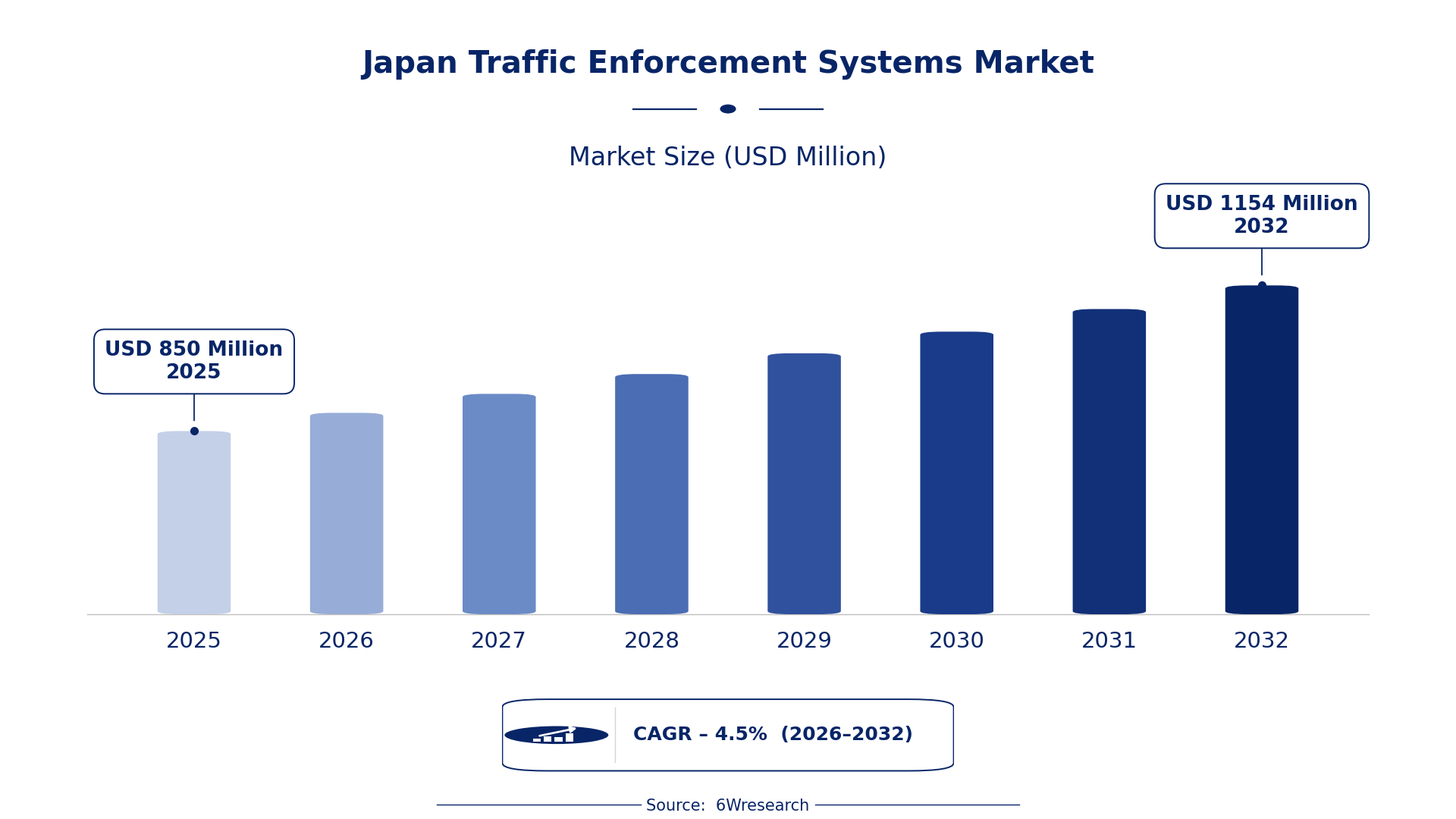
According to 6Wresearch internal database and industry insights, the Japan Traffic Enforcement Systems Market was valued at USD 850 Million in 2025 and is projected to reach USD 1,154 Million by 2032, growing at a CAGR of approximately 4.5% during 2026–2032.
Japan Traffic Enforcement Systems Market Highlights
| Report Metric | Details |
| Report Name | Japan Traffic Enforcement Systems Market (2026-2032) |
| Market Size 2025 | USD 850 Million |
| Market Size 2032 | USD 1,154 Million |
| Absolute Growth 2025–2032 | USD 304 Million |
| CAGR 2026–2032 | 4.5% |
| Peak Annual Growth | 5.1% in 2027 |
| Forecast Period | 2026–2032 |
| Historical Data | 2022–2025 |
| Base Year | 2025 |
| Leading Enforcement Systems, 2025 | Speed Cameras (43% share) |
| Leading System Type, 2025 | Fixed & Mobile (41% share) |
| Leading Detection Method, 2025 | Radar/Lidar (40% share) |
| Leading Distribution Channel, 2025 | Government Contractors (43% share) |
| Leading End User Industry, 2025 | Traffic Authorities (47% share) |
| Fastest-Growing Enforcement Systems | Red Light Cameras (6.4% CAGR) |
| Fastest-Growing System Type | Intersection Cameras (6.6% CAGR) |
| Fastest-Growing Detection Method | Infrared (6.9% CAGR) |
| Fastest-Growing Distribution Channel | Municipal Tenders (5.7% CAGR) |
| Fastest-Growing End User Industry | Smart City Agencies (6.0% CAGR) |
| Growing Sector | Traffic Authorities |
| Key End Users | Traffic Authorities, Smart City Agencies, Law Enforcement |
Japan Traffic Enforcement Systems Market Year-wise Growth Rate and Key Drivers (2022–2032)
This graph illustrates the annual growth rates of the market from 2022 to 2032, highlighting a steady upward trajectory and projected market expansion over the forecast period.
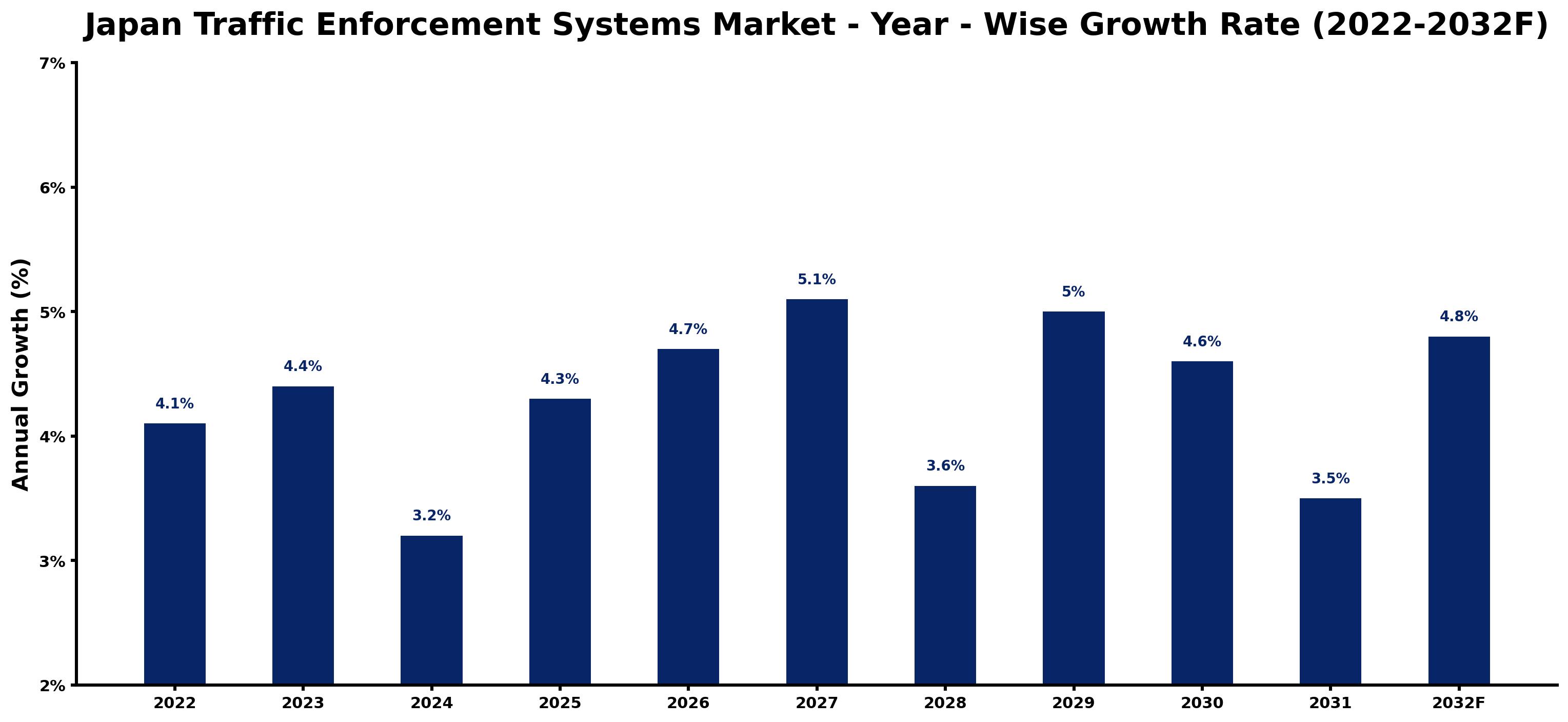
For each year, the table pairs the estimated growth rate with the leading influence on demand, showing how the drivers changed across the period.
| Year | Estimated Annual Growth (%) | Market Rationale |
| 2022 | 4.1 | The market experienced steady growth, reflecting ongoing investments in traffic management technologies. |
| 2023 | 4.4 | Demand increased due to a heightened focus on road safety and traffic regulation enforcement. |
| 2024 | 3.2 | Growth slowed as market saturation began to impact new installations and upgrades. |
| 2025 | 4.3 | A resurgence in demand occurred as municipalities sought to improve enforcement capabilities. |
| 2026 | 4.7 | The market is expected to continue growing, driven by technological advancements in traffic monitoring. |
| 2027 | 5.1 | Peak growth will be achieved as urban areas expand their traffic enforcement systems. |
| 2028 | 3.6 | Growth is projected to slow again as budget constraints affect new procurement initiatives. |
| 2029 | 5.0 | Demand is expected to surge due to increased investments in smart city infrastructure and traffic management. |
| 2030 | 4.6 | A slight slowdown is anticipated as existing systems reach operational maturity in many regions. |
| 2031 | 3.5 | The market will continue to grow, albeit at a slower pace, as authorities focus on system upgrades. |
| 2032 | 4.8 | Demand is projected to increase again as new technologies and urban planning initiatives gain traction. |
Note: Market size estimations and growth projections presented in this report are based on 6Wresearch's proprietary forecasting methodology, utilizing the latest available industry data, government publications, and primary research inputs.
Japan Traffic Enforcement Systems Market Synopsis
Traffic Enforcement Systems in Japan encompass speed cameras, red light cameras, and automatic number plate recognition systems, which play a crucial role in monitoring traffic violations and improving road safety. The Japan Traffic Enforcement Systems Market is expanding due to substantial investments from government agencies and municipalities, underscored by the allocation of ¥5 billion for advanced traffic management initiatives. The emphasis on reducing traffic accidents is driving demand for these technologies, as illustrated by a reported 15% decrease in accidents in areas equipped with enforcement systems.
Market Dynamics Impact Analysis (2026–2032)
| Factor | Type | Impact | Primary Segment Affected |
| Increased government investment in smart city initiatives | Driver | High | Traffic Authorities |
| Growing urbanisation and traffic congestion | Driver | High | Traffic Authorities |
| Expansion of smart city projects | Opportunity | High | Smart City Agencies |
| Rising need for advanced traffic management solutions | Opportunity | Medium | Traffic Authorities |
| Budget constraints limiting procurement capabilities | Restraint | High | Traffic Authorities |
| Market saturation affecting new installations | Restraint | Medium | Traffic Authorities |
| Technological integration challenges for existing systems | Challenge | High | System Integrators |
| Competition from alternative traffic management technologies | Challenge | Medium | Traffic Authorities |
Evaluation of Drivers in Japan Traffic Enforcement Systems Market (2026–2032)
The factors lifting demand, and the evidence behind each, are summarised below.
| Drivers | Primary Segment Affected | Why It Matters (Evidence) |
| Government funding for traffic enforcement systems | Traffic Authorities | In 2023, Japan allocated ¥5 billion for smart city initiatives, prompting increased procurement of enforcement technologies. |
| Rising urban traffic congestion | Traffic Authorities | Tokyo, with the highest concentration of traffic enforcement systems, faces severe congestion, driving demand for monitoring solutions. |
| Implementation of advanced traffic management strategies | Smart City Agencies | The ongoing push for smart city initiatives is increasing investments in enforcement technologies. |
| Focus on reducing traffic accidents | Traffic Authorities | Traffic authorities report a 15% decrease in accidents in areas with enforcement systems, encouraging further adoption. |
| Technological advancements in enforcement systems | System Integrators | The integration of new technologies in urban areas is increasing demand for advanced monitoring solutions. |
Several shifts outside the market lift sales. In urban areas like Tokyo, traffic authorities report a 15% decrease in accidents in areas with enforcement systems, motivating further investments in these technologies. The integration of new technologies is prompting system integrators to expand their offerings, improving the overall effectiveness of traffic management.
Evaluation of Restraints in Japan Traffic Enforcement Systems Market
The main factors holding the market back are set out below.
| Market Restraint | Primary Segment Affected | Why It Matters (Evidence) |
| Budget constraints limiting procurement capabilities | Traffic Authorities | Traffic authorities face budget limitations, affecting their ability to invest in new enforcement technologies. |
| Market saturation affecting new installations | Traffic Authorities | As many cities have already installed systems, the market is experiencing saturation, slowing growth. |
| Integration challenges with existing systems | System Integrators | Existing systems often face integration issues with new technologies, complicating upgrades and expansions. |
| Competition from alternative traffic management technologies | Traffic Authorities | Emerging technologies may divert funds from traditional enforcement systems, impacting overall market growth. |
| Regulatory hurdles for new installations | Traffic Authorities | Stringent regulations can delay the approval process for new traffic enforcement systems. |
Japan Traffic Enforcement Systems Market Challenges
Intense competition among local government agencies leads to lower prices for traffic enforcement systems, making it challenging for suppliers to sustain margins. This scenario arises from numerous municipalities seeking cost-effective solutions, which can result in diminished investment in modern technologies. Suppliers may encounter cost increases of up to 20% as they strive to provide differentiated products. Many municipalities grapple with outdated infrastructure, hindering the adoption of new technologies and potentially delaying implementation timelines for buyers by several months. Supply chain disruptions can complicate sourcing components, affecting project completion for municipalities.
Trends in the Japan Traffic Enforcement Systems Market
The trends below show where the Japan Traffic Enforcement Systems Market is heading.
- Smart City Initiatives Driving Technology Adoption: The ongoing push for smart city initiatives is increasing investments in traffic enforcement technologies, with ¥5 billion allocated for advanced traffic management solutions. This funding is prompting municipalities to adopt systems like ANPR and speed cameras.
- Transition to Advanced Enforcement Technologies: A shift towards advanced traffic enforcement systems, such as ANPR and radar technologies, is improving monitoring capabilities. Authorities are increasingly adopting these systems to improve road safety.
- Emphasis on Data-Driven Traffic Management: The focus on data analytics in traffic management is changing how enforcement systems are deployed. The integration of software for data analysis is becoming standard in new installations across Japan.
- Growth in Urban Traffic Surveillance: With urbanisation, there is a growing trend towards improving traffic surveillance through advanced systems. In Tokyo, the concentration of over 10,000 traffic cameras highlights this shift.
Investment Opportunities in the Japan Traffic Enforcement Systems Market
The following areas offer the clearest openings for investors and suppliers in the Japan Traffic Enforcement Systems Market.
- Advanced Traffic Enforcement Systems for Smart Cities: With the allocation of ¥5 billion for smart city initiatives, there is a strong opportunity to supply advanced traffic enforcement systems. Municipalities are actively seeking solutions to improve urban traffic management.
- Investment in ANPR Technology: The increasing use of ANPR systems presents an opportunity to supply advanced identification technologies. Traffic authorities are looking to improve vehicle tracking capabilities in urban areas.
- Collaborations with Government Contractors: Forming partnerships with government contractors can facilitate entry into the traffic enforcement market. This approach allows for collaboration on municipal tenders for enforcement systems.
- Expansion of Intersection Cameras: The rising demand for intersection cameras offers a timely investment opportunity. Traffic authorities are prioritising these systems to improve monitoring at critical junctions.
Government Initiatives in the Japan Traffic Enforcement Systems Market
The framework governing traffic enforcement systems includes the Industrial Standardization Act (1949, amended 2019), which sets standards for traffic enforcement technologies. Additionally, the Building Energy Efficiency Act (2015, amended 2022) mandates energy efficiency in new installations, influencing the adoption of sustainable technologies in traffic enforcement. These laws ensure that traffic enforcement systems meet specific standards, promoting the use of advanced technologies in the field.
In 2023, Japan allocated ¥5 billion for smart city initiatives, overseen by the Ministry of Land, Infrastructure, Transport and Tourism. This funding supports the implementation of advanced traffic management systems, benefiting traffic authorities and municipalities by facilitating the adoption of new technologies.
Future Insight of the Japan Traffic Enforcement Systems Market
By 2032, buyers will experience improved traffic management through the integration of advanced enforcement systems, driven by initiatives like the Smart City Strategy 2023. The average response time for traffic violations captured by cameras is expected to decrease, leading to quicker enforcement actions. Suppliers will need to adopt advanced imaging technologies to meet standards such as JIS Z 9101. The commitment to a 46% reduction in greenhouse-gas emissions by 2030 will further accelerate the adoption of sustainable traffic enforcement solutions.
Market Segmentation Analysis
Japan Traffic Enforcement Systems Market report covers a detailed analysis of the following market segments:
By Enforcement Systems – Speed Cameras Lead, Red Light Cameras Expected to Grow Fastest
According to Saurav Kr Singh, Senior Research Analyst at 6Wresearch, Speed Cameras accounted for 43% of the market by enforcement systems in 2025. Speed cameras hold the largest share due to their widespread use in monitoring vehicle speeds across Japan. With over 10,000 installations, they are integral to enhancing road safety and compliance with traffic laws. The quickest growth will come from Red Light Cameras, forecast to expand at a CAGR of 6.4% between 2026 and 2032. Red light cameras are experiencing rapid growth as municipalities increasingly install them at intersections to enforce traffic signals. The introduction of a new traffic enforcement programme by the Tokyo Metropolitan Government in 2023 exemplifies this trend, aiming to reduce violations further. This indicates that suppliers should focus on developing advanced features for red light cameras to meet the rising demand from municipalities.
By System Type – Fixed & Mobile Leads, Intersection Cameras Expected to Grow Fastest
In 2025, Fixed & Mobile led the system type split with a 41% share. Fixed and mobile systems dominate the market as they cater to diverse enforcement needs across various locations. Their versatility allows for effective monitoring in both stationary and dynamic traffic conditions, making them essential for traffic authorities. Over 2026–2032, Intersection Cameras are expected to post the fastest growth, at a CAGR of 6.6%. Intersection cameras are rapidly gaining traction due to their critical role in monitoring traffic at intersections, where many violations occur. The push for smarter traffic management systems in urban areas is driving this growth. Suppliers must ensure their products are adaptable for both fixed and mobile applications to capture a broader market.
By Detection Method – Radar/Lidar Leads, Infrared Expected to Grow Fastest
Radar/Lidar took 40% of detection method revenue in 2025, more than any other category. Radar and lidar are the primary detection methods for speed enforcement, providing accurate and reliable data for monitoring traffic. Their established technology and effectiveness across various conditions solidify their leading position in the market. Infrared is projected to grow fastest, at a CAGR of 6.9% during 2026–2032. Infrared detection methods are gaining popularity in specific scenarios, particularly for night-time enforcement applications. The increasing interest is driven by authorities' efforts to enhance detection capabilities in diverse conditions. Suppliers should prioritise advancements in infrared technologies to meet the unique requirements of traffic enforcement in varied environments.
By Distribution Channel – Government Contractors Lead, Municipal Tenders Expected to Grow Fastest
The largest distribution channel category in 2025 was Government Contractors, at 43% of revenue. Government contractors dominate the distribution channel by supplying systems directly to government agencies responsible for traffic enforcement. Their established relationships and understanding of regulatory requirements facilitate a smoother procurement process. Municipal Tenders are set to record the highest CAGR in this split, 5.7% over 2026–2032. Municipal tenders are rapidly emerging as the fastest-growing distribution method, allowing local governments to procure enforcement systems tailored to their specific needs. This trend reflects municipalities' increasing focus on improving local traffic management. Suppliers should actively engage with municipal governments to align their offerings with local enforcement needs.
By End User Industry – Traffic Authorities Lead, Smart City Agencies Expected to Grow Fastest
Traffic Authorities held 47% of the Japan Traffic Enforcement Systems Market by end user industry in 2025. Traffic authorities are the primary users of enforcement systems, utilising them to monitor compliance and enhance road safety. Their direct involvement in traffic management establishes them as the largest segment in the market. The quickest growth will come from Smart City Agencies, forecast to expand at a CAGR of 6.0% between 2026 and 2032. Smart city agencies are swiftly adopting enforcement systems as part of comprehensive urban traffic management strategies. The emphasis on smart city initiatives is driving this growth as cities aim to integrate technology into their infrastructure. Suppliers must tailor their products to meet the specific requirements of smart city initiatives to capture this expanding segment.
Key Attractiveness of the Report
- 10 Years of Market Numbers
- Historical Data Starting from 2022 to 2025
- Base Year 2025
- Forecast Data until 2032
- Key Performance Indicators Impacting the Market
- Major Upcoming Developments and Projects
Key Highlights of the Report:
- Japan Traffic Enforcement Systems Market Outlook
- Market Size of Japan Traffic Enforcement Systems Market, 2025
- Forecast of Japan Traffic Enforcement Systems Market, 2032
- Historical Data and Forecast of Japan Traffic Enforcement Systems Revenues & Volume for the Period 2022-2032F
- Japan Traffic Enforcement Systems Market Trend Evolution
- Japan Traffic Enforcement Systems Market Drivers and Challenges
- Japan Traffic Enforcement Systems Price Trends
- Japan Traffic Enforcement Systems Porter's Five Forces
- Japan Traffic Enforcement Systems Industry Life Cycle
- Historical Data and Forecast of Japan Traffic Enforcement Systems Market Revenues & Volume By Enforcement Systems for the Period 2022-2032F
- Historical Data and Forecast of Japan Traffic Enforcement Systems Market Revenues & Volume By Speed Cameras for the Period 2022-2032F
- Historical Data and Forecast of Japan Traffic Enforcement Systems Market Revenues & Volume By Red Light Cameras for the Period 2022-2032F
- Historical Data and Forecast of Japan Traffic Enforcement Systems Market Revenues & Volume By ANPR Systems for the Period 2022-2032F
- Historical Data and Forecast of Japan Traffic Enforcement Systems Market Revenues & Volume By Speed Enforcement Barriers for the Period 2022-2032F
- Historical Data and Forecast of Japan Traffic Enforcement Systems Market Revenues & Volume By System Type for the Period 2022-2032F
- Historical Data and Forecast of Japan Traffic Enforcement Systems Market Revenues & Volume By Fixed & Mobile for the Period 2022-2032F
- Historical Data and Forecast of Japan Traffic Enforcement Systems Market Revenues & Volume By Intersection Cameras for the Period 2022-2032F
- Historical Data and Forecast of Japan Traffic Enforcement Systems Market Revenues & Volume By License Plate Readers for the Period 2022-2032F
- Historical Data and Forecast of Japan Traffic Enforcement Systems Market Revenues & Volume By Entry Barriers for the Period 2022-2032F
- Historical Data and Forecast of Japan Traffic Enforcement Systems Market Revenues & Volume By Detection Method for the Period 2022-2032F
- Historical Data and Forecast of Japan Traffic Enforcement Systems Market Revenues & Volume By Radar/Lidar for the Period 2022-2032F
- Historical Data and Forecast of Japan Traffic Enforcement Systems Market Revenues & Volume By Infrared for the Period 2022-2032F
- Historical Data and Forecast of Japan Traffic Enforcement Systems Market Revenues & Volume By OCR & Infrared for the Period 2022-2032F
- Historical Data and Forecast of Japan Traffic Enforcement Systems Market Revenues & Volume By Laser Detection for the Period 2022-2032F
- Historical Data and Forecast of Japan Traffic Enforcement Systems Market Revenues & Volume By Distribution Channel for the Period 2022-2032F
- Historical Data and Forecast of Japan Traffic Enforcement Systems Market Revenues & Volume By Government Contractors for the Period 2022-2032F
- Historical Data and Forecast of Japan Traffic Enforcement Systems Market Revenues & Volume By Municipal Tenders for the Period 2022-2032F
- Historical Data and Forecast of Japan Traffic Enforcement Systems Market Revenues & Volume By System Integrators for the Period 2022-2032F
- Historical Data and Forecast of Japan Traffic Enforcement Systems Market Revenues & Volume By Toll System Suppliers for the Period 2022-2032F
- Historical Data and Forecast of Japan Traffic Enforcement Systems Market Revenues & Volume By End User Industry for the Period 2022-2032F
- Historical Data and Forecast of Japan Traffic Enforcement Systems Market Revenues & Volume By Traffic Authorities for the Period 2022-2032F
- Historical Data and Forecast of Japan Traffic Enforcement Systems Market Revenues & Volume By Smart City Agencies for the Period 2022-2032F
- Historical Data and Forecast of Japan Traffic Enforcement Systems Market Revenues & Volume By Law Enforcement for the Period 2022-2032F
- Historical Data and Forecast of Japan Traffic Enforcement Systems Market Revenues & Volume By Highway Operators for the Period 2022-2032F
- Japan Traffic Enforcement Systems Import Export Trade Statistics
- Market Opportunity Assessment By Enforcement Systems
- Market Opportunity Assessment By System Type
- Market Opportunity Assessment By Detection Method
- Market Opportunity Assessment By Distribution Channel
- Market Opportunity Assessment By End User Industry
- Japan Traffic Enforcement Systems Top Companies Market Share
- Japan Traffic Enforcement Systems Competitive Benchmarking By Technical and Operational Parameters
- Japan Traffic Enforcement Systems Company Profiles
- Japan Traffic Enforcement Systems Key Strategic Recommendations
Market Covered
The following segment groups are covered in the report.
By Enforcement Systems
- Speed Cameras
- Red Light Cameras
- ANPR Systems
- Speed Enforcement Barriers
By System Type
- Fixed & Mobile
- Intersection Cameras
- License Plate Readers
- Entry Barriers
By Detection Method
- Radar/Lidar
- Infrared
- OCR & Infrared
- Laser Detection
By Distribution Channel
- Government Contractors
- Municipal Tenders
- System Integrators
- Toll System Suppliers
By End User Industry
- Traffic Authorities
- Smart City Agencies
- Law Enforcement
- Highway Operators































