Japan Train Automation Systems Market Size & Growth Rate
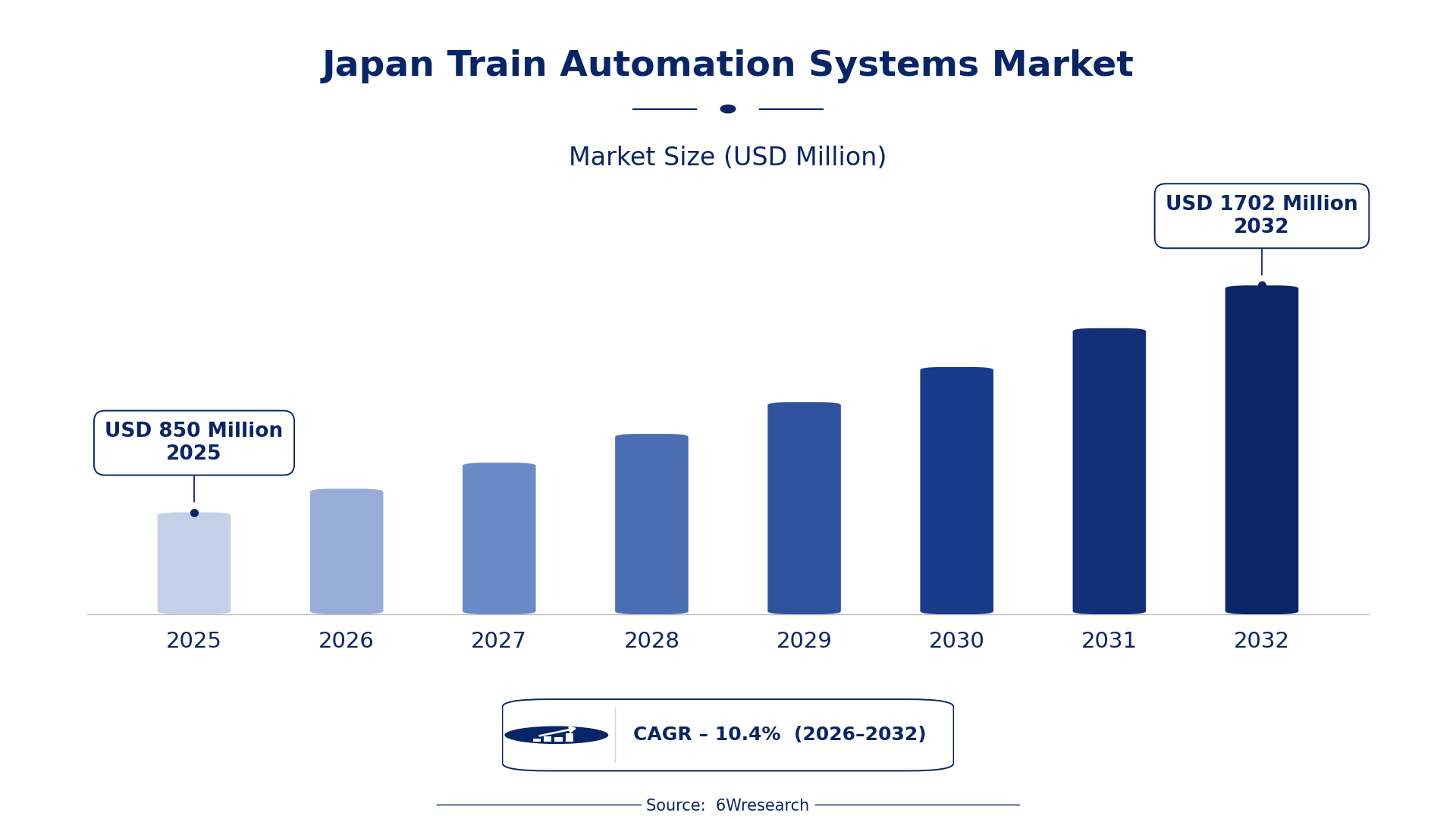
According to 6Wresearch internal database and industry insights, the Japan Train Automation Systems Market was valued at USD 850 Million in 2025 and is projected to reach USD 1,702 Million by 2032, growing at a CAGR of approximately 10.4% during 2026–2032.
Japan Train Automation Systems Market Highlights
| Report Metric | Details |
| Report Name | Japan Train Automation Systems Market (2026-2032) |
| Market Size 2025 | USD 850 Million |
| Market Size 2032 | USD 1,702 Million |
| Absolute Growth 2025–2032 | USD 852 Million |
| CAGR 2026–2032 | 10.4% |
| Peak Annual Growth | 11.2% in 2028 |
| Forecast Period | 2026–2032 |
| Historical Data | 2022–2025 |
| Base Year | 2025 |
| Leading Automation Type, 2025 | CBTC (Communication-Based Train Control) (42% share) |
| Leading Technology Used, 2025 | Wireless Signals (48% share) |
| Leading Application Type, 2025 | Urban Metros (42% share) |
| Leading End User, 2025 | Railway Authorities (42% share) |
| Fastest-Growing Automation Type | ATO (Automatic Train Operation) (15.1% CAGR) |
| Fastest-Growing Technology Used | Sensors + AI (15.8% CAGR) |
| Fastest-Growing Application Type | Intercity Trains (13.8% CAGR) |
| Fastest-Growing End User | National Rail Networks (13.2% CAGR) |
| Growing Sector | Rail Automation |
| Key End Users | Railway Authorities, National Rail Networks, Urban Metro Operators |
Japan Train Automation Systems Market Year-wise Growth Rate and Key Drivers (2022–2032)
This graph illustrates the annual growth rates of the market from 2022 to 2032, highlighting a steady upward trajectory and projected market expansion over the forecast period.
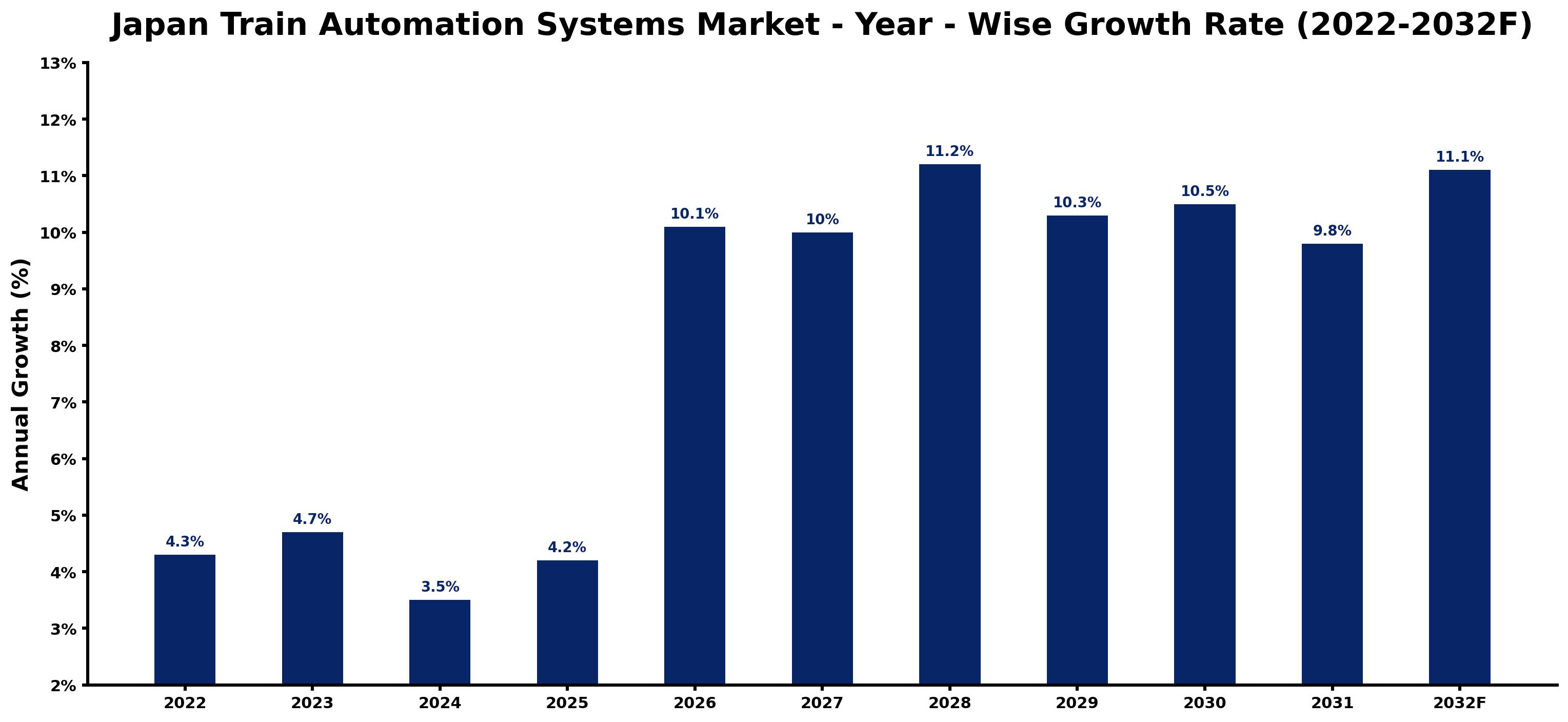
Annual growth estimates for each year appear below with the principal reason behind them, explaining the shifts that set the pace of the market.
| Year | Estimated Annual Growth (%) | Market Rationale |
| 2022 | 4.3 | The market saw steady growth due to ongoing investments in rail infrastructure. |
| 2023 | 4.7 | Demand increased as Japan Railways invested heavily in modernization efforts. |
| 2024 | 3.5 | Growth slowed slightly as projects faced delays in implementation timelines. |
| 2025 | 4.2 | Investment levels rose again, boosting demand for automation technologies. |
| 2026 | 10.1 | The market is expected to accelerate as new technologies gain traction. |
| 2027 | 10.0 | Growth is projected to moderate slightly as market conditions stabilise. |
| 2028 | 11.2 | Demand is anticipated to peak as fully autonomous systems become mainstream. |
| 2029 | 10.3 | A slight slowdown is expected as the market adjusts to rapid advancements. |
| 2030 | 10.5 | Growth is projected to rise again with new infrastructure initiatives. |
| 2031 | 9.8 | The market is expected to stabilise as technology adoption matures. |
| 2032 | 11.1 | Demand is forecasted to rise as sustainability efforts intensify. |
Note: Market size estimations and growth projections presented in this report are based on 6Wresearch's proprietary forecasting methodology, utilizing the latest available industry data, government publications, and primary research inputs.
Japan Train Automation Systems Market Synopsis
Train Automation Systems improve safety and efficiency in train operations through advanced communication technologies, sensors, and AI. These systems are vital for optimising scheduling and enabling fully automated operations. The Japan Train Automation Systems Market is expanding due to significant investments in infrastructure upgrades, driven by the need for improved safety and operational efficiency. With over 27,000 kilometers of railway lines operational, demand for automation is bolstered by ongoing technological advancements and strategic initiatives.
Market Dynamics Impact Analysis (2026–2032)
| Factor | Type | Impact | Primary Segment Affected |
| Growing investments in railway infrastructure and modernization efforts | Driver | High | CBTC (Communication-Based Train Control) |
| Increasing adoption of AI and sensor technologies for operational efficiency | Driver | High | Sensors + AI |
| Expansion of urban metro systems requiring advanced automation solutions | Opportunity | High | Urban Metros |
| Rising demand for intercity travel efficiency driving automation needs | Opportunity | Medium | Intercity Trains |
| Challenges in integrating new technologies with existing systems | Restraint | High | Fully Autonomous Train Systems |
| High costs associated with upgrading legacy systems to modern standards | Restraint | Medium | Driver Assistance Systems |
| Shortage of skilled workforce to implement advanced automation solutions | Challenge | High | National Rail Networks |
| Regulatory hurdles delaying the deployment of new technologies | Challenge | Medium | Railway Authorities |
Evaluation of Drivers in Japan Train Automation Systems Market (2026–2032)
Key forces behind demand, with the segment each one moves most, are listed below.
| Drivers | Primary Segment Affected | Why It Matters (Evidence) |
| Increased investment in rail infrastructure upgrades | CBTC (Communication-Based Train Control) | Japan Railways invested ¥1 trillion in 2023, improving train management capabilities. |
| Growing integration of AI in train systems | Sensors + AI | The AI Strategy 2023 promotes the use of AI, improving operational efficiency. |
| Expansion of urban metro systems in major cities | Urban Metros | Tokyo's population of approximately 14 million drives demand for advanced automation. |
| Rising intercity travel demand necessitating automation | Intercity Trains | The integration of ATO systems in the Shinkansen network improves travel efficiency. |
| Government initiatives promoting safety standards | Driver Assistance Systems | The Green Growth Strategy aims to reduce accidents by 50% by 2030. |
What keeps demand rising is the investment in rail infrastructure upgrades, with considerable commitments to improve operational capabilities. Urban population growth drives the need for efficiency improvements in rail operations, increasing demand for automation. The adoption of ATO systems in long-distance travel improves service delivery and operational reliability.
Evaluation of Restraints in Japan Train Automation Systems Market
Below are the constraints most often cited by buyers and suppliers, with the segment each affects.
| Market Restraint | Primary Segment Affected | Why It Matters (Evidence) |
| Integration challenges with existing rail systems | Fully Autonomous Train Systems | Legacy systems complicate the implementation of new automation technologies. |
| High costs of upgrading outdated infrastructure | Driver Assistance Systems | Upgrading legacy rail systems requires substantial investment. |
| Limited availability of skilled workforce for automation | National Rail Networks | The shortage of qualified personnel affects technology deployment. |
| Regulatory delays in technology approvals | Railway Authorities | Compliance with safety standards can slow down implementation timelines. |
| Resistance to change from traditional rail operators | Intercity Trains | Established operators may hesitate to adopt new technologies. |
Japan Train Automation Systems Market Challenges
Japan's rail industry faces high operational costs as the national minimum wage rose to JPY 1,055 per hour in October 2024, straining budgets for buyers. Delays in technology integration occur because outdated systems hinder the adoption of advanced automation, costing rail operators valuable time and resources. Supply chain disruptions arise from reliance on specific components, leading to project delays that affect safety upgrades for producers. Compliance with JIS standards complicates operations, requiring extensive documentation that slows down innovation for the entire sector.
Trends in the Japan Train Automation Systems Market
The trends below show where the Japan Train Automation Systems Market is heading.
- Smart Railway Initiative Promoting IoT Integration: The Smart Railway Initiative is promoting IoT integration in rail systems, with a ¥200 billion fund announced in 2023. This initiative aims to improve data sharing and operational efficiency across the network.
- Shift Towards Fully Autonomous Train Operations: The adoption of fully autonomous trains is projected to increase by 15% by 2025, driven by advancements in automation technology and safety standards.
- Increased Use of AI in Train Safety Monitoring: The AI Strategy 2023 promotes the use of AI for safety monitoring in trains, improving operational reliability and reducing human error.
- Expansion of Urban Metro Automation: Urban metros are increasingly adopting automation technologies, with CBTC systems widely implemented in Tokyo and Osaka, improving efficiency and safety.
Investment Opportunities in the Japan Train Automation Systems Market
Investors looking at the Japan Train Automation Systems Market should consider the following areas.
- Investment in Urban Metro Automation: With urban metro systems expanding, there is a strong need for automation solutions. The Tokyo Metro, one of the most advanced globally, presents investment opportunities for automation technologies.
- Demand for Intercity Train Efficiency: As intercity travel demand rises, automation technologies are needed to improve efficiency. National Rail Networks are key buyers for these systems, creating opportunities for suppliers.
- Partnerships for Advanced Automation Solutions: Now is the time for joint ventures with local firms to develop advanced automation technologies, particularly in urban areas where demand is surging.
- Funding for Rail Innovation Initiatives: The ¥200 billion fund for rail innovation announced in 2023 opens avenues for investment in automation technologies, benefiting various rail authorities.
Government Initiatives in the Japan Train Automation Systems Market
The New Robot Strategy, established in 2015, aims to expand the use of robotics in various sectors, including rail automation. This policy encourages investment in advanced technologies, directly impacting producers and improving operational efficiency across the rail industry. The AI Promotion Act of 2025 further supports the development of AI technologies in rail systems, establishing a framework for research and implementation.
The Ministry of Land, Infrastructure, Transport and Tourism oversees rail regulations and approves funding for innovative projects. It has allocated resources to support the integration of automation technologies, ensuring compliance with safety standards. This agency plays a key role in advancing the adoption of new systems, benefiting both producers and railway authorities.
Future Insight of the Japan Train Automation Systems Market
Technological advancements in train automation will reshape demand by 2032, driven by the Smart Railway Initiative promoting IoT integration. Investment in infrastructure upgrades, including a ¥150 trillion decarbonisation investment over 10 years, will strengthen the rail network's capabilities. The projected 15% increase in fully autonomous train adoption by 2025 will transform service delivery. Enhanced data management through AI will enable real-time responsiveness, benefiting both buyers and suppliers.
Market Segmentation Analysis
Japan Train Automation Systems Market report covers a detailed analysis of the following market segments:
By Automation Type – CBTC (Communication-Based Train Control) Leads, ATO (Automatic Train Operation) Expected to Grow Fastest
According to Saurav Kr Singh, Senior Research Analyst at 6Wresearch, CBTC (Communication-Based Train Control) held 42% of the Japan Train Automation Systems Market by automation type in 2025. CBTC systems are essential for real-time train management, allowing precise control and scheduling across Japan's railways. Their widespread implementation in urban areas such as Tokyo and Osaka solidifies their leading market position. Over 2026–2032, ATO (Automatic Train Operation) is expected to post the fastest growth, at a CAGR of 15.1%. The ATO segment is rapidly expanding due to its capacity to improve operational efficiency by automating train driving. With over 1,000 automated train operations in urban areas, this trend is set to accelerate as demand increases. Suppliers should prioritise the development of ATO technologies to meet the growing demand for efficient train operations.
By Technology Used – Wireless Signals Lead, Sensors + AI Expected to Grow Fastest
In 2025, Wireless Signals led the technology used split with a 48% share. Wireless signals are crucial for communication between trains and control centres, ensuring seamless operations across Japan's extensive railway network. Their importance is highlighted by the robust infrastructure supporting over 27,000 kilometres of railway lines. The quickest growth will come from Sensors + AI, forecast to expand at a CAGR of 15.8% between 2026 and 2032. The integration of sensors and AI is driving advancements in data collection and analysis, which are vital for optimising train performance. This technology is becoming increasingly important as the rail industry focuses on improving safety and operational efficiency. Buyers will benefit from investing in sensor technologies to enhance operational insights and safety measures.
By Application Type – Urban Metros Lead, Intercity Trains Expected to Grow Fastest
With 42% of application type revenue in 2025, Urban Metros was the largest category. Urban metros represent the primary application area for automation, with systems designed to boost efficiency in densely populated cities like Tokyo. The high demand for reliable urban transport sustains this segment's leading market share. Intercity Trains are set to record the highest CAGR in this split, 13.8% over 2026–2032. Intercity trains are witnessing rapid growth as automation enhances long-distance travel efficiency, responding to the needs of a growing population. This segment is expected to expand further with ongoing investments in infrastructure. Suppliers should focus on developing solutions tailored for intercity applications to capitalise on this expanding market.
By End User – Railway Authorities Lead, National Rail Networks Expected to Grow Fastest
The largest end user category in 2025 was Railway Authorities, at 42% of revenue. Railway authorities are pivotal in implementing automation systems, driving investments and regulatory support for advancements in safety and efficiency. Their significant role in governing rail operations reinforces their leading position in the market. National Rail Networks are projected to grow fastest, at a CAGR of 13.2% during 2026–2032. National rail networks are swiftly adopting automation technologies to improve service delivery and operational efficiency, reflecting a trend towards modernisation. This growth is bolstered by ongoing government initiatives and funding for rail innovation. Suppliers must engage with national rail networks to align their offerings with the evolving demands of modern rail operations.
Key Attractiveness of the Report
- 10 Years of Market Numbers
- Historical Data Starting from 2022 to 2025
- Base Year 2025
- Forecast Data until 2032
- Key Performance Indicators Impacting the Market
- Major Upcoming Developments and Projects
Key Highlights of the Report:
- Japan Train Automation Systems Market Outlook
- Market Size of Japan Train Automation Systems Market, 2025
- Forecast of Japan Train Automation Systems Market, 2032
- Historical Data and Forecast of Japan Train Automation Systems Revenues & Volume for the Period 2022-2032F
- Japan Train Automation Systems Market Trend Evolution
- Japan Train Automation Systems Market Drivers and Challenges
- Japan Train Automation Systems Price Trends
- Japan Train Automation Systems Porter's Five Forces
- Japan Train Automation Systems Industry Life Cycle
- Historical Data and Forecast of Japan Train Automation Systems Market Revenues & Volume By Automation Type for the Period 2022-2032F
- Historical Data and Forecast of Japan Train Automation Systems Market Revenues & Volume By CBTC (Communication-Based Train Control) for the Period 2022-2032F
- Historical Data and Forecast of Japan Train Automation Systems Market Revenues & Volume By ATO (Automatic Train Operation) for the Period 2022-2032F
- Historical Data and Forecast of Japan Train Automation Systems Market Revenues & Volume By Driver Assistance Systems for the Period 2022-2032F
- Historical Data and Forecast of Japan Train Automation Systems Market Revenues & Volume By Fully Autonomous Train Systems for the Period 2022-2032F
- Historical Data and Forecast of Japan Train Automation Systems Market Revenues & Volume By Technology Used for the Period 2022-2032F
- Historical Data and Forecast of Japan Train Automation Systems Market Revenues & Volume By Wireless Signals for the Period 2022-2032F
- Historical Data and Forecast of Japan Train Automation Systems Market Revenues & Volume By Sensors + AI for the Period 2022-2032F
- Historical Data and Forecast of Japan Train Automation Systems Market Revenues & Volume By Cameras + Algorithms for the Period 2022-2032F
- Historical Data and Forecast of Japan Train Automation Systems Market Revenues & Volume By IoT + Cloud for the Period 2022-2032F
- Historical Data and Forecast of Japan Train Automation Systems Market Revenues & Volume By Application Type for the Period 2022-2032F
- Historical Data and Forecast of Japan Train Automation Systems Market Revenues & Volume By Urban Metros for the Period 2022-2032F
- Historical Data and Forecast of Japan Train Automation Systems Market Revenues & Volume By Intercity Trains for the Period 2022-2032F
- Historical Data and Forecast of Japan Train Automation Systems Market Revenues & Volume By Regional Rail for the Period 2022-2032F
- Historical Data and Forecast of Japan Train Automation Systems Market Revenues & Volume By Industrial Rail for the Period 2022-2032F
- Historical Data and Forecast of Japan Train Automation Systems Market Revenues & Volume By End User for the Period 2022-2032F
- Historical Data and Forecast of Japan Train Automation Systems Market Revenues & Volume By Railway Authorities for the Period 2022-2032F
- Historical Data and Forecast of Japan Train Automation Systems Market Revenues & Volume By National Rail Networks for the Period 2022-2032F
- Historical Data and Forecast of Japan Train Automation Systems Market Revenues & Volume By OEMs for the Period 2022-2032F
- Historical Data and Forecast of Japan Train Automation Systems Market Revenues & Volume By Mining Companies for the Period 2022-2032F
- Japan Train Automation Systems Import Export Trade Statistics
- Market Opportunity Assessment By Automation Type
- Market Opportunity Assessment By Technology Used
- Market Opportunity Assessment By Application Type
- Market Opportunity Assessment By End User
- Japan Train Automation Systems Top Companies Market Share
- Japan Train Automation Systems Competitive Benchmarking By Technical and Operational Parameters
- Japan Train Automation Systems Company Profiles
- Japan Train Automation Systems Key Strategic Recommendations
Market Covered
Segments analysed in this report are listed below.
By Automation Type
- CBTC (Communication-Based Train Control)
- ATO (Automatic Train Operation)
- Driver Assistance Systems
- Fully Autonomous Train Systems
By Technology Used
- Wireless Signals
- Sensors + AI
- Cameras + Algorithms
- IoT + Cloud
By Application Type
- Urban Metros
- Intercity Trains
- Regional Rail
- Industrial Rail
By End User
- Railway Authorities
- National Rail Networks
- OEMs
- Mining Companies































