Japan Train Control Systems Market Size & Growth Rate
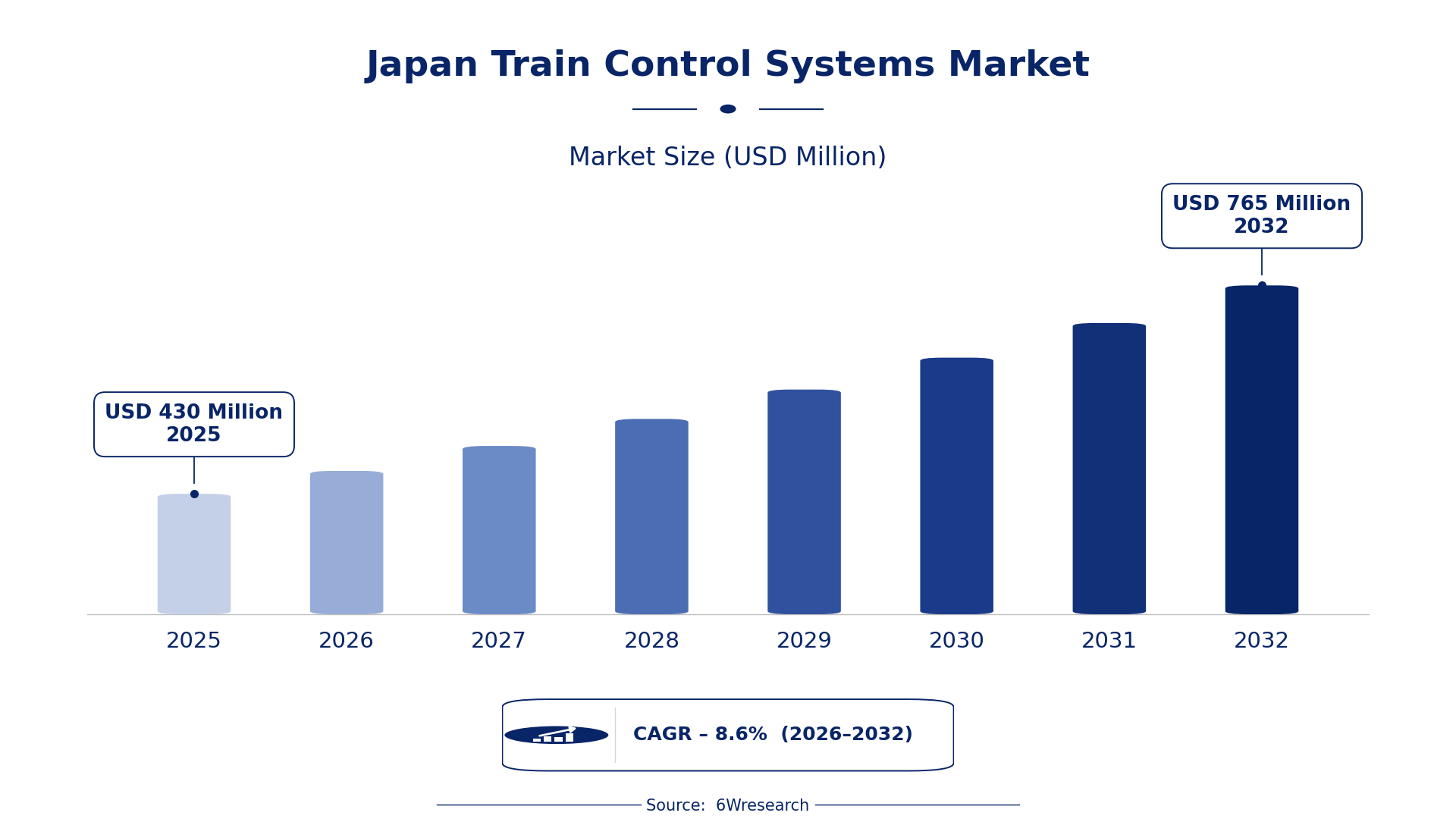
According to 6Wresearch internal database and industry insights, the Japan Train Control Systems Market was valued at USD 430 Million in 2025 and is projected to reach USD 765 Million by 2032, growing at a CAGR of approximately 8.6% during 2026–2032.
Japan Train Control Systems Market Highlights
| Report Metric | Details |
| Report Name | Japan Train Control Systems Market (2026-2032) |
| Market Size 2025 | USD 430 Million |
| Market Size 2032 | USD 765 Million |
| Absolute Growth 2025–2032 | USD 335 Million |
| CAGR 2026–2032 | 8.6% |
| Peak Annual Growth | 9.3% in 2027 |
| Forecast Period | 2026–2032 |
| Historical Data | 2022–2025 |
| Base Year | 2025 |
| Leading Control Type, 2025 | Centralized Control (48% share) |
| Leading Communication Mode, 2025 | Fiber Optic/Radio (47% share) |
| Leading System Level, 2025 | Network-wide (43% share) |
| Leading End User, 2025 | Metro Corporations (48% share) |
| Fastest-Growing Control Type | Onboard Control Units (11.9% CAGR) |
| Fastest-Growing Communication Mode | Ethernet (11.7% CAGR) |
| Fastest-Growing System Level | Train-Specific (12.0% CAGR) |
| Fastest-Growing End User | Train Manufacturers (10.9% CAGR) |
| Growing Sector | railway infrastructure |
| Key End Users | Metro Corporations, Railway Operators, Safety Authorities |
Japan Train Control Systems Market Year-wise Growth Rate and Key Drivers (2022–2032)
This graph illustrates the annual growth rates of the market from 2022 to 2032, highlighting a steady upward trajectory and projected market expansion over the forecast period.
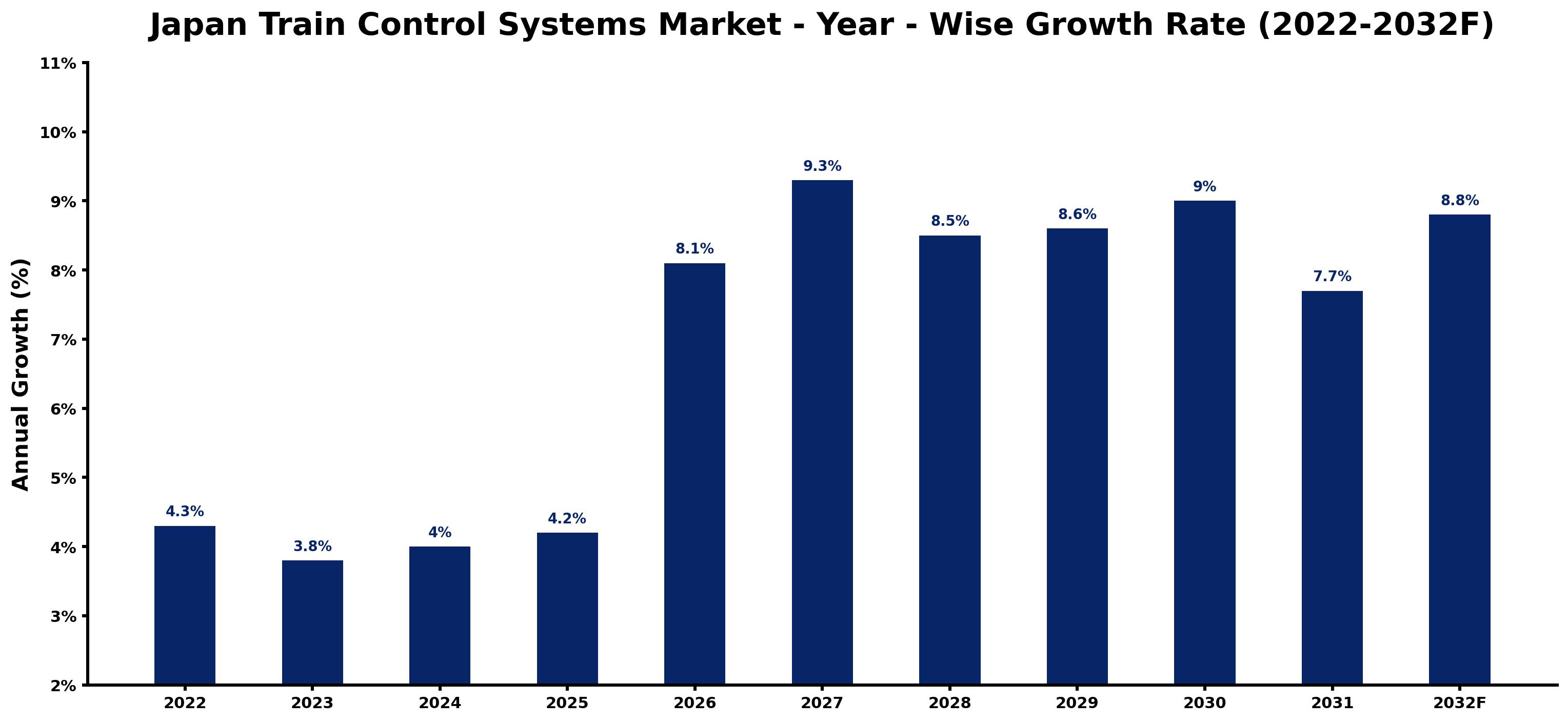
Each row of the following table gives one year's estimated growth and the event or demand shift that explains it.
| Year | Estimated Annual Growth (%) | Market Rationale |
| 2022 | 4.3 | The market showed stable growth due to ongoing investments in railway infrastructure. |
| 2023 | 3.8 | Growth slowed as supply chain disruptions affected system upgrades and installations. |
| 2024 | 4.0 | Demand increased with the introduction of new safety standards for train operations. |
| 2025 | 4.2 | Investment in urban transit systems drove higher demand for advanced control technologies. |
| 2026 | 8.1 | A surge in infrastructure projects is expected to lead to growth in train control systems. |
| 2027 | 9.3 | The peak growth will be reached as urbanisation intensifies and rail networks expand. |
| 2028 | 8.5 | Growth is projected to slow slightly as the market begins to stabilise after rapid expansion. |
| 2029 | 8.6 | Increased focus on safety and efficiency is expected to spur further investment in control systems. |
| 2030 | 9.0 | Demand will rise again as technological advancements in train control gain traction. |
| 2031 | 7.7 | Growth is anticipated to moderate as the market adjusts to new operational standards and technologies. |
| 2032 | 8.8 | Continued urbanisation and infrastructure upgrades are expected to sustain demand. |
Note: Market size estimations and growth projections presented in this report are based on 6Wresearch's proprietary forecasting methodology, utilizing the latest available industry data, government publications, and primary research inputs.
Japan Train Control Systems Market Synopsis
Train Control Systems are advanced technologies essential for managing train operations and ensuring safety in Japan's extensive railway network. These systems facilitate real-time monitoring, control of train movements, and communication between trains and control centres. The Japan Train Control Systems Market is experiencing growth driven by urban transit systems and intercity rail services. Investments in safety upgrades and technological advancements are propelling demand, supported by a growing population relying on efficient rail transport.
Market Dynamics Impact Analysis (2026–2032)
| Factor | Type | Impact | Primary Segment Affected |
| Growing urbanisation and population density in metropolitan areas | Driver | High | Centralized Control |
| Investment in safety and efficiency upgrades across railway networks | Driver | High | Integrated Control Systems |
| Increasing demand for real-time monitoring solutions | Opportunity | High | Onboard Control Units |
| Expansion of high-speed rail networks requiring advanced systems | Opportunity | Medium | Fail-Safe Control Units |
| High costs associated with system upgrades and maintenance | Restraint | High | Network-wide |
| Limited availability of skilled technicians for system installation | Restraint | Medium | Train-Specific |
| Competition from alternative transport modes affecting rail demand | Challenge | High | Railway Operators |
| Regulatory compliance costs for new safety standards | Challenge | Medium | Safety Authorities |
Evaluation of Drivers in Japan Train Control Systems Market (2026–2032)
The main growth drivers and the segments they affect most are set out below.
| Drivers | Primary Segment Affected | Why It Matters (Evidence) |
| Urbanisation in Tokyo driving demand for efficient train control systems | Centralized Control | Tokyo's population exceeds 14 million, necessitating advanced management systems for safety. |
| Investment in high-speed rail projects improving operational efficiency | Integrated Control Systems | The Shinkansen uses integrated control systems to maintain high-speed operations effectively. |
| Growing focus on safety compliance leading to system upgrades | Onboard Control Units | Emergency override systems are mandated for all new train models, increasing demand. |
| Technological advancements in communication methods improving system performance | Fiber Optic/Radio | Wireless + GPS technologies are increasingly adopted for real-time tracking, improving safety. |
| Government initiatives promoting railway safety and innovation | Fail-Safe Control Units | The Japan Railway Association promotes safety standards, driving demand for these systems. |
Purchasing is picking up as urbanisation drives demand for efficient train control systems. In 2023, Japan allocated ¥500 million for railway safety upgrades, prompting operators to invest in advanced technologies. The focus on safety compliance is expected to lead to system upgrades, with emergency override systems mandated for new train models. Advancements in communication methods are improving system performance, as wireless and GPS technologies are increasingly adopted for real-time tracking. This trend boosts demand for train control systems across the sector.
Evaluation of Restraints in Japan Train Control Systems Market
The main factors holding the market back are set out below.
| Market Restraint | Primary Segment Affected | Why It Matters (Evidence) |
| High costs associated with implementing advanced control systems | Network-wide | The average cost of upgrading systems can exceed millions, limiting investment opportunities. |
| Shortage of skilled technicians for installation and maintenance | Train-Specific | The demand for qualified personnel exceeds supply, delaying project timelines. |
| Competition from alternative transport modes affecting rail usage | Railway Operators | Increased reliance on road transport can divert passengers from rail services. |
| Regulatory compliance costs for new safety standards | Safety Authorities | Compliance with evolving regulations can strain budgets for railway operators. |
| Limited funding for infrastructure projects in rural areas | Centralized Control | Investment is often concentrated in urban centres, neglecting rural rail networks. |
Japan Train Control Systems Market Challenges
Japan's train control systems encounter fierce competition from emerging technologies, compelling suppliers to reduce prices and eroding profit margins. Supply chain disruptions arise from dependence on specific components, leading to delays in system upgrades for railway operators and jeopardising service reliability. A shortage of skilled technicians in advanced technology fields hampers the development and maintenance of these systems, resulting in prolonged training periods and escalating operational costs for companies. Resistance to adopting new technologies remains among many operators, restricting safety and efficiency improvements for end users.
Trends in the Japan Train Control Systems Market
Buyers and suppliers in the Japan Train Control Systems Market are adjusting to the following trends.
- Shift in Focus to Advanced Safety Features: Metro Corporations are increasingly emphasising advanced safety features in train control systems. In 2023, Japan mandated emergency override systems for all new train models, reflecting this trend.
- Transition from Wired to Wireless Communication Systems: In recent years, the railway sector has transitioned from hardwired to wireless communication systems. The uptake of wireless and GPS technologies is rising, enhancing operational efficiency.
- Emergence of Integrated Control Systems: The railway industry is moving towards integrated control systems, which combine various functions for improved efficiency. The Shinkansen's use of these systems illustrates this trend, ensuring high-speed operations.
- Growing Demand for Real-Time Monitoring Solutions: Railway Operators are increasingly investing in real-time monitoring solutions. In 2022, over 10,000 train stations in Japan implemented advanced monitoring systems, boosting safety and efficiency.
Investment Opportunities in the Japan Train Control Systems Market
The following opportunities in the Japan Train Control Systems Market pair current demand with a clear way in.
- Partnerships with Local Authorities for Infrastructure Projects: Local authorities are seeking partners for railway infrastructure upgrades. With a projected investment of ¥500 million in 2023, suppliers can engage through joint ventures.
- Supply of Advanced Safety Systems: There is a rising demand for advanced safety systems in railway operations. Metro Corporations are actively searching for suppliers to enhance safety measures, creating opportunities for new entrants.
- Investment in Real-Time Tracking Technologies: The need for real-time tracking technologies is increasing, revealing a substantial gap in supply. Railway Operators are in search of innovative solutions to enhance tracking capabilities.
- Certification Services for Compliance with Safety Standards: As safety standards evolve, the demand for certification services grows. Safety Authorities are enforcing compliance checks, presenting opportunities for service providers.
Government Initiatives in the Japan Train Control Systems Market
The Electrical Appliance and Material Safety Act of 1961 regulates the safety of electrical appliances, impacting train control systems. Compliance with this act is essential for manufacturers to ensure their products meet safety standards. Additionally, the Industrial Safety and Health Act of 1972 mandates employer responsibilities regarding hazardous materials, influencing operational practices in the railway sector.
The Ministry of Land, Infrastructure, Transport and Tourism oversees the implementation of safety standards for train control systems. In 2023, the agency approved funding for projects aimed at improving railway safety, including the allocation of ¥500 million for upgrades. This funding supports railway operators in meeting compliance requirements and enhancing overall safety.
Future Insight of the Japan Train Control Systems Market
Stricter railway safety standards will compel suppliers to innovate and refine their offerings by 2032. Investment in advanced technologies will rise as the government prioritises safety initiatives, with ¥500 million allocated for upgrades in 2023. Wireless and GPS technologies will become standard for real-time tracking, boosting operational efficiency for operators. Collaboration between research institutes and the railway sector will expedite the development of next-generation train control solutions, ensuring safer and more efficient rail transport for passengers.
Market Segmentation Analysis
Japan Train Control Systems Market report covers a detailed analysis of the following market segments:
By Control Type – Centralized Control Leads, Onboard Control Units Expected to Grow Fastest
According to Saurav Kr Singh, Senior Research Analyst at 6Wresearch, Centralized Control held 48% of the Japan Train Control Systems Market by control type in 2025. Centralized Control holds the largest share as it is vital for overseeing safety and operations across Japan's extensive railway network. This system is particularly crucial for the efficient management of the Tokyo Metro, which operates numerous lines. The quickest growth will come from Onboard Control Units, forecast to expand at a CAGR of 11.9% between 2026 and 2032. Onboard Control Units are rapidly growing in importance due to their role in ensuring real-time operations and safety on individual trains. The increasing focus on advanced safety features in newly designed trains is significantly driving this segment's expansion. Suppliers should focus on developing onboard technologies to cater to the rising demands from manufacturers.
By Communication Mode – Fiber Optic/Radio Leads, Ethernet Expected to Grow Fastest
With 47% of communication mode revenue in 2025, Fiber Optic/Radio was the largest category. Fiber Optic/Radio leads the market as it is essential for high-speed communication throughout Japan's extensive railway system. This mode is critical for the seamless operation of services like the Shinkansen, which relies on reliable data transmission for safety and efficiency. Over 2026–2032, Ethernet is expected to post the fastest growth, at a CAGR of 11.7%. Ethernet is witnessing rapid growth due to its rising adoption for internal networking within train control systems. Its integration is propelled by the need for efficient data handling and communication among various system components. Buyers should invest in Ethernet solutions to improve their internal communication capabilities.
By System Level – Network-wide Leads, Train-Specific Expected to Grow Fastest
Network-wide accounted for 43% of the market by system level in 2025. Network-wide systems are predominant as they ensure comprehensive management across entire railway networks, enhancing safety and operational efficiency. This approach is particularly beneficial for Japan's extensive railway infrastructure, which spans over 27,000 kilometres. Train-Specific is set to record the highest CAGR in this split, 12.0% over 2026–2032. Train-Specific systems are gaining traction due to their customised functionality for individual train operations. The increasing demand for tailored solutions in train design and operation is significantly driving this segment's growth. Suppliers must develop more customised solutions to meet the specific needs of train manufacturers.
By End User – Metro Corporations Lead, Train Manufacturers Expected to Grow Fastest
The largest end user category in 2025 was Metro Corporations, at 48% of revenue. Metro Corporations represent the largest user group, primarily due to their dependence on advanced train control systems for effective urban transit management. With Tokyo's population exceeding 14 million, these corporations play a crucial role in ensuring efficient transport. Train Manufacturers are projected to grow fastest, at a CAGR of 10.9% during 2026–2032. Train Manufacturers are experiencing the fastest growth as they increasingly integrate advanced control systems into their new train designs. The emphasis on safety and performance in these models is propelling this segment forward. Suppliers should target train manufacturers to align with the growing trend of advanced system integration.
Key Attractiveness of the Report
- 10 Years of Market Numbers
- Historical Data Starting from 2022 to 2025
- Base Year 2025
- Forecast Data until 2032
- Key Performance Indicators Impacting the Market
- Major Upcoming Developments and Projects
Key Highlights of the Report:
- Japan Train Control Systems Market Outlook
- Market Size of Japan Train Control Systems Market, 2025
- Forecast of Japan Train Control Systems Market, 2032
- Historical Data and Forecast of Japan Train Control Systems Revenues & Volume for the Period 2022-2032F
- Japan Train Control Systems Market Trend Evolution
- Japan Train Control Systems Market Drivers and Challenges
- Japan Train Control Systems Price Trends
- Japan Train Control Systems Porter's Five Forces
- Japan Train Control Systems Industry Life Cycle
- Historical Data and Forecast of Japan Train Control Systems Market Revenues & Volume By Control Type for the Period 2022-2032F
- Historical Data and Forecast of Japan Train Control Systems Market Revenues & Volume By Centralized Control for the Period 2022-2032F
- Historical Data and Forecast of Japan Train Control Systems Market Revenues & Volume By Onboard Control Units for the Period 2022-2032F
- Historical Data and Forecast of Japan Train Control Systems Market Revenues & Volume By Integrated Control Systems for the Period 2022-2032F
- Historical Data and Forecast of Japan Train Control Systems Market Revenues & Volume By Fail-Safe Control Units for the Period 2022-2032F
- Historical Data and Forecast of Japan Train Control Systems Market Revenues & Volume By Communication Mode for the Period 2022-2032F
- Historical Data and Forecast of Japan Train Control Systems Market Revenues & Volume By Fiber Optic/Radio for the Period 2022-2032F
- Historical Data and Forecast of Japan Train Control Systems Market Revenues & Volume By Ethernet for the Period 2022-2032F
- Historical Data and Forecast of Japan Train Control Systems Market Revenues & Volume By Wireless + GPS for the Period 2022-2032F
- Historical Data and Forecast of Japan Train Control Systems Market Revenues & Volume By Hardwired for the Period 2022-2032F
- Historical Data and Forecast of Japan Train Control Systems Market Revenues & Volume By System Level for the Period 2022-2032F
- Historical Data and Forecast of Japan Train Control Systems Market Revenues & Volume By Network-wide for the Period 2022-2032F
- Historical Data and Forecast of Japan Train Control Systems Market Revenues & Volume By Train-Specific for the Period 2022-2032F
- Historical Data and Forecast of Japan Train Control Systems Market Revenues & Volume By Corridor-Level for the Period 2022-2032F
- Historical Data and Forecast of Japan Train Control Systems Market Revenues & Volume By Emergency Override for the Period 2022-2032F
- Historical Data and Forecast of Japan Train Control Systems Market Revenues & Volume By End User for the Period 2022-2032F
- Historical Data and Forecast of Japan Train Control Systems Market Revenues & Volume By Metro Corporations for the Period 2022-2032F
- Historical Data and Forecast of Japan Train Control Systems Market Revenues & Volume By Train Manufacturers for the Period 2022-2032F
- Historical Data and Forecast of Japan Train Control Systems Market Revenues & Volume By Railway Operators for the Period 2022-2032F
- Historical Data and Forecast of Japan Train Control Systems Market Revenues & Volume By Safety Authorities for the Period 2022-2032F
- Japan Train Control Systems Import Export Trade Statistics
- Market Opportunity Assessment By Control Type
- Market Opportunity Assessment By Communication Mode
- Market Opportunity Assessment By System Level
- Market Opportunity Assessment By End User
- Japan Train Control Systems Top Companies Market Share
- Japan Train Control Systems Competitive Benchmarking By Technical and Operational Parameters
- Japan Train Control Systems Company Profiles
- Japan Train Control Systems Key Strategic Recommendations
Market Covered
Coverage by segment is as follows.
By Control Type
- Centralized Control
- Onboard Control Units
- Integrated Control Systems
- Fail-Safe Control Units
By Communication Mode
- Fiber Optic/Radio
- Ethernet
- Wireless + GPS
- Hardwired
By System Level
- Network-wide
- Train-Specific
- Corridor-Level
- Emergency Override
By End User
- Metro Corporations
- Train Manufacturers
- Railway Operators
- Safety Authorities































