Japan Train Safety Systems Market Size & Growth Rate
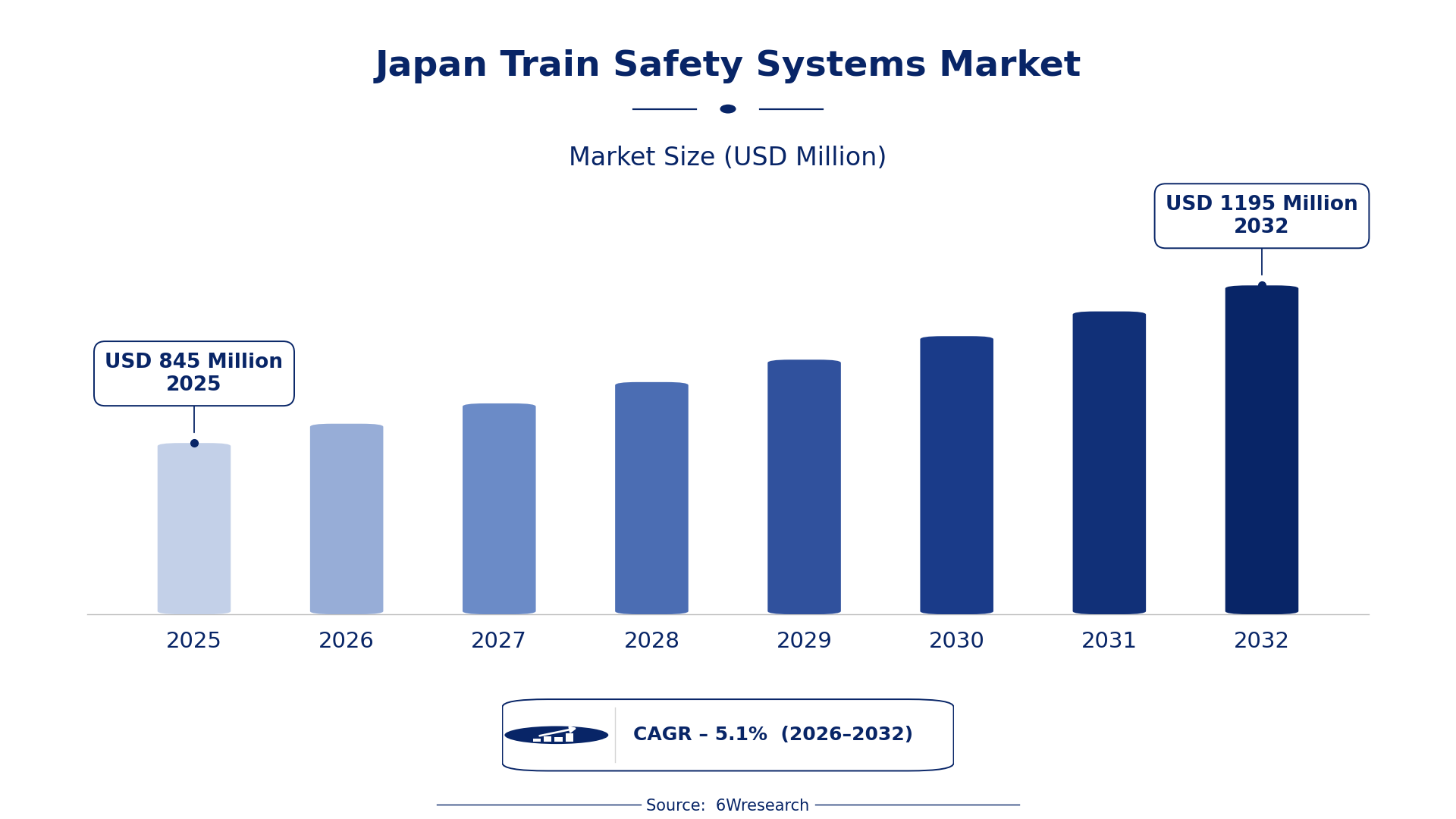
According to 6Wresearch internal database and industry insights, the Japan Train Safety Systems Market was valued at USD 845 Million in 2025 and is projected to reach USD 1,195 Million by 2032, growing at a CAGR of approximately 5.1% during 2026–2032.
Japan Train Safety Systems Market Highlights
| Report Metric | Details |
| Report Name | Japan Train Safety Systems Market (2026-2032) |
| Market Size 2025 | USD 845 Million |
| Market Size 2032 | USD 1,195 Million |
| Absolute Growth 2025–2032 | USD 350 Million |
| CAGR 2026–2032 | 5.1% |
| Peak Annual Growth | 5.5% in 2030 |
| Forecast Period | 2026–2032 |
| Historical Data | 2022–2025 |
| Base Year | 2025 |
| Leading Safety System Type, 2025 | Automatic Braking (43% share) |
| Leading Technology Used, 2025 | Radar + Sensors (52% share) |
| Leading Application Mode, 2025 | Collision Prevention (43% share) |
| Leading End User, 2025 | Public Transit (48% share) |
| Fastest-Growing Safety System Type | Fire Detection Systems (7.3% CAGR) |
| Fastest-Growing Technology Used | Smoke & Thermal Sensors (7.7% CAGR) |
| Fastest-Growing Application Mode | Emergency Management (6.9% CAGR) |
| Fastest-Growing End User | Urban Rail (6.6% CAGR) |
| Growing Sector | Public Transit |
| Key End Users | Public Transit, Urban Rail, Rail OEMs, Railway Safety Boards |
Japan Train Safety Systems Market Year-wise Growth Rate and Key Drivers (2022–2032)
This graph illustrates the annual growth rates of the market from 2022 to 2032, highlighting a steady upward trajectory and projected market expansion over the forecast period.
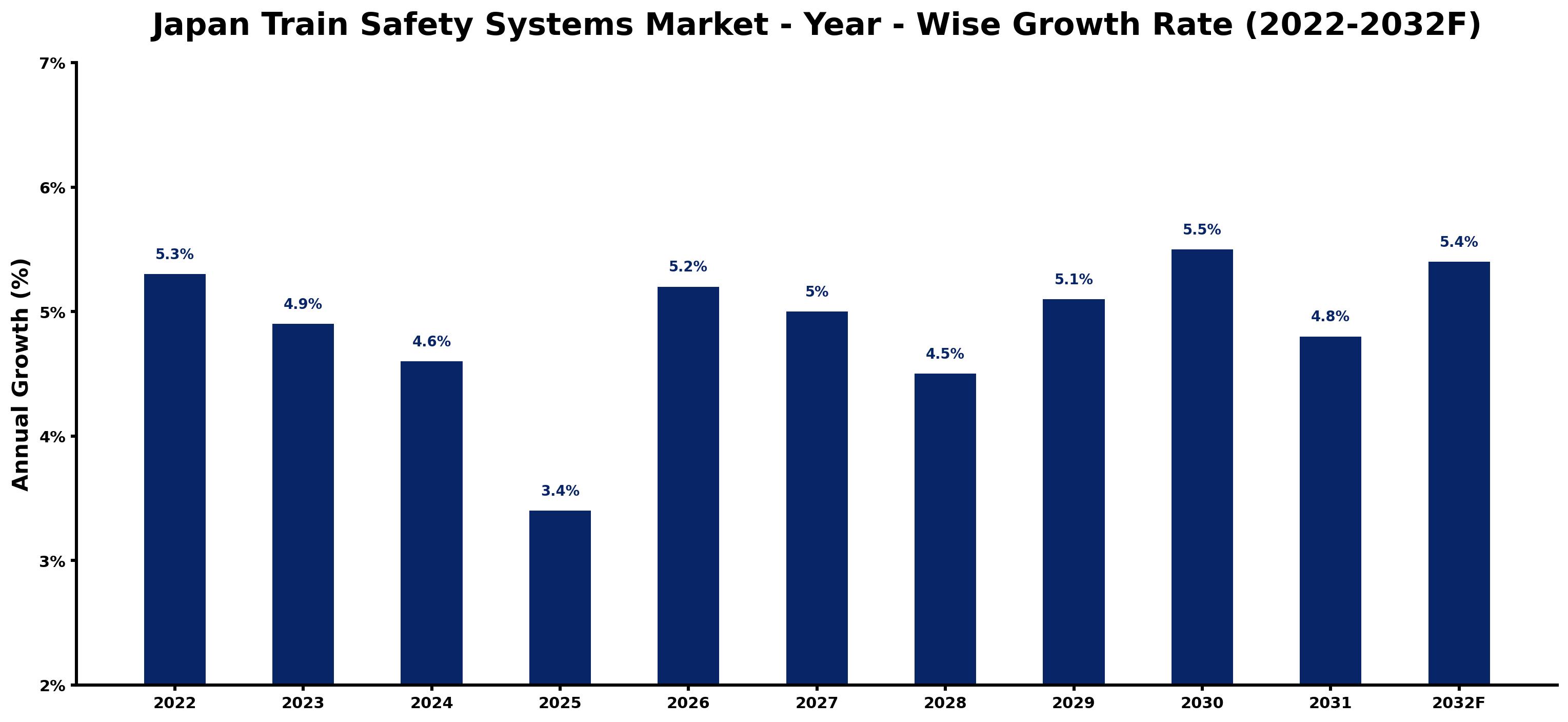
Year by year, the estimates below pair each growth rate with the development that shaped it.
| Year | Estimated Annual Growth (%) | Market Rationale |
| 2022 | 5.3 | The market experienced steady growth, reflecting strong rail passenger numbers and infrastructure investments. |
| 2023 | 4.9 | Demand growth slowed as the market adjusted to previous expansions and ongoing safety upgrades. |
| 2024 | 4.6 | The market continued to grow, albeit at a slower pace, due to sustained investments in rail safety technologies. |
| 2025 | 3.4 | Growth decelerated further as the market stabilised after a period of rapid expansion and technological adoption. |
| 2026 | 5.2 | Demand is expected to rise as new safety systems are introduced and infrastructure projects gain momentum. |
| 2027 | 5.0 | Growth will slow slightly as the market adjusts to the saturation of existing technologies and systems. |
| 2028 | 4.5 | Demand is projected to remain steady, driven by ongoing safety improvements and urban rail expansions. |
| 2029 | 5.1 | Growth is anticipated to accelerate as new safety standards and technologies are implemented across the network. |
| 2030 | 5.5 | The market is expected to peak with substantial investments in advanced safety systems and infrastructure upgrades. |
| 2031 | 4.8 | Demand growth will moderate as the market stabilises after reaching peak investment levels. |
| 2032 | 5.4 | Growth is projected to rise again as ongoing safety initiatives and urban rail projects continue to expand. |
Note: Market size estimations and growth projections presented in this report are based on 6Wresearch's proprietary forecasting methodology, utilizing the latest available industry data, government publications, and primary research inputs.
Japan Train Safety Systems Market Synopsis
Train safety systems in Japan encompass advanced technologies designed to improve the safety and reliability of rail operations. These systems, including collision prevention and fire detection mechanisms, are essential for ensuring passenger safety. The Japan Train Safety Systems Market is expanding due to increasing rail passenger numbers, infrastructure investments, and the implementation of stringent safety standards. In 2022, Japan recorded 1.3 billion rail passengers, highlighting the demand for improved safety technologies.
Market Dynamics Impact Analysis (2026–2032)
| Factor | Type | Impact | Primary Segment Affected |
| Increasing passenger numbers drive demand for advanced safety technologies, particularly in urban rail systems. | Driver | High | Urban Rail |
| Government funding for rail safety improvements encourages investment in innovative safety systems. | Driver | High | Public Transit |
| The need for compliance with updated safety regulations creates opportunities for suppliers of advanced safety systems. | Opportunity | High | Fire Detection Systems |
| Growing urbanisation in regions like Tokyo presents opportunities for expanding safety technology installations. | Opportunity | High | Automatic Braking |
| Compatibility issues with existing systems hinder the adoption of newer technologies, affecting operational efficiency. | Restraint | Medium | Derailment Detectors |
| The high cost of implementing advanced safety systems can deter smaller operators from upgrading their technologies. | Restraint | Medium | Collision Prevention |
| A shortage of skilled technicians limits the capacity for timely upgrades and maintenance of safety systems. | Challenge | High | Fire Detection Systems |
| Compliance with stringent safety regulations requires significant investment, impacting smaller rail operators' budgets. | Challenge | Medium | Automatic Braking |
Evaluation of Drivers in Japan Train Safety Systems Market (2026–2032)
The factors lifting demand, and the evidence behind each, are summarised below.
| Drivers | Primary Segment Affected | Why It Matters (Evidence) |
| Growing rail passenger numbers necessitate safety measures. | Passenger Safety | In 2022, Japan recorded 1.3 billion rail passengers, prompting increased investments in safety systems. |
| Infrastructure upgrades are mandated to improve safety standards. | Fire Detection Systems | The Economic Security Promotion Act updated in 2022 requires enhanced safety measures across the network. |
| Technological advancements in safety systems attract investment. | Automatic Braking | Recent developments in automatic train protection systems have led to increased adoption rates. |
| Public transit expansion drives demand for safety technologies. | Urban Rail | Public transit accounts for 60% of all rail traffic, creating a strong market for safety systems. |
| Government funding for rail safety upgrades boosts market growth. | Derailment Detectors | In 2023, the government allocated ¥10 billion for rail safety enhancements, supporting system implementation. |
Volumes grow on the back of increased rail passenger numbers, with 1.3 billion recorded in 2022, leading to heightened demand for safety technologies. The public transit sector, which accounts for 60% of rail traffic, drives demand for automatic braking systems. Funding of ¥10 billion for rail safety improvements in 2023 supports the adoption of derailment detectors and other critical safety technologies. Technological advancements in automatic train protection systems are attracting investment and driving overall market growth.
Evaluation of Restraints in Japan Train Safety Systems Market
Below are the constraints most often cited by buyers and suppliers, with the segment each affects.
| Market Restraint | Primary Segment Affected | Why It Matters (Evidence) |
| Regulatory compliance costs increase operational expenses for producers. | Automatic Braking | Compliance with updated safety standards can raise production costs by approximately 15%. |
| High initial investment costs deter small operators from upgrading systems. | Door Control Systems | Small public transit operators may struggle to allocate funds for advanced door control systems. |
| Market saturation limits growth potential for existing technologies. | Passenger Safety | As safety systems become standardised, growth in this segment may slow. |
| Maintenance costs for advanced systems can be prohibitive for some operators. | Derailment Detectors | Ongoing maintenance can account for 20% of total operational costs, impacting budget allocation. |
| Limited availability of skilled technicians hampers system implementation. | Fire Detection Systems | A shortage of trained personnel can delay the deployment of fire detection technologies by up to six months. |
Japan Train Safety Systems Market Challenges
In 2023, Japan allocated ¥10 billion for rail safety upgrades, highlighting a critical need for technological advancements. Many existing systems lack compatibility with modern technologies, causing delays that increase maintenance costs for rail operators by 15%. The average age of rolling stock, approximately 15 years, raises operational expenses and diminishes reliability for train operators. A shortage of skilled technicians in advanced safety systems forces companies to invest in training, resulting in postponed upgrades and compromising safety measures for passengers.
Trends in the Japan Train Safety Systems Market
Buyers and suppliers in the Japan Train Safety Systems Market are adjusting to the following trends.
- Urban Rail Systems Adopting Advanced Safety Technologies: Urban rail systems are increasingly implementing advanced safety technologies, with Tokyo Metro adopting new door control systems since 2021. This shift is driven by the need to improve safety measures, as public transit accounts for 60% of rail traffic.
- Increase in Fire Detection System Installations: Since the update of safety regulations in 2022, there has been a notable increase in fire detection system installations. The requirement for fire detection systems in all passenger trains, as per JIS standards, has driven this trend.
- Rise of Smart Collision Prevention Technologies: The introduction of smart collision prevention technologies has gained traction in urban rail networks, with a 30% increase in installations since 2020. This trend reflects the growing focus on passenger safety and operational efficiency.
- Surge in Derailment Detection Technology Investments: The installation of derailment detectors has surged by 30% since 2020, highlighting a trend towards improving track integrity monitoring. This shift is essential for preventing accidents and ensuring rail safety.
Investment Opportunities in the Japan Train Safety Systems Market
The following opportunities in the Japan Train Safety Systems Market pair current demand with a clear way in.
- Tokyo Metro's Expansion Projects: Tokyo Metro's ongoing expansion projects create a pressing need for advanced safety systems, with a projected investment of ¥10 billion in 2023. Suppliers can enter this market through partnerships with local transit authorities.
- Rising Demand for Urban Rail Safety Systems: With urban rail traffic expected to rise by 10% by 2030, there is an opportunity for suppliers of safety technologies. Collaborating with urban rail operators can facilitate entry into this expanding market.
- Growing Focus on Fire Detection Systems: The increasing emphasis on fire safety in passenger trains creates opportunities for suppliers of fire detection systems, especially following the JIS standards. Engaging with public transit agencies can improve market access.
- Upgrading Automatic Braking Systems: The push for automatic braking systems in new trains presents a timely opportunity for investment, as all new trains are mandated to have these systems. Partnering with rail OEMs can streamline market entry.
Government Initiatives in the Japan Train Safety Systems Market
The Ministry of Land, Infrastructure, Transport and Tourism oversees rail safety regulations, ensuring compliance with standards such as the JIS for fire detection systems. The updated Economic Security Promotion Act, implemented in 2022, mandates safety measures across the rail network, driving investments in safety technologies and systems.
Public transit agencies utilise government funding, such as the ¥10 billion allocated in 2023 for rail safety upgrades, to implement advanced safety systems. This funding supports the installation of critical technologies like derailment detectors and fire detection systems, improving overall rail safety.
Future Insight of the Japan Train Safety Systems Market
Investment in rail safety systems will increase significantly by 2032, supported by government initiatives and rising passenger expectations. New regulations will create a more secure environment for travellers, encouraging higher rail usage. The adoption of cutting-edge technologies will establish uniform quality across suppliers, enhancing system performance and dependability. With fire detection systems required in all passenger trains, suppliers must innovate to comply with rigorous standards and maintain competitiveness.
Market Segmentation Analysis
Japan Train Safety Systems Market report covers a detailed analysis of the following market segments:
By Safety System Type – Automatic Braking Leads, Fire Detection Systems Expected to Grow Fastest
According to Saurav Kr Singh, Senior Research Analyst at 6Wresearch, Automatic Braking accounted for 43% of the market by safety system type in 2025. Automatic braking systems are essential for preventing collisions on Japan's extensive railway network, which spans over 27,000 kilometres. With 1.3 billion rail passengers recorded in 2022, these systems are vital for maintaining high safety standards. Fire Detection Systems are projected to grow fastest, at a CAGR of 7.3% during 2026–2032. Fire detection systems are increasingly critical for ensuring passenger safety during emergencies, particularly as safety protocols are reinforced. Their mandatory installation in all passenger trains according to JIS standards is a major factor driving their rapid adoption. Suppliers should focus on advancing fire detection technologies to comply with regulations and enhance overall safety.
By Technology Used – Radar + Sensors Lead, Smoke & Thermal Sensors Expected to Grow Fastest
With 52% of technology used revenue in 2025, Radar + Sensors was the largest category. Radar and sensors are fundamental for collision prevention and monitoring, especially given the high-speed operations of Japan's rail systems. The Shinkansen, which operates at speeds up to 320 km/h, highlights the necessity of these technologies for ensuring safety. Over 2026–2032, Smoke & Thermal Sensors are expected to post the fastest growth, at a CAGR of 7.7%. Smoke and thermal sensors have become increasingly vital for effective fire detection in trains, with their adoption rising due to updated safety protocols. The growing focus on emergency management is significantly boosting the demand for these technologies. Buyers must prioritise the integration of smoke and thermal sensors to meet evolving safety regulations.
By Application Mode – Collision Prevention Leads, Emergency Management Expected to Grow Fastest
Collision Prevention took 43% of application mode revenue in 2025, more than any other category. Collision prevention is the primary function of safety systems, addressing the critical need for safe rail operations in Japan's busy transport network. With public transit accounting for 60% of all rail traffic, this application mode is crucial. The quickest growth will come from Emergency Management, forecast to expand at a CAGR of 6.9% between 2026 and 2032. Emergency management is essential for effectively handling crises, particularly in densely populated areas like Tokyo. The regular updates to emergency protocols by the Japan Transport Safety Board underscore the increasing importance of this application mode. Suppliers should enhance their emergency management solutions to align with the growing focus on safety standards.
By End User – Public Transit Leads, Urban Rail Expected to Grow Fastest
In 2025, Public Transit led the end user split with a 48% share. Public transit represents the largest user of train safety systems, reflecting the significant demand for safety measures across Japan's extensive rail infrastructure. The Tokyo metropolitan area, known for its high rail passenger density, exemplifies the urgent need for these systems. Urban Rail is set to record the highest CAGR in this split, 6.6% over 2026–2032. Urban rail is a significant segment utilising safety technologies, driven by ongoing infrastructure investments and safety upgrades. The government's allocation of ¥10 billion for rail safety improvements indicates a pressing need for urban rail safety solutions. Suppliers should concentrate on urban rail projects to capitalise on the increasing demand for advanced safety systems.
Key Attractiveness of the Report
- 10 Years of Market Numbers
- Historical Data Starting from 2022 to 2025
- Base Year 2025
- Forecast Data until 2032
- Key Performance Indicators Impacting the Market
- Major Upcoming Developments and Projects
Key Highlights of the Report:
- Japan Train Safety Systems Market Outlook
- Market Size of Japan Train Safety Systems Market, 2025
- Forecast of Japan Train Safety Systems Market, 2032
- Historical Data and Forecast of Japan Train Safety Systems Revenues & Volume for the Period 2022-2032F
- Japan Train Safety Systems Market Trend Evolution
- Japan Train Safety Systems Market Drivers and Challenges
- Japan Train Safety Systems Price Trends
- Japan Train Safety Systems Porter's Five Forces
- Japan Train Safety Systems Industry Life Cycle
- Historical Data and Forecast of Japan Train Safety Systems Market Revenues & Volume By Safety System Type for the Period 2022-2032F
- Historical Data and Forecast of Japan Train Safety Systems Market Revenues & Volume By Automatic Braking for the Period 2022-2032F
- Historical Data and Forecast of Japan Train Safety Systems Market Revenues & Volume By Fire Detection Systems for the Period 2022-2032F
- Historical Data and Forecast of Japan Train Safety Systems Market Revenues & Volume By Door Control Systems for the Period 2022-2032F
- Historical Data and Forecast of Japan Train Safety Systems Market Revenues & Volume By Derailment Detectors for the Period 2022-2032F
- Historical Data and Forecast of Japan Train Safety Systems Market Revenues & Volume By Technology Used for the Period 2022-2032F
- Historical Data and Forecast of Japan Train Safety Systems Market Revenues & Volume By Radar + Sensors for the Period 2022-2032F
- Historical Data and Forecast of Japan Train Safety Systems Market Revenues & Volume By Smoke & Thermal Sensors for the Period 2022-2032F
- Historical Data and Forecast of Japan Train Safety Systems Market Revenues & Volume By Proximity Sensors for the Period 2022-2032F
- Historical Data and Forecast of Japan Train Safety Systems Market Revenues & Volume By Track-Based Sensors for the Period 2022-2032F
- Historical Data and Forecast of Japan Train Safety Systems Market Revenues & Volume By Application Mode for the Period 2022-2032F
- Historical Data and Forecast of Japan Train Safety Systems Market Revenues & Volume By Collision Prevention for the Period 2022-2032F
- Historical Data and Forecast of Japan Train Safety Systems Market Revenues & Volume By Emergency Management for the Period 2022-2032F
- Historical Data and Forecast of Japan Train Safety Systems Market Revenues & Volume By Passenger Safety for the Period 2022-2032F
- Historical Data and Forecast of Japan Train Safety Systems Market Revenues & Volume By Infrastructure Monitoring for the Period 2022-2032F
- Historical Data and Forecast of Japan Train Safety Systems Market Revenues & Volume By End User for the Period 2022-2032F
- Historical Data and Forecast of Japan Train Safety Systems Market Revenues & Volume By Public Transit for the Period 2022-2032F
- Historical Data and Forecast of Japan Train Safety Systems Market Revenues & Volume By Rail OEMs for the Period 2022-2032F
- Historical Data and Forecast of Japan Train Safety Systems Market Revenues & Volume By Urban Rail for the Period 2022-2032F
- Historical Data and Forecast of Japan Train Safety Systems Market Revenues & Volume By Railway Safety Boards for the Period 2022-2032F
- Japan Train Safety Systems Import Export Trade Statistics
- Market Opportunity Assessment By Safety System Type
- Market Opportunity Assessment By Technology Used
- Market Opportunity Assessment By Application Mode
- Market Opportunity Assessment By End User
- Japan Train Safety Systems Top Companies Market Share
- Japan Train Safety Systems Competitive Benchmarking By Technical and Operational Parameters
- Japan Train Safety Systems Company Profiles
- Japan Train Safety Systems Key Strategic Recommendations
Market Covered
The report covers the following segments.
By Safety System Type
- Automatic Braking
- Fire Detection Systems
- Door Control Systems
- Derailment Detectors
By Technology Used
- Radar + Sensors
- Smoke & Thermal Sensors
- Proximity Sensors
- Track-Based Sensors
By Application Mode
- Collision Prevention
- Emergency Management
- Passenger Safety
- Infrastructure Monitoring
By End User
- Public Transit
- Rail OEMs
- Urban Rail
- Railway Safety Boards































