Japan Transformer Core Market Size & Growth Rate
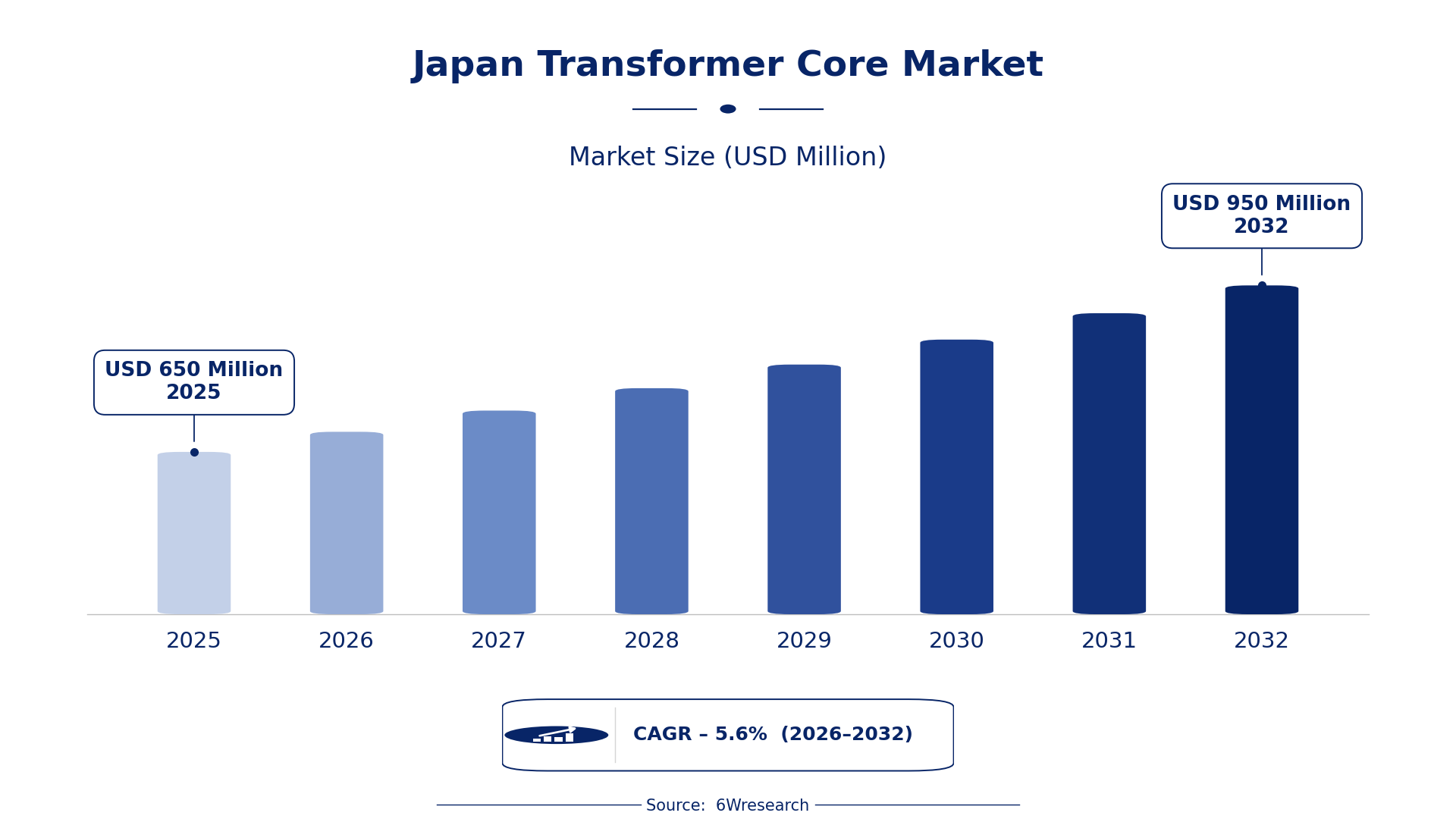
According to 6Wresearch internal database and industry insights, the Japan Transformer Core Market was valued at USD 650 Million in 2025 and is projected to reach USD 950 Million by 2032, growing at a CAGR of approximately 5.6% during 2026–2032.
Japan Transformer Core Market Highlights
| Report Metric | Details |
| Report Name | Japan Transformer Core Market (2026-2032) |
| Market Size 2025 | USD 650 Million |
| Market Size 2032 | USD 950 Million |
| Absolute Growth 2025–2032 | USD 300 Million |
| CAGR 2026–2032 | 5.6% |
| Peak Annual Growth | 6.4% in 2028 |
| Forecast Period | 2026–2032 |
| Historical Data | 2022–2025 |
| Base Year | 2025 |
| Leading Core, 2025 | Closed (46% share) |
| Leading Product, 2025 | Distribution Transformer (43% share) |
| Leading Winding, 2025 | Two Winding (45% share) |
| Leading Insulation, 2025 | Gas (48% share) |
| Leading Application, 2025 | Residential & Commercial (55% share) |
| Fastest-Growing Core | Shell (7.2% CAGR) |
| Fastest-Growing Product | Power Transformer (7.7% CAGR) |
| Fastest-Growing Winding | Auto-transformer (7.4% CAGR) |
| Fastest-Growing Insulation | Oil (7.3% CAGR) |
| Fastest-Growing Application | Utility (7.5% CAGR) |
| Growing Sector | Power Generation |
| Key End Users | Utility companies, industrial manufacturers, energy providers |
Japan Transformer Core Market Year-wise Growth Rate and Key Drivers (2022–2032)
This graph illustrates the annual growth rates of the market from 2022 to 2032, highlighting a steady upward trajectory and projected market expansion over the forecast period.
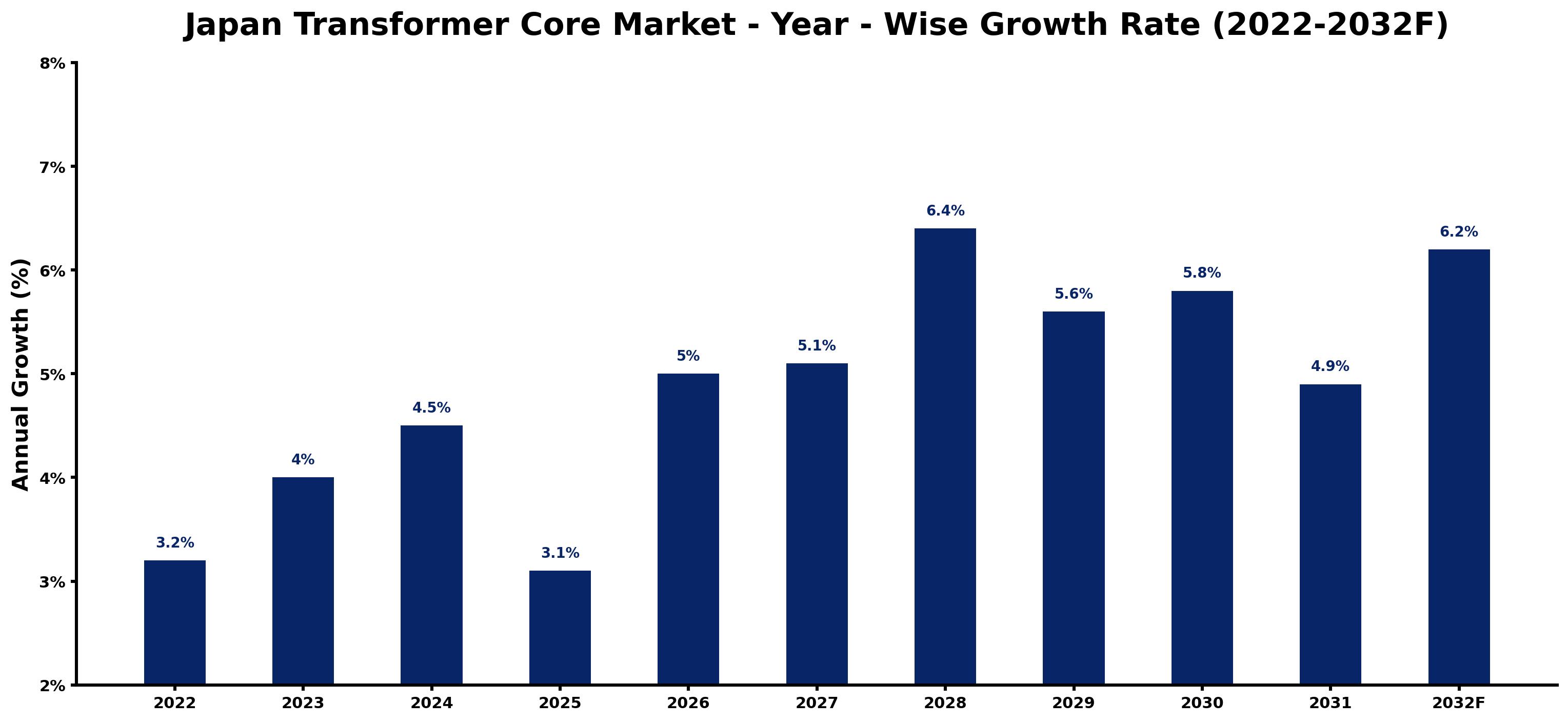
Below, each year's estimated growth is shown next to the factor that most influenced it.
| Year | Estimated Annual Growth (%) | Market Rationale |
| 2022 | 3.2 | The market experienced steady growth, driven by increased energy demands. |
| 2023 | 4.0 | Growth accelerated as investments in power infrastructure rose. |
| 2024 | 4.5 | Demand strengthened as utility companies upgraded their systems. |
| 2025 | 3.1 | Growth slowed due to market saturation impacting new orders. |
| 2026 | 5.0 | A renewed focus on energy efficiency is expected to spur demand for modern transformers. |
| 2027 | 5.1 | Continued urbanisation will lead to increased requirements for distribution transformers. |
| 2028 | 6.4 | Peak growth will be driven by infrastructure projects across the country. |
| 2029 | 5.6 | Demand growth is projected to moderate as supply chains adjust to new capacities. |
| 2030 | 5.8 | Investment in renewable energy sources will boost transformer requirements. |
| 2031 | 4.9 | Growth will slow slightly as market conditions stabilise. |
| 2032 | 6.2 | Increased adoption of energy-efficient technologies will drive further demand. |
Note: Market size estimations and growth projections presented in this report are based on 6Wresearch's proprietary forecasting methodology, utilizing the latest available industry data, government publications, and primary research inputs.
Japan Transformer Core Market Synopsis
Transformer cores are made from laminated silicon steel sheets and are essential for transferring electrical energy in power generation and distribution. The Japan Transformer Core Market is expanding due to rising energy demands from a population of approximately 125 million and substantial investments in infrastructure. The annual demand for power transformers is estimated at 15,000 units, while the Ministry of Economy, Trade and Industry promotes energy-efficient transformers, further driving market growth. The Tokyo metropolitan area serves as a key manufacturing hub, producing over 1 million distribution transformers in 2022.
Market Dynamics Impact Analysis (2026–2032)
| Factor | Type | Impact | Primary Segment Affected |
| Growing energy demands from urbanisation and industrialisation | Driver | High | Distribution Transformer |
| Investment in energy-efficient technologies | Driver | High | Power Transformer |
| Increasing demand for dry-type transformers in urban areas | Opportunity | Medium | Dry Type |
| Expansion of the Tokyo metropolitan area as a manufacturing hub | Opportunity | Medium | Distribution Transformer |
| Market saturation affecting new orders | Restraint | High | Power Transformer |
| Supply chain disruptions impacting production timelines | Restraint | Medium | Distribution Transformer |
| High production costs due to material price volatility | Challenge | High | Closed |
| Technological advancements requiring continuous investment | Challenge | Medium | Closed |
Evaluation of Drivers in Japan Transformer Core Market (2026–2032)
The table below links each growth driver to the segment it affects and the evidence for it.
| Drivers | Primary Segment Affected | Why It Matters (Evidence) |
| Increased energy consumption in urban areas | Distribution Transformer | The population of approximately 125 million drives local electricity distribution needs. |
| Government initiatives promoting energy-efficient transformers | Power Transformer | Support for upgrades to modern transformer systems boosts demand. |
| Rising investments in renewable energy infrastructure | Dry Type | The shift towards safer transformer options in urban settings increases demand. |
| Technological advancements in transformer design | Two Winding | Innovations improve efficiency and performance, attracting more buyers. |
| Regulatory standards driving transformer efficiency improvements | Gas | The JIS C 4000 standard mandates higher specifications for transformer cores. |
A wider customer base explains much of the growth, as increased energy consumption in urban areas fuels demand for distribution transformers. The population drives local electricity distribution needs, leading to the production of over 1 million distribution transformers in 2022. Investments in renewable energy infrastructure influence demand, as the shift towards safer dry-type transformers in urban settings becomes apparent.
Evaluation of Restraints in Japan Transformer Core Market
The following restraints limit how fast demand can grow.
| Market Restraint | Primary Segment Affected | Why It Matters (Evidence) |
| Market saturation affecting new orders | Power Transformer | As the market matures, fewer new installations are required, impacting sales. |
| Supply chain disruptions impacting production timelines | Distribution Transformer | Delays in material supply can hinder timely production and delivery. |
| High production costs due to material price volatility | Closed | Fluctuations in raw material prices increase overall manufacturing costs. |
| Technological advancements requiring continuous investment | Two Winding | Staying competitive demands ongoing investment in R&D and production capabilities. |
| Regulatory compliance costs for manufacturers | Gas | Meeting JIS C 4000 standards can increase operational expenses for producers. |
Japan Transformer Core Market Challenges
High electricity prices are burdening buyers in the manufacturing sector, with costs exceeding 30% above the regional average, forcing companies to cut back on production. Local manufacturers encounter intense competition from foreign producers, which pressures profit margins and may lead to layoffs. Stringent requirements of the JIS C 4000 standard complicate compliance for producers, potentially delaying product launches by up to six months and hindering market entry. Increasing prices for silicon steel sheets, now 15% higher than last year, push suppliers to raise costs, making transformer cores less accessible for buyers and straining budgets.
Trends in the Japan Transformer Core Market
The trends below show where the Japan Transformer Core Market is heading.
- Shift towards Energy-Efficient Transformers: Since 2023, there has been a marked shift towards energy-efficient transformers, as government initiatives promote these technologies. The Ministry of Economy, Trade and Industry supports this transition, resulting in increased adoption among utility companies.
- Growth of Dry-Type Transformers in Urban Areas: The use of dry-type transformers has surged since 2022, particularly in urban settings. This trend is influenced by safety regulations, with urban installations increasing by 20% in the last year.
- Expansion of Transformer Manufacturing in the Tokyo Area: The Tokyo metropolitan area has become a key hub for transformer manufacturing since 2022, with production exceeding 1 million units annually. This growth supports local utilities and industrial applications.
- Rising Demand for Power Transformers: The demand for power transformers has been increasing since 2023, driven by infrastructure investments. The annual demand is estimated at 15,000 units, reflecting the need for high-voltage transmission.
Investment Opportunities in the Japan Transformer Core Market
Investors looking at the Japan Transformer Core Market should consider the following areas.
- Utility Companies Seeking Modern Solutions: Utility companies are actively looking for modern transformer solutions to improve efficiency. With the annual demand for power transformers estimated at 15,000 units, suppliers can meet this need by partnering with local firms.
- Increasing Urbanisation Driving Demand: As urbanisation accelerates, the need for distribution transformers is rising. The Kansai region, known for industrial transformer production, presents opportunities for suppliers to enter the market through joint ventures.
- Focus on Energy Efficiency in Manufacturing: The current emphasis on energy efficiency creates opportunities for suppliers of energy-efficient transformers. The Electric Power Development Association supports research in this area, encouraging investments in innovative technologies.
- Growing Interest in Renewable Energy Solutions: The shift towards renewable energy sources is prompting increased demand for transformers. Suppliers can enter this market by obtaining ISO 9001 certification to meet quality standards.
Government Initiatives in the Japan Transformer Core Market
The Hydrogen Society Promotion Act, enacted in 2024, supports low-carbon hydrogen supply chains and complements existing regulations like the Waste Management and Public Cleansing Act from 1970. This new measure encourages transformer manufacturers to adopt cleaner technologies, improving their sustainability practices.
In 2023, the Battery Industry Strategy targeted 150 GWh of domestic battery manufacturing capacity by 2030, overseen by the Ministry of Economy, Trade and Industry. This initiative supports the development of energy-efficient transformers, facilitating their integration into new energy systems.
Future Insight of the Japan Transformer Core Market
By 2032, government initiatives will drive a shift towards energy-efficient transformer technologies, prompting suppliers to innovate. Advanced manufacturing facilities will emerge, boosting production capabilities and meeting buyer demands for efficiency. The rise of smart grid technologies will equip buyers with enhanced energy management solutions, improving operational efficiency. Urban expansion will elevate demand for dry-type transformers, aligning with safety regulations and supporting modern infrastructure development.
Market Segmentation Analysis
Japan Transformer Core Market report covers a detailed analysis of the following market segments:
By Core – Closed Leads, Shell Expected to Grow Fastest
According to Dhaval Chaurasia, Assistant Manager at 6Wresearch, Closed took 46% of core revenue in 2025, more than any other category. Closed cores dominate the market as they are vital for efficiency in power transformers, which are extensively used in substations across Japan. The concentration of manufacturing in the Tokyo metropolitan area highlights the reliance on closed cores for local power systems. Over 2026–2032, Shell is expected to post the fastest growth, at a CAGR of 7.2%. Shell cores are gaining traction due to their structural integrity in large transformers, which are increasingly required for high-capacity applications. As urban infrastructure projects expand, the demand for shell cores is projected to rise significantly. Suppliers should consider increasing their production of shell cores to meet the anticipated growth in large transformer applications.
By Product – Distribution Transformer Leads, Power Transformer Expected to Grow Fastest
With 43% of product revenue in 2025, Distribution Transformer was the largest category. Distribution transformers dominate the market as they are vital for local electricity distribution, with over 1 million units produced in 2022. Their extensive use in residential and commercial sectors ensures a stable and consistent demand. Power Transformer is set to record the highest CAGR in this split, 7.7% over 2026–2032. Power transformers are experiencing rapid growth because they are critical for high voltage transmission, with an estimated annual demand of around 15,000 units. Ongoing infrastructure developments and energy efficiency initiatives are driving this segment's expansion. Buyers should prioritise sourcing power transformers to meet the increasing demands of high voltage transmission projects.
By Winding – Two Winding Leads, Auto-transformer Expected to Grow Fastest
Two Winding accounted for 45% of the market by winding in 2025. Two winding transformers are the predominant design, widely utilised across various applications due to their standardised efficiency and reliability. This design is essential for the operation of most transformers installed throughout Japan, reflecting its established preference. Auto-transformer is projected to grow fastest, at a CAGR of 7.4% during 2026–2032. Auto-transformers are experiencing rapid growth as they are being adopted for specific applications that necessitate compact designs and cost efficiency. Their unique advantages make them increasingly relevant in niche markets, driving their adoption. Suppliers may need to expand their product offerings to include auto-transformers to address the evolving market demands.
By Insulation – Gas Lead, Oil Expected to Grow Fastest
Gas held 48% of the Japan Transformer Core Market by insulation in 2025. Gas insulation is primarily used in specific applications where safety and space constraints are critical, though it does not dominate the market. Its application in high-voltage environments showcases its importance in ensuring operational safety. The quickest growth will come from Oil, forecast to expand at a CAGR of 7.3% between 2026 and 2032. Oil insulation is experiencing growth as it remains the traditional choice for many transformers, particularly in regions with established infrastructure. Its reliability and performance in various conditions continue to drive its demand. Buyers should consider the advantages of oil insulation when selecting transformers for diverse operational environments.
By Application – Residential & Commercial Leads, Utility Expected to Grow Fastest
The largest application category in 2025 was Residential & Commercial, at 55% of revenue. The residential and commercial sector leads in transformer applications because transformers are essential for ensuring reliable local power supply. This segment's consistent growth reflects Japan's ongoing urbanisation and energy demands. Over 2026–2032, Utility is expected to post the fastest growth, at a CAGR of 7.5%. Utility applications are expanding rapidly as they are the primary sector for transformer use in power distribution networks. The increasing focus on energy efficiency and infrastructure upgrades is propelling this segment's growth. Suppliers should align their strategies to cater to the growing utility sector, ensuring they meet the evolving demands of power distribution.
Key Attractiveness of the Report
- 10 Years of Market Numbers
- Historical Data Starting from 2022 to 2025
- Base Year 2025
- Forecast Data until 2032
- Key Performance Indicators Impacting the Market
- Major Upcoming Developments and Projects
Key Highlights of the Report:
- Japan Transformer Core Market Outlook
- Market Size of Japan Transformer Core Market, 2025
- Forecast of Japan Transformer Core Market, 2032
- Historical Data and Forecast of Japan Transformer Core Revenues & Volume for the Period 2022-2032
- Japan Transformer Core Market Trend Evolution
- Japan Transformer Core Market Drivers and Challenges
- Japan Transformer Core Price Trends
- Japan Transformer Core Porter's Five Forces
- Japan Transformer Core Industry Life Cycle
- Historical Data and Forecast of Japan Transformer Core Market Revenues & Volume By Core for the Period 2022-2032
- Historical Data and Forecast of Japan Transformer Core Market Revenues & Volume By Closed for the Period 2022-2032
- Historical Data and Forecast of Japan Transformer Core Market Revenues & Volume By Shell for the Period 2022-2032
- Historical Data and Forecast of Japan Transformer Core Market Revenues & Volume By Berry for the Period 2022-2032
- Historical Data and Forecast of Japan Transformer Core Market Revenues & Volume By Product for the Period 2022-2032
- Historical Data and Forecast of Japan Transformer Core Market Revenues & Volume By Distribution Transformer for the Period 2022-2032
- Historical Data and Forecast of Japan Transformer Core Market Revenues & Volume By Power Transformer for the Period 2022-2032
- Historical Data and Forecast of Japan Transformer Core Market Revenues & Volume By Instrument Transformer for the Period 2022-2032
- Historical Data and Forecast of Japan Transformer Core Market Revenues & Volume By Winding for the Period 2022-2032
- Historical Data and Forecast of Japan Transformer Core Market Revenues & Volume By Two Winding for the Period 2022-2032
- Historical Data and Forecast of Japan Transformer Core Market Revenues & Volume By Auto-transformer for the Period 2022-2032
- Historical Data and Forecast of Japan Transformer Core Market Revenues & Volume By Cooling for the Period 2022-2032
- Historical Data and Forecast of Japan Transformer Core Market Revenues & Volume By Dry Type for the Period 2022-2032
- Historical Data and Forecast of Japan Transformer Core Market Revenues & Volume By Self-Cooled for the Period 2022-2032
- Historical Data and Forecast of Japan Transformer Core Market Revenues & Volume By Insulation for the Period 2022-2032
- Historical Data and Forecast of Japan Transformer Core Market Revenues & Volume By Gas for the Period 2022-2032
- Historical Data and Forecast of Japan Transformer Core Market Revenues & Volume By Oil for the Period 2022-2032
- Historical Data and Forecast of Japan Transformer Core Market Revenues & Volume By Solid for the Period 2022-2032
- Historical Data and Forecast of Japan Transformer Core Market Revenues & Volume By Air for the Period 2022-2032
- Historical Data and Forecast of Japan Transformer Core Market Revenues & Volume By Application for the Period 2022-2032
- Historical Data and Forecast of Japan Transformer Core Market Revenues & Volume By Residential & Commercial for the Period 2022-2032
- Historical Data and Forecast of Japan Transformer Core Market Revenues & Volume By Utility for the Period 2022-2032
- Historical Data and Forecast of Japan Transformer Core Market Revenues & Volume By Industrial for the Period 2022-2032
- Japan Transformer Core Import Export Trade Statistics
- Market Opportunity Assessment By Core
- Market Opportunity Assessment By Product
- Market Opportunity Assessment By Winding
- Market Opportunity Assessment By Insulation
- Market Opportunity Assessment By Application
- Japan Transformer Core Top Companies Market Share
- Japan Transformer Core Competitive Benchmarking By Technical and Operational Parameters
- Japan Transformer Core Company Profiles
- Japan Transformer Core Key Strategic Recommendations
Market Covered
Segments analysed in this report are listed below.
By Core
- Closed
- Shell
- Berry
By Product
- Distribution Transformer
- Power Transformer
- Instrument Transformer
By Winding
- Two Winding
- Auto-transformer
- Dry Type
- Self-Cooled
By Cooling
By Insulation
- Gas
- Oil
- Solid
- Air
By Application
- Residential & Commercial
- Utility
- Industrial






































