Japan Transformer Core Materials Market Size & Growth Rate
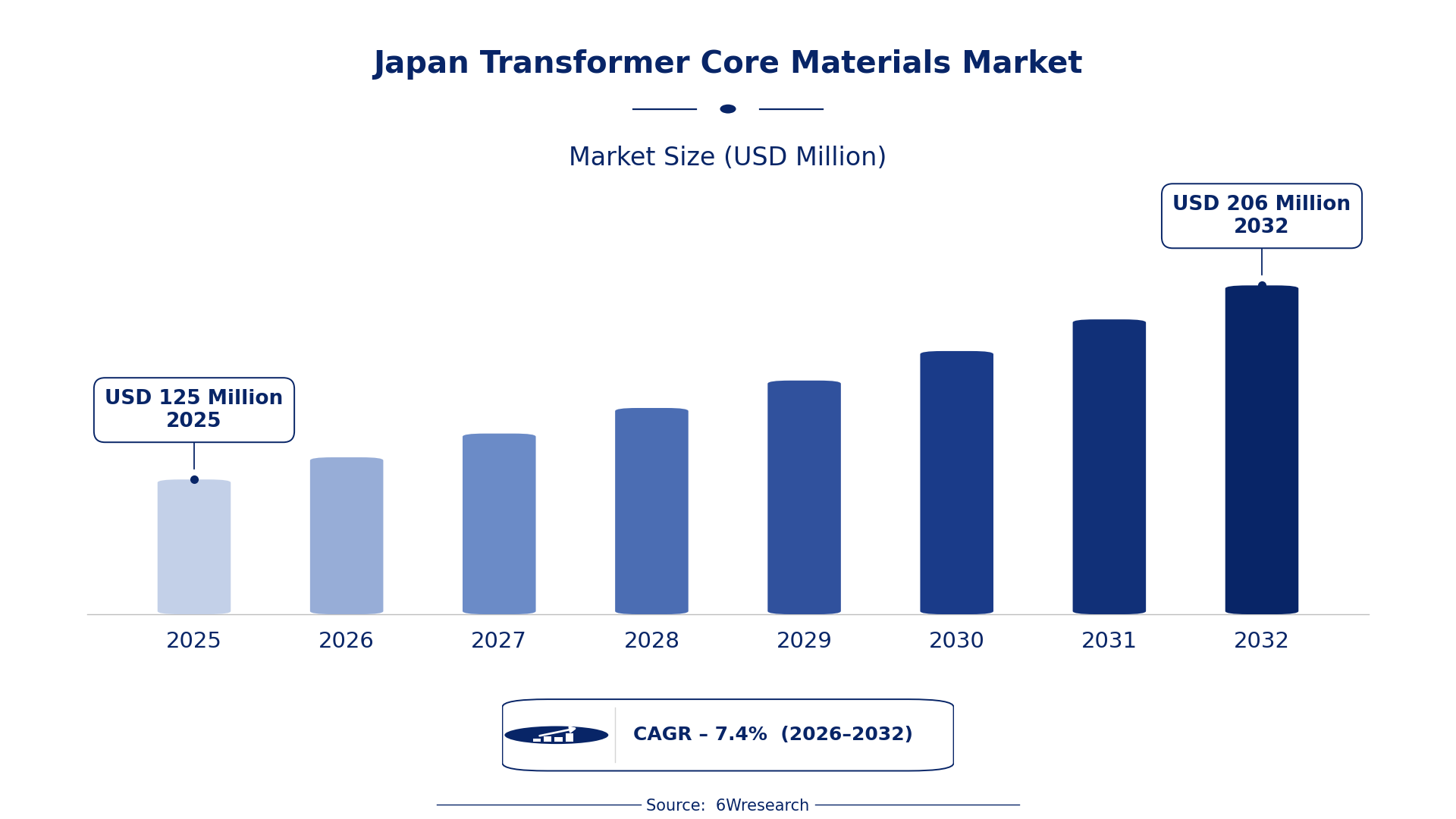
According to 6Wresearch internal database and industry insights, the Japan Transformer Core Materials Market was valued at USD 125 Million in 2025 and is projected to reach USD 206 Million by 2032, growing at a CAGR of approximately 7.4% during 2026–2032.
Japan Transformer Core Materials Market Highlights
| Report Metric | Details |
| Report Name | Japan Transformer Core Materials Market (2026-2032) |
| Market Size 2025 | USD 125 Million |
| Market Size 2032 | USD 206 Million |
| Absolute Growth 2025–2032 | USD 81 Million |
| CAGR 2026–2032 | 7.4% |
| Peak Annual Growth | 8.5% in 2032 |
| Forecast Period | 2026–2032 |
| Historical Data | 2022–2025 |
| Base Year | 2025 |
| Leading Material Type, 2025 | Silicon Steel (45% share) |
| Leading Magnetic Properties, 2025 | High Permeability (55% share) |
| Leading Application Type, 2025 | Distribution Transformers (38% share) |
| Leading End User, 2025 | Power Utilities (37% share) |
| Fastest-Growing Material Type | Amorphous Steel (10.9% CAGR) |
| Fastest-Growing Magnetic Properties | Low Core Loss (9.7% CAGR) |
| Fastest-Growing Application Type | Energy-Efficient Models (10.0% CAGR) |
| Fastest-Growing End User | Transformer OEMs (10.1% CAGR) |
| Growing Sector | Transformer Manufacturing |
| Key End Users | Power Utilities, Transformer OEMs, Industrial Suppliers, Smart Grid Developers |
Japan Transformer Core Materials Market Year-wise Growth Rate and Key Drivers (2022–2032)
This graph illustrates the annual growth rates of the market from 2022 to 2032, highlighting a steady upward trajectory and projected market expansion over the forecast period.
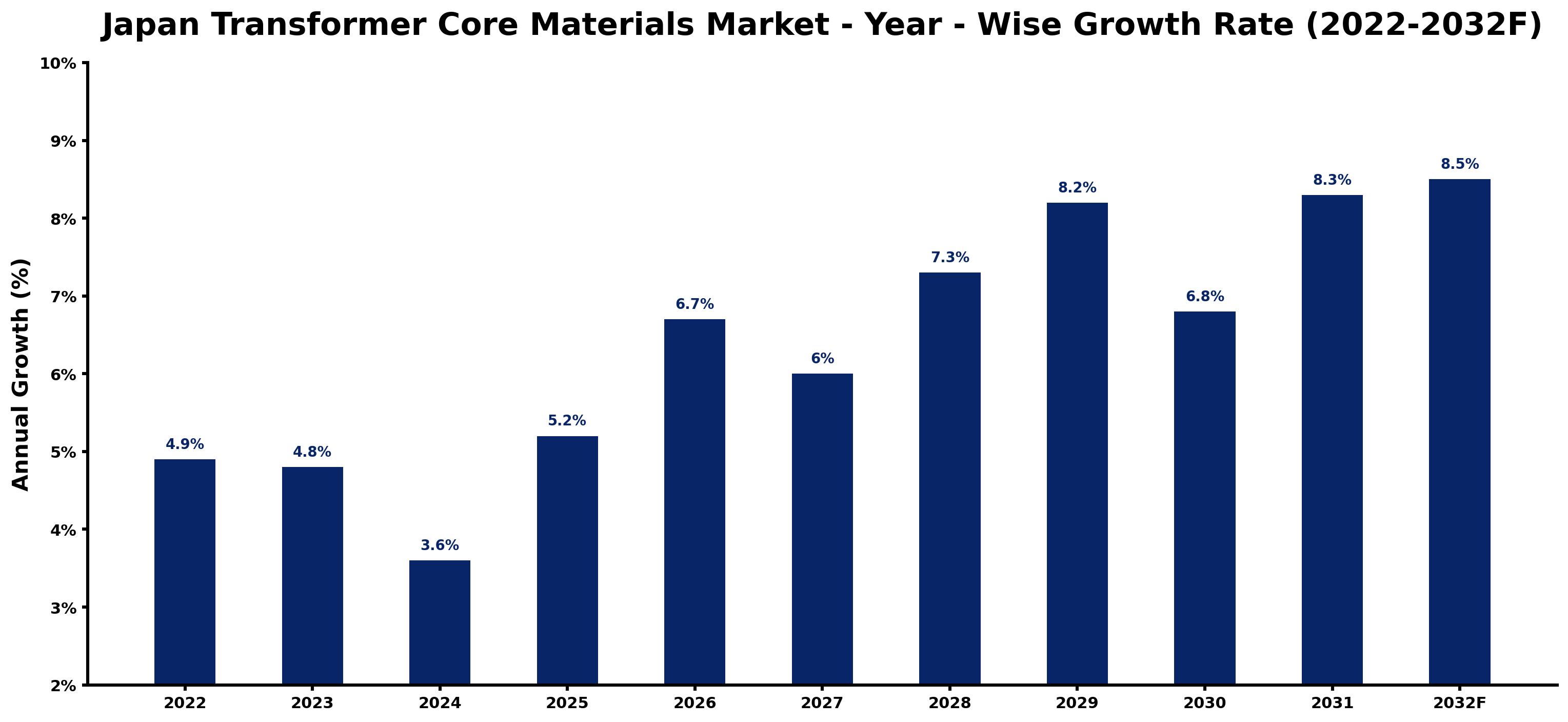
Annual growth estimates for each year appear below with the principal reason behind them, explaining the shifts that set the pace of the market.
| Year | Estimated Annual Growth (%) | Market Rationale |
| 2022 | 4.9 | The market experienced steady growth due to ongoing demand from power utilities. |
| 2023 | 4.8 | Growth slowed slightly as manufacturers adjusted to changing energy policies. |
| 2024 | 3.6 | A further slowdown occurred as supply chain issues impacted production rates. |
| 2025 | 5.2 | Demand increased as investments in energy-efficient technologies gained momentum. |
| 2026 | 6.7 | Growth accelerated with rising orders for advanced transformer materials. |
| 2027 | 6.0 | A slight slowdown was noted as market conditions stabilised. |
| 2028 | 7.3 | Demand surged as smart grid initiatives expanded across regions. |
| 2029 | 8.2 | Growth continued to rise with increased focus on sustainability measures. |
| 2030 | 6.8 | A slowdown was observed as market saturation began to take effect. |
| 2031 | 8.3 | Demand rebounded strongly due to renewed investments in infrastructure. |
| 2032 | 8.5 | The market peaked as energy efficiency became a priority across sectors. |
Note: Market size estimations and growth projections presented in this report are based on 6Wresearch's proprietary forecasting methodology, utilizing the latest available industry data, government publications, and primary research inputs.
Japan Transformer Core Materials Market Synopsis
Transformer core materials, primarily made from silicon steel and amorphous steel, are essential for efficient transformer operation, minimising energy losses during electricity transmission. The Japan Transformer Core Materials Market is expanding due to investments in energy-efficient solutions and smart grid developments, with public and private decarbonisation investments targeting around JPY 150 trillion over the next decade. The Tokyo metropolitan area serves as a major hub for transformer manufacturing, driven by local demand from power utilities and industrial suppliers. This growth is supported by a focus on sustainability and technological advancements in the sector.
Market Dynamics Impact Analysis (2026–2032)
| Factor | Type | Impact | Primary Segment Affected |
| Growing demand for energy-efficient transformers | Driver | High | Amorphous Steel |
| Increased investments in smart grid technology | Driver | High | Distribution Transformers |
| Rising focus on sustainable energy solutions | Opportunity | High | Energy-Efficient Models |
| Expansion of transformer manufacturing in the Tokyo metropolitan area | Opportunity | Medium | Silicon Steel |
| Supply chain disruptions affecting raw material availability | Restraint | High | Ferrite Cores |
| High production costs impacting profit margins | Restraint | Medium | Nanocrystalline Cores |
| Compliance with stringent environmental regulations | Challenge | High | High Permeability |
| Capacity constraints in manufacturing facilities | Challenge | Medium | Low Core Loss |
Evaluation of Drivers in Japan Transformer Core Materials Market (2026–2032)
The main growth drivers and the segments they affect most are set out below.
| Drivers | Primary Segment Affected | Why It Matters (Evidence) |
| Increased orders for energy-efficient transformers | Amorphous Steel | The demand for energy-efficient models is projected to increase by 15% by 2025, prompting manufacturers to invest in amorphous steel. |
| Growing investments in smart grid initiatives | Distribution Transformers | Investment in smart grid technology is expected to reach ¥500 billion by 2025, driving demand for distribution transformers. |
| Rising focus on reducing energy losses | High Permeability | High permeability materials are essential for reducing energy losses in transformers, leading to increased orders. |
| Demand from power utilities for reliable power solutions | Silicon Steel | With Japan's population of approximately 126 million, the need for reliable power solutions drives silicon steel demand. |
| Technological advancements in transformer design | Energy-Efficient Models | The growing demand for sustainability is pushing manufacturers to innovate in energy-efficient transformer designs. |
Orders keep climbing as the demand for energy-efficient transformers rises, with projections indicating a 15% increase by 2025. Investments in smart grid technology are expected to reach ¥500 billion by 2025, boosting the distribution transformer segment. The need for reliable power solutions in a population of around 126 million drives the demand for silicon steel, while technological advancements in transformer design are pushing the market towards more energy-efficient models. These factors contribute to a vibrant market environment, prompting manufacturers to innovate their offerings.
Evaluation of Restraints in Japan Transformer Core Materials Market
The following restraints limit how fast demand can grow.
| Market Restraint | Primary Segment Affected | Why It Matters (Evidence) |
| Supply chain disruptions affecting raw material availability | Ferrite Cores | Supply chain issues have led to delays in raw material procurement, impacting production schedules. |
| High production costs impacting profit margins | Nanocrystalline Cores | Rising costs of raw materials have squeezed profit margins for manufacturers, limiting investment. |
| Compliance with stringent environmental regulations | High Permeability | Stringent regulations require additional investments in compliance measures, increasing operational costs. |
| Limited availability of skilled workforce | Low Core Loss | A shortage of skilled workers in the manufacturing sector has constrained production capabilities. |
| Market saturation in certain segments | Silicon Steel | Increased competition and market saturation have led to price pressures in the silicon steel segment. |
Japan Transformer Core Materials Market Challenges
In Japan, power utilities face a shortage of skilled workers in the transformer sector, which delays production schedules and increases project timelines. Manufacturers struggle to obtain high-quality silicon steel, causing lead times to extend by up to 20%, impacting the availability of transformers. Compliance with JIS C 4004 introduces regulatory complexities, resulting in additional costs and delays for producers trying to meet market demands.
Trends in the Japan Transformer Core Materials Market
Four trends stand out in the Japan Transformer Core Materials Market.
- Shift towards Energy-Efficient Models: In 2023, the demand for energy-efficient transformer models surged, influenced by sustainability goals. The government aims for a 46% reduction in greenhouse gas emissions by 2030, encouraging manufacturers to innovate in this area.
- Transition from Traditional to Smart Grid Solutions: Power utilities are increasingly adopting smart grid technologies, particularly in the Tokyo metropolitan area. This shift is supported by expected investments of ¥500 billion by 2025, improving grid efficiency and reliability.
- Emergence of High Permeability Materials: High permeability materials are gaining traction in transformer production due to their efficiency. In 2022, over 1 million distribution transformers were produced, showcasing the growing reliance on these materials for energy efficiency.
- Growing Adoption of Amorphous Steel: Amorphous steel is becoming more prevalent in transformer manufacturing, particularly for energy-efficient models. Its lower energy losses are driving increased usage, with a projected growth rate of 10.9% through 2032.
Investment Opportunities in the Japan Transformer Core Materials Market
The openings below show where demand in the Japan Transformer Core Materials Market is visible and how suppliers can enter.
- Kansai Region as a Manufacturing Hub: The Kansai region is a focal point for transformer material suppliers, with potential for growth. Investment in local manufacturing facilities can tap into the expanding market, supported by regional demand.
- Timing for Energy-Efficient Solutions: As Japan targets a 46% reduction in emissions by 2030, the demand for energy-efficient transformers is rising. Suppliers should focus on developing advanced materials to meet this growing demand effectively.
- Partnerships with Transformer OEMs: Collaborating with transformer OEMs presents a timely opportunity for suppliers to enhance their market presence. By forming joint ventures, they can access advanced technologies and expand their reach in the industry.
- Investment in Smart Grid Technologies: With expected investments of ¥500 billion by 2025 in smart grid technologies, suppliers can enter this market by offering innovative transformer solutions tailored to these initiatives.
Government Initiatives in the Japan Transformer Core Materials Market
The PRTR Law of 1999 mandates businesses to report chemical substance releases, ensuring transparency in the production of transformer core materials. The Chemical Substances Control Law of 1973 requires evaluation and control of chemicals used in manufacturing, impacting production processes and compliance costs for manufacturers in the sector.
The Green Growth Strategy aims to promote sustainable practices, targeting JPY 150 trillion in investments over the next decade. The Ministry of Economy, Trade and Industry oversees various programmes that support investment in decarbonisation initiatives, benefiting transformer core material producers by encouraging compliance with environmental standards.
Future Insight of the Japan Transformer Core Materials Market
The investment pipeline for decarbonisation will create substantial demand for transformer core materials, with public and private investments projected at JPY 150 trillion over the next decade. By 2032, advancements in smart grid technology will require suppliers to enhance their offerings, aligning with new energy efficiency standards. The installed base of over 10 million transformers will necessitate upgrades, driving manufacturers to focus on high-performance solutions. Increased emphasis on reducing energy consumption by 20% in the power sector will further shape buyer preferences towards innovative transformer designs.
Market Segmentation Analysis
Japan Transformer Core Materials Market report covers a detailed analysis of the following market segments:
By Material Type – Silicon Steel Leads, Amorphous Steel Expected to Grow Fastest
According to Saurav Kr Singh, Senior Research Analyst at 6Wresearch, Silicon Steel held 45% of the Japan Transformer Core Materials Market by material type in 2025. Silicon steel holds a dominant position in transformer cores due to its efficiency in energy transmission. This material is integral to the majority of the over 1 million distribution transformers produced in Japan in 2022, making it essential for the industry. The quickest growth will come from Amorphous Steel, forecast to expand at a CAGR of 10.9% between 2026 and 2032. Amorphous steel is experiencing rapid growth because of its lower energy losses, appealing to manufacturers prioritising energy efficiency. The anticipated 15% increase in demand for energy-efficient models by 2025 will further accelerate this segment's expansion. Suppliers must focus on increasing production of amorphous steel to meet the rising demand for energy-efficient transformer solutions.
By Magnetic Properties – High Permeability Leads, Low Core Loss Expected to Grow Fastest
With 55% of magnetic properties revenue in 2025, High Permeability was the largest category. High permeability materials dominate the market as they are essential for reducing energy losses in transformer operation. Their critical role in efficiency makes them a preferred choice among manufacturers in Japan. Over 2026–2032, Low Core Loss is expected to post the fastest growth, at a CAGR of 9.7%. Low core loss materials are gaining traction due to their importance in energy-efficient designs, aligning with Japan's sustainability goals. The government's targets for reducing energy consumption in the power sector by 20% by 2030 will likely boost this segment's growth. Manufacturers must invest in developing low core loss materials to align with the increasing focus on energy efficiency.
By Application Type – Distribution Transformers Lead, Energy-Efficient Models Expected to Grow Fastest
In 2025, Distribution Transformers led the application type split with a 38% share. Distribution transformers represent over 50% of the transformer market, primarily due to their critical function in power distribution throughout Japan. The extensive installed base of over 10 million units underscores their importance in the energy infrastructure. Energy-Efficient Models are set to record the highest CAGR in this split, 10.0% over 2026–2032. Energy-efficient models are experiencing swift growth as sustainability becomes a priority for both consumers and utilities. The government's ambitious decarbonisation investment of JPY 150 trillion over the next decade will further drive this demand. Suppliers need to prioritise the development of energy-efficient transformer models to take advantage of the expanding market.
By End User – Power Utilities Lead, Transformer OEMs Expected to Grow Fastest
Power Utilities took 37% of end user revenue in 2025, more than any other category. Power utilities are the primary end users of transformers, essential for effective power distribution across Japan's population of around 126 million. Their substantial demand for transformers significantly shapes the market for core materials, ensuring a steady need for supply. Transformer OEMs are projected to grow fastest, at a CAGR of 10.1% during 2026–2032. Transformer OEMs are witnessing the fastest growth as they adapt to the increasing demand for energy-efficient transformers. The ongoing investment in smart grid technology and energy-efficient solutions will likely enhance their market presence. Suppliers should establish robust relationships with transformer OEMs to align with the industry's shift towards energy efficiency.
Key Attractiveness of the Report
- 10 Years of Market Numbers
- Historical Data Starting from 2022 to 2025
- Base Year 2025
- Forecast Data until 2032
- Key Performance Indicators Impacting the Market
- Major Upcoming Developments and Projects
Key Highlights of the Report:
- Japan Transformer Core Materials Market Outlook
- Market Size of Japan Transformer Core Materials Market, 2025
- Forecast of Japan Transformer Core Materials Market, 2032
- Historical Data and Forecast of Japan Transformer Core Materials Revenues & Volume for the Period 2022-2032F
- Japan Transformer Core Materials Market Trend Evolution
- Japan Transformer Core Materials Market Drivers and Challenges
- Japan Transformer Core Materials Price Trends
- Japan Transformer Core Materials Porter's Five Forces
- Japan Transformer Core Materials Industry Life Cycle
- Historical Data and Forecast of Japan Transformer Core Materials Market Revenues & Volume By Material Type for the Period 2022-2032F
- Historical Data and Forecast of Japan Transformer Core Materials Market Revenues & Volume By Silicon Steel for the Period 2022-2032F
- Historical Data and Forecast of Japan Transformer Core Materials Market Revenues & Volume By Amorphous Steel for the Period 2022-2032F
- Historical Data and Forecast of Japan Transformer Core Materials Market Revenues & Volume By Ferrite Cores for the Period 2022-2032F
- Historical Data and Forecast of Japan Transformer Core Materials Market Revenues & Volume By Nanocrystalline Cores for the Period 2022-2032F
- Historical Data and Forecast of Japan Transformer Core Materials Market Revenues & Volume By Magnetic Properties for the Period 2022-2032F
- Historical Data and Forecast of Japan Transformer Core Materials Market Revenues & Volume By High Permeability for the Period 2022-2032F
- Historical Data and Forecast of Japan Transformer Core Materials Market Revenues & Volume By Low Core Loss for the Period 2022-2032F
- Historical Data and Forecast of Japan Transformer Core Materials Market Revenues & Volume By High Frequency for the Period 2022-2032F
- Historical Data and Forecast of Japan Transformer Core Materials Market Revenues & Volume By Compact Size for the Period 2022-2032F
- Historical Data and Forecast of Japan Transformer Core Materials Market Revenues & Volume By Application Type for the Period 2022-2032F
- Historical Data and Forecast of Japan Transformer Core Materials Market Revenues & Volume By Distribution Transformers for the Period 2022-2032F
- Historical Data and Forecast of Japan Transformer Core Materials Market Revenues & Volume By Energy-Efficient Models for the Period 2022-2032F
- Historical Data and Forecast of Japan Transformer Core Materials Market Revenues & Volume By Electronics Transformers for the Period 2022-2032F
- Historical Data and Forecast of Japan Transformer Core Materials Market Revenues & Volume By Compact Grid Systems for the Period 2022-2032F
- Historical Data and Forecast of Japan Transformer Core Materials Market Revenues & Volume By End User for the Period 2022-2032F
- Historical Data and Forecast of Japan Transformer Core Materials Market Revenues & Volume By Power Utilities for the Period 2022-2032F
- Historical Data and Forecast of Japan Transformer Core Materials Market Revenues & Volume By Transformer OEMs for the Period 2022-2032F
- Historical Data and Forecast of Japan Transformer Core Materials Market Revenues & Volume By Industrial Suppliers for the Period 2022-2032F
- Historical Data and Forecast of Japan Transformer Core Materials Market Revenues & Volume By Smart Grid Developers for the Period 2022-2032F
- Japan Transformer Core Materials Import Export Trade Statistics
- Market Opportunity Assessment By Material Type
- Market Opportunity Assessment By Magnetic Properties
- Market Opportunity Assessment By Application Type
- Market Opportunity Assessment By End User
- Japan Transformer Core Materials Top Companies Market Share
- Japan Transformer Core Materials Competitive Benchmarking By Technical and Operational Parameters
- Japan Transformer Core Materials Company Profiles
- Japan Transformer Core Materials Key Strategic Recommendations
Market Covered
The following segment groups are covered in the report.
By Material Type
- Silicon Steel
- Amorphous Steel
- Ferrite Cores
- Nanocrystalline Cores
By Magnetic Properties
- High Permeability
- Low Core Loss
- High Frequency
- Compact Size
By Application Type
- Distribution Transformers
- Energy-Efficient Models
- Electronics Transformers
- Compact Grid Systems
By End User
- Power Utilities
- Transformer OEMs
- Industrial Suppliers
- Smart Grid Developers































