Japan Transfusion Services Market Size & Growth Rate
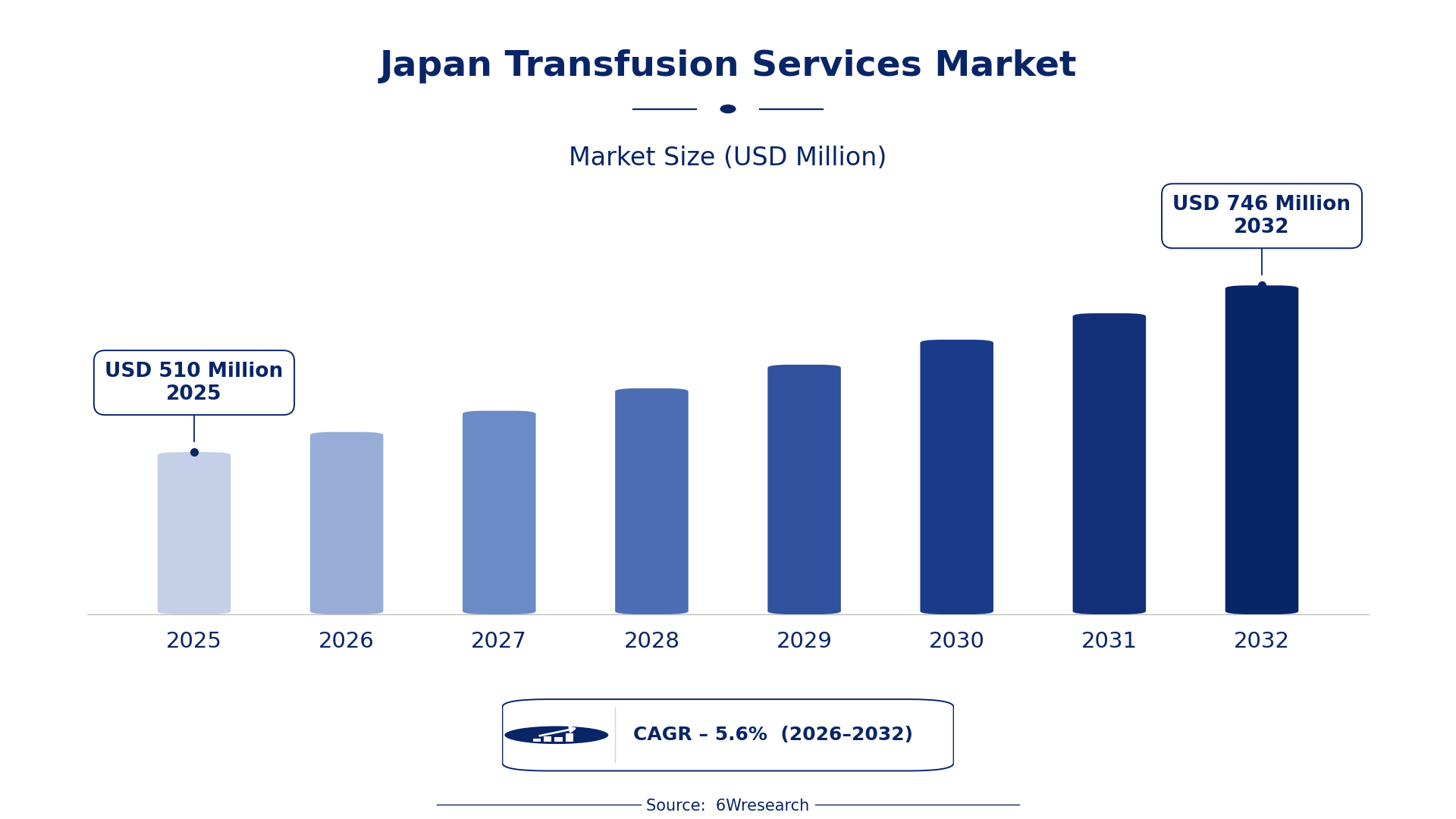
According to 6Wresearch internal database and industry insights, the Japan Transfusion Services Market was valued at USD 510 Million in 2025 and is projected to reach USD 746 Million by 2032, growing at a CAGR of approximately 5.6% during 2026–2032.
Japan Transfusion Services Market Highlights
| Report Metric | Details |
| Report Name | Japan Transfusion Services Market (2026-2032) |
| Market Size 2025 | USD 510 Million |
| Market Size 2032 | USD 746 Million |
| Absolute Growth 2025–2032 | USD 236 Million |
| CAGR 2026–2032 | 5.6% |
| Peak Annual Growth | 6.8% in 2032 |
| Forecast Period | 2026–2032 |
| Historical Data | 2022–2025 |
| Base Year | 2025 |
| Leading Service Type, 2025 | Blood Collection (44% share) |
| Leading Blood Product Type, 2025 | Whole Blood (48% share) |
| Leading Facility Type, 2025 | Hospitals (38% share) |
| Leading End User, 2025 | Healthcare Facilities (42% share) |
| Fastest-Growing Service Type | Storage & Transport (7.7% CAGR) |
| Fastest-Growing Blood Product Type | Plasma (8.3% CAGR) |
| Fastest-Growing Facility Type | Blood Banks (7.3% CAGR) |
| Growing Sector | Healthcare Facilities |
| Key End Users | Hospitals, Blood Banks, Emergency Services, Healthcare Facilities |
Japan Transfusion Services Market Year-wise Growth Rate and Key Drivers (2022–2032)
This graph illustrates the annual growth rates of the market from 2022 to 2032, highlighting a steady upward trajectory and projected market expansion over the forecast period.
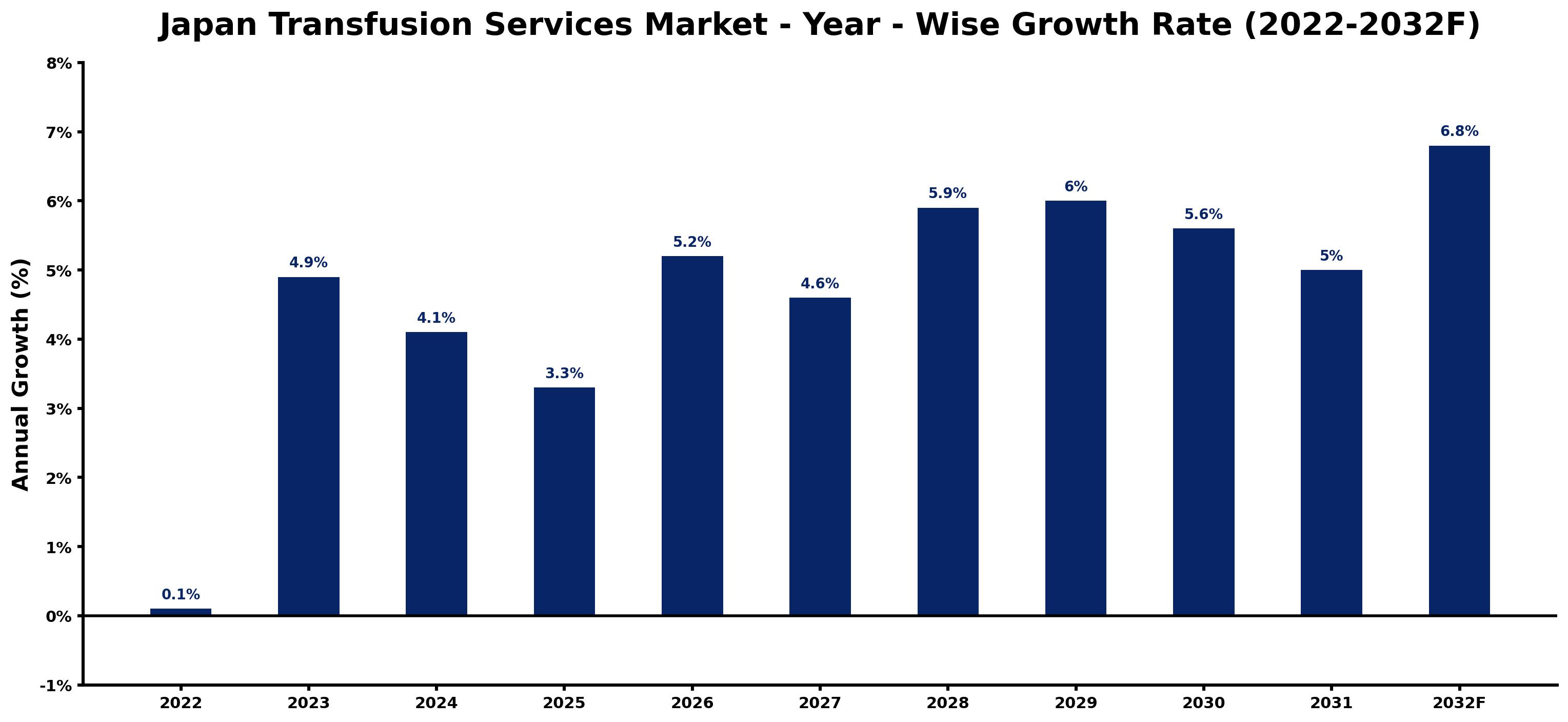
Below, each year's estimated growth is shown next to the factor that most influenced it.
| Year | Estimated Annual Growth (%) | Market Rationale |
| 2022 | 0.1 | The market experienced minimal growth as hospitals adjusted to recovery from previous challenges. |
| 2023 | 4.9 | Demand surged due to increased surgical procedures and trauma care requirements. |
| 2024 | 4.1 | Growth slowed as hospitals faced operational challenges and resource allocation issues. |
| 2025 | 3.3 | The market continued to grow, albeit at a slower pace due to fluctuations in donor engagement. |
| 2026 | 5.2 | Demand is expected to increase as new blood donation initiatives attract more voluntary donors. |
| 2027 | 4.6 | Growth will slow again as hospitals face staffing shortages impacting transfusion rates. |
| 2028 | 5.9 | The market is projected to rebound with rising awareness of blood donation benefits among citizens. |
| 2029 | 6.0 | Demand will continue to rise as emergency services expand their use of blood products. |
| 2030 | 5.6 | Growth is expected to slow due to challenges in maintaining donor engagement and retention. |
| 2031 | 5.0 | The market will still grow, but at a reduced rate as competition for donor attention increases. |
| 2032 | 6.8 | Demand is projected to peak with new technologies improving blood processing and storage capabilities. |
Note: Market size estimations and growth projections presented in this report are based on 6Wresearch's proprietary forecasting methodology, utilizing the latest available industry data, government publications, and primary research inputs.
Japan Transfusion Services Market Synopsis
Transfusion services involve the collection, testing, processing, and distribution of blood and its components, which are essential for surgeries and trauma care. The Japan Transfusion Services Market is expanding due to increased surgical procedures and a national initiative promoting voluntary blood donation among youth. With over 800 blood donation centers and hospitals performing over 1 million transfusions annually, advancements in blood management systems and rising public awareness are driving market growth.
Market Dynamics Impact Analysis (2026–2032)
| Factor | Type | Impact | Primary Segment Affected |
| Increased surgical procedures drive demand for blood services. | Driver | High | Blood Collection |
| New blood donation initiatives are expanding donor pools. | Driver | High | Blood Collection |
| Growing awareness of blood donation benefits opens new markets. | Opportunity | High | Healthcare Facilities |
| Technological advancements in blood processing create new supply needs. | Opportunity | High | Blood Banks |
| Staffing shortages in hospitals may limit service capacity. | Restraint | Medium | Hospitals |
| Fluctuations in donor engagement can affect blood supply consistency. | Restraint | Medium | Blood Collection |
| Competition for donor attention is increasing among various initiatives. | Challenge | High | Healthcare Facilities |
| Regulatory compliance costs can burden smaller blood banks. | Challenge | Medium | Blood Banks |
Evaluation of Drivers in Japan Transfusion Services Market (2026–2032)
Below are the drivers that matter most for revenue growth, with supporting evidence.
| Drivers | Primary Segment Affected | Why It Matters (Evidence) |
| Increased surgical procedures drive demand for blood services. | Blood Collection | Hospitals performed over 1 million blood transfusions annually, necessitating a steady blood supply. |
| New blood donation initiatives are expanding donor pools. | Blood Collection | Japan's national programme promotes voluntary blood donation among youth, attracting more donors. |
| Technological advancements in blood processing improve efficiency. | Blood Banks | Blood banks are adopting JIS Z 2801 standards, which support safety and processing capabilities. |
| Growing public awareness of blood donation benefits increases participation. | Healthcare Facilities | The blood donation rate in Japan is approximately 3.5% of the eligible population, reflecting rising engagement. |
| Emergency services are increasingly utilizing blood products for trauma cases. | Emergency Services | Emergency services in Tokyo utilize blood products, highlighting the critical need for timely blood access. |
Much of the new demand traces back to the blood donation rate among eligible citizens, which encourages hospitals to secure a steady blood supply for over 1 million transfusions annually. Blood banks are adhering to JIS Z 2801 standards, which supports demand by ensuring safety and processing capabilities. Emergency services increasingly utilise blood products for trauma cases, raising the urgency for reliable blood access.
Evaluation of Restraints in Japan Transfusion Services Market
The following restraints limit how fast demand can grow.
| Market Restraint | Primary Segment Affected | Why It Matters (Evidence) |
| Staffing shortages in hospitals may limit service capacity. | Hospitals | With over 1,200 hospitals equipped for blood transfusion, staffing challenges can hinder operational efficiency. |
| Fluctuations in donor engagement can affect blood supply consistency. | Blood Collection | The average population of blood donors in Japan is around 4.5 million annually, but engagement can vary. |
| Regulatory compliance costs can burden smaller blood banks. | Blood Banks | Blood banks must adhere to strict regulations, which can strain financial resources for smaller facilities. |
| Competition for donor attention is increasing among various initiatives. | Healthcare Facilities | Various blood donation drives are competing for the same donor pool, impacting overall collection rates. |
| Limited public awareness of specific blood component needs can hinder donations. | Component Separation | Awareness campaigns are necessary to educate potential donors on the importance of specific blood components. |
Japan Transfusion Services Market Challenges
Transfusion services encounter a shortage of skilled professionals, as training programmes fail to keep pace with the rising demand for safe blood handling, leading to delays for hospitals. Logistical inefficiencies hinder timely deliveries, potentially postponing critical transfusions for trauma patients and affecting emergency services. Many blood banks struggle with outdated testing equipment, resulting in longer processing times that may jeopardise patient safety. Increasing operational costs due to stringent regulatory standards place financial strain on suppliers, restricting their ability to upgrade essential infrastructure and meet market demands.
Trends in the Japan Transfusion Services Market
The shifts below are changing how Japan Transfusion Services Market products are bought and supplied.
- Annual Blood Donation Events Gaining Popularity: The annual blood donation event in Tokyo attracts thousands of participants, highlighting a growing community engagement. In 2022, Japan collected approximately 3.5 million units of blood, reflecting increased public participation.
- Shift Towards Advanced Blood Processing Technologies: Blood banks are increasingly adopting advanced processing technologies, improving safety and efficiency. In 2023, a new initiative was launched to increase platelet donations, showcasing the focus on specific blood components.
- Healthcare Facilities Expanding Blood Utilization: Healthcare facilities are increasingly incorporating blood products into treatment protocols. Hospitals in Japan perform over 1 million blood transfusions each year, demonstrating the critical role of transfusion services.
- Youth Engagement in Blood Donation Rising: Japan's national programme to promote voluntary blood donation among youth is gaining traction. The average age of blood donors is around 40 years, indicating a need to attract younger donors.
Investment Opportunities in the Japan Transfusion Services Market
Where to invest in the Japan Transfusion Services Market: the main openings are set out below.
- Increasing Demand for Plasma-Derived Products: The plasma-derived products market is expanding, with a focus on treating hemophilia patients. In 2022, Japan collected approximately 3.5 million units of blood, indicating a growing need for these products.
- Investment in Blood Processing Facilities: There is an opportunity to invest in modern blood processing facilities. Blood banks in Japan are expanding to improve their capabilities, creating openings for new suppliers.
- Partnerships for Blood Collection Drives: Collaborating with educational institutions for blood drives can boost donor numbers. The average population of blood donors in Japan is around 4.5 million annually, showing potential for growth.
- Expansion of Emergency Blood Services: Investing in emergency services that utilise blood products can meet rising demand. Emergency services in Tokyo utilise blood products for trauma cases, highlighting the need for timely access.
Government Initiatives in the Japan Transfusion Services Market
The Medical Care Act of 1948 establishes standards for hospitals and clinics, ensuring they meet necessary staffing and facility requirements for blood transfusion services. The Long-Term Care Insurance Act, in force since 2000, supports nursing care and services, indirectly benefiting blood service accessibility for older populations.
The Ministry of Health, Labour and Welfare oversees blood services in Japan, regulating compliance with safety standards and ensuring that blood service providers adhere to established protocols. The Clinical Trials Act, in force since 2018, ensures transparency in clinical research, which can impact blood service innovations.
Future Insight of the Japan Transfusion Services Market
Advancements in automated blood testing technology will streamline processing and improve safety, potentially increasing the availability of blood products by 2032. A national initiative to encourage youth blood donation could raise donor numbers, addressing the ageing demographic. Enhanced tracking systems will improve inventory management, ensuring timely supplies to hospitals. By 2032, Japan's blood donation rate may reach 5%, reflecting successful community engagement and awareness campaigns.
Market Segmentation Analysis
Japan Transfusion Services Market report covers a detailed analysis of the following market segments:
By Service Type – Blood Collection Leads, Storage & Transport Expected to Grow Fastest
According to Saurav Kr Singh, Senior Research Analyst at 6Wresearch, with 44% of service type revenue in 2025, Blood Collection was the largest category. Blood collection holds the largest share because it is essential for obtaining blood from voluntary donors, with Japan collecting approximately 3.5 million units in 2022. The extensive network of over 800 blood donation centres ensures a steady supply to meet healthcare demands. Over 2026–2032, Storage & Transport is expected to post the fastest growth, at a CAGR of 7.7%. The storage and transport segment is experiencing rapid growth, primarily due to the increasing need to maintain blood viability until use, especially in emergencies. The Tokyo region, which accounts for about 25% of blood donations, underscores the urgent need for efficient logistics in urban healthcare. Suppliers must improve their storage and transport solutions to keep pace with the rising demand for blood products.
By Blood Product Type – Whole Blood Leads, Plasma Expected to Grow Fastest
Whole Blood accounted for 48% of the market by blood product type in 2025. Whole blood is the leading product type as it is widely used in various medical procedures and emergencies, with hospitals performing over 1 million blood transfusions each year. This high volume of transfusions highlights the critical role of whole blood in patient care. Plasma is projected to grow fastest, at a CAGR of 8.3% during 2026–2032. Plasma is the fastest-growing product type, mainly due to its vital role in treating clotting disorders and burns. The increasing awareness of plasma-derived therapies among healthcare providers is propelling this segment's growth. Buyers should consider enhancing their plasma procurement strategies to meet the increasing demand for plasma-derived products.
By Facility Type – Hospitals Lead, Blood Banks Expected to Grow Fastest
Hospitals took 38% of facility type revenue in 2025, more than any other category. Hospitals dominate the market as the primary users of transfusion services, providing essential care for patients requiring blood transfusions. With over 1,200 hospitals equipped for these services, their role is pivotal in the healthcare system. The quickest growth will come from Blood Banks, forecast to expand at a CAGR of 7.3% between 2026 and 2032. Blood banks are the fastest-growing facility type, crucial for the collection and processing of blood. Ongoing initiatives to promote voluntary blood donation are enhancing the operational capacity of blood banks. Suppliers should prioritise building partnerships with blood banks to ensure a reliable supply chain for blood products.
By End User – Healthcare Facilities Lead and Record the Fastest Growth
The largest end user category in 2025 was Healthcare Facilities, at 42% of revenue. Healthcare facilities are the largest end-user group, encompassing a broad range of medical services that rely on transfusion services. The annual blood donation rate of approximately 3.5% of the eligible population supports this extensive usage. Healthcare Facilities are also forecast to expand faster than any other category, at a CAGR of 7.4% over 2026–2032. Healthcare facilities are also the fastest-growing end-user segment, as the demand for transfusion services continues to rise across various medical disciplines. This growth is further supported by national initiatives promoting blood donation. Suppliers need to align their offerings with the expanding requirements of healthcare facilities to capture market opportunities.
Key Attractiveness of the Report
- 10 Years of Market Numbers
- Historical Data Starting from 2022 to 2025
- Base Year 2025
- Forecast Data until 2032
- Key Performance Indicators Impacting the Market
- Major Upcoming Developments and Projects
Key Highlights of the Report:
- Japan Transfusion Services Market Outlook
- Market Size of Japan Transfusion Services Market, 2025
- Forecast of Japan Transfusion Services Market, 2032
- Historical Data and Forecast of Japan Transfusion Services Revenues & Volume for the Period 2022-2032F
- Japan Transfusion Services Market Trend Evolution
- Japan Transfusion Services Market Drivers and Challenges
- Japan Transfusion Services Price Trends
- Japan Transfusion Services Porter's Five Forces
- Japan Transfusion Services Industry Life Cycle
- Historical Data and Forecast of Japan Transfusion Services Market Revenues & Volume By Service Type for the Period 2022-2032F
- Historical Data and Forecast of Japan Transfusion Services Market Revenues & Volume By Blood Collection for the Period 2022-2032F
- Historical Data and Forecast of Japan Transfusion Services Market Revenues & Volume By Component Separation for the Period 2022-2032F
- Historical Data and Forecast of Japan Transfusion Services Market Revenues & Volume By Storage & Transport for the Period 2022-2032F
- Historical Data and Forecast of Japan Transfusion Services Market Revenues & Volume By Compatibility Testing for the Period 2022-2032F
- Historical Data and Forecast of Japan Transfusion Services Market Revenues & Volume By Blood Product Type for the Period 2022-2032F
- Historical Data and Forecast of Japan Transfusion Services Market Revenues & Volume By Whole Blood for the Period 2022-2032F
- Historical Data and Forecast of Japan Transfusion Services Market Revenues & Volume By Plasma, Platelets for the Period 2022-2032F
- Historical Data and Forecast of Japan Transfusion Services Market Revenues & Volume By RBC, Plasma for the Period 2022-2032F
- Historical Data and Forecast of Japan Transfusion Services Market Revenues & Volume By Antigen/Antibody for the Period 2022-2032F
- Historical Data and Forecast of Japan Transfusion Services Market Revenues & Volume By Facility Type for the Period 2022-2032F
- Historical Data and Forecast of Japan Transfusion Services Market Revenues & Volume By Hospitals for the Period 2022-2032F
- Historical Data and Forecast of Japan Transfusion Services Market Revenues & Volume By Blood Banks for the Period 2022-2032F
- Historical Data and Forecast of Japan Transfusion Services Market Revenues & Volume By Emergency Services for the Period 2022-2032F
- Historical Data and Forecast of Japan Transfusion Services Market Revenues & Volume By Diagnostic Centers for the Period 2022-2032F
- Historical Data and Forecast of Japan Transfusion Services Market Revenues & Volume By End User for the Period 2022-2032F
- Historical Data and Forecast of Japan Transfusion Services Market Revenues & Volume By Healthcare Facilities for the Period 2022-2032F
- Historical Data and Forecast of Japan Transfusion Services Market Revenues & Volume By Clinics for the Period 2022-2032F
- Historical Data and Forecast of Japan Transfusion Services Market Revenues & Volume By Ambulance Services for the Period 2022-2032F
- Historical Data and Forecast of Japan Transfusion Services Market Revenues & Volume By Labs for the Period 2022-2032F
- Japan Transfusion Services Import Export Trade Statistics
- Market Opportunity Assessment By Service Type
- Market Opportunity Assessment By Blood Product Type
- Market Opportunity Assessment By Facility Type
- Market Opportunity Assessment By End User
- Japan Transfusion Services Top Companies Market Share
- Japan Transfusion Services Competitive Benchmarking By Technical and Operational Parameters
- Japan Transfusion Services Company Profiles
- Japan Transfusion Services Key Strategic Recommendations
Market Covered
This report examines the market across the segments below.
By Service Type
- Blood Collection
- Component Separation
- Storage & Transport
- Compatibility Testing
By Blood Product Type
- Whole Blood
- Plasma
- Platelets
- RBC
- Antigen/Antibody
By Facility Type
- Hospitals
- Blood Banks
- Emergency Services
- Diagnostic Centers
By End User
- Healthcare Facilities
- Clinics
- Ambulance Services
- Labs































