Japan Transit Advertising Market Size & Growth Rate
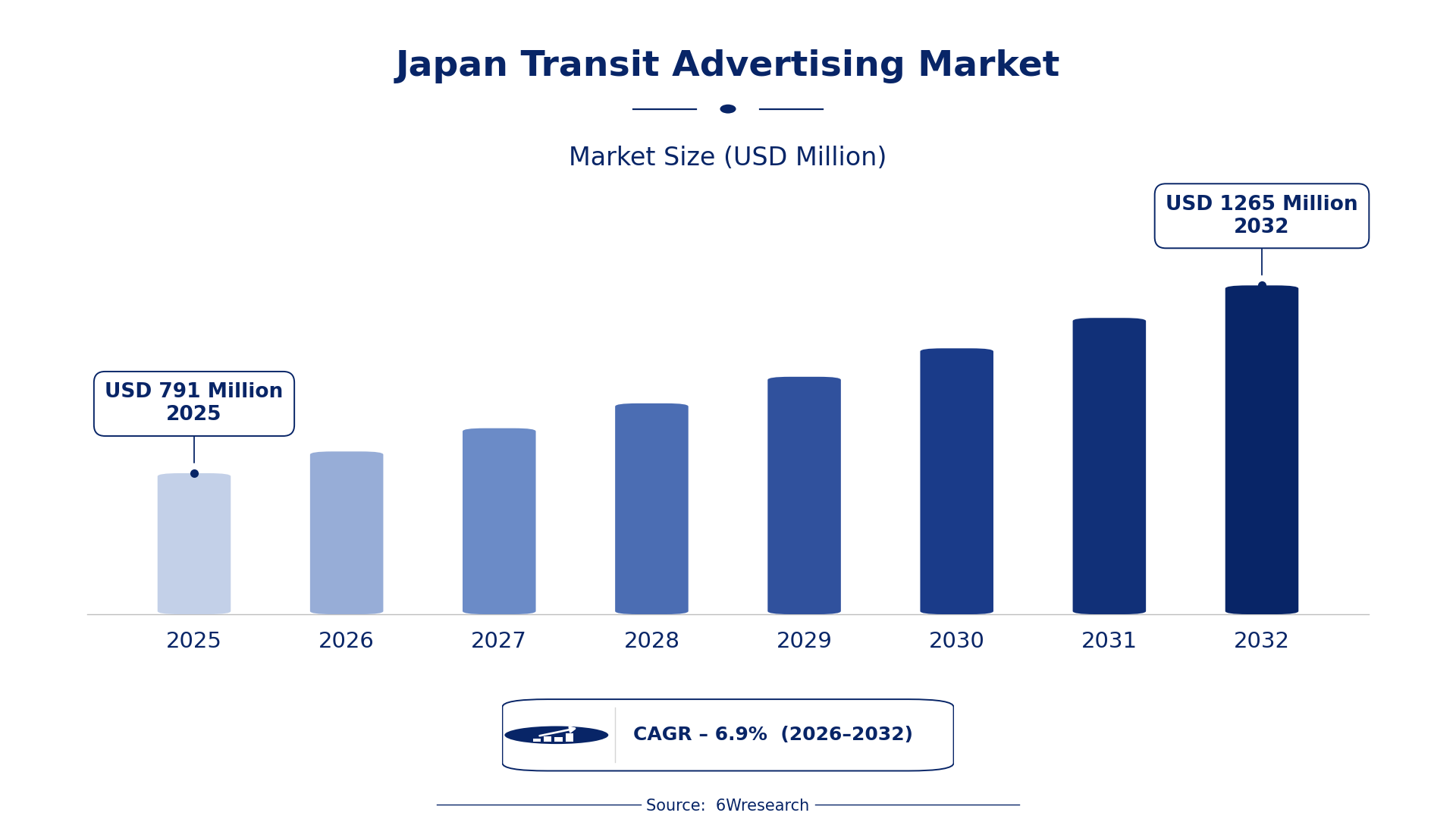
According to 6Wresearch internal database and industry insights, the Japan Transit Advertising Market was valued at USD 791 Million in 2025 and is projected to reach USD 1,265 Million by 2032, growing at a CAGR of approximately 6.9% during 2026–2032.
Japan Transit Advertising Market Highlights
| Report Metric | Details |
| Report Name | Japan Transit Advertising Market (2026-2032) |
| Market Size 2025 | USD 791 Million |
| Market Size 2032 | USD 1,265 Million |
| Absolute Growth 2025–2032 | USD 474 Million |
| CAGR 2026–2032 | 6.9% |
| Peak Annual Growth | 7.7% in 2027 |
| Forecast Period | 2026–2032 |
| Historical Data | 2022–2025 |
| Base Year | 2025 |
| Leading Advertising Type, 2025 | Digital Screens (52% share) |
| Leading Medium Used, 2025 | Digital & Static (46% share) |
| Leading Transit Mode, 2025 | Metro/Subways (45% share) |
| Leading End User, 2025 | FMCG Companies (43% share) |
| Fastest-Growing Medium Used | Vinyl Graphics (9.1% CAGR) |
| Fastest-Growing Transit Mode | Public Buses (9.3% CAGR) |
| Fastest-Growing End User | Local Businesses (8.7% CAGR) |
| Growing Sector | FMCG Companies |
| Key End Users | FMCG Companies, Local Businesses, Retail Brands |
Japan Transit Advertising Market Year-wise Growth Rate and Key Drivers (2022–2032)
This graph illustrates the annual growth rates of the market from 2022 to 2032, highlighting a steady upward trajectory and projected market expansion over the forecast period.
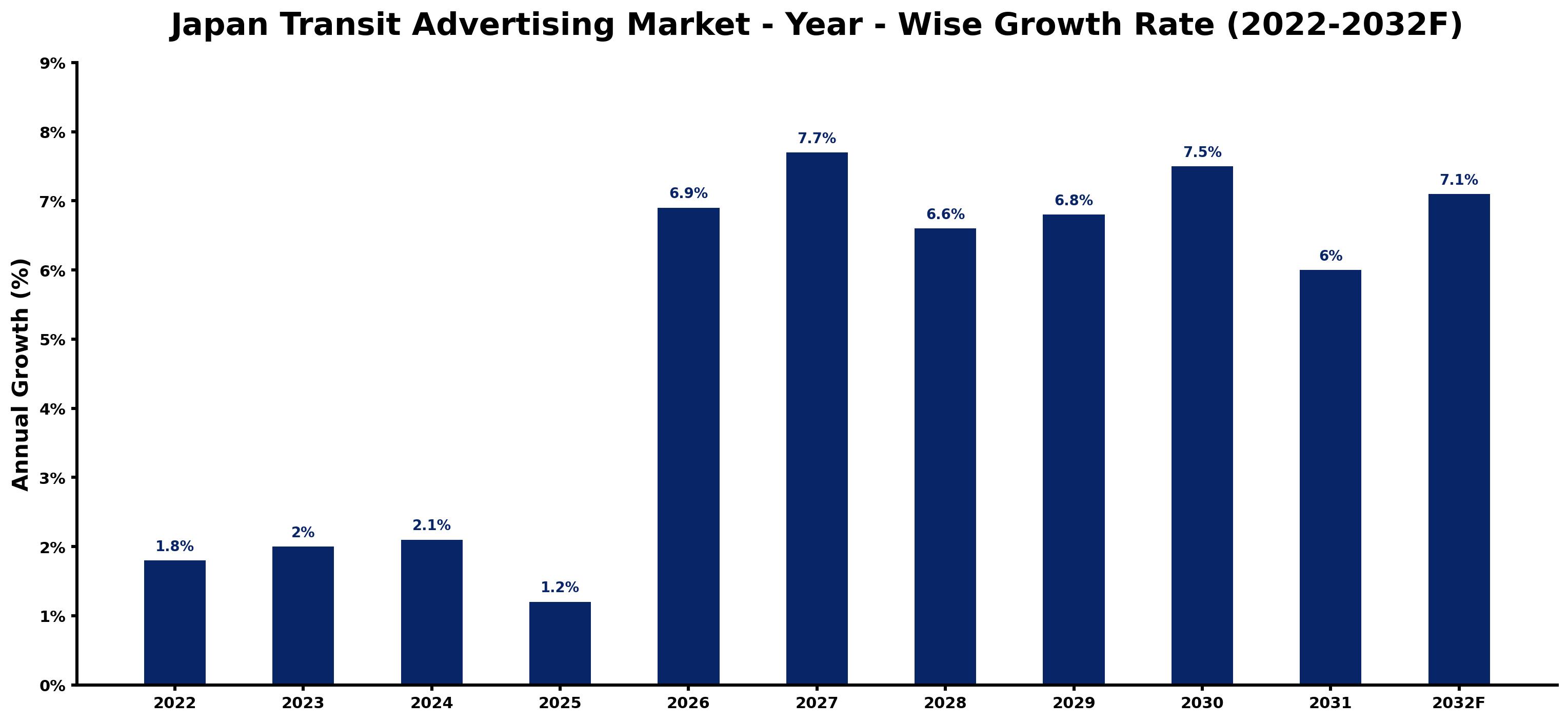
The table below sets out the estimated growth rate for each year and the main factor behind it.
| Year | Estimated Annual Growth (%) | Market Rationale |
| 2022 | 1.8 | The market showed steady growth as urban populations continued to rely on public transport. |
| 2023 | 2.0 | Increased advertising spending was noted as brands targeted commuters more aggressively. |
| 2024 | 2.1 | Demand rose further as digital screens became more prevalent in transit advertising. |
| 2025 | 1.2 | Growth slowed as the market adjusted to the saturation of certain advertising formats. |
| 2026 | 6.9 | A surge in digital advertising adoption will lead to a notable increase in market activity. |
| 2027 | 7.7 | The peak growth year will be driven by heightened competition among advertisers for visibility. |
| 2028 | 6.6 | Growth is expected to slow slightly as market dynamics stabilise after rapid digital adoption. |
| 2029 | 6.8 | Rising demand for public transport advertising will continue to drive market expansion. |
| 2030 | 7.5 | Increased investment in advertising technology will support sustained growth rates. |
| 2031 | 6.0 | Growth is projected to slow as the market matures, but demand will remain strong among key sectors. |
| 2032 | 7.1 | A resurgence in advertising campaigns is expected to boost market performance. |
Note: Market size estimations and growth projections presented in this report are based on 6Wresearch's proprietary forecasting methodology, utilizing the latest available industry data, government publications, and primary research inputs.
Japan Transit Advertising Market Synopsis
Transit advertising in Japan encompasses various forms displayed on public transportation systems, including buses and trains, utilising materials such as vinyl and digital technology. The Japan Transit Advertising Market is growing due to urban populations and high public transport usage, with FMCG companies representing 40% of expenditure. The rise of digital screens and local government initiatives are creating new demand, improving visibility for brands targeting commuters.
Market Dynamics Impact Analysis (2026–2032)
| Factor | Type | Impact | Primary Segment Affected |
| High public transport usage drives demand for transit advertising. | Driver | High | Public Buses |
| Digital technology adoption increases advertising effectiveness. | Driver | High | Digital Screens |
| Growing urban populations create new advertising opportunities. | Opportunity | High | Metro/Subways |
| Local business initiatives promote community engagement through transit ads. | Opportunity | High | Local Businesses |
| High costs associated with premium advertising placements can limit access. | Restraint | Medium | Bus Wraps |
| Regulatory standards may restrict certain advertising formats in transit. | Restraint | Medium | Train Interior Ads |
| Competition for advertising space increases costs for advertisers. | Challenge | High | Digital Screens |
| Rapid technological changes can lead to obsolescence of existing formats. | Challenge | Medium | Vinyl Graphics |
Evaluation of Drivers in Japan Transit Advertising Market (2026–2032)
These are the developments adding the most demand over the forecast period.
| Drivers | Primary Segment Affected | Why It Matters (Evidence) |
| High commuter traffic in urban areas increases ad visibility. | Metro/Subways | Tokyo's subway system has over 200 digital advertising screens, increasing brand exposure. |
| The shift to digital formats attracts more advertisers. | Digital Screens | In 2023, transit ad spending increased by 15%, driven by digital adoption. |
| FMCG companies prioritise transit advertising for brand promotion. | Public Buses | FMCG companies account for 40% of transit advertising spend in Japan. |
| Local government initiatives support community-focused advertising. | Local Businesses | The Tokyo Metropolitan Government promotes local businesses through transit advertising initiatives. |
| Long dwell times for train interior ads enhance engagement. | Train Interior Ads | The average dwell time for train interior ads is 12 minutes per passenger. |
Most of the extra volume stems from the increasing urban population, which drives demand for transit advertising. In 2023, transit ad spending rose by 15%, indicating a shift towards digital formats. The average dwell time for train interior ads is 12 minutes per passenger, offering ample opportunity for engagement. With the Tokyo subway system featuring over 200 digital screens, advertisers are taking advantage of improved visibility and engagement opportunities.
Evaluation of Restraints in Japan Transit Advertising Market
These are the pressures that could keep growth below its potential.
| Market Restraint | Primary Segment Affected | Why It Matters (Evidence) |
| High costs can limit access to premium advertising placements. | Bus Wraps | The average cost of a bus wrap in Tokyo is approximately 1 million yen, restricting smaller advertisers. |
| Regulatory standards may restrict certain advertising formats in transit. | Train Interior Ads | Public transport advertising standards are governed by JIS Z 8401, which can limit creativity. |
| Competition for advertising space increases costs for advertisers. | Digital Screens | As demand for digital screens rises, advertisers face higher costs to secure placements. |
| Technological changes can lead to obsolescence of existing formats. | Vinyl Graphics | Rapid advancements in digital technology may render vinyl graphics less effective. |
| Market saturation in certain advertising formats can limit growth. | Public Buses | With many advertisers targeting the same audience, competition can dilute effectiveness. |
Japan Transit Advertising Market Challenges
Strict regulations under JIS Z 8401 prolong the approval process for new ad formats, causing setbacks for suppliers aiming to innovate. The average cost of a bus wrap in Tokyo is approximately 1 million yen, which discourages smaller businesses from entering the transit advertising market. Shortages of skilled professionals in digital advertising technology impede producers' ability to meet the growing demand for dynamic displays, affecting their market competitiveness. High initial investment costs for transitioning to interactive displays in Osaka hinder revenue growth for suppliers and advertisers, constraining overall market expansion.
Trends in the Japan Transit Advertising Market
The trends below show where the Japan Transit Advertising Market is heading.
- FMCG Companies Increasing Focus on Transit Ads: FMCG companies are increasingly utilising transit advertising to reach commuters effectively, accounting for 40% of spending. In 2023, this sector boosted its ad budgets to improve visibility.
- Shift from Static to Digital Displays: The transition from static displays to digital screens is reshaping transit advertising. In urban areas, digital screens are replacing static displays, with a notable increase in installations across Tokyo.
- Rising Local Business Engagement in Transit Advertising: Local businesses are increasingly utilising transit advertising to engage communities. The Kanagawa Prefecture has seen a rise in local business ads on public transport, reflecting this trend.
- Expansion of Interactive Displays in Transit Systems: Interactive displays are being tested in select subway stations in Osaka, improving commuter engagement. This innovation is part of a broader trend towards more dynamic advertising formats.
Investment Opportunities in the Japan Transit Advertising Market
The following opportunities in the Japan Transit Advertising Market pair current demand with a clear way in.
- Local Businesses Seeking Transit Advertising Solutions: Local businesses are increasingly exploring ways to engage with their communities through transit ads. With a 15% increase in transit ad spending in 2023, partnerships with local governments can facilitate entry.
- Investment in Digital Advertising Technology: There is a gap in the adoption of advanced digital advertising technology, as many transit systems still rely on static displays. Investing in digital solutions can cater to the growing interest from advertisers.
- Expansion of Transit Advertising in Airports: Airports are becoming prime venues for transit advertising due to high traveller demographics. With over 2,500 bus shelters equipped with advertising panels in Tokyo, opportunities exist for new advertisers.
- Emerging Demand for Interactive Advertising Formats: The rise of interactive displays in transit systems offers new opportunities for advertisers. With ongoing trials in Osaka, suppliers can explore partnerships to introduce these formats.
Government Initiatives in the Japan Transit Advertising Market
The AI Promotion Act, established in 2025, adds a national framework for AI in advertising. This law encourages the integration of AI technologies in transit advertising, improving targeting and effectiveness for advertisers. The Digital Agency leads government digital transformation and oversees compliance with standards, ensuring that advertising practices align with modern technologies and consumer expectations.
The Ministry of Internal Affairs and Communications oversees public transport advertising regulations, ensuring compliance with standards. They approve advertising formats and practices, maintaining a balanced advertising environment across transit systems.
Future Insight of the Japan Transit Advertising Market
By 2032, digital advertising screens in the Tokyo subway system will expand, with over 300 installations expected, creating more opportunities for targeted advertising. A new programme to support local businesses through transit ads will increase participation and diversify ad content. Interactive displays will become standard in subway stations, improving engagement for commuters. The integration of advanced analytics will enable suppliers to optimise ad placements, increasing return on investment for buyers.
Market Segmentation Analysis
Japan Transit Advertising Market report covers a detailed analysis of the following market segments:
By Advertising Type – Digital Screens Lead and Record the Fastest Growth
According to Saurav Kr Singh, Senior Research Analyst at 6Wresearch, the largest advertising type category in 2025 was Digital Screens, at 52% of revenue. Digital screens lead the market due to their capability to present dynamic content that effectively captures the attention of commuters. With over 200 digital advertising screens installed in the Tokyo subway system, they engage a substantial audience in high-traffic areas. Digital Screens are also forecast to expand faster than any other category, at a CAGR of 9.0% over 2026–2032. The swift growth of digital screens is fuelled by their adaptability and the rising demand for visually striking advertising formats. As transit ad spending increased by 15% in 2023, digital screens are set to capture a larger share of this expanding market. Suppliers should prioritise the development of digital solutions to align with the increasing demand for engaging advertising formats.
By Medium Used – Digital & Static Leads, Vinyl Graphics Expected to Grow Fastest
With 46% of medium used revenue in 2025, Digital & Static was the largest category. Digital and static mediums provide a versatile advertising solution that effectively captures the attention of diverse audiences. This combination is particularly beneficial in urban settings like Tokyo, where high commuter traffic enhances visibility. Vinyl Graphics are projected to grow fastest, at a CAGR of 9.1% during 2026–2032. Vinyl graphics are increasingly popular due to their effectiveness for static displays on vehicles, appealing to advertisers seeking cost-efficient options. Their visual impact makes them particularly attractive for campaigns targeting commuters in major cities. Suppliers should consider offering a mix of digital and vinyl options to meet the varied preferences of advertisers.
By Transit Mode – Metro/Subways Lead, Public Buses Expected to Grow Fastest
In 2025, Metro/Subways led the transit mode split with a 45% share. Metro and subways lead the market as they experience substantial foot traffic, presenting advertisers with a captive audience during busy commuting hours. This mode is particularly effective in densely populated areas like Tokyo, where public transport is heavily utilised. The quickest growth will come from Public Buses, forecast to expand at a CAGR of 9.3% between 2026 and 2032. Public buses are witnessing rapid growth as they serve as a primary advertising medium, reaching a broad demographic across various regions. The extensive network of over 1,000 public buses in Tokyo significantly boosts their advertising effectiveness. Advertisers should focus on public buses to broaden their outreach and connect with a wider range of commuters.
By End User – FMCG Companies Lead, Local Businesses Expected to Grow Fastest
FMCG Companies accounted for 43% of the market by end user in 2025. FMCG companies hold the largest share as they frequently target daily commuters, ensuring consistent visibility for their brands. Their substantial investment in transit advertising reflects their reliance on this medium to enhance brand recognition. Local Businesses are set to record the highest CAGR in this split, 8.7% over 2026–2032. Local businesses are increasingly leveraging transit advertising to engage with their communities, particularly through initiatives supported by local government. This trend underscores a growing awareness of the value of localised advertising efforts. Suppliers should tailor their services to meet the unique needs of local businesses seeking to strengthen community ties through transit advertising.
Key Attractiveness of the Report
- 10 Years of Market Numbers
- Historical Data Starting from 2022 to 2025
- Base Year 2025
- Forecast Data until 2032
- Key Performance Indicators Impacting the Market
- Major Upcoming Developments and Projects
Key Highlights of the Report:
- Japan Transit Advertising Market Outlook
- Market Size of Japan Transit Advertising Market, 2025
- Forecast of Japan Transit Advertising Market, 2032
- Historical Data and Forecast of Japan Transit Advertising Revenues & Volume for the Period 2022-2032F
- Japan Transit Advertising Market Trend Evolution
- Japan Transit Advertising Market Drivers and Challenges
- Japan Transit Advertising Price Trends
- Japan Transit Advertising Porter's Five Forces
- Japan Transit Advertising Industry Life Cycle
- Historical Data and Forecast of Japan Transit Advertising Market Revenues & Volume By Advertising Type for the Period 2022-2032F
- Historical Data and Forecast of Japan Transit Advertising Market Revenues & Volume By Bus Wraps for the Period 2022-2032F
- Historical Data and Forecast of Japan Transit Advertising Market Revenues & Volume By Train Interior Ads for the Period 2022-2032F
- Historical Data and Forecast of Japan Transit Advertising Market Revenues & Volume By Billboard Panels for the Period 2022-2032F
- Historical Data and Forecast of Japan Transit Advertising Market Revenues & Volume By Digital Screens for the Period 2022-2032F
- Historical Data and Forecast of Japan Transit Advertising Market Revenues & Volume By Medium Used for the Period 2022-2032F
- Historical Data and Forecast of Japan Transit Advertising Market Revenues & Volume By Vinyl Graphics for the Period 2022-2032F
- Historical Data and Forecast of Japan Transit Advertising Market Revenues & Volume By Digital & Static for the Period 2022-2032F
- Historical Data and Forecast of Japan Transit Advertising Market Revenues & Volume By Static Hoardings for the Period 2022-2032F
- Historical Data and Forecast of Japan Transit Advertising Market Revenues & Volume By Interactive Display for the Period 2022-2032F
- Historical Data and Forecast of Japan Transit Advertising Market Revenues & Volume By Transit Mode for the Period 2022-2032F
- Historical Data and Forecast of Japan Transit Advertising Market Revenues & Volume By Public Buses for the Period 2022-2032F
- Historical Data and Forecast of Japan Transit Advertising Market Revenues & Volume By Metro/Subways for the Period 2022-2032F
- Historical Data and Forecast of Japan Transit Advertising Market Revenues & Volume By Bus Shelters for the Period 2022-2032F
- Historical Data and Forecast of Japan Transit Advertising Market Revenues & Volume By Airports/Stations for the Period 2022-2032F
- Historical Data and Forecast of Japan Transit Advertising Market Revenues & Volume By End User for the Period 2022-2032F
- Historical Data and Forecast of Japan Transit Advertising Market Revenues & Volume By Retail Brands for the Period 2022-2032F
- Historical Data and Forecast of Japan Transit Advertising Market Revenues & Volume By FMCG Companies for the Period 2022-2032F
- Historical Data and Forecast of Japan Transit Advertising Market Revenues & Volume By Local Businesses for the Period 2022-2032F
- Historical Data and Forecast of Japan Transit Advertising Market Revenues & Volume By OTT Platforms for the Period 2022-2032F
- Japan Transit Advertising Import Export Trade Statistics
- Market Opportunity Assessment By Advertising Type
- Market Opportunity Assessment By Medium Used
- Market Opportunity Assessment By Transit Mode
- Market Opportunity Assessment By End User
- Japan Transit Advertising Top Companies Market Share
- Japan Transit Advertising Competitive Benchmarking By Technical and Operational Parameters
- Japan Transit Advertising Company Profiles
- Japan Transit Advertising Key Strategic Recommendations
Market Covered
The following segment groups are covered in the report.
By Advertising Type
- Bus Wraps
- Train Interior Ads
- Billboard Panels
- Digital Screens
By Medium Used
- Vinyl Graphics
- Digital & Static
- Static Hoardings
- Interactive Display
By Transit Mode
- Public Buses
- Metro/Subways
- Bus Shelters
- Airports/Stations
By End User
- Retail Brands
- FMCG Companies
- Local Businesses
- OTT Platforms































