Japan Transit Analytics Market Size & Growth Rate
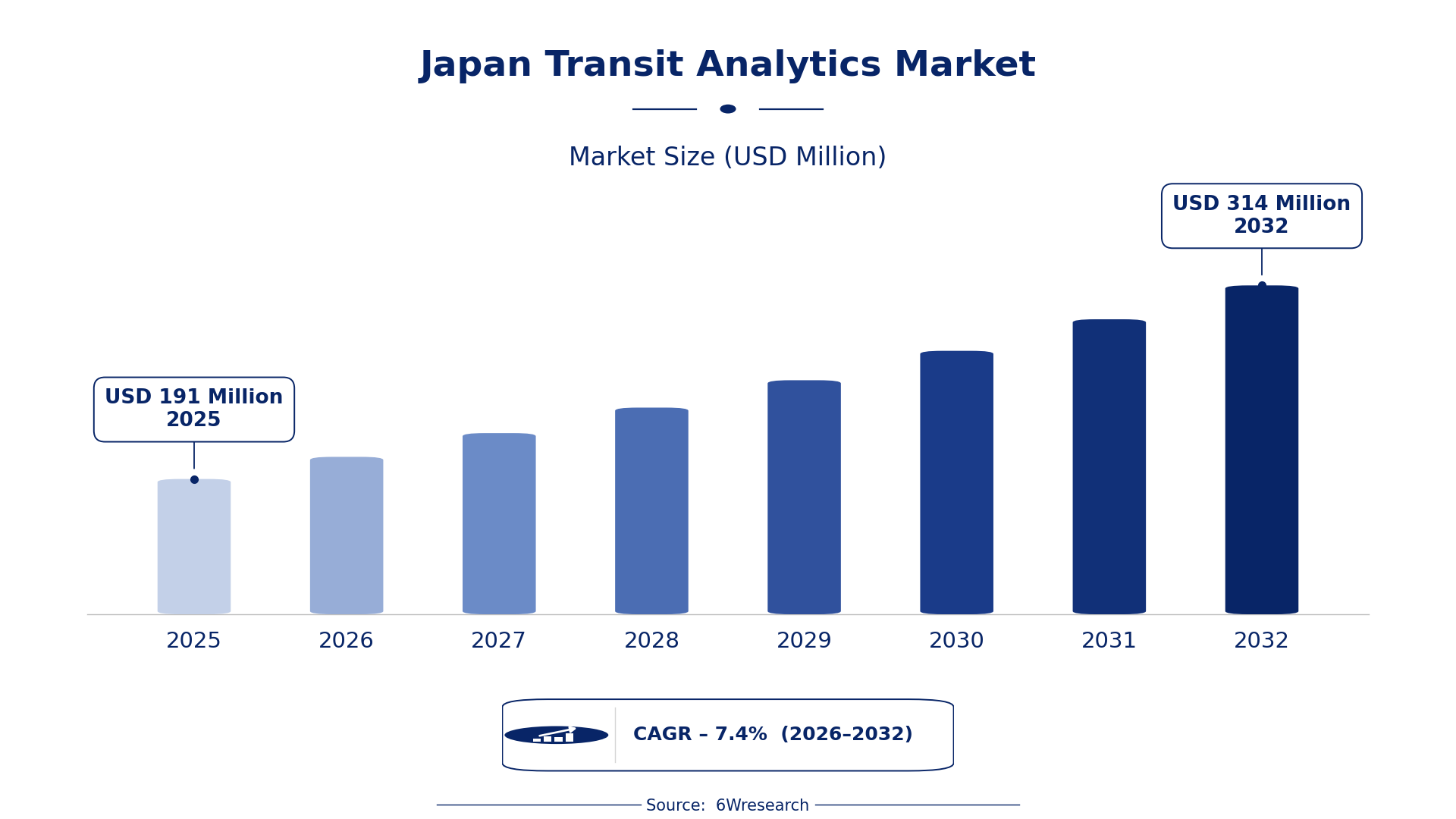
According to 6Wresearch internal database and industry insights, the Japan Transit Analytics Market was valued at USD 191 Million in 2025 and is projected to reach USD 314 Million by 2032, growing at a CAGR of approximately 7.4% during 2026–2032.
Japan Transit Analytics Market Highlights
| Report Metric | Details |
| Report Name | Japan Transit Analytics Market (2026-2032) |
| Market Size 2025 | USD 191 Million |
| Market Size 2032 | USD 314 Million |
| Absolute Growth 2025–2032 | USD 123 Million |
| CAGR 2026–2032 | 7.4% |
| Peak Annual Growth | 8.1% in 2028 |
| Forecast Period | 2026–2032 |
| Historical Data | 2022–2025 |
| Base Year | 2025 |
| Leading Analytics Type, 2025 | Operational Analytics (47% share) |
| Leading Data Focus, 2025 | Scheduling Efficiency (48% share) |
| Leading Application Area, 2025 | Metro Systems (41% share) |
| Leading End User, 2025 | City Transit Authorities (40% share) |
| Fastest-Growing Analytics Type | Predictive Analytics (10.1% CAGR) |
| Fastest-Growing Data Focus | Maintenance Forecasting (9.7% CAGR) |
| Fastest-Growing Application Area | Rail & Bus Fleets (8.8% CAGR) |
| Fastest-Growing End User | Transport Planners (9.3% CAGR) |
| Growing Sector | Public Transport |
| Key End Users | City Transit Authorities, Local Governments, Transport Planners, Urban Mobility Managers |
Japan Transit Analytics Market Year-wise Growth Rate and Key Drivers (2022–2032)
This graph illustrates the annual growth rates of the market from 2022 to 2032, highlighting a steady upward trajectory and projected market expansion over the forecast period.
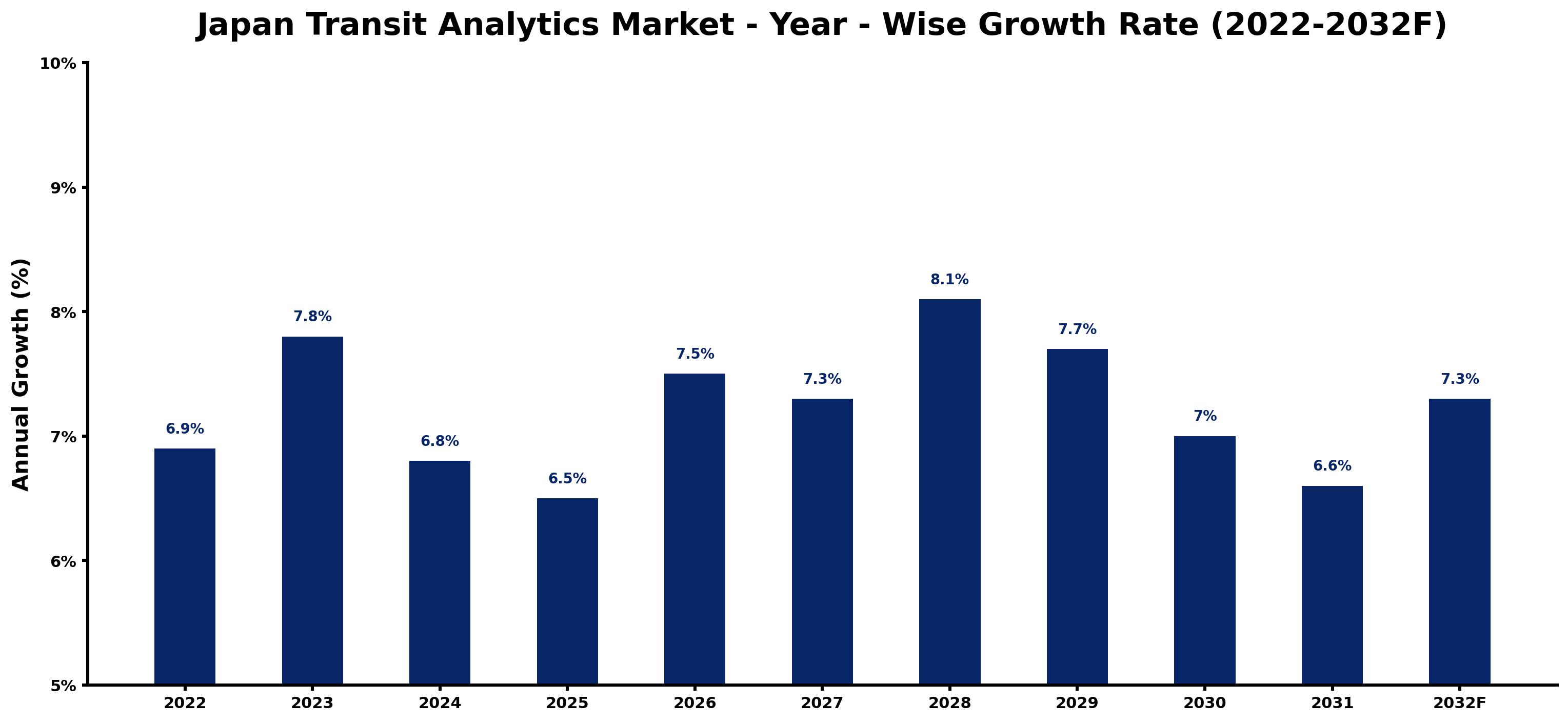
Below, each year's estimated growth is shown next to the factor that most influenced it.
| Year | Estimated Annual Growth (%) | Market Rationale |
| 2022 | 6.9 | The market experienced steady growth due to urbanisation and increased demand for efficient transit solutions. |
| 2023 | 7.8 | Demand surged following the Tokyo Metropolitan Government's initiatives to optimise public transport services. |
| 2024 | 6.8 | Growth slowed as the market adjusted to the previous year's rapid expansion and ongoing urban challenges. |
| 2025 | 6.5 | A further slowdown occurred as the focus shifted to implementing existing analytics solutions in transit systems. |
| 2026 | 7.5 | Growth is expected to accelerate again as investments in predictive analytics gain traction among urban mobility managers. |
| 2027 | 7.3 | The market is projected to experience a slight slowdown as the integration of new technologies takes time to implement. |
| 2028 | 8.1 | The peak growth year will see heightened demand for advanced analytics following successful pilot programmes. |
| 2029 | 7.7 | A slowdown is expected as the market stabilises after the peak growth period, maintaining positive momentum. |
| 2030 | 7.0 | Growth will continue to slow as the focus shifts to optimising existing analytics frameworks and systems. |
| 2031 | 6.6 | The market is projected to experience another slowdown as the emphasis on efficiency and cost management becomes prevalent. |
| 2032 | 7.3 | Demand is expected to increase again as urban transit authorities seek to improve service quality through data-driven strategies. |
Note: Market size estimations and growth projections presented in this report are based on 6Wresearch's proprietary forecasting methodology, utilizing the latest available industry data, government publications, and primary research inputs.
Japan Transit Analytics Market Synopsis
Transit analytics involves using data analysis techniques to improve public transportation systems, focusing on route optimisation and enhancing passenger experience. The Japan Transit Analytics Market is expanding due to a growing urban population of approximately 37 million and government initiatives promoting smart mobility. The Tokyo public transport system, serving over 8 million passengers daily, illustrates the increasing reliance on data analysis for service optimisation. Investments in predictive analytics are improving maintenance scheduling and operational efficiency across urban transit networks.
Market Dynamics Impact Analysis (2026–2032)
| Factor | Type | Impact | Primary Segment Affected |
| Increasing urban population drives demand for efficient transit solutions. | Driver | High | Public Transport |
| Growing investments in predictive analytics enhance maintenance scheduling. | Driver | High | Predictive Analytics |
| Urban mobility managers are seeking advanced analytics for improved services. | Opportunity | High | City Transit Authorities |
| Rail and bus fleets require optimisation to manage rising passenger numbers. | Opportunity | Medium | Rail & Bus Fleets |
| Implementation costs for analytics systems can be prohibitive for smaller transit authorities. | Restraint | High | City Transit Authorities |
| Data privacy concerns may limit the extent of data collection and usage. | Restraint | Medium | Passenger Flow Analytics |
| Talent shortages in data analytics hinder the growth of transit analytics capabilities. | Challenge | High | Operational Analytics |
| Integration of new technologies can delay the implementation of analytics solutions. | Challenge | Medium | Predictive Analytics |
Evaluation of Drivers in Japan Transit Analytics Market (2026–2032)
The following drivers explain most of the expected growth.
| Drivers | Primary Segment Affected | Why It Matters (Evidence) |
| Urbanisation increases the need for efficient public transport solutions. | Public Transport | Japan's urban population reached approximately 37 million in 2023, prompting local governments to invest in transit analytics. |
| Predictive analytics improves maintenance scheduling and reduces costs. | Predictive Analytics | Japan's railway sector is investing heavily in predictive analytics to improve operational efficiency and reduce downtime. |
| Smart mobility initiatives promote data-driven decision-making in urban transit. | Passenger Flow Analytics | The Ministry of Land, Infrastructure, Transport and Tourism supports smart mobility initiatives across major cities. |
| Data analytics optimises passenger flow and service efficiency. | Passenger Flow Analytics | Data from passenger flow analytics is used to optimise train schedules during peak hours in Osaka. |
| Analytics improves fare structures to maximise revenue. | Fare Analytics | Evaluating fare structures through analytics helps transit authorities improve profitability. |
Much of the new demand traces back to Japan's urban population, which reached approximately 37 million in 2023, leading local governments to invest in transit analytics. The railway sector's commitment to predictive analytics is clear, with substantial investments aimed at improving maintenance scheduling and reducing costs. In Osaka, data analytics optimises passenger flow, adjusting train schedules based on passenger movement data. Fare analytics further supports revenue maximisation by effectively evaluating fare structures.
Evaluation of Restraints in Japan Transit Analytics Market
These restraints slow adoption and weigh on supplier margins.
| Market Restraint | Primary Segment Affected | Why It Matters (Evidence) |
| High implementation costs for analytics systems deter smaller transit authorities. | City Transit Authorities | Smaller authorities often lack the budget to invest in sophisticated analytics technologies, limiting their operational capabilities. |
| Data privacy regulations restrict the collection and use of passenger data. | Passenger Flow Analytics | Concerns over data privacy may lead to reduced data collection, impacting the effectiveness of analytics solutions. |
| Shortage of skilled data analysts limits the growth of analytics capabilities. | Operational Analytics | Talent shortages in data analytics hinder the ability of transit authorities to implement advanced analytics effectively. |
| Integration challenges with existing systems delay analytics implementation. | Predictive Analytics | Transit authorities face difficulties in integrating new analytics technologies with legacy systems, causing delays. |
| Resistance to change from traditional operational practices hampers adoption. | Fare Analytics | Some transit authorities are hesitant to adopt new analytics approaches, preferring established methods. |
Japan Transit Analytics Market Challenges
A shortage of skilled professionals hampers the effective implementation of transit analytics, as educational institutions in Japan fail to produce enough graduates in data science and transportation management. Supply chain disruptions for data collection equipment delay the deployment of analytics systems, resulting in inefficient transit operations for local governments. Buyers, especially city transit authorities, face rising costs, with some reporting budget increases of 15% for transit enhancements due to heightened demand for advanced solutions. Regulatory hurdles complicate the integration of analytics into existing transport frameworks, causing project delays of up to six months for municipalities.
Trends in the Japan Transit Analytics Market
Four trends stand out in the Japan Transit Analytics Market.
- Shift from Traditional to Data-Driven Decision Making: In 2023, the Tokyo Metropolitan Government launched a programme to improve public transport through data-driven decision-making, reflecting a broader shift towards analytics. This initiative aims to improve service quality and operational efficiency, impacting urban transit authorities across Japan.
- Emergence of Predictive Analytics in Maintenance: Starting in 2026, predictive analytics is becoming a standard in maintenance scheduling for Japan's railway sector. This shift is projected to reduce downtime, with investments expected to improve operational efficiency by 15%.
- Increased Focus on Passenger Flow Analytics: As of 2023, cities like Osaka are prioritising passenger flow analytics to optimise train schedules during peak hours. This trend is critical for improving service reliability and enhancing the overall passenger experience.
- Integration of Smart Mobility Initiatives: The Ministry of Land, Infrastructure, Transport and Tourism's smart mobility initiatives, launched in 2023, are reshaping urban transport planning. This approach is projected to increase the efficiency of public transport systems.
Investment Opportunities in the Japan Transit Analytics Market
Below are the investment opportunities with the strongest case in the Japan Transit Analytics Market.
- Investment in Predictive Analytics: City Transit Authorities in Japan are currently seeking predictive analytics solutions to improve maintenance scheduling. This presents an opportunity for suppliers to provide these solutions, especially as urban populations grow.
- Improving Fare Analytics Capabilities: With fare structures under scrutiny, local governments are looking to improve revenue optimisation through advanced analytics. This presents a chance for technology providers to offer tailored solutions, especially in urban areas with high passenger volumes.
- Expansion of Passenger Flow Analytics: As urban populations grow, transit authorities are increasingly focusing on passenger flow analytics to improve service efficiency. This trend offers opportunities for analytics providers to partner with local governments to implement effective solutions.
- Development of Scheduling Efficiency Tools: The need for improved scheduling efficiency is urgent among transport planners, particularly in densely populated areas. Investing in tools that improve scheduling efficiency can meet this demand, especially in regions like Tokyo.
Government Initiatives in the Japan Transit Analytics Market
The Act on the Improvement of Public Transportation, enacted in 2015, mandates the use of data analysis to improve public transport services. This law encourages local governments to adopt advanced analytics solutions for better operational efficiency and service quality. Additionally, the AI Promotion Act, established in 2025, supports the development of AI technologies that can be applied to transit analytics, further boosting innovation in the sector.
In 2023, the Tokyo Metropolitan Government launched a programme to improve public transport through data-driven decision-making, supported by the Digital Agency, which oversees the implementation of digital transformation initiatives. This agency plays a key role in establishing common standards for data use in public transport, ensuring that analytics solutions are effectively integrated into transit systems.
Future Insight of the Japan Transit Analytics Market
City transit authorities will increasingly leverage data-driven strategies by 2032 to enhance urban mobility. The Ministry of Land, Infrastructure, Transport and Tourism's smart mobility initiatives will inspire similar programmes nationwide, driving innovation in transit solutions. Predictive maintenance technologies are projected to reduce maintenance costs by 20%, enabling better resource allocation. The adoption of ISO 37120 standards will promote consistency in transit analytics practices, enhancing efficiency and safety across public transportation systems.
Market Segmentation Analysis
Japan Transit Analytics Market report covers a detailed analysis of the following market segments:
By Analytics Type – Operational Analytics Leads, Predictive Analytics Expected to Grow Fastest
According to Saurav Kr Singh, Senior Research Analyst at 6Wresearch, Operational Analytics held 47% of the Japan Transit Analytics Market by analytics type in 2025. Operational Analytics holds the largest share as it is vital for real-time monitoring and decision-making in transit systems. Its extensive application in Tokyo's public transport system, which serves over 8 million passengers daily, underscores its importance. Predictive Analytics is set to record the highest CAGR in this split, 10.1% over 2026–2032. Predictive Analytics is expanding quickly because it plays a key role in forecasting future transit patterns and demands. The Tokyo Metropolitan Government's 2023 programme illustrates the growing reliance on data-driven decision-making to enhance transport services. Suppliers should focus on developing advanced predictive tools to meet the increasing demand from transit authorities.
By Data Focus – Scheduling Efficiency Leads, Maintenance Forecasting Expected to Grow Fastest
With 48% of data focus revenue in 2025, Scheduling Efficiency was the largest category. Scheduling Efficiency leads this segment as it directly improves service timing through data analysis, enhancing passenger experiences. The optimisation of train schedules during peak hours in Osaka exemplifies the critical importance of this focus area. Maintenance Forecasting is projected to grow fastest, at a CAGR of 9.7% during 2026–2032. Maintenance Forecasting is growing rapidly as it effectively predicts maintenance needs, reducing downtime and ensuring service reliability. The railway sector's investment in predictive analytics highlights its significance in improving maintenance scheduling. Buyers will benefit from solutions that incorporate maintenance forecasting to effectively minimise service disruptions.
By Application Area – Metro Systems Lead, Rail & Bus Fleets Expected to Grow Fastest
The largest application area category in 2025 was Metro Systems, at 41% of revenue. Metro Systems dominate the market as they are essential for urban metro networks, heavily relying on data analytics for operational efficiency. The extensive use of analytics in Tokyo's metro system illustrates its crucial role in urban transit management. The quickest growth will come from Rail & Bus Fleets, forecast to expand at a CAGR of 8.8% between 2026 and 2032. Rail & Bus Fleets are experiencing rapid growth as they are vital for managing transport fleets, particularly in urban areas. The increasing focus on optimising fleet operations through data analytics is driving this segment's expansion. Suppliers should tailor their offerings to enhance analytics capabilities specifically for rail and bus fleet management.
By End User – City Transit Authorities Lead, Transport Planners Expected to Grow Fastest
City Transit Authorities accounted for 40% of the market by end user in 2025. City Transit Authorities are the main users of transit analytics for urban planning, making them the largest segment in this market. Their proactive approach to implementing data-driven strategies for transport improvements highlights their significance. Over 2026–2032, Transport Planners are expected to post the fastest growth, at a CAGR of 9.3%. Transport Planners are witnessing the fastest growth as they increasingly leverage analytics for strategic transport planning, essential for addressing urban mobility challenges. Their demand for sophisticated analytical tools is rapidly increasing. Suppliers must engage with transport planners to provide tailored analytics solutions that effectively address strategic planning needs.
Key Attractiveness of the Report
- 10 Years of Market Numbers
- Historical Data Starting from 2022 to 2025
- Base Year 2025
- Forecast Data until 2032
- Key Performance Indicators Impacting the Market
- Major Upcoming Developments and Projects
Key Highlights of the Report:
- Japan Transit Analytics Market Outlook
- Market Size of Japan Transit Analytics Market, 2025
- Forecast of Japan Transit Analytics Market, 2032
- Historical Data and Forecast of Japan Transit Analytics Revenues & Volume for the Period 2022-2032F
- Japan Transit Analytics Market Trend Evolution
- Japan Transit Analytics Market Drivers and Challenges
- Japan Transit Analytics Price Trends
- Japan Transit Analytics Porter's Five Forces
- Japan Transit Analytics Industry Life Cycle
- Historical Data and Forecast of Japan Transit Analytics Market Revenues & Volume By Analytics Type for the Period 2022-2032F
- Historical Data and Forecast of Japan Transit Analytics Market Revenues & Volume By Operational Analytics for the Period 2022-2032F
- Historical Data and Forecast of Japan Transit Analytics Market Revenues & Volume By Predictive Analytics for the Period 2022-2032F
- Historical Data and Forecast of Japan Transit Analytics Market Revenues & Volume By Passenger Flow Analytics for the Period 2022-2032F
- Historical Data and Forecast of Japan Transit Analytics Market Revenues & Volume By Fare Analytics for the Period 2022-2032F
- Historical Data and Forecast of Japan Transit Analytics Market Revenues & Volume By Data Focus for the Period 2022-2032F
- Historical Data and Forecast of Japan Transit Analytics Market Revenues & Volume By Scheduling Efficiency for the Period 2022-2032F
- Historical Data and Forecast of Japan Transit Analytics Market Revenues & Volume By Maintenance Forecasting for the Period 2022-2032F
- Historical Data and Forecast of Japan Transit Analytics Market Revenues & Volume By Footfall Data for the Period 2022-2032F
- Historical Data and Forecast of Japan Transit Analytics Market Revenues & Volume By Revenue Optimization for the Period 2022-2032F
- Historical Data and Forecast of Japan Transit Analytics Market Revenues & Volume By Application Area for the Period 2022-2032F
- Historical Data and Forecast of Japan Transit Analytics Market Revenues & Volume By Metro Systems for the Period 2022-2032F
- Historical Data and Forecast of Japan Transit Analytics Market Revenues & Volume By Rail & Bus Fleets for the Period 2022-2032F
- Historical Data and Forecast of Japan Transit Analytics Market Revenues & Volume By Station Management for the Period 2022-2032F
- Historical Data and Forecast of Japan Transit Analytics Market Revenues & Volume By Public Transport for the Period 2022-2032F
- Historical Data and Forecast of Japan Transit Analytics Market Revenues & Volume By End User for the Period 2022-2032F
- Historical Data and Forecast of Japan Transit Analytics Market Revenues & Volume By City Transit Authorities for the Period 2022-2032F
- Historical Data and Forecast of Japan Transit Analytics Market Revenues & Volume By Transport Planners for the Period 2022-2032F
- Historical Data and Forecast of Japan Transit Analytics Market Revenues & Volume By Urban Mobility Managers for the Period 2022-2032F
- Historical Data and Forecast of Japan Transit Analytics Market Revenues & Volume By Local Governments for the Period 2022-2032F
- Japan Transit Analytics Import Export Trade Statistics
- Market Opportunity Assessment By Analytics Type
- Market Opportunity Assessment By Data Focus
- Market Opportunity Assessment By Application Area
- Market Opportunity Assessment By End User
- Japan Transit Analytics Top Companies Market Share
- Japan Transit Analytics Competitive Benchmarking By Technical and Operational Parameters
- Japan Transit Analytics Company Profiles
- Japan Transit Analytics Key Strategic Recommendations
Market Covered
The study includes the following segmentation.
By Analytics Type
- Operational Analytics
- Predictive Analytics
- Passenger Flow Analytics
- Fare Analytics
By Data Focus
- Scheduling Efficiency
- Maintenance Forecasting
- Footfall Data
- Revenue Optimization
By Application Area
- Metro Systems
- Rail & Bus Fleets
- Station Management
- Public Transport
By End User
- City Transit Authorities
- Transport Planners
- Urban Mobility Managers
- Local Governments































