Japan Transit Data Systems Market Size & Growth Rate
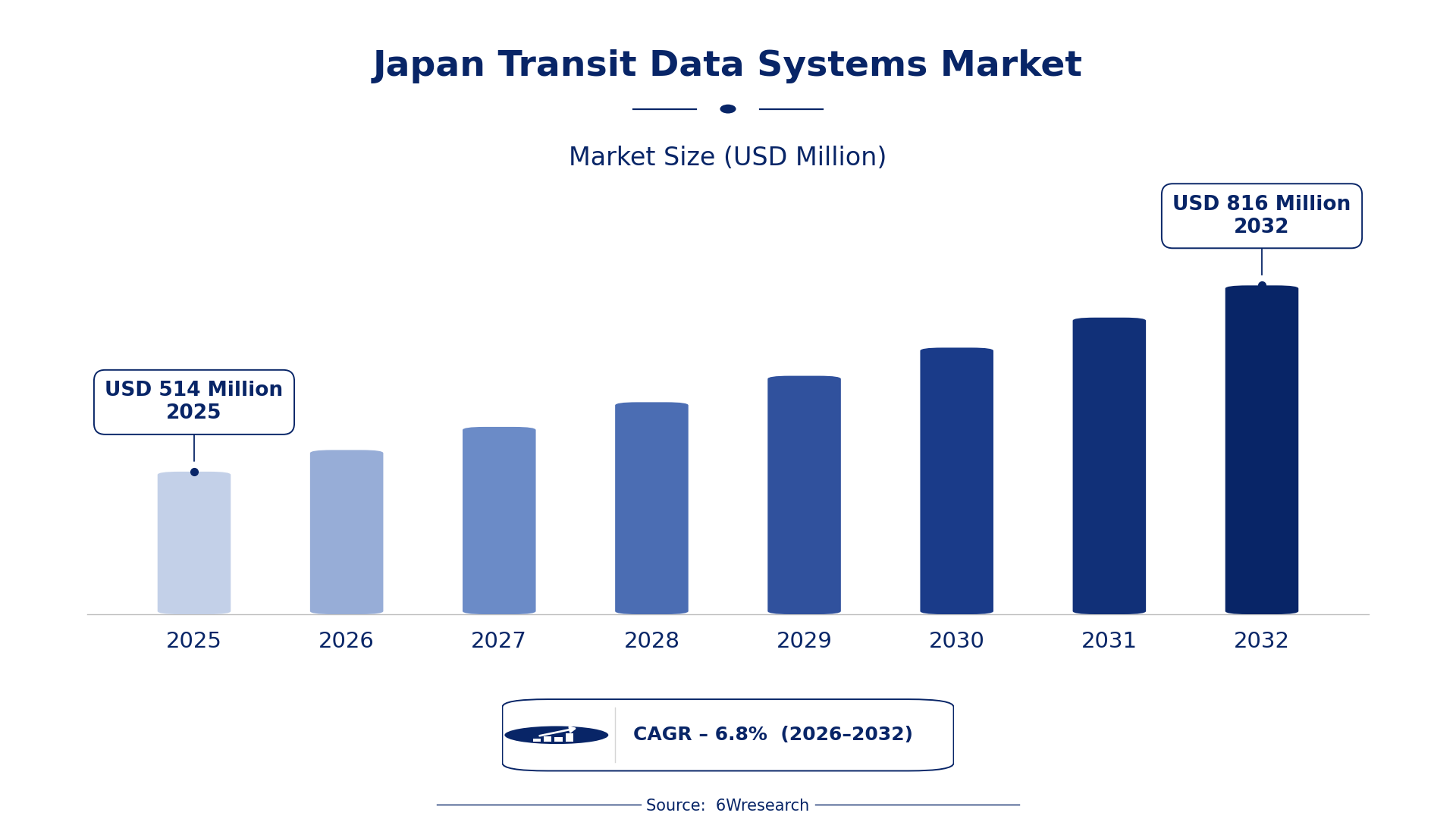
According to 6Wresearch internal database and industry insights, the Japan Transit Data Systems Market was valued at USD 514 Million in 2025 and is projected to reach USD 816 Million by 2032, growing at a CAGR of approximately 6.8% during 2026–2032.
Japan Transit Data Systems Market Highlights
| Report Metric | Details |
| Report Name | Japan Transit Data Systems Market (2026-2032) |
| Market Size 2025 | USD 514 Million |
| Market Size 2032 | USD 816 Million |
| Absolute Growth 2025–2032 | USD 302 Million |
| CAGR 2026–2032 | 6.8% |
| Peak Annual Growth | 7.6% in 2032 |
| Forecast Period | 2026–2032 |
| Historical Data | 2022–2025 |
| Base Year | 2025 |
| Leading System Type, 2025 | Real-Time Data Systems (37% share) |
| Leading Data Format, 2025 | GPS & IoT Feed (37% share) |
| Leading Use Case, 2025 | Vehicle Tracking (48% share) |
| Leading End User, 2025 | Traffic Controllers (41% share) |
| Fastest-Growing System Type | Maintenance Data Logs (10.0% CAGR) |
| Fastest-Growing Data Format | Telemetry (9.9% CAGR) |
| Fastest-Growing Use Case | Predictive Maintenance (9.1% CAGR) |
| Fastest-Growing End User | Metro Corporations (8.7% CAGR) |
| Growing Sector | Transit Data Systems |
| Key End Users | Traffic Controllers, Metro Corporations, Bus Networks |
Japan Transit Data Systems Market Year-wise Growth Rate and Key Drivers (2022–2032)
This graph illustrates the annual growth rates of the market from 2022 to 2032, highlighting a steady upward trajectory and projected market expansion over the forecast period.
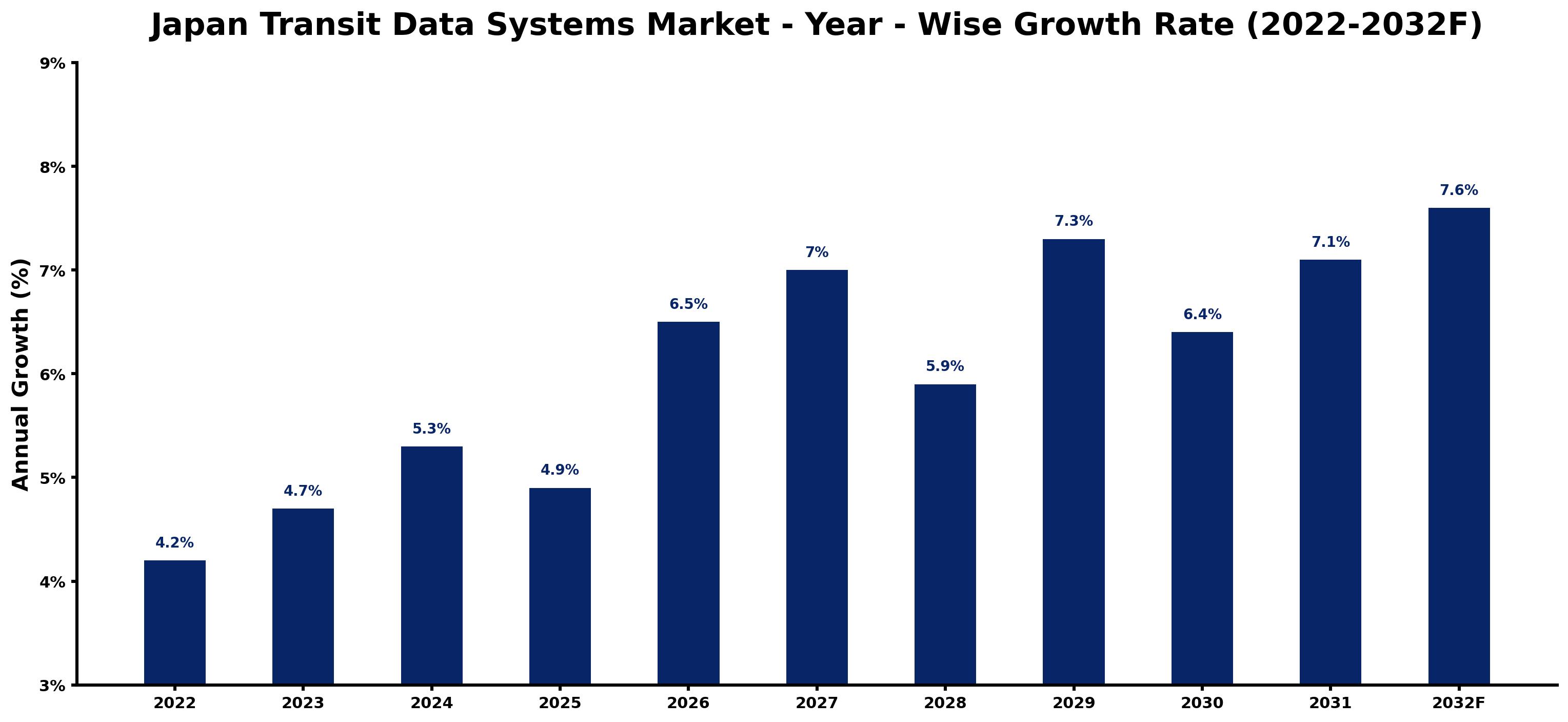
Year by year, the estimates below pair each growth rate with the development that shaped it.
| Year | Estimated Annual Growth (%) | Market Rationale |
| 2022 | 4.2 | The market experienced steady growth, reflecting ongoing investments in transit infrastructure. |
| 2023 | 4.7 | Demand rose as urban populations increased, particularly in metropolitan areas like Tokyo. |
| 2024 | 5.3 | Growth accelerated due to improvements in operational efficiency and passenger experience. |
| 2025 | 4.9 | A slight slowdown occurred as market adjustments took place following rapid expansion. |
| 2026 | 6.5 | The market is expected to rebound with renewed interest in real-time data systems and IoT integration. |
| 2027 | 7.0 | Continued investment in transit infrastructure will drive further growth in demand. |
| 2028 | 5.9 | Growth is projected to moderate as the market stabilises after several years of rapid expansion. |
| 2029 | 7.3 | Demand will surge again as predictive maintenance technologies gain traction in bus networks. |
| 2030 | 6.4 | A slowdown is anticipated as market saturation begins to affect growth rates. |
| 2031 | 7.1 | Growth will resume due to increased focus on safety enforcement and data analytics. |
| 2032 | 7.6 | The market is projected to peak as advanced technologies become standard across transit systems. |
Note: Market size estimations and growth projections presented in this report are based on 6Wresearch's proprietary forecasting methodology, utilizing the latest available industry data, government publications, and primary research inputs.
Japan Transit Data Systems Market Synopsis
Transit Data Systems encompass technologies designed for managing and analysing transit data, with an emphasis on real-time tracking and operational efficiency. The Japan Transit Data Systems Market is growing due to urbanisation, as over 10 billion passenger trips occur annually, creating a need for effective solutions. The Tokyo Metropolitan Government's smart transit initiative, launched in 2023, integrates IoT into public transport and represents ongoing investments that fuel this growth, with ¥5 billion earmarked for infrastructure improvements.
Market Dynamics Impact Analysis (2026–2032)
| Factor | Type | Impact | Primary Segment Affected |
| Increasing urbanisation and passenger trips drive demand for real-time tracking systems. | Driver | High | Real-Time Data Systems |
| Investment in smart transit initiatives enhances operational efficiency and safety. | Driver | High | Ticketing Data Systems |
| Growing need for predictive maintenance technologies presents opportunities for suppliers. | Opportunity | High | Maintenance Data Logs |
| High passenger volumes necessitate advanced data systems for traffic controllers. | Opportunity | High | Traffic Controllers |
| Market saturation may limit growth potential for new entrants. | Restraint | Medium | Real-Time Data Systems |
| High initial investment costs may deter some public transport operators. | Restraint | Medium | Ticketing Data Systems |
| Competition among technology providers may pressure pricing strategies. | Challenge | High | Maintenance Data Logs |
| Rapid technological advancements require constant adaptation from suppliers. | Challenge | High | Traffic Controllers |
Evaluation of Drivers in Japan Transit Data Systems Market (2026–2032)
The main growth drivers and the segments they affect most are set out below.
| Drivers | Primary Segment Affected | Why It Matters (Evidence) |
| Urban population growth increases demand for efficient transit solutions. | Real-Time Data Systems | Tokyo's population exceeds 37 million, necessitating advanced tracking systems. |
| Smart transit initiatives drive investment in data systems. | Ticketing Data Systems | The Tokyo Metropolitan Government allocated ¥5 billion for transit upgrades. |
| Increased passenger trips necessitate improved operational efficiency. | Vehicle Tracking | Public transport in Japan sees over 10 billion passenger trips annually. |
| Integration of IoT technology improves data analytics capabilities. | GPS & IoT Feed | The smart transit initiative launched in 2023 promotes IoT integration. |
| Focus on safety and compliance drives demand for incident reporting systems. | Incident Data Reporting | The Japan Transport Safety Board monitors compliance for safety improvements. |
Volumes grow on the back of urbanisation, with a population exceeding 37 million in Tokyo creating strong demand for efficient transit solutions. With over 10 billion passenger trips annually, public transport operators require enhanced operational efficiency through real-time tracking systems. The integration of IoT technology in these systems improves data analytics capabilities, driving demand for GPS and IoT feeds. Increased focus on safety and compliance encourages the adoption of incident reporting systems monitored by the Japan Transport Safety Board.
Evaluation of Restraints in Japan Transit Data Systems Market
The main factors holding the market back are set out below.
| Market Restraint | Primary Segment Affected | Why It Matters (Evidence) |
| Market saturation may limit growth potential for new entrants. | Real-Time Data Systems | With over 1,200 kilometers of metro rail systems, competition is intensifying. |
| High initial investment costs may deter some public transport operators. | Ticketing Data Systems | Substantial funding is required to implement advanced fare collection systems. |
| Technological advancements require constant adaptation from suppliers. | Maintenance Data Logs | Suppliers must continuously innovate to meet evolving market demands. |
| Regulatory compliance can slow down system implementation. | Incident Data Reporting | Meeting standards set by the Japan Transport Safety Board requires time and resources. |
| Intense competition among technology providers pressures pricing strategies. | Vehicle Tracking | Price wars can affect profitability for emerging technology firms. |
Japan Transit Data Systems Market Challenges
Public transport operators in Japan encounter fierce competition, which can lead to reduced prices and a potential 15% decrease in profit margins. Rising expenses associated with integrating IoT technologies can inflate project budgets by ¥500 million, limiting smaller buyers' capacity to invest in necessary upgrades. A shortage of skilled workers in data analytics and software development may extend project timelines by an average of six months, affecting service delivery for transit agencies. Stringent regulations from the Ministry of Land, Infrastructure, Transport and Tourism can complicate compliance, resulting in additional costs of up to ¥100 million for transit agencies.
Trends in the Japan Transit Data Systems Market
Below are the shifts with the largest effect on the Japan Transit Data Systems Market.
- Shift towards IoT Integration in Transit Systems: Tokyo's smart transit initiative, launched in 2023, incorporates IoT into public transport, enhancing operational efficiency. This initiative has received a funding allocation of ¥5 billion for upgrades.
- Transition from Traditional to Predictive Maintenance: Since 2023, Tokyo's bus networks have increasingly embraced predictive maintenance technologies, minimising downtime and improving service reliability. This transition is driven by the need to optimise fleet operations, supported by investments in data systems.
- Growing Demand for Real-Time Data Systems: Real-time data systems are becoming indispensable for transit operations, especially in urban areas. The demand for these systems is clear as Japan's transport industry adheres to ISO 9001 standards for quality management.
- Focus on Safety and Compliance in Transit Operations: In recent years, there has been an increased emphasis on safety enforcement within transit systems. The Japan Transport Safety Board's oversight of incident data reporting systems ensures compliance and strengthens safety measures.
Investment Opportunities in the Japan Transit Data Systems Market
Several openings in the Japan Transit Data Systems Market merit attention from investors.
- Traffic Controllers Seeking Advanced Data Solutions: Traffic controllers in urban areas require enhanced data systems to manage rising passenger volumes. With over 10 billion trips annually, there is a demand for advanced tracking solutions to improve operational efficiency.
- Growing Demand for Predictive Maintenance Technologies: Now is an opportune time for suppliers to invest in predictive maintenance solutions, as this rapidly growing sub-segment is expected to experience substantial growth. Metro corporations are actively pursuing these technologies to improve service reliability.
- Investment in Smart Transit Initiatives: The Tokyo Metropolitan Government's allocation of ¥5 billion for smart transit initiatives presents opportunities for technology providers. Collaborating with local partners can facilitate entry into this expanding market.
- Need for Enhanced Incident Reporting Systems: With an increasing focus on safety, there is a demand for improved incident reporting systems. The Japan Transport Safety Board's oversight creates a pathway for suppliers to deliver compliant solutions.
Government Initiatives in the Japan Transit Data Systems Market
The AI Promotion Act of 2025 encourages the integration of AI technologies in transit data systems, impacting producers by promoting operational efficiency and improved passenger experiences. This measure supports the development of advanced transit solutions across Japan, focusing on enhancing data management capabilities.
The Digital Agency supervises government digital transformation efforts, establishing standards for data systems. This ensures compliance and interoperability among transit operators, benefiting buyers by streamlining system integration and improving data management capabilities. The agency's initiatives aim to enhance the overall efficiency of transit operations.
Future Insight of the Japan Transit Data Systems Market
Investment in transit data systems is set to rise as the Japanese government allocates ¥5 billion for infrastructure upgrades, stimulating demand for advanced technologies. The integration of IoT will lead to smarter public transport solutions, improving operational efficiency. New compliance standards from the Japan Transport Safety Board will enhance safety measures, benefiting both suppliers and users. The Tokyo Metropolitan Government's smart transit initiative will drive the adoption of advanced data solutions, resulting in a more efficient urban transport network.
Market Segmentation Analysis
Japan Transit Data Systems Market report covers a detailed analysis of the following market segments:
By System Type – Real-Time Data Systems Lead, Maintenance Data Logs Expected to Grow Fastest
According to Saurav Kr Singh, Senior Research Analyst at 6Wresearch, Real-Time Data Systems accounted for 37% of the market by system type in 2025. Real-Time Data Systems dominate the market due to their essential role in tracking transit operations across Japan's extensive metro rail systems. With over 1,200 kilometres of metro rail, these systems are vital for efficient transit management. The quickest growth will come from Maintenance Data Logs, forecast to expand at a CAGR of 10.0% between 2026 and 2032. Maintenance Data Logs are rapidly growing as they support predictive maintenance technologies, increasingly adopted to minimise downtime in transit operations. The focus on operational efficiency propels this segment's expansion. Suppliers should enhance real-time data capabilities to address the rising demands of transit operators.
By Data Format – GPS & IoT Feed Leads, Telemetry Expected to Grow Fastest
In 2025, GPS & IoT Feed led the data format split with a 37% share. GPS & IoT Feed leads the market as it is critical for real-time location tracking, enabling the effective management of Japan's busy public transport systems. This format is essential for the smooth operation of transit data systems. Telemetry is projected to grow fastest, at a CAGR of 9.9% during 2026–2032. Telemetry is experiencing the fastest growth as it assists in data collection and analysis, addressing the need for improved operational insights in transit management. The growing complexity of transit operations drives this segment's development. Buyers must invest in advanced data formats to maintain competitiveness in the changing transit environment.
By Use Case – Vehicle Tracking Leads, Predictive Maintenance Expected to Grow Fastest
Vehicle Tracking took 48% of use case revenue in 2025, more than any other category. Vehicle Tracking holds the largest share as it is crucial for fleet management, allowing transit operators to monitor their vehicles efficiently across Japan's extensive networks. This functionality is key for ensuring service reliability and operational efficiency. Over 2026–2032, Predictive Maintenance is expected to post the fastest growth, at a CAGR of 9.1%. Predictive Maintenance is rapidly expanding as it provides substantial benefits in reducing maintenance costs and enhancing service reliability. The increasing adoption of advanced technologies in transit systems fuels this segment's growth. Suppliers should focus on solutions that improve predictive maintenance capabilities to meet the needs of transit operators.
By End User – Traffic Controllers Lead, Metro Corporations Expected to Grow Fastest
Traffic Controllers held 41% of the Japan Transit Data Systems Market by end user in 2025. Traffic Controllers are the primary users of transit data systems, utilising these technologies to manage and optimise traffic flow effectively. Their central role in overseeing transit operations in Japan creates a strong demand for these systems. Metro Corporations are set to record the highest CAGR in this split, 8.7% over 2026–2032. Metro Corporations are witnessing the fastest growth as they invest more in advanced transit data systems to boost operational efficiency and enhance passenger experience. Urbanisation and population growth in metropolitan areas drive this trend. Suppliers need to customise their offerings to align with the specific requirements of metro corporations as they expand their transit data capabilities.
Key Attractiveness of the Report
- 10 Years of Market Numbers
- Historical Data Starting from 2022 to 2025
- Base Year 2025
- Forecast Data until 2032
- Key Performance Indicators Impacting the Market
- Major Upcoming Developments and Projects
Key Highlights of the Report:
- Japan Transit Data Systems Market Outlook
- Market Size of Japan Transit Data Systems Market, 2025
- Forecast of Japan Transit Data Systems Market, 2032
- Historical Data and Forecast of Japan Transit Data Systems Revenues & Volume for the Period 2022-2032F
- Japan Transit Data Systems Market Trend Evolution
- Japan Transit Data Systems Market Drivers and Challenges
- Japan Transit Data Systems Price Trends
- Japan Transit Data Systems Porter's Five Forces
- Japan Transit Data Systems Industry Life Cycle
- Historical Data and Forecast of Japan Transit Data Systems Market Revenues & Volume By System Type for the Period 2022-2032F
- Historical Data and Forecast of Japan Transit Data Systems Market Revenues & Volume By Real-Time Data Systems for the Period 2022-2032F
- Historical Data and Forecast of Japan Transit Data Systems Market Revenues & Volume By Ticketing Data Systems for the Period 2022-2032F
- Historical Data and Forecast of Japan Transit Data Systems Market Revenues & Volume By Maintenance Data Logs for the Period 2022-2032F
- Historical Data and Forecast of Japan Transit Data Systems Market Revenues & Volume By Incident Data Reporting for the Period 2022-2032F
- Historical Data and Forecast of Japan Transit Data Systems Market Revenues & Volume By Data Format for the Period 2022-2032F
- Historical Data and Forecast of Japan Transit Data Systems Market Revenues & Volume By GPS & IoT Feed for the Period 2022-2032F
- Historical Data and Forecast of Japan Transit Data Systems Market Revenues & Volume By QR/Barcode Inputs for the Period 2022-2032F
- Historical Data and Forecast of Japan Transit Data Systems Market Revenues & Volume By Telemetry for the Period 2022-2032F
- Historical Data and Forecast of Japan Transit Data Systems Market Revenues & Volume By Video + Audio Logs for the Period 2022-2032F
- Historical Data and Forecast of Japan Transit Data Systems Market Revenues & Volume By Use Case for the Period 2022-2032F
- Historical Data and Forecast of Japan Transit Data Systems Market Revenues & Volume By Vehicle Tracking for the Period 2022-2032F
- Historical Data and Forecast of Japan Transit Data Systems Market Revenues & Volume By Passenger Management for the Period 2022-2032F
- Historical Data and Forecast of Japan Transit Data Systems Market Revenues & Volume By Predictive Maintenance for the Period 2022-2032F
- Historical Data and Forecast of Japan Transit Data Systems Market Revenues & Volume By Safety Enforcement for the Period 2022-2032F
- Historical Data and Forecast of Japan Transit Data Systems Market Revenues & Volume By End User for the Period 2022-2032F
- Historical Data and Forecast of Japan Transit Data Systems Market Revenues & Volume By Traffic Controllers for the Period 2022-2032F
- Historical Data and Forecast of Japan Transit Data Systems Market Revenues & Volume By Bus Networks for the Period 2022-2032F
- Historical Data and Forecast of Japan Transit Data Systems Market Revenues & Volume By Metro Corporations for the Period 2022-2032F
- Historical Data and Forecast of Japan Transit Data Systems Market Revenues & Volume By Security Departments for the Period 2022-2032F
- Japan Transit Data Systems Import Export Trade Statistics
- Market Opportunity Assessment By System Type
- Market Opportunity Assessment By Data Format
- Market Opportunity Assessment By Use Case
- Market Opportunity Assessment By End User
- Japan Transit Data Systems Top Companies Market Share
- Japan Transit Data Systems Competitive Benchmarking By Technical and Operational Parameters
- Japan Transit Data Systems Company Profiles
- Japan Transit Data Systems Key Strategic Recommendations
Market Covered
The report covers the following segments.
By System Type
- Real-Time Data Systems
- Ticketing Data Systems
- Maintenance Data Logs
- Incident Data Reporting
By Data Format
- GPS & IoT Feed
- QR/Barcode Inputs
- Telemetry
- Video + Audio Logs
By Use Case
- Vehicle Tracking
- Passenger Management
- Predictive Maintenance
- Safety Enforcement
By End User
- Traffic Controllers
- Bus Networks
- Metro Corporations
- Security Departments































