Japan Transit Payment Systems Market Size & Growth Rate
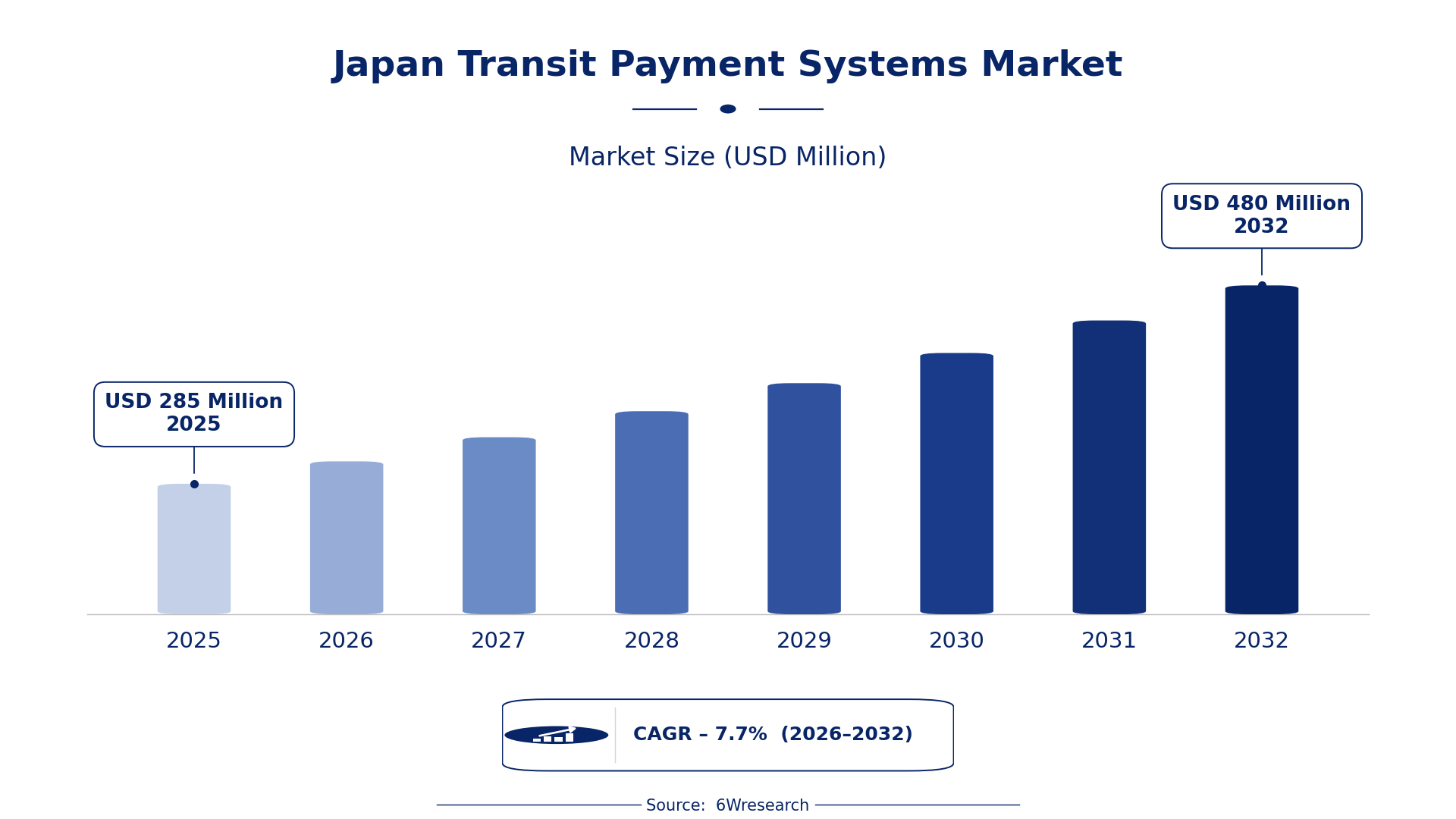
According to 6Wresearch internal database and industry insights, the Japan Transit Payment Systems Market was valued at USD 285 Million in 2025 and is projected to reach USD 480 Million by 2032, growing at a CAGR of approximately 7.7% during 2026–2032.
Japan Transit Payment Systems Market Highlights
| Report Metric | Details |
| Report Name | Japan Transit Payment Systems Market (2026-2032) |
| Market Size 2025 | USD 285 Million |
| Market Size 2032 | USD 480 Million |
| Absolute Growth 2025–2032 | USD 195 Million |
| CAGR 2026–2032 | 7.7% |
| Peak Annual Growth | 8.7% in 2030 |
| Forecast Period | 2026–2032 |
| Historical Data | 2022–2025 |
| Base Year | 2025 |
| Leading Payment Mode, 2025 | Smart Card Systems (47% share) |
| Leading Technology Used, 2025 | NFC/Contactless (47% share) |
| Leading Transit Medium, 2025 | Metro/Rail (44% share) |
| Leading End User, 2025 | Urban Transport Users (43% share) |
| Fastest-Growing Payment Mode | Mobile Wallets (10.1% CAGR) |
| Fastest-Growing Technology Used | App-Integrated (10.8% CAGR) |
| Fastest-Growing Transit Medium | Shared Mobility (10.0% CAGR) |
| Fastest-Growing End User | Commuters (9.8% CAGR) |
| Growing Sector | Urban Transport |
| Key End Users | Urban Transport Users, Commuters, Daily Passengers |
Japan Transit Payment Systems Market Year-wise Growth Rate and Key Drivers (2022–2032)
This graph illustrates the annual growth rates of the market from 2022 to 2032, highlighting a steady upward trajectory and projected market expansion over the forecast period.
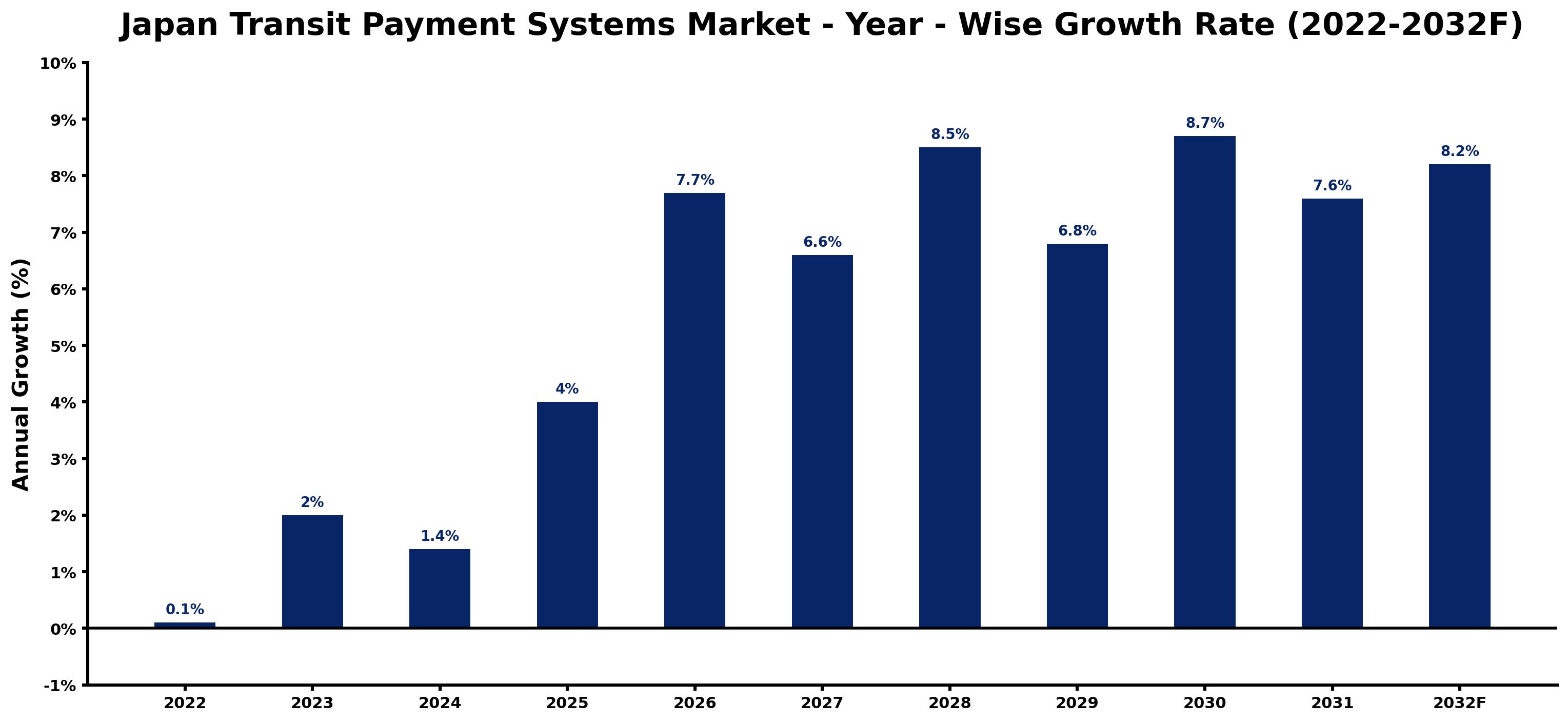
For each year, the table pairs the estimated growth rate with the leading influence on demand, showing how the drivers changed across the period.
| Year | Estimated Annual Growth (%) | Market Rationale |
| 2022 | 0.1 | The market was stable, with minimal growth reflecting ongoing adjustments in payment technologies. |
| 2023 | 2.0 | Growth accelerated due to increased adoption of mobile wallets among urban transport users. |
| 2024 | 1.4 | A slowdown occurred as the market adjusted to the rapid changes in payment preferences. |
| 2025 | 4.0 | Growth surged as smart card systems maintained their dominance in urban transit payments. |
| 2026 | 7.7 | Demand is expected to rise sharply as mobile wallet usage expands across the country. |
| 2027 | 6.6 | The market is projected to experience a slowdown as growth rates normalise after previous peaks. |
| 2028 | 8.5 | Growth is expected to pick up again, driven by the increasing integration of app-based payment solutions. |
| 2029 | 6.8 | A slowdown is projected as the market stabilises following rapid technological advancements. |
| 2030 | 8.7 | Peak growth is expected as shared mobility services adopt QR-based payment systems widely. |
| 2031 | 7.6 | The market will see a slight slowdown as growth rates adjust to a more sustainable level. |
| 2032 | 8.2 | Demand is projected to remain strong as urban transport users increasingly prefer contactless payment options. |
Note: Market size estimations and growth projections presented in this report are based on 6Wresearch's proprietary forecasting methodology, utilizing the latest available industry data, government publications, and primary research inputs.
Japan Transit Payment Systems Market Synopsis
Transit Payment Systems are advanced electronic solutions for fare collection in Japan's public transport. These systems utilise smart card technology, mobile applications, and QR codes to facilitate travel across various transit modes. The Japan Transit Payment Systems Market is growing due to a rising number of urban transport users, with over 80% using smart card systems in 2022. The adoption of mobile wallets has surged, with a 25% increase reported from 2021 to 2023, further supported by initiatives aimed at improving payment options in public transport.
Market Dynamics Impact Analysis (2026–2032)
| Factor | Type | Impact | Primary Segment Affected |
| Urban transport users are increasingly adopting smart card systems for seamless travel. | Driver | High | Smart Card Systems |
| Mobile wallet usage is surging due to convenience and smartphone penetration. | Driver | High | Mobile Wallets |
| The growing number of commuters in urban areas creates a need for efficient payment solutions. | Opportunity | High | Urban Transport Users |
| Shared mobility services are expanding, increasing demand for QR-based payment systems. | Opportunity | High | Shared Mobility |
| Integration challenges with legacy systems may hinder rapid adoption of new technologies. | Restraint | Medium | NFC/Contactless |
| Consumer preferences may shift, impacting the demand for traditional payment methods. | Restraint | Medium | Smart Card Systems |
| High costs associated with upgrading existing systems can deter investment in new technologies. | Challenge | High | Mobile Wallets |
| Competition among payment solutions may lead to market fragmentation and confusion for users. | Challenge | Medium | Prepaid Fare Systems |
Evaluation of Drivers in Japan Transit Payment Systems Market (2026–2032)
These are the developments adding the most demand over the forecast period.
| Drivers | Primary Segment Affected | Why It Matters (Evidence) |
| Increased smartphone penetration drives mobile wallet adoption for transit payments. | Mobile Wallets | Mobile wallet usage for transit payments increased by 25% from 2021 to 2023. |
| High daily ridership in major cities boosts demand for smart card systems. | Smart Card Systems | Tokyo Metro reported a daily ridership of approximately 7 million passengers in 2023. |
| Urbanisation trends lead to a growing number of commuters relying on public transport. | Urban Transport Users | Over 80% of urban transport users in Japan utilised smart card systems for payments in 2022. |
| Integration of NFC technology enhances the efficiency of fare collection systems. | NFC/Contactless | NFC technology is implemented in over 90% of major transit systems in Japan. |
| Government initiatives promote the adoption of modern payment solutions across transit networks. | QR-Based Payments | The Tokyo Metropolitan Government launched a programme in 2023 to enhance mobile payment options. |
Spending rises because urbanisation trends are increasing the number of commuters relying on public transport, with over 80% of urban transport users utilising smart card systems in 2022. The rise in mobile wallet usage, which surged by 25% from 2021 to 2023, is driven by high smartphone penetration. In major cities, daily ridership reached approximately 7 million passengers in 2023, boosting demand for efficient fare collection. The integration of NFC technology, implemented in over 90% of major transit systems, improves the speed and efficiency of transactions.
Evaluation of Restraints in Japan Transit Payment Systems Market
The table below lists the restraints and the evidence behind each.
| Market Restraint | Primary Segment Affected | Why It Matters (Evidence) |
| Integration challenges with legacy systems may hinder the adoption of new payment technologies. | NFC/Contactless | Many transit systems still rely on outdated technology, complicating upgrades to newer systems. |
| Consumer preferences shifting towards alternative payment methods could impact traditional systems. | Smart Card Systems | As mobile wallets gain popularity, reliance on smart cards may decline among users. |
| High costs associated with upgrading existing systems can deter investment in new technologies. | Mobile Wallets | Transit operators may hesitate to invest in mobile solutions due to budget constraints. |
| Limited public awareness of new payment options may slow adoption rates. | QR-Based Payments | Many users remain unfamiliar with QR-based payment systems, hindering their usage. |
| Regulatory hurdles can delay the implementation of new payment technologies. | Prepaid Fare Systems | Compliance with existing regulations may slow down the rollout of new solutions. |
Japan Transit Payment Systems Market Challenges
Rising costs in regulatory compliance burden producers, leading to increased operational expenses that can significantly reduce profit margins. Importers face challenges from fluctuating currency exchange rates, which can elevate costs by up to 10%, directly impacting pricing for public transport agencies. Buyers struggle with the integration of multiple payment systems, causing delays that can extend beyond six months, ultimately affecting service delivery for commuters. A lack of skilled personnel in technology deployment creates obstacles, as transit agencies report difficulties in sourcing qualified staff to implement advanced payment solutions effectively.
Trends in the Japan Transit Payment Systems Market
The following changes are redrawing the Japan Transit Payment Systems Market.
- Shift to Mobile Wallets for Transit Payments: The Tokyo Metropolitan Government launched a programme in 2023 to improve mobile payment options in public transport. This initiative is expected to boost mobile wallet usage, with a 25% rise reported from 2021 to 2023.
- Rise of QR-Based Payments in Shared Mobility: Shared mobility services in Japan are projected to grow, with QR-based payments gaining traction. This trend is supported by increasing consumer acceptance, with over 30 million prepaid fare systems currently in use.
- Adoption of NFC Technology in Transit Systems: NFC technology is implemented in over 90% of major transit systems in Japan. This widespread adoption facilitates quicker fare processing, improving user experience and operational efficiency.
- Integration of App-Based Payment Solutions: App-integrated payment systems are becoming more prevalent, with a CAGR of 10.8% projected from 2026 to 2032. This shift is driven by user demand for convenience and efficient travel experiences.
Investment Opportunities in the Japan Transit Payment Systems Market
Several openings in the Japan Transit Payment Systems Market merit attention from investors.
- Urban Transport Users Seeking Efficient Payment Solutions: Urban transport users are increasingly looking for efficient payment options, with over 80% using smart cards. Suppliers can invest in app-integrated solutions to meet this demand, particularly in major cities.
- Growth in Shared Mobility Services: Shared mobility services are projected to expand, creating a demand for QR-based payment systems. Suppliers can enter this market through partnerships with local service providers to improve payment integration.
- Increasing Demand for Mobile Wallets: Mobile wallet usage for transit payments increased by 25% from 2021 to 2023. Suppliers should focus on developing user-friendly applications to capture this growing market segment.
- Investment in NFC Technology Upgrades: With NFC technology implemented in over 90% of transit systems, there is a significant opportunity for suppliers to provide upgrades and maintenance services, ensuring continued efficiency.
Government Initiatives in the Japan Transit Payment Systems Market
The Act against Unjustifiable Premiums and Misleading Representations, established in 1962, protects consumers by prohibiting misleading labelling and advertising in transit payment systems. The Industrial Standardization Act, amended in 2019, ensures that transit payment technologies adhere to Japanese Industrial Standards, facilitating safety and interoperability. The GX Basic Policy, adopted in 2023, aims for JPY 150 trillion in public-private decarbonisation investments over ten years, which includes modernising transit payment systems to improve sustainability.
The Digital Agency, established in September 2021, oversees the implementation of digital transformation initiatives, including the standardisation of transit payment systems. It funds projects that enhance digital infrastructure, ensuring seamless integration of payment technologies across various transit modes. The Ministry of Land, Infrastructure, Transport and Tourism regulates transit payment systems, ensuring compliance with safety standards and promoting the adoption of modern payment solutions in public transport.
Future Insight of the Japan Transit Payment Systems Market
A policy-driven shift will drive the growth of mobile payment options, prompting suppliers to incorporate new technologies into their offerings. The Tokyo Metropolitan Government's initiatives will support the wider adoption of QR-based payments, improving transaction efficiency across transit networks. By 2032, over 90% of major transit systems are expected to implement the latest NFC standards, enhancing the user experience. Shared mobility services will expand, with mobile wallet usage projected to increase by 25%, providing greater convenience for commuters.
Market Segmentation Analysis
Japan Transit Payment Systems Market report covers a detailed analysis of the following market segments:
By Payment Mode – Smart Card Systems Lead, Mobile Wallets Expected to Grow Fastest
According to Saurav Kr Singh, Senior Research Analyst at 6Wresearch, Smart Card Systems held 47% of the Japan Transit Payment Systems Market by payment mode in 2025. Smart card systems dominate the market as they are the preferred choice for over 80% of urban transport users in Japan. Their extensive adoption is supported by the ISO 14443 standard, which ensures compatibility across various transit systems. Mobile Wallets are set to record the highest CAGR in this split, 10.1% over 2026–2032. Mobile wallets are witnessing rapid growth, with usage increasing by 25% from 2021 to 2023, driven by local government initiatives to enhance mobile payment options. This trend indicates that as convenience becomes essential, mobile wallets will continue to expand their market presence. Suppliers must adapt to the rising demand for mobile wallet solutions to remain competitive in the transit payment market.
By Technology Used – NFC/Contactless Leads, App-Integrated Expected to Grow Fastest
NFC/Contactless accounted for 47% of the market by technology used in 2025. NFC/contactless technology leads the market as it is implemented in over 90% of major transit systems, allowing for quick and efficient fare processing. This widespread use highlights its critical role in improving the user experience during transit. App-Integrated is projected to grow fastest, at a CAGR of 10.8% during 2026–2032. App-integrated payment solutions are experiencing significant growth as they offer seamless user experiences within transit services. This trend is likely to accelerate as more transit operators recognise the benefits of incorporating payment functionalities into their applications. Suppliers should prioritise the development of app-integrated solutions to align with the increasing preference for convenient payment methods among users.
By Transit Medium – Metro/Rail Leads, Shared Mobility Expected to Grow Fastest
Metro/Rail took 44% of transit medium revenue in 2025, more than any other category. Metro/rail systems are the primary transit medium for payment systems, with a substantial portion of daily ridership in urban areas relying on these modes. This dominance underscores the vital role of metro and rail services in the overall transit payment ecosystem. Over 2026–2032, Shared Mobility is expected to post the fastest growth, at a CAGR of 10.0%. Shared mobility services are emerging as the fastest-growing segment, reflecting a shift in user preferences towards flexible transportation options. This growth suggests that shared mobility will increasingly integrate payment systems to meet user demands. Suppliers should explore opportunities within shared mobility to capitalise on the changing dynamics of urban transportation.
By End User – Urban Transport Users Lead, Commuters Expected to Grow Fastest
The largest end user category in 2025 was Urban Transport Users, at 43% of revenue. Urban transport users represent the largest segment, as they rely heavily on payment systems for their daily commutes. This significant user base drives the demand for efficient and reliable transit payment solutions across the country. The quickest growth will come from Commuters, forecast to expand at a CAGR of 9.8% between 2026 and 2032. Commuters are the fastest-growing end user group, accounting for the majority of daily transactions in urban transport. Their increasing reliance on transit payment systems indicates a need for enhanced services tailored to their commuting patterns. Suppliers should focus on addressing the specific needs of commuters to capture a larger share of the transit payment market.
Key Attractiveness of the Report
- 10 Years of Market Numbers
- Historical Data Starting from 2022 to 2025
- Base Year 2025
- Forecast Data until 2032
- Key Performance Indicators Impacting the Market
- Major Upcoming Developments and Projects
Key Highlights of the Report:
- Japan Transit Payment Systems Market Outlook
- Market Size of Japan Transit Payment Systems Market, 2025
- Forecast of Japan Transit Payment Systems Market, 2032
- Historical Data and Forecast of Japan Transit Payment Systems Revenues & Volume for the Period 2022-2032F
- Japan Transit Payment Systems Market Trend Evolution
- Japan Transit Payment Systems Market Drivers and Challenges
- Japan Transit Payment Systems Price Trends
- Japan Transit Payment Systems Porter's Five Forces
- Japan Transit Payment Systems Industry Life Cycle
- Historical Data and Forecast of Japan Transit Payment Systems Market Revenues & Volume By Payment Mode for the Period 2022-2032F
- Historical Data and Forecast of Japan Transit Payment Systems Market Revenues & Volume By Smart Card Systems for the Period 2022-2032F
- Historical Data and Forecast of Japan Transit Payment Systems Market Revenues & Volume By Mobile Wallets for the Period 2022-2032F
- Historical Data and Forecast of Japan Transit Payment Systems Market Revenues & Volume By QR-Based Payments for the Period 2022-2032F
- Historical Data and Forecast of Japan Transit Payment Systems Market Revenues & Volume By Prepaid Fare Systems for the Period 2022-2032F
- Historical Data and Forecast of Japan Transit Payment Systems Market Revenues & Volume By Technology Used for the Period 2022-2032F
- Historical Data and Forecast of Japan Transit Payment Systems Market Revenues & Volume By NFC/Contactless for the Period 2022-2032F
- Historical Data and Forecast of Japan Transit Payment Systems Market Revenues & Volume By App-Integrated for the Period 2022-2032F
- Historical Data and Forecast of Japan Transit Payment Systems Market Revenues & Volume By Optical Scanning for the Period 2022-2032F
- Historical Data and Forecast of Japan Transit Payment Systems Market Revenues & Volume By Stored Value Cards for the Period 2022-2032F
- Historical Data and Forecast of Japan Transit Payment Systems Market Revenues & Volume By Transit Medium for the Period 2022-2032F
- Historical Data and Forecast of Japan Transit Payment Systems Market Revenues & Volume By Metro/Rail for the Period 2022-2032F
- Historical Data and Forecast of Japan Transit Payment Systems Market Revenues & Volume By Bus Networks for the Period 2022-2032F
- Historical Data and Forecast of Japan Transit Payment Systems Market Revenues & Volume By Shared Mobility for the Period 2022-2032F
- Historical Data and Forecast of Japan Transit Payment Systems Market Revenues & Volume By Suburban Rail for the Period 2022-2032F
- Historical Data and Forecast of Japan Transit Payment Systems Market Revenues & Volume By End User for the Period 2022-2032F
- Historical Data and Forecast of Japan Transit Payment Systems Market Revenues & Volume By Urban Transport Users for the Period 2022-2032F
- Historical Data and Forecast of Japan Transit Payment Systems Market Revenues & Volume By Commuters for the Period 2022-2032F
- Historical Data and Forecast of Japan Transit Payment Systems Market Revenues & Volume By Taxi Riders for the Period 2022-2032F
- Historical Data and Forecast of Japan Transit Payment Systems Market Revenues & Volume By Daily Passengers for the Period 2022-2032F
- Japan Transit Payment Systems Import Export Trade Statistics
- Market Opportunity Assessment By Payment Mode
- Market Opportunity Assessment By Technology Used
- Market Opportunity Assessment By Transit Medium
- Market Opportunity Assessment By End User
- Japan Transit Payment Systems Top Companies Market Share
- Japan Transit Payment Systems Competitive Benchmarking By Technical and Operational Parameters
- Japan Transit Payment Systems Company Profiles
- Japan Transit Payment Systems Key Strategic Recommendations
Market Covered
Segments analysed in this report are listed below.
By Payment Mode
- Smart Card Systems
- Mobile Wallets
- QR-Based Payments
- Prepaid Fare Systems
By Technology Used
- NFC/Contactless
- App-Integrated
- Optical Scanning
- Stored Value Cards
By Transit Medium
- Metro/Rail
- Bus Networks
- Shared Mobility
- Suburban Rail
By End User
- Urban Transport Users
- Commuters
- Taxi Riders
- Daily Passengers































