Japan Transmission Component Market Size & Growth Rate
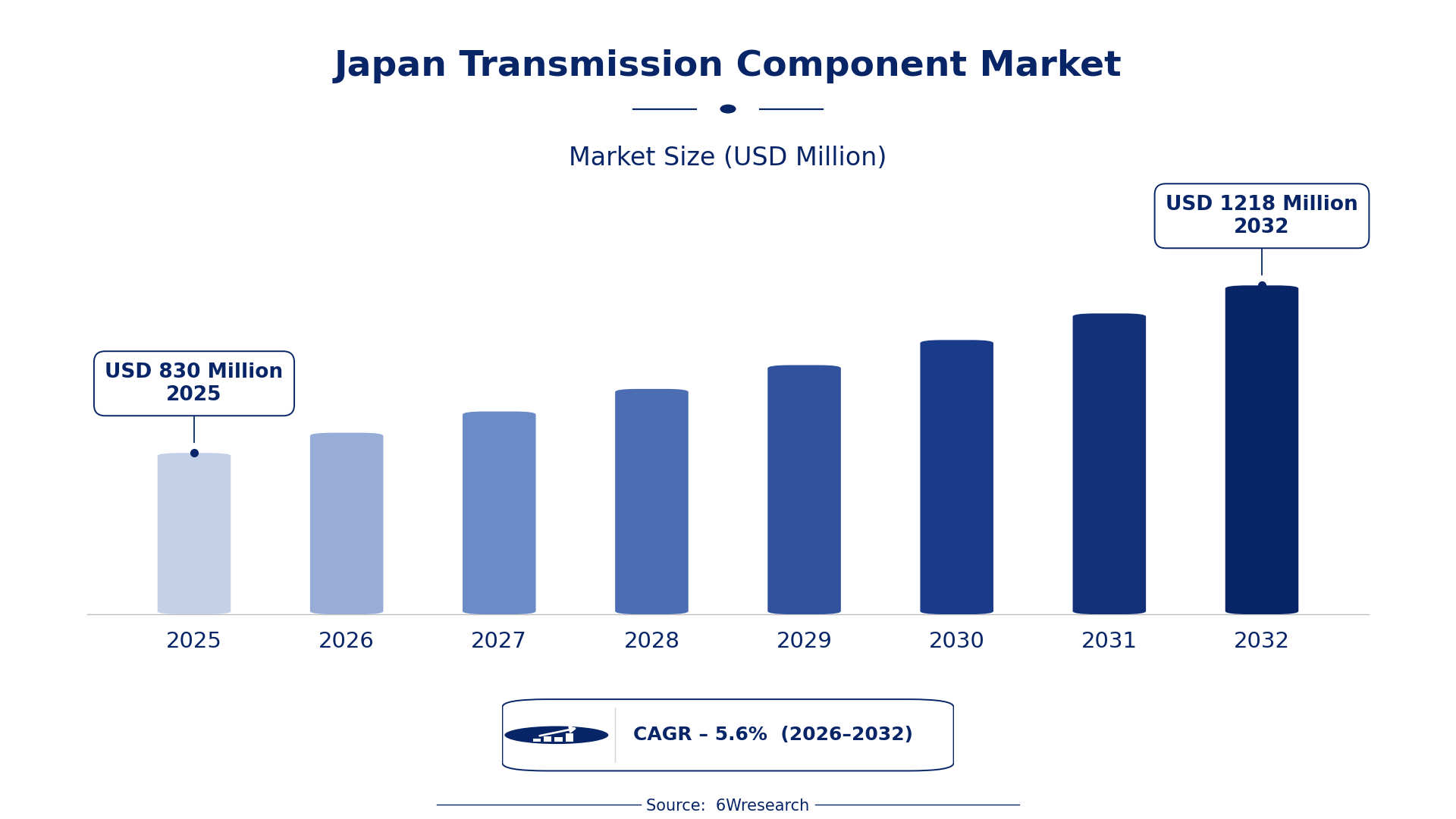
According to 6Wresearch internal database and industry insights, the Japan Transmission Component Market was valued at USD 830 Million in 2025 and is projected to reach USD 1,218 Million by 2032, growing at a CAGR of approximately 5.6% during 2026–2032.
Japan Transmission Component Market Highlights
| Report Metric | Details |
| Report Name | Japan Transmission Component Market (2026-2032) |
| Market Size 2025 | USD 830 Million |
| Market Size 2032 | USD 1,218 Million |
| Absolute Growth 2025–2032 | USD 388 Million |
| CAGR 2026–2032 | 5.6% |
| Peak Annual Growth | 6.5% in 2028 |
| Forecast Period | 2026–2032 |
| Historical Data | 2022–2025 |
| Base Year | 2025 |
| Leading Component Type, 2025 | Gear Assemblies (45% share) |
| Leading Functionality, 2025 | Torque Transfer (36% share) |
| Leading Vehicle Segment, 2025 | Passenger Vehicles (41% share) |
| Leading End User, 2025 | Auto Manufacturers (42% share) |
| Fastest-Growing Component Type | Torque Converters (7.8% CAGR) |
| Fastest-Growing Functionality | Power Modulation (7.2% CAGR) |
| Fastest-Growing Vehicle Segment | SUVs & Vans (7.4% CAGR) |
| Fastest-Growing End User | Transmission Suppliers (7.3% CAGR) |
| Growing Sector | automotive |
| Key End Users | Auto Manufacturers, Transmission Suppliers, Gearbox Manufacturers, OEMs |
Japan Transmission Component Market Year-wise Growth Rate and Key Drivers (2022–2032)
This graph illustrates the annual growth rates of the market from 2022 to 2032, highlighting a steady upward trajectory and projected market expansion over the forecast period.
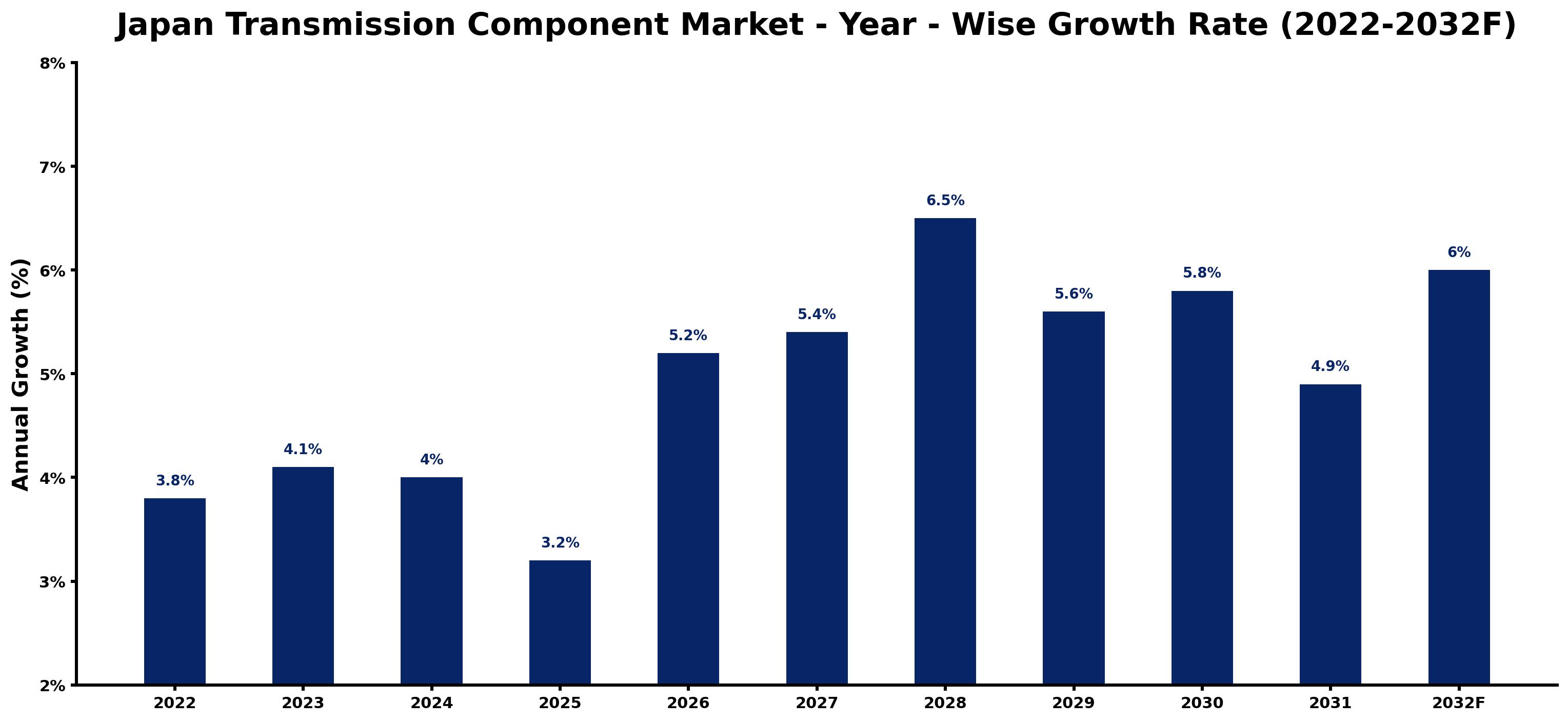
The yearly estimates that follow link every growth rate to its principal driver, so readers can see why the pace changed in each period.
| Year | Estimated Annual Growth (%) | Market Rationale |
| 2022 | 3.8 | The market experienced moderate growth due to steady vehicle production levels. |
| 2023 | 4.1 | Demand increased as automotive exports reached 4.5 million units, boosting component orders. |
| 2024 | 4.0 | Growth slowed slightly as manufacturers adjusted to changing market conditions. |
| 2025 | 3.2 | A decrease in growth rates occurred as the market stabilised after previous peaks. |
| 2026 | 5.2 | Demand is expected to rise with the introduction of new automotive technologies. |
| 2027 | 5.4 | Growth is projected to continue as manufacturers invest in advanced systems. |
| 2028 | 6.5 | The peak growth year is driven by heightened demand for automatic transmission components. |
| 2029 | 5.6 | Growth is expected to slow as the market adjusts to previous high levels of production. |
| 2030 | 5.8 | Demand is anticipated to rise again as vehicle replacement rates increase. |
| 2031 | 4.9 | Growth is expected to moderate as the market stabilises after expansions. |
| 2032 | 6.0 | Demand is projected to rise with ongoing investments in automotive innovation. |
Note: Market size estimations and growth projections presented in this report are based on 6Wresearch's proprietary forecasting methodology, utilizing the latest available industry data, government publications, and primary research inputs.
Japan Transmission Component Market Synopsis
Transmission components are critical mechanical parts in vehicles, facilitating power transfer from the engine to the wheels. In Japan, demand stems from domestic auto manufacturers, with the automotive sector contributing approximately 20% of the country's manufacturing output in 2022. The Japan Transmission Component Market is expanding due to increasing vehicle production, with 8.3 million vehicles produced in 2022 and ongoing investments in automotive technology, highlighted by the Ministry of Economy, Trade and Industry's 2023 programme to advance automotive technology. This trend is set to persist as manufacturers strive to improve performance and efficiency.
Market Dynamics Impact Analysis (2026–2032)
| Factor | Type | Impact | Primary Segment Affected |
| Increasing vehicle production drives demand for transmission components. | Driver | High | Gear Assemblies |
| Technological advancements in automatic transmissions create new opportunities. | Driver | High | Torque Converters |
| Rising exports of vehicles create demand for high-quality components. | Opportunity | High | Transmission Shafts |
| Growing interest in electric vehicles necessitates new transmission solutions. | Opportunity | Medium | Clutches |
| Stringent emission standards require compliance, impacting design and production. | Restraint | High | Torque Transfer |
| Aging vehicle fleet increases demand for replacement parts. | Restraint | Medium | Power Modulation |
| High production costs challenge profitability for manufacturers. | Challenge | High | Gear Assemblies |
| Supply chain disruptions can delay component availability. | Challenge | Medium | Transmission Suppliers |
Evaluation of Drivers in Japan Transmission Component Market (2026–2032)
Below are the drivers that matter most for revenue growth, with supporting evidence.
| Drivers | Primary Segment Affected | Why It Matters (Evidence) |
| Rising vehicle production levels drive demand for components. | Gear Assemblies | Japan produced 8.3 million vehicles in 2022, increasing orders for essential parts. |
| Technological advancements in automatic transmissions boost demand. | Torque Converters | The introduction of new automatic systems requires advanced transmission solutions. |
| Growing exports of vehicles increase component orders. | Transmission Shafts | Japan's automotive exports reached 4.5 million units in 2023, influencing component demand. |
| Increased investments in automotive technology stimulate market growth. | Clutches | The Ministry of Economy, Trade and Industry's 2023 programme supports technological advancements. |
| The aging vehicle fleet necessitates more replacement parts. | Power Modulation | With an average vehicle age of around 10 years, replacement demand rises. |
Behind the steady rise in orders sits increasing production levels, with Japan producing 8.3 million vehicles in 2022. This surge drives demand for components, particularly Gear Assemblies, essential for power transfer. The automotive sector accounted for approximately 20% of Japan's manufacturing output, highlighting the industry's significance. The introduction of new automatic transmission technologies stimulates demand, especially for Torque Converters. The average vehicle age of around 10 years creates a consistent need for replacement parts, as manufacturers respond to evolving market needs.
Evaluation of Restraints in Japan Transmission Component Market
These restraints slow adoption and weigh on supplier margins.
| Market Restraint | Primary Segment Affected | Why It Matters (Evidence) |
| Stringent emission standards increase production costs for manufacturers. | Torque Transfer | Japan's strict regulations necessitate compliance, raising costs for component production. |
| Aging vehicle fleet increases demand for replacement parts but limits new sales. | Power Modulation | The average vehicle age of 10 years means more focus on replacements rather than new sales. |
| High production costs challenge profitability for manufacturers. | Gear Assemblies | Rising material costs affect the overall profitability of transmission component production. |
| Supply chain disruptions can delay component availability. | Transmission Suppliers | Global supply chain issues have caused delays in component delivery, impacting production schedules. |
| Limited investment in R&D can hinder innovation in transmission technologies. | Clutches | Without adequate funding, advancements in transmission technologies may stall. |
Japan Transmission Component Market Challenges
A major obstacle in the transmission component market is the shortage of skilled workers, as training new employees can take up to six months, delaying production for manufacturers. Supply chain disruptions arise from global logistics challenges, causing component delivery delays that can extend lead times by 30%, impacting auto manufacturers. Buyers face challenges with the aging vehicle fleet, where the average age of vehicles is around 10 years, increasing demand for replacement parts and straining inventories. Rising raw material costs, particularly for high-strength steel and aluminium alloys, have surged by 15%, squeezing profit margins for producers and driving up prices for buyers.
Trends in the Japan Transmission Component Market
These developments are changing demand patterns in the Japan Transmission Component Market.
- Ministry of Economy, Trade and Industry's 2023 Programme for Advanced Transmissions: The Ministry of Economy, Trade and Industry's 2023 programme promotes advanced automatic transmission technologies. This shift is reflected in the projected growth of 7.8% for Torque Converters.
- Transition from Traditional to Electric Vehicles: The automotive industry is increasingly adopting electric vehicles, necessitating new transmission solutions. This transition is reflected in the growing demand for Clutches, with a projected CAGR of 7.2%.
- Passenger Vehicles Prioritised over Commercial Vehicles: Passenger Vehicles accounted for 41% of the market share in 2025, reflecting a stronger focus on consumer demand. This trend influences manufacturers to improve their offerings in this segment.
- Aichi Prefecture Emerging as Automotive Innovation Hub: The Aichi Prefecture is becoming a key automotive manufacturing hub, driving innovation in transmission components. This region produced 8.3 million vehicles in 2022, significantly impacting component demand.
Investment Opportunities in the Japan Transmission Component Market
The following opportunities in the Japan Transmission Component Market pair current demand with a clear way in.
- Entering through Joint Ventures with Local Manufacturers: Now is the time for foreign manufacturers to enter the market through joint ventures with local firms. Auto Manufacturers in Japan are seeking new transmission solutions, creating a demand for advanced components.
- Investment in Electric Vehicle Transmission Technologies: With the rise of electric vehicles, there is a significant opportunity to supply new transmission technologies. Transmission Suppliers are looking for partners to develop advanced systems that meet evolving market needs.
- Expansion of Production Facilities in Aichi Prefecture: Investing in new production facilities in Aichi Prefecture is a strategic move. With over 1,000 auto manufacturers operating in the region, suppliers can tap into a growing market.
- ISO 9001 Certification for Enhanced Credibility: Now is an ideal time to obtain ISO 9001 certification to boost credibility. This standard is commonly adopted by transmission component manufacturers, increasing market competitiveness.
Government Initiatives in the Japan Transmission Component Market
The GX Promotion Act, introduced in 2023, builds on the Green Growth Strategy established in 2020, which identified key sectors for sustainable development. This new law mandates the integration of carbon-neutral technologies in manufacturing processes, compelling transmission component producers to invest in cleaner production methods. Such measures aim to reduce emissions and improve energy efficiency, aligning with Japan's long-term environmental goals.
In 2023, the Ministry of Economy, Trade and Industry allocated USD 500 million to support the development of advanced automotive technologies. This funding will facilitate research and development projects aimed at enhancing transmission components, ensuring compliance with stringent emission standards. The agency's initiatives are crucial for maintaining competitiveness in the global automotive market.
Future Insight of the Japan Transmission Component Market
Buyers will see substantial improvements in transmission technologies that enhance vehicle performance and efficiency. By 2032, the adoption of ISO 9001 standards will ensure higher quality in component production, benefiting suppliers through increased reliability. The Ministry of Economy, Trade and Industry's new programme will stimulate innovation, resulting in more competitive offerings in the market. Japan's automotive exports, reaching 4.5 million units, will continue to drive demand for advanced components, allowing suppliers to expand their market presence.
Market Segmentation Analysis
Japan Transmission Component Market report covers a detailed analysis of the following market segments:
By Component Type – Gear Assemblies Lead, Torque Converters Expected to Grow Fastest
According to Saurav Kr Singh, Senior Research Analyst at 6Wresearch, Gear Assemblies accounted for 45% of the market by component type in 2025. Gear assemblies dominate the market as they are crucial for power transmission in vehicles. The production of 8.3 million vehicles in Japan in 2022 highlights the strong demand for these essential components. Torque Converters are set to record the highest CAGR in this split, 7.8% over 2026–2032. Torque converters are witnessing rapid growth due to their necessity in automatic transmission systems. The increase in automotive exports, reaching 4.5 million units in 2023, is expected to further drive this demand. Suppliers should focus on expanding their offerings in torque converters to capitalise on this upward trend.
By Functionality – Torque Transfer Leads, Power Modulation Expected to Grow Fastest
With 36% of functionality revenue in 2025, Torque Transfer was the largest category. Torque transfer functionality leads the market as it is vital for vehicle movement, making it indispensable across various vehicle types. The automotive sector's contribution of approximately 20% to Japan's manufacturing output in 2022 emphasises the importance of this functionality. The quickest growth will come from Power Modulation, forecast to expand at a CAGR of 7.2% between 2026 and 2032. Power modulation is growing quickly as it enables performance adjustments in vehicles, aligning with the industry's emphasis on efficiency. The 2023 programme launched by the Ministry of Economy, Trade and Industry to enhance automotive technology will likely support this growth. Buyers should prioritise components that feature advanced power modulation capabilities to fulfil performance requirements.
By Vehicle Segment – Passenger Vehicles Lead, SUVs & Vans Expected to Grow Fastest
The largest vehicle segment category in 2025 was Passenger Vehicles, at 41% of revenue. Passenger vehicles are the largest segment for transmission components, reflecting the high volume of personal transport in Japan. The average vehicle age of around 10 years indicates a consistent demand for replacement parts in this category. SUVs & Vans are projected to grow fastest, at a CAGR of 7.4% during 2026–2032. SUVs and vans are the fastest-growing segment, driven by a consumer shift towards larger vehicles that necessitate robust components. The automotive workforce of approximately 1.5 million people ensures a steady supply of necessary parts to accommodate this trend. Manufacturers should adapt their production strategies to address the increasing demand for transmission components in SUVs and vans.
By End User – Auto Manufacturers Lead, Transmission Suppliers Expected to Grow Fastest
Auto Manufacturers held 42% of the Japan Transmission Component Market by end user in 2025. Auto manufacturers are the primary users of transmission components, as they directly integrate these parts into their vehicles. The presence of over 1,000 auto manufacturers and suppliers in Japan ensures a steady demand for these components. Over 2026–2032, Transmission Suppliers are expected to post the fastest growth, at a CAGR of 7.3%. Transmission suppliers are experiencing the fastest growth as they provide essential parts to manufacturers, facilitating the production of vehicles. The ongoing support from the Japan Automobile Manufacturers Association for industry standards will likely boost this segment further. Suppliers must strengthen their partnerships with auto manufacturers to secure a larger share of the growing market.
Key Attractiveness of the Report
- 10 Years of Market Numbers
- Historical Data Starting from 2022 to 2025
- Base Year 2025
- Forecast Data until 2032
- Key Performance Indicators Impacting the Market
- Major Upcoming Developments and Projects
Key Highlights of the Report:
- Japan Transmission Component Market Outlook
- Market Size of Japan Transmission Component Market, 2025
- Forecast of Japan Transmission Component Market, 2032
- Historical Data and Forecast of Japan Transmission Component Revenues & Volume for the Period 2022-2032F
- Japan Transmission Component Market Trend Evolution
- Japan Transmission Component Market Drivers and Challenges
- Japan Transmission Component Price Trends
- Japan Transmission Component Porter's Five Forces
- Japan Transmission Component Industry Life Cycle
- Historical Data and Forecast of Japan Transmission Component Market Revenues & Volume By Component Type for the Period 2022-2032F
- Historical Data and Forecast of Japan Transmission Component Market Revenues & Volume By Gear Assemblies for the Period 2022-2032F
- Historical Data and Forecast of Japan Transmission Component Market Revenues & Volume By Clutches for the Period 2022-2032F
- Historical Data and Forecast of Japan Transmission Component Market Revenues & Volume By Torque Converters for the Period 2022-2032F
- Historical Data and Forecast of Japan Transmission Component Market Revenues & Volume By Transmission Shafts for the Period 2022-2032F
- Historical Data and Forecast of Japan Transmission Component Market Revenues & Volume By Functionality for the Period 2022-2032F
- Historical Data and Forecast of Japan Transmission Component Market Revenues & Volume By Torque Transfer for the Period 2022-2032F
- Historical Data and Forecast of Japan Transmission Component Market Revenues & Volume By Power Modulation for the Period 2022-2032F
- Historical Data and Forecast of Japan Transmission Component Market Revenues & Volume By Speed Regulation for the Period 2022-2032F
- Historical Data and Forecast of Japan Transmission Component Market Revenues & Volume By Rotation Transmission for the Period 2022-2032F
- Historical Data and Forecast of Japan Transmission Component Market Revenues & Volume By Vehicle Segment for the Period 2022-2032F
- Historical Data and Forecast of Japan Transmission Component Market Revenues & Volume By Passenger Vehicles for the Period 2022-2032F
- Historical Data and Forecast of Japan Transmission Component Market Revenues & Volume By Commercial Vehicles for the Period 2022-2032F
- Historical Data and Forecast of Japan Transmission Component Market Revenues & Volume By SUVs & Vans for the Period 2022-2032F
- Historical Data and Forecast of Japan Transmission Component Market Revenues & Volume By Off-Road Vehicles for the Period 2022-2032F
- Historical Data and Forecast of Japan Transmission Component Market Revenues & Volume By End User for the Period 2022-2032F
- Historical Data and Forecast of Japan Transmission Component Market Revenues & Volume By Auto Manufacturers for the Period 2022-2032F
- Historical Data and Forecast of Japan Transmission Component Market Revenues & Volume By Transmission Suppliers for the Period 2022-2032F
- Historical Data and Forecast of Japan Transmission Component Market Revenues & Volume By Gearbox Manufacturers for the Period 2022-2032F
- Historical Data and Forecast of Japan Transmission Component Market Revenues & Volume By OEMs for the Period 2022-2032F
- Japan Transmission Component Import Export Trade Statistics
- Market Opportunity Assessment By Component Type
- Market Opportunity Assessment By Functionality
- Market Opportunity Assessment By Vehicle Segment
- Market Opportunity Assessment By End User
- Japan Transmission Component Top Companies Market Share
- Japan Transmission Component Competitive Benchmarking By Technical and Operational Parameters
- Japan Transmission Component Company Profiles
- Japan Transmission Component Key Strategic Recommendations
Market Covered
Segments analysed in this report are listed below.
By Component Type
- Gear Assemblies
- Clutches
- Torque Converters
- Transmission Shafts
By Functionality
- Torque Transfer
- Power Modulation
- Speed Regulation
- Rotation Transmission
By Vehicle Segment
- Passenger Vehicles
- Commercial Vehicles
- SUVs & Vans
- Off-Road Vehicles
By End User
- Auto Manufacturers
- Transmission Suppliers
- Gearbox Manufacturers
- OEMs































