Japan Transmission Control Solenoids Market Size & Growth Rate
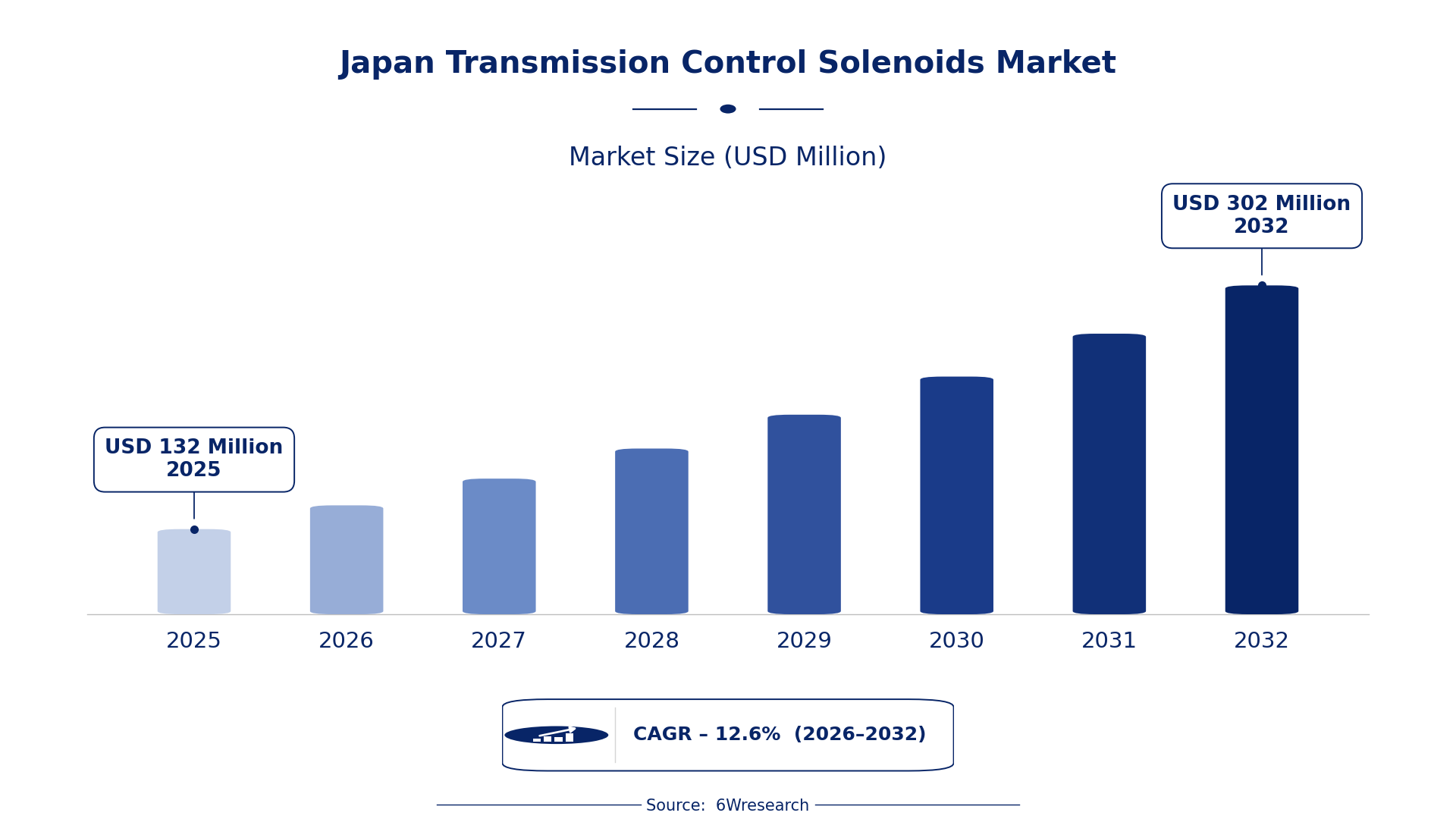
According to 6Wresearch internal database and industry insights, the Japan Transmission Control Solenoids Market was valued at USD 132 Million in 2025 and is projected to reach USD 302 Million by 2032, growing at a CAGR of approximately 12.6% during 2026–2032.
Japan Transmission Control Solenoids Market Highlights
| Report Metric | Details |
| Report Name | Japan Transmission Control Solenoids Market (2026-2032) |
| Market Size 2025 | USD 132 Million |
| Market Size 2032 | USD 302 Million |
| Absolute Growth 2025–2032 | USD 170 Million |
| CAGR 2026–2032 | 12.6% |
| Peak Annual Growth | 14.5% in 2032 |
| Forecast Period | 2026–2032 |
| Historical Data | 2022–2025 |
| Base Year | 2025 |
| Leading Solenoid Type, 2025 | Shift Solenoids (52% share) |
| Leading Transmission Type, 2025 | Automatic (47% share) |
| Leading Vehicle Type, 2025 | Passenger Cars (39% share) |
| Leading End User, 2025 | Car OEMs (40% share) |
| Fastest-Growing Solenoid Type | Variable Force Solenoids (17.7% CAGR) |
| Fastest-Growing Transmission Type | CVT (18.0% CAGR) |
| Fastest-Growing Vehicle Type | Electric Vehicles (18.4% CAGR) |
| Fastest-Growing End User | Transmission Makers (16.3% CAGR) |
| Growing Sector | Automotive |
| Key End Users | Car OEMs, Transmission Makers, Part Dealers |
Japan Transmission Control Solenoids Market Year-wise Growth Rate and Key Drivers (2022–2032)
This graph illustrates the annual growth rates of the market from 2022 to 2032, highlighting a steady upward trajectory and projected market expansion over the forecast period.
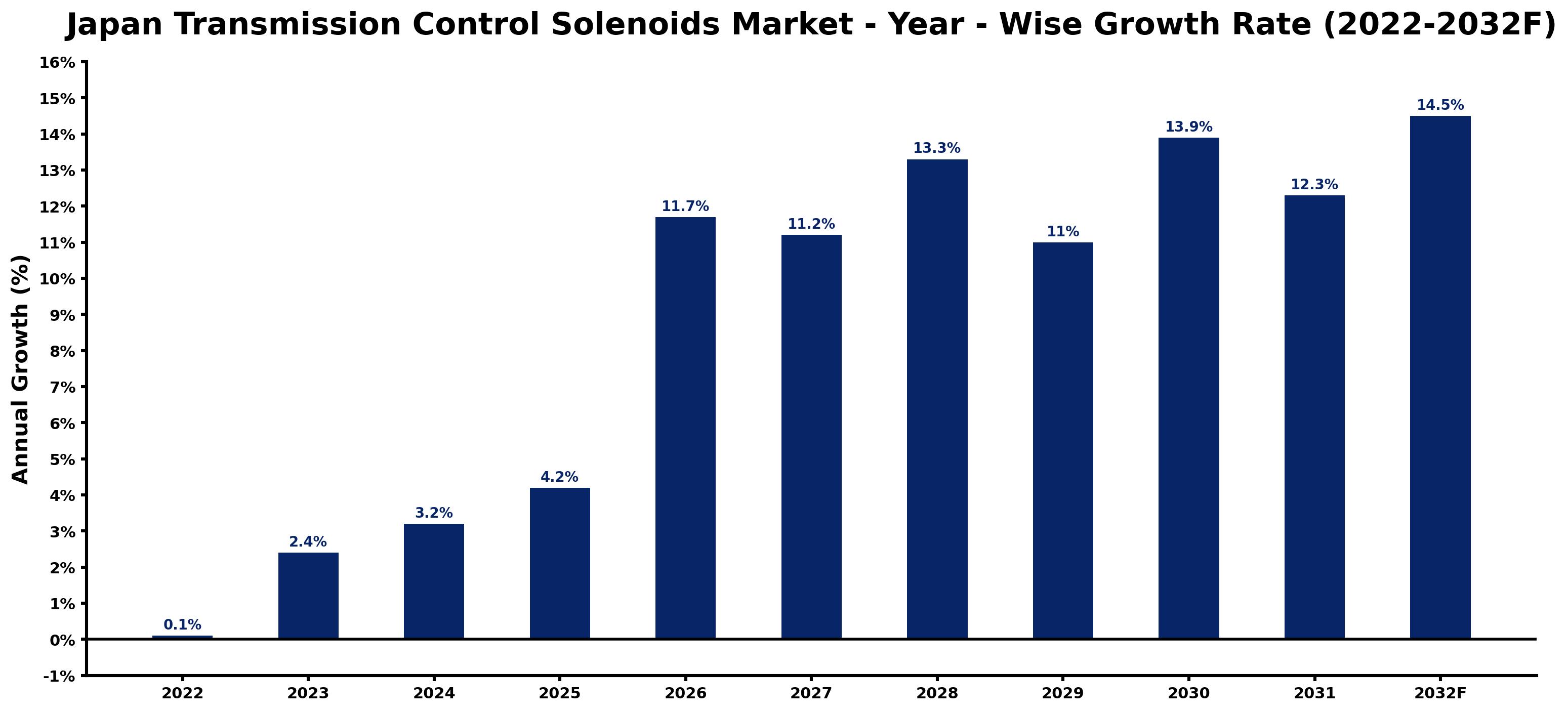
Annual growth estimates for each year appear below with the principal reason behind them, explaining the shifts that set the pace of the market.
| Year | Estimated Annual Growth (%) | Market Rationale |
| 2022 | 0.1 | The automotive sector's production levels remained stable, reflecting ongoing demand. |
| 2023 | 2.4 | Increased vehicle production and exports contributed to stronger market performance. |
| 2024 | 3.2 | The rise in domestic vehicle manufacturing boosted demand for solenoids. |
| 2025 | 4.2 | Higher production rates in the automotive industry supported market growth. |
| 2026 | 11.7 | The shift towards advanced transmission systems is expected to drive demand. |
| 2027 | 11.2 | The market continues to expand, although growth rates are slightly slower. |
| 2028 | 13.3 | Innovations in transmission technology are expected to stimulate demand for solenoids. |
| 2029 | 11.0 | The market experiences a gradual slowdown, yet remains on an upward trend. |
| 2030 | 13.9 | Growing adoption of advanced transmission types will fuel demand for solenoids. |
| 2031 | 12.3 | The market growth rate stabilises, supported by consistent automotive production. |
| 2032 | 14.5 | Increased focus on fuel efficiency and performance drives peak demand. |
Note: Market size estimations and growth projections presented in this report are based on 6Wresearch's proprietary forecasting methodology, utilizing the latest available industry data, government publications, and primary research inputs.
Japan Transmission Control Solenoids Market Synopsis
Transmission Control Solenoids are electromechanical devices that regulate the flow of transmission fluid in vehicles, essential for optimizing gear shifts and fuel efficiency. The Japan Transmission Control Solenoids Market is experiencing growth, driven by the booming automotive industry, which produced 8.3 million vehicles in 2022. Key buyer groups include car manufacturers and transmission makers, with increasing demand for advanced transmission technologies and a focus on fuel efficiency contributing to market expansion.
Market Dynamics Impact Analysis (2026–2032)
| Factor | Type | Impact | Primary Segment Affected |
| Growing automotive production and exports | Driver | High | Shift Solenoids |
| Increased focus on fuel efficiency | Driver | High | Lock-up Solenoids |
| Rising demand for electric vehicles | Opportunity | High | Electric Vehicles |
| Expansion of automotive manufacturing hubs | Opportunity | Medium | Passenger Cars |
| High competition among suppliers | Restraint | High | Pressure Control Solenoids |
| Fluctuating raw material prices | Restraint | Medium | Variable Force Solenoids |
| Challenges in meeting safety standards | Challenge | High | Automatic |
| Technological advancements requiring continuous investment | Challenge | Medium | DCT |
Evaluation of Drivers in Japan Transmission Control Solenoids Market (2026–2032)
The main growth drivers and the segments they affect most are set out below.
| Drivers | Primary Segment Affected | Why It Matters (Evidence) |
| Increased vehicle production | Shift Solenoids | Japan's automotive industry produced 8.3 million vehicles in 2022, boosting demand for solenoids. |
| Focus on fuel efficiency improvements | Lock-up Solenoids | The average age of vehicles in Japan is 12.5 years, increasing the need for efficient components. |
| Expansion of automotive manufacturing regions | Passenger Cars | The Tokyo region is a hub for automotive manufacturing, increasing local demand for solenoids. |
| Rising demand for advanced transmission systems | Variable Force Solenoids | The automotive sector is expected to invest ¥1 trillion in R&D by 2025, promoting innovation. |
| Growing electric vehicle adoption | Electric Vehicles | Electric vehicles accounted for 10% of new car sales in 2022, increasing demand for new solenoid designs. |
Spending increases as Japan's automotive industry produced 8.3 million vehicles in 2022, heightening demand for solenoids. The average age of vehicles in Japan is 12.5 years, creating a greater need for efficient components. The automotive sector is expected to invest ¥1 trillion in R&D by 2025, promoting advancements in transmission technology. With electric vehicles accounting for 10% of new car sales in 2022, manufacturers are redesigning solenoids to meet changing requirements. The Tokyo region serves as a hub for automotive manufacturing, boosting local demand for solenoids.
Evaluation of Restraints in Japan Transmission Control Solenoids Market
These restraints slow adoption and weigh on supplier margins.
| Market Restraint | Primary Segment Affected | Why It Matters (Evidence) |
| Intense competition among solenoid manufacturers | Pressure Control Solenoids | The automotive sector includes over 5,000 parts suppliers, heightening competition for market share. |
| Rising raw material costs impacting production | Variable Force Solenoids | Fluctuations in raw material prices can affect profit margins for manufacturers. |
| Challenges in compliance with safety standards | Automatic | ISO 26262 is a standard for automotive safety that solenoids must meet, complicating production. |
| Technological advancements requiring constant investment | DCT | Keeping up with rapid technological changes demands financial resources from suppliers. |
| Limited market for solenoids in electric vehicles | Electric Vehicles | Current EV models have restricted use for traditional solenoids, limiting market growth. |
Japan Transmission Control Solenoids Market Challenges
ISO 26262 compliance for transmission control solenoids imposes strict safety regulations, extending product development timelines for manufacturers. A limited number of parts suppliers in the automotive supply chain can lead to shortages, causing delays for producers reliant on timely deliveries. Rising material costs, driven by increased demand for components, strain budgets for manufacturers, ultimately raising prices for buyers. A shortage of skilled workers in advanced automotive technologies reduces production efficiency, compelling companies to invest in training, which delays the launch of new solenoid models.
Trends in the Japan Transmission Control Solenoids Market
The shifts below are changing how Japan Transmission Control Solenoids Market products are bought and supplied.
- Shift from Traditional to Advanced Transmission Systems: The automotive industry is increasingly adopting advanced transmission systems, such as CVTs, which are projected to grow at an 18.0% CAGR. This shift is occurring in the Tokyo region, where manufacturers are focusing on efficiency.
- Transition from Conventional to Electric Vehicles: Electric vehicles are becoming more prominent in Japan, accounting for 10% of new car sales in 2022. This trend is reshaping the automotive market and influencing solenoid design requirements.
- Emergence of Adaptive Transmission Technologies: Adaptive transmission technologies are gaining traction, with Variable Force Solenoids expected to grow at a CAGR of 17.7%. This change reflects the industry's push for improved vehicle performance and efficiency.
- Prioritisation of Fuel Efficiency in Automotive Design: The automotive sector is increasingly prioritising fuel efficiency, driven by consumer demand and regulatory pressures. The government aims for 100% electric vehicle sales by 2035, influencing manufacturers to innovate.
Investment Opportunities in the Japan Transmission Control Solenoids Market
Several openings in the Japan Transmission Control Solenoids Market merit attention from investors.
- Tokyo as a Hub for Automotive Innovation: Tokyo's automotive manufacturing sector is expanding, with an investment of ¥1 trillion in R&D by 2025. This presents opportunities for suppliers of advanced solenoids to enter the market.
- Growing Demand for Electric Vehicle Components: With electric vehicles projected to grow, suppliers can invest in solenoid designs tailored for EVs. Car OEMs are increasingly seeking efficient solutions.
- Expansion of Transmission Makers: As transmission makers seek to improve performance, there is a growing need for advanced solenoids. Collaborating with local manufacturers in Japan can facilitate market entry.
- Investment in Fuel Efficiency Technologies: The push for fuel efficiency in the automotive sector creates opportunities for solenoid manufacturers. The JAMA promotes automotive technology advancements, encouraging innovation.
Government Initiatives in the Japan Transmission Control Solenoids Market
The Electrical Appliance and Material Safety Act (1961) regulates the safety of electrical components, including solenoids, ensuring compliance with safety standards. The New Robot Strategy (2015) aims to improve manufacturing efficiency, indirectly impacting the production of automotive components. The government encourages R&D initiatives through various funding programs, supporting the capabilities of solenoid manufacturers.
The Ministry of Land, Infrastructure, Transport and Tourism oversees automotive regulations and approves safety standards for components. The government supports innovation in the automotive sector through subsidies, promoting advancements in technology and manufacturing processes.
Future Insight of the Japan Transmission Control Solenoids Market
The policy-driven shift towards 100% electric vehicle sales by 2035 will reshape the market, prompting suppliers to innovate their product lines. By 2032, advancements in transmission technologies will emerge as a response to regulatory changes. Investments in R&D are projected to reach ¥1 trillion by 2025, which will improve the capabilities of transmission control solenoids. As the number of registered passenger cars in Japan grows to 60 million, the demand for replacement parts will surge, providing growth opportunities for suppliers.
Market Segmentation Analysis
Japan Transmission Control Solenoids Market report covers a detailed analysis of the following market segments:
By Solenoid Type – Shift Solenoids Lead, Variable Force Solenoids Expected to Grow Fastest
According to Saurav Kr Singh, Senior Research Analyst at 6Wresearch, with 52% of solenoid type revenue in 2025, Shift Solenoids was the largest category. Shift Solenoids dominate the market as they are essential for gear shifting in automatic transmissions, which are prevalent in Japan's automotive sector. Their importance is underscored by the production of 8.3 million vehicles in 2022, where these solenoids play a critical role. Over 2026–2032, Variable Force Solenoids are expected to post the fastest growth, at a CAGR of 17.7%. Variable Force Solenoids are experiencing rapid growth due to their integration in adaptive transmission control systems that enhance fuel efficiency. This trend aligns with the automotive industry's increased investment in R&D, projected to reach ¥1 trillion by 2025. Suppliers should prioritise the development of Variable Force Solenoids to meet the rising demand for efficient transmission technologies.
By Transmission Type – Automatic Leads, CVT Expected to Grow Fastest
In 2025, Automatic led the transmission type split with a 47% share. Automatic transmissions lead the market as they are the preferred choice in passenger vehicles, reflecting consumer demand for user-friendly driving experiences. The widespread integration of automatic systems in new models illustrates their dominance in Japan's automotive landscape. CVT is set to record the highest CAGR in this split, 18.0% over 2026–2032. CVT systems are rapidly gaining traction due to their fuel efficiency advantages, appealing to manufacturers aiming to meet consumer preferences. This growth is further supported by government initiatives promoting electric vehicle adoption, which often favour CVT technology. Manufacturers should enhance their CVT offerings to align with the increasing consumer focus on fuel-efficient vehicle options.
By Vehicle Type – Passenger Cars Lead, Electric Vehicles Expected to Grow Fastest
Passenger Cars accounted for 39% of the market by vehicle type in 2025. Passenger Cars account for the largest share of solenoid usage, as they represent a significant portion of Japan's automotive output. With 60 million registered passenger cars in 2023, the reliance on solenoids for optimal performance and efficiency is crucial. Electric Vehicles are projected to grow fastest, at a CAGR of 18.4% during 2026–2032. Electric Vehicles are witnessing the fastest growth, although their current use of solenoids is limited. The government's goal of achieving 100% electric vehicle sales by 2035 is likely to accelerate the adoption of advanced solenoid technologies in this segment. Suppliers should prepare for a surge in demand for solenoids in electric vehicles as the market transitions towards electrification.
By End User – Car OEMs Lead, Transmission Makers Expected to Grow Fastest
Car OEMs took 40% of end user revenue in 2025, more than any other category. Car OEMs are the main users of solenoids, integrating these components into their manufacturing processes for new vehicles. Their pivotal role in producing millions of vehicles annually highlights the critical importance of solenoids in automotive engineering. The quickest growth will come from Transmission Makers, forecast to expand at a CAGR of 16.3% between 2026 and 2032. Transmission Makers are rapidly growing as they develop comprehensive transmission systems that incorporate advanced solenoid technologies. This expansion is driven by the industry's emphasis on improving transmission performance and efficiency. Suppliers should strengthen partnerships with transmission makers to leverage the increasing demand for sophisticated transmission solutions.
Key Attractiveness of the Report
- 10 Years of Market Numbers
- Historical Data Starting from 2022 to 2025
- Base Year 2025
- Forecast Data until 2032
- Key Performance Indicators Impacting the Market
- Major Upcoming Developments and Projects
Key Highlights of the Report:
- Japan Transmission Control Solenoids Market Outlook
- Market Size of Japan Transmission Control Solenoids Market, 2025
- Forecast of Japan Transmission Control Solenoids Market, 2032
- Historical Data and Forecast of Japan Transmission Control Solenoids Revenues & Volume for the Period 2022-2032F
- Japan Transmission Control Solenoids Market Trend Evolution
- Japan Transmission Control Solenoids Market Drivers and Challenges
- Japan Transmission Control Solenoids Price Trends
- Japan Transmission Control Solenoids Porter's Five Forces
- Japan Transmission Control Solenoids Industry Life Cycle
- Historical Data and Forecast of Japan Transmission Control Solenoids Market Revenues & Volume By Solenoid Type for the Period 2022-2032F
- Historical Data and Forecast of Japan Transmission Control Solenoids Market Revenues & Volume By Shift Solenoids for the Period 2022-2032F
- Historical Data and Forecast of Japan Transmission Control Solenoids Market Revenues & Volume By Lock-up Solenoids for the Period 2022-2032F
- Historical Data and Forecast of Japan Transmission Control Solenoids Market Revenues & Volume By Pressure Control Solenoids for the Period 2022-2032F
- Historical Data and Forecast of Japan Transmission Control Solenoids Market Revenues & Volume By Variable Force Solenoids for the Period 2022-2032F
- Historical Data and Forecast of Japan Transmission Control Solenoids Market Revenues & Volume By Transmission Type for the Period 2022-2032F
- Historical Data and Forecast of Japan Transmission Control Solenoids Market Revenues & Volume By Automatic for the Period 2022-2032F
- Historical Data and Forecast of Japan Transmission Control Solenoids Market Revenues & Volume By CVT for the Period 2022-2032F
- Historical Data and Forecast of Japan Transmission Control Solenoids Market Revenues & Volume By DCT for the Period 2022-2032F
- Historical Data and Forecast of Japan Transmission Control Solenoids Market Revenues & Volume By Hydraulic for the Period 2022-2032F
- Historical Data and Forecast of Japan Transmission Control Solenoids Market Revenues & Volume By Vehicle Type for the Period 2022-2032F
- Historical Data and Forecast of Japan Transmission Control Solenoids Market Revenues & Volume By Passenger Cars for the Period 2022-2032F
- Historical Data and Forecast of Japan Transmission Control Solenoids Market Revenues & Volume By Light Commercial for the Period 2022-2032F
- Historical Data and Forecast of Japan Transmission Control Solenoids Market Revenues & Volume By Electric Vehicles for the Period 2022-2032F
- Historical Data and Forecast of Japan Transmission Control Solenoids Market Revenues & Volume By Heavy-Duty Trucks for the Period 2022-2032F
- Historical Data and Forecast of Japan Transmission Control Solenoids Market Revenues & Volume By End User for the Period 2022-2032F
- Historical Data and Forecast of Japan Transmission Control Solenoids Market Revenues & Volume By Car OEMs for the Period 2022-2032F
- Historical Data and Forecast of Japan Transmission Control Solenoids Market Revenues & Volume By Part Dealers for the Period 2022-2032F
- Historical Data and Forecast of Japan Transmission Control Solenoids Market Revenues & Volume By Transmission Makers for the Period 2022-2032F
- Historical Data and Forecast of Japan Transmission Control Solenoids Market Revenues & Volume By MRO Providers for the Period 2022-2032F
- Japan Transmission Control Solenoids Import Export Trade Statistics
- Market Opportunity Assessment By Solenoid Type
- Market Opportunity Assessment By Transmission Type
- Market Opportunity Assessment By Vehicle Type
- Market Opportunity Assessment By End User
- Japan Transmission Control Solenoids Top Companies Market Share
- Japan Transmission Control Solenoids Competitive Benchmarking By Technical and Operational Parameters
- Japan Transmission Control Solenoids Company Profiles
- Japan Transmission Control Solenoids Key Strategic Recommendations
Market Covered
The report covers the following segments.
By Solenoid Type
- Shift Solenoids
- Lock-up Solenoids
- Pressure Control Solenoids
- Variable Force Solenoids
By Transmission Type
- Automatic
- CVT
- DCT
- Hydraulic
By Vehicle Type
- Passenger Cars
- Light Commercial
- Electric Vehicles
- Heavy-Duty Trucks
By End User
- Car OEMs
- Part Dealers
- Transmission Makers
- MRO Providers































