Japan Transmission engagement systems Market Size & Growth Rate
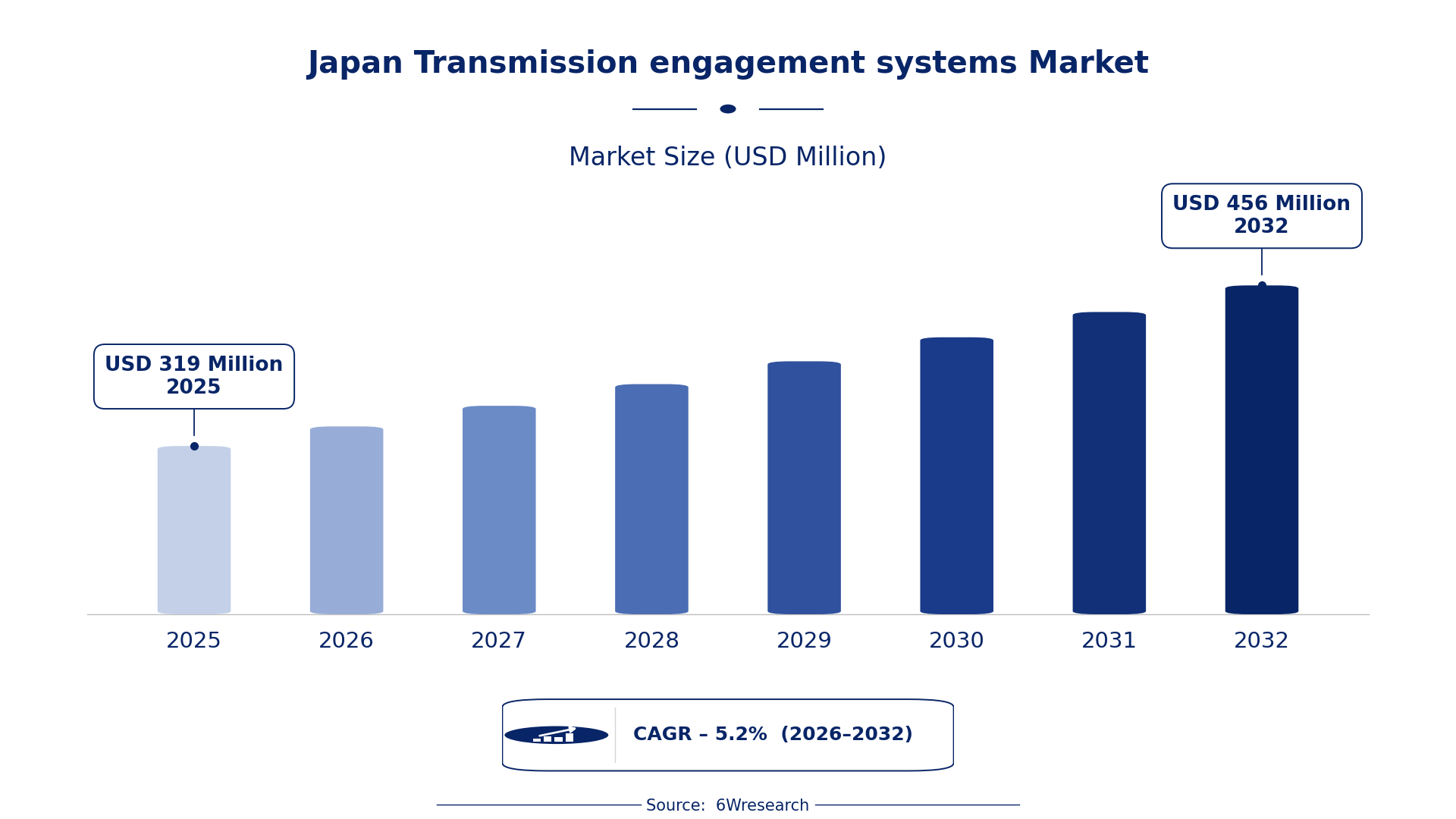
According to 6Wresearch internal database and industry insights, the Japan Transmission engagement systems Market was valued at USD 319 Million in 2025 and is projected to reach USD 456 Million by 2032, growing at a CAGR of approximately 5.2% during 2026–2032.
Japan Transmission engagement systems Market Highlights
| Report Metric | Details |
| Report Name | Japan Transmission engagement systems Market (2026-2032) |
| Market Size 2025 | USD 319 Million |
| Market Size 2032 | USD 456 Million |
| Absolute Growth 2025–2032 | USD 137 Million |
| CAGR 2026–2032 | 5.2% |
| Peak Annual Growth | 6.7% in 2026 |
| Forecast Period | 2026–2032 |
| Historical Data | 2022–2025 |
| Base Year | 2025 |
| Leading System Type, 2025 | Dual-Clutch Systems (48% share) |
| Leading Engagement Mechanism, 2025 | Electro-Hydraulic (39% share) |
| Leading Transmission Mode, 2025 | Sports Cars (42% share) |
| Leading End User, 2025 | Performance OEMs (48% share) |
| Fastest-Growing System Type | Synchromesh Systems (7.4% CAGR) |
| Fastest-Growing Engagement Mechanism | Friction-Based (6.6% CAGR) |
| Fastest-Growing Transmission Mode | Manual (6.9% CAGR) |
| Fastest-Growing End User | Car Makers (7.0% CAGR) |
| Growing Sector | automotive industry |
| Key End Users | Performance OEMs, Car Makers, EV Startups |
Japan Transmission engagement systems Market Year-wise Growth Rate and Key Drivers (2022–2032)
This graph illustrates the annual growth rates of the market from 2022 to 2032, highlighting a steady upward trajectory and projected market expansion over the forecast period.
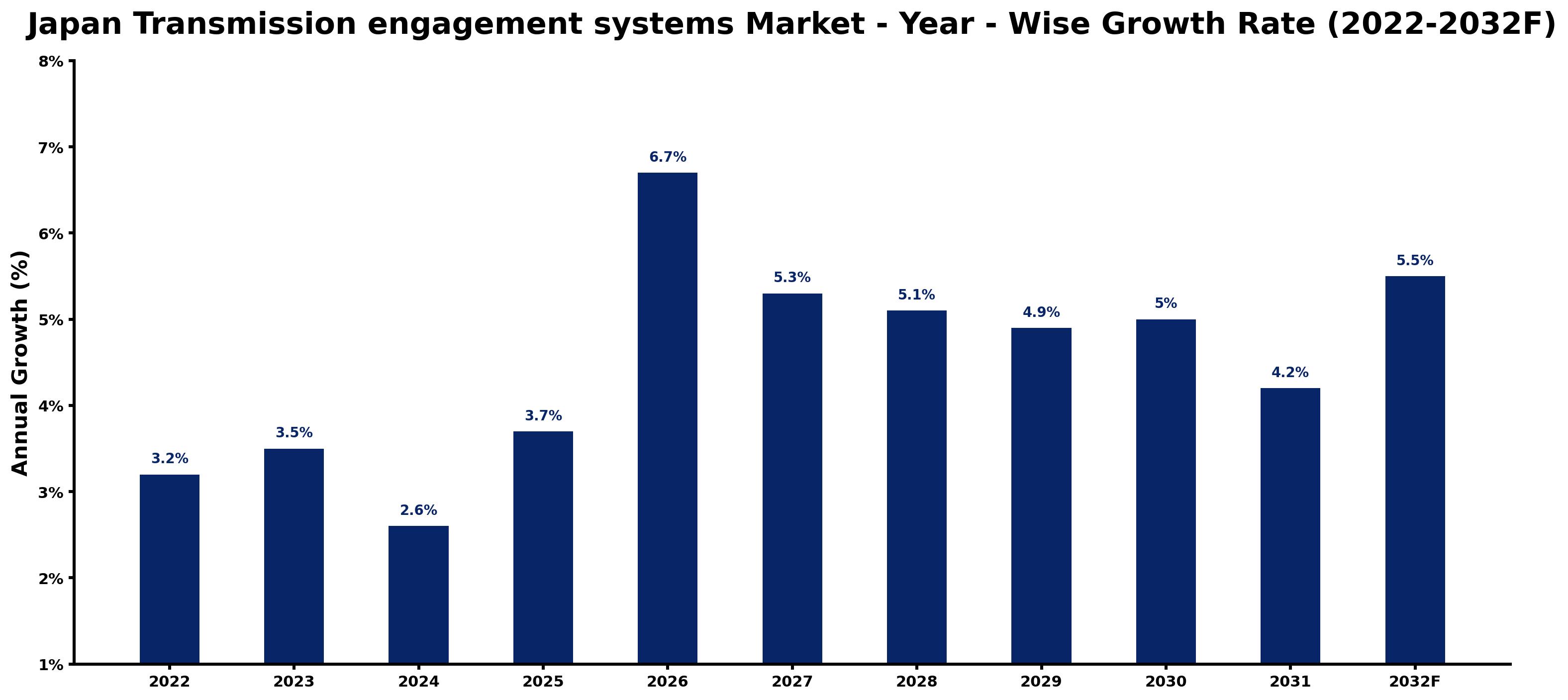
The following figures match every annual growth estimate with the main market development of that year, giving the reasoning behind each rise or slowdown.
| Year | Estimated Annual Growth (%) | Market Rationale |
| 2022 | 3.2 | The automotive sector experienced steady demand, reflecting ongoing production and exports. |
| 2023 | 3.5 | Growth accelerated as electric vehicle sales surged, boosting transmission system requirements. |
| 2024 | 2.6 | Market growth slowed due to supply chain constraints impacting production timelines. |
| 2025 | 3.7 | Demand increased as manufacturers focused on advanced transmission technologies for performance. |
| 2026 | 6.7 | The peak growth was driven by significant investments in electric vehicle technology. |
| 2027 | 5.3 | Growth decelerated as the market began to stabilise following rapid expansion. |
| 2028 | 5.1 | Continued investment in hybrid engagement units contributed to a slower growth rate. |
| 2029 | 4.9 | Market growth continued to slow as competition intensified among manufacturers. |
| 2030 | 5.0 | Demand increased again as new models with advanced systems were introduced. |
| 2031 | 4.2 | Growth slowed as market saturation began to affect new vehicle sales. |
| 2032 | 5.5 | The market is expected to see renewed interest in innovative transmission technologies. |
Note: Market size estimations and growth projections presented in this report are based on 6Wresearch's proprietary forecasting methodology, utilizing the latest available industry data, government publications, and primary research inputs.
Japan Transmission engagement systems Market Synopsis
Transmission engagement systems play a key role in transferring power from engines to wheels, improving vehicle performance and fuel efficiency. In Japan, the automotive industry is thriving, with 8.2 million vehicles produced in 2022, many equipped with advanced systems. The rise of electric vehicles, with sales reaching 200,000 units in 2022, fuels the demand for cutting-edge transmission solutions. Investment in R&D is expected to hit ¥1 trillion by 2025, concentrating on efficiency and performance improvements, suggesting a robust future for this market.
Market Dynamics Impact Analysis (2026–2032)
| Factor | Type | Impact | Primary Segment Affected |
| Growing demand for electric vehicles drives the need for advanced transmission systems. | Driver | High | Hybrid Engagement Units |
| Increasing focus on performance in automotive design creates opportunities for new technologies. | Driver | High | Dual-Clutch Systems |
| Emerging electric vehicle startups are seeking advanced transmission solutions. | Opportunity | High | Electric Vehicles |
| The growing trend towards hybrid systems offers new market entry points for suppliers. | Opportunity | Medium | Hybrid Engagement Units |
| Supply chain disruptions can delay production and delivery of components. | Restraint | High | Automated Manual Systems |
| High costs associated with R&D for new technologies may limit smaller manufacturers. | Restraint | Medium | Electro-Hydraulic |
| Intense competition among manufacturers can lead to price wars affecting margins. | Challenge | High | Sports Cars |
| The rapid pace of technological change can outstrip current manufacturing capabilities. | Challenge | Medium | Synchromesh Systems |
Evaluation of Drivers in Japan Transmission engagement systems Market (2026–2032)
The main growth drivers and the segments they affect most are set out below.
| Drivers | Primary Segment Affected | Why It Matters (Evidence) |
| Increased electric vehicle sales boost demand for specialized transmission systems. | Electric Vehicles | Sales reached 200,000 units in 2022, prompting manufacturers to innovate their offerings. |
| Growing performance expectations in vehicles necessitate advanced transmission technologies. | Dual-Clutch Systems | The automotive sector produced 8.2 million vehicles in 2022, many requiring high-performance systems. |
| Investment in R&D for transmission innovations improves product offerings. | Hybrid Engagement Units | Japan's automotive industry is projected to invest ¥1 trillion in R&D by 2025, focusing on advancements. |
| Adoption of new standards ensures safety and efficiency in transmission systems. | Electro-Hydraulic | ISO 26262 standards are applied to automotive systems, influencing design choices and safety. |
| The Tokyo region's focus on automotive R&D drives technological advancements. | Synchromesh Systems | The Tokyo region is a hub for automotive research, promoting innovation in transmission technologies. |
Several shifts outside the market lift sales. The automotive sector is evolving, with a focus on advanced technologies for performance. Japan's automotive industry is projected to invest ¥1 trillion in R&D by 2025, emphasising innovations in transmission systems. The Tokyo region's emphasis on automotive research drives technological advancements, particularly in electro-hydraulic systems. New investments in hybrid engagement units will influence manufacturers to improve their product offerings, reflecting the growing demand for efficiency and performance.
Evaluation of Restraints in Japan Transmission engagement systems Market
These are the pressures that could keep growth below its potential.
| Market Restraint | Primary Segment Affected | Why It Matters (Evidence) |
| Supply chain disruptions can delay the availability of critical components. | Automated Manual Systems | The automotive sector faced challenges in sourcing materials, impacting production timelines. |
| High R&D costs can limit investment in new technologies for smaller manufacturers. | Electro-Hydraulic | Smaller firms struggle to allocate funds for advanced transmission system development. |
| Intense competition among manufacturers can lead to price wars affecting margins. | Sports Cars | As more players enter the market, pricing strategies become aggressive, impacting profitability. |
| Technological advancements may outpace existing manufacturing capabilities. | Synchromesh Systems | Manufacturers may find it challenging to keep up with rapid changes in technology, affecting production. |
| Regulatory compliance can increase operational costs for producers. | Hybrid Engagement Units | Adhering to JIS standards requires investment in quality assurance processes. |
Japan Transmission engagement systems Market Challenges
A technology gap in transmission engagement systems has emerged due to the rapid evolution of electric vehicle technology. This gap delays the introduction of new models for producers, potentially resulting in a 10% loss in market share. Supply chain disruptions restrict access to essential materials, which can extend production timelines by up to three months, causing longer wait times for vehicle deliveries. Skills shortages in precision engineering lead to an estimated 15% decline in production efficiency for manufacturers, affecting their ability to meet rising demand. Compliance with JIS and ISO standards can raise operational costs by up to 20%, impacting profitability for producers.
Trends in the Japan Transmission engagement systems Market
Buyers and suppliers in the Japan Transmission engagement systems Market are adjusting to the following trends.
- Car Makers Increasing Focus on Advanced Transmission Systems: Car makers are prioritising advanced transmission systems to improve vehicle performance. In 2022, the automotive sector produced 8.2 million vehicles, many incorporating innovations in transmission technology.
- Growing Adoption of Hybrid Engagement Units: The trend towards hybrid engagement units is expanding as manufacturers pursue greater efficiency. In 2022, hybrid systems gained popularity, reflecting a shift in consumer preferences towards fuel-efficient vehicles.
- Electro-Hydraulic Systems Becoming More Common: Electro-hydraulic systems are increasingly featured in modern vehicles. The Tokyo region is at the forefront of this change, with R&D investments aimed at advancing transmission technologies.
- Performance OEMs Focusing on Precision Engineering: Performance OEMs are placing greater emphasis on precision engineering in transmission systems. This focus aligns with the production of 8.2 million vehicles in 2022, many designed for high performance.
Investment Opportunities in the Japan Transmission engagement systems Market
The openings below show where demand in the Japan Transmission engagement systems Market is visible and how suppliers can enter.
- Ideal Timing for Investment in EV Technologies: With electric vehicle sales reaching 200,000 units in 2022, now is the time to invest in advanced transmission systems. EV startups are actively seeking solutions to improve performance.
- Performance OEMs Seeking Advanced Solutions: Performance OEMs require advanced transmission systems to meet growing consumer expectations. Investing in dual-clutch systems can provide opportunities for suppliers.
- Increasing Demand for Hybrid Engagement Units: The rising demand for hybrid engagement units presents a unique opportunity. Collaborating with automotive manufacturers in the Nagoya region can facilitate market entry.
- Opportunities for Joint Ventures: Now is an ideal time for joint ventures to supply advanced transmission systems. Partnering with local firms in the Tokyo region can enhance market access and credibility.
Government Initiatives in the Japan Transmission engagement systems Market
The New Robot Strategy launched in 2015 supports the expansion of robotics in manufacturing, indirectly benefiting the development of transmission engagement systems by enhancing production efficiency. This strategy complements existing regulations under the Electrical Appliance and Material Safety Act, which ensures safety and quality in automotive components, including transmissions. The automotive sector is expected to see increased productivity as a result of these measures.
In 2023, the Japanese government initiated a program to support EV technology development, aiming for a substantial increase in domestic battery manufacturing capacity by 2030. The Ministry of Economy, Trade and Industry (METI) oversees this program, which will fund various projects aimed at advancing transmission technologies, benefiting both manufacturers and buyers.
Future Insight of the Japan Transmission engagement systems Market
A new programme focused on electric vehicle technology development will propel advancements in transmission engagement systems by 2032. Japan's automotive industry will invest ¥1 trillion in R&D by 2025, enhancing capabilities for suppliers and improving product offerings. The focus on hybrid engagement units will cater to buyers seeking efficient solutions. The Tokyo region's automotive R&D hub will encourage collaboration, enabling swift innovation in transmission technologies.
Market Segmentation Analysis
Japan Transmission engagement systems Market report covers a detailed analysis of the following market segments:
By System Type – Dual-Clutch Systems Lead, Synchromesh Systems Expected to Grow Fastest
According to Saurav Kr Singh, Senior Research Analyst at 6Wresearch, with 48% of system type revenue in 2025, Dual-Clutch Systems was the largest category. Dual-Clutch Systems command the largest share as they are integral to high-performance vehicles, which demand rapid gear changes for optimal functionality. The production of 8.2 million vehicles in Japan in 2022, many equipped with these systems, underpins their market dominance. Over 2026–2032, Synchromesh Systems are expected to post the fastest growth, at a CAGR of 7.4%. Synchromesh Systems are experiencing notable growth due to their common use in manual transmissions, appealing to driving enthusiasts who prefer smoother engagement. The rising interest in manual transmission vehicles among specific buyer groups indicates a strong potential for continued expansion. Suppliers should prioritise the development of Synchromesh Systems to capitalise on the growing enthusiasm among driving aficionados.
By Engagement Mechanism – Electro-Hydraulic Leads, Friction-Based Expected to Grow Fastest
Electro-Hydraulic accounted for 39% of the market by engagement mechanism in 2025. Electro-Hydraulic systems lead the market because they provide precise control in modern transmission systems, essential for optimising vehicle performance. The concentration of automotive R&D in regions like Tokyo further solidifies the dominance of this technology in new vehicle designs. Friction-Based is projected to grow fastest, at a CAGR of 6.6% during 2026–2032. Friction-Based systems are experiencing growth as they remain in use in some older transmission systems, appealing to cost-conscious consumers. The ongoing transition from older technologies to more advanced systems indicates a potential for increased adoption in the future. Suppliers should explore hybrid solutions that integrate traditional and modern engagement mechanisms to meet diverse consumer needs.
By Transmission Mode – Sports Cars Lead, Manual Expected to Grow Fastest
In 2025, Sports Cars led the transmission mode split with a 42% share. Sports Cars hold the largest share due to the high demand for performance-oriented driving experiences, which necessitate advanced transmission systems. The automotive industry's focus on performance enhancements aligns with the production of vehicles specifically designed for speed and agility. The quickest growth will come from Manual, forecast to expand at a CAGR of 6.9% between 2026 and 2032. Manual transmission mode is witnessing growth as it continues to attract driving enthusiasts and specific vehicle types, reflecting a desire for more engaging driving experiences. This segment's enduring appeal ensures its ongoing relevance and potential for expansion in the market. Suppliers should consider broadening their manual transmission offerings to cater to the dedicated segment of driving enthusiasts.
By End User – Performance OEMs Lead, Car Makers Expected to Grow Fastest
The largest end user category in 2025 was Performance OEMs, at 48% of revenue. Performance OEMs dominate the market as they require advanced transmission systems that significantly enhance vehicle performance. The automotive sector's substantial workforce of around 5.5 million people drives heavy investments in technologies aimed at improving performance. Car Makers are set to record the highest CAGR in this split, 7.0% over 2026–2032. Car Makers are rapidly growing as primary users of transmission systems, propelled by the need to meet changing consumer preferences for both performance and efficiency. The industry's significant investment in R&D supports this upward trend, ensuring their continued relevance. Suppliers must align their products with the evolving demands of Car Makers to maintain competitiveness in the market.
Key Attractiveness of the Report
- 10 Years of Market Numbers
- Historical Data Starting from 2022 to 2025
- Base Year 2025
- Forecast Data until 2032
- Key Performance Indicators Impacting the Market
- Major Upcoming Developments and Projects
Key Highlights of the Report:
- Japan Transmission engagement systems Market Outlook
- Market Size of Japan Transmission engagement systems Market, 2025
- Forecast of Japan Transmission engagement systems Market, 2032
- Historical Data and Forecast of Japan Transmission engagement systems Revenues & Volume for the Period 2022-2032F
- Japan Transmission engagement systems Market Trend Evolution
- Japan Transmission engagement systems Market Drivers and Challenges
- Japan Transmission engagement systems Price Trends
- Japan Transmission engagement systems Porter's Five Forces
- Japan Transmission engagement systems Industry Life Cycle
- Historical Data and Forecast of Japan Transmission engagement systems Market Revenues & Volume By System Type for the Period 2022-2032F
- Historical Data and Forecast of Japan Transmission engagement systems Market Revenues & Volume By Dual-Clutch Systems for the Period 2022-2032F
- Historical Data and Forecast of Japan Transmission engagement systems Market Revenues & Volume By Synchromesh Systems for the Period 2022-2032F
- Historical Data and Forecast of Japan Transmission engagement systems Market Revenues & Volume By Automated Manual Systems for the Period 2022-2032F
- Historical Data and Forecast of Japan Transmission engagement systems Market Revenues & Volume By Hybrid Engagement Units for the Period 2022-2032F
- Historical Data and Forecast of Japan Transmission engagement systems Market Revenues & Volume By Engagement Mechanism for the Period 2022-2032F
- Historical Data and Forecast of Japan Transmission engagement systems Market Revenues & Volume By Electro-Hydraulic for the Period 2022-2032F
- Historical Data and Forecast of Japan Transmission engagement systems Market Revenues & Volume By Friction-Based for the Period 2022-2032F
- Historical Data and Forecast of Japan Transmission engagement systems Market Revenues & Volume By Actuator Controlled for the Period 2022-2032F
- Historical Data and Forecast of Japan Transmission engagement systems Market Revenues & Volume By e-Axle Integration for the Period 2022-2032F
- Historical Data and Forecast of Japan Transmission engagement systems Market Revenues & Volume By Transmission Mode for the Period 2022-2032F
- Historical Data and Forecast of Japan Transmission engagement systems Market Revenues & Volume By Sports Cars for the Period 2022-2032F
- Historical Data and Forecast of Japan Transmission engagement systems Market Revenues & Volume By Manual for the Period 2022-2032F
- Historical Data and Forecast of Japan Transmission engagement systems Market Revenues & Volume By Commercial Vehicles for the Period 2022-2032F
- Historical Data and Forecast of Japan Transmission engagement systems Market Revenues & Volume By Electric Vehicles for the Period 2022-2032F
- Historical Data and Forecast of Japan Transmission engagement systems Market Revenues & Volume By End User for the Period 2022-2032F
- Historical Data and Forecast of Japan Transmission engagement systems Market Revenues & Volume By Performance OEMs for the Period 2022-2032F
- Historical Data and Forecast of Japan Transmission engagement systems Market Revenues & Volume By Car Makers for the Period 2022-2032F
- Historical Data and Forecast of Japan Transmission engagement systems Market Revenues & Volume By Truck Manufacturers for the Period 2022-2032F
- Historical Data and Forecast of Japan Transmission engagement systems Market Revenues & Volume By EV Startups for the Period 2022-2032F
- Japan Transmission engagement systems Import Export Trade Statistics
- Market Opportunity Assessment By System Type
- Market Opportunity Assessment By Engagement Mechanism
- Market Opportunity Assessment By Transmission Mode
- Market Opportunity Assessment By End User
- Japan Transmission engagement systems Top Companies Market Share
- Japan Transmission engagement systems Competitive Benchmarking By Technical and Operational Parameters
- Japan Transmission engagement systems Company Profiles
- Japan Transmission engagement systems Key Strategic Recommendations
Market Covered
This report examines the market across the segments below.
By System Type
- Dual-Clutch Systems
- Synchromesh Systems
- Automated Manual Systems
- Hybrid Engagement Units
By Engagement Mechanism
- Electro-Hydraulic
- Friction-Based
- Actuator Controlled
- e-Axle Integration
By Transmission Mode
- Sports Cars
- Manual
- Commercial Vehicles
- Electric Vehicles
By End User
- Performance OEMs
- Car Makers
- Truck Manufacturers
- EV Startups































