Japan Transmission Oil Market Size & Growth Rate
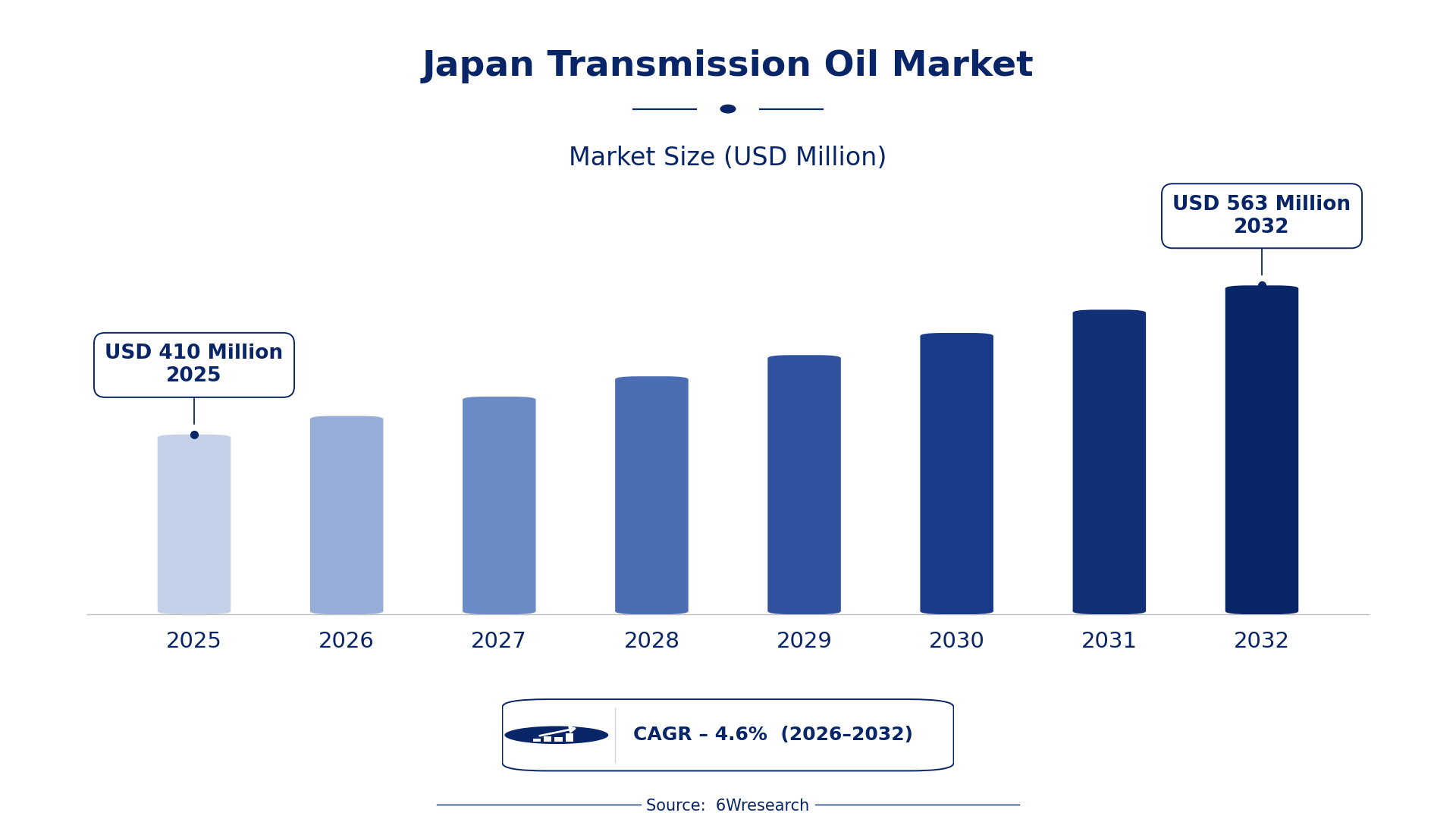
According to 6Wresearch internal database and industry insights, the Japan Transmission Oil Market was valued at USD 410 Million in 2025 and is projected to reach USD 563 Million by 2032, growing at a CAGR of approximately 4.6% during 2026–2032.
Japan Transmission Oil Market Highlights
| Report Metric | Details |
| Report Name | Japan Transmission Oil Market (2026-2032) |
| Market Size 2025 | USD 410 Million |
| Market Size 2032 | USD 563 Million |
| Absolute Growth 2025–2032 | USD 153 Million |
| CAGR 2026–2032 | 4.6% |
| Peak Annual Growth | 5.3% in 2032 |
| Forecast Period | 2026–2032 |
| Historical Data | 2022–2025 |
| Base Year | 2025 |
| Leading Oil Type, 2025 | Synthetic Transmission Oil (44% share) |
| Leading Vehicle Category, 2025 | Passenger Cars (49% share) |
| Leading Additive Package, 2025 | Anti-Wear (40% share) |
| Leading End User, 2025 | Oil Retailers (37% share) |
| Fastest-Growing Oil Type | High-Performance Oils (6.7% CAGR) |
| Fastest-Growing Vehicle Category | Two-Wheelers (6.0% CAGR) |
| Fastest-Growing Additive Package | Friction Modifiers (6.1% CAGR) |
| Fastest-Growing End User | Commercial Fleets (6.2% CAGR) |
| Growing Sector | Commercial Fleets |
| Key End Users | Oil Retailers, Local Garages, Commercial Fleets, Motorsport Teams |
Japan Transmission Oil Market Year-wise Growth Rate and Key Drivers (2022–2032)
This graph illustrates the annual growth rates of the market from 2022 to 2032, highlighting a steady upward trajectory and projected market expansion over the forecast period.
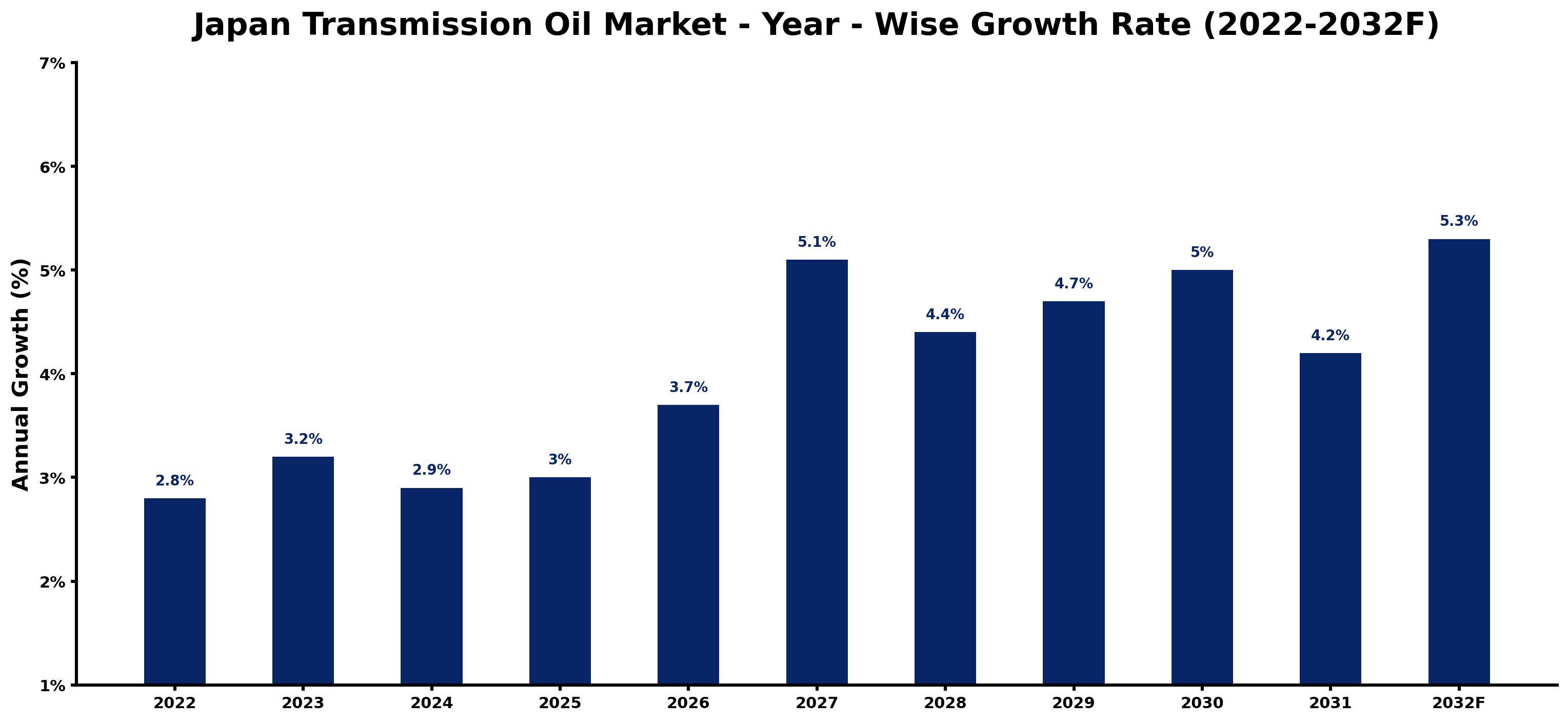
Year by year, the estimates below pair each growth rate with the development that shaped it.
| Year | Estimated Annual Growth (%) | Market Rationale |
| 2022 | 2.8 | The market experienced steady demand from the automotive sector, reflecting stable vehicle usage. |
| 2023 | 3.2 | Growth accelerated due to increased automotive production and consumer confidence in vehicle maintenance. |
| 2024 | 2.9 | Demand growth slowed slightly as consumers became more cautious amid economic uncertainties. |
| 2025 | 3.0 | The market rebounded with renewed investments in automotive technologies and lubricant formulations. |
| 2026 | 3.7 | Rising demand for eco-friendly lubricants is expected to influence purchasing decisions among consumers. |
| 2027 | 5.1 | The introduction of new high-performance oils will drive increased sales in the racing segment. |
| 2028 | 4.4 | Growth will slow as the market adjusts to previous high demand levels and competitive pressures. |
| 2029 | 4.7 | Increased registrations of motorcycles will contribute to a rise in two-wheeler oil sales. |
| 2030 | 5.0 | The automotive sector's focus on sustainability will lead to a surge in demand for eco-friendly products. |
| 2031 | 4.2 | Market growth will decelerate as manufacturers face challenges in meeting evolving consumer preferences. |
| 2032 | 5.3 | The peak growth will be driven by investments in advanced lubricant technologies. |
Note: Market size estimations and growth projections presented in this report are based on 6Wresearch's proprietary forecasting methodology, utilizing the latest available industry data, government publications, and primary research inputs.
Japan Transmission Oil Market Synopsis
Transmission oil acts as a lubricant in vehicles, reducing friction and wear in transmission systems. In Japan, millions of passenger cars and motorcycles create substantial demand, supported by local garages and automotive manufacturers. The Japan Transmission Oil Market is growing due to rising investments in eco-friendly lubricants and government initiatives promoting sustainable practices. In 2023, a program was launched to encourage the use of environmentally friendly automotive lubricants, reflecting a commitment to sustainability and progress in the sector.
Market Dynamics Impact Analysis (2026–2032)
| Factor | Type | Impact | Primary Segment Affected |
| Rising vehicle registrations and maintenance needs drive demand for transmission oil. | Driver | High | Passenger Cars |
| Growing emphasis on eco-friendly lubricants creates opportunities for specialized products. | Opportunity | High | Synthetic Transmission Oil |
| Increased competition among lubricant manufacturers can limit price flexibility. | Restraint | Medium | Mineral-Based Oils |
| The need for high-performance oils in motorsport presents a lucrative market segment. | Opportunity | High | High-Performance Oils |
| Consumer awareness of product quality may lead to preference for premium brands. | Restraint | Medium | Multi-Vehicle Formula |
| Fluctuating raw material prices can impact production costs for suppliers. | Challenge | High | Commercial Fleets |
| Technological advancements require continuous investment in R&D for manufacturers. | Challenge | Medium | Oil Retailers |
| Increased demand for two-wheeler oils due to rising motorcycle registrations. | Driver | High | Two-Wheelers |
Evaluation of Drivers in Japan Transmission Oil Market (2026–2032)
These are the developments adding the most demand over the forecast period.
| Drivers | Primary Segment Affected | Why It Matters (Evidence) |
| Increased vehicle registrations lead to higher demand for transmission oil. | Passenger Cars | Approximately 126 million people in Japan drive millions of passenger cars, increasing maintenance needs and oil purchases. |
| Growing interest in eco-friendly lubricants boosts sales of synthetic oils. | Synthetic Transmission Oil | The target to cut greenhouse-gas emissions by 46% by 2030 aligns with consumer preferences for greener products. |
| Rising popularity of motorsport increases demand for high-performance oils. | High-Performance Oils | Nationwide motorsport events create a need for reliable and efficient lubrication for racing vehicles. |
| Local garages are expanding services, increasing oil purchases for maintenance. | Local Garages | Millions of vehicles serviced annually require consistent oil supply for maintenance and repairs. |
| Commercial fleets require regular maintenance, driving consistent oil demand. | Commercial Fleets | Over 1 million vehicles in fleets necessitate routine oil changes and servicing, sustaining demand. |
Spending rises because increased vehicle registrations in Japan lead to higher demand for transmission oil. The automotive sector, a major consumer, drives purchases as local garages service millions of vehicles annually. Eco-friendly lubricants are gaining traction, supported by a target to cut greenhouse-gas emissions by 46% by 2030. The popularity of motorsport events nationwide boosts the demand for high-performance oils, as racing teams seek reliable lubrication for optimal performance. With over 1 million commercial vehicles requiring regular maintenance, suppliers must adapt their offerings to meet evolving consumer expectations.
Evaluation of Restraints in Japan Transmission Oil Market
Below are the constraints most often cited by buyers and suppliers, with the segment each affects.
| Market Restraint | Primary Segment Affected | Why It Matters (Evidence) |
| Regulatory pressures increase production costs for local producers. | Synthetic Transmission Oil | Compliance with the JIS K 2234 standard raises costs, potentially increasing prices for buyers by up to 15%. |
| High tariffs on certain lubricant formulations affect importers. | Mineral-Based Oils | Tariffs can lead to product availability delays and costs that may rise by 10% for end-users. |
| Fluctuating prices from competition among suppliers disrupt budgets. | Local Garages | Local garages struggle with unpredictable expenses, complicating service budgets for maintenance. |
| Competition from eco-friendly alternatives pressures traditional producers. | High-Performance Oils | Government initiatives force innovation, often at a cost exceeding 20% of R&D budgets. |
| Market saturation limits growth potential for established products. | Multi-Vehicle Formula | As options increase, consumers may delay purchases, affecting overall sales. |
Japan Transmission Oil Market Challenges
Regulatory pressures in Japan require compliance with the JIS K 2234 standard, which raises production costs for local producers, potentially increasing prices for buyers by up to 15%. Importers face high tariffs on certain lubricant formulations, leading to delays in product availability and costs that can rise by 10% for end-users. Buyers, particularly local garages, struggle with fluctuating prices due to competition among suppliers, causing unpredictable expenses that can disrupt service budgets. Competition from eco-friendly alternatives, driven by government initiatives, forces traditional producers to innovate, often at a cost that can exceed 20% of their R&D budgets.
Trends in the Japan Transmission Oil Market
Below are the shifts with the largest effect on the Japan Transmission Oil Market.
- Shift towards Eco-Friendly Lubricants: In 2023, the Japanese government launched a program to promote eco-friendly automotive lubricants, reflecting a broader trend towards sustainability. This initiative is expected to drive demand for greener products, influencing consumer choices and supplier offerings.
- Rising Popularity of High-Performance Oils: Motorsport events across Japan are increasing the demand for high-performance oils, essential for competitive racing. The growing number of events highlights the need for reliable lubrication, pushing suppliers to innovate their product lines.
- Transition from Mineral to Synthetic Oils: The automotive sector is experiencing a transition from mineral-based oils to synthetic oils, driven by performance requirements and environmental concerns. This shift is evident in the rising sales of synthetic transmission oils among consumers.
- Emergence of Multi-Vehicle Formulas: Consumers with diverse vehicle types are increasingly opting for multi-vehicle formulas, which simplify maintenance. This trend is gaining traction as more households own multiple vehicles, creating a demand for versatile lubrication solutions.
Investment Opportunities in the Japan Transmission Oil Market
The following areas offer the clearest openings for investors and suppliers in the Japan Transmission Oil Market.
- Investment in Eco-Friendly Lubricant Production: Tokyo is seeing investments in eco-friendly lubricant production facilities, with a focus on sustainable practices. This aligns with the government's target to cut greenhouse gas emissions by 46% by 2030, creating a demand for new products.
- Growth in Two-Wheeler Oil Demand: Motorcycle and scooter users in Aichi are driving the demand for two-wheeler transmission oil. Suppliers can capitalise on this by offering tailored products that meet the specific needs of this growing segment.
- Partnerships with Local Garages: Local garages represent a significant buyer group for transmission oil. Forming partnerships with these garages can provide suppliers with a steady demand for their products, ensuring consistent sales.
- Expansion of Commercial Fleet Services: Commercial fleets in Osaka are expanding their operations, increasing the need for regular maintenance and oil changes. Suppliers can enter this market by offering competitive pricing and reliable products.
Government Initiatives in the Japan Transmission Oil Market
The GX Basic Policy, adopted in 2023, aims for about JPY 150 trillion of public-private decarbonisation investment over 10 years, promoting the production of eco-friendly lubricants. This policy complements existing regulations, such as the Industrial Standardization Act, which governs product standards and testing, ensuring quality in the automotive lubricant market.
The Consumer Affairs Agency oversees the implementation of these policies, facilitating funding for projects aimed at promoting sustainable practices. This includes support for manufacturers transitioning to eco-friendly formulations, ensuring compliance with environmental standards.
Future Insight of the Japan Transmission Oil Market
Investment in advanced lubricant formulations will surge as the government promotes eco-friendly automotive lubricants, driving demand for innovative products. By 2032, the automotive sector will shift towards high-performance oils, aligning with consumer preferences for efficiency. The JIS K 2234 standard will enhance quality assurance for buyers, ensuring better product performance. As over 1 million commercial fleet vehicles require regular maintenance, suppliers must adapt their offerings to meet evolving regulatory standards and consumer expectations.
Market Segmentation Analysis
Japan Transmission Oil Market report covers a detailed analysis of the following market segments:
By Oil Type – Synthetic Transmission Oil Leads, High-Performance Oils Expected to Grow Fastest
According to Saurav Kr Singh, Senior Research Analyst at 6Wresearch, Synthetic Transmission Oil accounted for 44% of the market by oil type in 2025. Synthetic transmission oil holds the largest share due to its extensive application in modern vehicles that demand high performance. This segment thrives in key automotive regions such as Tokyo and Aichi, where millions of passenger cars rely on this type of oil for optimal functioning. The quickest growth will come from High-Performance Oils, forecast to expand at a CAGR of 6.7% between 2026 and 2032. High-performance oils are rapidly gaining traction as motorsport events proliferate across Japan, leading to heightened demand for superior lubricants. The ongoing investment in advanced lubricant formulations ensures that this segment can adequately meet the needs of high-performance applications. Suppliers should prioritise the development of high-performance products to seize opportunities in the expanding motorsport and performance vehicle market.
By Vehicle Category – Passenger Cars Lead, Two-Wheelers Expected to Grow Fastest
The largest vehicle category category in 2025 was Passenger Cars, at 49% of revenue. Passenger cars hold the largest share as they are the primary users of transmission oil in Japan. The automotive sector's strength, with millions of passenger vehicles on the road, ensures consistent demand for this lubricant. Two-Wheelers are projected to grow fastest, at a CAGR of 6.0% during 2026–2032. The two-wheeler segment is witnessing rapid growth, driven by the increasing number of registered motorcycles, which exceeds 8 million. This trend reflects a consumer shift towards more compact and efficient transportation options in urban areas. Suppliers need to focus on enhancing their product lines to meet the rising demand from the two-wheeler market, ensuring they remain competitive.
By Additive Package – Anti-Wear Leads, Friction Modifiers Expected to Grow Fastest
Anti-Wear held 40% of the Japan Transmission Oil Market by additive package in 2025. Anti-wear additives are crucial for prolonging the life of transmission components, making them the most widely used in the market. Their importance is underscored by the JIS K 2234 standard, which sets high-quality benchmarks for automotive lubricants in Japan. Friction Modifiers are set to record the highest CAGR in this split, 6.1% over 2026–2032. Friction modifiers are gaining traction as they enhance performance, particularly in demanding driving situations. The growing emphasis on advanced lubricant formulations is likely to drive their increased adoption in the market. Manufacturers should prioritise the development of additive packages that not only boost performance but also adhere to the stringent regulatory standards in the industry.
By End User – Oil Retailers Lead, Commercial Fleets Expected to Grow Fastest
In 2025, Oil Retailers led the end user split with a 37% share. Oil retailers are the main distribution channel for both consumers and businesses, providing a steady demand for transmission oil. Their extensive networks ensure that products are readily available across Japan's automotive market. Over 2026–2032, Commercial Fleets are expected to post the fastest growth, at a CAGR of 6.2%. Commercial fleets represent the fastest-growing end-user segment as they require regular maintenance for over 1 million vehicles. This trend is driven by the need for efficient operations and compliance with maintenance schedules. Suppliers should strengthen relationships with commercial fleet operators to secure long-term contracts and ensure consistent sales.
Key Attractiveness of the Report
- 10 Years of Market Numbers
- Historical Data Starting from 2022 to 2025
- Base Year 2025
- Forecast Data until 2032
- Key Performance Indicators Impacting the Market
- Major Upcoming Developments and Projects
Key Highlights of the Report:
- Japan Transmission Oil Market Outlook
- Market Size of Japan Transmission Oil Market, 2025
- Forecast of Japan Transmission Oil Market, 2032
- Historical Data and Forecast of Japan Transmission Oil Revenues & Volume for the Period 2022-2032F
- Japan Transmission Oil Market Trend Evolution
- Japan Transmission Oil Market Drivers and Challenges
- Japan Transmission Oil Price Trends
- Japan Transmission Oil Porter's Five Forces
- Japan Transmission Oil Industry Life Cycle
- Historical Data and Forecast of Japan Transmission Oil Market Revenues & Volume By Oil Type for the Period 2022-2032F
- Historical Data and Forecast of Japan Transmission Oil Market Revenues & Volume By Synthetic Transmission Oil for the Period 2022-2032F
- Historical Data and Forecast of Japan Transmission Oil Market Revenues & Volume By Mineral-Based Oils for the Period 2022-2032F
- Historical Data and Forecast of Japan Transmission Oil Market Revenues & Volume By High-Performance Oils for the Period 2022-2032F
- Historical Data and Forecast of Japan Transmission Oil Market Revenues & Volume By Multi-Vehicle Formula for the Period 2022-2032F
- Historical Data and Forecast of Japan Transmission Oil Market Revenues & Volume By Vehicle Category for the Period 2022-2032F
- Historical Data and Forecast of Japan Transmission Oil Market Revenues & Volume By Passenger Cars for the Period 2022-2032F
- Historical Data and Forecast of Japan Transmission Oil Market Revenues & Volume By Two-Wheelers for the Period 2022-2032F
- Historical Data and Forecast of Japan Transmission Oil Market Revenues & Volume By Racing Vehicles for the Period 2022-2032F
- Historical Data and Forecast of Japan Transmission Oil Market Revenues & Volume By Mixed Fleets for the Period 2022-2032F
- Historical Data and Forecast of Japan Transmission Oil Market Revenues & Volume By Additive Package for the Period 2022-2032F
- Historical Data and Forecast of Japan Transmission Oil Market Revenues & Volume By Anti-Wear, Detergent for the Period 2022-2032F
- Historical Data and Forecast of Japan Transmission Oil Market Revenues & Volume By Basic Formulations for the Period 2022-2032F
- Historical Data and Forecast of Japan Transmission Oil Market Revenues & Volume By Friction Modifiers for the Period 2022-2032F
- Historical Data and Forecast of Japan Transmission Oil Market Revenues & Volume By Universal Compatibility for the Period 2022-2032F
- Historical Data and Forecast of Japan Transmission Oil Market Revenues & Volume By End User for the Period 2022-2032F
- Historical Data and Forecast of Japan Transmission Oil Market Revenues & Volume By Oil Retailers for the Period 2022-2032F
- Historical Data and Forecast of Japan Transmission Oil Market Revenues & Volume By Local Garages for the Period 2022-2032F
- Historical Data and Forecast of Japan Transmission Oil Market Revenues & Volume By Motorsport Teams for the Period 2022-2032F
- Historical Data and Forecast of Japan Transmission Oil Market Revenues & Volume By Commercial Fleets for the Period 2022-2032F
- Japan Transmission Oil Import Export Trade Statistics
- Market Opportunity Assessment By Oil Type
- Market Opportunity Assessment By Vehicle Category
- Market Opportunity Assessment By Additive Package
- Market Opportunity Assessment By End User
- Japan Transmission Oil Top Companies Market Share
- Japan Transmission Oil Competitive Benchmarking By Technical and Operational Parameters
- Japan Transmission Oil Company Profiles
- Japan Transmission Oil Key Strategic Recommendations
Market Covered
The study includes the following segmentation.
By Oil Type
- Synthetic Transmission Oil
- Mineral-Based Oils
- High-Performance Oils
- Multi-Vehicle Formula
By Vehicle Category
- Passenger Cars
- Two-Wheelers
- Racing Vehicles
- Mixed Fleets
By Additive Package
- Anti-Wear
- Detergent
- Basic Formulations
- Friction Modifiers
- Universal Compatibility
By End User
- Oil Retailers
- Local Garages
- Motorsport Teams
- Commercial Fleets































