Japan Transmission Parts Market Size & Growth Rate
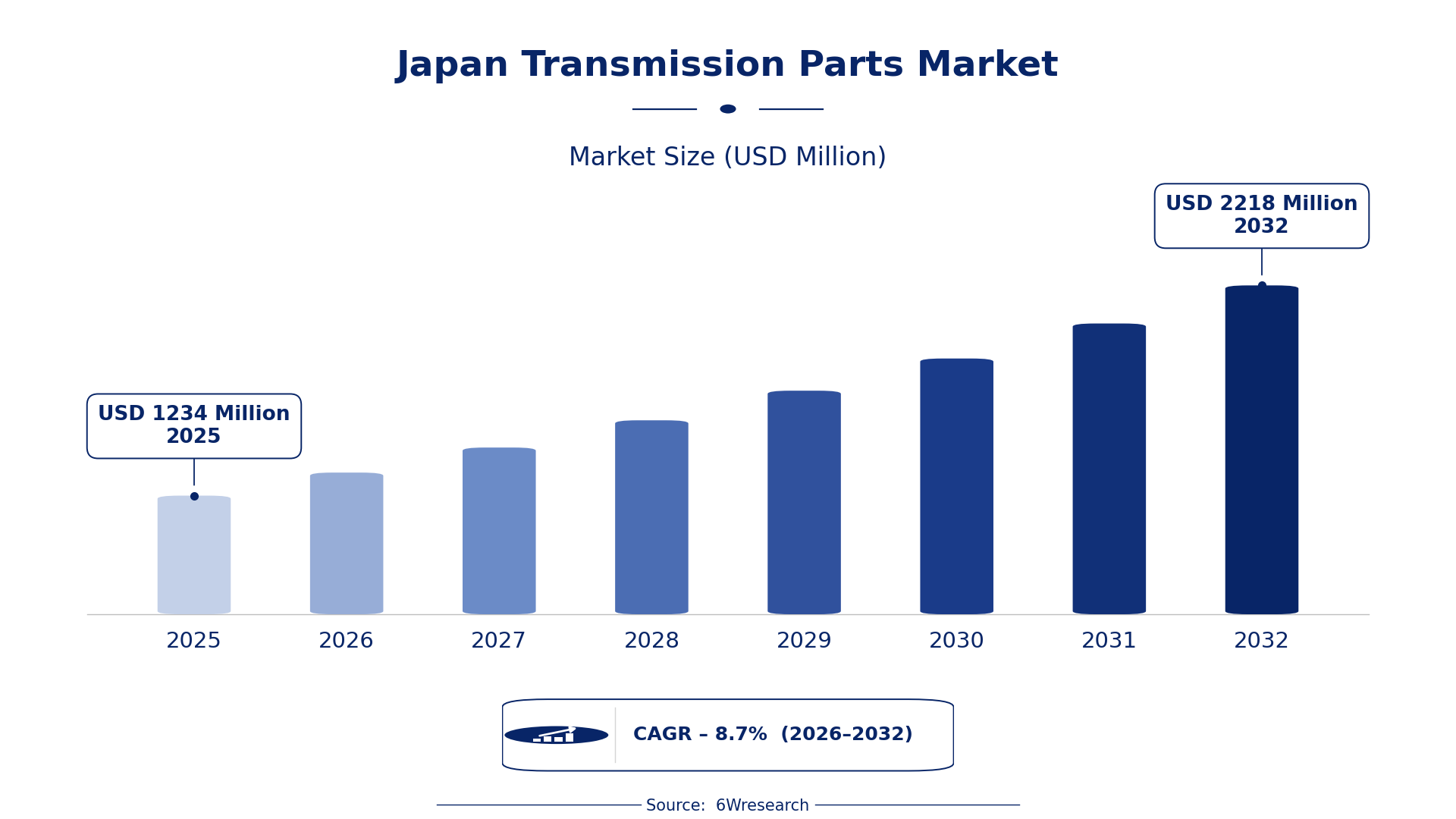
According to 6Wresearch internal database and industry insights, the Japan Transmission Parts Market was valued at USD 1,234 Million in 2025 and is projected to reach USD 2,218 Million by 2032, growing at a CAGR of approximately 8.7% during 2026–2032.
Japan Transmission Parts Market Highlights
| Report Metric | Details |
| Report Name | Japan Transmission Parts Market (2026-2032) |
| Market Size 2025 | USD 1,234 Million |
| Market Size 2032 | USD 2,218 Million |
| Absolute Growth 2025–2032 | USD 984 Million |
| CAGR 2026–2032 | 8.7% |
| Peak Annual Growth | 9.7% in 2032 |
| Forecast Period | 2026–2032 |
| Historical Data | 2022–2025 |
| Base Year | 2025 |
| Leading Part Type, 2025 | Clutch Assemblies (50% share) |
| Leading Material Type, 2025 | Hardened Steel (38% share) |
| Leading Application Type, 2025 | Passenger Vehicles (38% share) |
| Leading End User, 2025 | Automotive OEMs (42% share) |
| Fastest-Growing Part Type | Synchronizers (12.3% CAGR) |
| Fastest-Growing Material Type | Ceramic/Organic (12.9% CAGR) |
| Fastest-Growing Application Type | Off-road Vehicles (11.8% CAGR) |
| Fastest-Growing End User | Repair Workshops (11.3% CAGR) |
| Growing Sector | automotive repair and maintenance |
| Key End Users | automotive OEMs, repair workshops, transmission makers |
Japan Transmission Parts Market Year-wise Growth Rate and Key Drivers (2022–2032)
This graph illustrates the annual growth rates of the market from 2022 to 2032, highlighting a steady upward trajectory and projected market expansion over the forecast period.
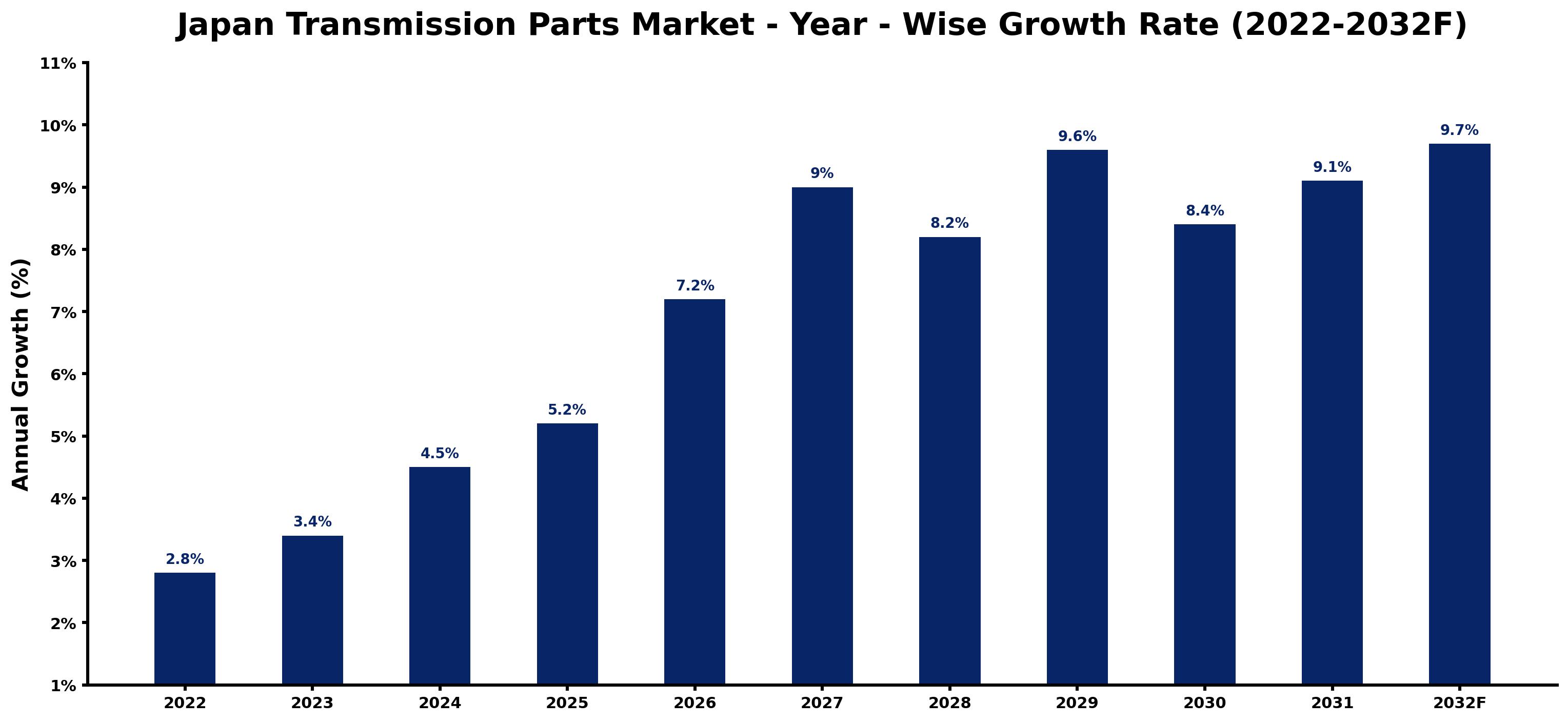
The yearly estimates that follow link every growth rate to its principal driver, so readers can see why the pace changed in each period.
| Year | Estimated Annual Growth (%) | Market Rationale |
| 2022 | 2.8 | The market showed steady demand from automotive OEMs and repair workshops. |
| 2023 | 3.4 | Growth accelerated due to increased vehicle production and repair activities. |
| 2024 | 4.5 | Demand continued to rise as the average vehicle age increased further. |
| 2025 | 5.2 | Growth peaked as automotive manufacturers expanded production capacity. |
| 2026 | 7.2 | The market is expected to grow with rising demand for spare parts. |
| 2027 | 9.0 | Demand is projected to increase as automotive innovation progresses. |
| 2028 | 8.2 | Growth slows slightly as the market stabilises after rapid expansion. |
| 2029 | 9.6 | The market is expected to grow faster due to rising vehicle exports. |
| 2030 | 8.4 | Growth is projected to slow again as production capacity reaches its limits. |
| 2031 | 9.1 | Demand is projected to rise as repair workshops expand services. |
| 2032 | 9.7 | The market is expected to peak with innovations in transmission technology. |
Note: Market size estimations and growth projections presented in this report are based on 6Wresearch's proprietary forecasting methodology, utilizing the latest available industry data, government publications, and primary research inputs.
Japan Transmission Parts Market Synopsis
Transmission parts are essential components that transfer power from an engine to the wheels, primarily made from durable materials like hardened steel and aluminum. The Japan Transmission Parts Market is experiencing growth, driven by the production of 8.3 million vehicles in 2022 and the increasing average vehicle age of 11.5 years. Factors such as the strong presence of automotive OEMs and the launch of government programs to support automotive innovation are propelling demand in this sector.
Market Dynamics Impact Analysis (2026–2032)
| Factor | Type | Impact | Primary Segment Affected |
| Growing vehicle production and repair activities drive demand for transmission parts. | Driver | High | Gear Sets |
| The increasing average vehicle age boosts the need for spare parts. | Driver | High | Clutch Assemblies |
| The automotive sector is projected to grow steadily, creating opportunities for suppliers. | Opportunity | High | Synchronizers |
| The push for electric vehicle adoption opens new markets for lightweight components. | Opportunity | Medium | Transmission Cases |
| High competition among suppliers may lead to price pressures. | Restraint | Medium | Hardened Steel |
| The complexity of regulatory compliance could slow down new entrants. | Restraint | High | Cast Aluminum |
| Supply chain disruptions can delay production schedules for manufacturers. | Challenge | High | Automotive OEMs |
| Technological advancements require continuous investment from suppliers. | Challenge | Medium | Repair Workshops |
Evaluation of Drivers in Japan Transmission Parts Market (2026–2032)
The factors lifting demand, and the evidence behind each, are summarised below.
| Drivers | Primary Segment Affected | Why It Matters (Evidence) |
| Increased vehicle production in Japan fuels demand for transmission parts. | Gear Sets | Japan produced 8.3 million vehicles in 2022, leading to higher demand for components. |
| The rise in vehicle age increases the need for replacement parts. | Clutch Assemblies | With an average vehicle age of 11.5 years, repair workshops are purchasing more parts. |
| Government support for automotive innovation encourages investment in new technologies. | Synchronizers | In 2023, ¥10 billion was allocated for automotive technology development, boosting demand. |
| The growing trend towards electric vehicles creates a need for lightweight transmission components. | Transmission Cases | The government initiated a program in 2023 to promote electric vehicle adoption. |
| The strong presence of automotive OEMs drives consistent demand for high-quality parts. | Hardened Steel | Japan has over 1,500 automotive OEMs and suppliers, ensuring steady orders. |
Orders keep climbing as vehicle production remains high, with Japan producing 8.3 million vehicles in 2022. The average vehicle age of 11.5 years leads to increased demand for replacement parts, particularly from repair workshops. The allocation of ¥10 billion for automotive technology development in 2023 stimulates demand. The push for electric vehicles creates opportunities for lightweight components, driving innovation in the sector. The strong presence of automotive manufacturers in the Kanto region ensures consistent orders for transmission parts, supporting market growth.
Evaluation of Restraints in Japan Transmission Parts Market
The key brakes on demand, and where they bite hardest, are shown below.
| Market Restraint | Primary Segment Affected | Why It Matters (Evidence) |
| High competition may lead to price pressures among suppliers. | Hardened Steel | With numerous suppliers, maintaining competitive pricing can be challenging. |
| Complex regulatory compliance can hinder new market entrants. | Cast Aluminum | Manufacturers must navigate strict regulations, delaying product launches. |
| Supply chain disruptions can affect production schedules. | Automotive OEMs | Global supply chain issues have caused delays in component availability. |
| Technological advancements require continuous investment from suppliers. | Repair Workshops | Keeping up with new technologies can strain financial resources for workshops. |
| Market fluctuations can impact overall demand for transmission parts. | Synchronizers | Economic uncertainties may lead to reduced vehicle sales and repairs. |
Japan Transmission Parts Market Challenges
High costs for buyers arise from the increasing average age of vehicles in Japan, now at 11.5 years, which drives up demand for spare parts. Repair workshops must stock more components, leading to a 15% rise in their operational expenses. Suppliers encounter difficulties due to a diminishing skilled workforce; with over 5 million people employed in the automotive sector, many are nearing retirement, which delays production timelines. Stringent regulations from the Ministry of Land, Infrastructure, Transport and Tourism, such as JIS B 1501, complicate compliance, resulting in longer time-to-market for new transmission parts.
Trends in the Japan Transmission Parts Market
Several trends are reshaping the Japan Transmission Parts Market; the most important are set out below.
- Repair Workshops Adopting Advanced Technologies: Repair workshops are increasingly integrating advanced diagnostic tools to enhance service quality. In 2023, over 2,000 workshops upgraded their systems, resulting in improved efficiency.
- Shift Towards Lightweight Materials in Transmission Parts: The trend of utilising lightweight materials is gaining traction, particularly in the Chubu region, where the production of cast aluminium components has risen by 15% in 2023.
- Growing Demand for Electric Vehicle Components: Automotive OEMs are concentrating on electric vehicle components, with a marked increase in demand for lightweight transmission parts, spurred by government initiatives promoting EV adoption.
- Expansion of Automotive Repair Workshops: The number of automotive repair workshops in Japan is increasing, with over 2,000 currently in operation, reflecting the heightened need for maintenance services.
Investment Opportunities in the Japan Transmission Parts Market
Where to invest in the Japan Transmission Parts Market: the main openings are set out below.
- Current Market Gap in Lightweight Components: With the emphasis on electric vehicles, there exists a market gap for lightweight transmission components, estimated to be worth ¥5 billion. Suppliers can target automotive OEMs in the Kanto region to address this demand.
- Investment in Automotive Technology Development: The government allocated ¥10 billion in 2023 for automotive technology, presenting opportunities for suppliers to invest in advanced transmission parts. Collaborating with local OEMs can ease market entry.
- Rising Vehicle Age Creating Spare Parts Demand: The increasing average vehicle age of 11.5 years offers an opportunity for suppliers to provide aftermarket parts. Targeting repair workshops can help capture this expanding market.
- Electric Vehicle Adoption Driving New Demand: The government's initiative to promote electric vehicles is anticipated to generate demand for specialised transmission parts. Suppliers should concentrate on developing components that cater to this emerging market.
Government Initiatives in the Japan Transmission Parts Market
The Economic Security Promotion Act of 2022 supports supply-chain resilience for critical automotive products. This law mandates that manufacturers improve their production capabilities to ensure a steady supply of transmission parts, which benefits both producers and buyers in the automotive sector.
The Japan Automobile Manufacturers Association oversees the implementation of various programs that support automotive innovation. In 2023, the association initiated a program allocating ¥10 billion to support technology development, directly benefiting automotive OEMs and repair workshops.
Future Insight of the Japan Transmission Parts Market
A substantial investment pipeline for automotive technology will stimulate demand for advanced transmission parts. By 2032, the transition to electric vehicles will necessitate new designs and components, prompting suppliers to innovate. The Tokyo Motor Show will continue to serve as a key platform for showcasing advancements, influencing buyer choices. With a government target of a 30% reduction in vehicle emissions by 2030, suppliers must develop products that meet these evolving standards to maintain market relevance.
Market Segmentation Analysis
Japan Transmission Parts Market report covers a detailed analysis of the following market segments:
By Part Type – Clutch Assemblies Lead, Synchronizers Expected to Grow Fastest
According to Saurav Kr Singh, Senior Research Analyst at 6Wresearch, Clutch Assemblies accounted for 50% of the market by part type in 2025. Clutch assemblies are essential for gear shifting, making them critical components in vehicles. The production of 8.3 million vehicles in Japan in 2022 demonstrates the strong demand for these parts, particularly from domestic automotive OEMs. The quickest growth will come from Synchronizers, forecast to expand at a CAGR of 12.3% between 2026 and 2032. Synchronizers are gaining traction due to their importance in ensuring smooth engagement during gear shifts. With the average age of vehicles in Japan at 11.5 years, the need for replacement parts like synchronizers is projected to increase as older vehicles require servicing. Suppliers should prioritise synchronizers in their product lines to meet the rising demand for these components.
By Material Type – Hardened Steel Leads, Ceramic/Organic Expected to Grow Fastest
In 2025, Hardened Steel led the material type split with a 38% share. Hardened steel is the primary material used in transmission parts due to its exceptional durability and strength. Its widespread adoption among over 1,500 automotive OEMs and suppliers in Japan reinforces its leading position in the market. Ceramic/Organic is set to record the highest CAGR in this split, 12.9% over 2026–2032. Ceramic and organic materials are gaining traction in specific applications, spurred by advancements in automotive technology. The government's allocation of ¥10 billion for automotive technology development in 2023 is likely to accelerate the adoption of these materials in the industry. Buyers may benefit from exploring options in ceramic and organic materials as they become more prevalent in the market.
By Application Type – Passenger Vehicles Lead, Off-road Vehicles Expected to Grow Fastest
With 38% of application type revenue in 2025, Passenger Vehicles was the largest category. Passenger vehicles represent the largest application segment for transmission parts, reflecting the strength of Japan's automotive industry. The production of over 8.3 million vehicles in 2022 highlights the significance of this segment in sustaining demand for transmission components. Over 2026–2032, Off-road Vehicles are expected to post the fastest growth, at a CAGR of 11.8%. Off-road vehicles are experiencing growth due to increasing consumer interest in recreational activities and outdoor adventures. This niche market is expanding as more consumers seek vehicles capable of traversing varied terrains effectively. Suppliers should explore partnerships with off-road vehicle manufacturers to capitalise on this growing segment.
By End User – Automotive OEMs Lead, Repair Workshops Expected to Grow Fastest
Automotive OEMs took 42% of end user revenue in 2025, more than any other category. Automotive OEMs are the primary end users of transmission parts, as they require these components for new vehicle production. The sector's employment of over 5 million people highlights the scale of demand from OEMs. Repair Workshops are projected to grow fastest, at a CAGR of 11.3% during 2026–2032. Repair workshops are seeing rapid growth as the average vehicle age increases, leading to higher demand for spare parts and maintenance services. With over 2,000 automotive repair workshops in Japan, this segment is vital for the aftermarket. Suppliers should strengthen partnerships with repair workshops to meet the rising demand for replacement parts.
Key Attractiveness of the Report
- 10 Years of Market Numbers
- Historical Data Starting from 2022 to 2025
- Base Year 2025
- Forecast Data until 2032
- Key Performance Indicators Impacting the Market
- Major Upcoming Developments and Projects
Key Highlights of the Report:
- Japan Transmission Parts Market Outlook
- Market Size of Japan Transmission Parts Market, 2025
- Forecast of Japan Transmission Parts Market, 2032
- Historical Data and Forecast of Japan Transmission Parts Revenues & Volume for the Period 2022-2032F
- Japan Transmission Parts Market Trend Evolution
- Japan Transmission Parts Market Drivers and Challenges
- Japan Transmission Parts Price Trends
- Japan Transmission Parts Porter's Five Forces
- Japan Transmission Parts Industry Life Cycle
- Historical Data and Forecast of Japan Transmission Parts Market Revenues & Volume By Part Type for the Period 2022-2032F
- Historical Data and Forecast of Japan Transmission Parts Market Revenues & Volume By Gear Sets for the Period 2022-2032F
- Historical Data and Forecast of Japan Transmission Parts Market Revenues & Volume By Clutch Assemblies for the Period 2022-2032F
- Historical Data and Forecast of Japan Transmission Parts Market Revenues & Volume By Synchronizers for the Period 2022-2032F
- Historical Data and Forecast of Japan Transmission Parts Market Revenues & Volume By Transmission Cases for the Period 2022-2032F
- Historical Data and Forecast of Japan Transmission Parts Market Revenues & Volume By Material Type for the Period 2022-2032F
- Historical Data and Forecast of Japan Transmission Parts Market Revenues & Volume By Hardened Steel for the Period 2022-2032F
- Historical Data and Forecast of Japan Transmission Parts Market Revenues & Volume By Ceramic/Organic for the Period 2022-2032F
- Historical Data and Forecast of Japan Transmission Parts Market Revenues & Volume By Bronze/Composite for the Period 2022-2032F
- Historical Data and Forecast of Japan Transmission Parts Market Revenues & Volume By Cast Aluminum for the Period 2022-2032F
- Historical Data and Forecast of Japan Transmission Parts Market Revenues & Volume By Application Type for the Period 2022-2032F
- Historical Data and Forecast of Japan Transmission Parts Market Revenues & Volume By Passenger Vehicles for the Period 2022-2032F
- Historical Data and Forecast of Japan Transmission Parts Market Revenues & Volume By Commercial Vehicles for the Period 2022-2032F
- Historical Data and Forecast of Japan Transmission Parts Market Revenues & Volume By Manual Transmissions for the Period 2022-2032F
- Historical Data and Forecast of Japan Transmission Parts Market Revenues & Volume By Off-road Vehicles for the Period 2022-2032F
- Historical Data and Forecast of Japan Transmission Parts Market Revenues & Volume By End User for the Period 2022-2032F
- Historical Data and Forecast of Japan Transmission Parts Market Revenues & Volume By Automotive OEMs for the Period 2022-2032F
- Historical Data and Forecast of Japan Transmission Parts Market Revenues & Volume By Transmission Makers for the Period 2022-2032F
- Historical Data and Forecast of Japan Transmission Parts Market Revenues & Volume By Spare Part Dealers for the Period 2022-2032F
- Historical Data and Forecast of Japan Transmission Parts Market Revenues & Volume By Repair Workshops for the Period 2022-2032F
- Japan Transmission Parts Import Export Trade Statistics
- Market Opportunity Assessment By Part Type
- Market Opportunity Assessment By Material Type
- Market Opportunity Assessment By Application Type
- Market Opportunity Assessment By End User
- Japan Transmission Parts Top Companies Market Share
- Japan Transmission Parts Competitive Benchmarking By Technical and Operational Parameters
- Japan Transmission Parts Company Profiles
- Japan Transmission Parts Key Strategic Recommendations
Market Covered
Segments analysed in this report are listed below.
By Part Type
- Gear Sets
- Clutch Assemblies
- Synchronizers
- Transmission Cases
By Material Type
- Hardened Steel
- Ceramic/Organic
- Bronze/Composite
- Cast Aluminum
By Application Type
- Passenger Vehicles
- Commercial Vehicles
- Manual Transmissions
- Off-road Vehicles
By End User
- Automotive OEMs
- Transmission Makers
- Spare Part Dealers
- Repair Workshops































