Japan Transmission System Market Size & Growth Rate
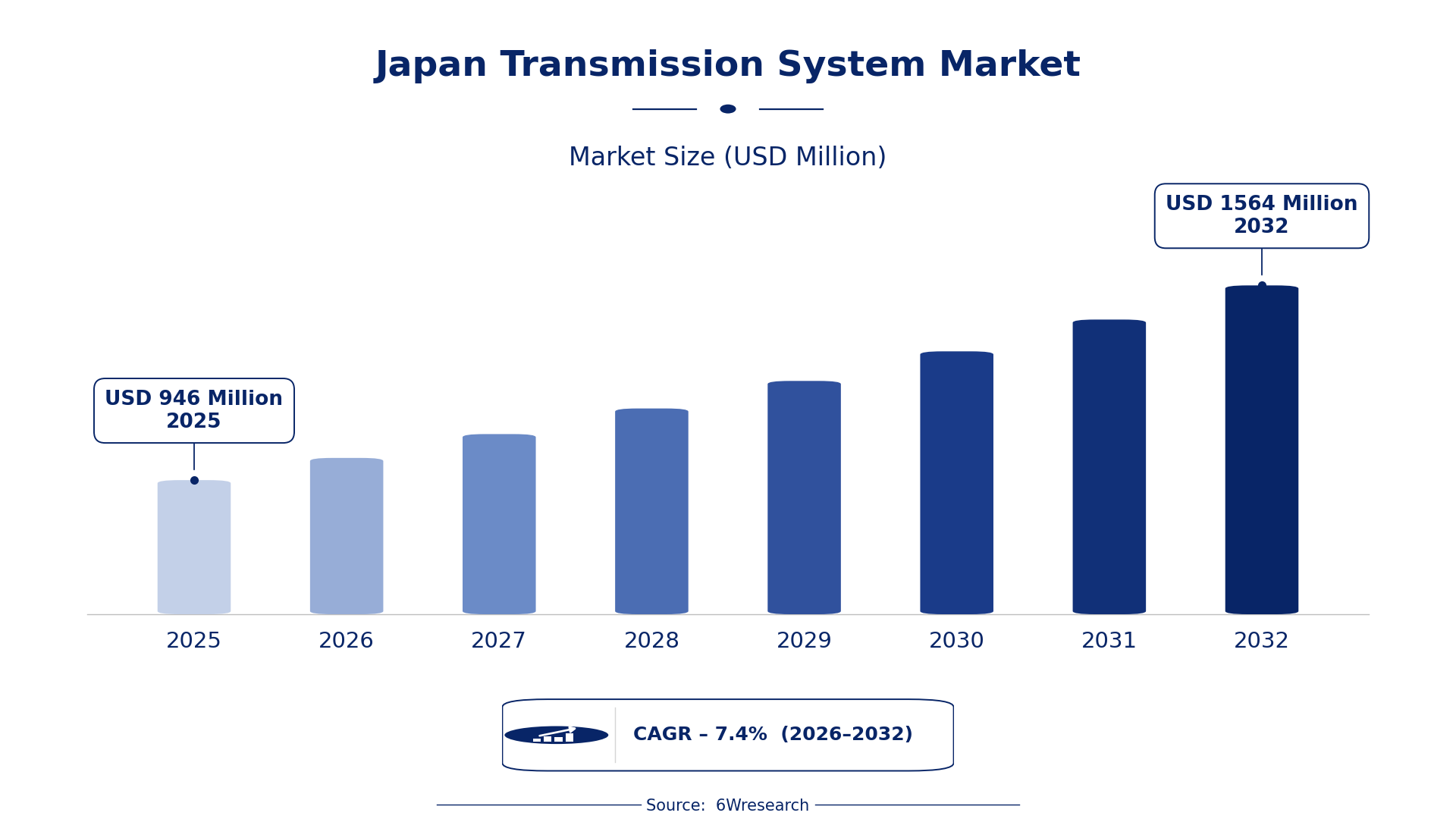
According to 6Wresearch internal database and industry insights, the Japan Transmission System Market was valued at USD 946 Million in 2025 and is projected to reach USD 1,564 Million by 2032, growing at a CAGR of approximately 7.4% during 2026–2032.
Japan Transmission System Market Highlights
| Report Metric | Details |
| Report Name | Japan Transmission System Market (2026-2032) |
| Market Size 2025 | USD 946 Million |
| Market Size 2032 | USD 1,564 Million |
| Absolute Growth 2025–2032 | USD 618 Million |
| CAGR 2026–2032 | 7.4% |
| Peak Annual Growth | 8.1% in 2028 |
| Forecast Period | 2026–2032 |
| Historical Data | 2022–2025 |
| Base Year | 2025 |
| Leading System Type, 2025 | Manual Transmission (38% share) |
| Leading Transmission Mode, 2025 | Mechanical (35% share) |
| Leading Vehicle Segment, 2025 | Passenger Cars (39% share) |
| Leading End User, 2025 | Automotive OEMs (48% share) |
| Fastest-Growing System Type | Automatic Transmission (10.5% CAGR) |
| Fastest-Growing Transmission Mode | Hydraulic (9.5% CAGR) |
| Fastest-Growing Vehicle Segment | Luxury Vehicles (9.9% CAGR) |
| Fastest-Growing End User | OEM Assemblers (9.4% CAGR) |
| Growing Sector | Automotive Industry |
| Key End Users | Automotive OEMs, Vehicle Manufacturers, OEM Assemblers |
Japan Transmission System Market Year-wise Growth Rate and Key Drivers (2022–2032)
This graph illustrates the annual growth rates of the market from 2022 to 2032, highlighting a steady upward trajectory and projected market expansion over the forecast period.
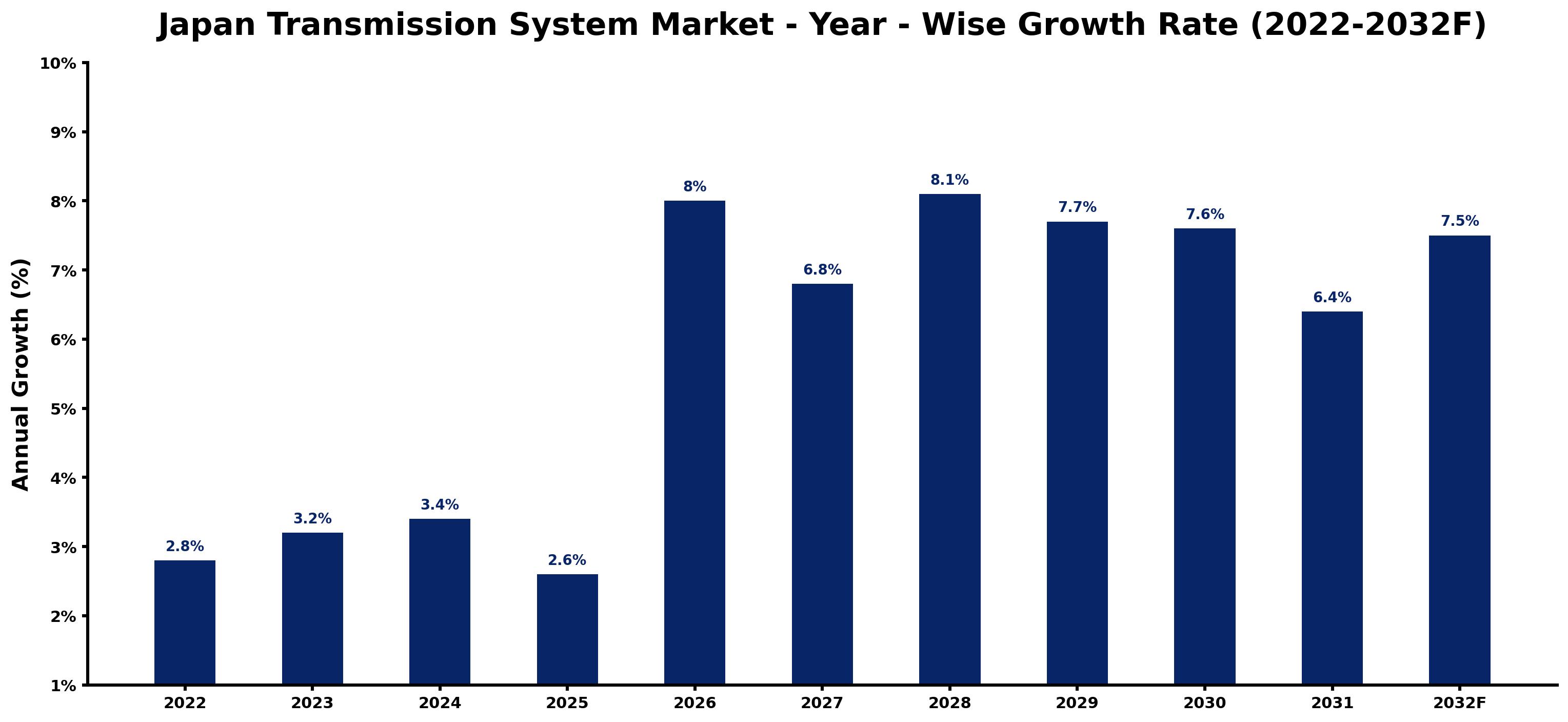
Year by year, the estimates below pair each growth rate with the development that shaped it.
| Year | Estimated Annual Growth (%) | Market Rationale |
| 2022 | 2.8 | Domestic vehicle production remained steady, supporting transmission system demand. |
| 2023 | 3.2 | Increased investments in automotive technology drove higher demand for advanced transmission systems. |
| 2024 | 3.4 | The Tokyo region's automotive hub continued to grow production capabilities, boosting market growth. |
| 2025 | 2.6 | A slight slowdown occurred as manufacturers adjusted to changing consumer preferences. |
| 2026 | 8.0 | Technological advancements in automatic transmissions are expected to spark renewed interest and demand. |
| 2027 | 6.8 | Demand will remain strong, although growth rates will moderate as the market matures. |
| 2028 | 8.1 | A surge in luxury vehicle production will lead to peak demand for high-performance transmissions. |
| 2029 | 7.7 | Growth will slow slightly as market saturation begins to affect new vehicle sales. |
| 2030 | 7.6 | Demand is projected to stabilise as manufacturers focus on efficiency and eco-friendly technologies. |
| 2031 | 6.4 | The market will continue to grow, driven by ongoing investments in transmission innovations. |
| 2032 | 7.5 | Increased adoption of electric vehicles is expected to further drive demand for advanced transmission systems. |
Note: Market size estimations and growth projections presented in this report are based on 6Wresearch's proprietary forecasting methodology, utilizing the latest available industry data, government publications, and primary research inputs.
Japan Transmission System Market Synopsis
Transmission systems are vital technologies that transfer power from vehicle engines to wheels, optimising fuel efficiency and enabling movement. In Japan, the automotive industry produced 8.3 million vehicles in 2022, creating substantial demand for various transmission systems. The market is expanding due to rising vehicle production, increasing sales of automatic transmissions, and a push for eco-friendly systems, supported by 1.5 trillion yen in automotive technology investments in 2023.
Market Dynamics Impact Analysis (2026–2032)
| Factor | Type | Impact | Primary Segment Affected |
| Rising vehicle production in the Tokyo region | Driver | High | Passenger Cars |
| Growing adoption of automatic transmissions for convenience | Driver | High | Automatic Transmission |
| Investment in electric vehicle transmission systems | Opportunity | High | Automatic Transmission |
| Expansion of luxury vehicle production requiring advanced transmissions | Opportunity | High | Luxury Vehicles |
| Regulatory pressure for emissions compliance | Restraint | High | Manual Transmission |
| Challenges in sourcing high-quality materials for production | Restraint | Medium | Manual Transmission |
| Competition from international manufacturers | Challenge | High | Manual Transmission |
| Technological advancements requiring continuous investment | Challenge | Medium | Manual Transmission |
Evaluation of Drivers in Japan Transmission System Market (2026–2032)
Demand rests on the following drivers, each shown with the segment it touches most.
| Drivers | Primary Segment Affected | Why It Matters (Evidence) |
| Increased vehicle production in Japan | Passenger Cars | Japan produced 8.3 million vehicles in 2022, driving demand for diverse transmission systems. |
| High demand for automatic transmissions | Automatic Transmission | Automatic transmissions accounted for over 70% of new vehicle sales in Japan. |
| Growing interest in hybrid vehicles | CVT | The average fuel economy of vehicles in Japan is improving, boosting demand for CVTs. |
| Rising luxury vehicle sales | Luxury Vehicles | The luxury vehicle segment is experiencing a notable increase in demand for advanced transmissions. |
| Technological advancements in transmission systems | DCT | The use of dual-clutch transmissions is growing in the luxury vehicle segment. |
Much of the new demand traces back to Japan's automotive sector, which produced 8.3 million vehicles in 2022, necessitating diverse transmission systems. The average age of vehicles in Japan is around 10 years, creating a strong need for transmission replacements. Automatic transmissions accounted for over 70% of new vehicle sales, reflecting consumer preferences for convenience. The compact car segment represents 30% of total vehicle sales, driving demand for efficient transmission systems. Investments in electric vehicle technologies are expected to further increase the demand for advanced transmission solutions.
Evaluation of Restraints in Japan Transmission System Market
The following restraints limit how fast demand can grow.
| Market Restraint | Primary Segment Affected | Why It Matters (Evidence) |
| Regulatory pressure for emissions compliance | Manual Transmission | Japan's stringent emissions regulations require continuous upgrades to transmission systems, increasing costs for manufacturers. |
| Challenges in sourcing high-quality materials for production | Manual Transmission | Supply chain disruptions have made it difficult to obtain essential materials for transmission manufacturing. |
| Intense competition from international manufacturers | Manual Transmission | Domestic producers face pressure from global competitors, affecting market share and pricing strategies. |
| Technological advancements requiring continuous investment | Manual Transmission | Rapid technological changes necessitate ongoing investments, straining budgets for smaller manufacturers. |
| Market saturation in certain vehicle segments | Passenger Cars | As the market matures, growth potential in basic vehicle segments is becoming limited. |
Japan Transmission System Market Challenges
Japan produced 8.3 million vehicles in 2022, but rising material costs are pushing local manufacturers to increase prices, straining budgets for vehicle producers. Competition from international markets is fierce, forcing domestic suppliers to reduce prices, which can diminish profit margins for manufacturers. Compliance with stringent JIS standards requires significant investments in quality assurance, raising operational costs and potentially delaying product launches for suppliers. Supply chain disruptions, particularly in sourcing metals and composites, can lead to production delays, impacting delivery schedules for vehicle manufacturers and resulting in lost sales opportunities.
Trends in the Japan Transmission System Market
These developments are changing demand patterns in the Japan Transmission System Market.
- Shift from Manual to Automatic Transmissions: Since 2022, consumer preference has shifted towards automatic transmissions, with over 70% of new vehicle sales reflecting this change. This trend is reshaping production strategies among automotive manufacturers in Japan.
- Increased Focus on Eco-Friendly Transmission Systems: Starting in 2023, manufacturers are prioritising eco-friendly transmission technologies to meet government targets. The government aims to enhance electric vehicle transmission systems by 2025, influencing market dynamics.
- Growing Popularity of Dual-Clutch Transmissions: In 2023, the use of dual-clutch transmissions surged in the luxury vehicle segment, reflecting a significant increase in demand. This trend is pushing manufacturers to innovate and improve performance.
- Expansion of Hybrid Vehicle Offerings: Beginning in 2023, the hybrid vehicle market has expanded significantly, with a marked increase in sales. This growth is driving demand for continuously variable transmissions, which optimise fuel efficiency.
Investment Opportunities in the Japan Transmission System Market
Investors looking at the Japan Transmission System Market should consider the following areas.
- Partner with Local Manufacturers: Now is an ideal time to enter the Japanese market by partnering with local automotive manufacturers, as they seek advanced transmission solutions to improve vehicle performance and efficiency.
- Invest in Advanced Transmission Technologies: The Tokyo region, a hub for automotive innovation, is seeing increased investments in advanced transmission systems, providing opportunities for suppliers to meet growing demand.
- Focus on Eco-Friendly Transmission Solutions: With the government's target to enhance electric vehicle transmission systems by 2025, suppliers should invest in eco-friendly technologies to capture emerging market opportunities.
- Expand Offerings for Luxury Vehicles: As luxury vehicle production rises, there is a growing need for advanced transmission systems. Suppliers can enter this market by developing high-performance solutions tailored to luxury OEMs.
Government Initiatives in the Japan Transmission System Market
The AI Promotion Act (2025) encourages the integration of AI in automotive technologies, improving the capabilities of transmission systems. This law incentivises manufacturers to adopt AI-driven processes, improving efficiency and innovation in the sector. The government has allocated significant funding to support these initiatives, aiming to boost competitiveness in the automotive industry.
The Ministry of Economy, Trade and Industry funds initiatives to support automotive technology innovation, including transmission systems. This agency plays a significant role in approving projects that enhance the competitiveness of Japan's automotive industry, with a focus on sustainable practices and technological advancements.
Future Insight of the Japan Transmission System Market
The emergence of advanced electric vehicle transmission systems will reshape demand dynamics by 2032, driven by government initiatives promoting eco-friendly technologies. The Tokyo Motor Show will continue to highlight new innovations, influencing buyer preferences towards more efficient systems. As the average fuel economy of vehicles improves, consumers will increasingly seek transmissions that enhance performance. With automotive employment exceeding 5 million, the focus on advanced transmission technologies will create new opportunities for both suppliers and buyers.
Market Segmentation Analysis
Japan Transmission System Market report covers a detailed analysis of the following market segments:
By System Type – Manual Transmission Leads, Automatic Transmission Expected to Grow Fastest
According to Saurav Kr Singh, Senior Research Analyst at 6Wresearch, Manual Transmission accounted for 38% of the market by system type in 2025. Manual transmissions are commonly used in basic vehicles for their cost efficiency, appealing to budget-conscious consumers. This segment benefits from the high volume of vehicle production in Japan, which reached 8.3 million units in 2022. Automatic Transmission is set to record the highest CAGR in this split, 10.5% over 2026–2032. The growth of automatic transmissions is supported by their convenience, with over 70% of new vehicle sales in Japan being automatic. This trend is expected to continue as consumer preferences shift towards more user-friendly driving experiences, widening the lead of this segment. Suppliers should prioritise the development of automatic transmission technologies to align with increasing consumer demand.
By Transmission Mode – Mechanical Leads, Hydraulic Expected to Grow Fastest
Mechanical took 35% of transmission mode revenue in 2025, more than any other category. Mechanical transmissions maintain a strong presence in Japan's automotive market due to their reliability and simplicity, appealing to traditional vehicle users. This method is particularly popular among local manufacturers who prioritise cost-effectiveness and durability in their production processes. The quickest growth will come from Hydraulic, forecast to expand at a CAGR of 9.5% between 2026 and 2032. Hydraulic transmissions are rapidly gaining popularity as they offer smoother operation in automatic systems, catering to the rising demand for enhanced driving comfort. This growth is supported by manufacturers' investments in advanced technologies aimed at improving overall vehicle performance. Suppliers should prioritise the development of hydraulic technologies to meet the increasing demand for smoother and more efficient transmission systems.
By Vehicle Segment – Passenger Cars Lead, Luxury Vehicles Expected to Grow Fastest
Passenger Cars held 39% of the Japan Transmission System Market by vehicle segment in 2025. Passenger cars dominate the Japanese market, accounting for the majority of vehicles on the road, which drives the demand for various transmission systems. The compact car segment, representing 30% of total vehicle sales, further contributes to this trend. Luxury Vehicles are projected to grow fastest, at a CAGR of 9.9% during 2026–2032. Luxury vehicles are experiencing a surge in demand for advanced transmission systems, reflecting consumer interest in high-performance features. This growth is supported by the automotive sector's investment in new technologies, which reached 1.5 trillion yen in 2023. Suppliers should tailor their offerings to meet the specific needs of the luxury vehicle segment to capture emerging opportunities.
By End User – Automotive OEMs Lead, OEM Assemblers Expected to Grow Fastest
The largest end user category in 2025 was Automotive OEMs, at 48% of revenue. Automotive OEMs are the primary users of transmission systems, as they design and manufacture vehicles that require reliable transmission solutions. This sector's substantial contribution to Japan's manufacturing GDP, approximately 20%, underscores its importance. Over 2026–2032, OEM Assemblers are expected to post the fastest growth, at a CAGR of 9.4%. OEM assemblers are rapidly increasing their use of various transmission types, driven by the need for efficiency in vehicle assembly processes. This trend is likely to accelerate as the automotive industry continues to innovate and streamline production. Suppliers should strengthen partnerships with OEM assemblers to ensure a steady demand for diverse transmission solutions.
Key Attractiveness of the Report
- 10 Years of Market Numbers
- Historical Data Starting from 2022 to 2025
- Base Year 2025
- Forecast Data until 2032
- Key Performance Indicators Impacting the Market
- Major Upcoming Developments and Projects
Key Highlights of the Report:
- Japan Transmission System Market Outlook
- Market Size of Japan Transmission System Market, 2025
- Forecast of Japan Transmission System Market, 2032
- Historical Data and Forecast of Japan Transmission System Revenues & Volume for the Period 2022-2032F
- Japan Transmission System Market Trend Evolution
- Japan Transmission System Market Drivers and Challenges
- Japan Transmission System Price Trends
- Japan Transmission System Porter's Five Forces
- Japan Transmission System Industry Life Cycle
- Historical Data and Forecast of Japan Transmission System Market Revenues & Volume By System Type for the Period 2022-2032F
- Historical Data and Forecast of Japan Transmission System Market Revenues & Volume By Manual Transmission for the Period 2022-2032F
- Historical Data and Forecast of Japan Transmission System Market Revenues & Volume By Automatic Transmission for the Period 2022-2032F
- Historical Data and Forecast of Japan Transmission System Market Revenues & Volume By CVT for the Period 2022-2032F
- Historical Data and Forecast of Japan Transmission System Market Revenues & Volume By DCT for the Period 2022-2032F
- Historical Data and Forecast of Japan Transmission System Market Revenues & Volume By Transmission Mode for the Period 2022-2032F
- Historical Data and Forecast of Japan Transmission System Market Revenues & Volume By Mechanical for the Period 2022-2032F
- Historical Data and Forecast of Japan Transmission System Market Revenues & Volume By Hydraulic for the Period 2022-2032F
- Historical Data and Forecast of Japan Transmission System Market Revenues & Volume By Belt-Based for the Period 2022-2032F
- Historical Data and Forecast of Japan Transmission System Market Revenues & Volume By Dual-Clutch for the Period 2022-2032F
- Historical Data and Forecast of Japan Transmission System Market Revenues & Volume By Vehicle Segment for the Period 2022-2032F
- Historical Data and Forecast of Japan Transmission System Market Revenues & Volume By Passenger Cars for the Period 2022-2032F
- Historical Data and Forecast of Japan Transmission System Market Revenues & Volume By Luxury Vehicles for the Period 2022-2032F
- Historical Data and Forecast of Japan Transmission System Market Revenues & Volume By Compact Cars for the Period 2022-2032F
- Historical Data and Forecast of Japan Transmission System Market Revenues & Volume By Sports Cars for the Period 2022-2032F
- Historical Data and Forecast of Japan Transmission System Market Revenues & Volume By End User for the Period 2022-2032F
- Historical Data and Forecast of Japan Transmission System Market Revenues & Volume By Automotive OEMs for the Period 2022-2032F
- Historical Data and Forecast of Japan Transmission System Market Revenues & Volume By OEM Assemblers for the Period 2022-2032F
- Historical Data and Forecast of Japan Transmission System Market Revenues & Volume By Vehicle Manufacturers for the Period 2022-2032F
- Historical Data and Forecast of Japan Transmission System Market Revenues & Volume By Performance Vehicle OEMs for the Period 2022-2032F
- Japan Transmission System Import Export Trade Statistics
- Market Opportunity Assessment By System Type
- Market Opportunity Assessment By Transmission Mode
- Market Opportunity Assessment By Vehicle Segment
- Market Opportunity Assessment By End User
- Japan Transmission System Top Companies Market Share
- Japan Transmission System Competitive Benchmarking By Technical and Operational Parameters
- Japan Transmission System Company Profiles
- Japan Transmission System Key Strategic Recommendations
Market Covered
This report examines the market across the segments below.
By System Type
- Manual Transmission
- Automatic Transmission
- CVT
- DCT
By Transmission Mode
- Mechanical
- Hydraulic
- Belt-Based
- Dual-Clutch
By Vehicle Segment
- Passenger Cars
- Luxury Vehicles
- Compact Cars
- Sports Cars
By End User
- Automotive OEMs
- OEM Assemblers
- Vehicle Manufacturers
- Performance Vehicle OEMs































