Japan Transmission Timing Component Market Size & Growth Rate
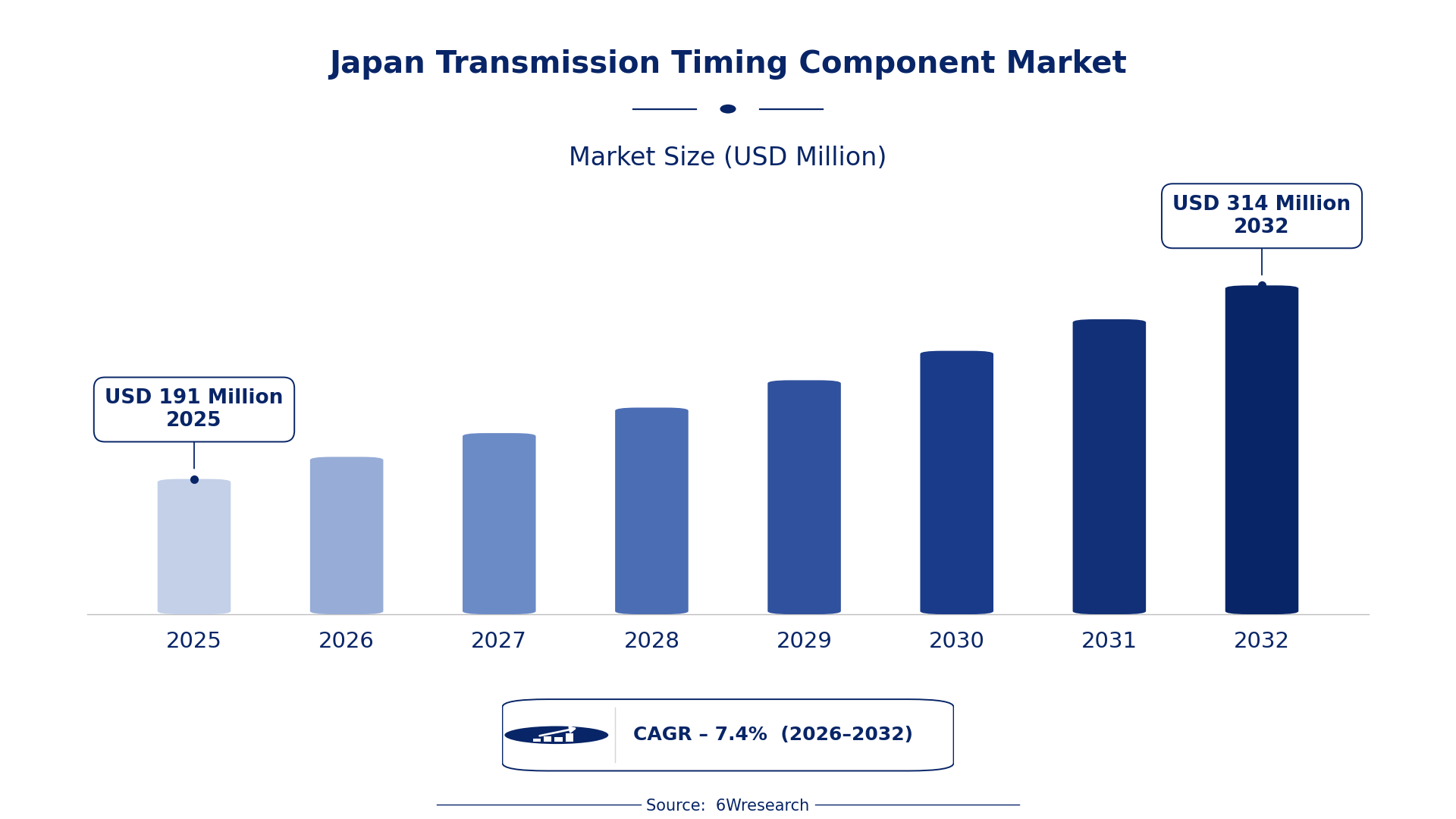
According to 6Wresearch internal database and industry insights, the Japan Transmission Timing Component Market was valued at USD 191 Million in 2025 and is projected to reach USD 314 Million by 2032, growing at a CAGR of approximately 7.4% during 2026–2032.
Japan Transmission Timing Component Market Highlights
| Report Metric | Details |
| Report Name | Japan Transmission Timing Component Market (2026-2032) |
| Market Size 2025 | USD 191 Million |
| Market Size 2032 | USD 314 Million |
| Absolute Growth 2025–2032 | USD 123 Million |
| CAGR 2026–2032 | 7.4% |
| Peak Annual Growth | 8.1% in 2028 |
| Forecast Period | 2026–2032 |
| Historical Data | 2022–2025 |
| Base Year | 2025 |
| Leading Component Type, 2025 | Timing Chains (50% share) |
| Leading Function, 2025 | Synchronize Valves (39% share) |
| Leading Engine Compatibility, 2025 | Gasoline Engines (38% share) |
| Leading End User, 2025 | Vehicle OEMs (37% share) |
| Fastest-Growing Component Type | Timing Belts (10.0% CAGR) |
| Fastest-Growing Engine Compatibility | Multi-Valve Engines (9.7% CAGR) |
| Fastest-Growing End User | Repair Garages (9.2% CAGR) |
| Growing Sector | automotive industry |
| Key End Users | vehicle OEMs, independent repair garages, motorsport teams, spare part suppliers |
Japan Transmission Timing Component Market Year-wise Growth Rate and Key Drivers (2022–2032)
This graph illustrates the annual growth rates of the market from 2022 to 2032, highlighting a steady upward trajectory and projected market expansion over the forecast period.
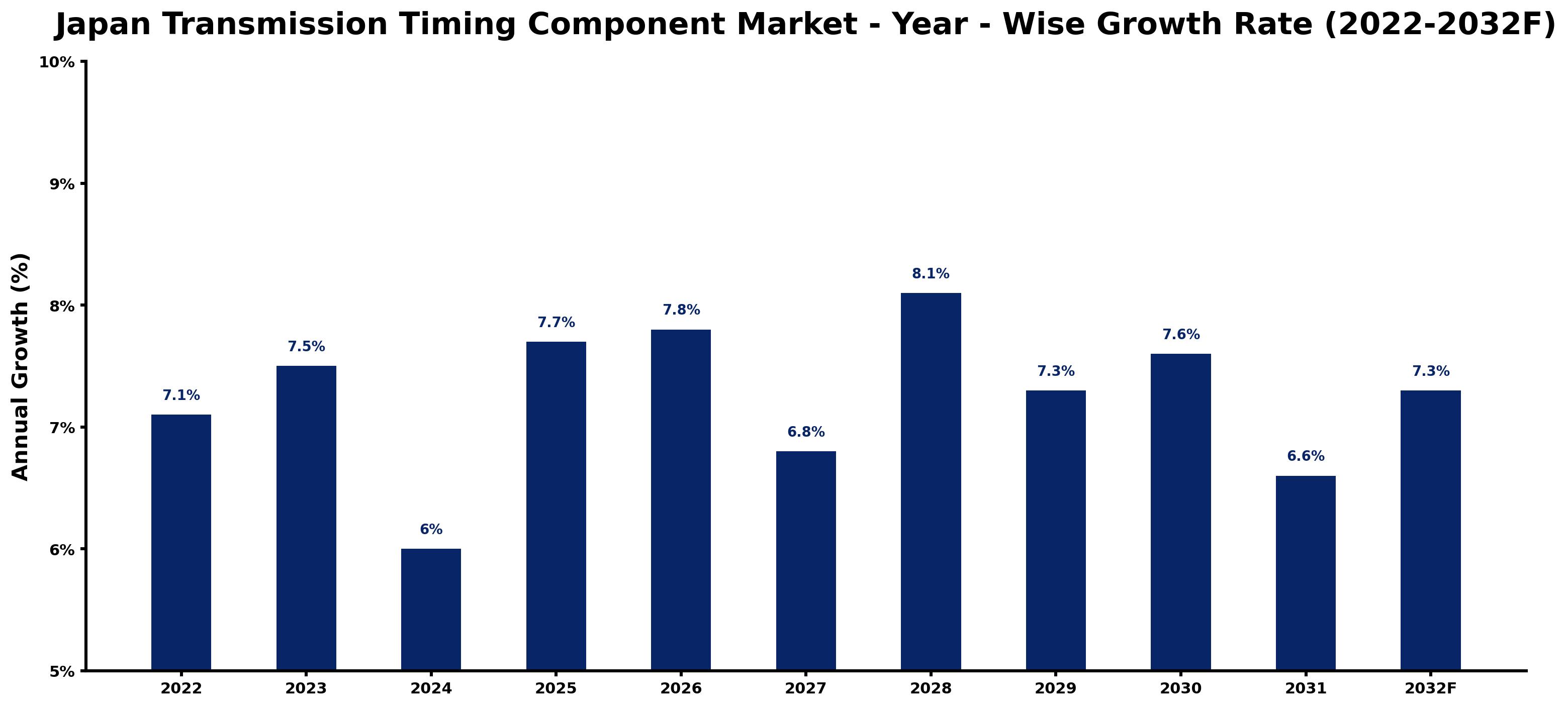
Annual growth estimates for each year appear below with the principal reason behind them, explaining the shifts that set the pace of the market.
| Year | Estimated Annual Growth (%) | Market Rationale |
| 2022 | 7.1 | The market experienced steady growth due to strong automotive demand. |
| 2023 | 7.5 | Growth accelerated as vehicle OEMs increased production and aftermarket services expanded. |
| 2024 | 6.0 | Growth slowed as supply chain disruptions affected component availability. |
| 2025 | 7.7 | The market rebounded with increased investments in automotive technology and R&D. |
| 2026 | 7.8 | Demand is expected to rise as manufacturers adopt advanced timing technologies for efficiency. |
| 2027 | 6.8 | Growth is projected to slow due to market saturation and increased competition among suppliers. |
| 2028 | 8.1 | The market is expected to peak as new regulations boost demand for high-performance components. |
| 2029 | 7.3 | Growth is projected to slow as manufacturers adjust to changing consumer preferences. |
| 2030 | 7.6 | Demand is expected to increase as investments in electric vehicle components gain momentum. |
| 2031 | 6.6 | Growth is projected to slow due to heightened competition and market consolidation. |
| 2032 | 7.3 | The market is expected to stabilise as innovation in timing components continues to drive demand. |
Note: Market size estimations and growth projections presented in this report are based on 6Wresearch's proprietary forecasting methodology, utilizing the latest available industry data, government publications, and primary research inputs.
Japan Transmission Timing Component Market Synopsis
Transmission timing components are critical mechanical parts in internal combustion engines, ensuring precise synchronization of the crankshaft and camshaft. The Japan Transmission Timing Component Market thrives on the automotive industry, valued at over 10 trillion JPY, with demand primarily driven by vehicle OEMs and independent repair garages. Investments exceeding 1 trillion JPY in R&D, alongside a focus on high-performance engines and aftermarket services, create a vibrant market environment.
Market Dynamics Impact Analysis (2026–2032)
| Factor | Type | Impact | Primary Segment Affected |
| Strong automotive production and aftermarket services drive component demand. | Driver | High | Timing Chains |
| Increasing adoption of advanced technologies in vehicle manufacturing creates opportunities. | Driver | High | Timing Belts |
| The rise in independent repair garages presents a growing market for components. | Opportunity | High | Repair Garages |
| High-performance engines are gaining popularity in motorsport, expanding the market. | Opportunity | Medium | High-Performance Engines |
| Supply chain disruptions affect component availability and production timelines. | Restraint | High | Timing Sprockets |
| Market saturation leads to increased competition among suppliers, impacting margins. | Restraint | Medium | Tensioners |
| Technological advancements require continuous investment, straining smaller suppliers. | Challenge | High | Synchronize Valves |
| Rising raw material costs are affecting pricing strategies for manufacturers. | Challenge | Medium | Crankshaft-Camshaft |
Evaluation of Drivers in Japan Transmission Timing Component Market (2026–2032)
Key forces behind demand, with the segment each one moves most, are listed below.
| Drivers | Primary Segment Affected | Why It Matters (Evidence) |
| Increased vehicle production drives demand for timing chains, with 60% usage in new gasoline engines. | Timing Chains | This high adoption rate among manufacturers results in increased purchases of timing chains. |
| Growing interest in fuel efficiency prompts the use of timing belts in gasoline engines. | Timing Belts | As manufacturers seek to meet efficiency standards, they invest more in timing belts. |
| The automotive repair market, valued at around 3 trillion JPY, boosts demand for replacement components. | Repair Garages | Independent garages are increasingly sourcing timing components for vehicle maintenance. |
| High-performance engines are gaining traction in motorsport events, increasing demand for specialized components. | High-Performance Engines | Motorsport teams are investing in advanced timing components to enhance performance. |
| Technological advancements in automotive engineering lead to increased demand for synchronize valves. | Synchronize Valves | As vehicles become more complex, the need for precise timing components rises. |
A wider customer base explains much of the growth, as the automotive industry in Japan is valued at over 10 trillion JPY, leading to increased production of timing components. Approximately 60% of new gasoline engines utilise timing chains, prompting manufacturers to invest in this segment. The automotive repair market, estimated at around 3 trillion JPY, supports demand for replacement parts, particularly from independent repair garages servicing 70% of vehicles. High-performance engines are becoming popular in motorsport events, driving further investment in advanced timing components. The focus on fuel efficiency and compliance with stringent standards encourages manufacturers to adopt new technologies, boosting overall demand.
Evaluation of Restraints in Japan Transmission Timing Component Market
Below are the constraints most often cited by buyers and suppliers, with the segment each affects.
| Market Restraint | Primary Segment Affected | Why It Matters (Evidence) |
| Supply chain disruptions have delayed component deliveries, impacting production schedules. | Timing Sprockets | Manufacturers face challenges in sourcing materials, resulting in longer lead times. |
| Increased competition among suppliers has led to price wars, affecting profit margins. | Tensioners | Price reductions to attract customers have strained smaller suppliers' profitability. |
| High raw material costs are limiting the ability of manufacturers to maintain competitive pricing. | Synchronize Valves | Rising costs of steel and rubber are impacting overall production expenses. |
| Market saturation is causing slower growth rates as demand stabilises. | Timing Chains | With many players in the market, differentiation becomes challenging. |
| Technological advancements require ongoing investment, which can be a barrier for smaller firms. | Timing Belts | Smaller suppliers may struggle to keep pace with rapid technological changes. |
Japan Transmission Timing Component Market Challenges
The automotive repair market in Japan is worth around 3 trillion JPY, yet delays arise from inconsistent supply of timing components, impacting independent repair garages that depend on timely deliveries. Many suppliers struggle with a shortage of skilled workers, resulting in longer production times for automotive manufacturers and ultimately affecting vehicle availability. Rising costs of high-strength materials like steel have increased input prices for suppliers, discouraging investment from vehicle OEMs. Rapid technological advancements create a gap between current supplier capabilities and market expectations, leaving buyers with limited options for modern engine performance.
Trends in the Japan Transmission Timing Component Market
The following changes are redrawing the Japan Transmission Timing Component Market.
- Battery Industry Strategy Driving Electric Vehicle Components: The Battery Industry Strategy, targeting 150 GWh of domestic battery manufacturing by 2030, is reshaping the automotive sector. This shift is prompting investments in electric vehicle components, including timing systems that support hybrid technologies, with over 1 trillion JPY allocated for R&D.
- Shift Towards Multi-Valve Engines in Automotive Manufacturing: The Tokyo region is experiencing a shift towards multi-valve engines, driven by consumer demand for performance and efficiency. Approximately 9.7% CAGR is projected for this segment, encouraging manufacturers to adapt their offerings accordingly.
- Growing Popularity of High-Performance Engines in Motorsport: The rise of high-performance engines in motorsport events in Japan is influencing component demand. With a focus on precision and performance, this niche market is expanding, prompting suppliers to innovate their product offerings.
- Adoption of ISO 9001 Standards in Automotive Supply Chain: ISO 9001 standards are increasingly being adopted across the automotive supply chain in Japan, enhancing quality assurance processes. This trend is vital for maintaining competitiveness, as manufacturers seek to meet stringent quality requirements.
Investment Opportunities in the Japan Transmission Timing Component Market
The following areas offer the clearest openings for investors and suppliers in the Japan Transmission Timing Component Market.
- Supply of Timing Belts for Gasoline Engines: With timing belts projected to grow, there is an opportunity to supply these components. Vehicle OEMs are increasingly seeking reliable suppliers to meet rising production demands.
- Investment in Aftermarket Services for Repair Garages: The automotive repair market, valued at around 3 trillion JPY, presents opportunities for suppliers of timing components. Engaging with independent repair garages can strengthen market presence and sales.
- Focus on High-Performance Engine Components: The growing interest in high-performance engines in motorsport events indicates a gap in specialised components. Suppliers can capitalise on this trend by developing tailored products for racing teams.
- Tokyo Region as a Hub for Automotive Innovation: The Tokyo region is a key area for automotive innovation, with investments exceeding 1 trillion JPY in R&D. Suppliers can enter this market by partnering with local manufacturers to provide advanced timing components.
Government Initiatives in the Japan Transmission Timing Component Market
The Hydrogen Society Promotion Act, enacted in 2024, supports low-carbon hydrogen supply chains, facilitating the automotive sector's transition to sustainable technologies. This act complements existing regulations, such as the Electrical Appliance and Material Safety Act, which ensures that automotive components meet safety standards, thereby creating a safer market environment.
Various funding initiatives, including the Battery Industry Strategy, overseen by the Ministry of Economy, Trade and Industry (METI), aim for 150 GWh of domestic battery capacity by 2030. This initiative encourages automotive manufacturers to invest in advanced technologies, ensuring compliance with future energy standards.
Future Insight of the Japan Transmission Timing Component Market
Investment exceeding 1 trillion JPY in R&D will drive advancements in transmission timing components by 2032, creating new opportunities for buyers and suppliers. New manufacturing technologies will streamline production processes, enabling suppliers to meet growing demand from domestic users and independent repair garages. The adoption of ISO 9001 and JIS standards will ensure higher quality and reliability in components, benefiting buyers. As the automotive sector evolves, suppliers will need to innovate continuously to cater to changing market preferences.
Market Segmentation Analysis
Japan Transmission Timing Component Market report covers a detailed analysis of the following market segments:
By Component Type – Timing Chains Lead, Timing Belts Expected to Grow Fastest
According to Saurav Kr Singh, Senior Research Analyst at 6Wresearch, Timing Chains took 50% of component type revenue in 2025, more than any other category. Timing chains dominate the market because they are integral to 60% of new gasoline engines in Japan, ensuring precise synchronisation of engine components. This extensive use by vehicle OEMs solidifies their leading position in the transmission timing component sector. Over 2026–2032, Timing Belts are expected to post the fastest growth, at a CAGR of 10.0%. The rapid adoption of timing belts in modern gasoline engines is propelling growth in this segment. As manufacturers increasingly focus on performance and efficiency, the demand for timing belts is set to rise significantly. Suppliers should diversify their offerings to include timing belts to take advantage of this expanding market segment.
By Function – Synchronize Valves Lead and Record the Fastest Growth
Synchronize Valves accounted for 39% of the market by function in 2025. The function of synchronising valves is crucial for optimal engine performance, making it the leading function in the market. The high demand for components that guarantee precise timing in Japan's automotive sector highlights the significance of this function. Its lead should widen, with a projected CAGR of 9.3% during 2026–2032, the highest in this split. As synchronising valves remain the primary function, their growth rate will continue to be robust as manufacturers strive to improve engine efficiency. This sustained demand will further reinforce the leading position of synchronising valves in the market. Buyers will benefit from suppliers that focus on advancements in valve synchronisation technology.
By Engine Compatibility – Gasoline Engines Lead, Multi-Valve Engines Expected to Grow Fastest
In 2025, Gasoline Engines led the engine compatibility split with a 38% share. Gasoline engines are the predominant application in passenger vehicles, making a substantial contribution to market share. Their widespread presence guarantees a consistent demand for transmission timing components within the automotive industry. Multi-Valve Engines are set to record the highest CAGR in this split, 9.7% over 2026–2032. The rising popularity of multi-valve engines, increasingly found in modern vehicles, is driving the growth of this segment. As manufacturers innovate and multi-valve designs become standard, the demand for compatible components is expected to surge. Suppliers should align their product development with the growing trend towards multi-valve engine compatibility.
By End User – Vehicle OEMs Lead, Repair Garages Expected to Grow Fastest
With 37% of end user revenue in 2025, Vehicle OEMs was the largest category. Vehicle OEMs are the main users of transmission timing components, incorporating these parts into new vehicles. Their essential role in the automotive supply chain ensures a steady demand for these components. Repair Garages are projected to grow fastest, at a CAGR of 9.2% during 2026–2032. Repair garages are experiencing growth as they cater to the maintenance needs of the majority of vehicles serviced outside of OEMs. This trend underscores the importance of aftermarket services in the overall market. Suppliers must address the needs of repair garages to effectively penetrate the aftermarket segment.
Key Attractiveness of the Report
- 10 Years of Market Numbers
- Historical Data Starting from 2022 to 2025
- Base Year 2025
- Forecast Data until 2032
- Key Performance Indicators Impacting the Market
- Major Upcoming Developments and Projects
Key Highlights of the Report:
- Japan Transmission Timing Component Market Outlook
- Market Size of Japan Transmission Timing Component Market, 2025
- Forecast of Japan Transmission Timing Component Market, 2032
- Historical Data and Forecast of Japan Transmission Timing Component Revenues & Volume for the Period 2022-2032F
- Japan Transmission Timing Component Market Trend Evolution
- Japan Transmission Timing Component Market Drivers and Challenges
- Japan Transmission Timing Component Price Trends
- Japan Transmission Timing Component Porter's Five Forces
- Japan Transmission Timing Component Industry Life Cycle
- Historical Data and Forecast of Japan Transmission Timing Component Market Revenues & Volume By Component Type for the Period 2022-2032F
- Historical Data and Forecast of Japan Transmission Timing Component Market Revenues & Volume By Timing Chains for the Period 2022-2032F
- Historical Data and Forecast of Japan Transmission Timing Component Market Revenues & Volume By Timing Belts for the Period 2022-2032F
- Historical Data and Forecast of Japan Transmission Timing Component Market Revenues & Volume By Timing Sprockets for the Period 2022-2032F
- Historical Data and Forecast of Japan Transmission Timing Component Market Revenues & Volume By Tensioners for the Period 2022-2032F
- Historical Data and Forecast of Japan Transmission Timing Component Market Revenues & Volume By Function for the Period 2022-2032F
- Historical Data and Forecast of Japan Transmission Timing Component Market Revenues & Volume By Synchronize Valves for the Period 2022-2032F
- Historical Data and Forecast of Japan Transmission Timing Component Market Revenues & Volume By Crankshaft-Camshaft for the Period 2022-2032F
- Historical Data and Forecast of Japan Transmission Timing Component Market Revenues & Volume By Gear Timing Control for the Period 2022-2032F
- Historical Data and Forecast of Japan Transmission Timing Component Market Revenues & Volume By Maintain Tension for the Period 2022-2032F
- Historical Data and Forecast of Japan Transmission Timing Component Market Revenues & Volume By Engine Compatibility for the Period 2022-2032F
- Historical Data and Forecast of Japan Transmission Timing Component Market Revenues & Volume By Diesel Engines for the Period 2022-2032F
- Historical Data and Forecast of Japan Transmission Timing Component Market Revenues & Volume By Gasoline Engines for the Period 2022-2032F
- Historical Data and Forecast of Japan Transmission Timing Component Market Revenues & Volume By High-Performance Engines for the Period 2022-2032F
- Historical Data and Forecast of Japan Transmission Timing Component Market Revenues & Volume By Multi-Valve Engines for the Period 2022-2032F
- Historical Data and Forecast of Japan Transmission Timing Component Market Revenues & Volume By End User for the Period 2022-2032F
- Historical Data and Forecast of Japan Transmission Timing Component Market Revenues & Volume By Vehicle OEMs for the Period 2022-2032F
- Historical Data and Forecast of Japan Transmission Timing Component Market Revenues & Volume By Repair Garages for the Period 2022-2032F
- Historical Data and Forecast of Japan Transmission Timing Component Market Revenues & Volume By Racing Teams for the Period 2022-2032F
- Historical Data and Forecast of Japan Transmission Timing Component Market Revenues & Volume By Spare Part Suppliers for the Period 2022-2032F
- Japan Transmission Timing Component Import Export Trade Statistics
- Market Opportunity Assessment By Component Type
- Market Opportunity Assessment By Function
- Market Opportunity Assessment By Engine Compatibility
- Market Opportunity Assessment By End User
- Japan Transmission Timing Component Top Companies Market Share
- Japan Transmission Timing Component Competitive Benchmarking By Technical and Operational Parameters
- Japan Transmission Timing Component Company Profiles
- Japan Transmission Timing Component Key Strategic Recommendations
Market Covered
The study includes the following segmentation.
By Component Type
- Timing Chains
- Timing Belts
- Timing Sprockets
- Tensioners
By Function
- Synchronize Valves
- Crankshaft-Camshaft
- Gear Timing Control
- Maintain Tension
By Engine Compatibility
- Diesel Engines
- Gasoline Engines
- High-Performance Engines
- Multi-Valve Engines
By End User
- Vehicle OEMs
- Repair Garages
- Racing Teams
- Spare Part Suppliers































