Japan Transparent Solar Panels Market Size & Growth Rate
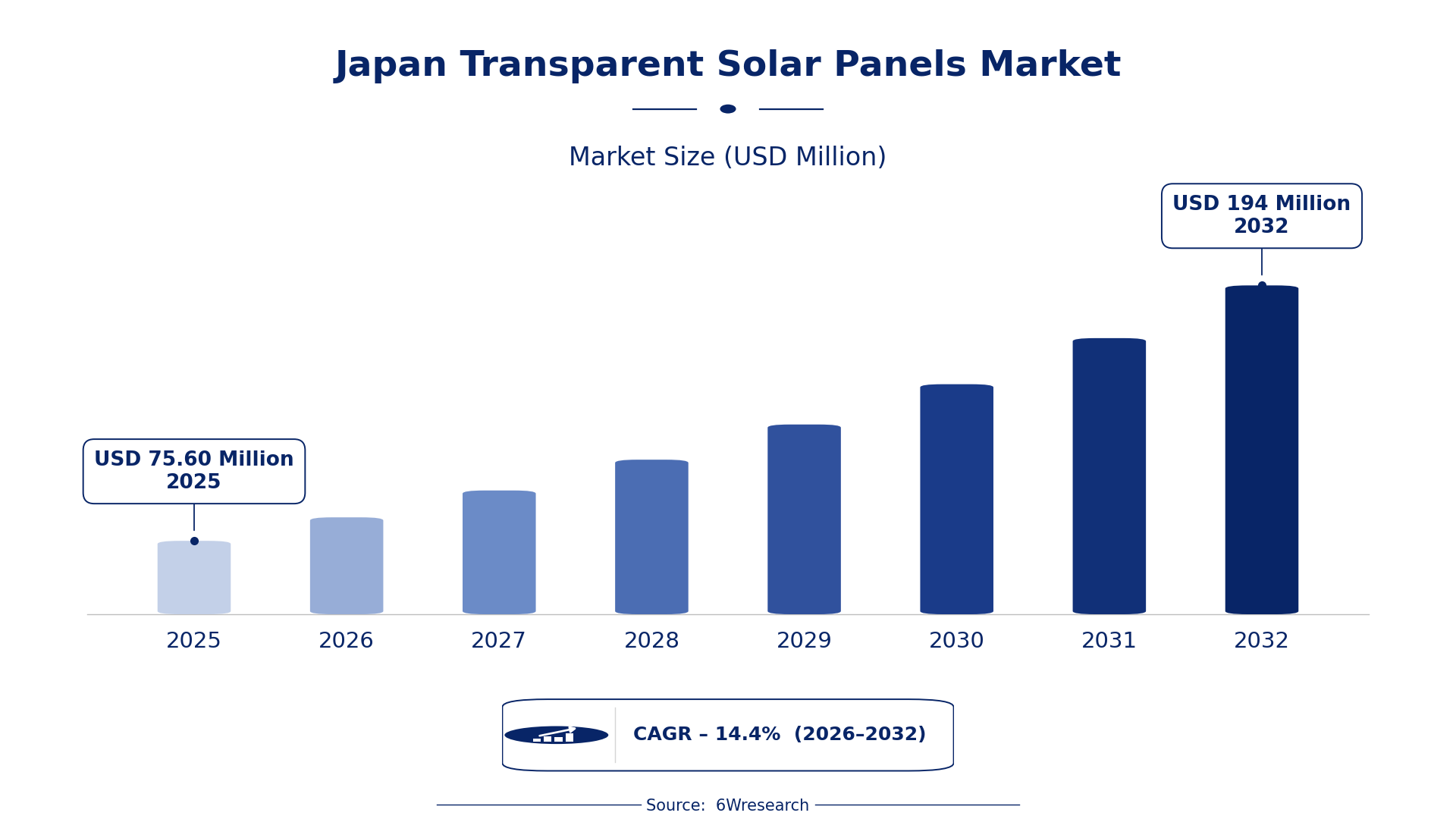
According to 6Wresearch internal database and industry insights, the Japan Transparent Solar Panels Market was valued at USD 75.60 Million in 2025 and is projected to reach USD 194 Million by 2032, growing at a CAGR of approximately 14.4% during 2026–2032.
Japan Transparent Solar Panels Market Highlights
| Report Metric | Details |
| Report Name | Japan Transparent Solar Panels Market (2026-2032) |
| Market Size 2025 | USD 75.60 Million |
| Market Size 2032 | USD 194 Million |
| Absolute Growth 2025–2032 | USD 118.40 Million |
| CAGR 2026–2032 | 14.4% |
| Peak Annual Growth | 17.1% in 2026 |
| Forecast Period | 2026–2032 |
| Historical Data | 2022–2025 |
| Base Year | 2025 |
| Leading Panel Type, 2025 | Organic Solar Panels (49% share) |
| Leading Technology Used, 2025 | OPV (32% share) |
| Leading Application Area, 2025 | Windows & Facades (39% share) |
| Leading End User, 2025 | Architects (50% share) |
| Fastest-Growing Panel Type | Perovskite-Based Panels (20.6% CAGR) |
| Fastest-Growing Technology Used | Semi-Transparent (19.3% CAGR) |
| Fastest-Growing Application Area | Building-Integrated PV (17.7% CAGR) |
| Fastest-Growing End User | Commercial Developers (18.5% CAGR) |
| Growing Sector | Building-Integrated PV |
| Key End Users | Windows & Facades, Building-Integrated PV, Smart Windows, Mobile Devices |
Japan Transparent Solar Panels Market Year-wise Growth Rate and Key Drivers (2022–2032)
This graph illustrates the annual growth rates of the market from 2022 to 2032, highlighting a steady upward trajectory and projected market expansion over the forecast period.
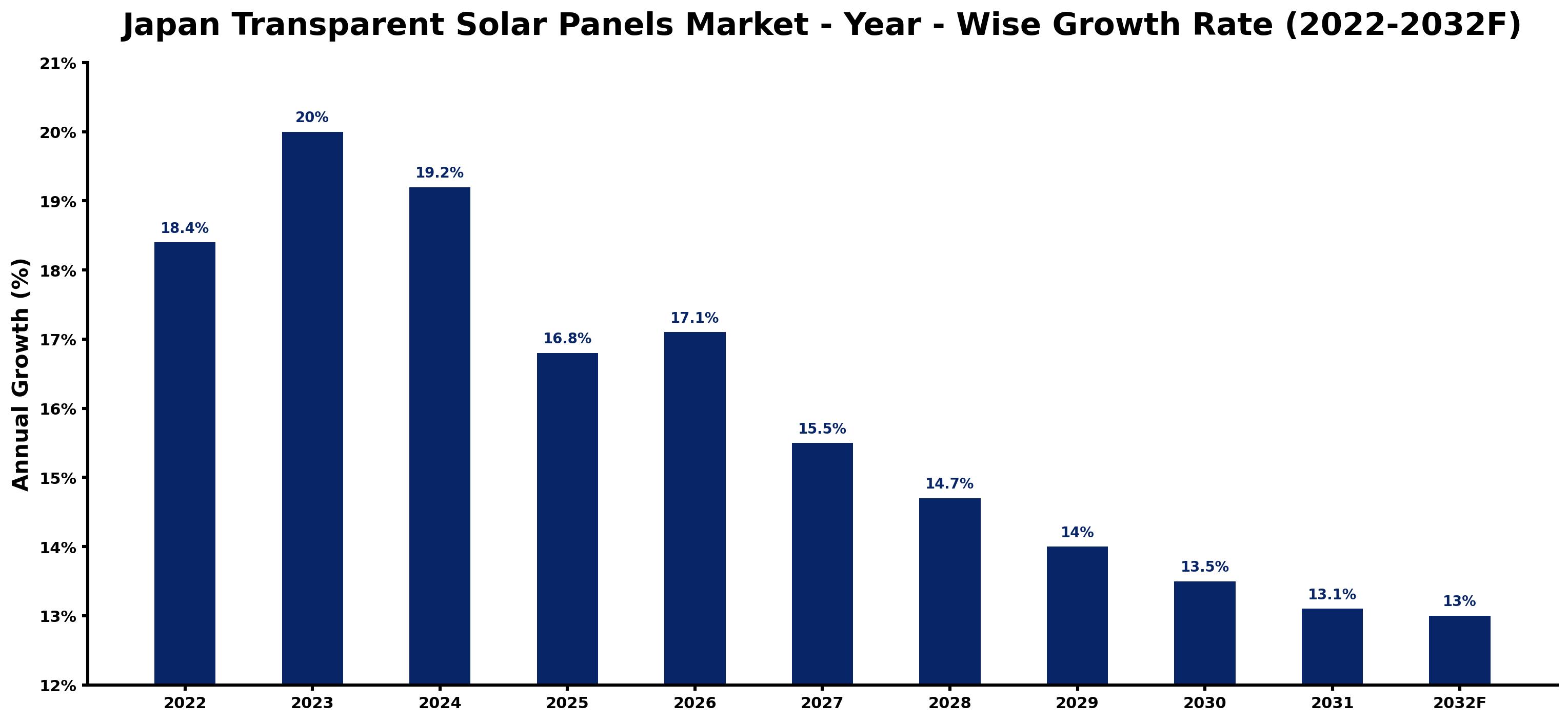
Annual growth estimates for each year appear below with the principal reason behind them, explaining the shifts that set the pace of the market.
| Year | Estimated Annual Growth (%) | Market Rationale |
| 2022 | 18.4 | The market showed strong demand for transparent solar panels from domestic users and commercial developers. |
| 2023 | 20.0 | Demand surged due to the focus on energy-efficient technologies in the Tokyo metropolitan area. |
| 2024 | 19.2 | Growth slowed as the market adjusted to previous high demand levels and project completions. |
| 2025 | 16.8 | The market continued to grow, driven by ongoing smart city projects and building-integrated photovoltaics. |
| 2026 | 17.1 | Growth is expected to accelerate as investments in renewable energy technologies increase. |
| 2027 | 15.5 | A slowdown is projected as the market matures and competition intensifies among suppliers. |
| 2028 | 14.7 | Demand growth is expected to decelerate as market saturation begins to take effect in urban areas. |
| 2029 | 14.0 | The market will maintain growth, but at a reduced pace as buyers become more selective. |
| 2030 | 13.5 | Growth is anticipated to continue slowing as the market reaches a more stable phase of development. |
| 2031 | 13.1 | Demand is expected to remain steady, reflecting the ongoing integration of transparent solar panels in construction. |
| 2032 | 13.0 | The market is projected to stabilise as new technologies emerge and adoption rates level off. |
Note: Market size estimations and growth projections presented in this report are based on 6Wresearch's proprietary forecasting methodology, utilizing the latest available industry data, government publications, and primary research inputs.
Japan Transparent Solar Panels Market Synopsis
Transparent solar panels are a photovoltaic technology that generates electricity while allowing light to pass through. They are primarily used in building integration, particularly in windows and facades, and are gaining traction in smart city projects. The Japan Transparent Solar Panels Market is growing due to rising demand from domestic users and commercial developers, bolstered by government initiatives that promote renewable energy. The Tokyo metropolitan area leads in smart city projects, which focus on energy-efficient technologies and contribute to market expansion. In 2023, the government allocated ¥10 billion for renewable energy initiatives, supporting the adoption of transparent solar technology.
Market Dynamics Impact Analysis (2026–2032)
| Factor | Type | Impact | Primary Segment Affected |
| Growing demand for energy-efficient building solutions | Driver | High | Windows & Facades |
| Government initiatives promoting renewable energy technologies | Driver | High | Building-Integrated PV |
| Increasing urbanisation leading to higher energy needs | Opportunity | High | Smart City Projects |
| Emerging technologies enhancing panel efficiency | Opportunity | Medium | Perovskite-Based Panels |
| High initial investment costs for installation | Restraint | High | Organic Solar Panels |
| Limited awareness among potential buyers about benefits | Restraint | Medium | Thin-Film Transparent |
| Competition from traditional solar technologies | Challenge | High | Semi-Transparent |
| Regulatory hurdles in building codes and standards | Challenge | Medium | Glass Substrate |
Evaluation of Drivers in Japan Transparent Solar Panels Market (2026–2032)
Key forces behind demand, with the segment each one moves most, are listed below.
| Drivers | Primary Segment Affected | Why It Matters (Evidence) |
| Increasing adoption of energy-efficient technologies | Building-Integrated PV | Japan's target to cut greenhouse gas emissions by 46% by 2030 prompts developers to invest in renewable solutions. |
| Government funding for renewable energy initiatives | Organic Solar Panels | In 2023, ¥10 billion was allocated for renewable energy initiatives, encouraging investments in transparent solar technology. |
| Growing urban population density | Windows & Facades | With an average density of 6,000 people per square kilometer, the demand for energy-efficient buildings is increasing. |
| Architects' preference for aesthetic solutions | Organic Solar Panels | Architectural firms are increasingly adopting transparent solar panels for their aesthetic and functional benefits. |
| Smart city projects focusing on sustainability | Smart City Projects | The Tokyo metropolitan area leads in smart city projects, integrating energy-efficient technologies into urban development. |
Much of the new demand stems from the increasing adoption of energy-efficient technologies in buildings. Japan's ambitious target of a 46% reduction in greenhouse gas emissions by 2030 compels developers to invest in renewable solutions. Rising population density in urban areas heightens the need for energy-efficient buildings. The smart city projects in the Tokyo metropolitan area are integrating these technologies, promoting urban sustainability.
Evaluation of Restraints in Japan Transparent Solar Panels Market
The table below lists the restraints and the evidence behind each.
| Market Restraint | Primary Segment Affected | Why It Matters (Evidence) |
| High production costs due to expensive raw materials | Organic Solar Panels | Producers face increased prices for domestic buyers, impacting affordability. |
| Technological limitations in manufacturing processes | Perovskite-Based Panels | Existing processes struggle to meet JIS quality standards, leading to delays in product availability. |
| Regulatory hurdles extending project timelines | Building-Integrated PV | Compliance with the Green Building Program can prolong project timelines by several months. |
| Supply chain disruptions from regional concentration | Thin-Film Transparent | Production concentration can cause delays that affect project schedules for urban developers. |
| Market saturation limiting new projects | Smart Windows | As urban areas become saturated, new project opportunities diminish, slowing growth. |
Japan Transparent Solar Panels Market Challenges
Producers of transparent solar panels face high production costs due to expensive raw materials, inflating prices by 20% for domestic buyers. Importers struggle with technological challenges, as existing manufacturing processes often fail to meet JIS standards, resulting in delays of up to three months for construction projects. Buyers encounter regulatory obstacles, as compliance with the Green Building Program can extend project timelines by six months, increasing overall costs for energy-efficient buildings. Supply chain disruptions arise from regional production concentration, causing delays that impact schedules for urban developers, potentially pushing project completions back by two months.
Trends in the Japan Transparent Solar Panels Market
The trends below show where the Japan Transparent Solar Panels Market is heading.
- Shift towards Building-Integrated PV: The focus on energy-efficient technologies is driving a shift towards building-integrated photovoltaics, with a projected increase in installations by 30% in the Tokyo metropolitan area.
- Transition from Conventional to Transparent Solar Solutions: In 2023, the adoption of transparent solar panels in residential buildings rose by 25%, driven by aesthetic preferences and energy efficiency demands.
- Emergence of Perovskite Technology: Perovskite-based panels are gaining traction, with a projected CAGR of 20.6% from 2026 to 2032, as developers seek higher efficiency solutions.
- Focus on Smart Windows: The demand for smart windows is expected to grow, with a 17.7% CAGR anticipated in the Building-Integrated PV segment, reflecting a shift towards energy-efficient designs.
Investment Opportunities in the Japan Transparent Solar Panels Market
Below are the investment opportunities with the strongest case in the Japan Transparent Solar Panels Market.
- Investment in Renewable Energy: With the government allocating ¥10 billion for renewable energy initiatives, there is an opportunity for suppliers in the transparent solar panel sector to expand their offerings.
- Growing Demand from Commercial Developers: Commercial developers are increasingly seeking energy-efficient solutions, creating opportunities for transparent solar panel manufacturers to cater to this expanding market.
- Urban Development Projects: The ongoing smart city projects in the Tokyo metropolitan area present a timely opportunity for suppliers to integrate transparent solar technology into new constructions.
- Market for Aesthetic Solutions: Architects are prioritising aesthetic and functional benefits, providing a chance for manufacturers to innovate and supply transparent solar panels tailored to design needs.
Government Initiatives in the Japan Transparent Solar Panels Market
The Building Energy Efficiency Act, amended in 2022, requires all new buildings to meet energy standards from April 2025, strengthening the regulatory framework for transparent solar panels. This measure builds on earlier laws by ensuring that energy-efficient technologies, including transparent solar panels, are integral to new constructions.
The Ministry of the Environment oversees the implementation of the Green Building Program, which funds initiatives promoting building-integrated photovoltaics. In 2023, the ministry allocated ¥10 billion to support renewable energy projects, facilitating the adoption of transparent solar technology across the country.
Future Insight of the Japan Transparent Solar Panels Market
The government plans to allocate ¥10 billion for renewable energy initiatives, driving demand for transparent solar technology. By 2032, advancements in photovoltaic materials will enhance efficiency, allowing better integration into urban environments. The Smart City Strategy will promote sustainable urban development, encouraging suppliers to innovate and expand their offerings. As Japan targets a 46% cut in greenhouse-gas emissions by 2030, the market for transparent solar panels will see robust growth, reflecting the increasing emphasis on renewable energy sources.
Market Segmentation Analysis
Japan Transparent Solar Panels Market report covers a detailed analysis of the following market segments:
By Panel Type – Organic Solar Panels Lead, Perovskite-Based Panels Expected to Grow Fastest
According to Saurav Kr Singh, Senior Research Analyst at 6Wresearch, Organic Solar Panels took 49% of panel type revenue in 2025, more than any other category. Organic solar panels hold the largest market share due to their prevalent use in building-integrated applications, appealing to both residential and commercial sectors. Their compatibility with Japan's energy-efficient construction goals makes them a preferred choice among developers and architects. Perovskite-Based Panels are projected to grow fastest, at a CAGR of 20.6% during 2026–2032. Perovskite-based panels are experiencing rapid growth as a promising technology with higher efficiency rates, attracting interest from modern architectural projects. The government's allocation of ¥10 billion for renewable energy initiatives further propels this segment's expansion. Suppliers should invest in perovskite technology to meet the rising demand and remain competitive.
By Technology Used – OPV Leads, Semi-Transparent Expected to Grow Fastest
The largest technology used category in 2025 was OPV, at 32% of revenue. OPV technology leads the market as it is favoured for lightweight and flexible solutions, making it ideal for various architectural applications. Its compatibility with modern building designs has driven its adoption among architects and developers. Semi-Transparent is set to record the highest CAGR in this split, 19.3% over 2026–2032. Semi-transparent technology is growing quickly due to its importance in architectural applications, allowing for aesthetic integration in buildings. The increasing demand for energy-efficient structures is propelling this segment's rapid expansion. Buyers should consider investing in semi-transparent solutions to meet the rising demand for energy-efficient building designs.
By Application Area – Windows & Facades Lead, Building-Integrated PV Expected to Grow Fastest
Windows & Facades held 39% of the Japan Transparent Solar Panels Market by application area in 2025. Windows and facades dominate the market as the primary application area for transparent solar panels, driven by the need for energy-efficient buildings in urban environments. The focus on integrating solar technology into architectural designs has solidified this segment's leading position. The quickest growth will come from Building-Integrated PV, forecast to expand at a CAGR of 17.7% between 2026 and 2032. Building-integrated PV is rapidly growing as a trend in construction, with increasing emphasis on sustainable building practices. This segment's growth is supported by government initiatives promoting renewable energy integration in new developments. Suppliers must align their strategies with the growing trend of building-integrated PV to remain competitive in the market.
By End User – Architects Lead, Commercial Developers Expected to Grow Fastest
In 2025, Architects led the end user split with a 50% share. Architects dominate the end user segment as they play a crucial role in the design and planning of energy-efficient buildings, significantly influencing the adoption of transparent solar panels. Their focus on integrating sustainable solutions into architectural designs supports market growth. Over 2026–2032, Commercial Developers are expected to post the fastest growth, at a CAGR of 18.5%. Commercial developers are emerging as the fastest-growing end user group, increasingly recognising the benefits of transparent solar panels in their construction projects. Their focus on sustainable development and energy efficiency is driving this segment's rapid expansion. Suppliers should establish strong relationships with commercial developers to capitalise on new market opportunities.
Key Attractiveness of the Report
- 10 Years of Market Numbers
- Historical Data Starting from 2022 to 2025
- Base Year 2025
- Forecast Data until 2032
- Key Performance Indicators Impacting the Market
- Major Upcoming Developments and Projects
Key Highlights of the Report:
- Japan Transparent Solar Panels Market Outlook
- Market Size of Japan Transparent Solar Panels Market, 2025
- Forecast of Japan Transparent Solar Panels Market, 2032
- Historical Data and Forecast of Japan Transparent Solar Panels Revenues & Volume for the Period 2022-2032F
- Japan Transparent Solar Panels Market Trend Evolution
- Japan Transparent Solar Panels Market Drivers and Challenges
- Japan Transparent Solar Panels Price Trends
- Japan Transparent Solar Panels Porter's Five Forces
- Japan Transparent Solar Panels Industry Life Cycle
- Historical Data and Forecast of Japan Transparent Solar Panels Market Revenues & Volume By Panel Type for the Period 2022-2032F
- Historical Data and Forecast of Japan Transparent Solar Panels Market Revenues & Volume By Organic Solar Panels for the Period 2022-2032F
- Historical Data and Forecast of Japan Transparent Solar Panels Market Revenues & Volume By Perovskite-Based Panels for the Period 2022-2032F
- Historical Data and Forecast of Japan Transparent Solar Panels Market Revenues & Volume By Dye-Sensitized Panels for the Period 2022-2032F
- Historical Data and Forecast of Japan Transparent Solar Panels Market Revenues & Volume By Thin-Film Transparent for the Period 2022-2032F
- Historical Data and Forecast of Japan Transparent Solar Panels Market Revenues & Volume By Technology Used for the Period 2022-2032F
- Historical Data and Forecast of Japan Transparent Solar Panels Market Revenues & Volume By OPV for the Period 2022-2032F
- Historical Data and Forecast of Japan Transparent Solar Panels Market Revenues & Volume By Semi-Transparent for the Period 2022-2032F
- Historical Data and Forecast of Japan Transparent Solar Panels Market Revenues & Volume By Glass Substrate for the Period 2022-2032F
- Historical Data and Forecast of Japan Transparent Solar Panels Market Revenues & Volume By Flexible Substrates for the Period 2022-2032F
- Historical Data and Forecast of Japan Transparent Solar Panels Market Revenues & Volume By Application Area for the Period 2022-2032F
- Historical Data and Forecast of Japan Transparent Solar Panels Market Revenues & Volume By Windows & Facades for the Period 2022-2032F
- Historical Data and Forecast of Japan Transparent Solar Panels Market Revenues & Volume By Building-Integrated PV for the Period 2022-2032F
- Historical Data and Forecast of Japan Transparent Solar Panels Market Revenues & Volume By Smart Windows for the Period 2022-2032F
- Historical Data and Forecast of Japan Transparent Solar Panels Market Revenues & Volume By Mobile Devices for the Period 2022-2032F
- Historical Data and Forecast of Japan Transparent Solar Panels Market Revenues & Volume By End User for the Period 2022-2032F
- Historical Data and Forecast of Japan Transparent Solar Panels Market Revenues & Volume By Architects for the Period 2022-2032F
- Historical Data and Forecast of Japan Transparent Solar Panels Market Revenues & Volume By Commercial Developers for the Period 2022-2032F
- Historical Data and Forecast of Japan Transparent Solar Panels Market Revenues & Volume By Smart City Projects for the Period 2022-2032F
- Historical Data and Forecast of Japan Transparent Solar Panels Market Revenues & Volume By Electronics Companies for the Period 2022-2032F
- Japan Transparent Solar Panels Import Export Trade Statistics
- Market Opportunity Assessment By Panel Type
- Market Opportunity Assessment By Technology Used
- Market Opportunity Assessment By Application Area
- Market Opportunity Assessment By End User
- Japan Transparent Solar Panels Top Companies Market Share
- Japan Transparent Solar Panels Competitive Benchmarking By Technical and Operational Parameters
- Japan Transparent Solar Panels Company Profiles
- Japan Transparent Solar Panels Key Strategic Recommendations
Market Covered
The following segment groups are covered in the report.
By Panel Type
- Organic Solar Panels
- Perovskite-Based Panels
- Dye-Sensitized Panels
- Thin-Film Transparent
By Technology Used
- OPV
- Semi-Transparent
- Glass Substrate
- Flexible Substrates
By Application Area
- Windows & Facades
- Building-Integrated PV
- Smart Windows
- Mobile Devices
By End User
- Architects
- Commercial Developers
- Smart City Projects
- Electronics Companies































