Japan Transport Automation Market Size & Growth Rate
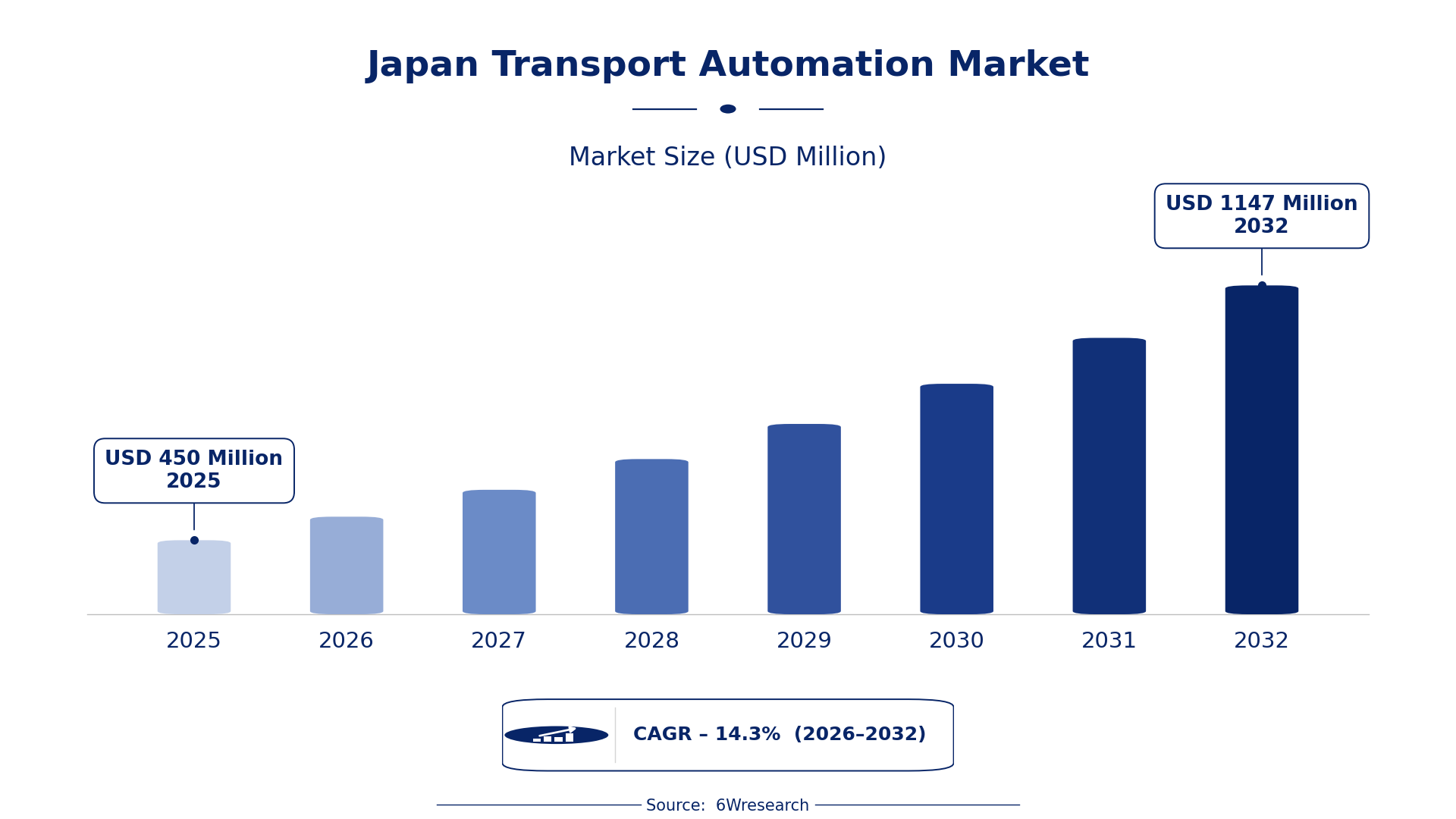
According to 6Wresearch internal database and industry insights, the Japan Transport Automation Market was valued at USD 450 Million in 2025 and is projected to reach USD 1,147 Million by 2032, growing at a CAGR of approximately 14.3% during 2026–2032.
Japan Transport Automation Market Highlights
| Report Metric | Details |
| Report Name | Japan Transport Automation Market (2026-2032) |
| Market Size 2025 | USD 450 Million |
| Market Size 2032 | USD 1,147 Million |
| Absolute Growth 2025–2032 | USD 697 Million |
| CAGR 2026–2032 | 14.3% |
| Peak Annual Growth | 17.7% in 2028 |
| Forecast Period | 2026–2032 |
| Historical Data | 2022–2025 |
| Base Year | 2025 |
| Leading Automation Type, 2025 | Traffic Signal Automation (49% share) |
| Leading Technology Used, 2025 | AI + Camera Sensors (39% share) |
| Leading Application Mode, 2025 | Urban Intersections (53% share) |
| Leading End User, 2025 | City Municipalities (35% share) |
| Fastest-Growing Automation Type | Fleet Automation (20.1% CAGR) |
| Fastest-Growing Technology Used | IoT + Robotics (21.1% CAGR) |
| Fastest-Growing Application Mode | Logistics (18.3% CAGR) |
| Fastest-Growing End User | Delivery Companies (17.6% CAGR) |
| Growing Sector | Logistics |
| Key End Users | Urban Intersections, Logistics, Metro Systems, Container Handling |
Japan Transport Automation Market Year-wise Growth Rate and Key Drivers (2022–2032)
This graph illustrates the annual growth rates of the market from 2022 to 2032, highlighting a steady upward trajectory and projected market expansion over the forecast period.
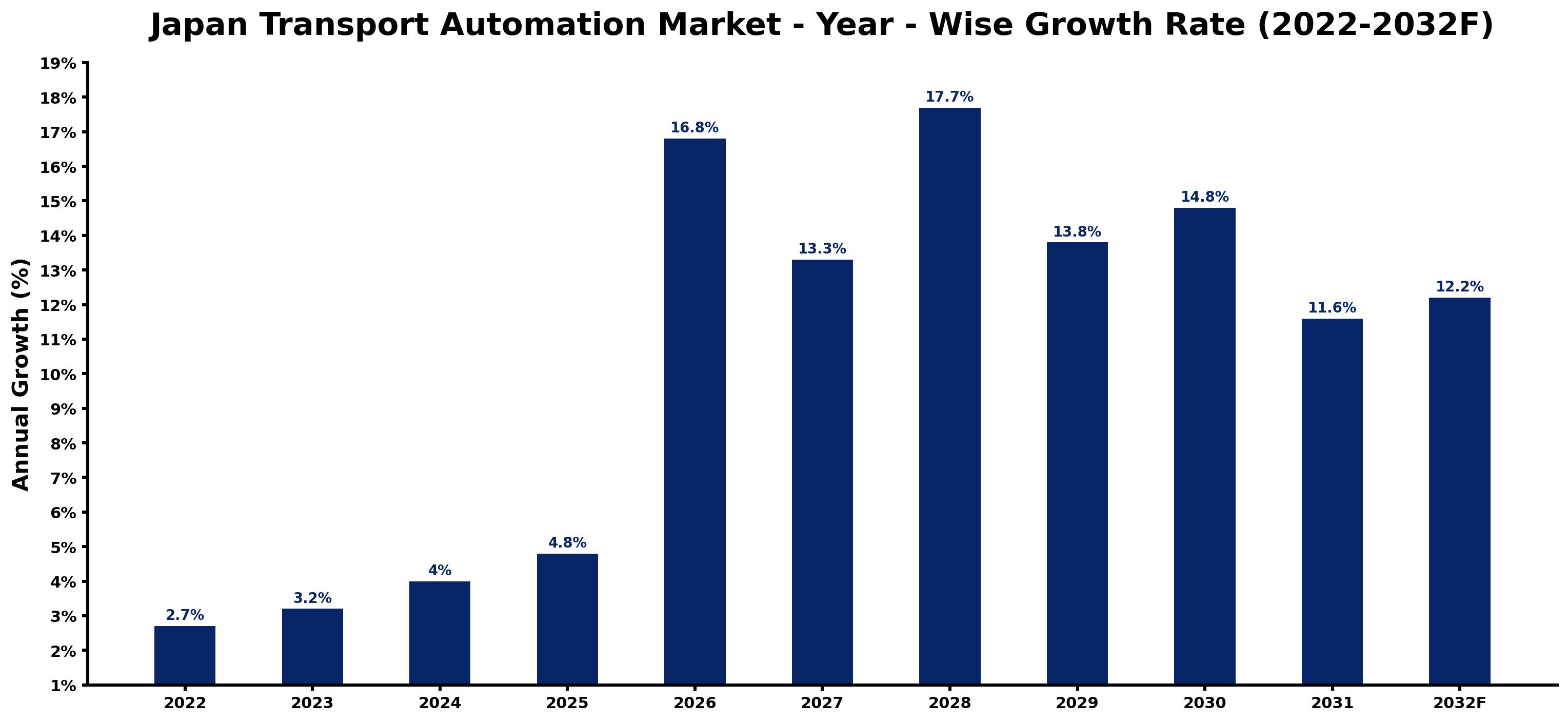
Each row of the following table gives one year's estimated growth and the event or demand shift that explains it.
| Year | Estimated Annual Growth (%) | Market Rationale |
| 2022 | 2.7 | The market showed steady growth due to increased urbanisation and demand for efficient transport solutions. |
| 2023 | 3.2 | Growth accelerated as more municipalities adopted advanced traffic management systems. |
| 2024 | 4.0 | The introduction of new technologies drove further improvements in logistics operations. |
| 2025 | 4.8 | Increased investments in fleet automation resulted in higher operational efficiency. |
| 2026 | 16.8 | A surge is anticipated as AI technologies gain traction in transport systems. |
| 2027 | 13.3 | Growth is projected to slow slightly as the market adjusts to rapid technological changes. |
| 2028 | 17.7 | A rise is expected due to heightened demand for smart transport solutions. |
| 2029 | 13.8 | The market will grow at a slower pace as saturation in urban areas begins to emerge. |
| 2030 | 14.8 | Continued investment in automation technologies will support a rebound in growth. |
| 2031 | 11.6 | Growth is projected to moderate as the market stabilises following previous rapid expansions. |
| 2032 | 12.2 | Demand will remain strong due to ongoing urban development projects and automation initiatives. |
Note: Market size estimations and growth projections presented in this report are based on 6Wresearch's proprietary forecasting methodology, utilizing the latest available industry data, government publications, and primary research inputs.
Japan Transport Automation Market Synopsis
Transport automation encompasses technologies aimed at improving the efficiency and safety of transportation networks, including traffic signal automation, fleet management, and rail systems. The Japan Transport Automation Market is expanding as urban municipalities, logistics companies, and transit authorities adopt advanced solutions to improve traffic flow and reduce congestion. The government's commitment to decarbonisation, targeting JPY 150 trillion in investment over ten years, supports this trend, alongside the increasing integration of AI and IoT technologies across various transport applications.
Market Dynamics Impact Analysis (2026–2032)
| Factor | Type | Impact | Primary Segment Affected |
| Rising urbanisation and population density | Driver | High | Traffic Signal Automation |
| Growing investments in logistics and delivery services | Driver | High | Fleet Automation |
| Expansion of smart city initiatives | Opportunity | Medium | Rail Transport Automation |
| Increased focus on environmental sustainability | Opportunity | Medium | Port Automation |
| High initial investment costs for automation technologies | Restraint | High | Fleet Automation |
| Limited awareness of automation benefits among smaller municipalities | Restraint | Medium | Traffic Signal Automation |
| Competition from traditional transport methods | Challenge | High | Rail Transport Automation |
| Technological integration challenges in existing systems | Challenge | Medium | Port Automation |
Evaluation of Drivers in Japan Transport Automation Market (2026–2032)
The table below links each growth driver to the segment it affects and the evidence for it.
| Drivers | Primary Segment Affected | Why It Matters (Evidence) |
| Urbanisation driving demand for efficient traffic management | Traffic Signal Automation | Over 1,200 urban intersections utilise traffic signal automation technologies in Japan. |
| Adoption of fleet automation by logistics companies | Fleet Automation | In 2023, 60% of logistics companies in Japan adopted fleet automation solutions. |
| Investment in smart transport systems by local authorities | Rail Transport Automation | The Tokyo Metro operates a fleet of over 1,000 automated trains using advanced technologies. |
| Technological advancements in AI and IoT | Port Automation | Osaka and Yokohama are key regions for port automation initiatives, driving demand. |
| Government funding for transport automation research | Traffic Signal Automation | In 2023, the government allocated ¥10 billion for transport automation research and development. |
Purchasing is picking up as urbanisation intensifies in Japan, leading to increased demand for efficient traffic management solutions. The implementation of traffic signal automation technologies at urban intersections improves traffic flow and safety. Logistics companies are integrating fleet automation solutions, with a notable percentage adopting such technologies in 2023. The integration of AI and IoT technologies in transport systems is driving further investment and adoption of smart solutions, as seen in major urban areas like Tokyo and Osaka.
Evaluation of Restraints in Japan Transport Automation Market
These restraints slow adoption and weigh on supplier margins.
| Market Restraint | Primary Segment Affected | Why It Matters (Evidence) |
| High initial costs for implementing automation technologies | Fleet Automation | Logistics companies face substantial upfront investments, which can deter adoption. |
| Limited awareness of automation benefits among smaller municipalities | Traffic Signal Automation | Many smaller city municipalities lack the resources to implement advanced systems. |
| Resistance to change from traditional transport methods | Rail Transport Automation | Established rail operators may hesitate to adopt new technologies, impacting efficiency. |
| Integration challenges with existing transport systems | Port Automation | Port facilities often struggle to incorporate new automation solutions into legacy systems. |
| Regulatory hurdles in adopting new technologies | Fleet Automation | Strict regulations can slow down the implementation of new fleet management systems. |
Japan Transport Automation Market Challenges
Transport automation in Japan faces intense competition from international markets, forcing local producers to lower prices. This competition arises from rapid technological advancements abroad, resulting in delays of up to six months for producers launching new products due to increased R&D investments. A shortage of skilled workers in advanced technologies hampers producers' ability to deploy effective solutions, causing project delays for urban municipalities. High technology costs inflate project budgets, with some municipalities experiencing a 20% rise in expenses, limiting their ability to pursue further automation initiatives.
Trends in the Japan Transport Automation Market
The trends below show where the Japan Transport Automation Market is heading.
- Shift towards Smart City Initiatives: City municipalities are increasingly adopting smart city initiatives to improve urban mobility. In 2023, 70% of city municipalities reported using some form of transport automation, indicating a strong trend towards modernising urban transport systems.
- Transition from Manual to Automated Traffic Management: The year 2022 marked a notable shift as cities began implementing automated traffic signal systems. With over 1,200 intersections now automated, this transition aims to improve traffic flow and reduce congestion.
- AI Integration in Rail Systems: Starting in 2023, AI technologies have been integrated into rail systems for improved safety. The Shinkansen rail system employs AI + CBTC, enhancing operational efficiency and safety standards.
- Increased Focus on Environmental Sustainability: Japan's Green Growth Strategy aims for a 46% cut in greenhouse-gas emissions by 2030. This initiative drives demand for transport automation solutions that support sustainable practices.
Investment Opportunities in the Japan Transport Automation Market
Several openings in the Japan Transport Automation Market merit attention from investors.
- Invest in Fleet Automation Solutions: With 60% of logistics companies adopting fleet automation in 2023, there is an opportunity to supply advanced fleet management technologies. Partnering with logistics firms in urban areas can facilitate market entry.
- Supply Traffic Signal Automation Technologies: The increasing number of urban intersections adopting automation presents a timely opportunity. Focusing on city municipalities in metropolitan areas can yield substantial returns on investment.
- Develop Port Automation Systems: Osaka and Yokohama are key regions for port automation initiatives, creating a demand for advanced container handling technologies. Collaborating with local port authorities can enhance market penetration.
- Provide AI and IoT Solutions for Transport: The ongoing integration of AI and IoT in transport systems creates a ripe opportunity for suppliers. Engaging with transit authorities can facilitate entry into this growing market.
Government Initiatives in the Japan Transport Automation Market
The AI Promotion Act, established in 2025, provides a national framework for AI research and development, improving the capabilities of transport automation technologies. This act complements the New Robot Strategy from 2015, which aimed to expand robot use across various sectors, including transport, thereby encouraging innovation and investment.
In 2023, the government allocated ¥10 billion for transport automation research and development, overseen by the Ministry of Land, Infrastructure, Transport and Tourism. This funding supports projects aimed at improving smart transport systems, ensuring that producers and buyers can access the latest technologies and innovations in the field.
Future Insight of the Japan Transport Automation Market
Urban municipalities will drive the adoption of advanced transport automation solutions by 2032, influenced by government incentives and ambitious decarbonisation goals. Implementing smart mobility strategies will enhance operational efficiency, benefiting buyers through improved traffic management. With JPY 150 trillion earmarked for public and private decarbonisation investments, buyers will see infrastructure upgrades and reduced emissions. The expansion of the Tokyo Metro's automated fleet will set new standards for safety and efficiency, encouraging other regions to follow suit.
Market Segmentation Analysis
Japan Transport Automation Market report covers a detailed analysis of the following market segments:
By Automation Type – Traffic Signal Automation Leads, Fleet Automation Expected to Grow Fastest
According to Saurav Kr Singh, Senior Research Analyst at 6Wresearch, Traffic Signal Automation accounted for 49% of the market by automation type in 2025. Traffic signal automation dominates the market due to its widespread use across urban settings, with over 1,200 urban intersections employing these systems. This extensive implementation is vital for improving traffic management efficiency in densely populated areas. Over 2026–2032, Fleet Automation is expected to post the fastest growth, at a CAGR of 20.1%. Fleet automation is experiencing rapid growth, with 60% of logistics companies in Japan adopting these solutions to enhance their operational efficiency. This trend is expected to continue as the demand for efficient logistics solutions escalates. Suppliers should prioritise the development of tailored solutions for logistics companies to capitalise on this expanding market.
By Technology Used – AI + Camera Sensors Lead, IoT + Robotics Expected to Grow Fastest
AI + Camera Sensors held 39% of the Japan Transport Automation Market by technology used in 2025. AI + Camera sensors lead the market as they are vital for real-time traffic monitoring, allowing cities to effectively manage and optimise traffic flow. Their widespread integration into urban traffic systems has established them as a standard in major metropolitan areas. IoT + Robotics are projected to grow fastest, at a CAGR of 21.1% during 2026–2032. IoT + Robotics is the fastest-growing technology, particularly in logistics, as it facilitates automation and improves efficiency in transport operations. The increasing dependence on these technologies by logistics firms is propelling their swift adoption. Buyers must invest in IoT and robotics solutions to maintain competitiveness in the advancing transport automation sector.
By Application Mode – Urban Intersections Lead, Logistics Expected to Grow Fastest
With 53% of application mode revenue in 2025, Urban Intersections was the largest category. Urban intersections serve as the leading application mode, essential for the effective deployment of traffic signal automation technologies that optimise traffic flow in busy areas. This focus on urban environments ensures the efficient use of traffic management systems. Logistics is set to record the highest CAGR in this split, 18.3% over 2026–2032. Logistics is the fastest-growing application mode, driven by the increasing automation within fleet operations. The surge in e-commerce and delivery services significantly propels this segment's rapid expansion. Suppliers should focus on logistics applications to meet the rising demand for automation in this sector.
By End User – City Municipalities Lead, Delivery Companies Expected to Grow Fastest
In 2025, City Municipalities led the end user split with a 35% share. City municipalities are the predominant end user group, as they are the primary implementers of traffic signal automation aimed at improving urban mobility. Their ongoing investments in smart transport systems underscore their dedication to enhancing traffic management. The quickest growth will come from Delivery Companies, forecast to expand at a CAGR of 17.6% between 2026 and 2032. Delivery companies represent the fastest-growing end user segment, investing heavily in fleet automation technologies to optimise their delivery processes. The growth of e-commerce is a crucial factor driving this trend. Suppliers should customise their offerings to address the specific needs of delivery companies aiming to increase operational efficiency.
Key Attractiveness of the Report
- 10 Years of Market Numbers
- Historical Data Starting from 2022 to 2025
- Base Year 2025
- Forecast Data until 2032
- Key Performance Indicators Impacting the Market
- Major Upcoming Developments and Projects
Key Highlights of the Report:
- Japan Transport Automation Market Outlook
- Market Size of Japan Transport Automation Market, 2025
- Forecast of Japan Transport Automation Market, 2032
- Historical Data and Forecast of Japan Transport Automation Revenues & Volume for the Period 2022-2032F
- Japan Transport Automation Market Trend Evolution
- Japan Transport Automation Market Drivers and Challenges
- Japan Transport Automation Price Trends
- Japan Transport Automation Porter's Five Forces
- Japan Transport Automation Industry Life Cycle
- Historical Data and Forecast of Japan Transport Automation Market Revenues & Volume By Automation Type for the Period 2022-2032F
- Historical Data and Forecast of Japan Transport Automation Market Revenues & Volume By Traffic Signal Automation for the Period 2022-2032F
- Historical Data and Forecast of Japan Transport Automation Market Revenues & Volume By Fleet Automation for the Period 2022-2032F
- Historical Data and Forecast of Japan Transport Automation Market Revenues & Volume By Rail Transport Automation for the Period 2022-2032F
- Historical Data and Forecast of Japan Transport Automation Market Revenues & Volume By Port Automation for the Period 2022-2032F
- Historical Data and Forecast of Japan Transport Automation Market Revenues & Volume By Technology Used for the Period 2022-2032F
- Historical Data and Forecast of Japan Transport Automation Market Revenues & Volume By AI + Camera Sensors for the Period 2022-2032F
- Historical Data and Forecast of Japan Transport Automation Market Revenues & Volume By Telematics + GPS for the Period 2022-2032F
- Historical Data and Forecast of Japan Transport Automation Market Revenues & Volume By AI + CBTC for the Period 2022-2032F
- Historical Data and Forecast of Japan Transport Automation Market Revenues & Volume By IoT + Robotics for the Period 2022-2032F
- Historical Data and Forecast of Japan Transport Automation Market Revenues & Volume By Application Mode for the Period 2022-2032F
- Historical Data and Forecast of Japan Transport Automation Market Revenues & Volume By Urban Intersections for the Period 2022-2032F
- Historical Data and Forecast of Japan Transport Automation Market Revenues & Volume By Logistics for the Period 2022-2032F
- Historical Data and Forecast of Japan Transport Automation Market Revenues & Volume By Metro Systems for the Period 2022-2032F
- Historical Data and Forecast of Japan Transport Automation Market Revenues & Volume By Container Handling for the Period 2022-2032F
- Historical Data and Forecast of Japan Transport Automation Market Revenues & Volume By End User for the Period 2022-2032F
- Historical Data and Forecast of Japan Transport Automation Market Revenues & Volume By City Municipalities for the Period 2022-2032F
- Historical Data and Forecast of Japan Transport Automation Market Revenues & Volume By Delivery Companies for the Period 2022-2032F
- Historical Data and Forecast of Japan Transport Automation Market Revenues & Volume By Transit Authorities for the Period 2022-2032F
- Historical Data and Forecast of Japan Transport Automation Market Revenues & Volume By Shipping Terminals for the Period 2022-2032F
- Japan Transport Automation Import Export Trade Statistics
- Market Opportunity Assessment By Automation Type
- Market Opportunity Assessment By Technology Used
- Market Opportunity Assessment By Application Mode
- Market Opportunity Assessment By End User
- Japan Transport Automation Top Companies Market Share
- Japan Transport Automation Competitive Benchmarking By Technical and Operational Parameters
- Japan Transport Automation Company Profiles
- Japan Transport Automation Key Strategic Recommendations
Market Covered
Segments analysed in this report are listed below.
By Automation Type
- Traffic Signal Automation
- Fleet Automation
- Rail Transport Automation
- Port Automation
By Technology Used
- AI + Camera Sensors
- Telematics + GPS
- AI + CBTC
- IoT + Robotics
By Application Mode
- Urban Intersections
- Logistics
- Metro Systems
- Container Handling
By End User
- City Municipalities
- Delivery Companies
- Transit Authorities
- Shipping Terminals































