Japan Transportation Sealants Market Size & Growth Rate
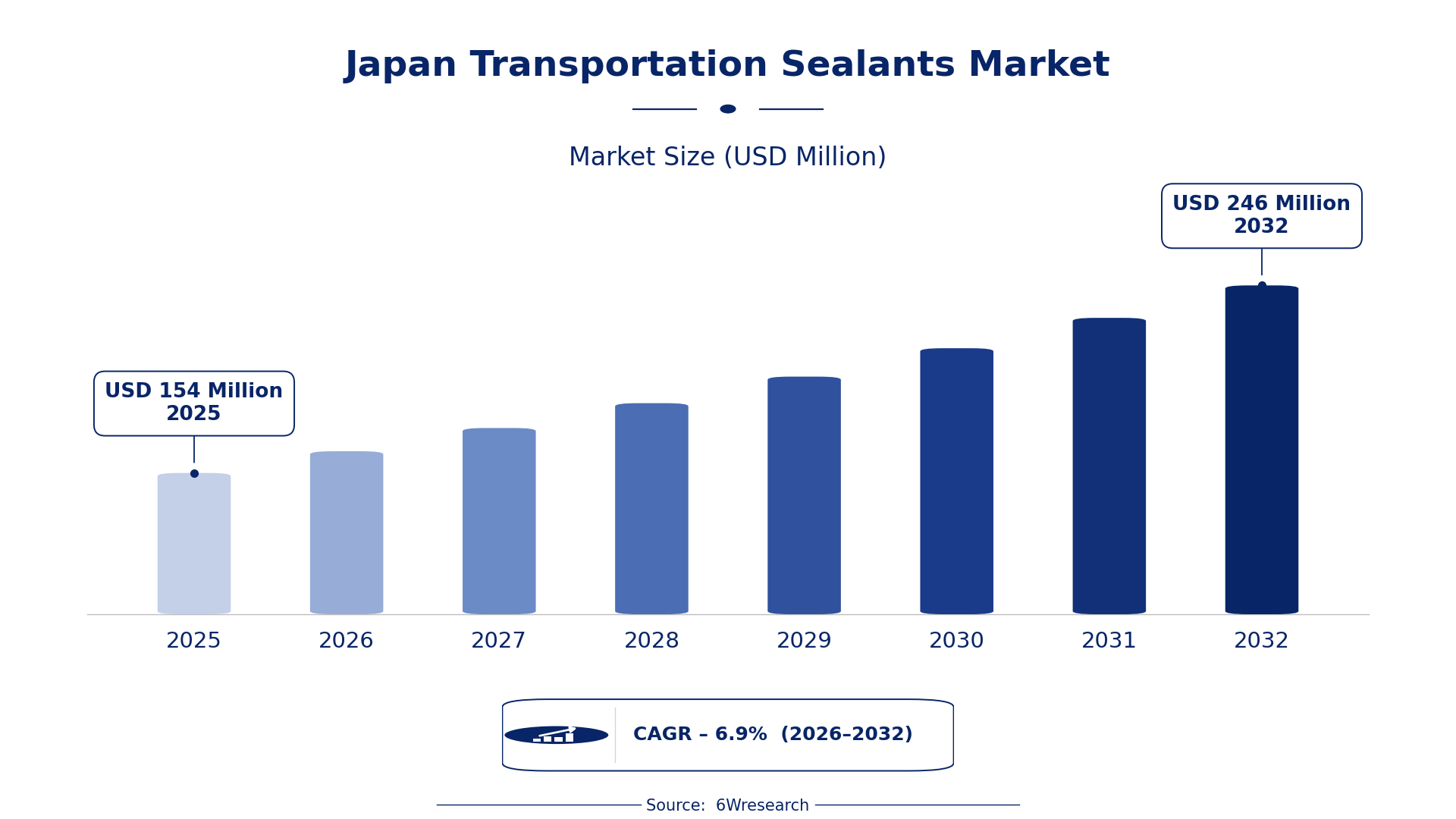
According to 6Wresearch internal database and industry insights, the Japan Transportation Sealants Market was valued at USD 154 Million in 2025 and is projected to reach USD 246 Million by 2032, growing at a CAGR of approximately 6.9% during 2026–2032.
Japan Transportation Sealants Market Highlights
| Report Metric | Details |
| Report Name | Japan Transportation Sealants Market (2026-2032) |
| Market Size 2025 | USD 154 Million |
| Market Size 2032 | USD 246 Million |
| Absolute Growth 2025–2032 | USD 92 Million |
| CAGR 2026–2032 | 6.9% |
| Peak Annual Growth | 7.4% in 2032 |
| Forecast Period | 2026–2032 |
| Historical Data | 2022–2025 |
| Base Year | 2025 |
| Leading Sealant Type, 2025 | Silicone Sealants (43% share) |
| Leading Base Material, 2025 | Silicone Polymer (40% share) |
| Leading Vehicle/Application Type, 2025 | Buses (30% share) |
| Leading End User, 2025 | Transport OEMs (40% share) |
| Fastest-Growing Sealant Type | Polyurethane Sealants (9.7% CAGR) |
| Fastest-Growing Base Material | PU Resin (9.8% CAGR) |
| Fastest-Growing Vehicle/Application Type | Trains (9.9% CAGR) |
| Fastest-Growing End User | Fleet Maintenance Firms (8.9% CAGR) |
| Growing Sector | transportation infrastructure |
| Key End Users | Transport OEMs, Fleet Maintenance Firms, Aerospace MROs |
Japan Transportation Sealants Market Year-wise Growth Rate and Key Drivers (2022–2032)
This graph illustrates the annual growth rates of the market from 2022 to 2032, highlighting a steady upward trajectory and projected market expansion over the forecast period.
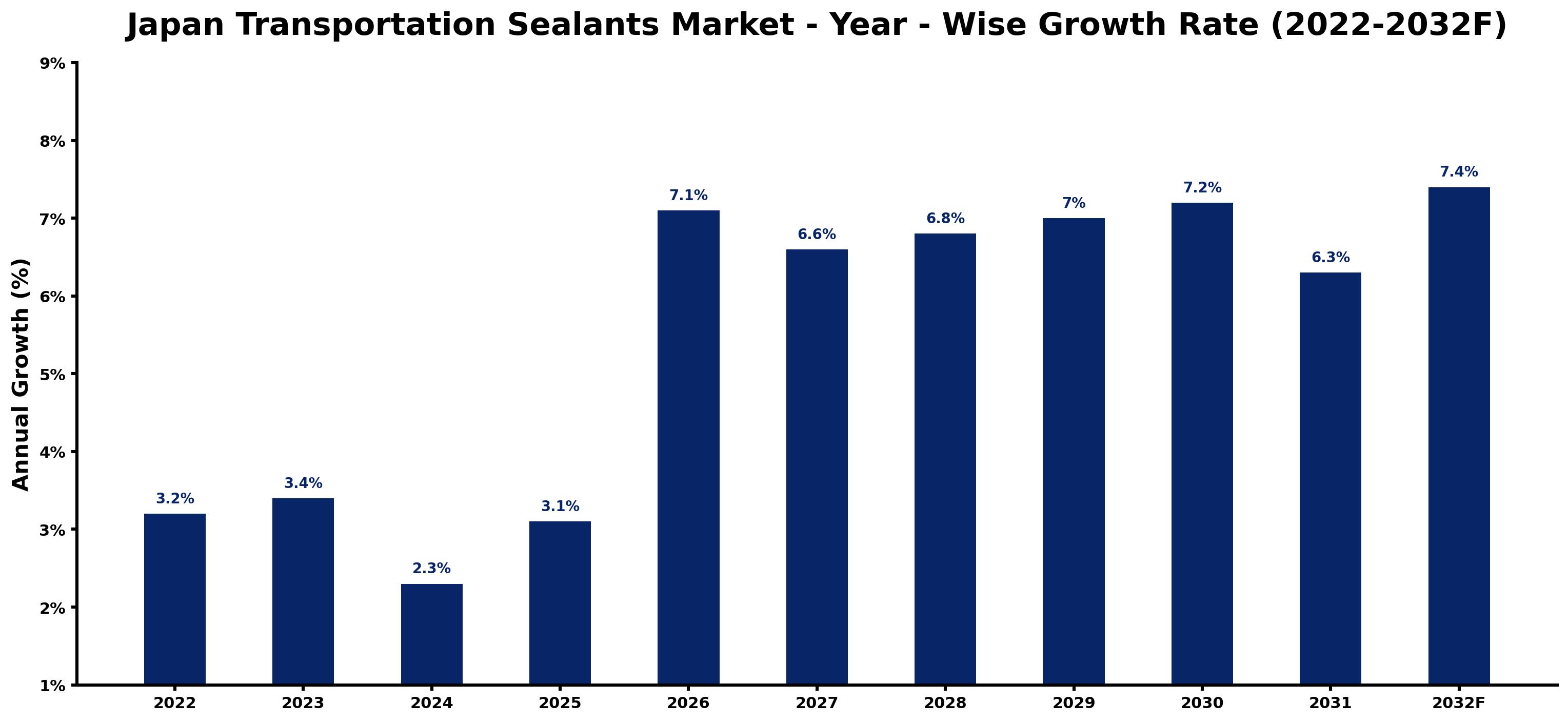
Annual growth estimates for each year appear below with the principal reason behind them, explaining the shifts that set the pace of the market.
| Year | Estimated Annual Growth (%) | Market Rationale |
| 2022 | 3.2 | The market experienced steady demand due to ongoing transportation activities. |
| 2023 | 3.4 | Growth accelerated as infrastructure projects gained momentum in urban areas. |
| 2024 | 2.3 | A slowdown occurred as some projects faced delays, impacting sealant usage. |
| 2025 | 3.1 | Demand increased again as vehicle production levels rose in the automotive sector. |
| 2026 | 7.1 | The market is expected to surge with investments in railway upgrades. |
| 2027 | 6.6 | Growth is projected to slow slightly as market stabilisation occurs after peak demand. |
| 2028 | 6.8 | An increase in public transport projects will drive demand for sealants further. |
| 2029 | 7.0 | Demand is anticipated to rise as the focus on sustainability influences material choices. |
| 2030 | 7.2 | Continued investment in infrastructure will further increase sealant requirements. |
| 2031 | 6.3 | Growth is expected to moderate as the market adjusts to new standards. |
| 2032 | 7.4 | A peak in demand is projected as major transportation projects reach completion. |
Note: Market size estimations and growth projections presented in this report are based on 6Wresearch's proprietary forecasting methodology, utilizing the latest available industry data, government publications, and primary research inputs.
Japan Transportation Sealants Market Synopsis
Transportation sealants are specialised adhesives used to seal joints and seams in various applications, primarily made from polymers like silicone and polyurethane. The Japan Transportation Sealants Market is growing due to investments in infrastructure, particularly in the Tokyo metropolitan area, which is home to around 14 million residents. The automotive sector, which produced over 8 million vehicles in 2022, is a primary source of demand, along with increasing needs from fleet maintenance firms and public transport projects.
Market Dynamics Impact Analysis (2026–2032)
| Factor | Type | Impact | Primary Segment Affected |
| Growing infrastructure projects in urban areas are increasing demand for sealants. | Driver | High | Silicone Sealants |
| Rising vehicle production levels are driving demand for durable sealants. | Driver | High | Polyurethane Sealants |
| Investment in railway upgrades presents opportunities for sealant suppliers. | Opportunity | High | Acrylic Sealants |
| The construction of new subway lines in Tokyo creates a significant demand gap. | Opportunity | High | Silicone Sealants |
| Regulatory compliance with standards like ISO 11600 can limit market entry. | Restraint | Medium | Polyurethane Sealants |
| The average age of vehicles exceeding 13 years increases maintenance challenges. | Restraint | Medium | Acrylic Sealants |
| Cost pressures from raw material price fluctuations affect profitability. | Challenge | High | Silicone Sealants |
| Capacity constraints in production facilities may delay supply to the market. | Challenge | Medium | Polyurethane Sealants |
Evaluation of Drivers in Japan Transportation Sealants Market (2026–2032)
Key forces behind demand, with the segment each one moves most, are listed below.
| Drivers | Primary Segment Affected | Why It Matters (Evidence) |
| Investment in urban infrastructure projects boosts demand for sealants. | Silicone Sealants | The Tokyo metropolitan area is a major hub, driving high demand with a population of approximately 14 million. |
| Increased vehicle production necessitates durable sealants for assembly. | Polyurethane Sealants | The automotive sector produced over 8 million vehicles in 2022, requiring extensive sealing solutions. |
| Growing focus on sustainability influences sealant formulations. | Acrylic Sealants | Transport OEMs are prioritising eco-friendly materials, impacting sealant choices. |
| Expansion of public transport systems drives sealant usage in new projects. | Silicone Sealants | Major transportation projects in Osaka are expected to boost demand significantly. |
| Fleet maintenance firms are adopting advanced sealant technologies. | Polyurethane Sealants | The average age of vehicles in Japan is over 13 years, increasing maintenance needs. |
The strongest pull on demand comes from substantial investments in urban infrastructure, particularly in the Tokyo metropolitan area, which houses around 14 million residents. In 2022, the automotive sector produced over 8 million vehicles, creating a persistent need for durable sealants. Fleet maintenance firms are increasingly adopting advanced technologies to address the growing average vehicle age of over 13 years. Major transportation projects in Osaka are anticipated to boost sealant usage, while the focus on sustainability is influencing material choices among transport manufacturers. These factors are driving demand for transportation sealants across various applications.
Evaluation of Restraints in Japan Transportation Sealants Market
The table below lists the restraints and the evidence behind each.
| Market Restraint | Primary Segment Affected | Why It Matters (Evidence) |
| Compliance with ISO 11600 standards can complicate market entry for new products. | Polyurethane Sealants | Producers must ensure their products meet stringent quality requirements, increasing costs. |
| The aging vehicle fleet presents maintenance challenges for sealant applications. | Acrylic Sealants | As vehicles age, the need for repairs and sealant replacements increases, impacting demand. |
| Fluctuating raw material prices can affect production costs and margins. | Silicone Sealants | Producers face challenges in maintaining profitability amid rising material costs. |
| Limited production capacity may lead to supply delays in meeting growing demand. | Polyurethane Sealants | Manufacturers may struggle to scale operations quickly enough to meet market needs. |
| Regulatory changes may require additional testing and certification for new sealants. | Acrylic Sealants | Producers must navigate evolving regulations, adding complexity to product development. |
Japan Transportation Sealants Market Challenges
In 2023, raw material costs for transportation sealants increased by 15%, affecting suppliers' profitability. Buyers in the automotive sector are experiencing production delays, as shortages of sealants can extend lead times by four weeks, disrupting vehicle assembly. Technology adoption remains limited, with only 30% of fleet maintenance firms employing advanced sealant solutions, resulting in higher repair costs and reduced efficiency. Regulatory challenges persist, as compliance with ISO 11600 standards can delay product approvals, impacting timelines for construction and transport projects.
Trends in the Japan Transportation Sealants Market
These developments are changing demand patterns in the Japan Transportation Sealants Market.
- Shift towards Sustainable Sealant Formulations: The focus on sustainability is reshaping sealant formulations, with transport manufacturers prioritising eco-friendly materials. In 2023, a government programme aimed at improving public transport efficiency is influencing material choices across the sector.
- Transition from Traditional to Advanced a leading supplier: Since 2023, fleet maintenance firms have increasingly adopted advanced sealants to improve performance. This shift is apparent as the average age of vehicles exceeds 13 years, necessitating more effective sealing solutions.
- Emergence of Smart Sealants for Enhanced Performance: In recent years, smart sealants that respond to environmental conditions are gaining traction. The Japan Aerospace Exploration Agency is exploring these innovations for aerospace applications, improving sealing effectiveness.
- Expansion of Urban Public Transport Systems: The construction of new subway lines in Tokyo is driving demand for sealants. This trend began in 2023, with investments expected to increase sealant usage in urban infrastructure.
Investment Opportunities in the Japan Transportation Sealants Market
The following opportunities in the Japan Transportation Sealants Market pair current demand with a clear way in.
- Tokyo's Urban Infrastructure Projects: The ongoing construction of new subway lines in Tokyo presents a strong opportunity for sealant suppliers. With projected demand increasing, firms can enter this market by partnering with local contractors.
- Fleet Maintenance Firms Seeking Advanced Solutions: Fleet maintenance firms are increasingly looking for advanced sealant technologies to improve vehicle longevity. With over 8 million vehicles produced in 2022, suppliers can target this sector by offering effective products.
- Investment in Railway Upgrades: Japan's investment in railway infrastructure upgrades creates a demand gap for sealants. The Ministry of Land, Infrastructure, Transport and Tourism is driving this initiative, providing a clear entry point for suppliers.
- Growing Demand from Transport OEMs: Transport manufacturers are focusing on sustainable materials, creating a market for eco-friendly sealants. With the automotive sector producing millions of vehicles annually, suppliers can meet this demand through sustainable product offerings.
Government Initiatives in the Japan Transportation Sealants Market
The Building Energy Efficiency Act, amended in 2022, mandates that all new buildings meet energy efficiency standards from April 2025. This requirement affects transportation sealants as producers must ensure compliance with these standards to access the construction market.
The Japan Ministry of Land, Infrastructure, Transport and Tourism oversees transportation regulations and approves new sealant products. Their focus on improving public transport efficiency is likely to drive funding for effective sealing solutions.
Future Insight of the Japan Transportation Sealants Market
Emerging polymer technologies will transform the performance of transportation sealants, improving their effectiveness in various applications. A government initiative to enhance public transport efficiency will necessitate the use of advanced sealing solutions in new infrastructure developments. As Japan's railway network expands, sealant demand is expected to rise by 25%, driven by new construction and maintenance activities. The emphasis on sustainability will spur the creation of environmentally friendly sealants, aligning with national emission reduction goals.
Market Segmentation Analysis
Japan Transportation Sealants Market report covers a detailed analysis of the following market segments:
By Sealant Type – Silicone Sealants Lead, Polyurethane Sealants Expected to Grow Fastest
According to Saurav Kr Singh, Senior Research Analyst at 6Wresearch, Silicone Sealants took 43% of sealant type revenue in 2025, more than any other category. Silicone sealants dominate the market due to their extensive use in sealing joints across various transportation applications. This is particularly evident in urban areas like Tokyo, where the demand for reliable sealing solutions is substantial. Polyurethane Sealants are set to record the highest CAGR in this split, 9.7% over 2026–2032. Polyurethane sealants are experiencing rapid growth because of their durability and flexibility, which are essential for modern vehicles. The ongoing upgrades to Japan's railway infrastructure are expected to further boost the demand for these sealants. Suppliers should focus on enhancing the availability of polyurethane sealants to meet the rising market needs.
By Base Material – Silicone Polymer Leads, PU Resin Expected to Grow Fastest
With 40% of base material revenue in 2025, Silicone Polymer was the largest category. Silicone polymer is the leading base material for sealants, prized for its excellent properties in transportation applications. Its widespread use is reflected in the high production rates of vehicles in Japan, which rely heavily on silicone-based solutions. PU Resin is projected to grow fastest, at a CAGR of 9.8% during 2026–2032. PU resin is gaining traction as the fastest-growing base material due to its critical role in the formulation of polyurethane sealants. The increasing focus on sustainability in transport materials is likely to accelerate its adoption. Buyers should consider sourcing more PU resin-based sealants to align with evolving material preferences.
By Vehicle/Application Type – Buses Lead, Trains Expected to Grow Fastest
Buses accounted for 30% of the market by vehicle/application type in 2025. Buses represent the largest application for sealants, primarily due to their critical role in public transport systems. The significant number of buses operating in cities like Tokyo consistently drives the demand for effective sealing solutions. Over 2026–2032, Trains are expected to post the fastest growth, at a CAGR of 9.9%. Trains are the fastest-growing application type, as they require robust sealing solutions for rail systems. The planned construction of new subway lines in Tokyo is projected to considerably increase sealant usage in this area. Suppliers must prepare for increased demand in train applications by expanding their product range.
By End User – Transport OEMs Lead, Fleet Maintenance Firms Expected to Grow Fastest
The largest end user category in 2025 was Transport OEMs, at 40% of revenue. Transport OEMs represent the largest end user group for sealants, as they play a critical role in the manufacturing processes of vehicles. Their substantial production volume, especially in the automotive sector, highlights the necessity for dependable sealing solutions. The quickest growth will come from Fleet Maintenance Firms, forecast to expand at a CAGR of 8.9% between 2026 and 2032. Fleet maintenance firms are experiencing the fastest growth as they increasingly implement advanced sealant technologies for maintenance and repair tasks. The rising average age of vehicles in Japan intensifies the need for effective maintenance solutions. Suppliers should concentrate on fleet maintenance firms to capitalise on this expanding market segment.
Key Attractiveness of the Report
- 10 Years of Market Numbers
- Historical Data Starting from 2022 to 2025
- Base Year 2025
- Forecast Data until 2032
- Key Performance Indicators Impacting the Market
- Major Upcoming Developments and Projects
Key Highlights of the Report:
- Japan Transportation Sealants Market Outlook
- Market Size of Japan Transportation Sealants Market, 2025
- Forecast of Japan Transportation Sealants Market, 2032
- Historical Data and Forecast of Japan Transportation Sealants Revenues & Volume for the Period 2022-2032F
- Japan Transportation Sealants Market Trend Evolution
- Japan Transportation Sealants Market Drivers and Challenges
- Japan Transportation Sealants Price Trends
- Japan Transportation Sealants Porter's Five Forces
- Japan Transportation Sealants Industry Life Cycle
- Historical Data and Forecast of Japan Transportation Sealants Market Revenues & Volume By Sealant Type for the Period 2022-2032F
- Historical Data and Forecast of Japan Transportation Sealants Market Revenues & Volume By Silicone Sealants for the Period 2022-2032F
- Historical Data and Forecast of Japan Transportation Sealants Market Revenues & Volume By Polyurethane Sealants for the Period 2022-2032F
- Historical Data and Forecast of Japan Transportation Sealants Market Revenues & Volume By Acrylic Sealants for the Period 2022-2032F
- Historical Data and Forecast of Japan Transportation Sealants Market Revenues & Volume By Butyl Sealants for the Period 2022-2032F
- Historical Data and Forecast of Japan Transportation Sealants Market Revenues & Volume By Base Material for the Period 2022-2032F
- Historical Data and Forecast of Japan Transportation Sealants Market Revenues & Volume By Silicone Polymer for the Period 2022-2032F
- Historical Data and Forecast of Japan Transportation Sealants Market Revenues & Volume By PU Resin for the Period 2022-2032F
- Historical Data and Forecast of Japan Transportation Sealants Market Revenues & Volume By Acrylic Copolymer for the Period 2022-2032F
- Historical Data and Forecast of Japan Transportation Sealants Market Revenues & Volume By Rubber-Based for the Period 2022-2032F
- Historical Data and Forecast of Japan Transportation Sealants Market Revenues & Volume By Vehicle/Application Type for the Period 2022-2032F
- Historical Data and Forecast of Japan Transportation Sealants Market Revenues & Volume By Buses, Trains for the Period 2022-2032F
- Historical Data and Forecast of Japan Transportation Sealants Market Revenues & Volume By Trucks, Vans for the Period 2022-2032F
- Historical Data and Forecast of Japan Transportation Sealants Market Revenues & Volume By Aircraft, Ships for the Period 2022-2032F
- Historical Data and Forecast of Japan Transportation Sealants Market Revenues & Volume By Rail Cars, Subways for the Period 2022-2032F
- Historical Data and Forecast of Japan Transportation Sealants Market Revenues & Volume By End User for the Period 2022-2032F
- Historical Data and Forecast of Japan Transportation Sealants Market Revenues & Volume By Transport OEMs for the Period 2022-2032F
- Historical Data and Forecast of Japan Transportation Sealants Market Revenues & Volume By Fleet Maintenance Firms for the Period 2022-2032F
- Historical Data and Forecast of Japan Transportation Sealants Market Revenues & Volume By Aerospace MROs for the Period 2022-2032F
- Historical Data and Forecast of Japan Transportation Sealants Market Revenues & Volume By Construction Contractors for the Period 2022-2032F
- Japan Transportation Sealants Import Export Trade Statistics
- Market Opportunity Assessment By Sealant Type
- Market Opportunity Assessment By Base Material
- Market Opportunity Assessment By Vehicle/Application Type
- Market Opportunity Assessment By End User
- Japan Transportation Sealants Top Companies Market Share
- Japan Transportation Sealants Competitive Benchmarking By Technical and Operational Parameters
- Japan Transportation Sealants Company Profiles
- Japan Transportation Sealants Key Strategic Recommendations
Market Covered
The report covers the following segments.
By Sealant Type
- Silicone Sealants
- Polyurethane Sealants
- Acrylic Sealants
- Butyl Sealants
By Base Material
- Silicone Polymer
- PU Resin
- Acrylic Copolymer
- Rubber-Based
By Vehicle/Application Type
- Buses
- Trains
- Trucks
- Vans
- Aircraft
- Ships
- Rail Cars
- Subways
By End User
- Transport OEMs
- Fleet Maintenance Firms
- Aerospace MROs
- Construction Contractors































