Japan Trauma Care Products Market Size & Growth Rate
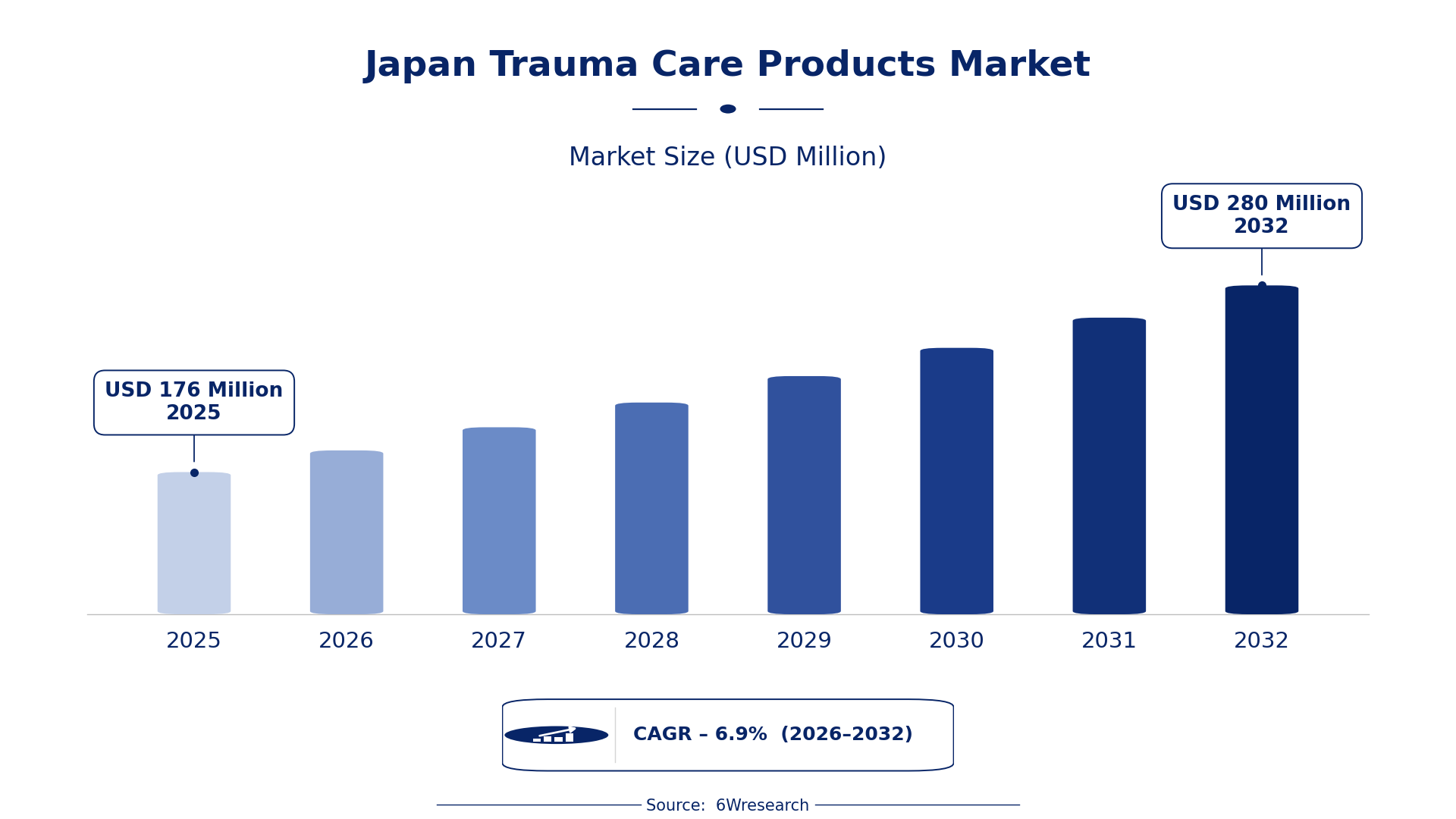
According to 6Wresearch internal database and industry insights, the Japan Trauma Care Products Market was valued at USD 176 Million in 2025 and is projected to reach USD 280 Million by 2032, growing at a CAGR of approximately 6.9% during 2026–2032.
Japan Trauma Care Products Market Highlights
| Report Metric | Details |
| Report Name | Japan Trauma Care Products Market (2026-2032) |
| Market Size 2025 | USD 176 Million |
| Market Size 2032 | USD 280 Million |
| Absolute Growth 2025–2032 | USD 104 Million |
| CAGR 2026–2032 | 6.9% |
| Peak Annual Growth | 7.5% in 2032 |
| Forecast Period | 2026–2032 |
| Historical Data | 2022–2025 |
| Base Year | 2025 |
| Leading Product Type, 2025 | Cervical Collars (41% share) |
| Leading Material Type, 2025 | Rigid Plastic (53% share) |
| Leading Use Case, 2025 | Spinal Injuries (42% share) |
| Leading End User, 2025 | Ambulance Services (39% share) |
| Fastest-Growing Product Type | Tourniquets (9.6% CAGR) |
| Fastest-Growing Material Type | Nylon/Velcro (9.8% CAGR) |
| Fastest-Growing Use Case | Bleeding Control (9.9% CAGR) |
| Fastest-Growing End User | Emergency Kits (8.9% CAGR) |
| Growing Sector | Emergency medical services |
| Key End Users | Hospitals, Ambulance Services, Emergency Kits, First Responders |
Japan Trauma Care Products Market Year-wise Growth Rate and Key Drivers (2022–2032)
This graph illustrates the annual growth rates of the market from 2022 to 2032, highlighting a steady upward trajectory and projected market expansion over the forecast period.
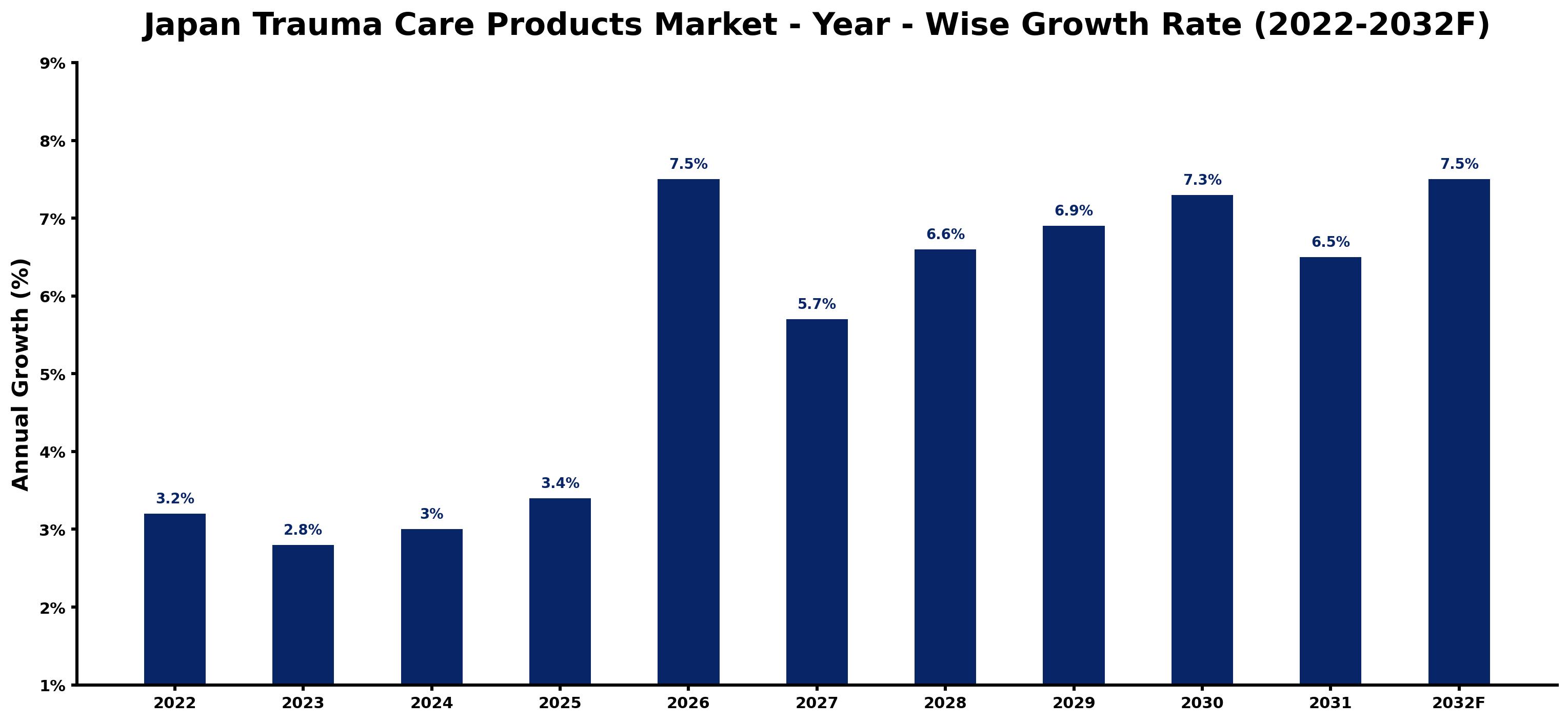
Year by year, the estimates below pair each growth rate with the development that shaped it.
| Year | Estimated Annual Growth (%) | Market Rationale |
| 2022 | 3.2 | The market experienced steady growth due to ongoing demand from emergency services. |
| 2023 | 2.8 | Growth slowed as hospitals adjusted to resource allocation and care demands. |
| 2024 | 3.0 | Increased awareness of trauma care led to faster growth as emergency protocols improved. |
| 2025 | 3.4 | Expansion in trauma care facilities contributed to a faster growth rate than before. |
| 2026 | 7.5 | The market is expected to surge as new emergency response initiatives are rolled out nationwide. |
| 2027 | 5.7 | Growth is projected to slow as the market begins stabilising after the peak demand period. |
| 2028 | 6.6 | Demand is expected to increase again with advancements in trauma care training and protocols. |
| 2029 | 6.9 | The market will continue to grow as ambulance services upgrade their equipment. |
| 2030 | 7.3 | Increased public spending on healthcare will further support trauma care product demand. |
| 2031 | 6.5 | Growth is projected to slow as the market adjusts to saturation in certain product categories. |
| 2032 | 7.5 | The market is expected to peak again with renewed investments in trauma care infrastructure. |
Note: Market size estimations and growth projections presented in this report are based on 6Wresearch's proprietary forecasting methodology, utilizing the latest available industry data, government publications, and primary research inputs.
Japan Trauma Care Products Market Synopsis
Trauma care products are crucial medical devices for treating traumatic injuries, including spinal injuries and bleeding control. The Japan Trauma Care Products Market is propelled by hospitals and emergency services that manage trauma cases effectively. An aging population, with 29.3% aged 65 or older, combined with increased national medical expenditure of JPY 46.7 trillion in fiscal 2022, is driving market growth. The Tokyo metropolitan area stands out as a key centre for trauma care products, reflecting substantial investment in healthcare infrastructure and emergency response capabilities.
Market Dynamics Impact Analysis (2026–2032)
| Factor | Type | Impact | Primary Segment Affected |
| Aging population increases the need for trauma care products. | Driver | High | Spinal Injuries |
| Rising awareness of trauma care protocols boosts product adoption. | Driver | High | Bleeding Control |
| Investment in emergency services infrastructure creates demand for trauma products. | Opportunity | High | Ambulance Services |
| Growing focus on training for first responders enhances market potential. | Opportunity | Medium | Emergency Kits |
| Strict regulations on product standards can limit market entry. | Restraint | High | Trauma Dressings |
| High costs of advanced trauma care equipment may deter purchases. | Restraint | Medium | Trauma Shears |
| Limited availability of trained personnel affects service delivery. | Challenge | High | Cervical Collars |
| Competition from alternative treatment methods may impact sales. | Challenge | Medium | Tourniquets |
Evaluation of Drivers in Japan Trauma Care Products Market (2026–2032)
The table below links each growth driver to the segment it affects and the evidence for it.
| Drivers | Primary Segment Affected | Why It Matters (Evidence) |
| Increasing elderly population necessitates more trauma care products. | Spinal Injuries | 29.3% of Japan's population was aged 65 or older in September 2024, driving demand for spinal injury management. |
| Emergency response training improves product usage. | Bleeding Control | Increased trauma care training leads to higher usage of bleeding control products, enhancing emergency response effectiveness. |
| Expansion of hospitals and emergency services increases product availability. | Ambulance Services | The demand for trauma care products is rising as services expand, supported by over 8,000 hospitals in Japan. |
| Government initiatives support trauma care infrastructure development. | Emergency Kits | In 2023, the Japanese government launched a new emergency response program, boosting demand for essential trauma products. |
| Adoption of international quality standards increases product credibility. | Trauma Dressings | Japan's adoption of ISO 13485 for medical devices ensures higher quality, increasing buyer confidence. |
Purchasing is picking up as demand for trauma care products rises, influenced by an aging population in Japan. Enhanced training for first responders has led to increased usage of bleeding control items. Public spending on healthcare reached approximately JPY 46.7 trillion in fiscal 2022, supporting the expansion of trauma care services across the country.
Evaluation of Restraints in Japan Trauma Care Products Market
Several factors work against faster growth; the main ones are summarised below.
| Market Restraint | Primary Segment Affected | Why It Matters (Evidence) |
| Regulatory compliance costs can hinder new market entrants. | Trauma Dressings | Compliance with JIS standards for medical products increases operational costs for manufacturers. |
| High initial investment for advanced trauma care equipment limits accessibility. | Trauma Shears | The average hospital bed occupancy rate in trauma units is around 80%, limiting budget allocations for new equipment. |
| Limited availability of trained personnel affects effective product use. | Cervical Collars | Skills shortages in trauma care training hinder the effective use of trauma care products, impacting emergency response times. |
| Market saturation in certain product categories may slow growth. | Tourniquets | Increased competition from alternative treatment methods can limit market expansion. |
| Stringent product testing requirements can delay product launches. | Emergency Kits | Manufacturers must meet specific safety standards for absorbent materials used in trauma dressings. |
Japan Trauma Care Products Market Challenges
Strict regulations governing trauma care products result in high costs due to compliance with JIS standards and ISO 13485. This complexity raises production expenses, forcing hospitals to contend with larger procurement budgets, which can strain their resources. Supply chain disruptions occur from the limited availability of specific materials that meet safety standards, causing delays in product delivery for emergency services. A shortage of adequately trained personnel in trauma care leads to inefficiencies, potentially extending response times for over 1 million emergency medical calls each year.
Trends in the Japan Trauma Care Products Market
Four trends stand out in the Japan Trauma Care Products Market.
- Shift from Traditional to Advanced Trauma Care Training: In 2023, the Tokyo Fire Department implemented advanced trauma care protocols, improving the skills of first responders. This shift aligns with the increasing demand for effective emergency care, evidenced by the annual budget for emergency medical services exceeding 100 billion yen.
- Emergence of Integrated Emergency Response Systems: The introduction of new emergency response initiatives in 2023 has transformed how trauma care is delivered. With a focus on rapid response, the average ambulance response time in urban areas is around 8 minutes, improving patient outcomes and driving demand for trauma care products.
- Rising Adoption of Quality Standards in Trauma Products: Since the adoption of ISO 13485, manufacturers have improved quality management systems for trauma care products. This change increases product reliability, encouraging hospitals to invest in higher-quality trauma solutions, thus boosting market demand.
- Increased Focus on Wound Management Techniques: The growing emphasis on effective wound management has led to the development of advanced trauma dressings. As per JIS standards, these products are now essential in emergency kits, reflecting a shift towards prioritising patient care.
Investment Opportunities in the Japan Trauma Care Products Market
The following areas offer the clearest openings for investors and suppliers in the Japan Trauma Care Products Market.
- Investing in Partnerships with Local Emergency Services: Now is an opportune moment to invest in partnerships with local ambulance services, which account for 39% of trauma care product usage. With an annual budget exceeding 100 billion yen, there is a clear gap for suppliers to address.
- Forming Joint Ventures for Advanced Trauma Equipment: As the market is set to grow, forming joint ventures with hospitals can provide access to new technologies. The Tokyo metropolitan area, a key hub for trauma care, presents ample opportunities for collaboration.
- Seeking Approval for High-Quality Trauma Products: The current demand for high-quality trauma care products offers manufacturers a chance to pursue JIS certification. This pathway is crucial for building trust with hospitals and emergency services, especially in urban regions.
- Investing in Training Programs for First Responders: Investing in training programs for first responders can improve product usage and effectiveness. As the Japanese Red Cross Society promotes trauma care training, suppliers stand to benefit from increased demand.
Government Initiatives in the Japan Trauma Care Products Market
The Medical Care Act of 1948 establishes standards for hospitals and clinics, ensuring that trauma care facilities maintain high-quality services, which directly impacts the demand for trauma care products. The Long-Term Care Insurance Act, enacted in 1997 and in force since 2000, provides funding for support services for older individuals, increasing the need for effective injury management solutions among the aging population.
In 2023, the Japanese government launched a new emergency response program, overseen by the Ministry of Health, Labour and Welfare (MHLW). This program allocates substantial funding to improve trauma care infrastructure, increasing the availability of essential products. The MHLW also approves various training initiatives for first responders, ensuring they are equipped with the necessary skills to effectively use trauma care products.
Future Insight of the Japan Trauma Care Products Market
Investment in advanced trauma care infrastructure will rise significantly by 2032, driven by government initiatives and the introduction of new emergency response programs. This will lead to increased demand for trauma care products, particularly in urban areas like Tokyo. Enhanced training programs for ambulance personnel will improve service delivery and response effectiveness. By 2032, the adoption of cutting-edge medical technologies will streamline trauma management processes, enabling suppliers and emergency services to better meet the needs of an ageing population, projected to exceed 29.3% of the total population.
Market Segmentation Analysis
Japan Trauma Care Products Market report covers a detailed analysis of the following market segments:
By Product Type – Cervical Collars Lead, Tourniquets Expected to Grow Fastest
According to Saurav Kr Singh, Senior Research Analyst at 6Wresearch, Cervical Collars took 41% of product type revenue in 2025, more than any other category. Cervical collars play a vital role in stabilising spinal injuries, which are common in trauma cases across Japan. Their widespread use in over 8,000 hospitals ensures they maintain the largest market share in trauma care products. The quickest growth will come from Tourniquets, forecast to expand at a CAGR of 9.6% between 2026 and 2032. Tourniquets are increasingly recognised for their crucial role in controlling severe bleeding, particularly in emergency medical situations. The recent government initiatives mandating their inclusion in emergency kits are significantly boosting their market growth. Suppliers must enhance their focus on tourniquet production to meet the rising demand driven by regulatory changes.
By Material Type – Rigid Plastic Leads, Nylon/Velcro Expected to Grow Fastest
In 2025, Rigid Plastic led the material type split with a 53% share. Rigid plastic is extensively used in cervical collars and splints, providing the necessary support for trauma care applications. Its durability and effectiveness in critical situations make it the preferred choice among medical professionals. Nylon/Velcro is set to record the highest CAGR in this split, 9.8% over 2026–2032. Nylon and Velcro are gaining traction due to their adaptability in adjustable trauma products, which are essential for various patient needs. The growing emphasis on customisable solutions in trauma care is propelling their rapid adoption. Buyers may benefit from exploring products made with nylon and Velcro for better adaptability in trauma care.
By Use Case – Spinal Injuries Lead, Bleeding Control Expected to Grow Fastest
Spinal Injuries accounted for 42% of the market by use case in 2025. Spinal injuries represent a substantial portion of trauma cases, necessitating effective management in emergency services. Their critical nature in patient stabilisation ensures ongoing demand for related products in trauma care. Bleeding Control is projected to grow fastest, at a CAGR of 9.9% during 2026–2032. Bleeding control has become a focal point in emergency care, especially with the increase in severe trauma incidents. The pressing need for effective bleeding management solutions is propelling rapid growth in this area. Suppliers should prioritise the development of advanced bleeding control solutions to align with the increasing demand in emergency care.
By End User – Ambulance Services Lead, Emergency Kits Expected to Grow Fastest
Ambulance Services held 39% of the Japan Trauma Care Products Market by end user in 2025. Ambulance services are the main consumers of trauma products, relying on them for immediate response during emergencies. Their high volume of emergency calls necessitates a reliable supply of trauma care solutions. Over 2026–2032, Emergency Kits are expected to post the fastest growth, at a CAGR of 8.9%. Emergency kits are now recognised as vital for effective trauma care, containing essential items for immediate response. Recent government initiatives aimed at improving emergency preparedness are boosting the demand for these kits. Suppliers need to ensure that emergency kits are adequately stocked and compliant with regulations to satisfy the increasing requirements of ambulance services.
Key Attractiveness of the Report
- 10 Years of Market Numbers
- Historical Data Starting from 2022 to 2025
- Base Year 2025
- Forecast Data until 2032
- Key Performance Indicators Impacting the Market
- Major Upcoming Developments and Projects
Key Highlights of the Report:
- Japan Trauma Care Products Market Outlook
- Market Size of Japan Trauma Care Products Market, 2025
- Forecast of Japan Trauma Care Products Market, 2032
- Historical Data and Forecast of Japan Trauma Care Products Revenues & Volume for the Period 2022-2032F
- Japan Trauma Care Products Market Trend Evolution
- Japan Trauma Care Products Market Drivers and Challenges
- Japan Trauma Care Products Price Trends
- Japan Trauma Care Products Porter's Five Forces
- Japan Trauma Care Products Industry Life Cycle
- Historical Data and Forecast of Japan Trauma Care Products Market Revenues & Volume By Product Type for the Period 2022-2032F
- Historical Data and Forecast of Japan Trauma Care Products Market Revenues & Volume By Cervical Collars for the Period 2022-2032F
- Historical Data and Forecast of Japan Trauma Care Products Market Revenues & Volume By Tourniquets for the Period 2022-2032F
- Historical Data and Forecast of Japan Trauma Care Products Market Revenues & Volume By Trauma Shears for the Period 2022-2032F
- Historical Data and Forecast of Japan Trauma Care Products Market Revenues & Volume By Trauma Dressings for the Period 2022-2032F
- Historical Data and Forecast of Japan Trauma Care Products Market Revenues & Volume By Material Type for the Period 2022-2032F
- Historical Data and Forecast of Japan Trauma Care Products Market Revenues & Volume By Rigid Plastic for the Period 2022-2032F
- Historical Data and Forecast of Japan Trauma Care Products Market Revenues & Volume By Nylon/Velcro for the Period 2022-2032F
- Historical Data and Forecast of Japan Trauma Care Products Market Revenues & Volume By Stainless Steel for the Period 2022-2032F
- Historical Data and Forecast of Japan Trauma Care Products Market Revenues & Volume By Absorbent Materials for the Period 2022-2032F
- Historical Data and Forecast of Japan Trauma Care Products Market Revenues & Volume By Use Case for the Period 2022-2032F
- Historical Data and Forecast of Japan Trauma Care Products Market Revenues & Volume By Spinal Injuries for the Period 2022-2032F
- Historical Data and Forecast of Japan Trauma Care Products Market Revenues & Volume By Bleeding Control for the Period 2022-2032F
- Historical Data and Forecast of Japan Trauma Care Products Market Revenues & Volume By Rapid Clothing Removal for the Period 2022-2032F
- Historical Data and Forecast of Japan Trauma Care Products Market Revenues & Volume By Wound Management for the Period 2022-2032F
- Historical Data and Forecast of Japan Trauma Care Products Market Revenues & Volume By End User for the Period 2022-2032F
- Historical Data and Forecast of Japan Trauma Care Products Market Revenues & Volume By Ambulance Services for the Period 2022-2032F
- Historical Data and Forecast of Japan Trauma Care Products Market Revenues & Volume By Emergency Kits for the Period 2022-2032F
- Historical Data and Forecast of Japan Trauma Care Products Market Revenues & Volume By First Responders for the Period 2022-2032F
- Historical Data and Forecast of Japan Trauma Care Products Market Revenues & Volume By Hospitals for the Period 2022-2032F
- Japan Trauma Care Products Import Export Trade Statistics
- Market Opportunity Assessment By Product Type
- Market Opportunity Assessment By Material Type
- Market Opportunity Assessment By Use Case
- Market Opportunity Assessment By End User
- Japan Trauma Care Products Top Companies Market Share
- Japan Trauma Care Products Competitive Benchmarking By Technical and Operational Parameters
- Japan Trauma Care Products Company Profiles
- Japan Trauma Care Products Key Strategic Recommendations
Market Covered
The report covers the following segments.
By Product Type
- Cervical Collars
- Tourniquets
- Trauma Shears
- Trauma Dressings
By Material Type
- Rigid Plastic
- Nylon/Velcro
- Stainless Steel
- Absorbent Materials
By Use Case
- Spinal Injuries
- Bleeding Control
- Rapid Clothing Removal
- Wound Management
By End User
- Ambulance Services
- Emergency Kits
- First Responders
- Hospitals































