Japan Trauma Management Market Size & Growth Rate
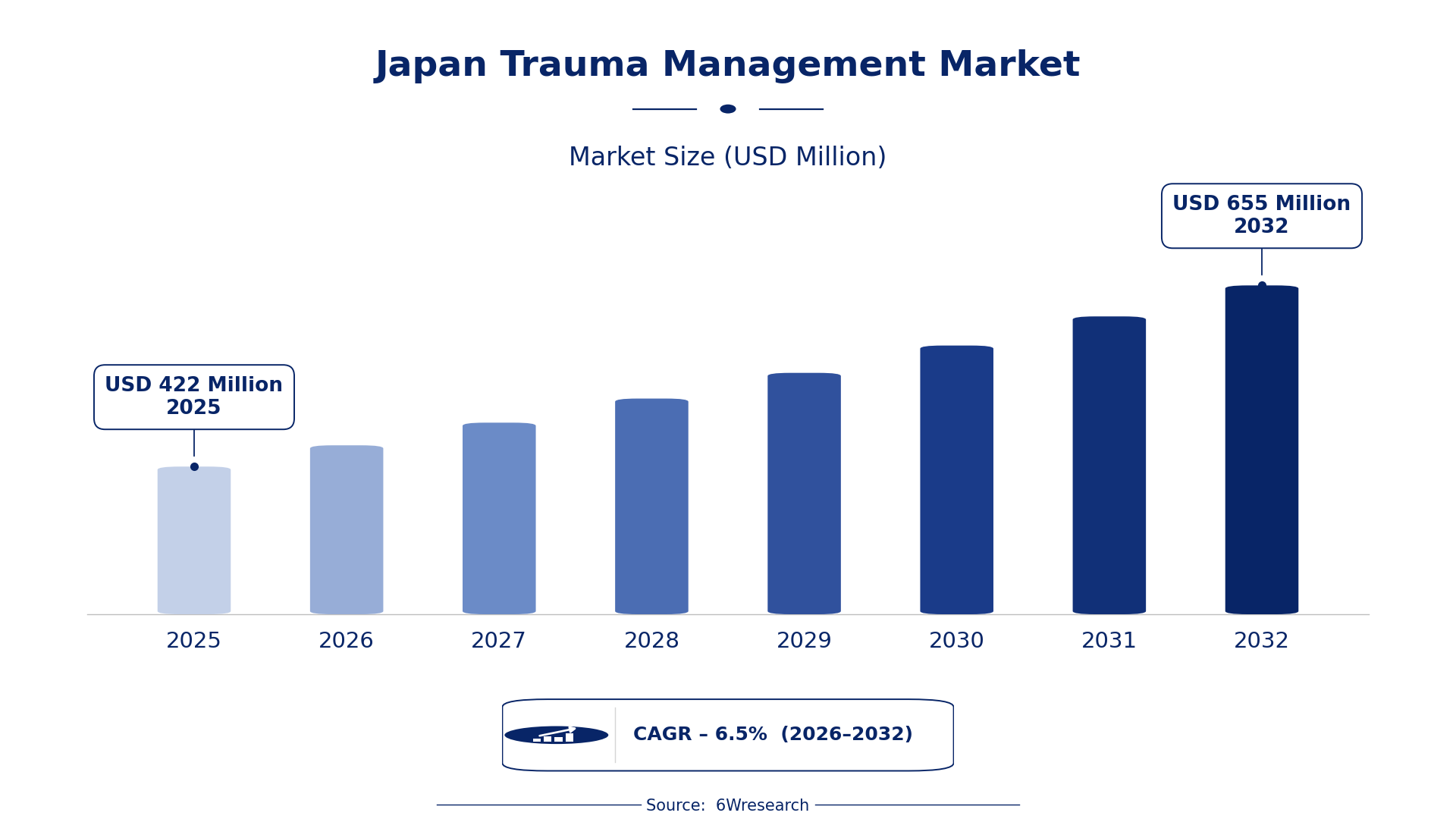
According to 6Wresearch internal database and industry insights, the Japan Trauma Management Market was valued at USD 422 Million in 2025 and is projected to reach USD 655 Million by 2032, growing at a CAGR of approximately 6.5% during 2026–2032.
Japan Trauma Management Market Highlights
| Report Metric | Details |
| Report Name | Japan Trauma Management Market (2026-2032) |
| Market Size 2025 | USD 422 Million |
| Market Size 2032 | USD 655 Million |
| Absolute Growth 2025–2032 | USD 233 Million |
| CAGR 2026–2032 | 6.5% |
| Peak Annual Growth | 7.6% in 2028 |
| Forecast Period | 2026–2032 |
| Historical Data | 2022–2025 |
| Base Year | 2025 |
| Leading Management Approach, 2025 | Surgical Trauma Care (50% share) |
| Leading Specialty Focus, 2025 | Orthopedic/Neuro (37% share) |
| Leading Delivery Type, 2025 | Inpatient (45% share) |
| Leading End User, 2025 | Hospitals (46% share) |
| Fastest-Growing Management Approach | Non-Surgical Care (8.4% CAGR) |
| Fastest-Growing Specialty Focus | Physiotherapy (8.8% CAGR) |
| Fastest-Growing Delivery Type | Outpatient (9.0% CAGR) |
| Fastest-Growing End User | Clinics (8.3% CAGR) |
| Growing Sector | Healthcare Services |
| Key End Users | Hospitals, Clinics, Trauma Survivors, Pediatric Facilities |
Japan Trauma Management Market Year-wise Growth Rate and Key Drivers (2022–2032)
This graph illustrates the annual growth rates of the market from 2022 to 2032, highlighting a steady upward trajectory and projected market expansion over the forecast period.
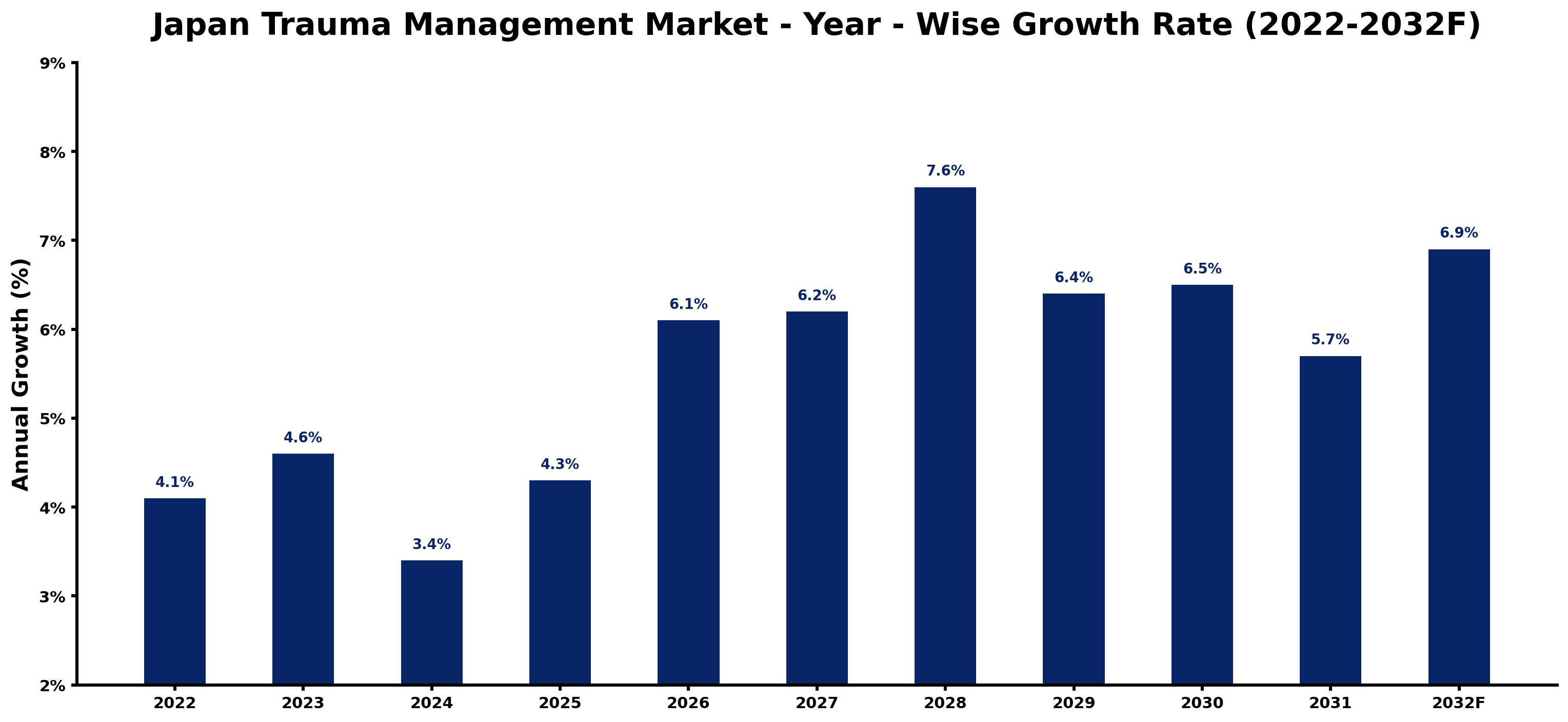
Each row of the following table gives one year's estimated growth and the event or demand shift that explains it.
| Year | Estimated Annual Growth (%) | Market Rationale |
| 2022 | 4.1 | The market showed steady growth in response to rising trauma cases and healthcare investments. |
| 2023 | 4.6 | Growth accelerated due to increased trauma awareness and improved healthcare facilities. |
| 2024 | 3.4 | The growth rate slowed as the market adjusted to previous peaks in demand. |
| 2025 | 4.3 | An uptick in trauma cases led to faster growth as hospitals expanded services. |
| 2026 | 6.1 | Investment in trauma care technology is expected to drive demand, boosting growth rates. |
| 2027 | 6.2 | Continued investment in trauma facilities will support further growth in the market. |
| 2028 | 7.6 | The peak growth rate will be driven by advancements in trauma management technologies. |
| 2029 | 6.4 | Growth is projected to moderate as the market stabilises after reaching peak levels. |
| 2030 | 6.5 | A resurgence in demand for trauma services is expected to lead to faster growth once again. |
| 2031 | 5.7 | The growth rate is projected to slow as the market begins to normalise after rapid expansion. |
| 2032 | 6.9 | Continued technological advancements are expected to sustain a healthy growth rate. |
Note: Market size estimations and growth projections presented in this report are based on 6Wresearch's proprietary forecasting methodology, utilizing the latest available industry data, government publications, and primary research inputs.
Japan Trauma Management Market Synopsis
Trauma management encompasses surgical and non-surgical methods to treat physical injuries and psychological trauma. Approximately 1.2 million trauma cases are treated annually, driving demand for improved healthcare services. The Japan Trauma Management Market is expanding due to investments in healthcare infrastructure, particularly in urban areas. The government allocated ¥2 billion for trauma care improvement initiatives, supporting the growth of this sector through better facilities and services.
Market Dynamics Impact Analysis (2026–2032)
| Factor | Type | Impact | Primary Segment Affected |
| Growing number of trauma cases driving demand for immediate treatment solutions. | Driver | High | Surgical Trauma Care |
| Increasing investments in healthcare facilities enhancing trauma care capabilities. | Driver | High | Non-Surgical Care |
| Expansion of pediatric trauma units to meet the needs of injured children. | Opportunity | High | Pediatric Trauma Units |
| Adoption of teletherapy in mental trauma care to address psychological needs. | Opportunity | Medium | Mental Trauma Care |
| Limited availability of specialized trauma care facilities in rural areas. | Restraint | High | Surgical Trauma Care |
| High operational costs associated with maintaining trauma care standards. | Restraint | Medium | Non-Surgical Care |
| Staff shortages in trauma care facilities affecting service delivery. | Challenge | High | Critical Care |
| Inadequate funding for trauma care improvement initiatives delaying advancements. | Challenge | Medium | Pediatric Trauma Units |
Evaluation of Drivers in Japan Trauma Management Market (2026–2032)
The main growth drivers and the segments they affect most are set out below.
| Drivers | Primary Segment Affected | Why It Matters (Evidence) |
| Increase in trauma cases due to urbanisation and lifestyle changes. | Surgical Trauma Care | Japan treats approximately 1.2 million trauma cases annually, necessitating immediate surgical interventions. |
| Investment in advanced medical technologies for trauma care. | Non-Surgical Care | Healthcare facilities are adopting new technologies to improve patient outcomes and recovery times, supporting better trauma management. |
| Government initiatives to improve pediatric trauma care capabilities. | Pediatric Trauma Units | The number of pediatric trauma units has increased to 150, addressing the needs of injured children effectively. |
| Growth in mental health awareness leading to increased demand for psychological support. | Mental Trauma Care | Teletherapy adoption in mental trauma care has risen by 30% since 2021, reflecting changing patient needs. |
| Rising healthcare expenditure supporting trauma management improvements. | Critical Care | The government allocated ¥2 billion for trauma care improvement initiatives in 2023, enhancing service quality. |
Spending rises because of the increasing number of trauma cases, with approximately 1.2 million treated annually, driving demand for surgical interventions. Investments in advanced medical technologies are improving recovery times, as facilities adopt new equipment. The number of specialized pediatric trauma units has increased to 150, addressing the needs of injured children. Mental health awareness is growing, leading to a rise in teletherapy adoption for trauma care. Overall healthcare expenditure is rising, with ¥2 billion allocated for trauma care improvements in 2023, expected to improve service delivery across the sector.
Evaluation of Restraints in Japan Trauma Management Market
The main factors holding the market back are set out below.
| Market Restraint | Primary Segment Affected | Why It Matters (Evidence) |
| Limited access to trauma care in rural areas affecting patient outcomes. | Surgical Trauma Care | Over 8,000 hospitals provide trauma care, but many are concentrated in urban regions, leaving rural patients underserved. |
| High operational costs for trauma care facilities impacting service availability. | Non-Surgical Care | Facilities face challenges in maintaining standards due to rising costs associated with advanced trauma management. |
| Staff shortages in trauma care affecting quality of service delivery. | Critical Care | The average hospital stay for trauma patients is around 10 days, placing strain on available staffing resources. |
| Inadequate funding for trauma care initiatives delaying advancements. | Pediatric Trauma Units | Despite government allocations, funding remains insufficient to meet all operational needs of pediatric trauma units. |
| Regulatory hurdles slowing the adoption of new trauma care technologies. | Mental Trauma Care | Compliance with standards set by the Japanese Orthopedic Association can delay implementation of new practices. |
Japan Trauma Management Market Challenges
In 2022, Japan treated approximately 1.2 million trauma cases, straining hospitals and leading to longer wait times for patients requiring urgent care. A lack of skilled trauma professionals exists due to an ageing workforce, complicating timely treatment and increasing pressure on current medical staff. High operational costs arise from stringent regulations, resulting in elevated fees for patients seeking quality trauma services. Intense competition among hospitals in urban areas, particularly Tokyo, forces facilities to invest heavily in marketing, diverting funds from essential improvements in trauma care capabilities.
Trends in the Japan Trauma Management Market
The trends below show where the Japan Trauma Management Market is heading.
- Shift from Traditional to Teletherapy in Mental Health Support: Mental health support is increasingly moving towards teletherapy, with a 30% rise in adoption since 2021. This shift allows trauma survivors to access care more conveniently, reflecting changing patient needs.
- Expansion of Pediatric Trauma Units: The number of pediatric trauma units has increased to 150, reflecting a growing focus on specialized care for children. This trend is supported by initiatives from healthcare associations aiming to improve pediatric services.
- Adoption of Advanced Medical Technologies: Healthcare facilities are increasingly investing in advanced medical technologies for trauma management. In 2023, the government allocated ¥2 billion for trauma care improvements, facilitating better patient outcomes.
- Increased Focus on Mental Health Awareness: There is a growing emphasis on mental health awareness in trauma care, with teletherapy becoming a common option. This shift is evident in the rising adoption rates, which have increased by 30% since 2021.
Investment Opportunities in the Japan Trauma Management Market
The openings below show where demand in the Japan Trauma Management Market is visible and how suppliers can enter.
- Partnerships with Local Healthcare Providers: Collaborating with local healthcare providers can improve trauma care services. Hospitals are expanding their capabilities, and the government allocated ¥2 billion for trauma care improvements in 2023.
- Investment in Pediatric Trauma Care: The demand for specialized pediatric trauma care is increasing, with 150 units established. Investing in these facilities can meet the growing needs of injured children effectively.
- Supply of Advanced Rehabilitation Technologies: There is a gap in the supply of advanced rehabilitation technologies for trauma recovery. The Japan Rehabilitation Society focuses on improving rehabilitation standards, creating opportunities for suppliers.
- Approval of New Trauma Care Solutions: The demand for new trauma care solutions is rising, with the Japanese Orthopedic Association setting new standards. Engaging in partnerships can facilitate entry into this growing market.
Government Initiatives in the Japan Trauma Management Market
The Economic Security Promotion Act of 2022 supports supply-chain resilience for critical products, improving trauma management capabilities. This law complements the Medical Care Act of 1948, which sets standards for hospitals and clinics, ensuring quality trauma care delivery.
In 2023, the government allocated ¥2 billion for trauma care improvement initiatives, overseen by the Ministry of Health, Labour and Welfare. This funding aims to improve trauma response times and the quality of care provided across facilities.
Future Insight of the Japan Trauma Management Market
Teletherapy adoption in mental trauma care will reshape treatment approaches by 2032, improving access for patients in need. The Pediatric Trauma Care Program initiated in 2023 will expand resources for young patients, enhancing care quality. Funding for trauma care initiatives is projected to exceed ¥5 billion, enabling hospitals to upgrade facilities and technology. Enhanced training programmes will equip trauma professionals with necessary skills, ensuring better service delivery across the healthcare system.
Market Segmentation Analysis
Japan Trauma Management Market report covers a detailed analysis of the following market segments:
By Management Approach – Surgical Trauma Care Leads, Non-Surgical Care Expected to Grow Fastest
According to Saurav Kr Singh, Senior Research Analyst at 6Wresearch, Surgical Trauma Care took 50% of management approach revenue in 2025, more than any other category. Surgical trauma care commands the largest share due to its critical function in treating immediate injuries. With over 8,000 hospitals in Japan providing these services, it is indispensable for effective trauma management. The quickest growth will come from Non-Surgical Care, forecast to expand at a CAGR of 8.4% between 2026 and 2032. Non-surgical care is rapidly growing, propelled by an increased emphasis on rehabilitation practices. The notable rise in teletherapy adoption for mental trauma care, which surged by 30% since 2021, highlights this shift. Suppliers should focus on developing non-surgical solutions to meet the rising demand for rehabilitation services.
By Specialty Focus – Orthopedic/Neuro Leads, Physiotherapy Expected to Grow Fastest
Orthopedic/Neuro accounted for 37% of the market by specialty focus in 2025. Orthopedic and neuro specialties lead the market as they specifically address the most prevalent trauma injuries in Japan. The high incidence of musculoskeletal and neurological cases necessitates focused care in these areas. Physiotherapy is projected to grow fastest, at a CAGR of 8.8% during 2026–2032. Physiotherapy is the fastest-growing segment, fuelled by the escalating need for effective rehabilitation post-trauma. This trend underscores the importance of recovery methods as patients increasingly seek improved outcomes after injuries. Buyers should consider integrating physiotherapy services to enhance patient recovery and overall satisfaction.
By Delivery Type – Inpatient Leads, Outpatient Expected to Grow Fastest
The largest delivery type category in 2025 was Inpatient, at 45% of revenue. Inpatient care is the predominant delivery type, essential for managing serious trauma cases that require intensive medical intervention. Hospitals are equipped to provide this level of comprehensive treatment for patients. Over 2026–2032, Outpatient is expected to post the fastest growth, at a CAGR of 9.0%. Outpatient care is witnessing rapid growth, reflecting a trend towards more efficient follow-up services for trauma patients. Clinics are adapting to cater to minor trauma cases, facilitating quicker recovery processes. Suppliers must adjust to the increasing demand for outpatient services to capitalise on this market trend.
By End User – Hospitals Lead, Clinics Expected to Grow Fastest
Hospitals held 46% of the Japan Trauma Management Market by end user in 2025. Hospitals are the main providers of trauma care, holding the largest share due to their capacity to manage severe cases effectively. They have the necessary resources and trained personnel to deliver comprehensive treatment. Clinics are set to record the highest CAGR in this split, 8.3% over 2026–2032. Clinics represent the fastest-growing end user segment, as they fulfil a supportive role in managing minor trauma cases. This growth indicates a broader trend towards decentralised healthcare services in Japan. Suppliers should target clinics to expand their market presence in trauma management.
Key Attractiveness of the Report
- 10 Years of Market Numbers
- Historical Data Starting from 2022 to 2025
- Base Year 2025
- Forecast Data until 2032
- Key Performance Indicators Impacting the Market
- Major Upcoming Developments and Projects
Key Highlights of the Report:
- Japan Trauma Management Market Outlook
- Market Size of Japan Trauma Management Market, 2025
- Forecast of Japan Trauma Management Market, 2032
- Historical Data and Forecast of Japan Trauma Management Revenues & Volume for the Period 2022-2032F
- Japan Trauma Management Market Trend Evolution
- Japan Trauma Management Market Drivers and Challenges
- Japan Trauma Management Price Trends
- Japan Trauma Management Porter's Five Forces
- Japan Trauma Management Industry Life Cycle
- Historical Data and Forecast of Japan Trauma Management Market Revenues & Volume By Management Approach for the Period 2022-2032F
- Historical Data and Forecast of Japan Trauma Management Market Revenues & Volume By Surgical Trauma Care for the Period 2022-2032F
- Historical Data and Forecast of Japan Trauma Management Market Revenues & Volume By Non-Surgical Care for the Period 2022-2032F
- Historical Data and Forecast of Japan Trauma Management Market Revenues & Volume By Mental Trauma Care for the Period 2022-2032F
- Historical Data and Forecast of Japan Trauma Management Market Revenues & Volume By Pediatric Trauma Units for the Period 2022-2032F
- Historical Data and Forecast of Japan Trauma Management Market Revenues & Volume By Specialty Focus for the Period 2022-2032F
- Historical Data and Forecast of Japan Trauma Management Market Revenues & Volume By Orthopedic/Neuro for the Period 2022-2032F
- Historical Data and Forecast of Japan Trauma Management Market Revenues & Volume By Physiotherapy for the Period 2022-2032F
- Historical Data and Forecast of Japan Trauma Management Market Revenues & Volume By Psychiatry/Psychology for the Period 2022-2032F
- Historical Data and Forecast of Japan Trauma Management Market Revenues & Volume By Pediatric Surgery for the Period 2022-2032F
- Historical Data and Forecast of Japan Trauma Management Market Revenues & Volume By Delivery Type for the Period 2022-2032F
- Historical Data and Forecast of Japan Trauma Management Market Revenues & Volume By Inpatient for the Period 2022-2032F
- Historical Data and Forecast of Japan Trauma Management Market Revenues & Volume By Outpatient for the Period 2022-2032F
- Historical Data and Forecast of Japan Trauma Management Market Revenues & Volume By Teletherapy for the Period 2022-2032F
- Historical Data and Forecast of Japan Trauma Management Market Revenues & Volume By Critical Care for the Period 2022-2032F
- Historical Data and Forecast of Japan Trauma Management Market Revenues & Volume By End User for the Period 2022-2032F
- Historical Data and Forecast of Japan Trauma Management Market Revenues & Volume By Hospitals for the Period 2022-2032F
- Historical Data and Forecast of Japan Trauma Management Market Revenues & Volume By Clinics for the Period 2022-2032F
- Historical Data and Forecast of Japan Trauma Management Market Revenues & Volume By Trauma Survivors for the Period 2022-2032F
- Historical Data and Forecast of Japan Trauma Management Market Revenues & Volume By Children's Hospitals for the Period 2022-2032F
- Japan Trauma Management Import Export Trade Statistics
- Market Opportunity Assessment By Management Approach
- Market Opportunity Assessment By Specialty Focus
- Market Opportunity Assessment By Delivery Type
- Market Opportunity Assessment By End User
- Japan Trauma Management Top Companies Market Share
- Japan Trauma Management Competitive Benchmarking By Technical and Operational Parameters
- Japan Trauma Management Company Profiles
- Japan Trauma Management Key Strategic Recommendations
Market Covered
This report examines the market across the segments below.
By Management Approach
- Surgical Trauma Care
- Non-Surgical Care
- Mental Trauma Care
- Pediatric Trauma Units
By Specialty Focus
- Orthopedic/Neuro
- Physiotherapy
- Psychiatry/Psychology
- Pediatric Surgery
By Delivery Type
- Inpatient
- Outpatient
- Teletherapy
- Critical Care
By End User
- Hospitals
- Clinics
- Trauma Survivors
- Children's Hospitals































