Japan Treasury Management Software Market Size & Growth Rate
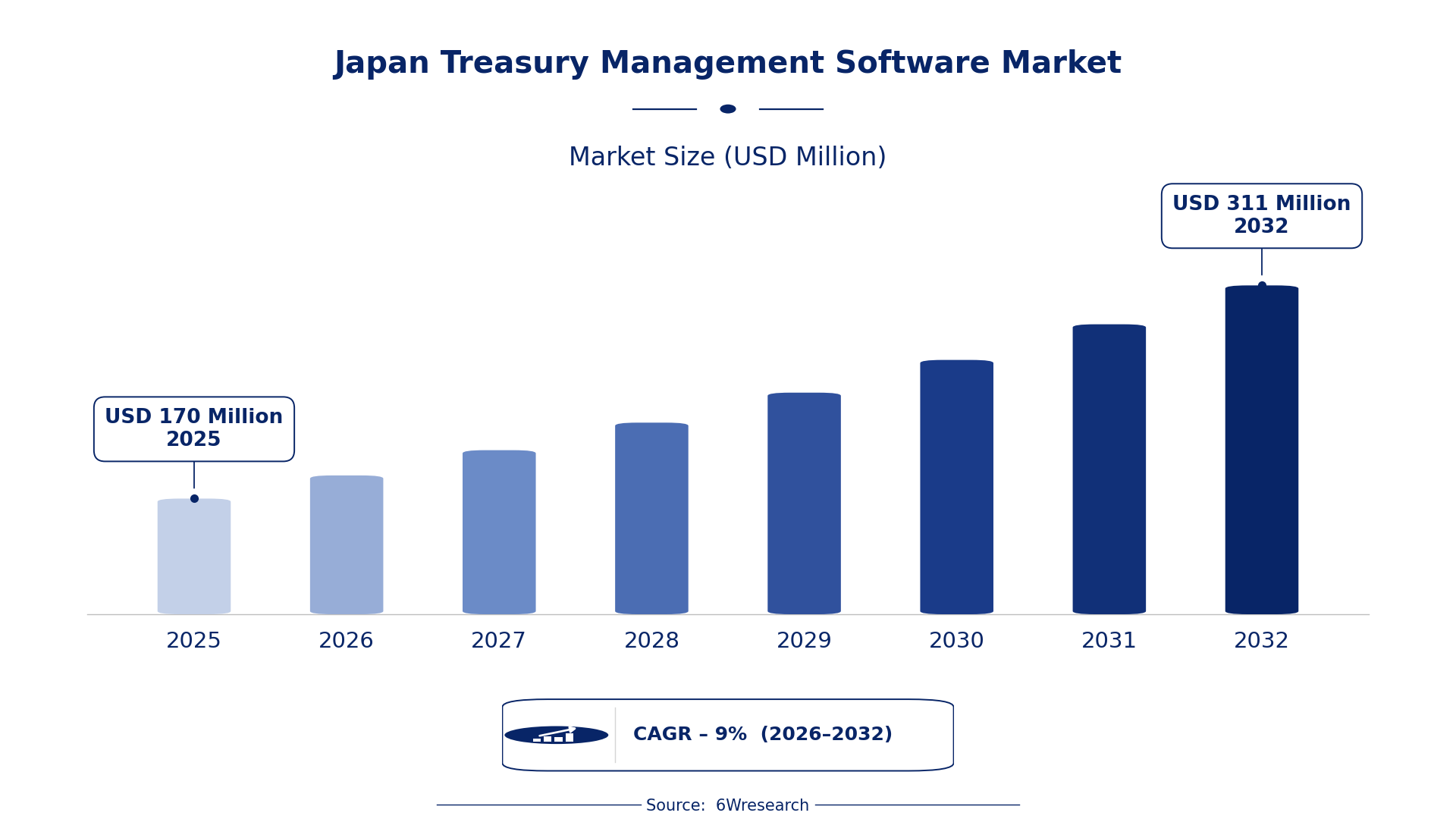
According to 6Wresearch internal database and industry insights, the Japan Treasury Management Software Market was valued at USD 170 Million in 2025 and is projected to reach USD 311 Million by 2032, growing at a CAGR of approximately 9% during 2026–2032.
Japan Treasury Management Software Market Highlights
| Report Metric | Details |
| Report Name | Japan Treasury Management Software Market (2026-2032) |
| Market Size 2025 | USD 170 Million |
| Market Size 2032 | USD 311 Million |
| Absolute Growth 2025–2032 | USD 141 Million |
| CAGR 2026–2032 | 9% |
| Peak Annual Growth | 10.2% in 2026 |
| Forecast Period | 2026–2032 |
| Historical Data | 2022–2025 |
| Base Year | 2025 |
| Leading Module Type, 2025 | Cash & Liquidity Mgmt (38% share) |
| Leading Functionality, 2025 | Real-Time Cash Flow (43% share) |
| Leading Deployment Mode, 2025 | SaaS (38% share) |
| Leading End User, 2025 | Corporations (42% share) |
| Fastest-Growing Module Type | Risk Management (12.5% CAGR) |
| Fastest-Growing Deployment Mode | Cloud/On-Premise (13.0% CAGR) |
| Fastest-Growing End User | Financial Institutions (11.3% CAGR) |
| Growing Sector | Financial Institutions |
| Key End Users | Corporations, Banks, Financial Institutions, Treasury Teams |
Japan Treasury Management Software Market Year-wise Growth Rate and Key Drivers (2022–2032)
This graph illustrates the annual growth rates of the market from 2022 to 2032, highlighting a steady upward trajectory and projected market expansion over the forecast period.
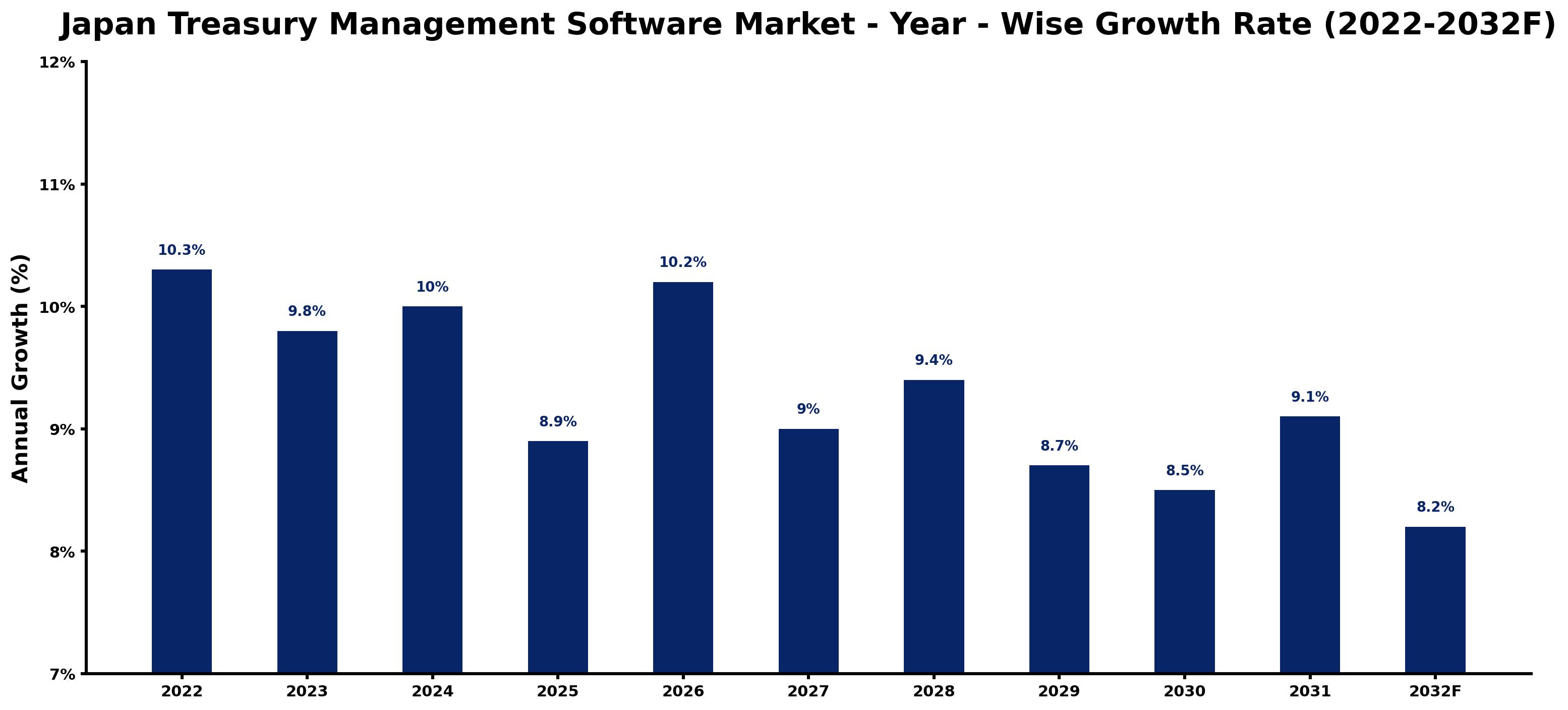
Below, each year's estimated growth is shown next to the factor that most influenced it.
| Year | Estimated Annual Growth (%) | Market Rationale |
| 2022 | 10.3 | The market experienced strong demand due to increased adoption of treasury management solutions. |
| 2023 | 9.8 | Growth slowed as firms adjusted to economic conditions and refined their treasury strategies. |
| 2024 | 10.0 | Demand rose as companies focused on improving cash flow management and risk mitigation. |
| 2025 | 8.9 | Growth moderated as market saturation began to impact new customer acquisitions. |
| 2026 | 10.2 | A surge in investment in treasury technology is anticipated to lead to a peak in growth rates. |
| 2027 | 9.0 | The market will see a slowdown as firms consolidate their treasury operations. |
| 2028 | 9.4 | Demand is projected to increase as financial institutions seek advanced risk management tools. |
| 2029 | 8.7 | Growth is expected to decelerate as competition intensifies among treasury software providers. |
| 2030 | 8.5 | A slight slowdown is projected as market maturity affects growth. |
| 2031 | 9.1 | Demand will rebound as corporations renew their focus on efficient treasury operations. |
| 2032 | 8.2 | Growth is expected to slow as the market stabilises, reflecting a mature adoption phase. |
Note: Market size estimations and growth projections presented in this report are based on 6Wresearch's proprietary forecasting methodology, utilizing the latest available industry data, government publications, and primary research inputs.
Japan Treasury Management Software Market Synopsis
The Japan Treasury Management Software Market is expanding due to the financial services sector, which includes over 1,200 banks and financial institutions. The demand for efficient treasury operations drives growth, with over 80% of large corporations utilising these solutions. The rise of SaaS-based TMS, with an adoption rate of around 60%, further supports market expansion.
Market Dynamics Impact Analysis (2026–2032)
| Factor | Type | Impact | Primary Segment Affected |
| Increased adoption of SaaS-based TMS solutions | Driver | High | SaaS |
| Growing focus on risk management due to economic uncertainties | Driver | High | Risk Management |
| Rising demand for real-time cash flow monitoring | Opportunity | High | Real-Time Cash Flow |
| Expansion of fintech solutions enhancing treasury operations | Opportunity | High | Treasury Operations |
| Market saturation leading to slower growth rates | Restraint | Medium | Cash & Liquidity Mgmt |
| Increased competition among treasury software providers | Restraint | Medium | Payment Reconciliation |
| Talent shortages in treasury management expertise | Challenge | High | Treasury Teams |
| High implementation costs for advanced TMS solutions | Challenge | Medium | Financial Institutions |
Evaluation of Drivers in Japan Treasury Management Software Market (2026–2032)
These are the developments adding the most demand over the forecast period.
| Drivers | Primary Segment Affected | Why It Matters (Evidence) |
| Increased investment in treasury technology | Cash & Liquidity Mgmt | Over 80% of large corporations in Japan utilise TMS solutions, driving demand for cash management functionalities. |
| Focus on risk mitigation strategies | Risk Management | Japan's corporate debt reached approximately 1,000 trillion yen, prompting firms to adopt risk management tools. |
| Demand for real-time financial reporting | Real-Time Cash Flow | Standards established by the Bank of Japan encourage firms to improve their reporting capabilities. |
| Growth in fintech solutions for treasury management | Treasury Operations | In 2023, the government launched a programme to boost fintech solutions, stimulating demand for treasury software. |
| Shift towards SaaS deployment models | SaaS | The adoption rate of SaaS-based TMS in Japan is around 60%, appealing to corporations seeking flexibility. |
Volumes grow on the back of increasing investment in treasury technology, with over 80% of large corporations in Japan utilising TMS solutions. The focus on risk management is clear, as corporate debt reached approximately 1,000 trillion yen, prompting firms to adopt advanced risk management tools. Real-time financial reporting has gained traction, driven by standards established by the Bank of Japan. The shift towards SaaS deployment models, with a notable adoption rate, reflects the desire for flexibility and scalability among financial institutions.
Evaluation of Restraints in Japan Treasury Management Software Market
The main factors holding the market back are set out below.
| Market Restraint | Primary Segment Affected | Why It Matters (Evidence) |
| Market saturation leading to slower growth rates | Cash & Liquidity Mgmt | As more firms adopt TMS, the potential for new customer acquisition diminishes, affecting overall growth. |
| Increased competition among treasury software providers | Payment Reconciliation | The influx of providers has led to price wars, impacting profitability for existing vendors. |
| Talent shortages in treasury management expertise | Treasury Teams | A lack of skilled professionals in treasury management can hinder effective implementation of TMS solutions. |
| High implementation costs for advanced TMS solutions | Financial Institutions | The investment required for advanced features can deter smaller institutions from adopting TMS. |
| Regulatory compliance challenges | Risk Management | Meeting the standards set by the Financial Services Agency can be resource-intensive for firms. |
Japan Treasury Management Software Market Challenges
Large corporations face intense competition among over 1,200 banks and financial institutions, which compresses profit margins and increases pressure on treasury teams. Supply chain disruptions in software development can delay Treasury Management Software implementation by up to six months, impacting operational efficiency for these firms. Regulatory changes from the Financial Services Agency require frequent updates to TMS, raising compliance costs for buyers by approximately 15% of their software budgets. A shortage of skilled personnel in financial technology limits the availability of qualified staff, forcing firms to invest heavily in training and recruitment, which can extend timelines by up to a year.
Trends in the Japan Treasury Management Software Market
The following changes are redrawing the Japan Treasury Management Software Market.
- Shift from On-Premise to Cloud-Based Solutions: The adoption of cloud-based treasury management solutions is increasing, with around 60% of firms opting for SaaS models. This shift allows for greater flexibility and scalability, particularly in Tokyo's financial hub.
- Growing Emphasis on Real-Time Cash Flow Monitoring: In 2023, the demand for real-time cash flow monitoring surged, driven by the need for better liquidity management. This trend is clear among corporations seeking to optimise their cash positions.
- Increased Integration of Fintech Solutions: Since the launch of the fintech programme in 2023, there has been a notable rise in the integration of fintech solutions within treasury management. This integration improves operational efficiency for financial institutions.
- Focus on Risk Management Tools: The financial services sector is increasingly prioritising risk management tools, with corporate debt reaching approximately 1,000 trillion yen. This trend reflects the need for effective risk mitigation strategies.
Investment Opportunities in the Japan Treasury Management Software Market
Several openings in the Japan Treasury Management Software Market merit attention from investors.
- Timing for Investment in Treasury Solutions: With the market projected to grow, investing in advanced treasury management software is timely. Financial institutions in Tokyo are actively seeking solutions to improve their operations, presenting a prime opportunity for suppliers.
- Entry through Strategic Partnerships: Forming joint ventures with local fintech firms can facilitate market entry. Collaborating with established players in Japan's financial services sector can provide valuable insights and access to potential clients.
- Focus on SaaS-Based Solutions: The increasing demand for SaaS-based treasury management software presents an opportunity to supply flexible solutions. Financial institutions are keen on adopting cloud-based systems for improved scalability and cost efficiency.
- Investment in Risk Management Tools: As firms prioritise risk management, there is a growing opportunity to develop specialised tools. Financial institutions are investing in advanced risk management solutions to navigate the complexities of corporate debt.
Government Initiatives in the Japan Treasury Management Software Market
The Industrial Standardization Act (1949; amended and renamed in 2019) governs product and test standards, impacting TMS producers. Compliance with these standards ensures that software meets quality benchmarks, which is essential for buyer confidence and market acceptance.
In 2023, funding was allocated through the Digital Agency to support the development of fintech solutions in treasury management. This initiative aims to improve operational efficiency and modernise the financial services sector, benefiting both producers and buyers of TMS.
Future Insight of the Japan Treasury Management Software Market
The government's fintech program will initiate new treasury management solutions by 2032, improving operational efficiency for users. The adoption of the JIS X 9001 standard will ensure reliable performance for firms. By 2032, integrating AI technologies in TMS will streamline cash flow management and reduce processing times. With corporate debt reaching approximately 1,000 trillion yen, companies will increasingly depend on advanced analytics for investment decisions, transforming treasury operations across the financial sector.
Market Segmentation Analysis
Japan Treasury Management Software Market report covers a detailed analysis of the following market segments:
By Module Type – Cash & Liquidity Mgmt Leads, Risk Management Expected to Grow Fastest
According to Prakhar Dixit, Senior Research Analyst at 6Wresearch, Cash & Liquidity Mgmt accounted for 38% of the market by module type in 2025. Cash and liquidity management leads the market as it is essential for efficiently managing cash flow, particularly for over 80% of large corporations in Japan. This high adoption rate showcases the critical demand for effective liquidity solutions among domestic users. Risk Management is projected to grow fastest, at a CAGR of 12.5% during 2026–2032. Risk management is witnessing substantial growth as organisations increasingly focus on identifying and mitigating financial risks, especially given Japan's corporate debt of approximately 1,000 trillion yen. The heightened emphasis on risk management will likely propel its adoption further. Suppliers should enhance their offerings in risk management to capitalise on this growing demand.
By Functionality – Real-Time Cash Flow Leads and Records the Fastest Growth
The largest functionality category in 2025 was Real-Time Cash Flow, at 43% of revenue. Real-time cash flow functionality holds the largest share as it is vital for monitoring cash positions in real-time, crucial for effective financial management. This capability is particularly significant for financial institutions operating in Japan's dynamic financial landscape. Its lead should widen, with a projected CAGR of 11.6% during 2026–2032, the highest in this split. The real-time cash flow segment is also the fastest-growing as organisations increasingly recognise the importance of immediate visibility into their cash positions for timely decision-making. This dual role as leader and fastest will likely expand its market dominance further. Suppliers must ensure their solutions provide robust real-time cash flow capabilities to meet rising client expectations.
By Deployment Mode – SaaS Lead, Cloud/On-Premise Expected to Grow Fastest
With 38% of deployment mode revenue in 2025, SaaS was the largest category. SaaS is the leading deployment mode, favoured for its flexibility and scalability, enabling organisations to adapt their treasury management solutions to changing needs. This preference is evident among the majority of users in Japan's financial services sector. The quickest growth will come from Cloud/On-Premise, forecast to expand at a CAGR of 13.0% between 2026 and 2032. Cloud/on-premise deployment is experiencing rapid growth as organisations seek tailored solutions that combine the benefits of both cloud and on-premise systems for treasury management. This trend indicates a shift towards more customisable deployment options. Suppliers should consider offering hybrid deployment options to cater to diverse client preferences.
By End User – Corporations Lead, Financial Institutions Expected to Grow Fastest
In 2025, Corporations led the end user split with a 42% share. Corporations are the primary users of treasury management software, employing these solutions for effective financial management across various sectors. The extensive use of TMS among large corporations underscores their importance in Japan's financial environment. Over 2026–2032, Financial Institutions are expected to post the fastest growth, at a CAGR of 11.3%. Financial institutions are the fastest-growing end user segment as they increasingly adopt treasury management solutions to streamline their operations and enhance efficiency. This growth reflects a broader trend towards digital transformation in the financial services sector. Suppliers should focus on developing tailored solutions for financial institutions to capture this expanding market.
Key Attractiveness of the Report
- 10 Years of Market Numbers
- Historical Data Starting from 2022 to 2025
- Base Year 2025
- Forecast Data until 2032
- Key Performance Indicators Impacting the Market
- Major Upcoming Developments and Projects
Key Highlights of the Report:
- Japan Treasury Management Software Market Outlook
- Market Size of Japan Treasury Management Software Market, 2025
- Forecast of Japan Treasury Management Software Market, 2032
- Historical Data and Forecast of Japan Treasury Management Software Revenues & Volume for the Period 2022-2032F
- Japan Treasury Management Software Market Trend Evolution
- Japan Treasury Management Software Market Drivers and Challenges
- Japan Treasury Management Software Price Trends
- Japan Treasury Management Software Porter's Five Forces
- Japan Treasury Management Software Industry Life Cycle
- Historical Data and Forecast of Japan Treasury Management Software Market Revenues & Volume By Module Type for the Period 2022-2032F
- Historical Data and Forecast of Japan Treasury Management Software Market Revenues & Volume By Cash & Liquidity Mgmt for the Period 2022-2032F
- Historical Data and Forecast of Japan Treasury Management Software Market Revenues & Volume By Risk Management for the Period 2022-2032F
- Historical Data and Forecast of Japan Treasury Management Software Market Revenues & Volume By Investment Management for the Period 2022-2032F
- Historical Data and Forecast of Japan Treasury Management Software Market Revenues & Volume By Payment Reconciliation for the Period 2022-2032F
- Historical Data and Forecast of Japan Treasury Management Software Market Revenues & Volume By Functionality for the Period 2022-2032F
- Historical Data and Forecast of Japan Treasury Management Software Market Revenues & Volume By Real-Time Cash Flow for the Period 2022-2032F
- Historical Data and Forecast of Japan Treasury Management Software Market Revenues & Volume By FX & Interest Hedging for the Period 2022-2032F
- Historical Data and Forecast of Japan Treasury Management Software Market Revenues & Volume By Treasury Operations for the Period 2022-2032F
- Historical Data and Forecast of Japan Treasury Management Software Market Revenues & Volume By Payment Tracking for the Period 2022-2032F
- Historical Data and Forecast of Japan Treasury Management Software Market Revenues & Volume By Deployment Mode for the Period 2022-2032F
- Historical Data and Forecast of Japan Treasury Management Software Market Revenues & Volume By Cloud/On-Premise for the Period 2022-2032F
- Historical Data and Forecast of Japan Treasury Management Software Market Revenues & Volume By SaaS for the Period 2022-2032F
- Historical Data and Forecast of Japan Treasury Management Software Market Revenues & Volume By Hosted/Custom for the Period 2022-2032F
- Historical Data and Forecast of Japan Treasury Management Software Market Revenues & Volume By Web-Based for the Period 2022-2032F
- Historical Data and Forecast of Japan Treasury Management Software Market Revenues & Volume By End User for the Period 2022-2032F
- Historical Data and Forecast of Japan Treasury Management Software Market Revenues & Volume By Corporations for the Period 2022-2032F
- Historical Data and Forecast of Japan Treasury Management Software Market Revenues & Volume By Financial Institutions for the Period 2022-2032F
- Historical Data and Forecast of Japan Treasury Management Software Market Revenues & Volume By Banks for the Period 2022-2032F
- Historical Data and Forecast of Japan Treasury Management Software Market Revenues & Volume By Treasury Teams for the Period 2022-2032F
- Japan Treasury Management Software Import Export Trade Statistics
- Market Opportunity Assessment By Module Type
- Market Opportunity Assessment By Functionality
- Market Opportunity Assessment By Deployment Mode
- Market Opportunity Assessment By End User
- Japan Treasury Management Software Top Companies Market Share
- Japan Treasury Management Software Competitive Benchmarking By Technical and Operational Parameters
- Japan Treasury Management Software Company Profiles
- Japan Treasury Management Software Key Strategic Recommendations
Market Covered
The report covers the following segments.
By Module Type
- Cash & Liquidity Mgmt
- Risk Management
- Investment Management
- Payment Reconciliation
By Functionality
- Real-Time Cash Flow
- FX & Interest Hedging
- Treasury Operations
- Payment Tracking
By Deployment Mode
- Cloud/On-Premise
- SaaS
- Hosted/Custom
- Web-Based
By End User
- Corporations
- Financial Institutions
- Banks
- Treasury Teams































