Japan Treatment Recommendation AI Market Size & Growth Rate
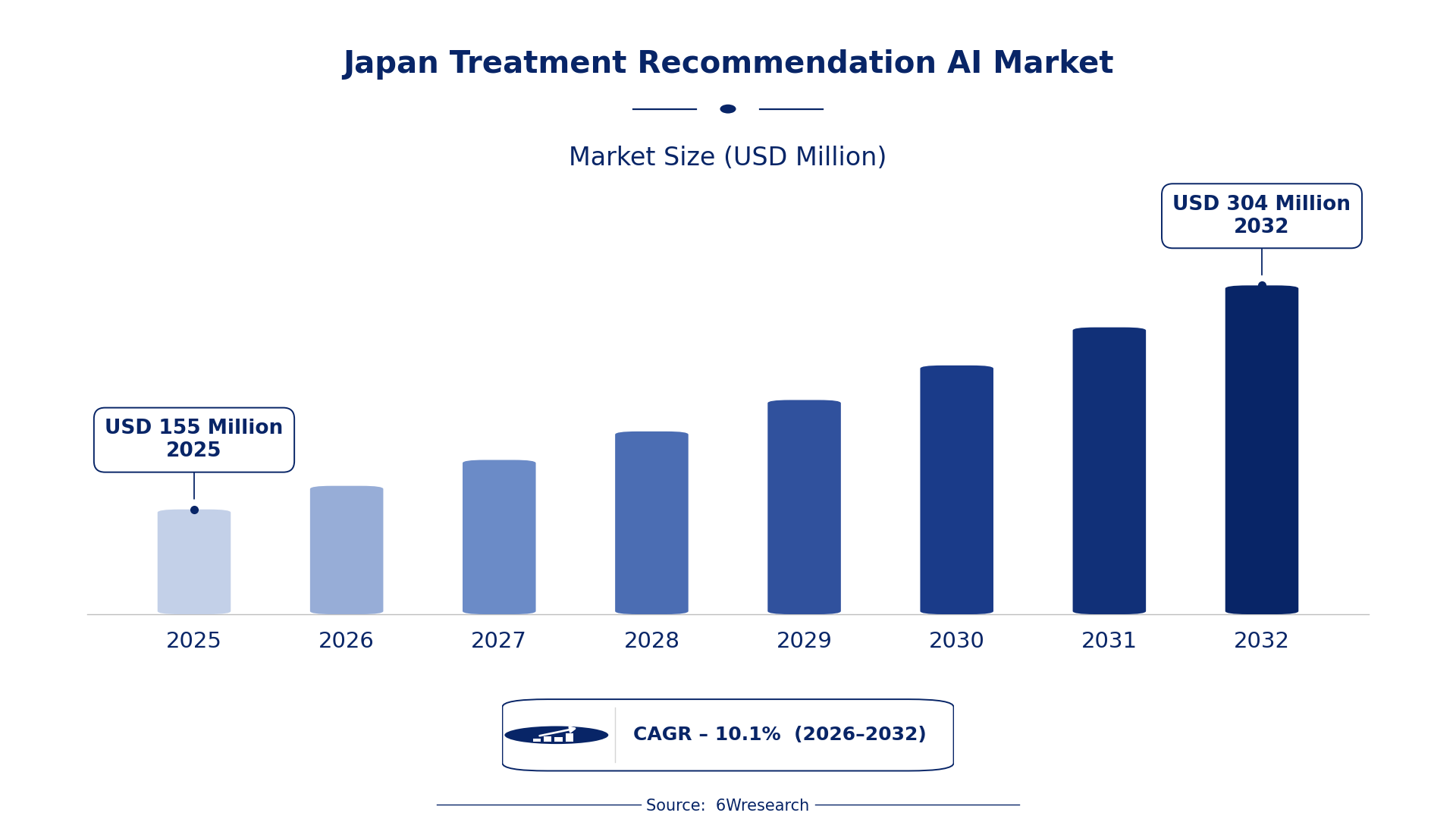
According to 6Wresearch internal database and industry insights, the Japan Treatment Recommendation AI Market was valued at USD 155 Million in 2025 and is projected to reach USD 304 Million by 2032, growing at a CAGR of approximately 10.1% during 2026–2032.
Japan Treatment Recommendation AI Market Highlights
| Report Metric | Details |
| Report Name | Japan Treatment Recommendation AI Market (2026-2032) |
| Market Size 2025 | USD 155 Million |
| Market Size 2032 | USD 304 Million |
| Absolute Growth 2025–2032 | USD 149 Million |
| CAGR 2026–2032 | 10.1% |
| Peak Annual Growth | 12.0% in 2028 |
| Forecast Period | 2026–2032 |
| Historical Data | 2022–2025 |
| Base Year | 2025 |
| Leading AI Type, 2025 | Rule-Based Systems (48% share) |
| Leading Input Data Type, 2025 | Patient History (52% share) |
| Leading Application Focus, 2025 | Chronic Condition Support (42% share) |
| Leading End User, 2025 | Hospitals (44% share) |
| Fastest-Growing AI Type | ML-Based Engines (13.7% CAGR) |
| Fastest-Growing Input Data Type | Real-Time Vitals (14.6% CAGR) |
| Fastest-Growing Application Focus | Critical Care Decisions (13.1% CAGR) |
| Fastest-Growing End User | Intensive Care Units (13.2% CAGR) |
| Growing Sector | Critical Care Decisions |
| Key End Users | Chronic Condition Support, Critical Care Decisions, Oncology Recommendations, Personalized Medicine |
Japan Treatment Recommendation AI Market Year-wise Growth Rate and Key Drivers (2022–2032)
This graph illustrates the annual growth rates of the market from 2022 to 2032, highlighting a steady upward trajectory and projected market expansion over the forecast period.
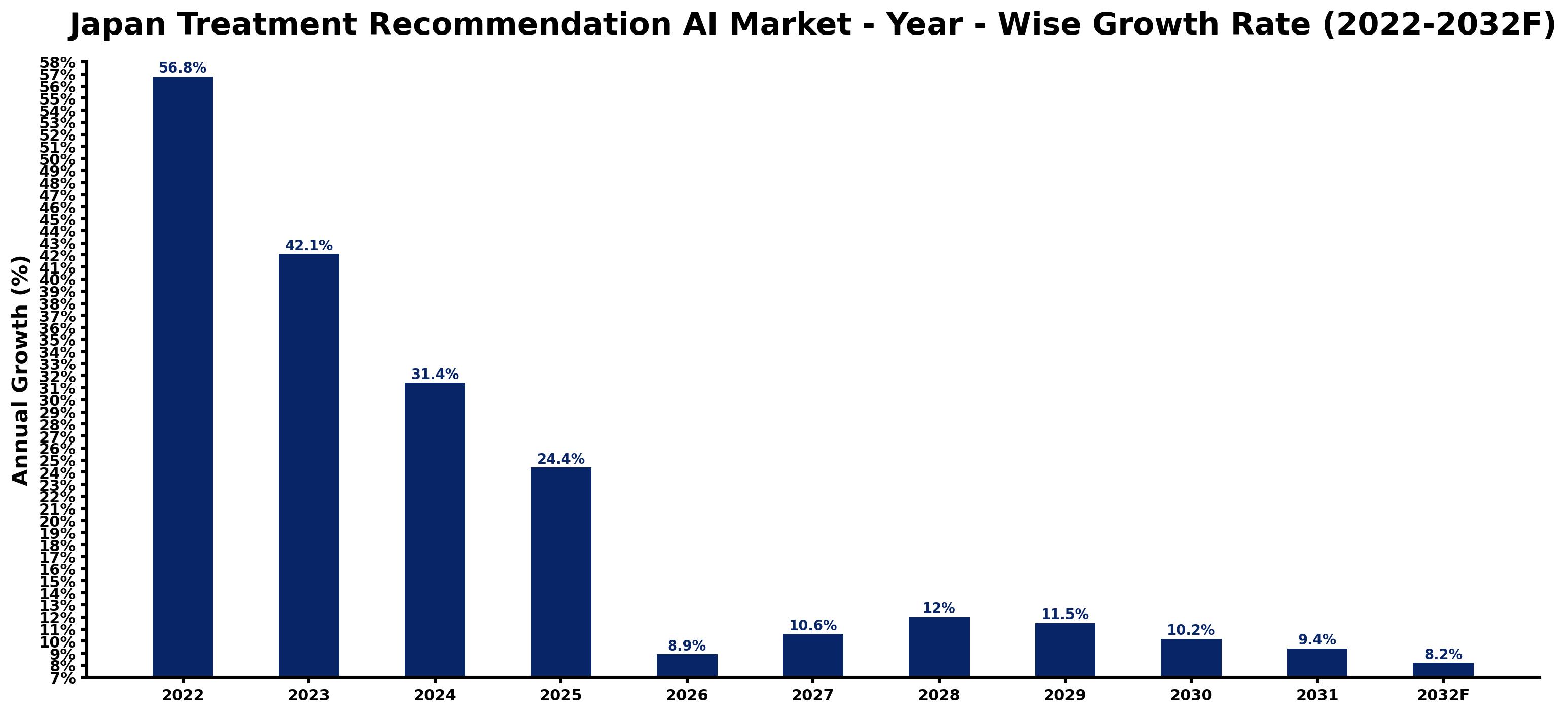
The table below sets out the estimated growth rate for each year and the main factor behind it.
| Year | Estimated Annual Growth (%) | Market Rationale |
| 2022 | 56.8 | The market experienced strong demand due to the rapid integration of AI technologies in healthcare settings. |
| 2023 | 42.1 | Growth slowed as hospitals faced challenges in fully integrating AI into their workflows and processes. |
| 2024 | 31.4 | The market continued to expand, driven by the increasing number of patients with chronic conditions requiring tailored treatments. |
| 2025 | 24.4 | Demand remained strong as hospitals broadened their AI applications in treatment recommendations and patient management. |
| 2026 | 8.9 | Growth is anticipated to decelerate as the market stabilises following initial rapid adoption phases. |
| 2027 | 10.6 | The market is projected to see renewed interest in AI technologies as hospitals upgrade their existing systems and capabilities. |
| 2028 | 12.0 | Demand is expected to rise again, fuelled by advancements in machine learning and data analytics. |
| 2029 | 11.5 | Growth will moderate as hospitals focus on optimising and refining their current AI solutions. |
| 2030 | 10.2 | The market is projected to continue expanding as new AI applications emerge in specialised healthcare services. |
| 2031 | 9.4 | Growth is expected to slow as the market matures, with hospitals enhancing their AI strategies and implementations. |
| 2032 | 8.2 | Demand is projected to remain steady as healthcare providers increasingly depend on AI for effective patient management. |
Note: Market size estimations and growth projections presented in this report are based on 6Wresearch's proprietary forecasting methodology, utilizing the latest available industry data, government publications, and primary research inputs.
Japan Treatment Recommendation AI Market Synopsis
Treatment Recommendation AI utilises algorithms and data analysis to deliver tailored treatment suggestions for patients, improving outcomes in chronic conditions and critical care. The market is expanding due to the increasing prevalence of chronic illnesses, with over 40 million patients affected. The healthcare sector is investing heavily in AI technologies, supported by the government's allocation of 5 billion yen for AI healthcare research in 2023, which aims to integrate AI into clinical practices and improve decision-making processes.
Market Dynamics Impact Analysis (2026–2032)
| Factor | Type | Impact | Primary Segment Affected |
| Growing prevalence of chronic conditions drives demand for tailored treatment solutions. | Driver | High | Chronic Condition Support |
| Increased investment in AI technologies by hospitals enhances treatment capabilities. | Driver | High | Hospitals |
| Rising patient numbers create a significant market opportunity for AI applications. | Opportunity | High | Patient History |
| Advancements in machine learning technologies present new avenues for investment. | Opportunity | Medium | ML-Based Engines |
| Integration challenges with existing healthcare systems can hinder adoption rates. | Restraint | High | Hospitals |
| Limited understanding of AI technologies among healthcare professionals may slow growth. | Restraint | Medium | Chronic Condition Support |
| Insufficient skilled workforce in AI technology limits implementation capabilities. | Challenge | High | Intensive Care Units |
| High costs associated with AI implementation can deter smaller facilities from adopting. | Challenge | Medium | Specialty Clinics |
Evaluation of Drivers in Japan Treatment Recommendation AI Market (2026–2032)
Below are the drivers that matter most for revenue growth, with supporting evidence.
| Drivers | Primary Segment Affected | Why It Matters (Evidence) |
| Increasing patient numbers with chronic conditions drive demand for AI solutions. | Chronic Condition Support | Over 40 million patients in Japan require tailored treatment, leading hospitals to invest in AI. |
| Investment in AI technology by hospitals enhances treatment capabilities. | Hospitals | The adoption rate of AI technologies in hospitals reached 30% in 2023. |
| Advancements in machine learning improve treatment recommendations. | ML-Based Engines | Research hospitals are expected to increase AI investment by 15% by 2025. |
| Integration of real-time patient data enhances decision-making in critical care. | Critical Care Decisions | Clinical decision support systems are implemented in over 1,500 intensive care units. |
| Government funding for AI healthcare research supports market growth. | Patient History | The Japanese government allocated 5 billion yen for AI healthcare research in 2023. |
What keeps demand rising is the increasing patient population with chronic conditions, which exceeds 40 million individuals. The adoption rate of AI technologies in hospitals reached 30% in 2023, reflecting a significant investment in AI solutions. Research hospitals are projected to boost AI investments by 15% by 2025, enhancing treatment capabilities. The integration of real-time patient data into clinical decision support systems, now present in over 1,500 intensive care units, is essential for improving patient outcomes.
Evaluation of Restraints in Japan Treatment Recommendation AI Market
The following restraints limit how fast demand can grow.
| Market Restraint | Primary Segment Affected | Why It Matters (Evidence) |
| Integration challenges with existing healthcare systems hinder AI adoption. | Hospitals | Many hospitals face difficulties in merging AI technologies with their current systems, slowing implementation. |
| Limited understanding of AI technologies among healthcare professionals may slow growth. | Chronic Condition Support | Healthcare providers often lack the necessary training to effectively utilise AI tools, impacting adoption rates. |
| Regulatory hurdles can delay the approval of AI applications in healthcare. | ML-Based Engines | Compliance with standards like ISO 13485 complicates the introduction of new AI solutions, affecting deployment timelines. |
| High costs associated with AI implementation deter smaller facilities from adopting. | Specialty Clinics | Budget constraints make it challenging for smaller clinics to invest in AI technology, limiting their capabilities. |
| Insufficient skilled workforce in AI technology limits implementation capabilities. | Intensive Care Units | A shortage of trained professionals hampers the effective use of AI in patient management, affecting service delivery. |
Japan Treatment Recommendation AI Market Challenges
Limited expertise in AI development constrains producers, resulting in project delays that increase costs for hospitals seeking timely solutions. With only 30% of hospitals adopting AI technologies, competition remains low, making it challenging for clinics to attract patients and differentiate their services. Regulatory compliance with ISO 13485 standards introduces complexities that lead to deployment delays, negatively impacting patient care improvements. Supply chain issues arise from dependence on a narrow range of technology providers, potentially affecting the availability of AI tools in clinics and delaying treatment recommendations for over 40 million patients with chronic conditions.
Trends in the Japan Treatment Recommendation AI Market
Buyers and suppliers in the Japan Treatment Recommendation AI Market are adjusting to the following trends.
- Shift towards AI-Driven Patient Management: Since 2022, hospitals have increasingly adopted AI technologies for managing patient care, with over 8,000 hospitals now utilising advanced AI systems. This shift is expected to improve treatment outcomes for patients.
- Emergence of Real-Time Data Integration: The integration of real-time patient data into treatment recommendation systems began in 2023, enhancing decision-making capabilities in critical care. This trend is apparent in over 1,500 intensive care units across Japan, improving patient management.
- Prioritisation of Chronic Condition Management: In 2023, hospitals prioritised AI applications for chronic condition management, reflecting the growing patient population with over 40 million affected individuals. This focus is driving investment in tailored treatment solutions to meet patient needs.
- Expansion of AI in Oncology Recommendations: The use of AI for oncology recommendations has surged since 2022, with hospitals increasingly relying on AI for cancer treatment planning. This trend is reflected in the rising adoption rates of AI technologies for oncology applications.
Investment Opportunities in the Japan Treatment Recommendation AI Market
The following opportunities in the Japan Treatment Recommendation AI Market pair current demand with a clear way in.
- Investment in AI Technologies for Chronic Conditions: With over 40 million patients needing tailored treatments, hospitals should invest in AI technologies to bridge the current market gap. This demand for effective solutions in chronic condition management presents a notable opportunity.
- Supply of Real-Time Vitals Monitoring Solutions: The average age of patients in hospitals using AI is 65 years, highlighting a need for real-time monitoring solutions. Hospitals in Tokyo are particularly seeking advanced AI tools to improve patient care and management.
- Development of AI-Enhanced Clinical Decision Support Systems: The increasing implementation of clinical decision support systems presents an opportunity to supply AI-enhanced solutions. Hospitals are actively looking for technologies that improve decision-making in critical care settings.
- Expansion of AI Applications in Specialty Clinics: With a growing trend towards AI adoption, specialty clinics are seeking effective solutions. The current market gap indicates a need for partnerships to develop tailored AI applications that meet specific patient needs.
Government Initiatives in the Japan Treatment Recommendation AI Market
The Economic Security Promotion Act (2022) supports supply-chain resilience for critical healthcare products, directly impacting the adoption of AI technologies in hospitals. This act encourages investments in AI systems, ensuring that healthcare providers can access advanced tools to improve patient outcomes and treatment efficiency. The Ministry of Health, Labour and Welfare promotes AI through the Clinical Trials Act (2017), aiming to integrate AI into clinical practices and improve decision-making processes for healthcare professionals.
The Japan Medical Association actively supports AI integration in clinical practices, facilitating the adoption of new technologies by healthcare providers. This support is reflected in the funding of AI research initiatives by the National Institute of Health Sciences, which oversees various AI healthcare projects. In 2023, the government allocated 5 billion yen for AI healthcare research, benefiting hospitals and specialty clinics looking to enhance their services and capabilities.
Future Insight of the Japan Treatment Recommendation AI Market
Treatment Recommendation AI will transform healthcare demand by 2032, driven by advancements in machine learning and the integration of real-time patient data. Research hospitals are expected to increase AI investment by 15% by 2025, leading to more sophisticated solutions. Telemedicine initiatives will expand access to AI technologies, improving patient outcomes. As the population reaches 125 million by 2025, suppliers must innovate continuously to meet the rising demand for personalised treatment solutions.
Market Segmentation Analysis
Japan Treatment Recommendation AI Market report covers a detailed analysis of the following market segments:
By AI Type – Rule-Based Systems Lead, ML-Based Engines Expected to Grow Fastest
According to Saurav Kr Singh, Senior Research Analyst at 6Wresearch, Rule-Based Systems took 48% of ai type revenue in 2025, more than any other category. Rule-Based Systems dominate the market as they are often employed in hospitals where adherence to established protocols is essential for patient care. Their application in routine treatment pathways ensures compliance with clinical guidelines, making them a preferred choice among healthcare providers. Over 2026–2032, ML-Based Engines are expected to post the fastest growth, at a CAGR of 13.7%. The growth of ML-Based Engines is fuelled by their ability to provide personalised treatment suggestions, which are increasingly sought after in Japan's healthcare system. With a significant number of patients suffering from chronic conditions, the demand for tailored solutions is expected to rise further. Suppliers should focus on enhancing machine learning capabilities to meet the growing need for personalised treatment solutions.
By Input Data Type – Patient History Leads, Real-Time Vitals Expected to Grow Fastest
With 52% of input data type revenue in 2025, Patient History was the largest category. Patient History holds the largest share as it provides crucial insights for treatment recommendations, allowing for personalised suggestions based on individual patient backgrounds. This data is vital in hospitals where comprehensive patient profiles are systematically maintained to ensure effective care. Real-Time Vitals are set to record the highest CAGR in this split, 14.6% over 2026–2032. Real-Time Vitals are experiencing rapid growth due to their essential role in enabling immediate treatment adjustments, particularly in critical care environments. As healthcare facilities increasingly adopt advanced technologies, the need for timely data integration becomes paramount. Buyers must establish effective data collection systems to leverage real-time vitals in treatment recommendations.
By Application Focus – Chronic Condition Support Leads, Critical Care Decisions Expected to Grow Fastest
Chronic Condition Support accounted for 42% of the market by application focus in 2025. Chronic Condition Support is the leading application focus as it caters to a substantial patient demographic, especially those managing long-term health issues. This area is prioritised in hospitals, where the effective management of chronic conditions is a primary objective. The quickest growth will come from Critical Care Decisions, forecast to expand at a CAGR of 13.1% between 2026 and 2032. Critical Care Decisions are the fastest-growing focus area due to the pressing need for real-time decision-making in intensive care units. The deployment of these systems in over 1,500 ICUs underscores the urgency of timely interventions in patient management. Suppliers should emphasise solutions that improve decision-making capabilities in critical care settings.
By End User – Hospitals Lead, Intensive Care Units Expected to Grow Fastest
Hospitals held 44% of the Japan Treatment Recommendation AI Market by end user in 2025. Hospitals represent the largest user group for treatment recommendation systems, as they are the primary settings for patient care and management. With over 8,000 hospitals in Japan, the demand for AI technologies is substantial. Intensive Care Units are projected to grow fastest, at a CAGR of 13.2% during 2026–2032. Intensive Care Units are the fastest-growing end user segment, reflecting their high reliance on AI for managing complex patient cases. The increasing number of AI implementations in ICUs indicates a trend towards more advanced patient management solutions. Suppliers need to tailor their offerings to meet the specific requirements of intensive care units.
Key Attractiveness of the Report
- 10 Years of Market Numbers
- Historical Data Starting from 2022 to 2025
- Base Year 2025
- Forecast Data until 2032
- Key Performance Indicators Impacting the Market
- Major Upcoming Developments and Projects
Key Highlights of the Report:
- Japan Treatment Recommendation AI Market Outlook
- Market Size of Japan Treatment Recommendation AI Market, 2025
- Forecast of Japan Treatment Recommendation AI Market, 2032
- Historical Data and Forecast of Japan Treatment Recommendation AI Revenues & Volume for the Period 2022-2032F
- Japan Treatment Recommendation AI Market Trend Evolution
- Japan Treatment Recommendation AI Market Drivers and Challenges
- Japan Treatment Recommendation AI Price Trends
- Japan Treatment Recommendation AI Porter's Five Forces
- Japan Treatment Recommendation AI Industry Life Cycle
- Historical Data and Forecast of Japan Treatment Recommendation AI Market Revenues & Volume By AI Type for the Period 2022-2032F
- Historical Data and Forecast of Japan Treatment Recommendation AI Market Revenues & Volume By Rule-Based Systems for the Period 2022-2032F
- Historical Data and Forecast of Japan Treatment Recommendation AI Market Revenues & Volume By ML-Based Engines for the Period 2022-2032F
- Historical Data and Forecast of Japan Treatment Recommendation AI Market Revenues & Volume By NLP-Powered Assistants for the Period 2022-2032F
- Historical Data and Forecast of Japan Treatment Recommendation AI Market Revenues & Volume By Predictive Analytics for the Period 2022-2032F
- Historical Data and Forecast of Japan Treatment Recommendation AI Market Revenues & Volume By Input Data Type for the Period 2022-2032F
- Historical Data and Forecast of Japan Treatment Recommendation AI Market Revenues & Volume By Patient History for the Period 2022-2032F
- Historical Data and Forecast of Japan Treatment Recommendation AI Market Revenues & Volume By Real-Time Vitals for the Period 2022-2032F
- Historical Data and Forecast of Japan Treatment Recommendation AI Market Revenues & Volume By EHR/Clinical Notes for the Period 2022-2032F
- Historical Data and Forecast of Japan Treatment Recommendation AI Market Revenues & Volume By Genomic Data for the Period 2022-2032F
- Historical Data and Forecast of Japan Treatment Recommendation AI Market Revenues & Volume By Application Focus for the Period 2022-2032F
- Historical Data and Forecast of Japan Treatment Recommendation AI Market Revenues & Volume By Chronic Condition Support for the Period 2022-2032F
- Historical Data and Forecast of Japan Treatment Recommendation AI Market Revenues & Volume By Critical Care Decisions for the Period 2022-2032F
- Historical Data and Forecast of Japan Treatment Recommendation AI Market Revenues & Volume By Oncology Recommendations for the Period 2022-2032F
- Historical Data and Forecast of Japan Treatment Recommendation AI Market Revenues & Volume By Personalized Medicine for the Period 2022-2032F
- Historical Data and Forecast of Japan Treatment Recommendation AI Market Revenues & Volume By End User for the Period 2022-2032F
- Historical Data and Forecast of Japan Treatment Recommendation AI Market Revenues & Volume By Hospitals for the Period 2022-2032F
- Historical Data and Forecast of Japan Treatment Recommendation AI Market Revenues & Volume By Intensive Care Units for the Period 2022-2032F
- Historical Data and Forecast of Japan Treatment Recommendation AI Market Revenues & Volume By Specialty Clinics for the Period 2022-2032F
- Historical Data and Forecast of Japan Treatment Recommendation AI Market Revenues & Volume By Research Hospitals for the Period 2022-2032F
- Japan Treatment Recommendation AI Import Export Trade Statistics
- Market Opportunity Assessment By AI Type
- Market Opportunity Assessment By Input Data Type
- Market Opportunity Assessment By Application Focus
- Market Opportunity Assessment By End User
- Japan Treatment Recommendation AI Top Companies Market Share
- Japan Treatment Recommendation AI Competitive Benchmarking By Technical and Operational Parameters
- Japan Treatment Recommendation AI Company Profiles
- Japan Treatment Recommendation AI Key Strategic Recommendations
Market Covered
This report examines the market across the segments below.
By AI Type
- Rule-Based Systems
- ML-Based Engines
- NLP-Powered Assistants
- Predictive Analytics
By Input Data Type
- Patient History
- Real-Time Vitals
- EHR/Clinical Notes
- Genomic Data
By Application Focus
- Chronic Condition Support
- Critical Care Decisions
- Oncology Recommendations
- Personalized Medicine
By End User
- Hospitals
- Intensive Care Units
- Specialty Clinics
- Research Hospitals































