Japan Trend Prediction AI Market Size & Growth Rate
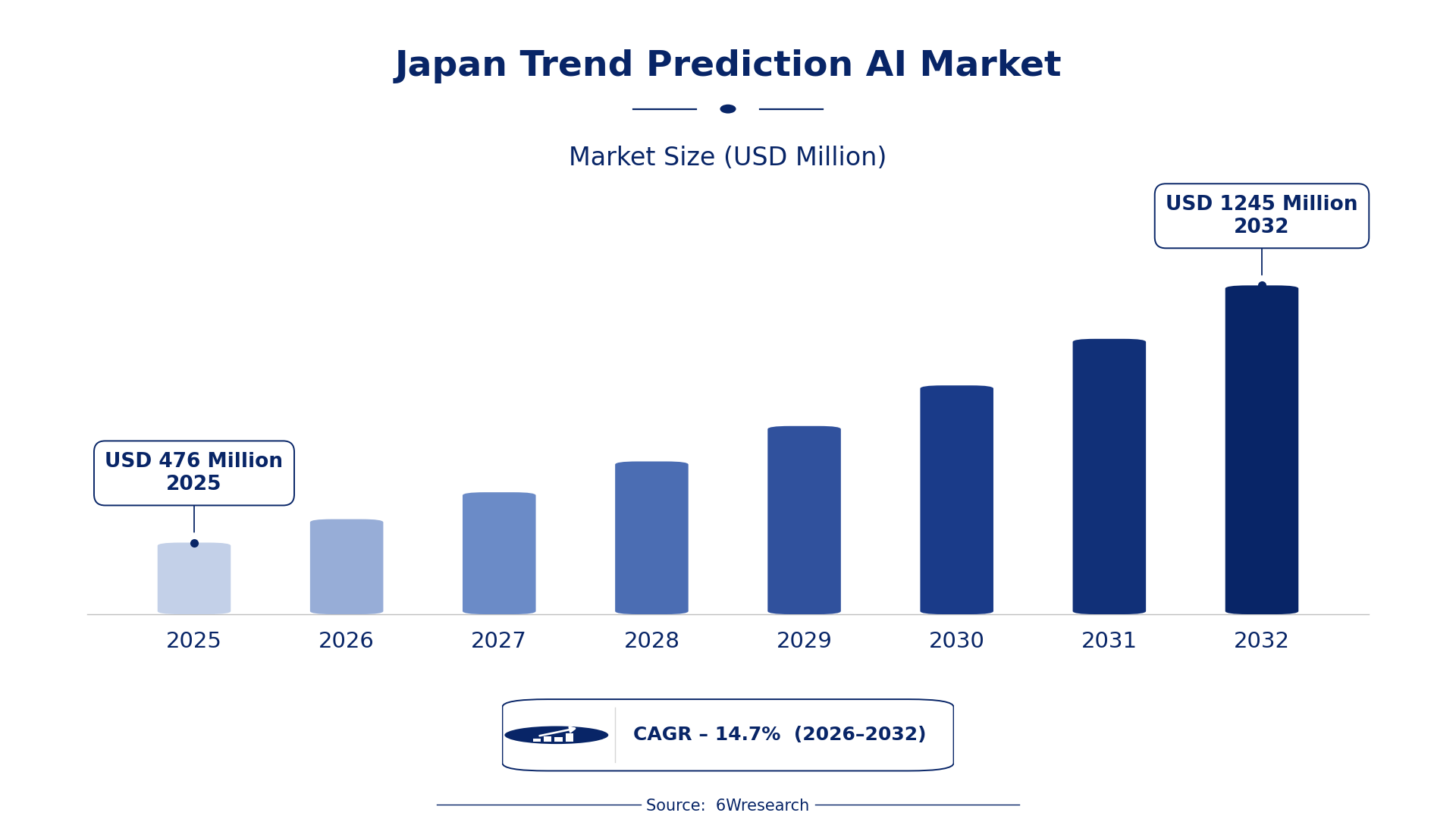
According to 6Wresearch internal database and industry insights, the Japan Trend Prediction AI Market was valued at USD 476 Million in 2025 and is projected to reach USD 1,245 Million by 2032, growing at a CAGR of approximately 14.7% during 2026–2032.
Japan Trend Prediction AI Market Highlights
| Report Metric | Details |
| Report Name | Japan Trend Prediction AI Market (2026-2032) |
| Market Size 2025 | USD 476 Million |
| Market Size 2032 | USD 1,245 Million |
| Absolute Growth 2025–2032 | USD 769 Million |
| CAGR 2026–2032 | 14.7% |
| Peak Annual Growth | 15.5% in 2028 |
| Forecast Period | 2026–2032 |
| Historical Data | 2022–2025 |
| Base Year | 2025 |
| Leading AI Type, 2025 | Predictive Analytics (43% share) |
| Leading Input Data Source, 2025 | Social Media/News Feeds (37% share) |
| Leading Application Area, 2025 | Fashion (46% share) |
| Leading End User, 2025 | E-commerce Companies (46% share) |
| Fastest-Growing AI Type | NLP-Based Insights (21.2% CAGR) |
| Fastest-Growing Input Data Source | Textual Trend Extraction (21.3% CAGR) |
| Fastest-Growing Application Area | Marketing Optimization (18.1% CAGR) |
| Fastest-Growing End User | Ad Agencies (19.1% CAGR) |
| Growing Sector | Marketing Optimization |
| Key End Users | Fashion, Retail Trends, Stock & Investment Trends, Product Forecasting |
Japan Trend Prediction AI Market Year-wise Growth Rate and Key Drivers (2022–2032)
This graph illustrates the annual growth rates of the market from 2022 to 2032, highlighting a steady upward trajectory and projected market expansion over the forecast period.
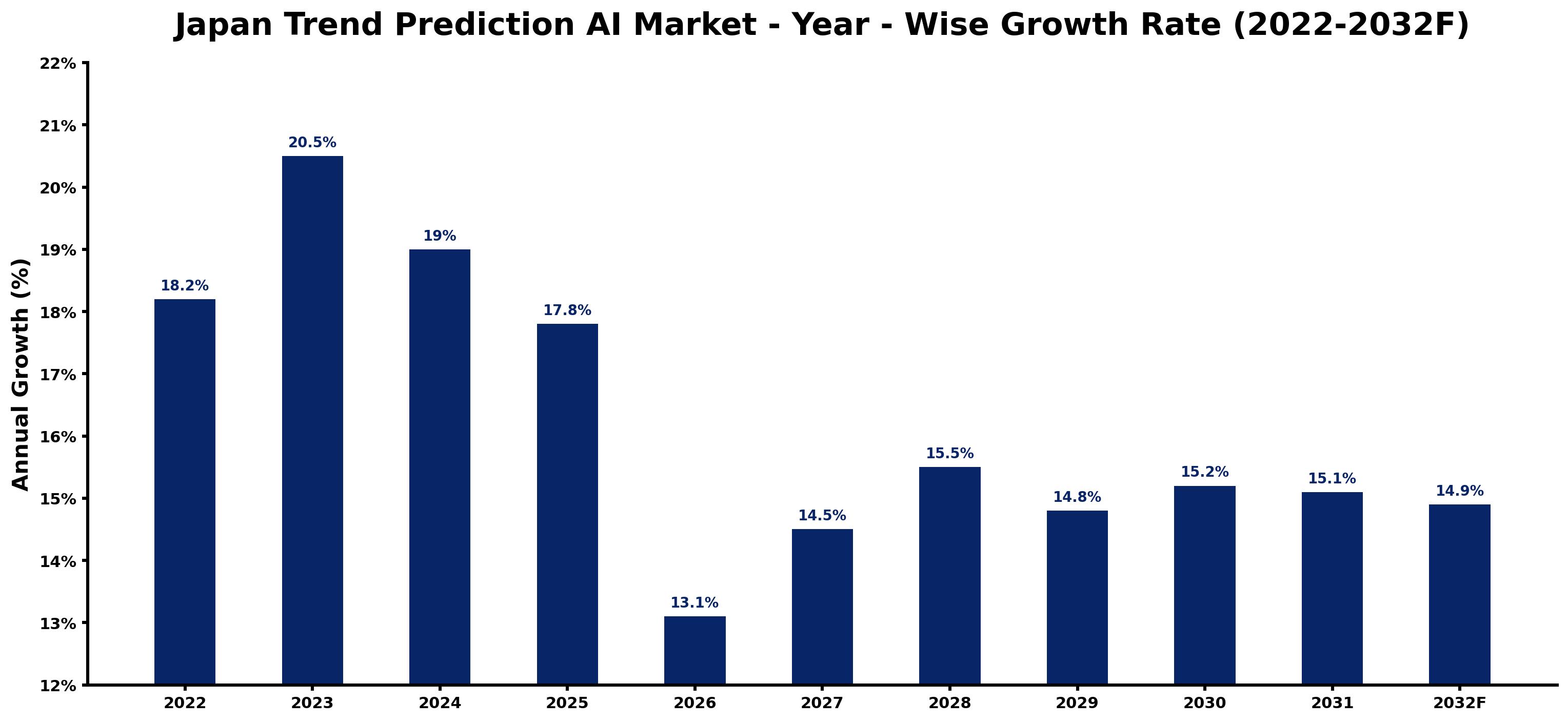
Each row of the following table gives one year's estimated growth and the event or demand shift that explains it.
| Year | Estimated Annual Growth (%) | Market Rationale |
| 2022 | 18.2 | The market exhibited strong growth due to increasing consumer spending and technological advancements. |
| 2023 | 20.5 | Growth accelerated as e-commerce companies expanded their reliance on predictive analytics for consumer insights. |
| 2024 | 19.0 | The market experienced a slowdown as investments in AI technology began to stabilise. |
| 2025 | 17.8 | Growth continued to slow as the market matured and competition intensified. |
| 2026 | 13.1 | A further slowdown is expected as the market adjusts to evolving consumer preferences and technological shifts. |
| 2027 | 14.5 | Demand will rise again as companies seek to improve marketing strategies through data-driven insights. |
| 2028 | 15.5 | The peak growth year will be driven by substantial investments in AI technologies across sectors. |
| 2029 | 14.8 | Growth will slow as the market begins to stabilise after reaching peak demand. |
| 2030 | 15.2 | A resurgence in growth is expected as AI adoption increases in various industries. |
| 2031 | 15.1 | The market will continue to grow as businesses adapt to changing consumer behaviours and trends. |
| 2032 | 14.9 | Growth will stabilise as the market reaches maturity and competition intensifies. |
Note: Market size estimations and growth projections presented in this report are based on 6Wresearch's proprietary forecasting methodology, utilizing the latest available industry data, government publications, and primary research inputs.
Japan Trend Prediction AI Market Synopsis
Trend Prediction AI employs algorithms and machine learning to analyse data and forecast future trends, primarily serving e-commerce and finance sectors. The Japan Trend Prediction AI Market is growing due to rising consumer spending, which reached 300 trillion yen in 2022, alongside government initiatives that support AI adoption. As businesses increasingly seek predictive analytics to optimise operations and marketing strategies, demand for this technology is poised for substantial growth.
Market Dynamics Impact Analysis (2026–2032)
| Factor | Type | Impact | Primary Segment Affected |
| Growing reliance on data analytics for consumer insights | Driver | High | Predictive Analytics |
| Increased investment in AI technologies by e-commerce companies | Driver | High | NLP-Based Insights |
| Expansion of AI applications in marketing strategies | Opportunity | High | Marketing Optimization |
| Rising demand for real-time data analysis in retail | Opportunity | High | Social Media/News Feeds |
| Concerns over data security and compliance with standards | Restraint | Medium | Financial + Market Data |
| Limited understanding of AI capabilities among potential users | Restraint | Medium | Consumer Behavior AI |
| High costs associated with implementing AI solutions | Challenge | High | E-commerce Companies |
| Rapid technological advancements leading to obsolescence | Challenge | High | Retail Chains |
Evaluation of Drivers in Japan Trend Prediction AI Market (2026–2032)
The following drivers explain most of the expected growth.
| Drivers | Primary Segment Affected | Why It Matters (Evidence) |
| Increasing consumer spending in Japan | Predictive Analytics | Consumer spending reached 300 trillion yen in 2022, driving demand for trend forecasting. |
| Investment in AI for marketing optimisation | NLP-Based Insights | Retail chains are allocating substantial resources to AI to enhance customer engagement and sales strategies. |
| Growth of e-commerce platforms | Social Media/News Feeds | The Tokyo metropolitan area serves as a major hub for e-commerce innovation, boosting demand for trend analysis. |
| Need for accurate stock predictions | Stock & Investment Trends | The Tokyo Stock Exchange relies on AI for stock trend predictions, increasing demand for predictive analytics. |
| Adoption of AI standards like ISO/IEC 27001 | Financial + Market Data | Compliance with data security standards is essential for AI applications, driving demand for secure solutions. |
Much of the new demand traces back to the increasing consumer spending in Japan, which reached 300 trillion yen in 2022. E-commerce companies are investing in AI technologies to improve marketing strategies, leading to a rise in predictive analytics usage. The Tokyo metropolitan area serves as a hub for retail innovation, further boosting demand for trend prediction. The Tokyo Stock Exchange utilises AI for accurate stock predictions, contributing to market growth. Compliance with standards like ISO/IEC 27001 drives demand for secure AI applications, ensuring data protection.
Evaluation of Restraints in Japan Trend Prediction AI Market
These are the pressures that could keep growth below its potential.
| Market Restraint | Primary Segment Affected | Why It Matters (Evidence) |
| Concerns over data security and compliance issues | Financial + Market Data | Data breaches can result in financial losses, affecting investment in AI technologies. |
| Limited understanding of AI capabilities among potential users | Consumer Behavior AI | Many businesses lack knowledge about AI's benefits, hindering adoption and investment. |
| High costs associated with implementing AI solutions | E-commerce Companies | The initial investment for AI systems can be prohibitive, restricting market entry for smaller firms. |
| Rapid technological advancements leading to obsolescence | Retail Chains | Keeping up with the latest AI technologies can be challenging and costly for retailers. |
| Regulatory compliance requirements slowing down implementation | NLP-Based Insights | Meeting compliance can delay the deployment of AI solutions in marketing strategies. |
Japan Trend Prediction AI Market Challenges
Limited access to advanced technology restricts the Trend Prediction AI market in Japan. Smaller firms struggle with initial investments, often exceeding several million yen, which delays their entry and diminishes competitiveness. Intense competition among domestic players drives prices down, resulting in quality compromises that buyers encounter when seeking reliable insights. A shortage of skilled professionals in AI development leads to project delays, costing firms valuable time and resources, as implementation can take up to 12 months longer than anticipated.
Trends in the Japan Trend Prediction AI Market
The trends below show where the Japan Trend Prediction AI Market is heading.
- Shift towards AI-driven Marketing Strategies: In 2023, the Japan Marketing Association initiated a programme for AI-driven marketing strategies, reflecting a shift in how companies approach consumer engagement. This trend is supported by the growing need for data-driven insights, with an estimated annual spending of several billion yen on AI technology.
- Transition from Traditional to Digital Retail: The fashion industry in Japan, valued at over 10 trillion yen, is increasingly relying on AI for trend forecasting. This shift began in 2023 as retailers sought to optimise inventory and design based on predictive analytics, improving responsiveness to consumer preferences.
- Emergence of Real-Time Data Analysis: The Tokyo metropolitan area is experiencing a rise in real-time data analysis for trend prediction, particularly in e-commerce. This trend started in 2023, driven by the need for immediate insights to inform marketing strategies and stock management.
- Prioritisation of Data Security Standards: ISO/IEC 27001 has become a priority for AI applications in Japan, particularly in the finance sector. The shift began in 2023 as companies recognised the importance of data security, leading to increased investments in compliant AI solutions.
Investment Opportunities in the Japan Trend Prediction AI Market
The following opportunities in the Japan Trend Prediction AI Market pair current demand with a clear way in.
- Gap in AI Adoption in Small Businesses: With the Japanese government aiming for a 30% increase in AI adoption by 2030, small businesses represent a substantial opportunity. E-commerce companies can benefit from AI solutions to improve their marketing strategies and operational efficiency.
- Growing Demand for Marketing Optimisation: The fashion industry is increasingly investing in AI for marketing optimisation, driven by the need for data-driven insights. Retail chains in Tokyo are seeking local partners to implement AI solutions that improve customer engagement.
- Need for Consumer Insights: As consumer preferences evolve, there is a growing demand for AI solutions that provide deeper insights. Ad agencies in Japan are looking to invest in AI technologies to better understand and predict consumer behaviour.
- Investment in Real-Time Data Solutions: The rise of e-commerce in Japan creates a need for real-time data analysis solutions. Retailers in the Tokyo area can explore partnerships with AI solution providers to improve their trend prediction capabilities.
Government Initiatives in the Japan Trend Prediction AI Market
The AI Promotion Act, established in 2025, lays the groundwork for AI research and development across various sectors. This law encourages producers to invest in AI technologies while ensuring compliance with national standards. The Digital Agency, established in September 2021, oversees the implementation of digital transformation initiatives, further supporting AI adoption in the market.
The Ministry of Economy, Trade and Industry plays an important role in promoting AI in retail through various funding programmes. These initiatives aim to support businesses in integrating AI technologies, improving their operational capabilities and ensuring compliance with relevant standards. The agency's efforts are expected to increase AI adoption across industries, benefitting producers and buyers alike.
Future Insight of the Japan Trend Prediction AI Market
By 2032, buyers in finance will increasingly utilise AI-driven tools for forecasting consumer behaviour, supported by government initiatives targeting a 30% increase in AI adoption. The Tokyo Stock Exchange will refine its predictive capabilities, employing advanced algorithms to enhance stock trend accuracy. Investment in AI for inventory management will rise, streamlining operations and improving customer insights. Annual spending on AI technology is anticipated to reach several billion yen, indicating a strong commitment to integrating AI across various sectors.
Market Segmentation Analysis
Japan Trend Prediction AI Market report covers a detailed analysis of the following market segments:
By AI Type – Predictive Analytics Leads, NLP-Based Insights Expected to Grow Fastest
According to Saurav Kr Singh, Senior Research Analyst at 6Wresearch, Predictive Analytics took 43% of ai type revenue in 2025, more than any other category. Predictive Analytics holds the largest share due to its critical role in forecasting trends through data analysis. This is particularly important in e-commerce, where accurate predictions are essential for aligning product offerings with consumer preferences. Over 2026–2032, NLP-Based Insights are expected to post the fastest growth, at a CAGR of 21.2%. NLP-Based Insights is experiencing rapid growth as businesses increasingly seek tools to process extensive textual data for trend identification. The surge in social media content has heightened the demand for extracting valuable insights from user-generated information. Suppliers need to focus on enhancing capabilities in textual analysis to address the growing need for insights in trend prediction.
By Input Data Source – Social Media/News Feeds Lead, Textual Trend Extraction Expected to Grow Fastest
The largest input data source category in 2025 was Social Media/News Feeds, at 37% of revenue. Social Media/News Feeds commands the largest share as it provides real-time data essential for effective trend analysis. This is particularly crucial in sectors like fashion, where timely insights can significantly influence design and inventory decisions. The quickest growth will come from Textual Trend Extraction, forecast to expand at a CAGR of 21.3% between 2026 and 2032. Textual Trend Extraction is the fastest-growing segment, propelled by the rising necessity for businesses to analyse unstructured text data for emerging trends. The growth of online content creation has highlighted the importance of deriving actionable insights from this data. Buyers should prioritise investments in solutions that leverage social media data to stay competitive in market trends.
By Application Area – Fashion Leads, Marketing Optimization Expected to Grow Fastest
Fashion accounted for 46% of the market by application area in 2025. Fashion leads the market as it heavily relies on trend predictions for design and inventory management. The industry's valuation of over 10 trillion yen underscores the need for precise forecasting to maintain a competitive advantage. Marketing Optimization is set to record the highest CAGR in this split, 18.1% over 2026–2032. Marketing Optimization is rapidly expanding as businesses strive to enhance their strategies using data-driven insights. The competitive landscape of marketing necessitates advanced analytics to boost campaign effectiveness and reach. Suppliers must adjust their offerings to support marketing optimisation initiatives across various sectors.
By End User – E-commerce Companies Lead, Ad Agencies Expected to Grow Fastest
E-commerce Companies held 46% of the Japan Trend Prediction AI Market by end user in 2025. E-commerce Companies represent the largest user group, employing trend prediction technologies to refine their sales strategies. The robust growth of the e-commerce sector in Japan positions these companies at the forefront of adopting advanced analytical solutions. Ad Agencies are projected to grow fastest, at a CAGR of 19.1% during 2026–2032. Ad Agencies are the fastest-growing segment, increasingly utilising trend prediction insights for targeted advertising campaigns. The demand for precise audience targeting in a competitive landscape is driving this swift adoption. Buyers in advertising should seek collaborations with technology providers that specialise in advanced trend prediction capabilities.
Key Attractiveness of the Report
- 10 Years of Market Numbers
- Historical Data Starting from 2022 to 2025
- Base Year 2025
- Forecast Data until 2032
- Key Performance Indicators Impacting the Market
- Major Upcoming Developments and Projects
Key Highlights of the Report:
- Japan Trend Prediction AI Market Outlook
- Market Size of Japan Trend Prediction AI Market, 2025
- Forecast of Japan Trend Prediction AI Market, 2032
- Historical Data and Forecast of Japan Trend Prediction AI Revenues & Volume for the Period 2022-2032F
- Japan Trend Prediction AI Market Trend Evolution
- Japan Trend Prediction AI Market Drivers and Challenges
- Japan Trend Prediction AI Price Trends
- Japan Trend Prediction AI Porter's Five Forces
- Japan Trend Prediction AI Industry Life Cycle
- Historical Data and Forecast of Japan Trend Prediction AI Market Revenues & Volume By AI Type for the Period 2022-2032F
- Historical Data and Forecast of Japan Trend Prediction AI Market Revenues & Volume By Predictive Analytics for the Period 2022-2032F
- Historical Data and Forecast of Japan Trend Prediction AI Market Revenues & Volume By Time-Series Forecasting for the Period 2022-2032F
- Historical Data and Forecast of Japan Trend Prediction AI Market Revenues & Volume By Consumer Behavior AI for the Period 2022-2032F
- Historical Data and Forecast of Japan Trend Prediction AI Market Revenues & Volume By NLP-Based Insights for the Period 2022-2032F
- Historical Data and Forecast of Japan Trend Prediction AI Market Revenues & Volume By Input Data Source for the Period 2022-2032F
- Historical Data and Forecast of Japan Trend Prediction AI Market Revenues & Volume By Social Media/News Feeds for the Period 2022-2032F
- Historical Data and Forecast of Japan Trend Prediction AI Market Revenues & Volume By Financial + Market Data for the Period 2022-2032F
- Historical Data and Forecast of Japan Trend Prediction AI Market Revenues & Volume By Purchase History for the Period 2022-2032F
- Historical Data and Forecast of Japan Trend Prediction AI Market Revenues & Volume By Textual Trend Extraction for the Period 2022-2032F
- Historical Data and Forecast of Japan Trend Prediction AI Market Revenues & Volume By Application Area for the Period 2022-2032F
- Historical Data and Forecast of Japan Trend Prediction AI Market Revenues & Volume By Fashion, Retail Trends for the Period 2022-2032F
- Historical Data and Forecast of Japan Trend Prediction AI Market Revenues & Volume By Stock & Investment Trends for the Period 2022-2032F
- Historical Data and Forecast of Japan Trend Prediction AI Market Revenues & Volume By Product Forecasting for the Period 2022-2032F
- Historical Data and Forecast of Japan Trend Prediction AI Market Revenues & Volume By Marketing Optimization for the Period 2022-2032F
- Historical Data and Forecast of Japan Trend Prediction AI Market Revenues & Volume By End User for the Period 2022-2032F
- Historical Data and Forecast of Japan Trend Prediction AI Market Revenues & Volume By E-commerce Companies for the Period 2022-2032F
- Historical Data and Forecast of Japan Trend Prediction AI Market Revenues & Volume By Hedge Funds for the Period 2022-2032F
- Historical Data and Forecast of Japan Trend Prediction AI Market Revenues & Volume By Retail Chains for the Period 2022-2032F
- Historical Data and Forecast of Japan Trend Prediction AI Market Revenues & Volume By Ad Agencies for the Period 2022-2032F
- Japan Trend Prediction AI Import Export Trade Statistics
- Market Opportunity Assessment By AI Type
- Market Opportunity Assessment By Input Data Source
- Market Opportunity Assessment By Application Area
- Market Opportunity Assessment By End User
- Japan Trend Prediction AI Top Companies Market Share
- Japan Trend Prediction AI Competitive Benchmarking By Technical and Operational Parameters
- Japan Trend Prediction AI Company Profiles
- Japan Trend Prediction AI Key Strategic Recommendations
Market Covered
The report covers the following segments.
By AI Type
- Predictive Analytics
- Time-Series Forecasting
- Consumer Behavior AI
- NLP-Based Insights
By Input Data Source
- Social Media/News Feeds
- Financial + Market Data
- Purchase History
- Textual Trend Extraction
By Application Area
- Fashion
- Retail Trends
- Stock & Investment Trends
- Product Forecasting
- Marketing Optimization
By End User
- E-commerce Companies
- Hedge Funds
- Retail Chains
- Ad Agencies































