Japan Trial Analytics AI Market Size & Growth Rate
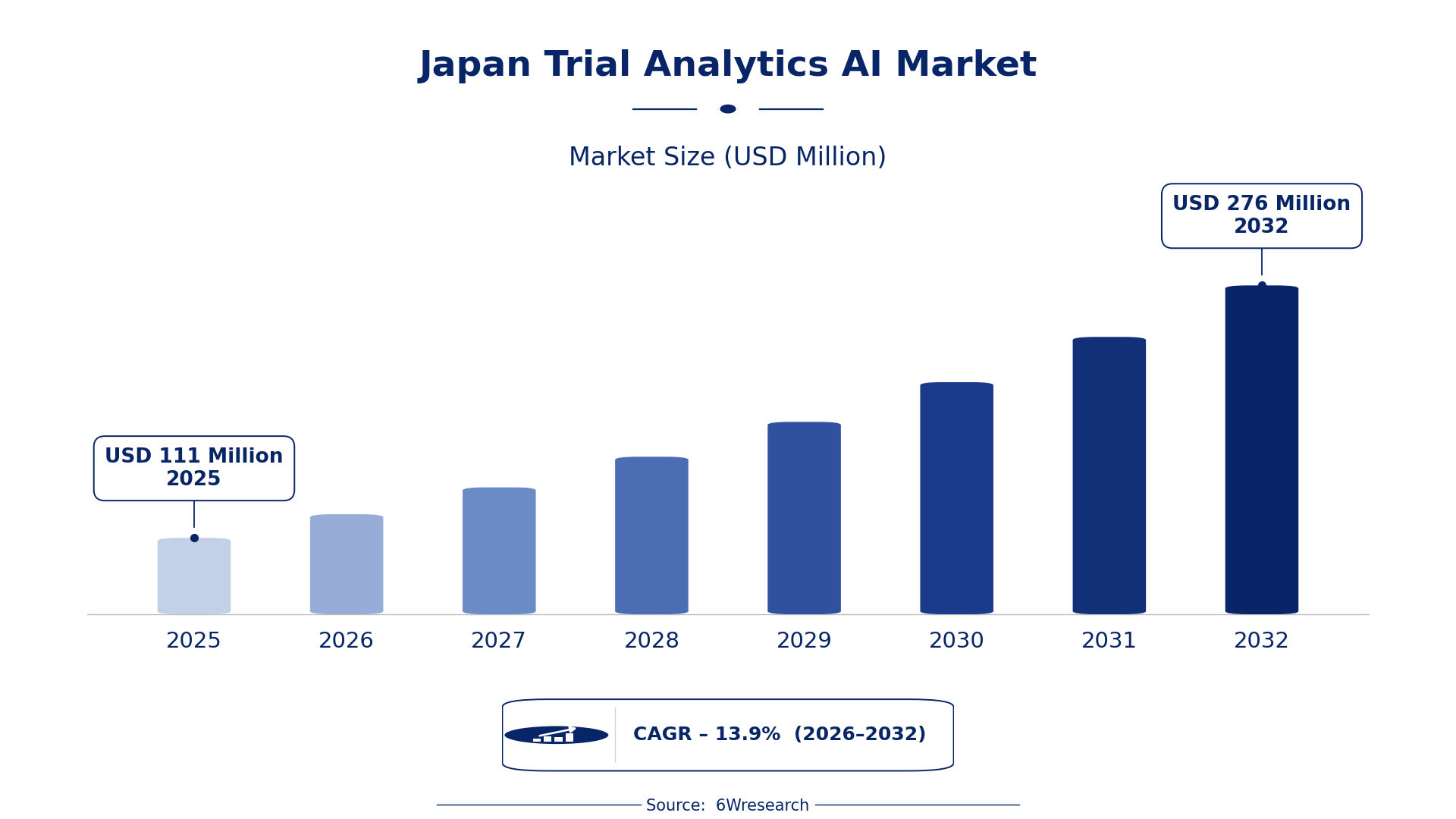
According to 6Wresearch internal database and industry insights, the Japan Trial Analytics AI Market was valued at USD 111 Million in 2025 and is projected to reach USD 276 Million by 2032, growing at a CAGR of approximately 13.9% during 2026–2032.
Japan Trial Analytics AI Market Highlights
| Report Metric | Details |
| Report Name | Japan Trial Analytics AI Market (2026-2032) |
| Market Size 2025 | USD 111 Million |
| Market Size 2032 | USD 276 Million |
| Absolute Growth 2025–2032 | USD 165 Million |
| CAGR 2026–2032 | 13.9% |
| Peak Annual Growth | 18.0% in 2032 |
| Forecast Period | 2026–2032 |
| Historical Data | 2022–2025 |
| Base Year | 2025 |
| Leading AI Type, 2025 | Patient Recruitment AI (39% share) |
| Leading Data Processed, 2025 | Demographics + Genomics (50% share) |
| Leading Application Area, 2025 | Faster Enrollment (46% share) |
| Leading End User, 2025 | Pharma Companies (49% share) |
| Fastest-Growing AI Type | Trial Risk Analytics (20.2% CAGR) |
| Fastest-Growing Application Area | Efficiency Metrics (16.9% CAGR) |
| Fastest-Growing End User | CROs (18.1% CAGR) |
| Growing Sector | clinical trial management |
| Key End Users | pharmaceutical companies, clinical research organizations, regulatory authorities, clinical research units |
Japan Trial Analytics AI Market Year-wise Growth Rate and Key Drivers (2022–2032)
This graph illustrates the annual growth rates of the market from 2022 to 2032, highlighting a steady upward trajectory and projected market expansion over the forecast period.
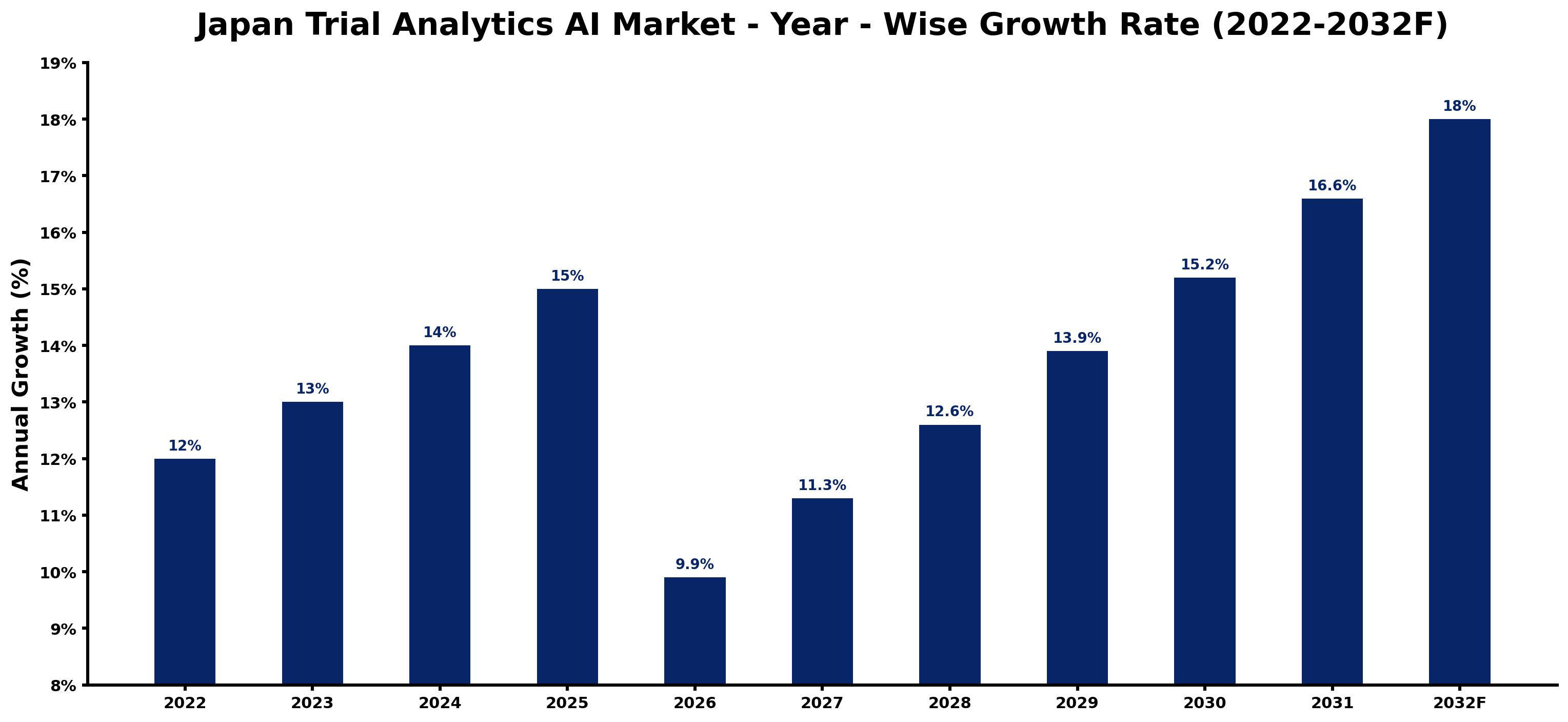
Year by year, the estimates below pair each growth rate with the development that shaped it.
| Year | Estimated Annual Growth (%) | Market Rationale |
| 2022 | 12.0 | The market displayed steady growth as clinical trials expanded across Japan. |
| 2023 | 13.0 | Growth accelerated due to heightened investments in trial technologies and analytics. |
| 2024 | 14.0 | The rise in demand for efficient patient recruitment methods drove further market expansion. |
| 2025 | 15.0 | The peak growth rate was achieved as major pharmaceutical companies embraced advanced analytics. |
| 2026 | 9.9 | Growth is expected to slow as the market begins to stabilise after rapid expansion. |
| 2027 | 11.3 | Demand will increase again as new technologies enhance trial efficiency and outcomes. |
| 2028 | 12.6 | The market is projected to continue growing as real-time monitoring tools gain traction. |
| 2029 | 13.9 | Growth will accelerate with the rising adoption of trial risk analytics among clinical research organizations. |
| 2030 | 15.2 | The upward trend is expected to persist as compliance with regulations becomes more stringent. |
| 2031 | 16.6 | Demand will surge as the focus on patient safety and data integrity intensifies. |
| 2032 | 18.0 | The market is expected to peak as innovative solutions transform trial processes. |
Note: Market size estimations and growth projections presented in this report are based on 6Wresearch's proprietary forecasting methodology, utilizing the latest available industry data, government publications, and primary research inputs.
Japan Trial Analytics AI Market Synopsis
Trial Analytics AI optimises clinical trial processes using artificial intelligence and machine learning algorithms. It improves patient recruitment, site performance, and compliance with regulatory standards. The Japan Trial Analytics AI Market is expanding due to the increasing number of clinical trials, driven by domestic pharmaceutical companies and research institutions. In 2023, over 1,000 clinical trials were registered annually, creating demand for technologies that reduce enrollment times and enhance trial outcomes. This growth is supported by ongoing investment in trial analytics solutions and a rising emphasis on patient safety.
Market Dynamics Impact Analysis (2026–2032)
| Factor | Type | Impact | Primary Segment Affected |
| Increasing number of clinical trials registered annually | Driver | High | Patient Recruitment AI |
| Adoption of real-time monitoring tools | Driver | High | Real-Time Monitoring |
| Growing need for efficient trial management | Opportunity | High | Site Performance AI |
| Rising focus on patient safety | Opportunity | High | Safety Monitoring |
| Regulatory compliance requirements | Restraint | Medium | Trial Risk Analytics |
| Limited awareness of AI technologies in smaller firms | Restraint | Medium | Faster Enrollment |
| High costs associated with implementing AI solutions | Challenge | High | Patient Recruitment AI |
| Shortage of skilled professionals in AI and analytics | Challenge | Medium | Site Performance AI |
Evaluation of Drivers in Japan Trial Analytics AI Market (2026–2032)
Below are the drivers that matter most for revenue growth, with supporting evidence.
| Drivers | Primary Segment Affected | Why It Matters (Evidence) |
| Over 1,000 clinical trials registered annually | Patient Recruitment AI | This high volume drives demand for efficient patient identification and recruitment strategies. |
| Patient Recruitment AI reduces enrollment times by up to 30% | Faster Enrollment | This efficiency attracts pharmaceutical companies seeking to expedite trial timelines. |
| Real-Time Monitoring tools are adopted in 70% of new trials | Real-Time Monitoring | This widespread use increases oversight and compliance, boosting demand for analytics. |
| Safety Monitoring is mandated by the PMDA | Safety Monitoring | Regulatory requirements compel firms to invest in analytics for patient safety assurance. |
| Trial Risk Analytics assesses potential risks in protocols | Trial Risk Analytics | This capability helps firms mitigate risks, driving demand for advanced analytics solutions. |
Buyers are adding capacity as over 1,000 clinical trials are registered annually in Japan, creating strong demand for efficient patient recruitment technologies. The ability of Patient Recruitment AI to reduce enrollment times by up to 30% prompts pharmaceutical companies to invest more in these solutions. Real-Time Monitoring tools are now used in 70% of new trials, increasing compliance and oversight.
Evaluation of Restraints in Japan Trial Analytics AI Market
These restraints slow adoption and weigh on supplier margins.
| Market Restraint | Primary Segment Affected | Why It Matters (Evidence) |
| Regulatory compliance requirements can be complex and time-consuming | Trial Risk Analytics | These requirements necessitate extensive documentation, which can delay trial processes. |
| Limited awareness of AI technologies among smaller firms | Faster Enrollment | This lack of knowledge restricts adoption, hindering overall market growth. |
| High costs associated with implementing AI solutions | Patient Recruitment AI | These costs can deter smaller firms from investing in necessary technologies. |
| Shortage of skilled professionals in AI and analytics | Site Performance AI | This shortage limits the ability of firms to effectively utilise advanced analytics. |
| Data privacy concerns may restrict data sharing | Real-Time Monitoring | Such concerns can hinder the implementation of effective monitoring solutions. |
Japan Trial Analytics AI Market Challenges
Producers face high costs from lengthy clinical trials, which average 24 months, delaying drug availability and raising development expenses. Competition intensifies among around 200 clinical research organizations, resulting in price wars that can erode profit margins for producers. Many distributors encounter difficulties with technology adoption, as only 70% of new trials implement real-time monitoring tools, reducing efficiency and data accuracy. Strict regulatory compliance mandated by the Pharmaceuticals and Medical Devices Agency leads to potential delays in trial approvals, impacting timelines for buyers and increasing costs associated with extended project durations.
Trends in the Japan Trial Analytics AI Market
Several trends are reshaping the Japan Trial Analytics AI Market; the most important are set out below.
- Shift towards Real-Time Monitoring in Clinical Trials: The adoption of Real-Time Monitoring tools has surged, with 75% of new trials implementing these systems in 2023. This shift improves trial oversight and compliance, resulting in better patient safety.
- Increased Focus on Patient Recruitment Efficiency: The emphasis on faster patient enrollment has led to the widespread use of Patient Recruitment AI, which can reduce enrollment times by up to 30%. This trend is reshaping recruitment strategies across the industry.
- Growth of Trial Risk Analytics Solutions: Trial Risk Analytics is gaining traction, with a projected CAGR of 20.2% from 2026 to 2032. This growth reflects the increasing need for risk assessment in clinical trial protocols.
- Expansion of CROs in Japan: The number of clinical research organizations (CROs) has reached around 200, supporting the growing demand for trial analytics. This expansion facilitates better management of clinical trials across the country.
Investment Opportunities in the Japan Trial Analytics AI Market
The following areas offer the clearest openings for investors and suppliers in the Japan Trial Analytics AI Market.
- Pharmaceutical Companies seeking efficient trial solutions: With over 1,000 clinical trials registered annually, there is an opportunity to supply advanced analytics tools that improve patient recruitment and site performance.
- Clinical Research Units in major hubs: The presence of Clinical Research Units in Tokyo and Osaka creates a demand for trial analytics solutions. Suppliers can enter this market through local partnerships.
- Growing investment in trial technologies: As the market expands, there is an opportunity to invest in AI-driven solutions that streamline trial processes, particularly in the context of regulatory compliance.
- Increasing focus on patient safety: The rising emphasis on patient safety presents an opportunity to supply analytics tools that ensure compliance with safety monitoring requirements.
Government Initiatives in the Japan Trial Analytics AI Market
The AI Promotion Act, established in 2025, creates a national framework for the development and use of AI technologies in clinical trials. This law encourages pharmaceutical companies to adopt AI solutions, improving trial efficiency and compliance with regulatory standards. The Digital Agency, established in September 2021, supports digital transformation in healthcare, promoting the integration of AI in clinical research and enhancing operational capabilities.
The Clinical Trials Act, in force since 2018, sets rules for conducting clinical research to ensure transparency and safety. The Pharmaceuticals and Medical Devices Agency oversees compliance with these regulations, impacting how clinical research units and CROs implement trial analytics. The Health and Labour Sciences Research Grant also supports innovation in clinical trials, funding projects that utilise advanced analytics to improve outcomes.
Future Insight of the Japan Trial Analytics AI Market
Investment in trial analytics will surge, creating substantial demand for Trial Analytics AI as government support and innovation grants flow into the sector. With over 1,000 clinical trials registered annually, the competition will drive technological advancements and improve patient recruitment processes. Real-time monitoring tools will facilitate faster trial completion, while adherence to ISO 14155 standards will elevate compliance and quality in research practices. These developments will empower both buyers and suppliers to optimise their operations and outcomes.
Market Segmentation Analysis
Japan Trial Analytics AI Market report covers a detailed analysis of the following market segments:
By AI Type – Patient Recruitment AI Leads, Trial Risk Analytics Expected to Grow Fastest
According to Saurav Kr Singh, Senior Research Analyst at 6Wresearch, in 2025, Patient Recruitment AI led the ai type split with a 39% share. Patient Recruitment AI holds the largest share as it directly aids in identifying suitable candidates for trials, which is crucial for trial success. Its ability to reduce enrollment times by up to 30% makes it highly valuable to clinical researchers in Japan. Trial Risk Analytics is set to record the highest CAGR in this split, 20.2% over 2026–2032. Trial Risk Analytics is experiencing rapid growth due to its capacity to assess potential risks in trial protocols, which is vital in today's regulatory environment. The increasing emphasis on safety monitoring mandated by the PMDA further accelerates this segment's expansion. Suppliers should focus on enhancing features that improve risk assessment capabilities to meet the growing demand.
By Data Processed – Demographics + Genomics Lead and Record the Fastest Growth
Demographics + Genomics held 50% of the Japan Trial Analytics AI Market by data processed in 2025. Demographics + Genomics dominates this segment as it plays a critical role in supporting recruitment strategies, allowing for more targeted patient selection. This approach is essential in a country with a growing elderly demographic, influencing trial participation. Demographics + Genomics are also forecast to expand faster than any other category, at a CAGR of 15.8% over 2026–2032. The same segment, Demographics + Genomics, is also the fastest growing due to its dual role in recruitment and its relevance in understanding patient profiles. As the population ages, the need for tailored approaches in trials will continue to rise, driving further growth. Buyers should invest in technologies that enhance demographic and genomic data integration to optimise trial outcomes.
By Application Area – Faster Enrollment Leads, Efficiency Metrics Expected to Grow Fastest
Faster Enrollment accounted for 46% of the market by application area in 2025. Faster Enrollment leads the application area as it is a primary goal of using Trial Analytics AI, directly impacting the efficiency of clinical trials. The focus on reducing the average trial duration of approximately 24 months is a key driver behind its popularity. Over 2026–2032, Efficiency Metrics are expected to post the fastest growth, at a CAGR of 16.9%. Efficiency Metrics is the fastest growing area as it measures the success of trial processes and timelines, providing critical insights for improvement. The increasing adoption of these metrics in trial analytics reflects the industry's push for more effective operations. Suppliers must prioritise the development of tools that provide comprehensive efficiency metrics to stay competitive.
By End User – Pharma Companies Lead, CROs Expected to Grow Fastest
With 49% of end user revenue in 2025, Pharma Companies was the largest category. Pharma Companies are the leading end users of Trial Analytics AI, as they rely heavily on these tools for drug development and to streamline their clinical trials. Their significant investment in trial analytics underscores the importance of these technologies in the pharmaceutical sector. CROs are projected to grow fastest, at a CAGR of 18.1% during 2026–2032. CROs are the fastest growing end user group, utilising these tools to manage clinical trials efficiently and meet the demands of their pharmaceutical clients. The increasing number of registered CROs in Japan highlights the expanding market for trial analytics solutions. Suppliers should tailor their offerings to meet the specific needs of CROs to capture this growing market segment.
Key Attractiveness of the Report
- 10 Years of Market Numbers
- Historical Data Starting from 2022 to 2025
- Base Year 2025
- Forecast Data until 2032
- Key Performance Indicators Impacting the Market
- Major Upcoming Developments and Projects
Key Highlights of the Report:
- Japan Trial Analytics AI Market Outlook
- Market Size of Japan Trial Analytics AI Market, 2025
- Forecast of Japan Trial Analytics AI Market, 2032
- Historical Data and Forecast of Japan Trial Analytics AI Revenues & Volume for the Period 2022-2032F
- Japan Trial Analytics AI Market Trend Evolution
- Japan Trial Analytics AI Market Drivers and Challenges
- Japan Trial Analytics AI Price Trends
- Japan Trial Analytics AI Porter's Five Forces
- Japan Trial Analytics AI Industry Life Cycle
- Historical Data and Forecast of Japan Trial Analytics AI Market Revenues & Volume By AI Type for the Period 2022-2032F
- Historical Data and Forecast of Japan Trial Analytics AI Market Revenues & Volume By Patient Recruitment AI for the Period 2022-2032F
- Historical Data and Forecast of Japan Trial Analytics AI Market Revenues & Volume By Site Performance AI for the Period 2022-2032F
- Historical Data and Forecast of Japan Trial Analytics AI Market Revenues & Volume By Trial Risk Analytics for the Period 2022-2032F
- Historical Data and Forecast of Japan Trial Analytics AI Market Revenues & Volume By Real-Time Monitoring for the Period 2022-2032F
- Historical Data and Forecast of Japan Trial Analytics AI Market Revenues & Volume By Data Processed for the Period 2022-2032F
- Historical Data and Forecast of Japan Trial Analytics AI Market Revenues & Volume By Demographics + Genomics for the Period 2022-2032F
- Historical Data and Forecast of Japan Trial Analytics AI Market Revenues & Volume By Historical Trial Data for the Period 2022-2032F
- Historical Data and Forecast of Japan Trial Analytics AI Market Revenues & Volume By Protocol Deviations for the Period 2022-2032F
- Historical Data and Forecast of Japan Trial Analytics AI Market Revenues & Volume By EHR + Wearables for the Period 2022-2032F
- Historical Data and Forecast of Japan Trial Analytics AI Market Revenues & Volume By Application Area for the Period 2022-2032F
- Historical Data and Forecast of Japan Trial Analytics AI Market Revenues & Volume By Faster Enrollment for the Period 2022-2032F
- Historical Data and Forecast of Japan Trial Analytics AI Market Revenues & Volume By Efficiency Metrics for the Period 2022-2032F
- Historical Data and Forecast of Japan Trial Analytics AI Market Revenues & Volume By Safety Monitoring for the Period 2022-2032F
- Historical Data and Forecast of Japan Trial Analytics AI Market Revenues & Volume By Participant Compliance for the Period 2022-2032F
- Historical Data and Forecast of Japan Trial Analytics AI Market Revenues & Volume By End User for the Period 2022-2032F
- Historical Data and Forecast of Japan Trial Analytics AI Market Revenues & Volume By Pharma Companies for the Period 2022-2032F
- Historical Data and Forecast of Japan Trial Analytics AI Market Revenues & Volume By CROs for the Period 2022-2032F
- Historical Data and Forecast of Japan Trial Analytics AI Market Revenues & Volume By Regulatory Authorities for the Period 2022-2032F
- Historical Data and Forecast of Japan Trial Analytics AI Market Revenues & Volume By Clinical Research Units for the Period 2022-2032F
- Japan Trial Analytics AI Import Export Trade Statistics
- Market Opportunity Assessment By AI Type
- Market Opportunity Assessment By Data Processed
- Market Opportunity Assessment By Application Area
- Market Opportunity Assessment By End User
- Japan Trial Analytics AI Top Companies Market Share
- Japan Trial Analytics AI Competitive Benchmarking By Technical and Operational Parameters
- Japan Trial Analytics AI Company Profiles
- Japan Trial Analytics AI Key Strategic Recommendations
Market Covered
Segments analysed in this report are listed below.
By AI Type
- Patient Recruitment AI
- Site Performance AI
- Trial Risk Analytics
- Real-Time Monitoring
By Data Processed
- Demographics + Genomics
- Historical Trial Data
- Protocol Deviations
- EHR + Wearables
By Application Area
- Faster Enrollment
- Efficiency Metrics
- Safety Monitoring
- Participant Compliance
By End User
- Pharma Companies
- CROs
- Regulatory Authorities
- Clinical Research Units































