Japan Trial Data Analytics AI Market Size & Growth Rate
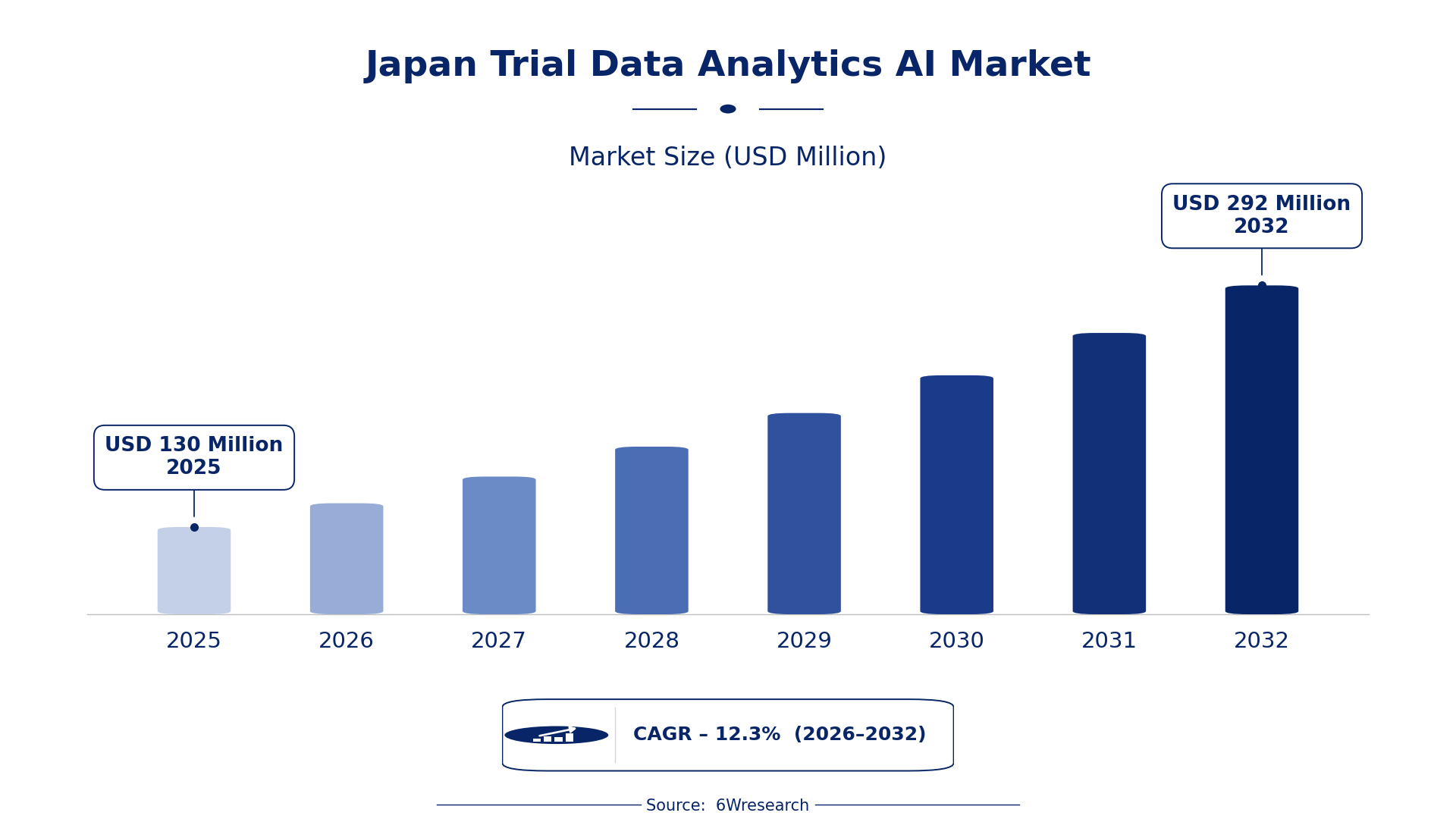
According to 6Wresearch internal database and industry insights, the Japan Trial Data Analytics AI Market was valued at USD 130 Million in 2025 and is projected to reach USD 292 Million by 2032, growing at a CAGR of approximately 12.3% during 2026–2032.
Japan Trial Data Analytics AI Market Highlights
| Report Metric | Details |
| Report Name | Japan Trial Data Analytics AI Market (2026-2032) |
| Market Size 2025 | USD 130 Million |
| Market Size 2032 | USD 292 Million |
| Absolute Growth 2025–2032 | USD 162 Million |
| CAGR 2026–2032 | 12.3% |
| Peak Annual Growth | 15.9% in 2026 |
| Forecast Period | 2026–2032 |
| Historical Data | 2022–2025 |
| Base Year | 2025 |
| Leading Analytics Focus, 2025 | Predictive Efficacy (44% share) |
| Leading Data Sources, 2025 | Clinical Trial Results (40% share) |
| Leading Outcome Type, 2025 | Trial Success Probability (40% share) |
| Leading End User, 2025 | Pharmaceutical Firms (40% share) |
| Fastest-Growing Analytics Focus | Adverse Event Detection (15.4% CAGR) |
| Fastest-Growing Data Sources | Wearables & Lab Results (17.7% CAGR) |
| Fastest-Growing Outcome Type | Trial Continuity (16.6% CAGR) |
| Fastest-Growing End User | Research Hospitals (15.2% CAGR) |
| Growing Sector | Pharmaceutical Research |
| Key End Users | Pharmaceutical Firms, Research Hospitals, Clinical Research Organisations |
Japan Trial Data Analytics AI Market Year-wise Growth Rate and Key Drivers (2022–2032)
This graph illustrates the annual growth rates of the market from 2022 to 2032, highlighting a steady upward trajectory and projected market expansion over the forecast period.
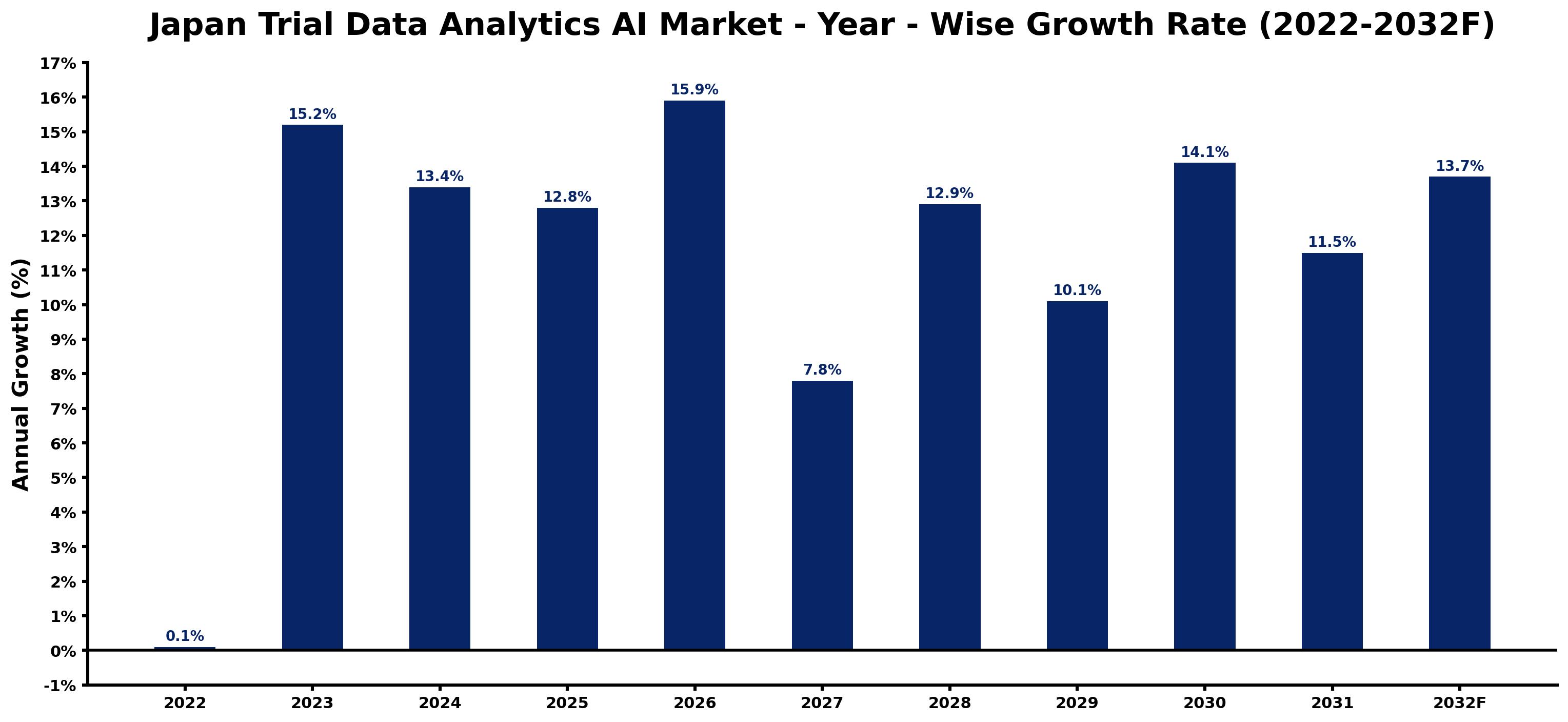
Year by year, the estimates below pair each growth rate with the development that shaped it.
| Year | Estimated Annual Growth (%) | Market Rationale |
| 2022 | 0.1 | The market experienced minimal growth due to initial adoption phases. |
| 2023 | 15.2 | Growth accelerated as more pharmaceutical firms integrated advanced analytics into their processes. |
| 2024 | 13.4 | The market continued to grow, but at a slower pace as early adopters stabilised their operations. |
| 2025 | 12.8 | Growth slowed further as the market matured and competition among providers increased. |
| 2026 | 15.9 | Demand surged again as new technologies and methodologies gained traction in clinical trials. |
| 2027 | 7.8 | Growth is expected to slow as market saturation begins to take effect among established firms. |
| 2028 | 12.9 | Demand is projected to increase as more research hospitals adopt data analytics solutions for trials. |
| 2029 | 10.1 | The market is expected to grow at a slower rate as the focus shifts to optimising existing systems and processes. |
| 2030 | 14.1 | Growth is anticipated to accelerate again as new AI applications are introduced in clinical trial methodologies. |
| 2031 | 11.5 | The market is projected to see a slowdown as firms consolidate their positions in the analytics space. |
| 2032 | 13.7 | Demand is expected to rise as clinical trials expand, driven by new drug developments and innovations. |
Note: Market size estimations and growth projections presented in this report are based on 6Wresearch's proprietary forecasting methodology, utilizing the latest available industry data, government publications, and primary research inputs.
Japan Trial Data Analytics AI Market Synopsis
Trial Data Analytics AI employs advanced algorithms and machine learning techniques to analyse clinical trial data, optimising trial designs and ensuring patient safety. The Japan Trial Data Analytics AI Market is expanding due to a strong pharmaceutical sector, with 1,200 active clinical trials registered in 2023. The government allocated ¥10 billion for clinical research funding, while the adoption of AI in clinical trials is projected to reach 50% by 2025, stimulating further demand from pharmaceutical firms and research hospitals.
Market Dynamics Impact Analysis (2026–2032)
| Factor | Type | Impact | Primary Segment Affected |
| Growing adoption of AI technologies in clinical trials | Driver | High | Predictive Efficacy |
| Increased funding for clinical research | Driver | High | Clinical Trial Results |
| Emerging demand for real-time data analysis | Opportunity | High | Wearables & Lab Results |
| Rising need for patient safety measures | Opportunity | High | Adverse Event Detection |
| Limited awareness of advanced analytics benefits | Restraint | Medium | Dropout Risk Forecast |
| Regulatory hurdles in data usage | Restraint | Medium | Statistical Correlation |
| High competition among analytics providers | Challenge | High | CROs |
| Integration of new technologies into existing systems | Challenge | Medium | Pharmaceutical Firms |
Evaluation of Drivers in Japan Trial Data Analytics AI Market (2026–2032)
The following drivers explain most of the expected growth.
| Drivers | Primary Segment Affected | Why It Matters (Evidence) |
| Increased investment in drug development | Clinical Trial Results | In 2023, over 70% of research hospitals utilised advanced data analytics, enhancing trial efficiency. |
| Rising patient safety concerns | Adverse Event Detection | Clinical trial success rates in Japan are around 60% for Phase III trials, necessitating improved safety measures. |
| Growing number of active clinical trials | Predictive Efficacy | Japan had 1,200 active clinical trials registered in 2023, driving demand for predictive analytics. |
| Government funding for clinical research | Wearables & Lab Results | The government allocated ¥10 billion for clinical research funding in 2023, boosting analytics adoption. |
| Increased use of wearable devices | Trial Success Probability | Wearable devices are used in 30% of clinical trials, providing valuable data for success probability analysis. |
Buyers are adding capacity as the number of active clinical trials in Japan reached 1,200 in 2023, creating a demand for predictive analytics solutions. Patient safety measures are critical, with clinical trial success rates around 60% for Phase III trials, prompting pharmaceutical firms to invest in advanced data analytics. Over 70% of research hospitals now utilise advanced data analytics, indicating a strong shift towards data-driven decision-making. The integration of wearable devices in 30% of trials provides additional data, improving trial efficiency and outcomes.
Evaluation of Restraints in Japan Trial Data Analytics AI Market
The key brakes on demand, and where they bite hardest, are shown below.
| Market Restraint | Primary Segment Affected | Why It Matters (Evidence) |
| Limited understanding of analytics benefits among smaller firms | Dropout Risk Forecast | Many smaller pharmaceutical firms lack awareness of the advantages of advanced analytics, hindering their adoption in trials. |
| Complex regulatory environment for data usage | Statistical Correlation | The Pharmaceuticals and Medical Devices Agency oversees strict regulations, complicating data integration for analytics purposes. |
| High costs associated with implementing AI solutions | Adverse Event Detection | The initial investment required for AI technologies can deter smaller firms from adopting these solutions effectively. |
| Insufficient training for staff on new technologies | Predictive Efficacy | Many firms struggle to train staff adequately, limiting the effective use of advanced analytics in clinical trials. |
| Resistance to change within established firms | Trial Success Probability | Established firms may resist adopting new technologies, preferring traditional methods despite their inefficiencies. |
Japan Trial Data Analytics AI Market Challenges
Japan hosts 1,200 active clinical trials, yet a shortage of skilled data analysts limits the effective application of advanced algorithms, delaying trial results for producers by an average of six months. Complex regulations from the Pharmaceuticals and Medical Devices Agency can extend approval timelines, impacting buyers who rely on timely data for decision-making, leading to potential revenue losses of up to ¥1 billion. Intense competition among research hospitals for funding often results in inadequate trial designs, which compromises the quality of insights available to producers. The rising need for AI integration forces buyers to invest in new systems, increasing operational costs by 20%.
Trends in the Japan Trial Data Analytics AI Market
The shifts below are changing how Japan Trial Data Analytics AI Market products are bought and supplied.
- Shift towards Real-Time Data Analytics: Japan's clinical trials are increasingly adopting real-time data analytics, with 30% of trials using wearable devices in 2023. This shift improves trial efficiency and patient monitoring, allowing for quicker decision-making.
- Adoption Rate of AI in Clinical Trials: The adoption rate of AI in clinical trials is projected to reach 50% by 2025, reflecting a trend towards automation. This integration will streamline processes and improve trial outcomes.
- Increased Focus on Patient Safety: Pharmaceutical firms are prioritising patient safety, with over 70% of research hospitals utilising advanced data analytics. This focus is critical as clinical trial success rates are around 60% for Phase III trials.
- Expansion of Clinical Trials in Urban Areas: The Tokyo region is emerging as a hub for clinical trials, with a government aim to increase trial numbers by 20% by 2025. This expansion is likely to attract more research hospitals and pharmaceutical firms.
Investment Opportunities in the Japan Trial Data Analytics AI Market
Investors looking at the Japan Trial Data Analytics AI Market should consider the following areas.
- Supply Advanced Data Analytics Solutions: The demand for advanced data analytics solutions in Japan's clinical trials is strong, with over 70% of research hospitals already utilising them. Suppliers can enter this market by partnering with local firms.
- Invest in AI Technologies for Clinical Trials: With the adoption rate of AI projected to reach 50% by 2025, there is a gap for investment in AI technologies. Research hospitals are key buyers, and local partnerships can facilitate entry.
- Develop Wearable Devices for Clinical Trials: The use of wearable devices in clinical trials is increasing, with 30% of trials incorporating them. Suppliers can target pharmaceutical firms looking to enhance data collection and patient monitoring.
- Enhance Training Programs for Analytics Adoption: As firms face challenges in staff training, developing effective training programs can meet the demand for skilled personnel in analytics. Research hospitals are seeking practical training solutions.
Government Initiatives in the Japan Trial Data Analytics AI Market
The Clinical Trials Act, enacted in 2017, streamlined trial processes and established clear guidelines for conducting clinical research. Following this, the Next-Generation Medical Infrastructure Act of 2017 enabled certified bodies to anonymise medical data for research, promoting innovation in analytics. The AI Promotion Act, introduced in 2025, creates a national framework for AI research and development, encouraging the adoption of AI technologies in clinical trials, which is important for optimising trial designs and improving patient safety.
Pharmaceutical firms benefit from the Digital Agency's initiatives, which support the integration of digital health technologies in clinical trials. The agency oversees the implementation of standards that improve data collection and analysis. In 2023, the government allocated ¥10 billion for clinical research funding, which supports projects that leverage AI and big data, ultimately enhancing trial efficiency and success rates. This funding is crucial for research hospitals aiming to adopt advanced analytics in their operations.
Future Insight of the Japan Trial Data Analytics AI Market
New clinical research facilities will emerge, boosting analytics capabilities for suppliers. By 2032, the integration of AI in clinical trials is expected to facilitate data processing, improving efficiency and reducing trial durations. The use of wearable devices in 30% of trials will provide real-time patient insights, enhancing safety and outcomes. Government-backed digital health initiatives will streamline processes, benefiting buyers and suppliers as they adopt more efficient methodologies.
Market Segmentation Analysis
Japan Trial Data Analytics AI Market report covers a detailed analysis of the following market segments:
By Analytics Focus – Predictive Efficacy Leads, Adverse Event Detection Expected to Grow Fastest
According to Saurav Kr Singh, Senior Research Analyst at 6Wresearch, Predictive Efficacy held 44% of the Japan Trial Data Analytics AI Market by analytics focus in 2025. Predictive Efficacy holds the largest share due to its essential role in forecasting outcomes in clinical trials, which is crucial for successful drug development. The 1,200 active clinical trials registered in Japan create a strong demand for precise predictive capabilities. The quickest growth will come from Adverse Event Detection, forecast to expand at a CAGR of 15.4% between 2026 and 2032. Adverse Event Detection is experiencing rapid growth because it plays a critical role in ensuring patient safety, especially as clinical trial complexities increase. Government initiatives aimed at enhancing safety measures in trials further accelerate this segment's expansion. Suppliers should prioritise advancements in predictive analytics to meet the increasing demands of the pharmaceutical sector.
By Data Sources – Clinical Trial Results Lead, Wearables & Lab Results Expected to Grow Fastest
In 2025, Clinical Trial Results led the data sources split with a 40% share. Clinical Trial Results lead the market as they are a fundamental data source for analytics, providing vital information for evaluating trial outcomes. This reliance is underscored by the significant number of active clinical trials in Japan that depend on these results. Wearables & Lab Results are set to record the highest CAGR in this split, 17.7% over 2026–2032. Wearables & Lab Results are the fastest-growing segment as they provide supplemental data that enriches trial insights, particularly with wearable devices being utilised in 30% of trials. This growth is supported by government initiatives that promote digital health integration. Buyers should consider incorporating diverse data sources to improve their trial analytics capabilities.
By Outcome Type – Trial Success Probability Leads, Trial Continuity Expected to Grow Fastest
Trial Success Probability took 40% of outcome type revenue in 2025, more than any other category. Trial Success Probability is the leading outcome type as it is a key metric for trial planning, directly influencing decisions in drug development. This significance is underscored by the clinical trial success rates of approximately 60% for Phase III trials in Japan. Trial Continuity is projected to grow fastest, at a CAGR of 16.6% during 2026–2032. Trial Continuity is growing rapidly because it is vital for maintaining trial integrity, especially with the government's goal to increase clinical trials by 20% by 2025. This emphasis on continuity ensures trials remain effective and viable. Suppliers need to create solutions that improve trial continuity to accommodate the increasing number of clinical trials.
By End User – Pharmaceutical Firms Lead, Research Hospitals Expected to Grow Fastest
Pharmaceutical Firms accounted for 40% of the market by end user in 2025. Pharmaceutical Firms represent the largest share of end users as they are the primary users of analytics in clinical trials, driving the demand for effective data analysis. Their involvement is highlighted by Japan's strong drug development landscape and the number of ongoing trials. Over 2026–2032, Research Hospitals are expected to post the fastest growth, at a CAGR of 15.2%. Research Hospitals are the fastest-growing end user group as they significantly contribute to trial data and are increasingly adopting advanced analytics. Their role is becoming more prominent due to government support for digital health initiatives and the need for improved trial efficiency. Buyers in research hospitals should invest in advanced analytics to strengthen their contributions to clinical trials.
Key Attractiveness of the Report
- 10 Years of Market Numbers
- Historical Data Starting from 2022 to 2025
- Base Year 2025
- Forecast Data until 2032
- Key Performance Indicators Impacting the Market
- Major Upcoming Developments and Projects
Key Highlights of the Report:
- Japan Trial Data Analytics AI Market Outlook
- Market Size of Japan Trial Data Analytics AI Market, 2025
- Forecast of Japan Trial Data Analytics AI Market, 2032
- Historical Data and Forecast of Japan Trial Data Analytics AI Revenues & Volume for the Period 2022-2032F
- Japan Trial Data Analytics AI Market Trend Evolution
- Japan Trial Data Analytics AI Market Drivers and Challenges
- Japan Trial Data Analytics AI Price Trends
- Japan Trial Data Analytics AI Porter's Five Forces
- Japan Trial Data Analytics AI Industry Life Cycle
- Historical Data and Forecast of Japan Trial Data Analytics AI Market Revenues & Volume By Analytics Focus for the Period 2022-2032F
- Historical Data and Forecast of Japan Trial Data Analytics AI Market Revenues & Volume By Predictive Efficacy for the Period 2022-2032F
- Historical Data and Forecast of Japan Trial Data Analytics AI Market Revenues & Volume By Adverse Event Detection for the Period 2022-2032F
- Historical Data and Forecast of Japan Trial Data Analytics AI Market Revenues & Volume By Dropout Risk Forecast for the Period 2022-2032F
- Historical Data and Forecast of Japan Trial Data Analytics AI Market Revenues & Volume By Statistical Correlation for the Period 2022-2032F
- Historical Data and Forecast of Japan Trial Data Analytics AI Market Revenues & Volume By Data Sources for the Period 2022-2032F
- Historical Data and Forecast of Japan Trial Data Analytics AI Market Revenues & Volume By Clinical Trial Results for the Period 2022-2032F
- Historical Data and Forecast of Japan Trial Data Analytics AI Market Revenues & Volume By Wearables & Lab Results for the Period 2022-2032F
- Historical Data and Forecast of Japan Trial Data Analytics AI Market Revenues & Volume By Behavioral + Medical Data for the Period 2022-2032F
- Historical Data and Forecast of Japan Trial Data Analytics AI Market Revenues & Volume By Large Trial Datasets for the Period 2022-2032F
- Historical Data and Forecast of Japan Trial Data Analytics AI Market Revenues & Volume By Outcome Type for the Period 2022-2032F
- Historical Data and Forecast of Japan Trial Data Analytics AI Market Revenues & Volume By Trial Success Probability for the Period 2022-2032F
- Historical Data and Forecast of Japan Trial Data Analytics AI Market Revenues & Volume By Safety Profiling for the Period 2022-2032F
- Historical Data and Forecast of Japan Trial Data Analytics AI Market Revenues & Volume By Trial Continuity for the Period 2022-2032F
- Historical Data and Forecast of Japan Trial Data Analytics AI Market Revenues & Volume By Phase Progress Analysis for the Period 2022-2032F
- Historical Data and Forecast of Japan Trial Data Analytics AI Market Revenues & Volume By End User for the Period 2022-2032F
- Historical Data and Forecast of Japan Trial Data Analytics AI Market Revenues & Volume By Pharmaceutical Firms for the Period 2022-2032F
- Historical Data and Forecast of Japan Trial Data Analytics AI Market Revenues & Volume By Research Hospitals for the Period 2022-2032F
- Historical Data and Forecast of Japan Trial Data Analytics AI Market Revenues & Volume By Trial Coordinators for the Period 2022-2032F
- Historical Data and Forecast of Japan Trial Data Analytics AI Market Revenues & Volume By CROs for the Period 2022-2032F
- Japan Trial Data Analytics AI Import Export Trade Statistics
- Market Opportunity Assessment By Analytics Focus
- Market Opportunity Assessment By Data Sources
- Market Opportunity Assessment By Outcome Type
- Market Opportunity Assessment By End User
- Japan Trial Data Analytics AI Top Companies Market Share
- Japan Trial Data Analytics AI Competitive Benchmarking By Technical and Operational Parameters
- Japan Trial Data Analytics AI Company Profiles
- Japan Trial Data Analytics AI Key Strategic Recommendations
Market Covered
Coverage by segment is as follows.
By Analytics Focus
- Predictive Efficacy
- Adverse Event Detection
- Dropout Risk Forecast
- Statistical Correlation
By Data Sources
- Clinical Trial Results
- Wearables & Lab Results
- Behavioral + Medical Data
- Large Trial Datasets
By Outcome Type
- Trial Success Probability
- Safety Profiling
- Trial Continuity
- Phase Progress Analysis
By End User
- Pharmaceutical Firms
- Research Hospitals
- Trial Coordinators
- CROs































