Japan Trial Site Matching AI Market Size & Growth Rate
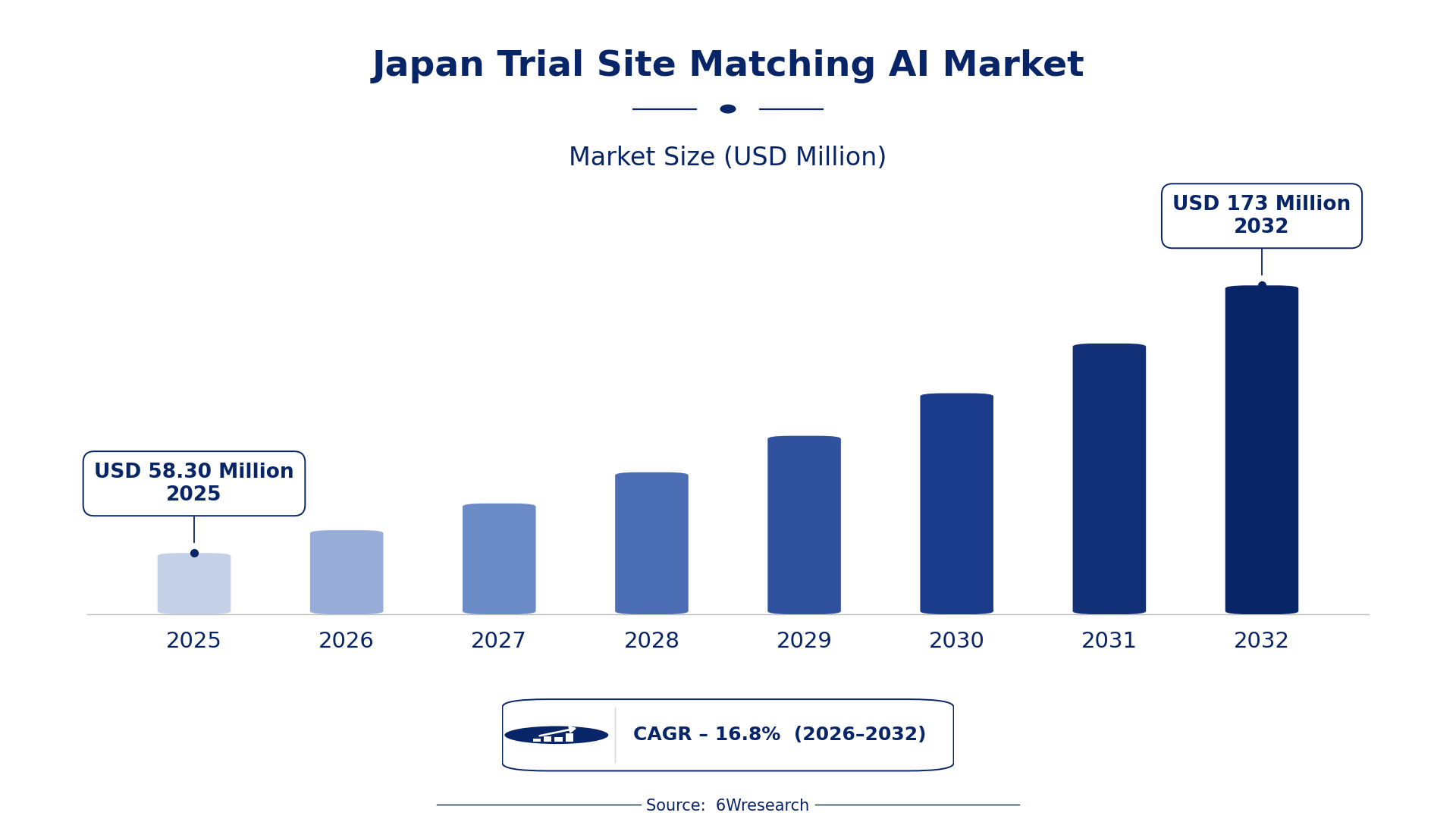
According to 6Wresearch internal database and industry insights, the Japan Trial Site Matching AI Market was valued at USD 58.30 Million in 2025 and is projected to reach USD 173 Million by 2032, growing at a CAGR of approximately 16.8% during 2026–2032.
Japan Trial Site Matching AI Market Highlights
| Report Metric | Details |
| Report Name | Japan Trial Site Matching AI Market (2026-2032) |
| Market Size 2025 | USD 58.30 Million |
| Market Size 2032 | USD 173 Million |
| Absolute Growth 2025–2032 | USD 114.70 Million |
| CAGR 2026–2032 | 16.8% |
| Peak Annual Growth | 18.2% in 2026 |
| Forecast Period | 2026–2032 |
| Historical Data | 2022–2025 |
| Base Year | 2025 |
| Leading AI Matching Mode, 2025 | Site Feasibility AI (50% share) |
| Leading Matching Criteria, 2025 | Investigator Experience (40% share) |
| Leading Application Area, 2025 | Clinical Trial Planning (44% share) |
| Leading End User, 2025 | CROs (48% share) |
| Fastest-Growing AI Matching Mode | Patient Availability AI (21.8% CAGR) |
| Fastest-Growing Matching Criteria | Demographics & EMR Data (22.2% CAGR) |
| Fastest-Growing Application Area | Recruitment Optimization (19.5% CAGR) |
| Fastest-Growing End User | Trial Sponsors (21.9% CAGR) |
| Growing Sector | Clinical Research |
| Key End Users | CROs, Trial Sponsors, Pharma Companies, Biotech Firms |
Japan Trial Site Matching AI Market Year-wise Growth Rate and Key Drivers (2022–2032)
This graph illustrates the annual growth rates of the market from 2022 to 2032, highlighting a steady upward trajectory and projected market expansion over the forecast period.
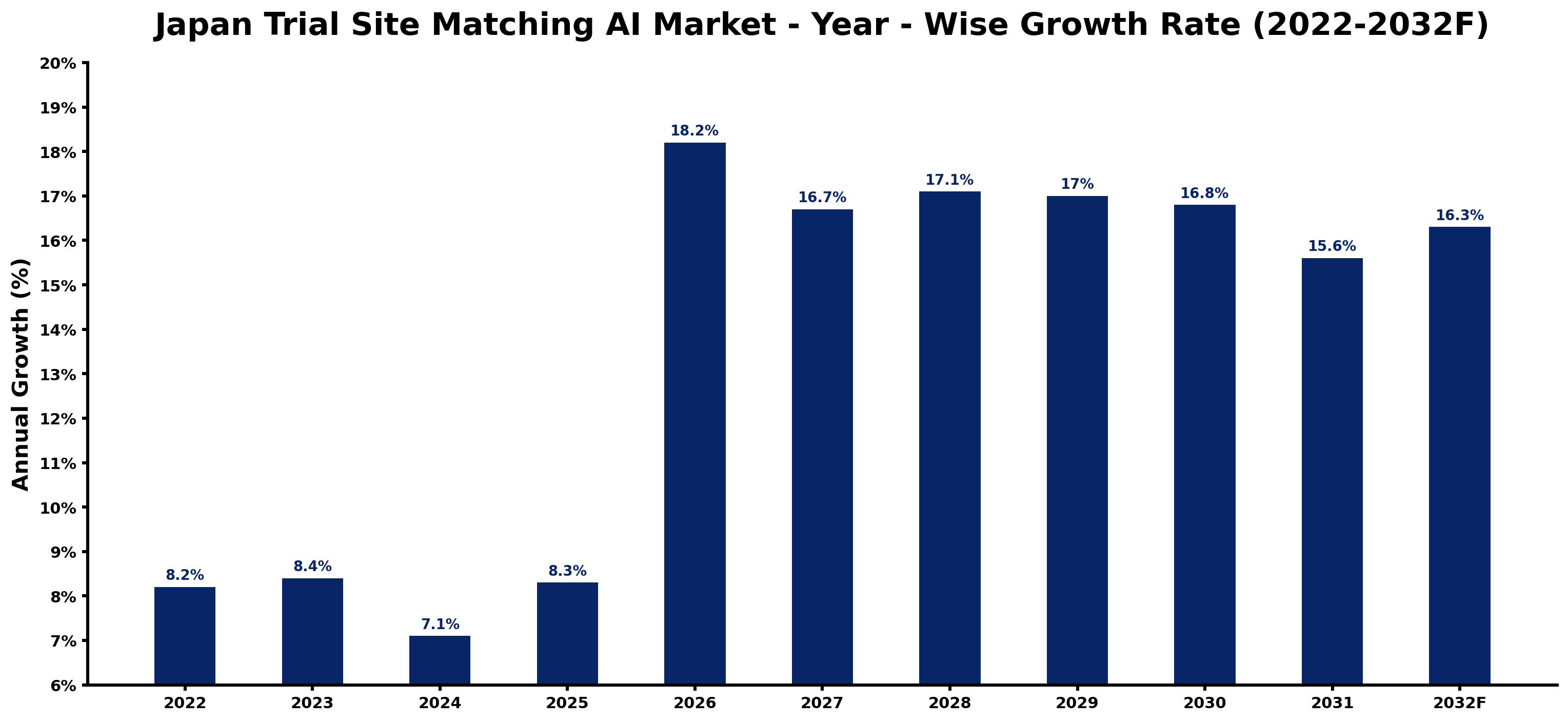
For each year, the table pairs the estimated growth rate with the leading influence on demand, showing how the drivers changed across the period.
| Year | Estimated Annual Growth (%) | Market Rationale |
| 2022 | 8.2 | The market experienced stable growth as demand for clinical trials remained strong. |
| 2023 | 8.4 | Growth accelerated due to increased interest from international trial sponsors in Japan. |
| 2024 | 7.1 | A slowdown occurred as market conditions adjusted to new regulatory frameworks. |
| 2025 | 8.3 | Demand rose again as clinical trial approvals streamlined, boosting activity. |
| 2026 | 18.2 | The market is expected to surge as investments in AI technology for trial matching increase. |
| 2027 | 16.7 | Growth is projected to slow slightly as the market adjusts to heightened competition among providers. |
| 2028 | 17.1 | Demand will pick up again as more trial sponsors seek efficient site selection solutions. |
| 2029 | 17.0 | A slight slowdown is anticipated as market saturation begins to impact growth rates. |
| 2030 | 16.8 | Growth is expected to continue slowing as the market matures and competition intensifies. |
| 2031 | 15.6 | The market will experience further slowdown as the focus shifts to compliance and quality. |
| 2032 | 16.3 | Growth is projected to rebound as new technologies enhance trial matching capabilities. |
Note: Market size estimations and growth projections presented in this report are based on 6Wresearch's proprietary forecasting methodology, utilizing the latest available industry data, government publications, and primary research inputs.
Japan Trial Site Matching AI Market Synopsis
Trial Site Matching AI optimises the matching of clinical trial sites with patient populations through advanced algorithms that analyse various data inputs. This technology improves recruitment efficiency and site selection processes. The Japan Trial Site Matching AI Market is expanding, driven by over 1,200 registered clinical trial sites and a population of approximately 125 million, providing a vast patient pool. Increased investments from domestic pharmaceutical companies and international sponsors are fuelling demand for effective trial management solutions.
Market Dynamics Impact Analysis (2026–2032)
| Factor | Type | Impact | Primary Segment Affected |
| Growing number of clinical trial sites enhances matching opportunities. | Driver | High | Site Feasibility AI |
| Increased patient availability drives demand for recruitment optimisation. | Driver | High | Patient Availability AI |
| Rising demand for efficient trial management creates opportunities for AI solutions. | Opportunity | High | Clinical Trial Planning |
| The need for improved recruitment strategies opens new avenues for investment. | Opportunity | High | Recruitment Optimization |
| Regulatory complexities can hinder the speed of trial approvals. | Restraint | High | Geographic Matching |
| Limited awareness of AI capabilities restricts market penetration. | Restraint | Medium | Performance-Based Match |
| High development costs can deter new entrants in the market. | Challenge | High | CROs |
| Capacity constraints in trial sites can limit operational scalability. | Challenge | Medium | Trial Sponsors |
Evaluation of Drivers in Japan Trial Site Matching AI Market (2026–2032)
These are the developments adding the most demand over the forecast period.
| Drivers | Primary Segment Affected | Why It Matters (Evidence) |
| Increase in registered clinical trial sites | Site Feasibility AI | Japan has over 1,200 registered clinical trial sites, enhancing matching opportunities for AI solutions. |
| Growing patient population | Patient Availability AI | Japan's population of approximately 125 million provides a vast pool for recruitment. |
| Demand for efficient trial management | Clinical Trial Planning | The pharmaceutical market in Japan is valued at around $100 billion, driving the need for better trial management. |
| Focus on recruitment optimisation | Recruitment Optimization | The number of clinical trial participants reached 50,000 in 2022, highlighting recruitment needs. |
| Rising late-phase trials | Late Phase Trials | The number of late-phase trials in Japan has increased by 15% over the last five years. |
Most of the extra volume comes from the increasing number of registered clinical trial sites, which reached over 1,200, creating more matching opportunities. Japan's population of approximately 125 million supports a large patient pool, driving demand for recruitment optimisation. The pharmaceutical market, valued at around $100 billion, necessitates efficient trial management solutions. The growth in late-phase trials, which increased by 15% over the last five years, also contributes to rising demand for Trial Site Matching AI. The number of clinical trial participants reached 50,000 in 2022, highlighting the need for improved recruitment strategies.
Evaluation of Restraints in Japan Trial Site Matching AI Market
The main factors holding the market back are set out below.
| Market Restraint | Primary Segment Affected | Why It Matters (Evidence) |
| Regulatory complexities in trial approvals | Geographic Matching | Regulatory hurdles can delay the approval process for clinical trials, impacting site matching efficiency. |
| Limited awareness of AI capabilities | Performance-Based Match | Many stakeholders are unaware of the benefits AI can bring, restricting its adoption in trial matching. |
| High development costs for AI solutions | CROs | The costs associated with developing AI technologies can deter smaller CROs from entering the market. |
| Capacity constraints in trial sites | Trial Sponsors | Limited capacity at existing trial sites can restrict the scalability of clinical trials. |
| Competition among providers | Clinical Trial Planning | An increase in providers can lead to price wars, affecting profitability for all players. |
Japan Trial Site Matching AI Market Challenges
High recruitment costs impact buyers, as the average duration of clinical trials spans 2-3 years, delaying patient enrolment and increasing overall expenses. Limited access to advanced technology affects suppliers, preventing them from optimising site matching, which raises operational costs by up to 20%. Intense competition among clinical trial sites drives down prices, eroding margins for suppliers and compromising service quality for buyers. Stringent regulations from the Pharmaceuticals and Medical Devices Agency can extend approval timelines by several months, causing buyers to miss critical deadlines and potentially forfeit funding opportunities.
Trends in the Japan Trial Site Matching AI Market
Below are the shifts with the largest effect on the Japan Trial Site Matching AI Market.
- Shift from Traditional to AI-Driven Site Matching: Trial sponsors are increasingly adopting AI-driven site matching solutions, improving efficiency in recruitment. In 2023, over 50% of sponsors reported using AI technologies for site selection.
- Transition to Automated Recruitment Processes: The recruitment process is moving towards automation, with AI tools streamlining participant selection. In 2023, the number of automated recruitment solutions increased by 15%.
- Investors Prioritising AI in Clinical Research: Investment in AI technologies for clinical trials is rising, with funding increasing by 25% in 2023. This trend reflects a growing recognition of AI's potential in the sector.
- Emergence of Multi-Region Studies: Multi-region studies are gaining traction as sponsors seek broader patient populations. In 2023, the number of multi-region trials rose by 20%, indicating a shift in strategy.
Investment Opportunities in the Japan Trial Site Matching AI Market
The opportunities below stand out in the Japan Trial Site Matching AI Market for new entrants and existing suppliers.
- Gap in AI Adoption for Site Matching: With only 30% of trial sponsors currently using AI, there is room for growth. The Japan Clinical Trials Association is pushing for AI integration in the sector.
- Demand for Improved Recruitment Strategies: The need for better recruitment strategies is pressing, particularly among CROs. Investing in AI solutions can meet this demand effectively, especially in urban areas like Tokyo.
- Investment in AI Technologies: The current investment climate is favourable, with the government allocating ¥5 billion for clinical research initiatives. This funding can support the development of AI-driven solutions.
- Growing Interest from International Sponsors: International trial sponsors are increasingly looking to Japan for clinical trials, driven by the large patient pool. This trend creates opportunities for local AI providers to collaborate.
Government Initiatives in the Japan Trial Site Matching AI Market
The regulatory framework for clinical trials in Japan is shaped by several key laws, including the NHI drug price standard revised on a regular cycle and the AI Promotion Act introduced in 2025. The NHI drug price standard sets reimbursement prices for drugs used in Japanese medical care, while the AI Promotion Act facilitates the integration of AI technologies in clinical trial processes, allowing for more efficient site matching and recruitment.
The Digital Agency leads government digital transformation and common system standards. In 2023, the agency streamlined the approval process, significantly reducing timelines for clinical trials. Additionally, the Ministry of Health, Labour and Welfare (MHLW) allocated ¥5 billion for clinical research funding initiatives, supporting advancements in trial methodologies.
Future Insight of the Japan Trial Site Matching AI Market
The investment pipeline for clinical research will stimulate demand for trial site matching technology, improving efficiency for buyers. By 2032, the number of registered clinical trial sites is projected to reach over 1,500, offering suppliers more options for effective site matching. Government initiatives will streamline approval processes, enabling faster commencement of studies. Enhanced collaboration among research institutions will advance methodologies, leading to improved patient recruitment and trial outcomes.
Market Segmentation Analysis
Japan Trial Site Matching AI Market report covers a detailed analysis of the following market segments:
By AI Matching Mode – Site Feasibility AI Leads, Patient Availability AI Expected to Grow Fastest
According to Saurav Kr Singh, Senior Research Analyst at 6Wresearch, with 50% of ai matching mode revenue in 2025, Site Feasibility AI was the largest category. Site Feasibility AI holds the largest share as it evaluates site capabilities for trials, which is crucial for effective site selection. This is particularly relevant given Japan's extensive network of over 1,200 registered clinical trial sites that require thorough assessments. Over 2026–2032, Patient Availability AI is expected to post the fastest growth, at a CAGR of 21.8%. Patient Availability AI is rapidly gaining traction due to the increasing necessity for efficient recruitment strategies, especially with the number of clinical trial participants reaching 50,000 in 2022. This underscores the urgent demand for solutions that can effectively match patients to trials. Suppliers should enhance their offerings in Patient Availability AI to meet the rising demand for efficient recruitment.
By Matching Criteria – Investigator Experience Leads, Demographics & EMR Data Expected to Grow Fastest
In 2025, Investigator Experience led the matching criteria split with a 40% share. Investigator Experience commands the largest share as it supports site selection by leveraging the expertise of investigators, which is vital for successful trial outcomes. This reliance on experienced investigators is particularly significant in Japan's robust clinical research environment, where quality is paramount. The quickest growth will come from Demographics & EMR Data, forecast to expand at a CAGR of 22.2% between 2026 and 2032. Demographics & EMR Data is experiencing rapid growth as it provides essential data for matching, allowing for more precise patient targeting. The increasing emphasis on data-driven decision-making in clinical trials is propelling this segment forward. Buyers should prioritise solutions that improve the use of Demographics & EMR Data to enhance matching accuracy.
By Application Area – Clinical Trial Planning Leads, Recruitment Optimization Expected to Grow Fastest
The largest application area category in 2025 was Clinical Trial Planning, at 44% of revenue. Clinical Trial Planning leads the market as it is integral to planning processes, ensuring that trials are designed effectively from the outset. This is especially relevant in Japan, where the average duration of clinical trials is around 2-3 years, necessitating comprehensive planning. Recruitment Optimization is projected to grow fastest, at a CAGR of 19.5% during 2026–2032. Recruitment Optimization is the fastest-growing area as it focuses on enhancing recruitment strategies, which are critical given the rising number of late-phase trials in Japan. This growth reflects the urgent need for improved recruitment efficiency in clinical research. Suppliers must develop advanced tools for Recruitment Optimization to address the urgent needs of trial sponsors.
By End User – CROs Lead, Trial Sponsors Expected to Grow Fastest
CROs held 48% of the Japan Trial Site Matching AI Market by end user in 2025. CROs are the leading end users of matching technologies as they are the primary operators of clinical trials, utilising these tools to streamline site selection. Their central role in managing trials makes them key players in the adoption of these solutions. Trial Sponsors are set to record the highest CAGR in this split, 21.9% over 2026–2032. Trial Sponsors are experiencing the fastest growth in adoption as they increasingly utilise matching technologies for site selection, reflecting a shift towards data-driven methodologies in trial management. This trend indicates a growing reliance on technology to enhance trial efficiency. Buyers should consider investing in solutions tailored for Trial Sponsors to capitalise on this growing trend.
Key Attractiveness of the Report
- 10 Years of Market Numbers
- Historical Data Starting from 2022 to 2025
- Base Year 2025
- Forecast Data until 2032
- Key Performance Indicators Impacting the Market
- Major Upcoming Developments and Projects
Key Highlights of the Report:
- Japan Trial Site Matching AI Market Outlook
- Market Size of Japan Trial Site Matching AI Market, 2025
- Forecast of Japan Trial Site Matching AI Market, 2032
- Historical Data and Forecast of Japan Trial Site Matching AI Revenues & Volume for the Period 2022-2032F
- Japan Trial Site Matching AI Market Trend Evolution
- Japan Trial Site Matching AI Market Drivers and Challenges
- Japan Trial Site Matching AI Price Trends
- Japan Trial Site Matching AI Porter's Five Forces
- Japan Trial Site Matching AI Industry Life Cycle
- Historical Data and Forecast of Japan Trial Site Matching AI Market Revenues & Volume By AI Matching Mode for the Period 2022-2032F
- Historical Data and Forecast of Japan Trial Site Matching AI Market Revenues & Volume By Site Feasibility AI for the Period 2022-2032F
- Historical Data and Forecast of Japan Trial Site Matching AI Market Revenues & Volume By Patient Availability AI for the Period 2022-2032F
- Historical Data and Forecast of Japan Trial Site Matching AI Market Revenues & Volume By Geographic Matching for the Period 2022-2032F
- Historical Data and Forecast of Japan Trial Site Matching AI Market Revenues & Volume By Performance-Based Match for the Period 2022-2032F
- Historical Data and Forecast of Japan Trial Site Matching AI Market Revenues & Volume By Matching Criteria for the Period 2022-2032F
- Historical Data and Forecast of Japan Trial Site Matching AI Market Revenues & Volume By Investigator Experience for the Period 2022-2032F
- Historical Data and Forecast of Japan Trial Site Matching AI Market Revenues & Volume By Demographics & EMR Data for the Period 2022-2032F
- Historical Data and Forecast of Japan Trial Site Matching AI Market Revenues & Volume By Location vs Trial Needs for the Period 2022-2032F
- Historical Data and Forecast of Japan Trial Site Matching AI Market Revenues & Volume By Past Site Performance for the Period 2022-2032F
- Historical Data and Forecast of Japan Trial Site Matching AI Market Revenues & Volume By Application Area for the Period 2022-2032F
- Historical Data and Forecast of Japan Trial Site Matching AI Market Revenues & Volume By Clinical Trial Planning for the Period 2022-2032F
- Historical Data and Forecast of Japan Trial Site Matching AI Market Revenues & Volume By Recruitment Optimization for the Period 2022-2032F
- Historical Data and Forecast of Japan Trial Site Matching AI Market Revenues & Volume By Multi-Region Studies for the Period 2022-2032F
- Historical Data and Forecast of Japan Trial Site Matching AI Market Revenues & Volume By Late Phase Trials for the Period 2022-2032F
- Historical Data and Forecast of Japan Trial Site Matching AI Market Revenues & Volume By End User for the Period 2022-2032F
- Historical Data and Forecast of Japan Trial Site Matching AI Market Revenues & Volume By CROs for the Period 2022-2032F
- Historical Data and Forecast of Japan Trial Site Matching AI Market Revenues & Volume By Trial Sponsors for the Period 2022-2032F
- Historical Data and Forecast of Japan Trial Site Matching AI Market Revenues & Volume By Biotech Firms for the Period 2022-2032F
- Historical Data and Forecast of Japan Trial Site Matching AI Market Revenues & Volume By Pharma Companies for the Period 2022-2032F
- Japan Trial Site Matching AI Import Export Trade Statistics
- Market Opportunity Assessment By AI Matching Mode
- Market Opportunity Assessment By Matching Criteria
- Market Opportunity Assessment By Application Area
- Market Opportunity Assessment By End User
- Japan Trial Site Matching AI Top Companies Market Share
- Japan Trial Site Matching AI Competitive Benchmarking By Technical and Operational Parameters
- Japan Trial Site Matching AI Company Profiles
- Japan Trial Site Matching AI Key Strategic Recommendations
Market Covered
The study includes the following segmentation.
By AI Matching Mode
- Site Feasibility AI
- Patient Availability AI
- Geographic Matching
- Performance-Based Match
By Matching Criteria
- Investigator Experience
- Demographics & EMR Data
- Location vs Trial Needs
- Past Site Performance
By Application Area
- Clinical Trial Planning
- Recruitment Optimization
- Multi-Region Studies
- Late Phase Trials
By End User
- CROs
- Trial Sponsors
- Biotech Firms
- Pharma Companies































