Japan Tropical Disease Market Size & Growth Rate
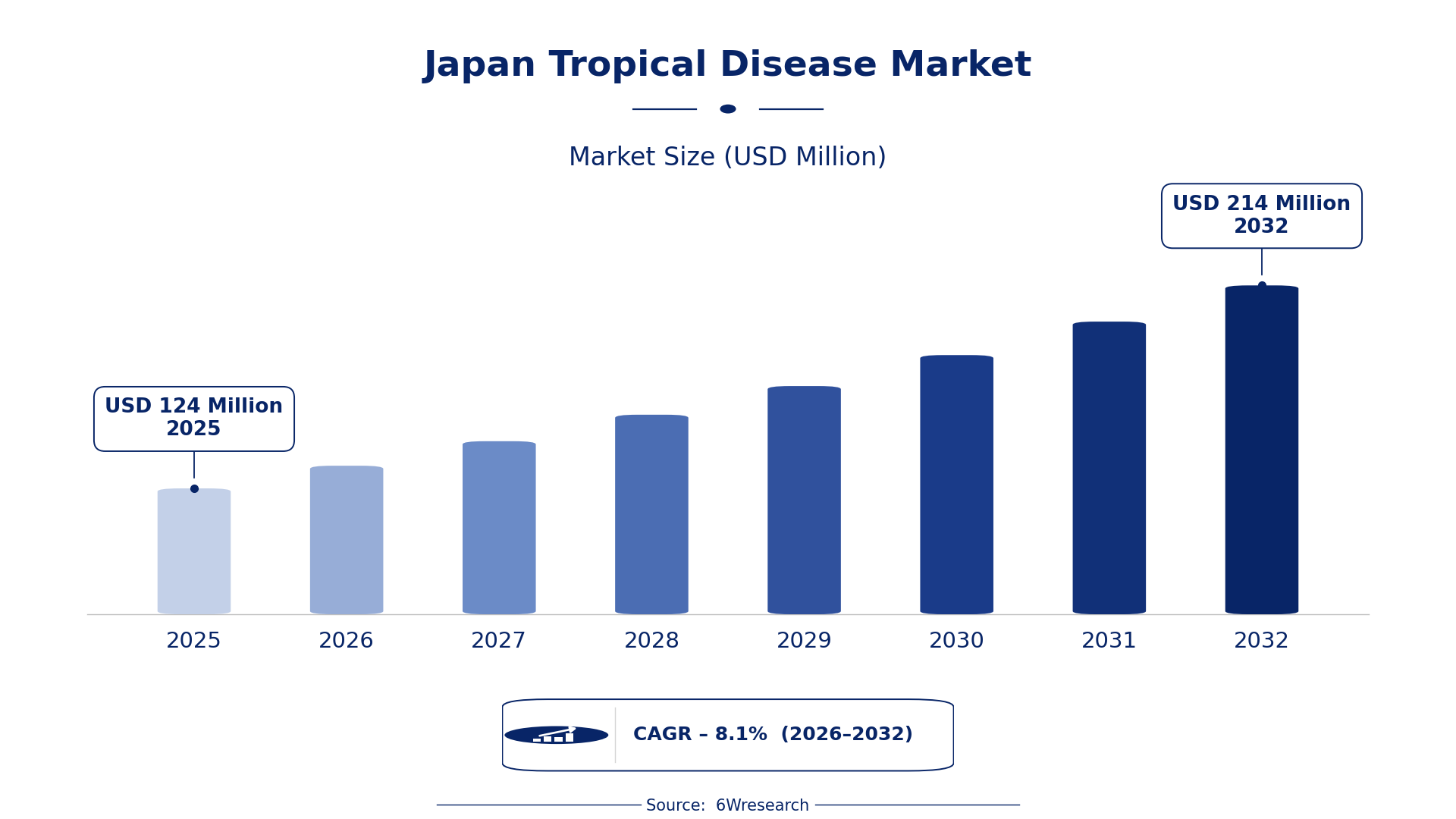
According to 6Wresearch internal database and industry insights, the Japan Tropical Disease Market was valued at USD 124 Million in 2025 and is projected to reach USD 214 Million by 2032, growing at a CAGR of approximately 8.1% during 2026–2032.
Japan Tropical Disease Market Highlights
| Report Metric | Details |
| Report Name | Japan Tropical Disease Market (2026-2032) |
| Market Size 2025 | USD 124 Million |
| Market Size 2032 | USD 214 Million |
| Absolute Growth 2025–2032 | USD 90 Million |
| CAGR 2026–2032 | 8.1% |
| Peak Annual Growth | 8.9% in 2032 |
| Forecast Period | 2026–2032 |
| Historical Data | 2022–2025 |
| Base Year | 2025 |
| Leading Disease Category, 2025 | Parasitic Infections (42% share) |
| Leading Transmission Mode, 2025 | Vector-Borne (Mosquito) (37% share) |
| Leading Risk Geography, 2025 | Africa (39% share) |
| Leading End User, 2025 | WHO & NGOs (47% share) |
| Fastest-Growing Disease Category | Viral Infections (10.5% CAGR) |
| Fastest-Growing Transmission Mode | Contact/Waterborne (10.7% CAGR) |
| Fastest-Growing Risk Geography | South Asia (10.0% CAGR) |
| Fastest-Growing End User | National Health Bodies (10.6% CAGR) |
| Growing Sector | Public health initiatives |
| Key End Users | WHO & NGOs, National Health Bodies, Hospitals |
Japan Tropical Disease Market Year-wise Growth Rate and Key Drivers (2022–2032)
This graph illustrates the annual growth rates of the market from 2022 to 2032, highlighting a steady upward trajectory and projected market expansion over the forecast period.
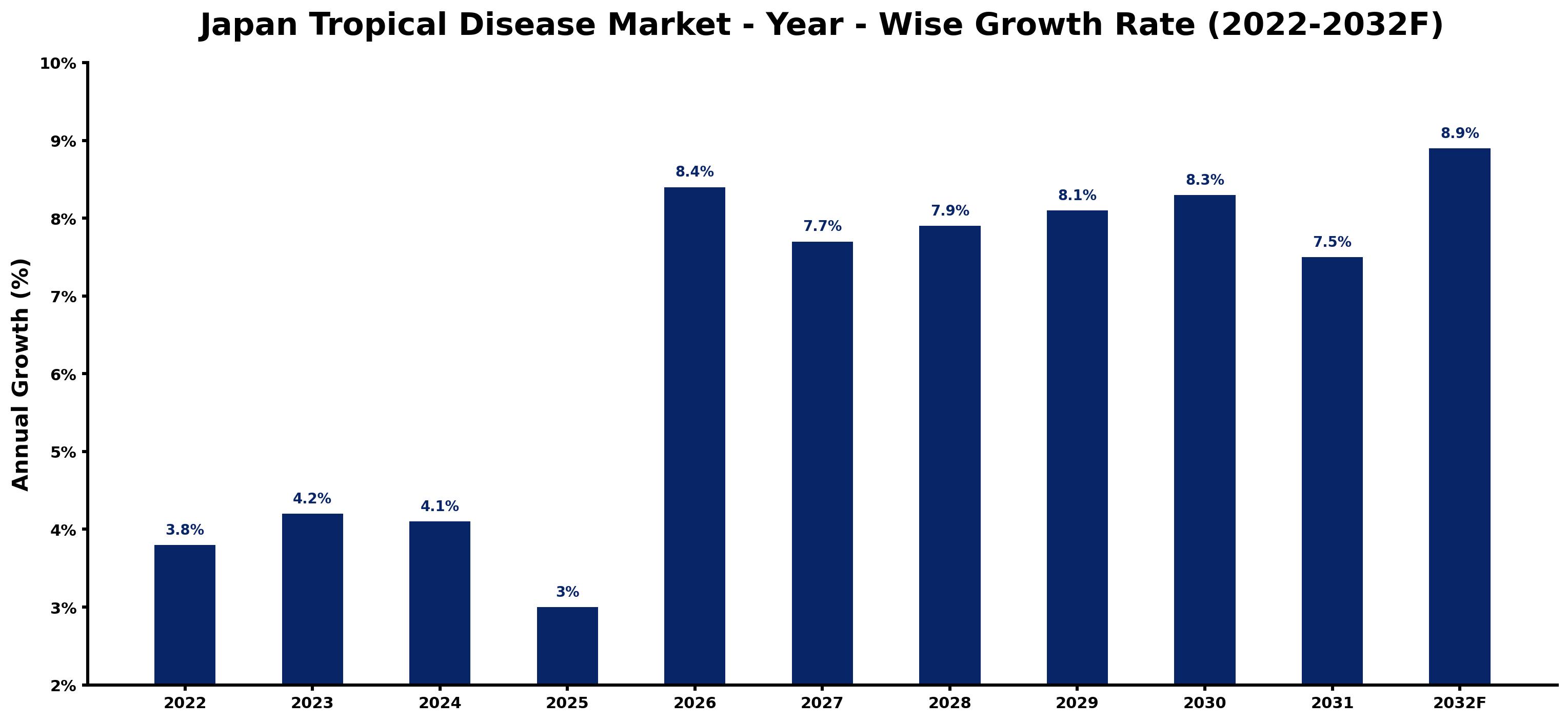
Annual growth estimates for each year appear below with the principal reason behind them, explaining the shifts that set the pace of the market.
| Year | Estimated Annual Growth (%) | Market Rationale |
| 2022 | 3.8 | The market experienced steady demand from health organizations addressing tropical diseases. |
| 2023 | 4.2 | Demand increased due to Japan's heightened focus on global health initiatives. |
| 2024 | 4.1 | Growth slowed as competition intensified in the tropical disease treatment sector. |
| 2025 | 3.0 | Market growth decelerated as funding for research faced some constraints. |
| 2026 | 8.4 | Demand is expected to surge as Japan launches new programs supporting tropical disease research. |
| 2027 | 7.7 | Growth will moderate as the market adjusts to increased research outputs. |
| 2028 | 7.9 | Demand is projected to rise again due to new partnerships with international health organizations. |
| 2029 | 8.1 | The market is expected to expand as awareness of tropical diseases increases among health bodies. |
| 2030 | 8.3 | Growth will continue as Japan's health expenditure focuses on infectious diseases. |
| 2031 | 7.5 | The market will see a slowdown as global health priorities shift slightly. |
| 2032 | 8.9 | Demand is projected to peak as Japan's contributions to global health initiatives reach new heights. |
Note: Market size estimations and growth projections presented in this report are based on 6Wresearch's proprietary forecasting methodology, utilizing the latest available industry data, government publications, and primary research inputs.
Japan Tropical Disease Market Synopsis
Tropical diseases arise from various pathogens and are transmitted by vectors such as mosquitoes or contaminated water. In Japan, treatments prioritise public health initiatives alongside international aid. The Japan Tropical Disease Market is growing due to heightened funding for research, with the country contributing $1 billion to global health initiatives in 2023. This demand is driven by health organisations and NGOs seeking effective treatments and preventive measures, particularly in endemic regions.
Market Dynamics Impact Analysis (2026–2032)
| Factor | Type | Impact | Primary Segment Affected |
| Increased funding for tropical disease research and treatment initiatives | Driver | High | Neglected Tropical Diseases |
| Growing collaboration with international health organizations | Driver | High | WHO & NGOs |
| Emerging demand for treatments in South Asia | Opportunity | Medium | South Asia |
| Investment in vector control programs in Africa | Opportunity | Medium | Africa |
| Limited direct involvement in tropical disease treatment | Restraint | High | Bacterial Infections |
| Competition from other countries in tropical disease research | Restraint | Medium | Viral Infections |
| High costs associated with research and development | Challenge | High | Neglected Tropical Diseases |
| Slow adoption of new treatment protocols | Challenge | Medium | Parasitic Infections |
Evaluation of Drivers in Japan Tropical Disease Market (2026–2032)
The main growth drivers and the segments they affect most are set out below.
| Drivers | Primary Segment Affected | Why It Matters (Evidence) |
| Increased funding for global health initiatives | Neglected Tropical Diseases | Japan contributed $1 billion in 2023, boosting research and treatment efforts. |
| Collaboration with WHO and NGOs | WHO & NGOs | Partnerships improve resource allocation for tropical disease management. |
| Rising prevalence of tropical diseases in South Asia | South Asia | Growing health challenges in the region drive demand for effective treatments. |
| Investment in vector control programs | Africa | Japan's involvement in global health initiatives drives demand for vector control solutions. |
| Focus on research for neglected tropical diseases | Neglected Tropical Diseases | Japanese universities conduct extensive research, increasing treatment availability. |
In 2023, Japan allocated $1 billion to global health, supporting research and treatment for tropical diseases. Extensive research conducted by Japanese universities on neglected tropical diseases increases treatment availability, supporting market growth.
Evaluation of Restraints in Japan Tropical Disease Market
The following restraints limit how fast demand can grow.
| Market Restraint | Primary Segment Affected | Why It Matters (Evidence) |
| Limited direct involvement in tropical disease treatment | Bacterial Infections | Japan primarily focuses on research and international aid rather than direct treatment. |
| Competition from other countries in tropical disease research | Viral Infections | Other nations are ramping up their tropical disease efforts, impacting Japan's market share. |
| High costs associated with research and development | Neglected Tropical Diseases | Investment is needed for effective research and treatment development. |
| Slow adoption of new treatment protocols | Parasitic Infections | Healthcare providers may hesitate to implement new protocols due to training needs. |
| Limited public awareness of tropical diseases | Neglected Tropical Diseases | Insufficient awareness may hinder demand for treatments and preventive measures. |
Japan Tropical Disease Market Challenges
A shortage of skilled professionals in tropical disease management costs health organisations in Japan approximately $200 million each year, as they rely on foreign specialists. Limited access to advanced research tools hampers treatment innovations, affecting health organisations that need timely solutions for endemic regions. Intense competition among NGOs for funding results in fragmented efforts, leading to inefficiencies that waste around $150 million annually due to overlapping initiatives. Rising compliance costs with international health standards strain budgets, compelling hospitals to allocate an additional 10% of their resources to meet these requirements, diverting funds from direct treatment efforts.
Trends in the Japan Tropical Disease Market
Four trends stand out in the Japan Tropical Disease Market.
- Shift in Focus to Vector Control: In 2023, Japan initiated a program to support vector control initiatives in Africa, contributing $1 billion to global health efforts. This shift prioritises prevention strategies, improving the effectiveness of tropical disease management.
- Emergence of Collaborative Research Initiatives: Since 2023, Tokyo has become a hub for international health organisations, encouraging collaborative research on tropical diseases. This partnership has led to increased funding and novel solutions, with Japan's health expenditure reaching approximately 10% of GDP.
- Increased Investment in Tropical Disease Research: In 2023, Japan's universities ramped up research on neglected tropical diseases, receiving substantial funding. This investment is expected to enhance treatment options and health outcomes in endemic regions.
- Growing Awareness of Tropical Diseases: Japan hosted a conference on vector-borne diseases in 2023, raising awareness among health professionals. This event underscored the importance of addressing tropical diseases, resulting in increased funding and research.
Investment Opportunities in the Japan Tropical Disease Market
Where to invest in the Japan Tropical Disease Market: the main openings are set out below.
- Partnerships with NGOs for Health Initiatives: Now is the time to invest in partnerships with NGOs focusing on tropical diseases, as Japan's involvement in global health initiatives increases funding opportunities. Collaborating with organizations in Africa can improve treatment access.
- Investment in Vector Control Programs: With Japan's commitment to global health, there is an opportunity to invest in vector control programs in Africa. Engaging local health organizations can facilitate entry into this growing market.
- Research Collaboration with Japanese Universities: Japanese universities are seeking partnerships for tropical disease research, presenting an opportunity for collaboration. Engaging with these institutions can improve research capabilities and treatment development.
- Focus on South Asia's Health Challenges: Now is an opportune moment to address health challenges in South Asia, where demand for tropical disease treatments is rising. Collaborating with national health bodies can facilitate market entry.
Government Initiatives in the Japan Tropical Disease Market
The Water Supply Act (1957) establishes standards for drinking-water quality, ensuring a safe water supply for tropical disease prevention. The Sewerage Act (1958) regulates wastewater treatment, crucial for controlling waterborne diseases in Japan.
The Ministry of Health, Labour and Welfare oversees tropical disease policies, approving funding for research initiatives. The Clinical Trials Act (2017) governs clinical research, ensuring safety and efficacy for new treatments.
Future Insight of the Japan Tropical Disease Market
Advancements in data analytics will transform the monitoring and treatment of tropical diseases, improving outbreak response times. By 2032, Japan's investment in AI-driven research tools will exceed $1 billion, enhancing disease tracking capabilities. Ongoing support for global health initiatives will strengthen collaborations, enabling better resource distribution. With healthcare expenditure projected to reach 12% of GDP, suppliers will face increased demand for effective treatments and preventive measures.
Market Segmentation Analysis
Japan Tropical Disease Market report covers a detailed analysis of the following market segments:
By Disease Category – Parasitic Infections Lead, Viral Infections Expected to Grow Fastest
According to Saurav Kr Singh, Senior Research Analyst at 6Wresearch, with 42% of disease category revenue in 2025, Parasitic Infections was the largest category. Parasitic infections hold the largest share due to extensive research and treatment efforts in Japan, particularly through the Japan Anti-Tuberculosis Association. The country's focus on these infections is also reflected in its National Health Policy, which prioritises infectious diseases. Over 2026–2032, Viral Infections are expected to post the fastest growth, at a CAGR of 10.5%. Viral infections are experiencing rapid growth as they are critical for public health monitoring, especially with Japan's active participation in the Global Fund to Fight AIDS, Tuberculosis and Malaria. The ongoing support for tropical disease research in Africa further highlights the urgency of addressing viral threats. Suppliers should align their strategies with the increasing focus on viral infection treatments to meet the growing demand.
By Transmission Mode – Vector-Borne (Mosquito) Leads, Contact/Waterborne Expected to Grow Fastest
Vector-Borne (Mosquito) took 37% of transmission mode revenue in 2025, more than any other category. Vector-borne (mosquito) transmission captures the largest share as it is a primary concern for disease transmission in Japan. Initiatives like the WHO's Global Vector Control Response underscore its significance in shaping national health strategies. Contact/Waterborne is set to record the highest CAGR in this split, 10.7% over 2026–2032. Contact/waterborne transmission is growing rapidly due to increased monitoring of its potential public health impacts. The country's efforts to improve healthcare in South Asia further emphasise the need for vigilance in this area. Suppliers should prioritise the development of solutions that encompass both vector-borne and contact/waterborne transmission to ensure comprehensive disease management.
By Risk Geography – Africa Leads, South Asia Expected to Grow Fastest
Africa held 39% of the Japan Tropical Disease Market by risk geography in 2025. Africa is the leading risk geography as Japan provides substantial aid and support for health initiatives in the region, highlighting its commitment to global health. The country’s involvement in WHO programs further solidifies its focus on African tropical diseases. The quickest growth will come from South Asia, forecast to expand at a CAGR of 10.0% between 2026 and 2032. South Asia is the fastest-growing risk geography, driven by Japan's emphasis on aid and research rather than direct treatment. The establishment of partnerships with NGOs for health initiatives in this region reflects the increasing attention given to South Asia. Suppliers should explore opportunities in South Asia to capitalise on the growing focus on health initiatives and research.
By End User – WHO & NGOs Lead, National Health Bodies Expected to Grow Fastest
The largest end user category in 2025 was WHO & NGOs, at 47% of revenue. WHO and NGOs lead the market as they are the main users implementing health programmes focused on addressing tropical diseases in Japan. Their active participation in global health initiatives ensures a steady demand for effective treatments and research support. National Health Bodies are projected to grow fastest, at a CAGR of 10.6% during 2026–2032. National health bodies are experiencing the fastest growth as they play a critical role in managing disease response in Japan. The focus on infectious diseases within the National Health Policy highlights their essential function in the healthcare system. Suppliers must enhance collaborations with national health bodies to improve market presence and effectively tackle urgent disease management challenges.
Key Attractiveness of the Report
- 10 Years of Market Numbers
- Historical Data Starting from 2022 to 2025
- Base Year 2025
- Forecast Data until 2032
- Key Performance Indicators Impacting the Market
- Major Upcoming Developments and Projects
Key Highlights of the Report:
- Japan Tropical Disease Market Outlook
- Market Size of Japan Tropical Disease Market, 2025
- Forecast of Japan Tropical Disease Market, 2032
- Historical Data and Forecast of Japan Tropical Disease Revenues & Volume for the Period 2022-2032F
- Japan Tropical Disease Market Trend Evolution
- Japan Tropical Disease Market Drivers and Challenges
- Japan Tropical Disease Price Trends
- Japan Tropical Disease Porter's Five Forces
- Japan Tropical Disease Industry Life Cycle
- Historical Data and Forecast of Japan Tropical Disease Market Revenues & Volume By Disease Category for the Period 2022-2032F
- Historical Data and Forecast of Japan Tropical Disease Market Revenues & Volume By Parasitic Infections for the Period 2022-2032F
- Historical Data and Forecast of Japan Tropical Disease Market Revenues & Volume By Viral Infections for the Period 2022-2032F
- Historical Data and Forecast of Japan Tropical Disease Market Revenues & Volume By Bacterial Infections for the Period 2022-2032F
- Historical Data and Forecast of Japan Tropical Disease Market Revenues & Volume By Neglected Tropical Diseases for the Period 2022-2032F
- Historical Data and Forecast of Japan Tropical Disease Market Revenues & Volume By Transmission Mode for the Period 2022-2032F
- Historical Data and Forecast of Japan Tropical Disease Market Revenues & Volume By Vector-Borne (Mosquito) for the Period 2022-2032F
- Historical Data and Forecast of Japan Tropical Disease Market Revenues & Volume By Contact/Waterborne for the Period 2022-2032F
- Historical Data and Forecast of Japan Tropical Disease Market Revenues & Volume By Contaminated Water for the Period 2022-2032F
- Historical Data and Forecast of Japan Tropical Disease Market Revenues & Volume By Multi-Pathogen for the Period 2022-2032F
- Historical Data and Forecast of Japan Tropical Disease Market Revenues & Volume By Risk Geography for the Period 2022-2032F
- Historical Data and Forecast of Japan Tropical Disease Market Revenues & Volume By Africa, South Asia for the Period 2022-2032F
- Historical Data and Forecast of Japan Tropical Disease Market Revenues & Volume By Tropics & Equator Zones for the Period 2022-2032F
- Historical Data and Forecast of Japan Tropical Disease Market Revenues & Volume By Coastal Regions for the Period 2022-2032F
- Historical Data and Forecast of Japan Tropical Disease Market Revenues & Volume By Poor Infrastructure Zones for the Period 2022-2032F
- Historical Data and Forecast of Japan Tropical Disease Market Revenues & Volume By End User for the Period 2022-2032F
- Historical Data and Forecast of Japan Tropical Disease Market Revenues & Volume By WHO & NGOs for the Period 2022-2032F
- Historical Data and Forecast of Japan Tropical Disease Market Revenues & Volume By National Health Bodies for the Period 2022-2032F
- Historical Data and Forecast of Japan Tropical Disease Market Revenues & Volume By Hospitals for the Period 2022-2032F
- Historical Data and Forecast of Japan Tropical Disease Market Revenues & Volume By UN Health Programs for the Period 2022-2032F
- Japan Tropical Disease Import Export Trade Statistics
- Market Opportunity Assessment By Disease Category
- Market Opportunity Assessment By Transmission Mode
- Market Opportunity Assessment By Risk Geography
- Market Opportunity Assessment By End User
- Japan Tropical Disease Top Companies Market Share
- Japan Tropical Disease Competitive Benchmarking By Technical and Operational Parameters
- Japan Tropical Disease Company Profiles
- Japan Tropical Disease Key Strategic Recommendations
Market Covered
The study includes the following segmentation.
By Disease Category
- Parasitic Infections
- Viral Infections
- Bacterial Infections
- Neglected Tropical Diseases
By Transmission Mode
- Vector-Borne (Mosquito)
- Contact/Waterborne
- Contaminated Water
- Multi-Pathogen
By Risk Geography
- Africa
- South Asia
- Tropics & Equator Zones
- Coastal Regions
- Poor Infrastructure Zones
By End User
- WHO & NGOs
- National Health Bodies
- Hospitals
- UN Health Programs































