Japan Tropical Fruit Market Size & Growth Rate
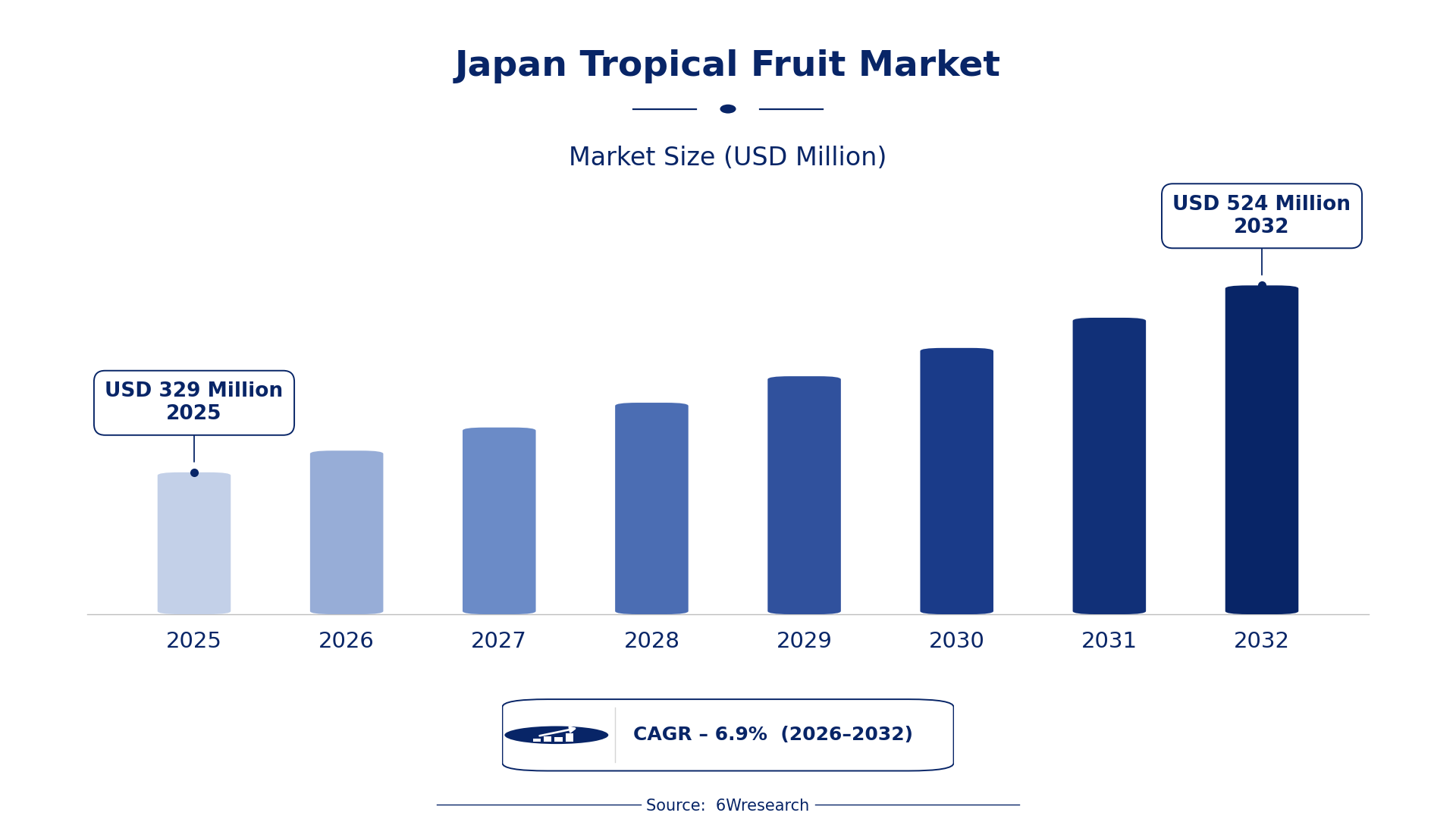
According to 6Wresearch internal database and industry insights, the Japan Tropical Fruit Market was valued at USD 329 Million in 2025 and is projected to reach USD 524 Million by 2032, growing at a CAGR of approximately 6.9% during 2026–2032.
Japan Tropical Fruit Market Highlights
| Report Metric | Details |
| Report Name | Japan Tropical Fruit Market (2026-2032) |
| Market Size 2025 | USD 329 Million |
| Market Size 2032 | USD 524 Million |
| Absolute Growth 2025–2032 | USD 195 Million |
| CAGR 2026–2032 | 6.9% |
| Peak Annual Growth | 7.3% in 2028 |
| Forecast Period | 2026–2032 |
| Historical Data | 2022–2025 |
| Base Year | 2025 |
| Leading Fruit Type, 2025 | Mango (49% share) |
| Leading Processing Type, 2025 | Fresh / Pulp (40% share) |
| Leading Packaging Type, 2025 | Canned/Juice Pack (42% share) |
| Leading End User, 2025 | Juice Manufacturers (37% share) |
| Fastest-Growing Fruit Type | Pineapple (9.5% CAGR) |
| Fastest-Growing Processing Type | Fresh / Dried (10.1% CAGR) |
| Fastest-Growing Packaging Type | Vacuum Sealed (9.8% CAGR) |
| Fastest-Growing End User | Retail Supermarkets (8.8% CAGR) |
| Growing Sector | Foodservice Industry |
| Key End Users | Retail Supermarkets, Juice Manufacturers, Foodservice Industry |
Japan Tropical Fruit Market Year-wise Growth Rate and Key Drivers (2022–2032)
This graph illustrates the annual growth rates of the market from 2022 to 2032, highlighting a steady upward trajectory and projected market expansion over the forecast period.
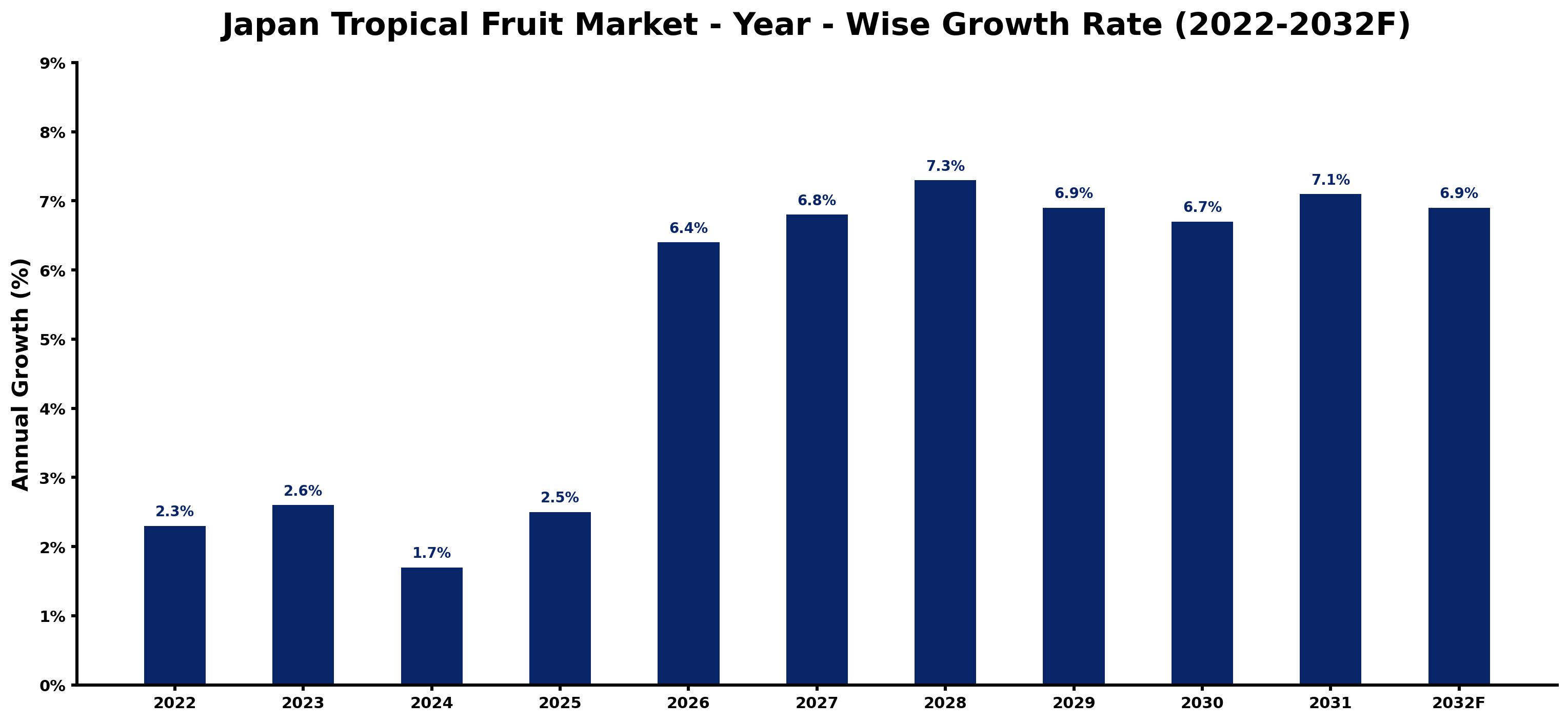
The following figures match every annual growth estimate with the main market development of that year, giving the reasoning behind each rise or slowdown.
| Year | Estimated Annual Growth (%) | Market Rationale |
| 2022 | 2.3 | The market showed steady growth with increasing tropical fruit imports and consumption. |
| 2023 | 2.6 | Growth accelerated as consumer interest in tropical fruits rose, particularly in fresh varieties. |
| 2024 | 1.7 | A slowdown occurred due to market saturation and fluctuating consumer preferences. |
| 2025 | 2.5 | Demand picked up again as new marketing strategies targeted health-conscious consumers. |
| 2026 | 6.4 | Growth surged as the foodservice sector expanded, increasing tropical fruit usage. |
| 2027 | 6.8 | Demand continued to rise with a growing trend towards convenience food options. |
| 2028 | 7.3 | The peak growth year saw heightened interest in tropical fruit juices and smoothies. |
| 2029 | 6.9 | Growth slowed slightly but remained strong due to sustained consumer interest. |
| 2030 | 6.7 | A further slowdown occurred as market conditions stabilised and competition increased. |
| 2031 | 7.1 | Demand rebounded with renewed marketing efforts and product diversification. |
| 2032 | 6.9 | Growth stabilised as the market matured, with consistent consumer demand. |
Note: Market size estimations and growth projections presented in this report are based on 6Wresearch's proprietary forecasting methodology, utilizing the latest available industry data, government publications, and primary research inputs.
Japan Tropical Fruit Market Synopsis
Retail supermarkets and the foodservice industry drive the Japan Tropical Fruit Market, serving millions of customers daily. In 2022, Japan imported 1.2 million tons of tropical fruits, with mangoes leading consumption at 300,000 tons annually. Recent government initiatives to promote tropical fruit consumption are expected to stimulate market growth, particularly in the juice segment.
Market Dynamics Impact Analysis (2026–2032)
| Factor | Type | Impact | Primary Segment Affected |
| Rising health consciousness among consumers | Driver | High | Fresh / Pulp |
| Expansion of the foodservice industry | Driver | High | Foodservice Industry |
| Growing demand for convenience food products | Opportunity | High | Frozen Pouches |
| Increased interest in tropical fruit juices | Opportunity | High | Juice Manufacturers |
| High import dependency on tropical fruits | Restraint | High | Mango |
| Limited domestic production capabilities | Restraint | High | Mango |
| Competition from local fruit alternatives | Challenge | Medium | Mango |
| Fluctuating import prices due to global supply chain issues | Challenge | Medium | Mango |
Evaluation of Drivers in Japan Tropical Fruit Market (2026–2032)
The factors lifting demand, and the evidence behind each, are summarised below.
| Drivers | Primary Segment Affected | Why It Matters (Evidence) |
| Increased health awareness | Fresh / Pulp | Health-conscious consumers are opting for fresh juices, driving demand for fresh pulp, with retail supermarkets accounting for 60% of sales. |
| Growth in the foodservice sector | Foodservice Industry | The foodservice industry serves over 10 million customers daily, increasing the need for fresh tropical fruits. |
| Rising popularity of frozen tropical products | Frozen Pouches | Frozen tropical fruits are increasingly popular in convenience stores, catering to busy consumers seeking quick meal options. |
| Expansion of juice production | Juice Manufacturers | Tropical fruit juice production is governed by ISO 22000 standards, ensuring quality and safety, which boosts consumer trust. |
| Diverse product offerings | Canned/Juice Pack | Canned and juice pack products are common, with 42% market share, catering to various consumer preferences. |
Much of the new demand stems from increasing health awareness among consumers, with the average annual expenditure on tropical fruits per household around ¥15,000. The foodservice industry, catering to over 10 million customers daily, fuels demand for fresh fruits, especially mangoes and pineapples. Frozen tropical products are gaining popularity in convenience stores, reflecting a shift towards quick meal solutions. The production of tropical fruit juices, regulated under ISO 22000 standards, has surged, boosting consumer confidence in quality. Retail supermarkets, which account for 60% of sales, continue to play a key role in this growing market.
Evaluation of Restraints in Japan Tropical Fruit Market
Below are the constraints most often cited by buyers and suppliers, with the segment each affects.
| Market Restraint | Primary Segment Affected | Why It Matters (Evidence) |
| High import dependency on tropical fruits | Mango | Japan's tropical fruit imports reached 1.2 million tons in 2022, limiting local market resilience. |
| Limited domestic production capabilities | Mango | With production concentrated in Okinawa, domestic supply cannot meet rising demand for tropical fruits. |
| Competition from local fruit alternatives | Mango | Local fruits often compete on price and availability, affecting tropical fruit sales in supermarkets. |
| Fluctuating import prices due to global supply chain issues | Mango | Global supply chain disruptions have caused price volatility, impacting buyer decisions. |
| Regulatory compliance costs for imports | Mango | Compliance with stringent import regulations increases costs for buyers, affecting pricing strategies. |
Japan Tropical Fruit Market Challenges
Japan's limited domestic cultivation of tropical fruits creates a reliance on imports, which can disrupt supply chains during global shipping delays. Importers face strict regulatory standards, such as JAS, leading to compliance costs that raise retail prices for buyers. Intense competition from other countries in the banana and mango sectors pressures importers to lower prices, which can diminish profit margins and affect product quality for consumers. Skills shortages in tropical fruit processing hinder producers' ability to meet the growing demand for processed products, delaying availability and impacting sales for retailers.
Trends in the Japan Tropical Fruit Market
Buyers and suppliers in the Japan Tropical Fruit Market are adjusting to the following trends.
- Shift towards Healthier Beverage Options: Retail supermarkets are increasingly stocking tropical fruit juices as consumers seek healthier beverage alternatives. In 2023, a government program was launched to promote tropical fruit consumption, encouraging this trend.
- Growing Popularity of Frozen Tropical Fruits: Convenience stores across Japan are expanding their frozen tropical fruit offerings, reflecting changing consumer preferences for ready-to-eat options. In 2022, frozen tropical fruit imports reached 200,000 tons.
- Emergence of Dried Tropical Fruits in Health Markets: Health food markets are experiencing a rise in demand for dried tropical fruits, appealing to health-conscious consumers. In 2022, dried tropical fruit sales increased by 15%.
- Expansion of Tropical Fruit Juice Production: Juice manufacturers are diversifying their product lines to include tropical fruit blends. In 2023, the production of tropical fruit juices was governed by ISO 22000 standards.
Investment Opportunities in the Japan Tropical Fruit Market
The following opportunities in the Japan Tropical Fruit Market pair current demand with a clear way in.
- Expansion of Frozen Fruit Offerings: Convenience stores in urban areas are seeking to expand their frozen tropical fruit selections, with a market gap of approximately 200,000 tons. Collaborating with local suppliers can facilitate entry into this growing segment.
- Investment in Juice Production Facilities: Juice manufacturers are looking to improve production capabilities, with an estimated investment of ¥1 billion needed for new facilities. Partnering with local producers can streamline supply chains.
- Development of Dried Fruit Products: Health food retailers are increasingly interested in sourcing dried tropical fruits, with a market potential of ¥5 billion. Establishing local partnerships can facilitate market entry.
- Promotion of Tropical Fruit Consumption: The government’s initiative to promote tropical fruit consumption offers opportunities for suppliers to engage with retail supermarkets, aiming to increase sales by 20%.
Government Initiatives in the Japan Tropical Fruit Market
The Food Sanitation Act amendment, fully applied in June 2021, mandates HACCP-based hygiene management for food businesses, ensuring that producers of tropical fruits adhere to strict safety standards. This regulation builds consumer confidence and encourages higher sales in the market. Additionally, the average annual expenditure on tropical fruits per household is approximately ¥15,000, highlighting the importance of maintaining quality standards.
In 2023, the government allocated ¥500 million to promote tropical fruit consumption through various initiatives, overseen by the Ministry of Agriculture, Forestry and Fisheries. This funding supports marketing campaigns and educational programs to increase awareness among consumers.
Future Insight of the Japan Tropical Fruit Market
Technological improvements in cultivation methods will allow local farmers to grow tropical fruits more effectively, increasing domestic supply by 2032. A government initiative aimed at boosting tropical fruit consumption will enhance consumer awareness and drive demand. Upgraded processing facilities meeting ISO 22000 standards will elevate product quality, appealing to health-conscious buyers. With the foodservice industry serving over 10 million customers daily, the market is likely to see a shift towards premium offerings as consumer preferences evolve.
Market Segmentation Analysis
Japan Tropical Fruit Market report covers a detailed analysis of the following market segments:
By Fruit Type – Mango Leads, Pineapple Expected to Grow Fastest
According to Saurav Kr Singh, Senior Research Analyst at 6Wresearch, the largest fruit type category in 2025 was Mango, at 49% of revenue. Mango holds the largest share due to its widespread consumption in fresh and juice forms, with an annual consumption of 300,000 tons. This high demand is primarily driven by retail supermarkets, which account for 60% of tropical fruit sales in Japan. Over 2026–2032, Pineapple is expected to post the fastest growth, at a CAGR of 9.5%. Pineapple is experiencing rapid growth as it is increasingly used in both fresh and processed forms, appealing to health-conscious consumers. The popularity of pineapple in convenience stores has also contributed to its rising demand. Suppliers should focus on expanding mango offerings while also capitalising on the growing interest in pineapple products.
By Processing Type – Fresh / Pulp Leads, Fresh / Dried Expected to Grow Fastest
In 2025, Fresh / Pulp led the processing type split with a 40% share. Fresh / Pulp leads the market as it is essential for juice production, which is a major segment in the tropical fruit industry. The established standards under JAS ensure quality, further solidifying its dominance. The quickest growth will come from Fresh / Dried, forecast to expand at a CAGR of 10.1% between 2026 and 2032. Fresh / Dried is growing quickly as health trends drive demand for dried tropical fruits, which are becoming popular in health food markets. This shift indicates a changing consumer preference towards convenient and nutritious options. Buyers should consider diversifying their sourcing to include fresh and dried products to meet evolving consumer preferences.
By Packaging Type – Canned/Juice Pack Leads, Vacuum Sealed Expected to Grow Fastest
Canned/Juice Pack accounted for 42% of the market by packaging type in 2025. Canned/Juice Pack holds the largest share as it serves as the main packaging for beverages consumed widely in Japan. This method is favoured for its convenience, ensuring easy access to tropical fruit products for consumers. Vacuum Sealed is set to record the highest CAGR in this split, 9.8% over 2026–2032. Vacuum Sealed packaging is seeing rapid growth due to its effectiveness in maintaining freshness, which appeals to health-conscious consumers. As more products prioritise quality preservation, this packaging method is likely to gain further traction. Suppliers should adapt their packaging strategies to include vacuum sealing to meet consumer preferences for freshness.
By End User – Juice Manufacturers Lead, Retail Supermarkets Expected to Grow Fastest
With 37% of end user revenue in 2025, Juice Manufacturers was the largest category. Juice Manufacturers lead the market as they are the primary consumers of tropical fruits, using them extensively in juice production. Their established networks and consistent demand for quality ingredients reinforce their dominant position in the market. Retail Supermarkets are projected to grow fastest, at a CAGR of 8.8% during 2026–2032. Retail Supermarkets are experiencing the fastest growth as they serve as the main distribution channel for tropical fruits, catering to a diverse customer base. Their expansion aligns with changing consumer shopping habits towards convenience and accessibility. Suppliers must focus on establishing partnerships with retail supermarkets to enhance shelf space and visibility for their tropical fruit products.
Key Attractiveness of the Report
- 10 Years of Market Numbers
- Historical Data Starting from 2022 to 2025
- Base Year 2025
- Forecast Data until 2032
- Key Performance Indicators Impacting the Market
- Major Upcoming Developments and Projects
Key Highlights of the Report:
- Japan Tropical Fruit Market Outlook
- Market Size of Japan Tropical Fruit Market, 2025
- Forecast of Japan Tropical Fruit Market, 2032
- Historical Data and Forecast of Japan Tropical Fruit Revenues & Volume for the Period 2022-2032F
- Japan Tropical Fruit Market Trend Evolution
- Japan Tropical Fruit Market Drivers and Challenges
- Japan Tropical Fruit Price Trends
- Japan Tropical Fruit Porter's Five Forces
- Japan Tropical Fruit Industry Life Cycle
- Historical Data and Forecast of Japan Tropical Fruit Market Revenues & Volume By Fruit Type for the Period 2022-2032F
- Historical Data and Forecast of Japan Tropical Fruit Market Revenues & Volume By Mango for the Period 2022-2032F
- Historical Data and Forecast of Japan Tropical Fruit Market Revenues & Volume By Pineapple for the Period 2022-2032F
- Historical Data and Forecast of Japan Tropical Fruit Market Revenues & Volume By Papaya for the Period 2022-2032F
- Historical Data and Forecast of Japan Tropical Fruit Market Revenues & Volume By Banana (Tropical) for the Period 2022-2032F
- Historical Data and Forecast of Japan Tropical Fruit Market Revenues & Volume By Processing Type for the Period 2022-2032F
- Historical Data and Forecast of Japan Tropical Fruit Market Revenues & Volume By Fresh / Pulp for the Period 2022-2032F
- Historical Data and Forecast of Japan Tropical Fruit Market Revenues & Volume By Fresh / Dried for the Period 2022-2032F
- Historical Data and Forecast of Japan Tropical Fruit Market Revenues & Volume By Cut / Frozen for the Period 2022-2032F
- Historical Data and Forecast of Japan Tropical Fruit Market Revenues & Volume By Whole / Pureed for the Period 2022-2032F
- Historical Data and Forecast of Japan Tropical Fruit Market Revenues & Volume By Packaging Type for the Period 2022-2032F
- Historical Data and Forecast of Japan Tropical Fruit Market Revenues & Volume By Canned/Juice Pack for the Period 2022-2032F
- Historical Data and Forecast of Japan Tropical Fruit Market Revenues & Volume By Vacuum Sealed for the Period 2022-2032F
- Historical Data and Forecast of Japan Tropical Fruit Market Revenues & Volume By Frozen Pouches for the Period 2022-2032F
- Historical Data and Forecast of Japan Tropical Fruit Market Revenues & Volume By Shrink Wrap / Export Box for the Period 2022-2032F
- Historical Data and Forecast of Japan Tropical Fruit Market Revenues & Volume By End User for the Period 2022-2032F
- Historical Data and Forecast of Japan Tropical Fruit Market Revenues & Volume By Juice Manufacturers for the Period 2022-2032F
- Historical Data and Forecast of Japan Tropical Fruit Market Revenues & Volume By Retail Supermarkets for the Period 2022-2032F
- Historical Data and Forecast of Japan Tropical Fruit Market Revenues & Volume By Foodservice Industry for the Period 2022-2032F
- Historical Data and Forecast of Japan Tropical Fruit Market Revenues & Volume By Export Traders for the Period 2022-2032F
- Japan Tropical Fruit Import Export Trade Statistics
- Market Opportunity Assessment By Fruit Type
- Market Opportunity Assessment By Processing Type
- Market Opportunity Assessment By Packaging Type
- Market Opportunity Assessment By End User
- Japan Tropical Fruit Top Companies Market Share
- Japan Tropical Fruit Competitive Benchmarking By Technical and Operational Parameters
- Japan Tropical Fruit Company Profiles
- Japan Tropical Fruit Key Strategic Recommendations
Market Covered
Segments analysed in this report are listed below.
By Fruit Type
- Mango
- Pineapple
- Papaya
- Banana (Tropical)
By Processing Type
- Fresh / Pulp
- Fresh / Dried
- Cut / Frozen
- Whole / Pureed
By Packaging Type
- Canned/Juice Pack
- Vacuum Sealed
- Frozen Pouches
- Shrink Wrap / Export Box
By End User
- Juice Manufacturers
- Retail Supermarkets
- Foodservice Industry
- Export Traders































