Japan TSO Certification Service Market Size & Growth Rate
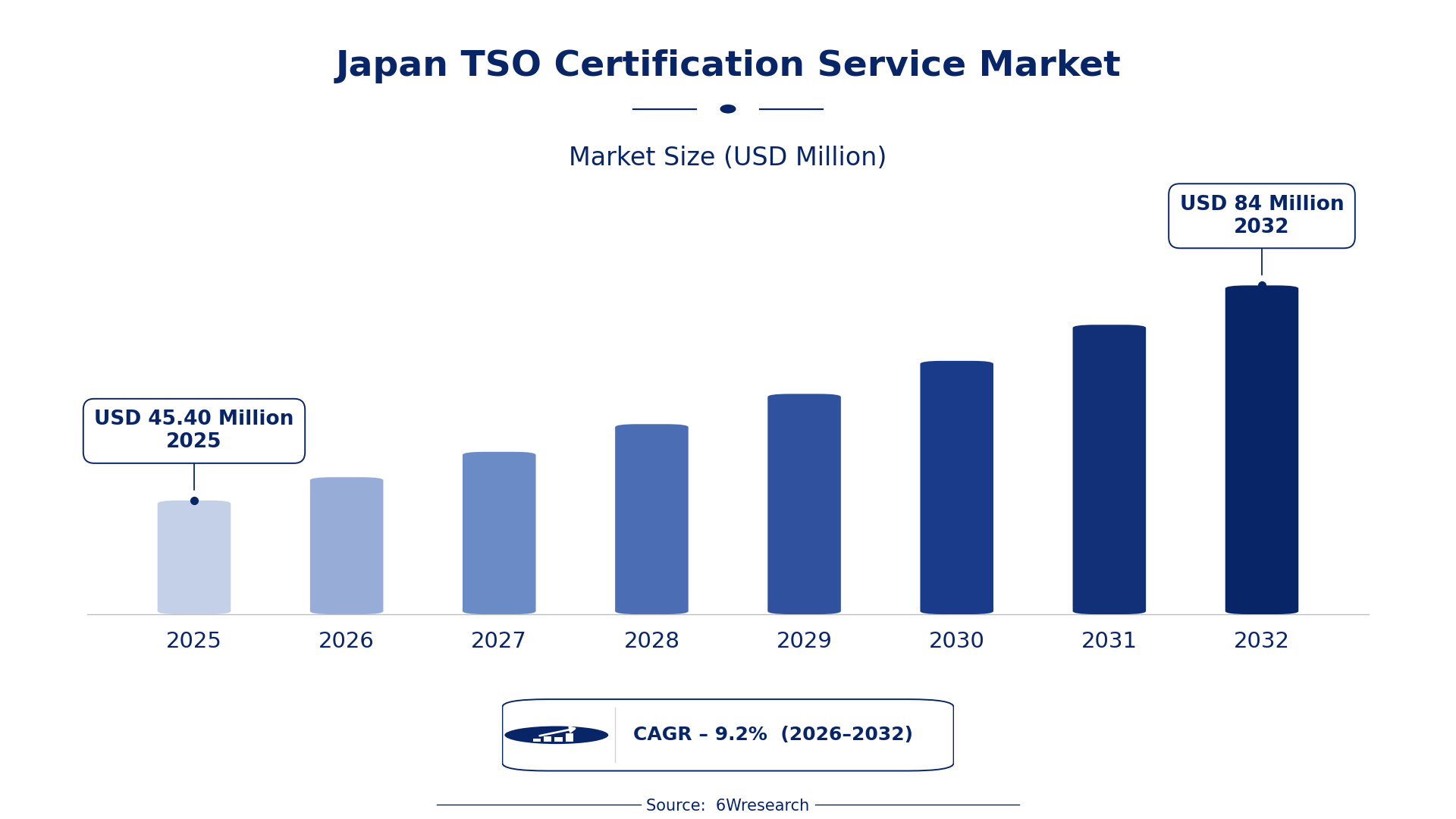
According to 6Wresearch internal database and industry insights, the Japan TSO Certification Service Market was valued at USD 45.40 Million in 2025 and is projected to reach USD 84 Million by 2032, growing at a CAGR of approximately 9.2% during 2026–2032.
Japan TSO Certification Service Market Highlights
| Report Metric | Details |
| Report Name | Japan TSO Certification Service Market (2026-2032) |
| Market Size 2025 | USD 45.40 Million |
| Market Size 2032 | USD 84 Million |
| Absolute Growth 2025–2032 | USD 38.60 Million |
| CAGR 2026–2032 | 9.2% |
| Peak Annual Growth | 10.6% in 2032 |
| Forecast Period | 2026–2032 |
| Historical Data | 2022–2025 |
| Base Year | 2025 |
| Leading Certification Type, 2025 | Avionics Systems (41% share) |
| Leading Component Focus, 2025 | Communication & Control (44% share) |
| Leading Certification Body, 2025 | FAA/EASA (40% share) |
| Leading End User, 2025 | Aircraft OEMs (48% share) |
| Fastest-Growing Certification Type | Structural Components (13.0% CAGR) |
| Fastest-Growing Component Focus | Interior & Frame (13.6% CAGR) |
| Fastest-Growing Certification Body | EASA (12.3% CAGR) |
| Fastest-Growing End User | Tier 1 Suppliers (12.0% CAGR) |
| Growing Sector | aerospace industry |
| Key End Users | Aircraft OEMs, Tier 1 Suppliers, Retrofit Providers |
Japan TSO Certification Service Market Year-wise Growth Rate and Key Drivers (2022–2032)
This graph illustrates the annual growth rates of the market from 2022 to 2032, highlighting a steady upward trajectory and projected market expansion over the forecast period.
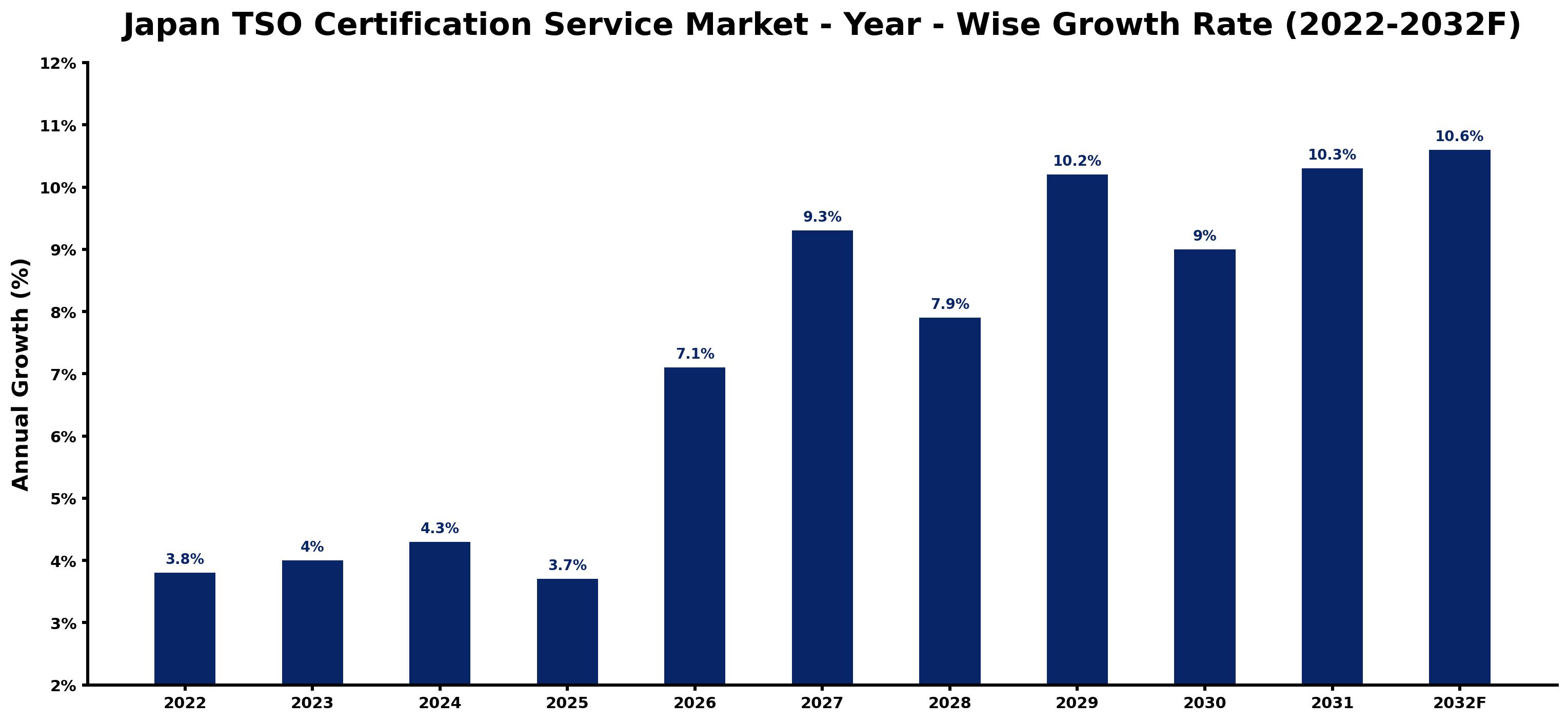
Below, each year's estimated growth is shown next to the factor that most influenced it.
| Year | Estimated Annual Growth (%) | Market Rationale |
| 2022 | 3.8 | The market experienced stable growth as the aerospace sector remained active. |
| 2023 | 4.0 | Demand increased as domestic aircraft manufacturers expanded production capabilities. |
| 2024 | 4.3 | Growth continued due to heightened investments in safety and performance standards. |
| 2025 | 3.7 | The growth rate slowed as the market adjusted to regulatory changes. |
| 2026 | 7.1 | Demand is expected to surge with new innovations in aerospace technology and certification processes. |
| 2027 | 9.3 | Increased passenger traffic will drive further growth in the aerospace sector. |
| 2028 | 7.9 | The growth rate is projected to moderate as market conditions stabilise after rapid expansion. |
| 2029 | 10.2 | A surge in fleet modernization will lead to faster growth in certification services. |
| 2030 | 9.0 | Demand will slow slightly as the market begins to reach saturation levels. |
| 2031 | 10.3 | Growth is expected to accelerate again as new regulations prompt increased certification needs. |
| 2032 | 10.6 | The market is projected to peak as the aerospace industry expands. |
Note: Market size estimations and growth projections presented in this report are based on 6Wresearch's proprietary forecasting methodology, utilizing the latest available industry data, government publications, and primary research inputs.
Japan TSO Certification Service Market Synopsis
TSO Certification Services evaluate and approve aviation products to ensure compliance with safety and performance standards, primarily for aircraft manufacturing and maintenance. The Japan TSO Certification Service Market is projected to grow to USD 84 Million by 2032, driven by over 300 aircraft OEMs and suppliers. Increased passenger traffic, fleet modernisation, and government initiatives like new drone certification regulations are propelling this growth.
Market Dynamics Impact Analysis (2026–2032)
| Factor | Type | Impact | Primary Segment Affected |
| Increased passenger traffic is driving demand for aircraft certification services. | Driver | High | Avionics Systems |
| Technological advancements in aerospace are creating new certification requirements. | Driver | High | Communication & Control |
| The Tokyo Region is becoming a hub for aerospace certification services. | Opportunity | High | Tier 1 Suppliers |
| The Aerospace Technology Strategy aims to enhance Japan's global competitiveness. | Opportunity | Medium | Aircraft OEMs |
| Regulatory changes can complicate the certification process. | Restraint | High | Structural Components |
| The need for compliance with international standards can slow down certification timelines. | Restraint | Medium | Passenger Safety |
| Limited capacity among certification bodies may delay approvals. | Challenge | High | FAA/EASA |
| Competition from international certification bodies can pressure local providers. | Challenge | Medium | EASA |
Evaluation of Drivers in Japan TSO Certification Service Market (2026–2032)
The table below links each growth driver to the segment it affects and the evidence for it.
| Drivers | Primary Segment Affected | Why It Matters (Evidence) |
| Increased passenger traffic in Japan leads to higher demand for aircraft certification services. | Avionics Systems | In 2022, Japan's aerospace manufacturing sector employed approximately 100,000 people, increasing demand for safety compliance. |
| Technological advancements in aerospace create new certification requirements. | Communication & Control | New regulations announced in 2023 by the Ministry of Land, Infrastructure, Transport and Tourism affect certification processes. |
| Growing domestic aircraft manufacturers expand production capabilities. | Structural Components | Japan has over 300 aircraft OEMs and suppliers, increasing the need for compliance. |
| Government support for aerospace innovation boosts certification services. | Passenger Safety | The Japanese government allocated ¥10 billion for aerospace R&D in 2023, improving safety standards. |
| Regulatory changes necessitate updated certifications for compliance. | Interior & Frame | New regulations announced in 2023 by the Ministry of Land, Infrastructure, Transport and Tourism affect certification processes. |
The strongest pull on demand comes from increased passenger traffic, which has led to a rise in the need for aircraft certification services. Approximately 100,000 employees in Japan's aerospace sector drive this demand by ensuring compliance with safety standards. The growing number of aircraft OEMs and suppliers in Japan also contributes to this rising demand.
Evaluation of Restraints in Japan TSO Certification Service Market
Several factors work against faster growth; the main ones are summarised below.
| Market Restraint | Primary Segment Affected | Why It Matters (Evidence) |
| Regulatory changes can complicate the certification process, causing delays. | Structural Components | Changes in regulations often require additional testing and documentation, slowing approvals. |
| Compliance with international standards can slow down certification timelines. | Passenger Safety | Meeting diverse international requirements increases the complexity of the certification process. |
| Limited capacity among certification bodies may delay approvals. | Avionics Systems | A few dominant certification bodies are often overwhelmed with applications, leading to longer wait times. |
| Competition from international certification bodies can pressure local providers. | FAA/EASA | Local providers may struggle to meet the same standards and timelines as international competitors. |
| High operational costs can deter smaller firms from pursuing certification. | Communication & Control | The financial burden of compliance can limit participation from smaller manufacturers. |
Japan TSO Certification Service Market Challenges
Producers face rising costs due to a shortage of skilled workers in the aerospace sector, which can inflate labour expenses by up to 20% and delay project timelines. New regulations, such as the 2023 drone certification rules, create compliance hurdles that can extend certification processes by an average of three months, resulting in lost revenue for suppliers. Buyers encounter increased project budgets as demand for TSO certification services rises, potentially inflating costs by 15%. Slow technology adoption among some manufacturers leads to inefficiencies that can delay product launches, impacting competitiveness for producers in the market.
Trends in the Japan TSO Certification Service Market
Buyers and suppliers in the Japan TSO Certification Service Market are adjusting to the following trends.
- Aircraft OEMs Increasing Focus on Safety Compliance: Aircraft OEMs are prioritising safety compliance to meet regulatory requirements. In 2023, the Japanese government allocated ¥10 billion for aerospace R&D, pushing manufacturers to improve safety protocols.
- New Regulations Driving Innovation in Certification: New regulations are prompting advancements in certification processes. This initiative aims to improve Japan's competitiveness, leading to a projected increase in certification demand by 10% by 2030.
- Tokyo Region Emerging as a Certification Hub: The Tokyo Metropolitan area is becoming a major hub for aviation certification services, with over 300 aircraft OEMs and suppliers located there, increasing the efficiency of certification processes.
- Increased Focus on Drone Certification: In 2023, new regulations for drone certification were announced, reflecting a shift in focus towards integrating unmanned aerial vehicles into the aerospace sector, which is projected to grow significantly.
Investment Opportunities in the Japan TSO Certification Service Market
Several openings in the Japan TSO Certification Service Market merit attention from investors.
- Tokyo Region as a Certification Services Hub: The Tokyo Metropolitan area presents an opportunity for investment in certification services, with over 300 aircraft OEMs and suppliers located there, driving demand for local partnerships.
- Investing in Structural Components Certification: With a projected growth of 13.0%, investing in structural components certification services is timely, as Aircraft OEMs increasingly seek compliance for new models.
- Partnerships for Improved Certification Processes: Now is the time to establish partnerships with local certification bodies, as demand for compliance services is rising due to new regulations and increased production rates.
- Focus on Passenger Safety Certification: Investing in passenger safety certification services is timely, as the Japanese government emphasises compliance with safety standards, driving demand.
Government Initiatives in the Japan TSO Certification Service Market
The newest measure, announced in 2023, introduces updated regulations for drone certification, improving the existing framework established by the Electrical Appliance and Material Safety Act. This addition aims to streamline the certification process for unmanned aerial vehicles, ensuring compliance with safety standards and promoting innovation in the aerospace sector.
Buyers, particularly Aircraft OEMs, benefit from the streamlined certification process established by the Japan Aerospace Exploration Agency (JAXA) and the Ministry of Land, Infrastructure, Transport and Tourism. These agencies collaborate to approve certification applications and fund projects, ensuring that manufacturers can meet regulatory requirements efficiently.
Future Insight of the Japan TSO Certification Service Market
Domestic aircraft manufacturers will experience changes as the government's ¥10 billion allocation for aerospace R&D in 2023 drives innovation in compliance processes. By 2032, advancements in automation and digital tools will streamline certification, reducing approval times for buyers. Collaboration between JAXA and the private sector will enhance safety standards, improving overall industry performance. As passenger traffic increases, suppliers must prepare for heightened demand for certification services, ensuring they can meet stricter regulatory requirements.
Market Segmentation Analysis
Japan TSO Certification Service Market report covers a detailed analysis of the following market segments:
By Certification Type – Avionics Systems Lead, Structural Components Expected to Grow Fastest
According to Saurav Kr Singh, Senior Research Analyst at 6Wresearch, the largest certification type category in 2025 was Avionics Systems, at 41% of revenue. Avionics Systems hold the largest share as they are critical for ensuring aircraft safety and functionality, with many domestic manufacturers relying on these systems for compliance. The Tokyo Metropolitan area, a major hub for aviation certification services, significantly contributes to the demand for avionics evaluations. The quickest growth will come from Structural Components, forecast to expand at a CAGR of 13.0% between 2026 and 2032. Structural Components are experiencing rapid growth due to the increasing focus on aircraft integrity and performance, particularly as fleet modernisation efforts continue. The Japanese government's ¥10 billion allocation for aerospace R&D in 2023 is expected to further stimulate this segment's development. Suppliers should focus on enhancing their capabilities in structural components to meet the rising market demands.
By Component Focus – Communication & Control Leads, Interior & Frame Expected to Grow Fastest
Communication & Control took 44% of component focus revenue in 2025, more than any other category. Communication & Control components lead the market because they are vital for operational efficiency and safety, making them indispensable for aircraft manufacturers. The presence of numerous Tier 1 suppliers in the Tokyo Region ensures a steady demand for these essential components. Over 2026–2032, Interior & Frame is expected to post the fastest growth, at a CAGR of 13.6%. Interior & Frame components are growing quickly as the aerospace sector prioritises improving passenger experience and cabin aesthetics. This growth is driven by increasing passenger traffic and the need for modernised aircraft interiors. Buyers should explore diversifying their supplier base for interior and frame components to enhance their product offerings.
By Certification Body – FAA/EASA Leads, EASA Expected to Grow Fastest
With 40% of certification body revenue in 2025, FAA/EASA was the largest category. FAA/EASA is the leading certification body as they are the primary authorities for aviation certification, ensuring compliance with international safety standards. Their established reputation and regulatory framework make them the preferred choice for many manufacturers in Japan. EASA is projected to grow fastest, at a CAGR of 12.3% during 2026–2032. EASA is growing at a faster rate due to the increasing importance of European compliance for Japanese manufacturers looking to expand into international markets. As global aviation regulations tighten, reliance on EASA for certification is likely to increase. Suppliers should align their processes with EASA standards to facilitate access to European markets.
By End User – Aircraft OEMs Lead, Tier 1 Suppliers Expected to Grow Fastest
Aircraft OEMs held 48% of the Japan TSO Certification Service Market by end user in 2025. Aircraft OEMs represent the largest share of end users since they are the primary recipients of certification services, directly impacting aircraft safety and performance. The robust aerospace ecosystem in Japan, with over 300 OEMs, supports this demand. Tier 1 Suppliers are set to record the highest CAGR in this split, 12.0% over 2026–2032. Tier 1 Suppliers are experiencing rapid growth as they play a crucial role in the component supply chain for aircraft manufacturers. The rising complexity of aircraft systems requires closer collaboration with these suppliers to ensure efficient certification processes. Buyers should strengthen their partnerships with Tier 1 Suppliers to maintain a reliable supply chain.
Key Attractiveness of the Report
- 10 Years of Market Numbers
- Historical Data Starting from 2022 to 2025
- Base Year 2025
- Forecast Data until 2032
- Key Performance Indicators Impacting the Market
- Major Upcoming Developments and Projects
Key Highlights of the Report:
- Japan TSO Certification Service Market Outlook
- Market Size of Japan TSO Certification Service Market, 2025
- Forecast of Japan TSO Certification Service Market, 2032
- Historical Data and Forecast of Japan TSO Certification Service Revenues & Volume for the Period 2022-2032F
- Japan TSO Certification Service Market Trend Evolution
- Japan TSO Certification Service Market Drivers and Challenges
- Japan TSO Certification Service Price Trends
- Japan TSO Certification Service Porter's Five Forces
- Japan TSO Certification Service Industry Life Cycle
- Historical Data and Forecast of Japan TSO Certification Service Market Revenues & Volume By Certification Type for the Period 2022-2032F
- Historical Data and Forecast of Japan TSO Certification Service Market Revenues & Volume By Avionics Systems for the Period 2022-2032F
- Historical Data and Forecast of Japan TSO Certification Service Market Revenues & Volume By Structural Components for the Period 2022-2032F
- Historical Data and Forecast of Japan TSO Certification Service Market Revenues & Volume By Lighting Systems for the Period 2022-2032F
- Historical Data and Forecast of Japan TSO Certification Service Market Revenues & Volume By Seating Systems for the Period 2022-2032F
- Historical Data and Forecast of Japan TSO Certification Service Market Revenues & Volume By Component Focus for the Period 2022-2032F
- Historical Data and Forecast of Japan TSO Certification Service Market Revenues & Volume By Communication & Control for the Period 2022-2032F
- Historical Data and Forecast of Japan TSO Certification Service Market Revenues & Volume By Interior & Frame for the Period 2022-2032F
- Historical Data and Forecast of Japan TSO Certification Service Market Revenues & Volume By Navigation & Cabin for the Period 2022-2032F
- Historical Data and Forecast of Japan TSO Certification Service Market Revenues & Volume By Passenger Safety for the Period 2022-2032F
- Historical Data and Forecast of Japan TSO Certification Service Market Revenues & Volume By Certification Body for the Period 2022-2032F
- Historical Data and Forecast of Japan TSO Certification Service Market Revenues & Volume By FAA/EASA for the Period 2022-2032F
- Historical Data and Forecast of Japan TSO Certification Service Market Revenues & Volume By EASA for the Period 2022-2032F
- Historical Data and Forecast of Japan TSO Certification Service Market Revenues & Volume By FAA for the Period 2022-2032F
- Historical Data and Forecast of Japan TSO Certification Service Market Revenues & Volume By DGCA for the Period 2022-2032F
- Historical Data and Forecast of Japan TSO Certification Service Market Revenues & Volume By End User for the Period 2022-2032F
- Historical Data and Forecast of Japan TSO Certification Service Market Revenues & Volume By Aircraft OEMs for the Period 2022-2032F
- Historical Data and Forecast of Japan TSO Certification Service Market Revenues & Volume By Tier 1 Suppliers for the Period 2022-2032F
- Historical Data and Forecast of Japan TSO Certification Service Market Revenues & Volume By Retrofit Providers for the Period 2022-2032F
- Historical Data and Forecast of Japan TSO Certification Service Market Revenues & Volume By Seating Manufacturers for the Period 2022-2032F
- Japan TSO Certification Service Import Export Trade Statistics
- Market Opportunity Assessment By Certification Type
- Market Opportunity Assessment By Component Focus
- Market Opportunity Assessment By Certification Body
- Market Opportunity Assessment By End User
- Japan TSO Certification Service Top Companies Market Share
- Japan TSO Certification Service Competitive Benchmarking By Technical and Operational Parameters
- Japan TSO Certification Service Company Profiles
- Japan TSO Certification Service Key Strategic Recommendations
Market Covered
Coverage by segment is as follows.
By Certification Type
- Avionics Systems
- Structural Components
- Lighting Systems
- Seating Systems
By Component Focus
- Communication & Control
- Interior & Frame
- Navigation & Cabin
- Passenger Safety
By Certification Body
- FAA/EASA
- EASA
- FAA
- DGCA
By End User
- Aircraft OEMs
- Tier 1 Suppliers
- Retrofit Providers
- Seating Manufacturers































