Japan TSV Technology Market Size & Growth Rate
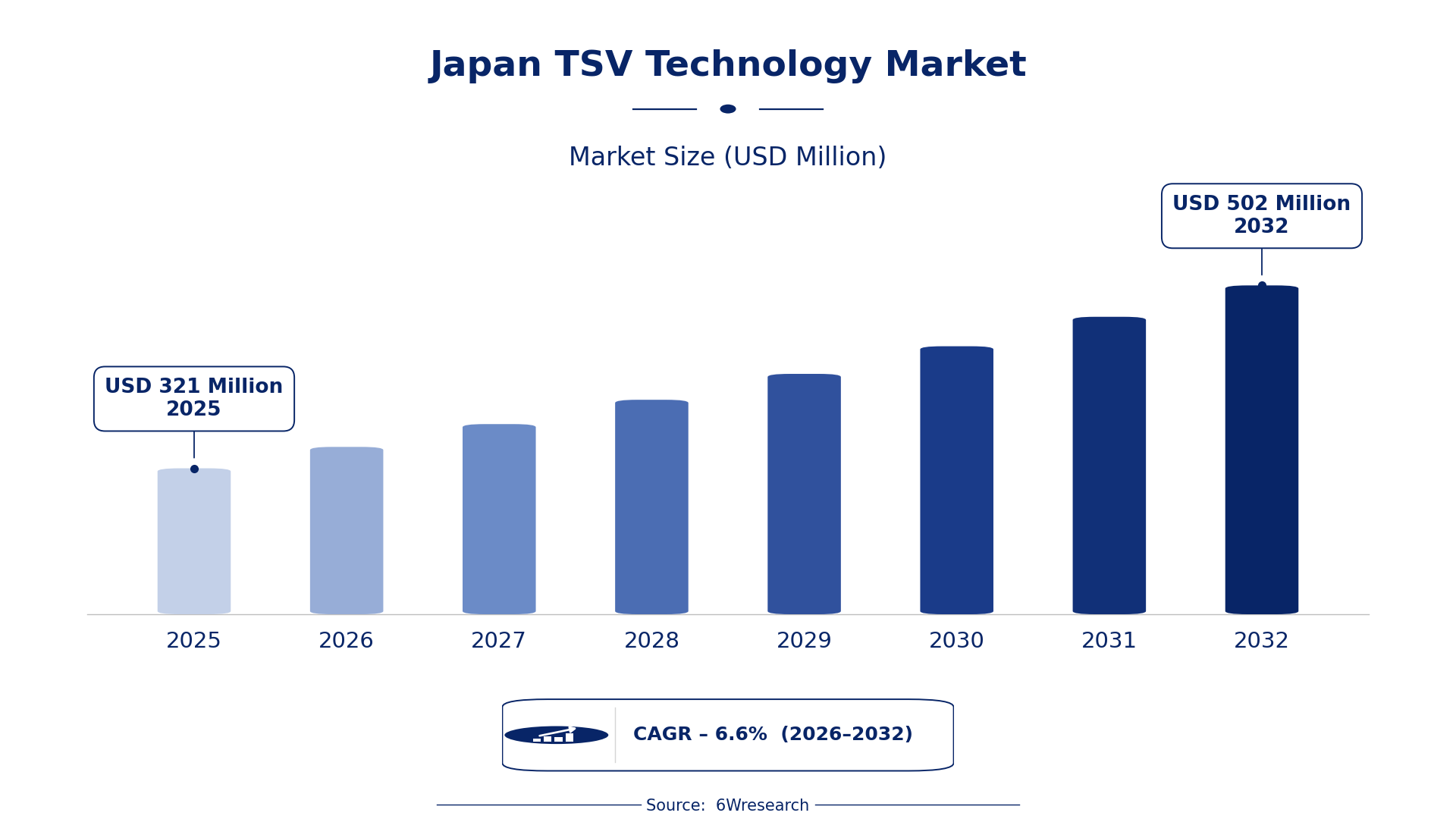
According to 6Wresearch internal database and industry insights, the Japan TSV Technology Market was valued at USD 321 Million in 2025 and is projected to reach USD 502 Million by 2032, growing at a CAGR of approximately 6.6% during 2026–2032.
Japan TSV Technology Market Highlights
| Report Metric | Details |
| Report Name | Japan TSV Technology Market (2026-2032) |
| Market Size 2025 | USD 321 Million |
| Market Size 2032 | USD 502 Million |
| Absolute Growth 2025–2032 | USD 181 Million |
| CAGR 2026–2032 | 6.6% |
| Peak Annual Growth | 7.4% in 2028 |
| Forecast Period | 2026–2032 |
| Historical Data | 2022–2025 |
| Base Year | 2025 |
| Leading TSV Type, 2025 | Via-First (39% share) |
| Leading Integration Level, 2025 | 3D IC Packaging (36% share) |
| Leading Use Case, 2025 | Memory Chips (41% share) |
| Leading End User, 2025 | Chip Manufacturers (51% share) |
| Fastest-Growing TSV Type | Via-Middle (9.0% CAGR) |
| Fastest-Growing Integration Level | Heterogeneous Integration (8.8% CAGR) |
| Fastest-Growing Use Case | Mobile Processors (9.1% CAGR) |
| Fastest-Growing End User | Electronics OEMs (8.6% CAGR) |
| Growing Sector | semiconductor manufacturing |
| Key End Users | Chip Manufacturers, Electronics OEMs, Semiconductor Foundries, IC Designers |
Japan TSV Technology Market Year-wise Growth Rate and Key Drivers (2022–2032)
This graph illustrates the annual growth rates of the market from 2022 to 2032, highlighting a steady upward trajectory and projected market expansion over the forecast period.
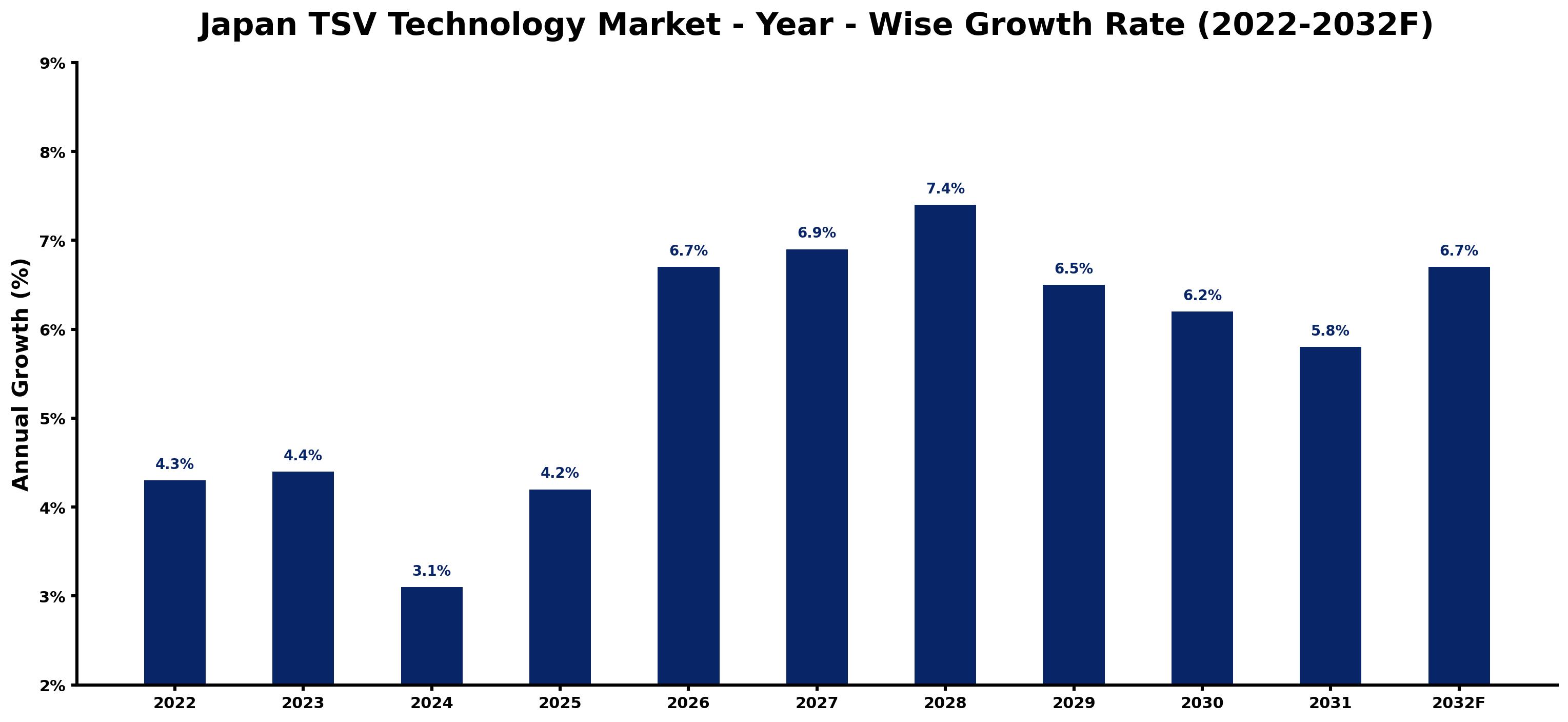
Each row of the following table gives one year's estimated growth and the event or demand shift that explains it.
| Year | Estimated Annual Growth (%) | Market Rationale |
| 2022 | 4.3 | The semiconductor industry showed stable demand from domestic chip manufacturers. |
| 2023 | 4.4 | Growth accelerated due to increased production of semiconductor units in Japan. |
| 2024 | 3.1 | A slowdown occurred as market adjustments took place after previous growth. |
| 2025 | 4.2 | Demand picked up again as investments in semiconductor research increased. |
| 2026 | 6.7 | Growth is expected to surge as the semiconductor strategy takes effect. |
| 2027 | 6.9 | Continued investment in technology is projected to drive further market expansion. |
| 2028 | 7.4 | The peak growth year reflects heightened demand for advanced packaging solutions. |
| 2029 | 6.5 | Growth is expected to slow as the market begins to stabilise after rapid expansion. |
| 2030 | 6.2 | A gradual slowdown is projected as the market adjusts to new standards. |
| 2031 | 5.8 | Growth is expected to continue slowing as the market matures and competition intensifies. |
| 2032 | 6.7 | Demand is expected to rise again with new technological advancements. |
Note: Market size estimations and growth projections presented in this report are based on 6Wresearch's proprietary forecasting methodology, utilizing the latest available industry data, government publications, and primary research inputs.
Japan TSV Technology Market Synopsis
TSV technology is a method for creating vertical electrical connections in semiconductor manufacturing, improving memory chip performance and enabling advanced packaging solutions. The Japan TSV Technology Market is growing due to increased domestic demand from chip manufacturers and electronics OEMs, driven by substantial investments in semiconductor research, including 200 billion JPY allocated in 2023. The Tokyo region serves as a key hub for semiconductor manufacturing, further stimulating growth in this sector.
Market Dynamics Impact Analysis (2026–2032)
| Factor | Type | Impact | Primary Segment Affected |
| Increasing production of semiconductor units | Driver | High | Memory Chips |
| Investment in semiconductor research and development | Driver | High | 3D IC Packaging |
| Growing demand for high-performance computing | Opportunity | Medium | High-Performance Computing |
| Expansion of AI accelerators integrating TSV technology | Opportunity | Medium | AI Accelerators |
| Competition from international semiconductor markets | Restraint | High | Chip Manufacturers |
| Challenges in maintaining supply chain efficiency | Restraint | Medium | Electronics OEMs |
| Limited availability of skilled workforce in semiconductor manufacturing | Challenge | High | Semiconductor Foundries |
| High costs associated with advanced manufacturing technologies | Challenge | Medium | IC Designers |
Evaluation of Drivers in Japan TSV Technology Market (2026–2032)
These are the developments adding the most demand over the forecast period.
| Drivers | Primary Segment Affected | Why It Matters (Evidence) |
| Rising domestic production of semiconductor units | Memory Chips | Japan produced over 1.2 billion semiconductor units in 2022, leading to increased demand from chip manufacturers. |
| Investments in semiconductor research | 3D IC Packaging | In 2023, Japan allocated 200 billion JPY to semiconductor research, promoting technology adoption. |
| Demand for high-performance computing systems | High-Performance Computing | High-performance computing systems increasingly utilise TSV technology, driving demand for advanced solutions. |
| Integration of AI accelerators in consumer electronics | AI Accelerators | AI accelerators are projected to see increased TSV integration in 2024, boosting market demand. |
| Support from industry associations for TSV adoption | Electronics OEMs | The Japan Semiconductor Association promotes TSV technology, encouraging adoption among electronics manufacturers. |
Volumes rise alongside increased domestic production of semiconductor units, with Japan producing over 1.2 billion units in 2022, leading to heightened demand from chip manufacturers. Substantial investments in semiconductor research, amounting to 200 billion JPY in 2023, support technology adoption, particularly in advanced packaging solutions. The demand for high-performance computing systems is also on the rise, as these systems utilise TSV technology for improved performance. The integration of AI accelerators in consumer electronics is expected to drive demand, with increased TSV integration anticipated in 2024. Industry support further propels the adoption of TSV technology among electronics manufacturers, solidifying the market's growth path.
Evaluation of Restraints in Japan TSV Technology Market
The following restraints limit how fast demand can grow.
| Market Restraint | Primary Segment Affected | Why It Matters (Evidence) |
| Competition from international semiconductor markets | Chip Manufacturers | Japan's semiconductor industry faces stiff competition from global players, affecting local manufacturers' market share. |
| Challenges in maintaining supply chain efficiency | Electronics OEMs | Supply chain disruptions can delay production schedules, impacting the timely delivery of products. |
| Limited availability of skilled workforce | Semiconductor Foundries | A shortage of skilled workers in semiconductor manufacturing can hinder production capacity and innovation. |
| High costs associated with advanced manufacturing technologies | IC Designers | Investments in advanced manufacturing technologies can be prohibitively expensive, limiting design capabilities. |
| Regulatory compliance costs for semiconductor production | Chip Manufacturers | Compliance with industry standards increases operational costs, affecting profitability. |
Japan TSV Technology Market Challenges
Regulatory hurdles complicate the adoption of TSV technology, causing delays for manufacturers in meeting production schedules. Supply chain disruptions arise from reliance on specific materials required for TSV fabrication, resulting in production halts and extended lead times for producers. A lack of skilled labour in advanced semiconductor techniques restricts the workforce's ability to implement TSV processes effectively, leading to reduced output for chip manufacturers. Increased costs associated with semiconductor research, exemplified by a 200 billion JPY investment in 2023, strain budgets for suppliers and limit their capacity to innovate.
Trends in the Japan TSV Technology Market
The trends below show where the Japan TSV Technology Market is heading.
- Shift from Traditional to Advanced Packaging Solutions: Since 2023, the trend towards advanced packaging solutions has emerged in the Tokyo region, where semiconductor foundries are adopting 3D IC packaging techniques, improving performance and efficiency.
- Transition to AI Integration in Electronics: In 2024, AI accelerators are increasingly being integrated into consumer electronics, with projections indicating a rise in TSV technology adoption, reflecting the growing need for smarter devices.
- Emergence of High-Performance Computing: The trend towards high-performance computing systems has gained momentum in Japan, with a notable increase in TSV technology usage, particularly in supercomputers and data centres.
- Prioritisation of Domestic Semiconductor Manufacturing: The Semiconductor and Digital Industry Strategy launched in 2021 has led to a focus on domestic semiconductor manufacturing, with Japan aiming to increase its market share to 10% by 2030.
Investment Opportunities in the Japan TSV Technology Market
The openings below show where demand in the Japan TSV Technology Market is visible and how suppliers can enter.
- Tokyo Region as a Hub for Semiconductor Manufacturing: With Japan's semiconductor industry valued at approximately 3 trillion JPY, investing in facilities in the Tokyo region can tap into the rising demand for TSV technology.
- Joint Ventures for Advanced Packaging Solutions: The need for advanced packaging solutions is clear, with projected market growth; forming joint ventures with local manufacturers can facilitate entry into this market.
- Electronics OEMs Seeking TSV Integration: Electronics OEMs are increasingly integrating TSV technology into their products, presenting an opportunity for suppliers to provide advanced solutions and materials.
- Investment in AI Accelerator Development: With AI accelerators projected to see increased TSV integration, investing in R&D for these technologies can yield substantial returns.
Government Initiatives in the Japan TSV Technology Market
The Semiconductor and Digital Industry Strategy, launched by the Ministry of Economy, Trade and Industry in June 2021, aims to secure domestic semiconductor manufacturing capabilities. This strategy complements earlier measures by promoting investment in advanced technologies and ensuring a skilled workforce. As a result, producers are encouraged to improve their production processes and adopt TSV technology, which is critical for meeting the growing demand in the semiconductor market.
In 2023, Japan allocated 200 billion JPY for semiconductor research, administered by the Ministry of Economy, Trade and Industry. This funding supports various initiatives aimed at improving semiconductor manufacturing capabilities, including the adoption of TSV technology. The investments are expected to benefit chip manufacturers and electronics OEMs, enabling them to enhance their product offerings and competitiveness in the global market.
Future Insight of the Japan TSV Technology Market
By 2032, a shift in government policy will drive increased investment in semiconductor technology, particularly in TSV applications. This will expand the installed base of semiconductor manufacturing equipment, enabling suppliers to respond to rising demand from domestic electronics manufacturers. The implementation of the JIS Z 8801 standard will facilitate broader adoption of TSV processes across the industry. Japan's goal to capture a 10% market share by 2030 will create new opportunities for both buyers and suppliers.
Market Segmentation Analysis
Japan TSV Technology Market report covers a detailed analysis of the following market segments:
By TSV Type – Via-First Leads, Via-Middle Expected to Grow Fastest
According to Saurav Kr Singh, Senior Research Analyst at 6Wresearch, with 39% of tsv type revenue in 2025, Via-First was the largest category. The Via-First segment leads the market due to its critical role in the initial formation of TSVs in semiconductor chips, particularly within Japan's advanced manufacturing landscape. This method is widely utilised by domestic chip manufacturers, ensuring a substantial installed base in the semiconductor sector. Via-Middle is set to record the highest CAGR in this split, 9.0% over 2026–2032. The Via-Middle segment is witnessing rapid growth, driven by its essential function for inter-layer connections in 3D integrated circuits, which are increasingly sought after. The demand for advanced packaging solutions in the Tokyo region is a significant factor propelling this trend. Suppliers should prioritise their offerings in Via-Middle technology to capitalise on the growing market demand.
By Integration Level – 3D IC Packaging Leads, Heterogeneous Integration Expected to Grow Fastest
3D IC Packaging held 36% of the Japan TSV Technology Market by integration level in 2025. 3D IC Packaging holds the largest share as it is extensively employed for advanced packaging solutions, enabling higher performance and efficiency in semiconductor devices. This method is particularly favoured by local chip manufacturers, solidifying its position in Japan's semiconductor industry. Heterogeneous Integration is projected to grow fastest, at a CAGR of 8.8% during 2026–2032. Heterogeneous Integration is the fastest-growing segment, spurred by the necessity to combine various technologies for enhanced functionality in electronic products. The focus on innovation in semiconductor manufacturing is driving this integration method forward. Buyers will gain from suppliers who can deliver state-of-the-art heterogeneous integration solutions.
By Use Case – Memory Chips Lead, Mobile Processors Expected to Grow Fastest
Memory Chips accounted for 41% of the market by use case in 2025. Memory Chips account for the largest share of TSV technology applications, primarily due to their vital role in boosting performance in semiconductor devices. This segment is crucial for chip manufacturers focusing on memory solutions across various electronic products. The quickest growth will come from Mobile Processors, forecast to expand at a CAGR of 9.1% between 2026 and 2032. Mobile Processors represent the fastest-growing use case, largely due to the surging demand for smartphones and tablets that require efficient processing capabilities. The increase in mobile device production in Japan is a key driver of this growth. Suppliers should align their strategies to address the rising demand for TSV technology in mobile processors.
By End User – Chip Manufacturers Lead, Electronics OEMs Expected to Grow Fastest
In 2025, Chip Manufacturers led the end user split with a 51% share. Chip Manufacturers are the predominant end users of TSV technology, as they are the primary producers of semiconductor devices that utilise this method. Their substantial investment in advanced manufacturing processes reinforces their leadership in the market. Over 2026–2032, Electronics OEMs are expected to post the fastest growth, at a CAGR of 8.6%. Electronics OEMs are experiencing the fastest growth as they increasingly incorporate TSV technology into consumer electronics, responding to the market's demand for improved device performance. The rise in consumer electronics production in Japan is a major factor behind this trend. Suppliers must cater to the requirements of electronics OEMs to leverage expanding market opportunities.
Key Attractiveness of the Report
- 10 Years of Market Numbers
- Historical Data Starting from 2022 to 2025
- Base Year 2025
- Forecast Data until 2032
- Key Performance Indicators Impacting the Market
- Major Upcoming Developments and Projects
Key Highlights of the Report:
- Japan TSV Technology Market Outlook
- Market Size of Japan TSV Technology Market, 2025
- Forecast of Japan TSV Technology Market, 2032
- Historical Data and Forecast of Japan TSV Technology Revenues & Volume for the Period 2022-2032F
- Japan TSV Technology Market Trend Evolution
- Japan TSV Technology Market Drivers and Challenges
- Japan TSV Technology Price Trends
- Japan TSV Technology Porter's Five Forces
- Japan TSV Technology Industry Life Cycle
- Historical Data and Forecast of Japan TSV Technology Market Revenues & Volume By TSV Type for the Period 2022-2032F
- Historical Data and Forecast of Japan TSV Technology Market Revenues & Volume By Via-First for the Period 2022-2032F
- Historical Data and Forecast of Japan TSV Technology Market Revenues & Volume By Via-Middle for the Period 2022-2032F
- Historical Data and Forecast of Japan TSV Technology Market Revenues & Volume By Via-Last for the Period 2022-2032F
- Historical Data and Forecast of Japan TSV Technology Market Revenues & Volume By High Aspect Ratio TSV for the Period 2022-2032F
- Historical Data and Forecast of Japan TSV Technology Market Revenues & Volume By Integration Level for the Period 2022-2032F
- Historical Data and Forecast of Japan TSV Technology Market Revenues & Volume By 3D IC Packaging for the Period 2022-2032F
- Historical Data and Forecast of Japan TSV Technology Market Revenues & Volume By Heterogeneous Integration for the Period 2022-2032F
- Historical Data and Forecast of Japan TSV Technology Market Revenues & Volume By Logic + Memory Stacking for the Period 2022-2032F
- Historical Data and Forecast of Japan TSV Technology Market Revenues & Volume By Advanced Interconnect for the Period 2022-2032F
- Historical Data and Forecast of Japan TSV Technology Market Revenues & Volume By Use Case for the Period 2022-2032F
- Historical Data and Forecast of Japan TSV Technology Market Revenues & Volume By Memory Chips for the Period 2022-2032F
- Historical Data and Forecast of Japan TSV Technology Market Revenues & Volume By Mobile Processors for the Period 2022-2032F
- Historical Data and Forecast of Japan TSV Technology Market Revenues & Volume By High-Performance Computing for the Period 2022-2032F
- Historical Data and Forecast of Japan TSV Technology Market Revenues & Volume By AI Accelerators for the Period 2022-2032F
- Historical Data and Forecast of Japan TSV Technology Market Revenues & Volume By End User for the Period 2022-2032F
- Historical Data and Forecast of Japan TSV Technology Market Revenues & Volume By Chip Manufacturers for the Period 2022-2032F
- Historical Data and Forecast of Japan TSV Technology Market Revenues & Volume By Electronics OEMs for the Period 2022-2032F
- Historical Data and Forecast of Japan TSV Technology Market Revenues & Volume By Semiconductor Foundries for the Period 2022-2032F
- Historical Data and Forecast of Japan TSV Technology Market Revenues & Volume By IC Designers for the Period 2022-2032F
- Japan TSV Technology Import Export Trade Statistics
- Market Opportunity Assessment By TSV Type
- Market Opportunity Assessment By Integration Level
- Market Opportunity Assessment By Use Case
- Market Opportunity Assessment By End User
- Japan TSV Technology Top Companies Market Share
- Japan TSV Technology Competitive Benchmarking By Technical and Operational Parameters
- Japan TSV Technology Company Profiles
- Japan TSV Technology Key Strategic Recommendations
Market Covered
This report examines the market across the segments below.
By TSV Type
- Via-First
- Via-Middle
- Via-Last
- High Aspect Ratio TSV
By Integration Level
- 3D IC Packaging
- Heterogeneous Integration
- Logic + Memory Stacking
- Advanced Interconnect
By Use Case
- Memory Chips
- Mobile Processors
- High-Performance Computing
- AI Accelerators
By End User
- Chip Manufacturers
- Electronics OEMs
- Semiconductor Foundries
- IC Designers































