Japan Tube & Pipe Materials Market Size & Growth Rate
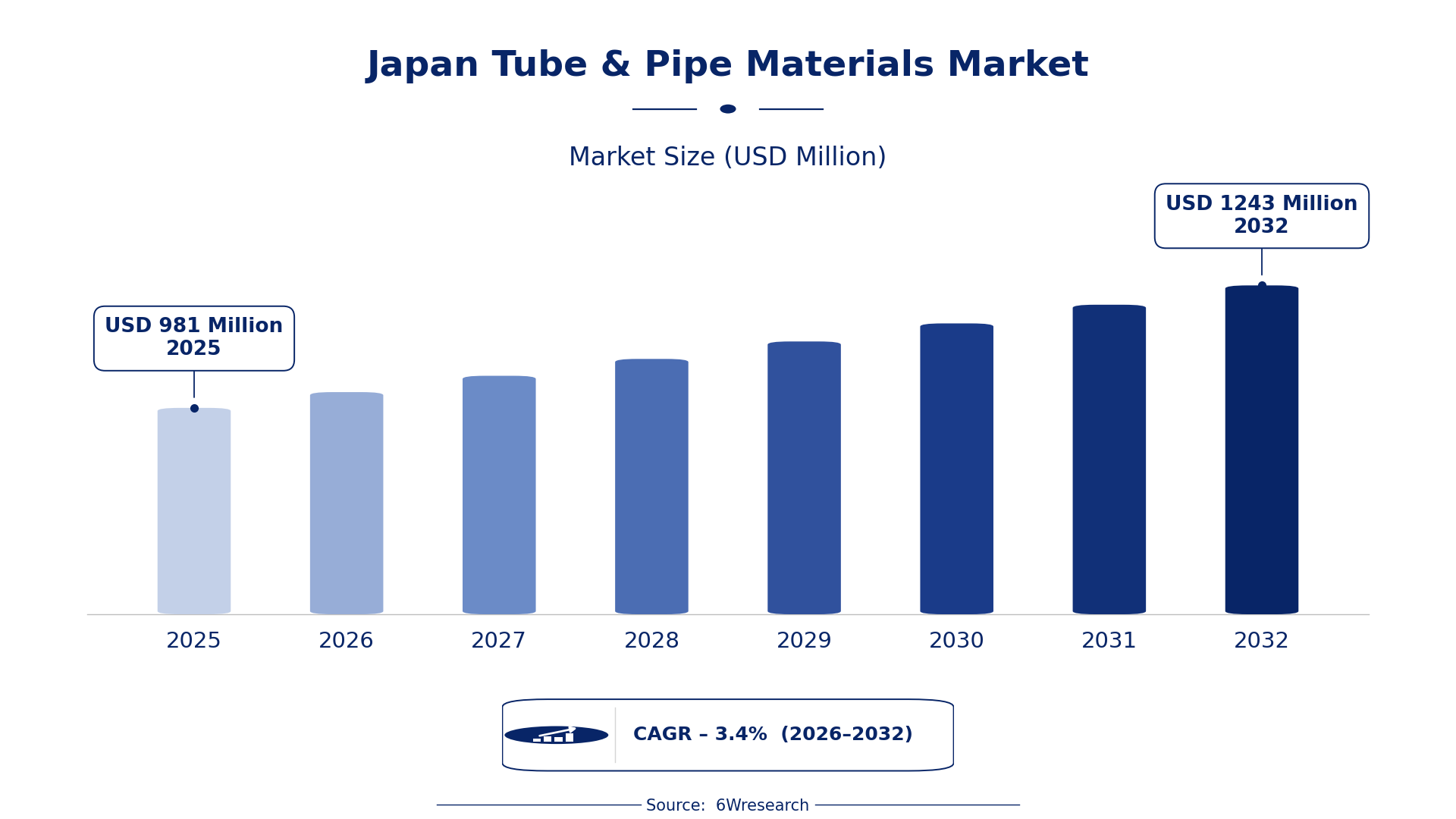
According to 6Wresearch internal database and industry insights, the Japan Tube & Pipe Materials Market was valued at USD 981 Million in 2025 and is projected to reach USD 1,243 Million by 2032, growing at a CAGR of approximately 3.4% during 2026–2032.
Japan Tube & Pipe Materials Market Highlights
| Report Metric | Details |
| Report Name | Japan Tube & Pipe Materials Market (2026-2032) |
| Market Size 2025 | USD 981 Million |
| Market Size 2032 | USD 1,243 Million |
| Absolute Growth 2025–2032 | USD 262 Million |
| CAGR 2026–2032 | 3.4% |
| Peak Annual Growth | 4.8% in 2028 |
| Forecast Period | 2026–2032 |
| Historical Data | 2022–2025 |
| Base Year | 2025 |
| Leading Material Type, 2025 | Carbon Steel (49% share) |
| Leading Form Type, 2025 | Seamless Pipe (46% share) |
| Leading Application Area, 2025 | Oil & Gas Pipelines (38% share) |
| Leading End User, 2025 | Industrial Manufacturers (46% share) |
| Fastest-Growing Material Type | Stainless Steel (4.6% CAGR) |
| Fastest-Growing Form Type | Welded Tubes (5.0% CAGR) |
| Fastest-Growing Application Area | Chemical Processing (4.4% CAGR) |
| Fastest-Growing End User | Construction Firms (4.5% CAGR) |
| Growing Sector | Chemical Processing |
| Key End Users | Oil & Gas Pipelines, Chemical Processing, Automotive Frameworks, HVAC Systems |
Japan Tube & Pipe Materials Market Year-wise Growth Rate and Key Drivers (2022–2032)
This graph illustrates the annual growth rates of the market from 2022 to 2032, highlighting a steady upward trajectory and projected market expansion over the forecast period.
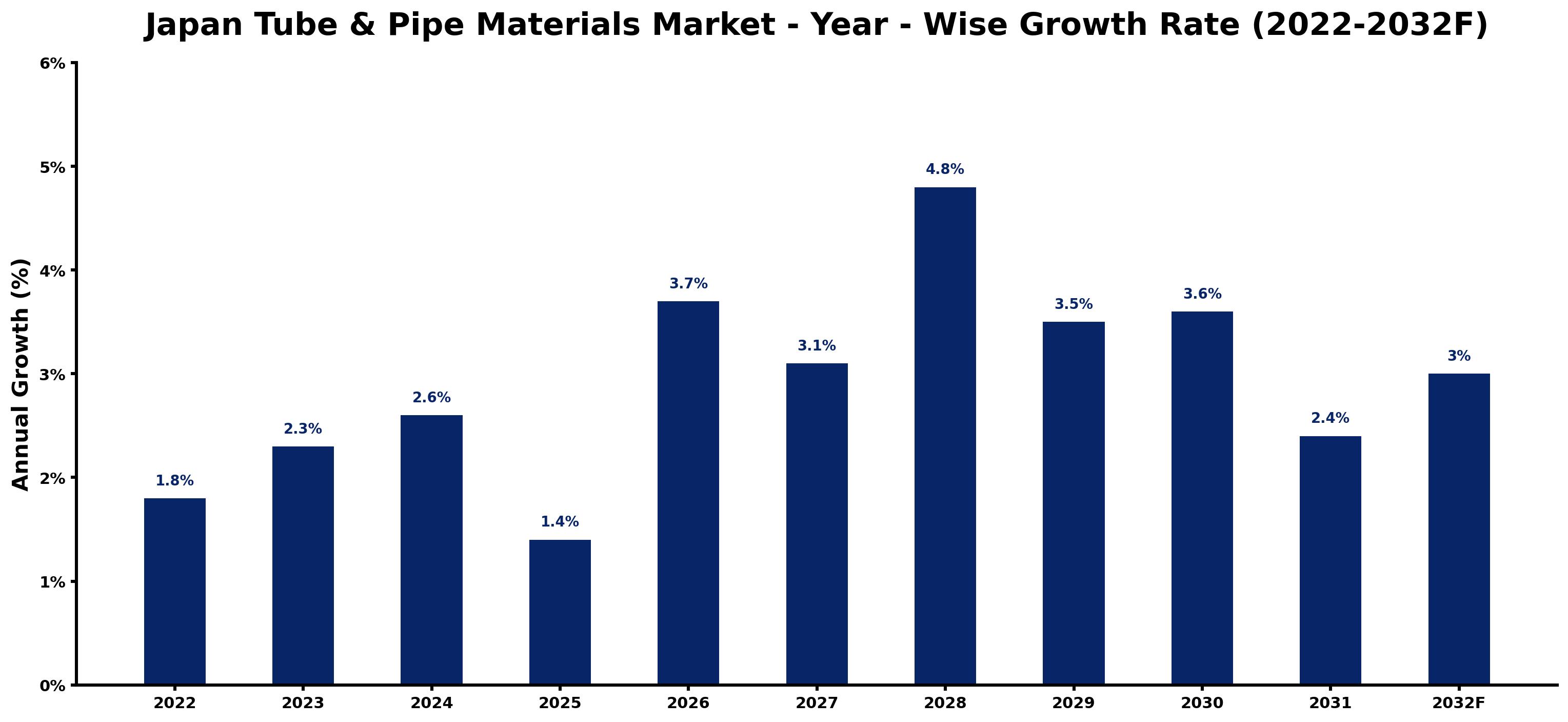
For each year, the table pairs the estimated growth rate with the leading influence on demand, showing how the drivers changed across the period.
| Year | Estimated Annual Growth (%) | Market Rationale |
| 2022 | 1.8 | The market experienced steady growth, driven by strong demand from construction and automotive sectors. |
| 2023 | 2.3 | Increased production in the automotive sector accelerated demand for structural pipes and related materials. |
| 2024 | 2.6 | The rise in construction activity further boosted the need for tube and pipe materials across various applications. |
| 2025 | 1.4 | Growth slowed slightly due to market saturation in some segments, yet demand remained strong overall. |
| 2026 | 3.7 | Demand is expected to surge as manufacturers adopt advanced technologies, improving production efficiency and capacity. |
| 2027 | 3.1 | A slight slowdown is projected as the market adjusts to new production standards and practices. |
| 2028 | 4.8 | The market is expected to peak with heightened investments in infrastructure and energy projects, particularly in oil and gas. |
| 2029 | 3.5 | Growth is projected to decelerate as the market stabilises after reaching its peak, maintaining a healthy demand. |
| 2030 | 3.6 | Demand will increase again, driven by ongoing investments in sustainable energy and construction projects. |
| 2031 | 2.4 | The market is expected to see a reduction in growth as it adjusts to new regulatory frameworks and standards. |
| 2032 | 3.0 | Growth will resume as industries adapt to new technologies and increase production capabilities. |
Note: Market size estimations and growth projections presented in this report are based on 6Wresearch's proprietary forecasting methodology, utilizing the latest available industry data, government publications, and primary research inputs.
Japan Tube & Pipe Materials Market Synopsis
Tube and pipe materials in Japan consist mainly of metals like carbon steel and stainless steel, produced through processes such as rolling and welding. Primary applications include construction, automotive, and industrial sectors, particularly in oil and gas pipelines. The Japan Tube & Pipe Materials Market is expanding due to rising demand from the automotive sector, which produced over 8 million vehicles in 2023, and investments in infrastructure, projected at JPY 150 trillion over the next decade. The chemical processing industry is also growing, further driving the need for stainless steel tubes.
Market Dynamics Impact Analysis (2026–2032)
| Factor | Type | Impact | Primary Segment Affected |
| Rising automotive production | Driver | High | Structural Pipes |
| Growing investments in infrastructure | Driver | High | Oil & Gas Pipelines |
| Expansion of the chemical processing industry | Opportunity | High | Chemical Processing |
| Increasing demand for sustainable materials | Opportunity | Medium | Stainless Steel |
| Fluctuating raw material prices | Restraint | High | Carbon Steel |
| Regulatory compliance costs | Restraint | Medium | Welded Tubes |
| Capacity constraints in production | Challenge | High | Seamless Pipe |
| Technological adaptation delays | Challenge | Medium | Structural Pipes |
Evaluation of Drivers in Japan Tube & Pipe Materials Market (2026–2032)
The following drivers explain most of the expected growth.
| Drivers | Primary Segment Affected | Why It Matters (Evidence) |
| Increased vehicle production | Structural Pipes | In 2023, Japan's automotive sector produced over 8 million vehicles, driving demand for structural pipes used in frameworks. |
| Infrastructure investments | Oil & Gas Pipelines | Japan's oil and gas sector invested 1 trillion yen in infrastructure development, increasing the need for high-strength pipe materials. |
| Growth in chemical processing | Chemical Processing | The chemical processing industry is projected to grow, leading to higher demand for stainless steel tubes used in various plants. |
| Focus on decarbonisation | Stainless Steel | Japan targets a 46% cut in greenhouse-gas emissions by 2030, boosting demand for sustainable materials like stainless steel. |
| Technological advancements in manufacturing | Welded Tubes | Advanced manufacturing technologies are improving production efficiency, increasing output for welded tubes. |
Most of the extra volume comes from Japan's automotive sector, which produced over 8 million vehicles in 2023, increasing demand for structural pipes. The oil and gas sector's investment of 1 trillion yen in infrastructure development has further driven the need for high-strength pipe materials. The chemical processing industry is projected to expand, leading to higher demand for stainless steel tubes required for various applications. Japan's commitment to reducing greenhouse-gas emissions by 2030 has prompted a shift towards sustainable materials, boosting the market for stainless steel. The promotion of advanced manufacturing technologies is improving production efficiency, leading to increased output for welded tubes.
Evaluation of Restraints in Japan Tube & Pipe Materials Market
These restraints slow adoption and weigh on supplier margins.
| Market Restraint | Primary Segment Affected | Why It Matters (Evidence) |
| Fluctuating raw material prices | Carbon Steel | Rising global market fluctuations can increase production expenses, resulting in higher prices for end-users in the automotive and construction industries. |
| Regulatory compliance costs | Welded Tubes | Strict adherence to JIS and ISO standards raises compliance costs for manufacturers, delaying project timelines for buyers. |
| Supply shortages | Structural Pipes | Increased demand from the construction sector can lead to supply shortages, affecting project timelines for construction firms. |
| Competition from low-cost imports | Welded Tubes | Local producers face pressure to lower prices due to competition from lower-cost imports, impacting profitability. |
| Capacity constraints in production | Welded Tubes | Manufacturers may struggle to meet rising demand due to limitations in production capacity, affecting supply availability. |
Japan Tube & Pipe Materials Market Challenges
In 2023, Japan's construction industry was valued at approximately 60 trillion yen, leading to supply shortages for buyers in that sector. Local producers struggle against low-cost imports, which forces them to lower prices and diminishes their profit margins. Strict adherence to JIS and ISO standards results in high compliance costs for manufacturers, delaying project timelines for buyers. Rising raw material prices, driven by global market fluctuations, inflate production costs, ultimately raising prices for end-users in both the automotive and construction sectors.
Trends in the Japan Tube & Pipe Materials Market
The shifts below are changing how Japan Tube & Pipe Materials Market products are bought and supplied.
- Shift Towards Sustainable Materials: Japan's construction firms are increasingly opting for sustainable materials, influenced by the GX Promotion Act's targets. This shift is expected to drive demand for stainless steel, with a projected market growth of 4.6% in the coming years.
- Increase in Infrastructure Development: The Kanto region is experiencing a surge in infrastructure projects, supported by government investments. In 2023, the oil and gas sector allocated 1 trillion yen for infrastructure, driving demand for high-strength pipe materials.
- Growing Demand in Chemical Processing: The chemical processing industry is expanding, particularly in Kansai, where new plants are being established. This growth is projected to increase the demand for stainless steel tubes by 4.4% over the next few years.
- Rising Automotive Production: The automotive sector continues to thrive, producing over 8 million vehicles in 2023. This growth is driving demand for structural pipes, essential for vehicle manufacturing and frameworks.
Investment Opportunities in the Japan Tube & Pipe Materials Market
Below are the investment opportunities with the strongest case in the Japan Tube & Pipe Materials Market.
- Investment in Decarbonisation: Industrial manufacturers are focusing on sustainable practices, with Japan targeting a 46% reduction in greenhouse gases by 2030. This creates opportunities for suppliers of stainless steel and other sustainable materials.
- Growth in HVAC Market: The HVAC market is set to reach 2 trillion yen by 2025, creating demand for efficient tube materials. Suppliers can enter this market by partnering with local manufacturers to provide high-quality products.
- Expansion of Chemical Processing Facilities: With the chemical processing industry expected to grow, there is an opportunity for suppliers of stainless steel tubes. Companies can engage with industrial manufacturers in regions like Kansai to meet this demand.
- Infrastructure Development Projects: Construction firms are set to benefit from increased infrastructure investments, projected at JPY 150 trillion over the next decade. Suppliers can collaborate with these firms to provide essential tube materials.
Government Initiatives in the Japan Tube & Pipe Materials Market
The GX Promotion Act (2023) establishes a legal framework for decarbonisation efforts, supporting investments in sustainable materials and practices. This act drives demand for eco-friendly tube and pipe materials, benefiting producers and buyers alike.
The Water Supply Act (1957) and the Sewerage Act (1958) set standards for water quality and sewerage systems. These regulations ensure that tube and pipe materials meet safety and quality requirements for public infrastructure projects.
Future Insight of the Japan Tube & Pipe Materials Market
By 2032, the integration of advanced manufacturing technologies will reshape the tube and pipe materials market, improving production capabilities and reducing waste. The anticipated growth of the HVAC market to 2 trillion yen by 2025 will create new opportunities for buyers focused on energy-efficient solutions. As the chemical processing industry expands, demand for stainless steel tubes will increase, benefiting suppliers who adapt to these changes. Japan's commitment to a 46% reduction in greenhouse-gas emissions by 2030 will further drive innovation in sustainable materials.
Market Segmentation Analysis
Japan Tube & Pipe Materials Market report covers a detailed analysis of the following market segments:
By Material Type – Carbon Steel Leads, Stainless Steel Expected to Grow Fastest
According to Saurav Kr Singh, Senior Research Analyst at 6Wresearch, in 2025, Carbon Steel led the material type split with a 49% share. Carbon steel secures the largest market share due to its extensive use in construction and automotive frameworks, particularly in the Kanto region where manufacturing is robust. Its dominance is reinforced by the construction industry's valuation of approximately 60 trillion yen in 2023, highlighting the material's critical role. Over 2026–2032, Stainless Steel is expected to post the fastest growth, at a CAGR of 4.6%. Stainless steel is experiencing rapid growth as it is essential for chemical processing and food applications, where corrosion resistance is crucial. The projected expansion of the chemical processing industry is expected to significantly boost the demand for stainless steel tubes in the coming years. Suppliers should focus on enhancing their stainless steel offerings to capitalise on the increasing demand from the chemical processing sector.
By Form Type – Seamless Pipe Leads, Welded Tubes Expected to Grow Fastest
Seamless Pipe held 46% of the Japan Tube & Pipe Materials Market by form type in 2025. Seamless pipes lead the market as they are vital for oil and gas pipelines that require high strength and reliability. The substantial investments in infrastructure development within the oil and gas sector underscore the preference for seamless pipes in these critical applications. Welded Tubes are set to record the highest CAGR in this split, 5.0% over 2026–2032. Welded tubes are witnessing rapid growth due to their cost-effectiveness and versatility in various industrial applications. Their ability to optimise production costs makes them increasingly appealing to manufacturers looking to improve efficiency. Buyers should evaluate the advantages of welded tubes for cost savings, while suppliers may need to adjust production strategies to accommodate rising demand.
By Application Area – Oil & Gas Pipelines Lead, Chemical Processing Expected to Grow Fastest
Oil & Gas Pipelines accounted for 38% of the market by application area in 2025. Oil and gas pipelines constitute the largest application area, driven by Japan's energy requirements and significant investments in infrastructure. The oil and gas sector's investment of 1 trillion yen in 2023 underscores the importance of this application area for tube and pipe materials. The quickest growth will come from Chemical Processing, forecast to expand at a CAGR of 4.4% between 2026 and 2032. Chemical processing is the fastest-growing segment, with substantial usage in various chemical plants across the country. As the chemical processing industry continues to expand, the demand for tube materials in this sector is anticipated to increase sharply. Suppliers must align their production capabilities to meet the escalating demand from the chemical processing sector.
By End User – Industrial Manufacturers Lead, Construction Firms Expected to Grow Fastest
With 46% of end user revenue in 2025, Industrial Manufacturers was the largest category. Industrial manufacturers are the primary consumers of tube and pipe materials, reflecting their extensive application across multiple sectors. This group benefits from Japan's strong manufacturing base, which is bolstered by advanced production technologies and significant investments. Construction Firms are projected to grow fastest, at a CAGR of 4.5% during 2026–2032. Construction firms are experiencing the fastest growth in demand for tube materials due to the substantial need for structural applications in ongoing projects. The construction industry's valuation at 60 trillion yen indicates that this trend is likely to persist in the future. Suppliers should target construction firms to capture the increasing demand for structural applications in the market.
Key Attractiveness of the Report
- 10 Years of Market Numbers
- Historical Data Starting from 2022 to 2025
- Base Year 2025
- Forecast Data until 2032
- Key Performance Indicators Impacting the Market
- Major Upcoming Developments and Projects
Key Highlights of the Report:
- Japan Tube & Pipe Materials Market Outlook
- Market Size of Japan Tube & Pipe Materials Market, 2025
- Forecast of Japan Tube & Pipe Materials Market, 2032
- Historical Data and Forecast of Japan Tube & Pipe Materials Revenues & Volume for the Period 2022-2032F
- Japan Tube & Pipe Materials Market Trend Evolution
- Japan Tube & Pipe Materials Market Drivers and Challenges
- Japan Tube & Pipe Materials Price Trends
- Japan Tube & Pipe Materials Porter's Five Forces
- Japan Tube & Pipe Materials Industry Life Cycle
- Historical Data and Forecast of Japan Tube & Pipe Materials Market Revenues & Volume By Material Type for the Period 2022-2032F
- Historical Data and Forecast of Japan Tube & Pipe Materials Market Revenues & Volume By Carbon Steel for the Period 2022-2032F
- Historical Data and Forecast of Japan Tube & Pipe Materials Market Revenues & Volume By Stainless Steel for the Period 2022-2032F
- Historical Data and Forecast of Japan Tube & Pipe Materials Market Revenues & Volume By Copper for the Period 2022-2032F
- Historical Data and Forecast of Japan Tube & Pipe Materials Market Revenues & Volume By Aluminum for the Period 2022-2032F
- Historical Data and Forecast of Japan Tube & Pipe Materials Market Revenues & Volume By Form Type for the Period 2022-2032F
- Historical Data and Forecast of Japan Tube & Pipe Materials Market Revenues & Volume By Seamless Pipe for the Period 2022-2032F
- Historical Data and Forecast of Japan Tube & Pipe Materials Market Revenues & Volume By Welded Tubes for the Period 2022-2032F
- Historical Data and Forecast of Japan Tube & Pipe Materials Market Revenues & Volume By Coiled Tubes for the Period 2022-2032F
- Historical Data and Forecast of Japan Tube & Pipe Materials Market Revenues & Volume By Structural Pipes for the Period 2022-2032F
- Historical Data and Forecast of Japan Tube & Pipe Materials Market Revenues & Volume By Application Area for the Period 2022-2032F
- Historical Data and Forecast of Japan Tube & Pipe Materials Market Revenues & Volume By Oil & Gas Pipelines for the Period 2022-2032F
- Historical Data and Forecast of Japan Tube & Pipe Materials Market Revenues & Volume By Chemical Processing for the Period 2022-2032F
- Historical Data and Forecast of Japan Tube & Pipe Materials Market Revenues & Volume By HVAC Systems for the Period 2022-2032F
- Historical Data and Forecast of Japan Tube & Pipe Materials Market Revenues & Volume By Automotive Frameworks for the Period 2022-2032F
- Historical Data and Forecast of Japan Tube & Pipe Materials Market Revenues & Volume By End User for the Period 2022-2032F
- Historical Data and Forecast of Japan Tube & Pipe Materials Market Revenues & Volume By Refinery Contractors for the Period 2022-2032F
- Historical Data and Forecast of Japan Tube & Pipe Materials Market Revenues & Volume By Industrial Manufacturers for the Period 2022-2032F
- Historical Data and Forecast of Japan Tube & Pipe Materials Market Revenues & Volume By Construction Firms for the Period 2022-2032F
- Historical Data and Forecast of Japan Tube & Pipe Materials Market Revenues & Volume By Vehicle OEMs for the Period 2022-2032F
- Japan Tube & Pipe Materials Import Export Trade Statistics
- Market Opportunity Assessment By Material Type
- Market Opportunity Assessment By Form Type
- Market Opportunity Assessment By Application Area
- Market Opportunity Assessment By End User
- Japan Tube & Pipe Materials Top Companies Market Share
- Japan Tube & Pipe Materials Competitive Benchmarking By Technical and Operational Parameters
- Japan Tube & Pipe Materials Company Profiles
- Japan Tube & Pipe Materials Key Strategic Recommendations
Market Covered
Coverage by segment is as follows.
By Material Type
- Carbon Steel
- Stainless Steel
- Copper
- Aluminum
By Form Type
- Seamless Pipe
- Welded Tubes
- Coiled Tubes
- Structural Pipes
By Application Area
- Oil & Gas Pipelines
- Chemical Processing
- HVAC Systems
- Automotive Frameworks
By End User
- Refinery Contractors
- Industrial Manufacturers
- Construction Firms
- Vehicle OEMs































