Japan Tumor Board Decision AI Market Size & Growth Rate
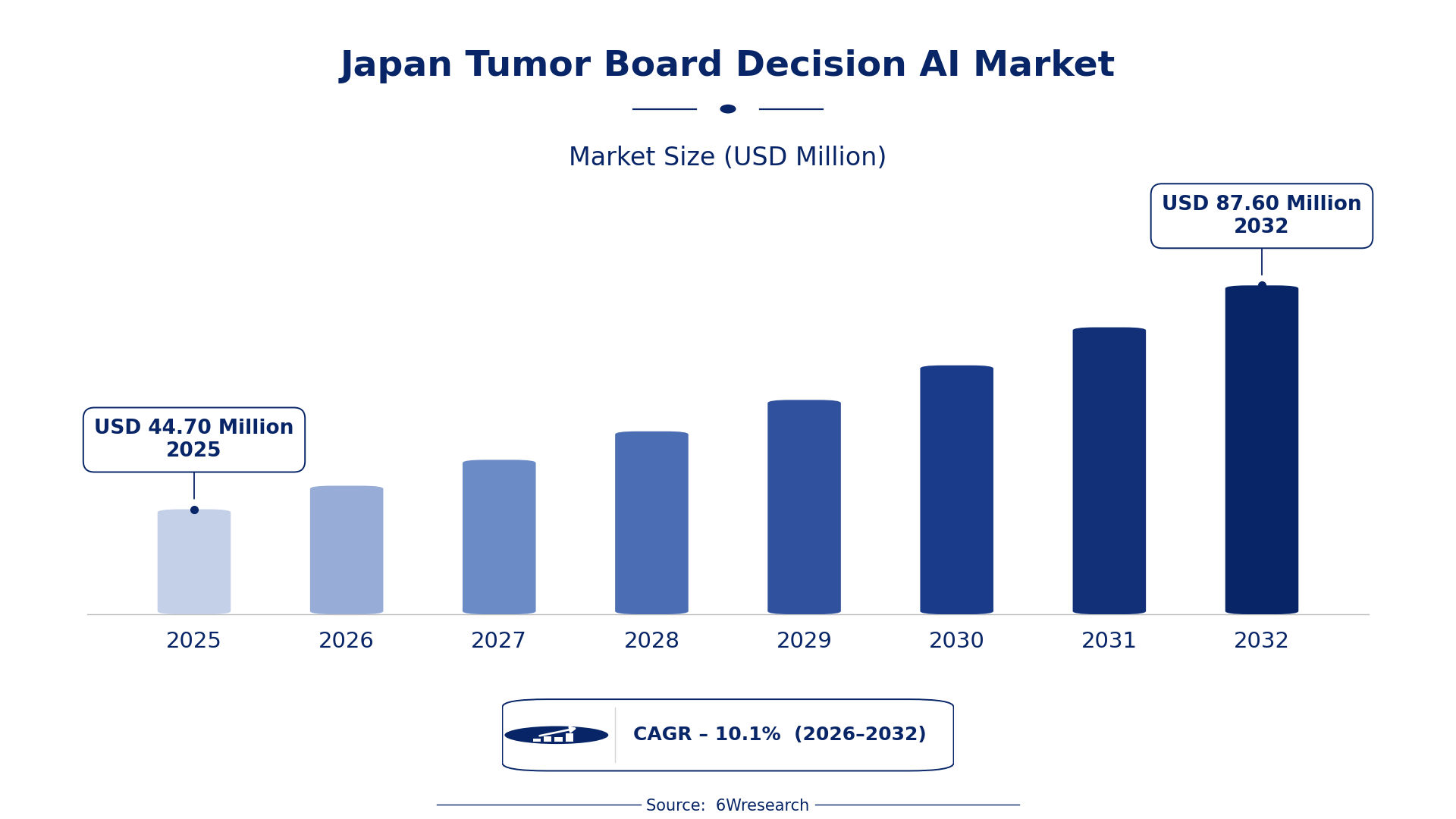
According to 6Wresearch internal database and industry insights, the Japan Tumor Board Decision AI Market was valued at USD 44.70 Million in 2025 and is projected to reach USD 87.60 Million by 2032, growing at a CAGR of approximately 10.1% during 2026–2032.
Japan Tumor Board Decision AI Market Highlights
| Report Metric | Details |
| Report Name | Japan Tumor Board Decision AI Market (2026-2032) |
| Market Size 2025 | USD 44.70 Million |
| Market Size 2032 | USD 87.60 Million |
| Absolute Growth 2025–2032 | USD 42.90 Million |
| CAGR 2026–2032 | 10.1% |
| Peak Annual Growth | 13.9% in 2032 |
| Forecast Period | 2026–2032 |
| Historical Data | 2022–2025 |
| Base Year | 2025 |
| Leading AI Capability, 2025 | Treatment Planning AI (39% share) |
| Leading Data Input Source, 2025 | EHR + Genomic Data (47% share) |
| Leading Use Case, 2025 | Oncology Board Support (44% share) |
| Leading End User, 2025 | Cancer Centers (45% share) |
| Fastest-Growing AI Capability | Prognosis Prediction AI (13.8% CAGR) |
| Fastest-Growing Use Case | Complex Case Review (13.7% CAGR) |
| Fastest-Growing End User | Research Hospitals (13.2% CAGR) |
| Growing Sector | oncology |
| Key End Users | cancer centers, hospitals, research hospitals, tumor boards |
Japan Tumor Board Decision AI Market Year-wise Growth Rate and Key Drivers (2022–2032)
This graph illustrates the annual growth rates of the market from 2022 to 2032, highlighting a steady upward trajectory and projected market expansion over the forecast period.
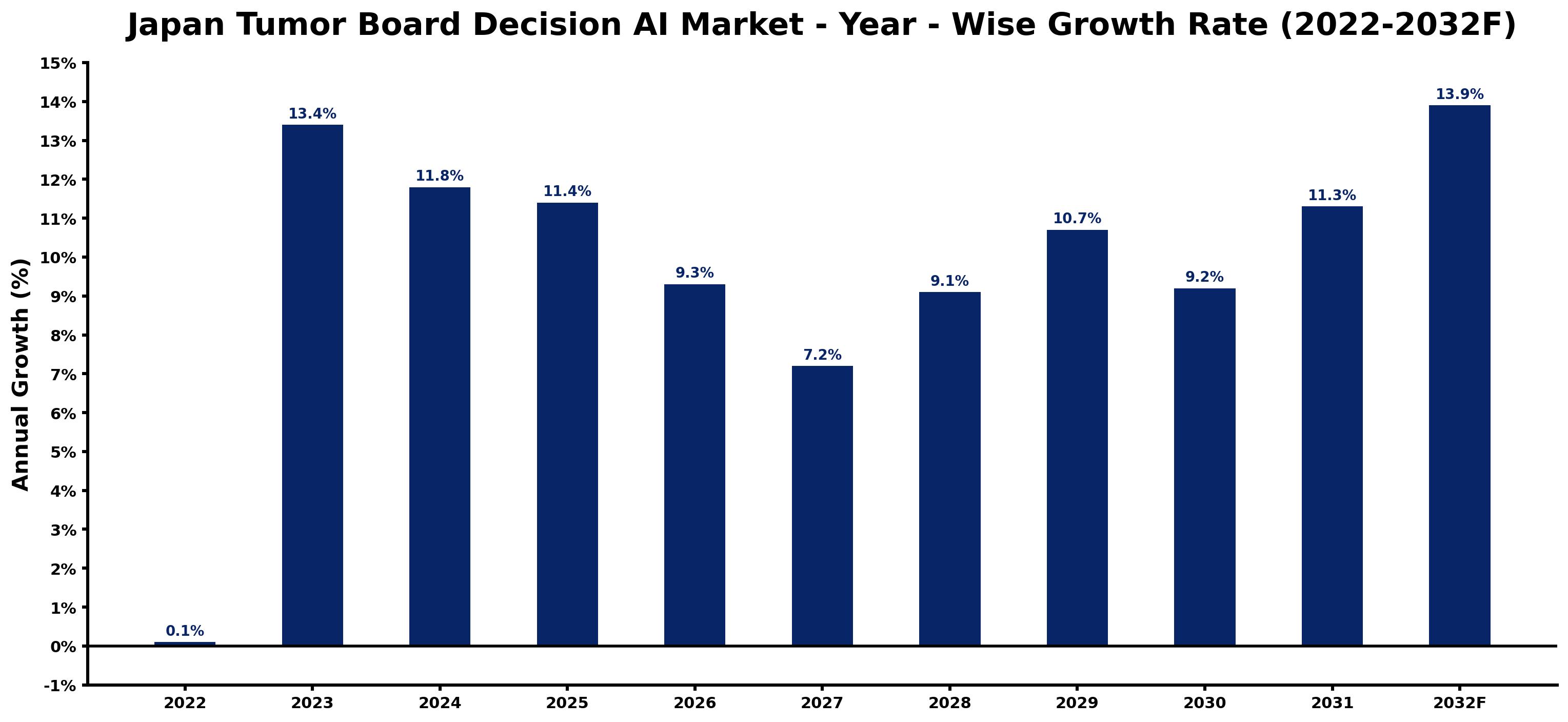
Below, each year's estimated growth is shown next to the factor that most influenced it.
| Year | Estimated Annual Growth (%) | Market Rationale |
| 2022 | 0.1 | The market experienced minimal growth due to early-stage adoption of AI technologies. |
| 2023 | 13.4 | The integration of AI into treatment planning accelerated demand. |
| 2024 | 11.8 | Growth slowed as the market adjusted to increased competition and technology adoption. |
| 2025 | 11.4 | Demand continued to grow, but at a slower pace due to market saturation effects. |
| 2026 | 9.3 | The market is expected to see a further slowdown as investment patterns stabilise. |
| 2027 | 7.2 | Growth is projected to slow further, reflecting a maturing market with established players. |
| 2028 | 9.1 | The introduction of new AI technologies is expected to revitalise growth momentum. |
| 2029 | 10.7 | Demand will increase as healthcare facilities expand their AI capabilities. |
| 2030 | 9.2 | Growth is projected to slow again as the market begins to consolidate. |
| 2031 | 11.3 | A resurgence in demand is expected as new treatment methodologies gain traction. |
| 2032 | 13.9 | The market will peak with high demand driven by advanced AI applications. |
Note: Market size estimations and growth projections presented in this report are based on 6Wresearch's proprietary forecasting methodology, utilizing the latest available industry data, government publications, and primary research inputs.
Japan Tumor Board Decision AI Market Synopsis
Tumor Board Decision AI is a technology that utilises artificial intelligence to assist oncology professionals in making treatment decisions. In 2022, Japan reported approximately 1 million new cancer cases annually, driving demand for advanced treatment solutions. The integration of AI in the Japan Tumor Board Decision AI Market is supported by substantial investments from cancer centres and hospitals, alongside initiatives from the Japanese Society of Clinical Oncology and the Ministry of Health, Labour and Welfare, which backs digital health initiatives with a budget of ¥10 billion.
Market Dynamics Impact Analysis (2026–2032)
| Factor | Type | Impact | Primary Segment Affected |
| Integration of AI technologies in treatment planning | Driver | High | Treatment Planning AI |
| Increasing number of cancer cases requiring advanced decision-making tools | Driver | High | Oncology Board Support |
| Growing demand for personalised medicine solutions | Opportunity | High | Prognosis Prediction AI |
| Expansion of cancer treatment facilities in major regions | Opportunity | High | Cancer Centers |
| Limited awareness of AI benefits among healthcare professionals | Restraint | Medium | Diagnostic Assistance |
| High initial investment costs for AI systems | Restraint | Medium | Pathology + Radiology |
| Shortage of skilled professionals to implement AI solutions | Challenge | High | Clinical Summaries |
| Regulatory hurdles in AI technology adoption | Challenge | Medium | Complex Case Review |
Evaluation of Drivers in Japan Tumor Board Decision AI Market (2026–2032)
The table below links each growth driver to the segment it affects and the evidence for it.
| Drivers | Primary Segment Affected | Why It Matters (Evidence) |
| Increased adoption of AI technologies in hospitals | Treatment Planning AI | Over 200 hospitals adopted AI systems by 2023, improving treatment planning efficiency and patient outcomes. |
| Rising incidence of cancer cases | Oncology Board Support | Japan reported approximately 1 million new cancer cases annually, increasing demand for decision support technologies. |
| Support from professional societies for AI integration | Prognosis Prediction AI | The Japanese Society of Clinical Oncology promotes AI, encouraging its use in treatment protocols and enhancing clinical decisions. |
| Investment in healthcare technology | Cancer Centers | The Ministry of Health, Labour and Welfare allocated ¥10 billion to support digital health initiatives, boosting AI adoption. |
| Development of Clinical Pathways for standardisation | Diagnostic Assistance | Standardisation efforts are improving the accuracy of diagnostic interpretations across facilities, enhancing treatment consistency. |
A wider customer base explains much of the growth, as Tokyo's cancer centers increasingly adopt AI technologies to improve treatment outcomes. In 2023, over 200 hospitals implemented AI systems, streamlining treatment planning processes. The integration of AI tools is driving demand for prognosis prediction capabilities, with the average patient population in major cancer centers exceeding 5,000 annually. As healthcare facilities invest in advanced technologies, oncology professionals are utilising AI for complex case reviews, which improves decision-making capabilities across the sector.
Evaluation of Restraints in Japan Tumor Board Decision AI Market
The table below lists the restraints and the evidence behind each.
| Market Restraint | Primary Segment Affected | Why It Matters (Evidence) |
| Limited understanding of AI benefits among healthcare professionals | Diagnostic Assistance | Many professionals lack awareness of how AI can improve diagnostic accuracy, hindering adoption and leading to slower integration. |
| High initial costs of AI implementation | Pathology + Radiology | The substantial investment required for AI systems, averaging ¥50 million per facility, deters some facilities from adopting them. |
| Insufficient training programs for AI technologies | Clinical Summaries | A lack of skilled professionals limits the effective use of AI in clinical settings, impacting treatment outcomes. |
| Regulatory challenges in AI technology deployment | Complex Case Review | Compliance with existing regulations complicates the integration of AI solutions, resulting in extended timelines. |
| Concerns over data privacy and security | Oncology Board Support | Healthcare providers are cautious about sharing sensitive patient data with AI systems, affecting adoption rates. |
Japan Tumor Board Decision AI Market Challenges
Cancer centres struggle to integrate AI technologies, delaying treatment planning and negatively impacting patient outcomes. Hospitals face intensified competition as they race to adopt the latest AI systems, leading to increased operational costs for those lagging behind. Suppliers find it challenging to meet the demand from over 1,000 cancer centres, with only 200 hospitals currently utilising AI solutions, creating a supply gap. Regulatory hurdles extend the approval timelines for new AI applications, resulting in increased costs and delays for healthcare providers seeking to implement these technologies.
Trends in the Japan Tumor Board Decision AI Market
The trends below show where the Japan Tumor Board Decision AI Market is heading.
- Shift from Traditional to AI-Driven Decision Making: The oncology sector is increasingly adopting AI-driven decision-making tools, improving treatment planning. In 2023, over 300 hospitals implemented AI systems, allowing for more accurate and efficient patient care.
- Transition to Standardised Treatment Protocols: Since 2021, there has been a move towards standardising treatment protocols through Clinical Pathways. This initiative aims to improve the consistency of care across hospitals, positively impacting patient outcomes.
- Emergence of AI in Prognosis Prediction: Prognosis Prediction AI has gained traction, with a 13.8% CAGR projected from 2026 to 2032. This growth reflects the increasing need for tailored treatment plans in cancer care.
- Increased Focus on Patient-Centric Care: Cancer Centres are prioritising patient-centric care models, utilising AI to improve treatment recommendations. In 2023, the average patient population in major centres exceeded 5,000 annually, driving demand for personalised solutions.
Investment Opportunities in the Japan Tumor Board Decision AI Market
The opportunities below stand out in the Japan Tumor Board Decision AI Market for new entrants and existing suppliers.
- Investment in Cancer Treatment Facilities: With over 1,000 cancer centres in Japan, there is an opportunity to invest in AI technologies. The growing patient population, exceeding 5,000 annually in major centres, highlights the demand for advanced decision-making tools.
- Partnerships with Research Hospitals: Collaborating with research hospitals can improve AI development in oncology. The National Cancer Center Japan is a leader in cancer research, making it an ideal partner for advanced AI solutions.
- Expansion of AI Training Programs: There is a pressing need for training programs to improve AI literacy among healthcare professionals. The growing adoption of AI technologies necessitates skilled personnel to maximise their potential.
- Development of AI Standards for Oncology: Establishing standards for AI applications in oncology can facilitate wider adoption. The Japanese Society of Medical Oncology is actively promoting AI integration, creating a pathway for standardisation.
Government Initiatives in the Japan Tumor Board Decision AI Market
The AI Promotion Act, established in 2025, provides a national framework for AI research and development, encouraging healthcare facilities to adopt AI technologies and ensuring compliance with safety and efficacy standards. This act builds on previous laws by focusing on the integration of AI in treatment planning and decision-making processes within oncology, enhancing the overall quality of care.
In 2023, the Digital Agency allocated ¥10 billion to support projects aimed at integrating AI into healthcare, benefiting both producers and buyers. This agency oversees the implementation of digital health initiatives, ensuring that AI technologies align with national standards and improve patient care.
Future Insight of the Japan Tumor Board Decision AI Market
By 2032, the Japanese government's Cancer Control Strategy program will drive a significant increase in AI adoption across healthcare. Enhanced funding for digital health initiatives will support the development of new AI applications tailored for treatment planning. As clinical pathways are standardised, buyers will benefit from improved treatment consistency across facilities. Research breakthroughs in regions like Tokyo and Osaka will further refine decision-making tools, empowering oncology professionals to deliver better patient care.
Market Segmentation Analysis
Japan Tumor Board Decision AI Market report covers a detailed analysis of the following market segments:
By AI Capability – Treatment Planning AI Leads, Prognosis Prediction AI Expected to Grow Fastest
According to Saurav Kr Singh, Senior Research Analyst at 6Wresearch, in 2025, Treatment Planning AI led the ai capability split with a 39% share. Treatment Planning AI holds the largest share as it directly influences patient outcomes, with over 1,000 cancer centres in Japan implementing it for tailored treatment recommendations. This technology is essential for optimising treatment strategies, making it a cornerstone of oncology care. The quickest growth will come from Prognosis Prediction AI, forecast to expand at a CAGR of 13.8% between 2026 and 2032. Prognosis Prediction AI is experiencing rapid growth due to its ability to estimate patient outcomes, a feature increasingly sought after given Japan's annual report of approximately 1 million new cancer cases. The continued integration of this capability will likely allow Treatment Planning AI to maintain its lead. Suppliers should prioritise the development of advanced solutions that enhance treatment planning capabilities.
By Data Input Source – EHR + Genomic Data Leads and Records the Fastest Growth
With 47% of data input source revenue in 2025, EHR + Genomic Data was the largest category. EHR + Genomic Data leads the market by providing comprehensive patient profiles that are vital for effective treatment planning, with many facilities adopting this integration approach. This combination is crucial for oncology professionals to make well-informed decisions. Its lead should widen, with a projected CAGR of 11.9% during 2026–2032, the highest in this split. EHR + Genomic Data is also the fastest-growing segment as its role in personalised medicine gains recognition, particularly with the Ministry of Health, Labour and Welfare's support for digital health initiatives. This dual role will further solidify its market dominance. Buyers must ensure their systems can seamlessly integrate EHR and genomic data to remain competitive.
By Use Case – Oncology Board Support Leads, Complex Case Review Expected to Grow Fastest
The largest use case category in 2025 was Oncology Board Support, at 44% of revenue. Oncology Board Support is the leading use case as it facilitates discussions among specialists in over 1,000 cancer centres, making it essential for collaborative decision-making. This support is critical for developing optimal treatment strategies across various cases. Over 2026–2032, Complex Case Review is expected to post the fastest growth, at a CAGR of 13.7%. Complex Case Review is the fastest-growing use case, driven by the increasing intricacy of cancer cases that necessitate thorough analysis, especially in major regions like Tokyo and Osaka. The rising demand for such reviews will continue to support the need for Oncology Board Support. Suppliers should focus on enhancing collaborative features in their solutions for oncology settings.
By End User – Cancer Centers Lead, Research Hospitals Expected to Grow Fastest
Cancer Centers accounted for 45% of the market by end user in 2025. Cancer Centers are the primary users of Tumor Board Decision AI, with an average patient population exceeding 5,000 annually, making them a crucial market segment. Their commitment to improving treatment outcomes drives the adoption of AI technologies. Research Hospitals are projected to grow fastest, at a CAGR of 13.2% during 2026–2032. Research Hospitals are experiencing the fastest growth as they concentrate on advanced treatment methodologies and innovation, bolstered by initiatives from leading cancer research organisations. This trend signals a shift towards more research-focused applications of AI in oncology. Buyers in research hospitals should prioritise the acquisition of cutting-edge technologies to enhance their treatment methodologies.
Key Attractiveness of the Report
- 10 Years of Market Numbers
- Historical Data Starting from 2022 to 2025
- Base Year 2025
- Forecast Data until 2032
- Key Performance Indicators Impacting the Market
- Major Upcoming Developments and Projects
Key Highlights of the Report:
- Japan Tumor Board Decision AI Market Outlook
- Market Size of Japan Tumor Board Decision AI Market, 2025
- Forecast of Japan Tumor Board Decision AI Market, 2032
- Historical Data and Forecast of Japan Tumor Board Decision AI Revenues & Volume for the Period 2022-2032F
- Japan Tumor Board Decision AI Market Trend Evolution
- Japan Tumor Board Decision AI Market Drivers and Challenges
- Japan Tumor Board Decision AI Price Trends
- Japan Tumor Board Decision AI Porter's Five Forces
- Japan Tumor Board Decision AI Industry Life Cycle
- Historical Data and Forecast of Japan Tumor Board Decision AI Market Revenues & Volume By AI Capability for the Period 2022-2032F
- Historical Data and Forecast of Japan Tumor Board Decision AI Market Revenues & Volume By Treatment Planning AI for the Period 2022-2032F
- Historical Data and Forecast of Japan Tumor Board Decision AI Market Revenues & Volume By Prognosis Prediction AI for the Period 2022-2032F
- Historical Data and Forecast of Japan Tumor Board Decision AI Market Revenues & Volume By Case Prioritization AI for the Period 2022-2032F
- Historical Data and Forecast of Japan Tumor Board Decision AI Market Revenues & Volume By Diagnostic Assistance for the Period 2022-2032F
- Historical Data and Forecast of Japan Tumor Board Decision AI Market Revenues & Volume By Data Input Source for the Period 2022-2032F
- Historical Data and Forecast of Japan Tumor Board Decision AI Market Revenues & Volume By Pathology + Radiology for the Period 2022-2032F
- Historical Data and Forecast of Japan Tumor Board Decision AI Market Revenues & Volume By EHR + Genomic Data for the Period 2022-2032F
- Historical Data and Forecast of Japan Tumor Board Decision AI Market Revenues & Volume By Clinical Summaries for the Period 2022-2032F
- Historical Data and Forecast of Japan Tumor Board Decision AI Market Revenues & Volume By Histology/Imaging for the Period 2022-2032F
- Historical Data and Forecast of Japan Tumor Board Decision AI Market Revenues & Volume By Use Case for the Period 2022-2032F
- Historical Data and Forecast of Japan Tumor Board Decision AI Market Revenues & Volume By Oncology Board Support for the Period 2022-2032F
- Historical Data and Forecast of Japan Tumor Board Decision AI Market Revenues & Volume By Patient Risk Assessment for the Period 2022-2032F
- Historical Data and Forecast of Japan Tumor Board Decision AI Market Revenues & Volume By Scheduling Discussions for the Period 2022-2032F
- Historical Data and Forecast of Japan Tumor Board Decision AI Market Revenues & Volume By Complex Case Review for the Period 2022-2032F
- Historical Data and Forecast of Japan Tumor Board Decision AI Market Revenues & Volume By End User for the Period 2022-2032F
- Historical Data and Forecast of Japan Tumor Board Decision AI Market Revenues & Volume By Cancer Centers for the Period 2022-2032F
- Historical Data and Forecast of Japan Tumor Board Decision AI Market Revenues & Volume By Hospitals for the Period 2022-2032F
- Historical Data and Forecast of Japan Tumor Board Decision AI Market Revenues & Volume By Tumor Boards for the Period 2022-2032F
- Historical Data and Forecast of Japan Tumor Board Decision AI Market Revenues & Volume By Research Hospitals for the Period 2022-2032F
- Japan Tumor Board Decision AI Import Export Trade Statistics
- Market Opportunity Assessment By AI Capability
- Market Opportunity Assessment By Data Input Source
- Market Opportunity Assessment By Use Case
- Market Opportunity Assessment By End User
- Japan Tumor Board Decision AI Top Companies Market Share
- Japan Tumor Board Decision AI Competitive Benchmarking By Technical and Operational Parameters
- Japan Tumor Board Decision AI Company Profiles
- Japan Tumor Board Decision AI Key Strategic Recommendations
Market Covered
Coverage by segment is as follows.
By AI Capability
- Treatment Planning AI
- Prognosis Prediction AI
- Case Prioritization AI
- Diagnostic Assistance
By Data Input Source
- Pathology + Radiology
- EHR + Genomic Data
- Clinical Summaries
- Histology/Imaging
By Use Case
- Oncology Board Support
- Patient Risk Assessment
- Scheduling Discussions
- Complex Case Review
By End User
- Cancer Centers
- Hospitals
- Tumor Boards
- Research Hospitals































