Japan Turbine Blade Cooling Market Size & Growth Rate
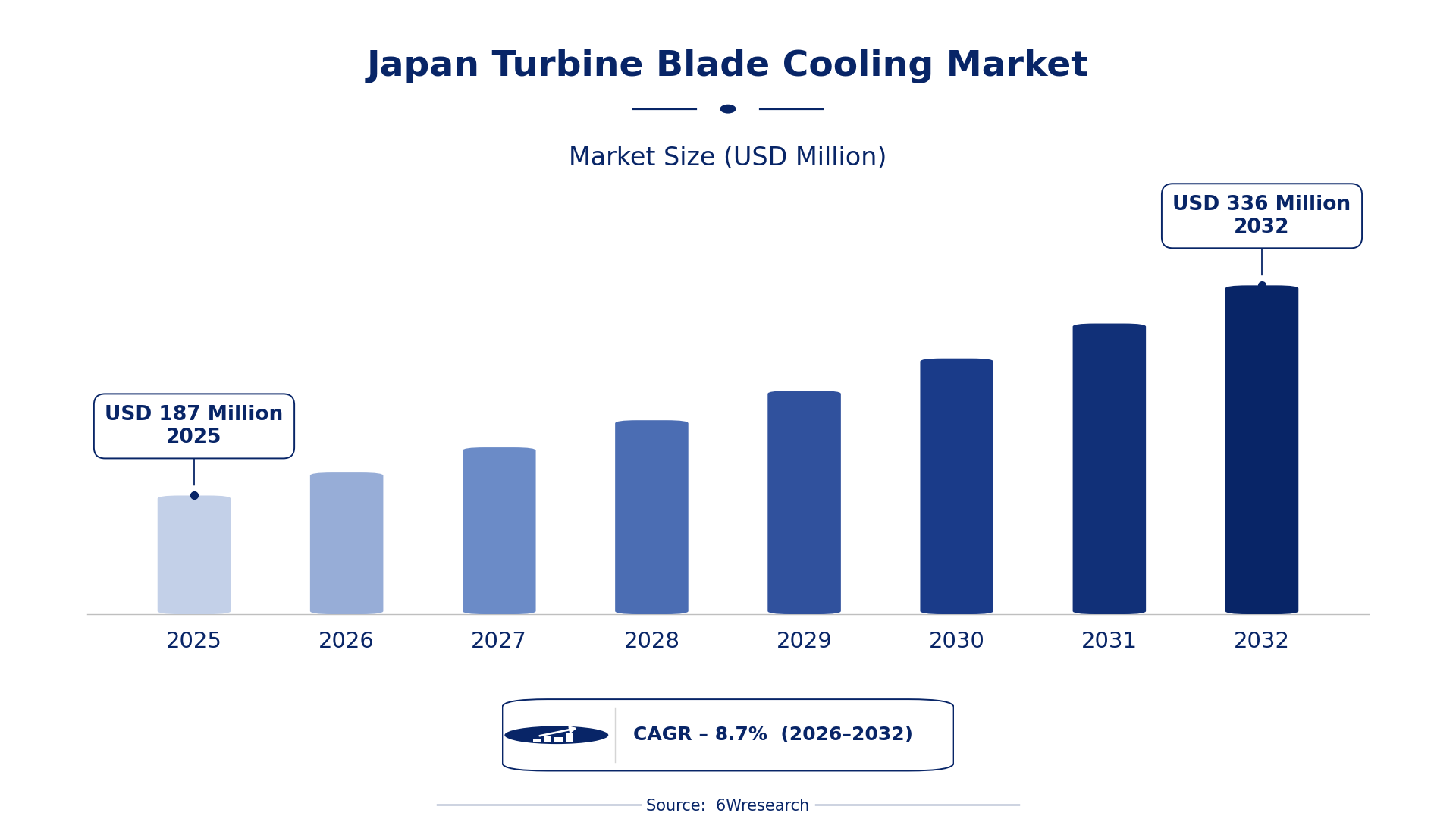
According to 6Wresearch internal database and industry insights, the Japan Turbine Blade Cooling Market was valued at USD 187 Million in 2025 and is projected to reach USD 336 Million by 2032, growing at a CAGR of approximately 8.7% during 2026–2032.
Japan Turbine Blade Cooling Market Highlights
| Report Metric | Details |
| Report Name | Japan Turbine Blade Cooling Market (2026-2032) |
| Market Size 2025 | USD 187 Million |
| Market Size 2032 | USD 336 Million |
| Absolute Growth 2025–2032 | USD 149 Million |
| CAGR 2026–2032 | 8.7% |
| Peak Annual Growth | 9.7% in 2026 |
| Forecast Period | 2026–2032 |
| Historical Data | 2022–2025 |
| Base Year | 2025 |
| Leading Cooling Method, 2025 | Film Cooling (52% share) |
| Leading Blade Material, 2025 | Superalloys (43% share) |
| Leading Engine Type, 2025 | Jet Engines (45% share) |
| Leading End User, 2025 | Aircraft OEMs (39% share) |
| Fastest-Growing Cooling Method | Transpiration Cooling (11.8% CAGR) |
| Fastest-Growing Blade Material | Single Crystal Blades (12.2% CAGR) |
| Fastest-Growing Engine Type | Gas Turbines (12.1% CAGR) |
| Fastest-Growing End User | Turbine Manufacturers (10.8% CAGR) |
| Growing Sector | Aerospace |
| Key End Users | Aircraft OEMs, Military Contractors, Turbine Manufacturers, Power Gen Companies |
Japan Turbine Blade Cooling Market Year-wise Growth Rate and Key Drivers (2022–2032)
This graph illustrates the annual growth rates of the market from 2022 to 2032, highlighting a steady upward trajectory and projected market expansion over the forecast period.
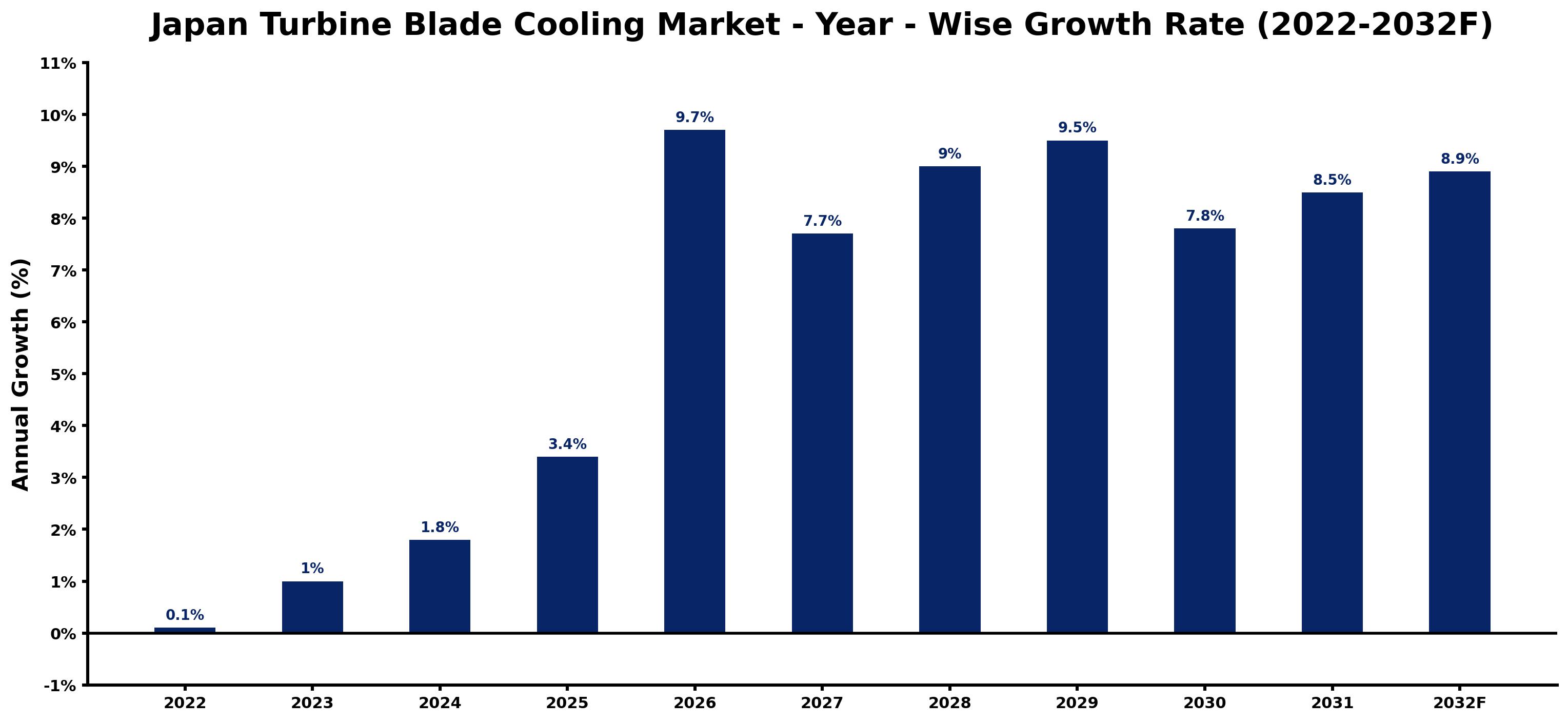
The table below sets out the estimated growth rate for each year and the main factor behind it.
| Year | Estimated Annual Growth (%) | Market Rationale |
| 2022 | 0.1 | The market exhibited minimal growth due to limited technological advancements in turbine cooling. |
| 2023 | 1.0 | Demand increased as the aerospace sector began to recover from prior disruptions. |
| 2024 | 1.8 | Growth continued as manufacturers adopted more efficient cooling technologies. |
| 2025 | 3.4 | The market saw growth driven by rising investments in aerospace innovations. |
| 2026 | 9.7 | Demand surged as new turbine technologies entered the market, improving performance. |
| 2027 | 7.7 | Growth slowed slightly as the market adjusted to previous rapid expansions. |
| 2028 | 9.0 | Demand rose again with increasing orders for advanced turbine systems. |
| 2029 | 9.5 | Technological advancements in cooling methods supported market expansion. |
| 2030 | 7.8 | Growth moderated as the market stabilised after previous high rates. |
| 2031 | 8.5 | Demand increased as manufacturers focused on efficiency and sustainability. |
| 2032 | 8.9 | The market is expected to grow steadily as new projects in aerospace emerge. |
Note: Market size estimations and growth projections presented in this report are based on 6Wresearch's proprietary forecasting methodology, utilizing the latest available industry data, government publications, and primary research inputs.
Japan Turbine Blade Cooling Market Synopsis
Turbine blade cooling technologies manage heat in turbine blades, utilising methods such as film cooling and transpiration cooling. These methods improve the performance and longevity of jet engines and gas turbines, primarily made from superalloys. The Japan Turbine Blade Cooling Market is expanding due to increasing demand from the aerospace sector, valued at approximately $40 billion, and the push for advanced turbine technologies, supported by initiatives from the Japan Aerospace Exploration Agency and the Ministry of Economy, Trade and Industry.
Market Dynamics Impact Analysis (2026–2032)
| Factor | Type | Impact | Primary Segment Affected |
| Increased demand for high-performance jet engines | Driver | High | Jet Engines |
| Technological advancements in cooling methods | Driver | High | Film Cooling |
| Growing investment in aerospace innovations | Opportunity | High | Aircraft OEMs |
| Rising focus on energy efficiency in power generation | Opportunity | High | Gas Turbines |
| High costs of advanced materials for turbine blades | Restraint | High | Superalloys |
| Regulatory compliance requirements for emissions | Restraint | Medium | Gas Turbines |
| Limited capacity for rapid production scaling | Challenge | High | Turbine Manufacturers |
| Dependence on imported advanced materials | Challenge | Medium | Turbine Manufacturers |
Evaluation of Drivers in Japan Turbine Blade Cooling Market (2026–2032)
The following drivers explain most of the expected growth.
| Drivers | Primary Segment Affected | Why It Matters (Evidence) |
| Increasing need for efficient jet engines | Jet Engines | The aerospace sector's growth, with over 1,000 registered aircraft in Japan, drives demand for advanced cooling technologies. |
| Technological advancements in cooling methods | Film Cooling | Innovations in cooling techniques, backed by research initiatives, enhance turbine performance. |
| Investment in turbine research and development | Gas Turbines | The government has allocated ¥10 billion for turbine technology advancements, boosting production capabilities. |
| Focus on energy efficiency in power generation | Gas Turbines | Gas turbines are essential for Japan's energy security, leading to increased demand for cooling technologies. |
| Adoption of ISO 9001 standards | Turbine Manufacturers | Compliance with quality standards in turbine manufacturing drives demand for reliable cooling solutions. |
What keeps demand rising is the increasing need for efficient jet engines, as evidenced by over 1,000 registered aircraft in Japan. The aerospace sector's growth leads manufacturers to invest in advanced cooling technologies, driven by the need for improved performance. Energy efficiency in power generation is vital, with gas turbines playing a key role in Japan's energy security. The adoption of ISO 9001 standards in turbine manufacturing further drives demand for reliable cooling solutions.
Evaluation of Restraints in Japan Turbine Blade Cooling Market
The main factors holding the market back are set out below.
| Market Restraint | Primary Segment Affected | Why It Matters (Evidence) |
| High costs associated with advanced materials | Superalloys | Superalloys, essential for turbine blades, account for 90% of blade materials, raising production costs. |
| Regulatory compliance for emissions | Gas Turbines | Compliance with environmental regulations requires investments in cleaner technologies, affecting profit margins. |
| Limited production capacity for scaling | Turbine Manufacturers | Manufacturers face challenges in scaling production quickly to meet rising demand, delaying deliveries. |
| Dependence on imported materials | Turbine Manufacturers | Reliance on imported superalloys can disrupt supply chains and raise costs. |
| Market competition from alternative technologies | Gas Turbines | Emerging technologies in energy generation may divert investments away from traditional gas turbines. |
Japan Turbine Blade Cooling Market Challenges
High competition in the turbine blade cooling market pressures producers to lower prices, which can erode profit margins and restrict investment in innovation. Regulatory standards from the Japan Standards Association impose strict compliance requirements, increasing operational costs for manufacturers and potentially delaying product launches. Rising prices of superalloys, which make up 90% of turbine blade materials, inflate production costs, impacting pricing strategies for distributors. A shortage of skilled technicians in advanced cooling technologies hampers producers' ability to meet growing demand, resulting in longer lead times for buyers.
Trends in the Japan Turbine Blade Cooling Market
The following changes are redrawing the Japan Turbine Blade Cooling Market.
- Shift towards Advanced Cooling Technologies: The adoption of transpiration cooling methods is increasing, with a projected CAGR of 11.8% for this technology. This shift is driven by the need for improved efficiency in jet engines.
- Growth in Government Support for Aerospace: The Japan Aerospace Exploration Agency is promoting advanced turbine technologies, with an investment of ¥10 billion in R&D. This support is vital for improving local manufacturing capabilities.
- Focus on Energy Efficiency in Power Generation: The Green Growth Strategy aims to reduce carbon emissions by 2030, influencing gas turbine manufacturers to adopt more efficient cooling technologies. This initiative is expected to drive demand significantly.
- Increased Collaboration in Aerospace Innovations: Collaboration among military contractors and aircraft OEMs is intensifying, leading to new projects that require advanced turbine cooling solutions. This trend reflects the growing need for high-performance systems.
Investment Opportunities in the Japan Turbine Blade Cooling Market
Investors looking at the Japan Turbine Blade Cooling Market should consider the following areas.
- Turbine Blade Cooling Technologies: With the aerospace sector valued at $40 billion, there is a pressing need for advanced turbine cooling solutions. Aircraft OEMs are actively seeking new technologies to improve performance.
- Investment in Gas Turbine Efficiency: The push for energy efficiency creates opportunities for suppliers of cooling technologies in gas turbines. Power generation companies are looking to improve their systems to meet regulatory standards.
- Emerging Demand for Transpiration Cooling: The increasing focus on advanced cooling methods presents an opportunity for suppliers to invest in transpiration cooling technologies. This is particularly relevant for manufacturers in the Tokyo region.
- Partnerships for Technological Advancements: Now is the time for joint ventures in turbine cooling technologies, especially with government support for R&D. Collaborating with local manufacturers in the Chubu region can facilitate market entry.
Government Initiatives in the Japan Turbine Blade Cooling Market
The Economic Security Promotion Act, enacted in 2022, strengthens supply-chain resilience for critical materials used in turbine manufacturing. This act complements existing regulations, such as the Chemical Substances Control Law, which mandates the evaluation of chemical substances in production processes, ensuring safety and compliance in the industry.
Buyers, particularly turbine manufacturers, benefit from the funding and support provided under the Economic Security Promotion Act. This funding enables them to invest in advanced cooling technologies and improve production efficiency, ultimately enhancing their competitive edge in the market.
Future Insight of the Japan Turbine Blade Cooling Market
New turbine manufacturing facilities will be established by 2032, improving production efficiency and capacity. Government-funded turbine research programmes will prioritise the development of next-generation cooling technologies, supporting environmental goals. The Japan Aerospace Exploration Agency will spearhead efforts to innovate cooling methods, enhancing performance in the aerospace sector. By 2032, the government targets a 30% reduction in carbon emissions in power generation, prompting suppliers to implement sustainable practices and comply with stricter standards.
Market Segmentation Analysis
Japan Turbine Blade Cooling Market report covers a detailed analysis of the following market segments:
By Cooling Method – Film Cooling Leads, Transpiration Cooling Expected to Grow Fastest
According to Saurav Kr Singh, Senior Research Analyst at 6Wresearch, in 2025, Film Cooling led the cooling method split with a 52% share. Film cooling is vital for maintaining optimal blade temperatures in high-performance engines, making it the preferred choice among manufacturers. Its widespread adoption in Japan's aerospace sector, particularly in the Tokyo region, underscores its dominance in turbine blade cooling technologies. Transpiration Cooling is set to record the highest CAGR in this split, 11.8% over 2026–2032. Transpiration cooling is gaining traction due to its effectiveness in advanced turbine designs, which are increasingly being implemented in new projects. The push for more efficient cooling solutions in the aerospace industry is driving this growth. Suppliers should focus on developing advanced cooling technologies to meet the rising demand from manufacturers.
By Blade Material – Superalloys Lead, Single Crystal Blades Expected to Grow Fastest
With 43% of blade material revenue in 2025, Superalloys was the largest category. Superalloys dominate the turbine blade market in Japan, accounting for 90% of blade production due to their unmatched high-temperature resistance. This material is vital for enhancing the performance and durability of turbine blades used in both aerospace and energy sectors. The quickest growth will come from Single Crystal Blades, forecast to expand at a CAGR of 12.2% between 2026 and 2032. Single crystal blades are witnessing rapid growth as they are critical for advanced turbine applications that require exceptional mechanical properties. The increasing focus on performance in the aerospace and energy industries is fuelling this segment's expansion. Buyers should prioritise the adoption of advanced materials to enhance the efficiency and lifespan of turbine blades.
By Engine Type – Jet Engines Lead, Gas Turbines Expected to Grow Fastest
Jet Engines held 45% of the Japan Turbine Blade Cooling Market by engine type in 2025. Jet engines represent the primary application for turbine blade cooling technologies, underscoring their essential role in the aerospace industry. With over 1,000 registered aircraft in operation, the demand for efficient cooling solutions in this segment is considerable. Over 2026–2032, Gas Turbines are expected to post the fastest growth, at a CAGR of 12.1%. Gas turbines are experiencing notable growth due to their crucial role in power generation, particularly in alignment with Japan's energy policies. The government's focus on energy security is driving substantial investments in this technology. Suppliers must tailor their products to meet the increasing demand for gas turbine technologies to capitalise on emerging market opportunities.
By End User – Aircraft OEMs Lead, Turbine Manufacturers Expected to Grow Fastest
The largest end user category in 2025 was Aircraft OEMs, at 39% of revenue. Aircraft OEMs lead as the primary end-users of turbine blade technologies, necessitating high-performance components for their aircraft. This segment's significance is further highlighted by the concentration of aircraft manufacturing facilities in the Tokyo region. Turbine Manufacturers are projected to grow fastest, at a CAGR of 10.8% during 2026–2032. Turbine manufacturers are rapidly expanding to address the rising demand for advanced turbine technologies. Their commitment to innovation in blade cooling is crucial for maintaining a competitive edge in the market. Suppliers should focus on building strong partnerships with turbine manufacturers to bolster their market presence.
Key Attractiveness of the Report
- 10 Years of Market Numbers
- Historical Data Starting from 2022 to 2025
- Base Year 2025
- Forecast Data until 2032
- Key Performance Indicators Impacting the Market
- Major Upcoming Developments and Projects
Key Highlights of the Report:
- Japan Turbine Blade Cooling Market Outlook
- Market Size of Japan Turbine Blade Cooling Market, 2025
- Forecast of Japan Turbine Blade Cooling Market, 2032
- Historical Data and Forecast of Japan Turbine Blade Cooling Revenues & Volume for the Period 2022-2032F
- Japan Turbine Blade Cooling Market Trend Evolution
- Japan Turbine Blade Cooling Market Drivers and Challenges
- Japan Turbine Blade Cooling Price Trends
- Japan Turbine Blade Cooling Porter's Five Forces
- Japan Turbine Blade Cooling Industry Life Cycle
- Historical Data and Forecast of Japan Turbine Blade Cooling Market Revenues & Volume By Cooling Method for the Period 2022-2032F
- Historical Data and Forecast of Japan Turbine Blade Cooling Market Revenues & Volume By Film Cooling for the Period 2022-2032F
- Historical Data and Forecast of Japan Turbine Blade Cooling Market Revenues & Volume By Transpiration Cooling for the Period 2022-2032F
- Historical Data and Forecast of Japan Turbine Blade Cooling Market Revenues & Volume By Convection Cooling for the Period 2022-2032F
- Historical Data and Forecast of Japan Turbine Blade Cooling Market Revenues & Volume By Impingement Cooling for the Period 2022-2032F
- Historical Data and Forecast of Japan Turbine Blade Cooling Market Revenues & Volume By Blade Material for the Period 2022-2032F
- Historical Data and Forecast of Japan Turbine Blade Cooling Market Revenues & Volume By Superalloys for the Period 2022-2032F
- Historical Data and Forecast of Japan Turbine Blade Cooling Market Revenues & Volume By Porous Metal Blades for the Period 2022-2032F
- Historical Data and Forecast of Japan Turbine Blade Cooling Market Revenues & Volume By Directionally Solidified for the Period 2022-2032F
- Historical Data and Forecast of Japan Turbine Blade Cooling Market Revenues & Volume By Single Crystal Blades for the Period 2022-2032F
- Historical Data and Forecast of Japan Turbine Blade Cooling Market Revenues & Volume By Engine Type for the Period 2022-2032F
- Historical Data and Forecast of Japan Turbine Blade Cooling Market Revenues & Volume By Jet Engines for the Period 2022-2032F
- Historical Data and Forecast of Japan Turbine Blade Cooling Market Revenues & Volume By Turbofan Engines for the Period 2022-2032F
- Historical Data and Forecast of Japan Turbine Blade Cooling Market Revenues & Volume By Gas Turbines for the Period 2022-2032F
- Historical Data and Forecast of Japan Turbine Blade Cooling Market Revenues & Volume By Industrial Turbines for the Period 2022-2032F
- Historical Data and Forecast of Japan Turbine Blade Cooling Market Revenues & Volume By End User for the Period 2022-2032F
- Historical Data and Forecast of Japan Turbine Blade Cooling Market Revenues & Volume By Aircraft OEMs for the Period 2022-2032F
- Historical Data and Forecast of Japan Turbine Blade Cooling Market Revenues & Volume By Military Contractors for the Period 2022-2032F
- Historical Data and Forecast of Japan Turbine Blade Cooling Market Revenues & Volume By Turbine Manufacturers for the Period 2022-2032F
- Historical Data and Forecast of Japan Turbine Blade Cooling Market Revenues & Volume By Power Gen Companies for the Period 2022-2032F
- Japan Turbine Blade Cooling Import Export Trade Statistics
- Market Opportunity Assessment By Cooling Method
- Market Opportunity Assessment By Blade Material
- Market Opportunity Assessment By Engine Type
- Market Opportunity Assessment By End User
- Japan Turbine Blade Cooling Top Companies Market Share
- Japan Turbine Blade Cooling Competitive Benchmarking By Technical and Operational Parameters
- Japan Turbine Blade Cooling Company Profiles
- Japan Turbine Blade Cooling Key Strategic Recommendations
Market Covered
The following segment groups are covered in the report.
By Cooling Method
- Film Cooling
- Transpiration Cooling
- Convection Cooling
- Impingement Cooling
By Blade Material
- Superalloys
- Porous Metal Blades
- Directionally Solidified
- Single Crystal Blades
By Engine Type
- Jet Engines
- Turbofan Engines
- Gas Turbines
- Industrial Turbines
By End User
- Aircraft OEMs
- Military Contractors
- Turbine Manufacturers
- Power Gen Companies































