Japan Turbine Disc Forging Market Size & Growth Rate
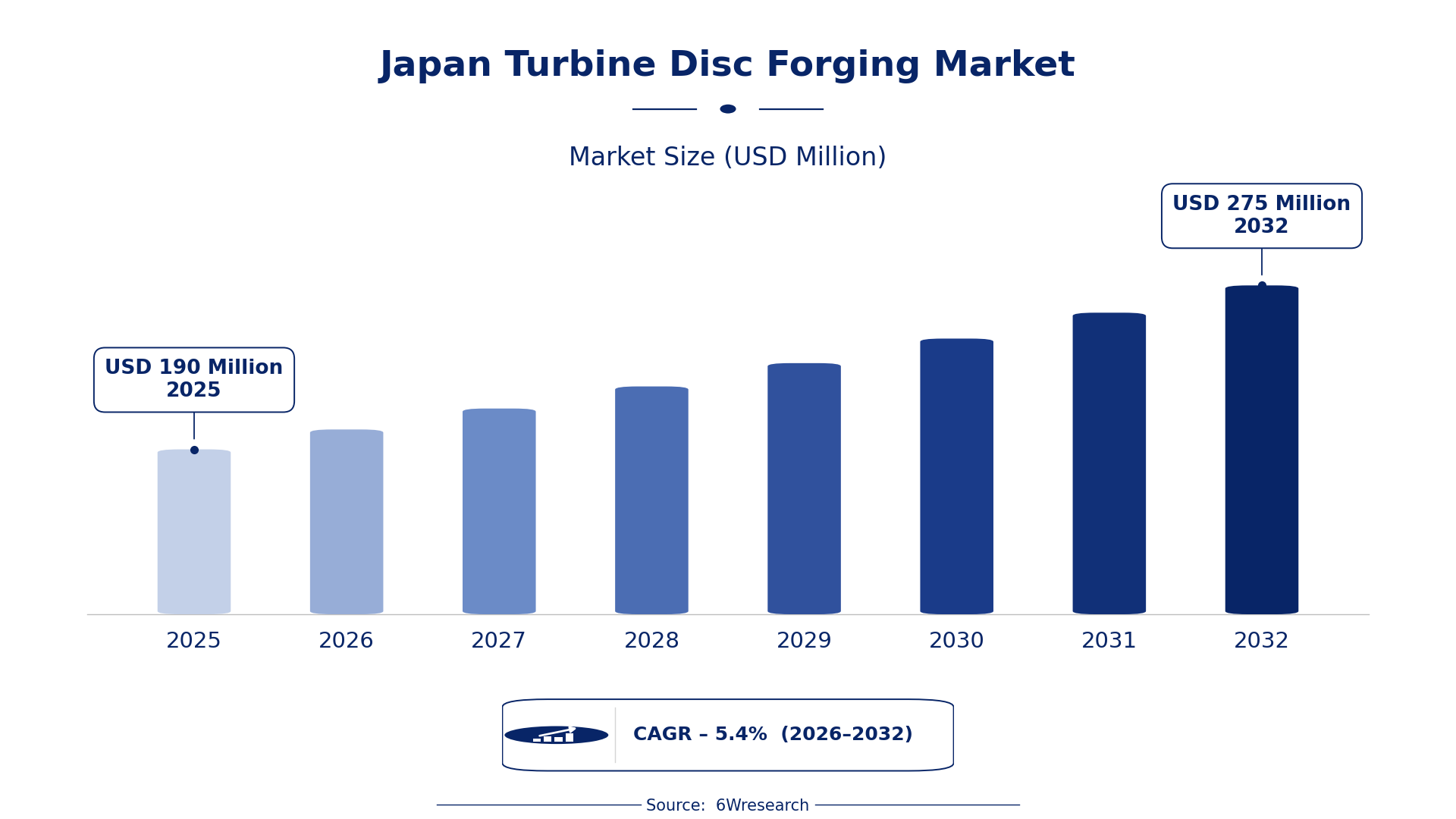
According to 6Wresearch internal database and industry insights, the Japan Turbine Disc Forging Market was valued at USD 190 Million in 2025 and is projected to reach USD 275 Million by 2032, growing at a CAGR of approximately 5.4% during 2026–2032.
Japan Turbine Disc Forging Market Highlights
| Report Metric | Details |
| Report Name | Japan Turbine Disc Forging Market (2026-2032) |
| Market Size 2025 | USD 190 Million |
| Market Size 2032 | USD 275 Million |
| Absolute Growth 2025–2032 | USD 85 Million |
| CAGR 2026–2032 | 5.4% |
| Peak Annual Growth | 6.6% in 2032 |
| Forecast Period | 2026–2032 |
| Historical Data | 2022–2025 |
| Base Year | 2025 |
| Leading Forging Type, 2025 | Open Die Forging (49% share) |
| Leading Material Used, 2025 | Inconel/Nickel Alloys (50% share) |
| Leading Turbine Class, 2025 | Aero Engines (45% share) |
| Leading End User, 2025 | Engine OEMs (40% share) |
| Fastest-Growing Forging Type | Closed Die Forging (8.0% CAGR) |
| Fastest-Growing Material Used | Titanium Alloys (7.7% CAGR) |
| Fastest-Growing Turbine Class | Military Turbines (7.4% CAGR) |
| Fastest-Growing End User | Defense OEMs (7.0% CAGR) |
| Growing Sector | Aerospace |
| Key End Users | Engine OEMs, Defense OEMs, Energy Equipment Firms |
Japan Turbine Disc Forging Market Year-wise Growth Rate and Key Drivers (2022–2032)
This graph illustrates the annual growth rates of the market from 2022 to 2032, highlighting a steady upward trajectory and projected market expansion over the forecast period.
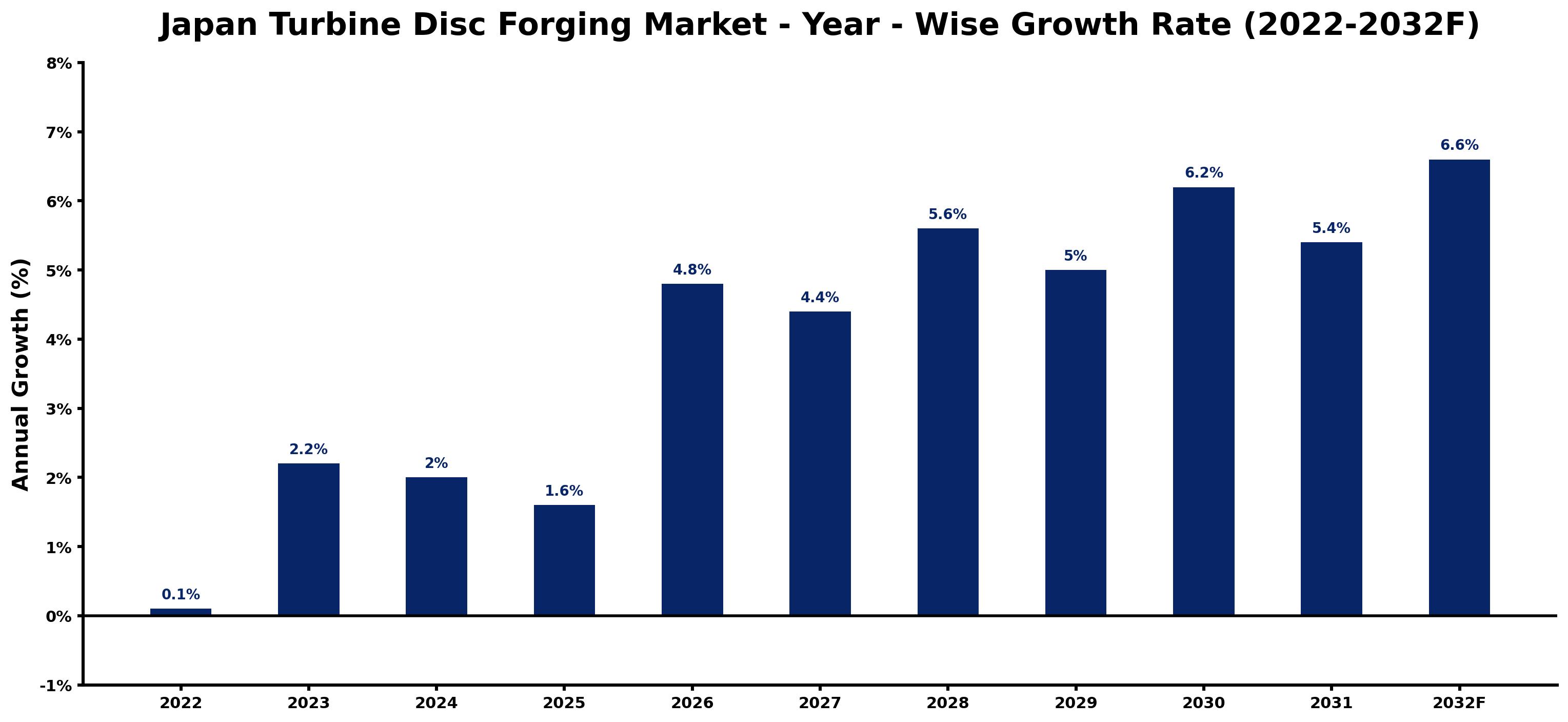
The yearly estimates that follow link every growth rate to its principal driver, so readers can see why the pace changed in each period.
| Year | Estimated Annual Growth (%) | Market Rationale |
| 2022 | 0.1 | The market experienced minimal growth due to ongoing adjustments in manufacturing processes. |
| 2023 | 2.2 | Demand increased as the aerospace sector valued at approximately ¥4 trillion expanded. |
| 2024 | 2.0 | Growth slowed as manufacturers adjusted to changing material costs and supply chain issues. |
| 2025 | 1.6 | Market growth continued to decelerate as production challenges persisted in the aerospace industry. |
| 2026 | 4.8 | Demand is expected to surge as military turbine production receives increased government contracts. |
| 2027 | 4.4 | Growth is projected to slow slightly as the market stabilises after a period of rapid expansion. |
| 2028 | 5.6 | Demand is expected to rise as new aerospace projects initiated in the Tokyo region boost production. |
| 2029 | 5.0 | Growth is projected to decelerate as manufacturers face challenges in sourcing high-performance alloys. |
| 2030 | 6.2 | Demand is expected to increase sharply as the energy sector transitions towards renewable sources. |
| 2031 | 5.4 | Growth is projected to slow as manufacturers adjust to evolving technological standards in production. |
| 2032 | 6.6 | Demand is expected to peak as the market capitalises on advancements in turbine disc forging technology. |
Note: Market size estimations and growth projections presented in this report are based on 6Wresearch's proprietary forecasting methodology, utilizing the latest available industry data, government publications, and primary research inputs.
Japan Turbine Disc Forging Market Synopsis
Turbine disc forging is a vital manufacturing process that produces turbine discs from high-performance alloys through methods like open die and closed die forging. These discs are essential components in aerospace and power generation applications. The Japan Turbine Disc Forging Market is expanding due to strong demand from domestic manufacturers and defense contracts, supported by an aerospace sector valued at approximately ¥4 trillion. The Tokyo region serves as a key hub for aerospace manufacturing, driving further investments and innovation in turbine disc production.
Market Dynamics Impact Analysis (2026–2032)
| Factor | Type | Impact | Primary Segment Affected |
| Increased military spending drives demand for turbine discs in defense applications. | Driver | High | Military Turbines |
| Growing aerospace projects in the Tokyo region create opportunities for turbine disc suppliers. | Opportunity | High | Aero Engines |
| Material sourcing challenges limit production capacity for turbine discs. | Restraint | High | Closed Die Forging |
| Technological advancements in forging techniques create new market opportunities. | Opportunity | Medium | Open Die Forging |
| Fluctuating prices of high-performance alloys constrain profit margins for manufacturers. | Restraint | Medium | Inconel/Nickel Alloys |
| Competition from international suppliers poses challenges for local manufacturers. | Challenge | High | Engine OEMs |
| Regulatory compliance costs can delay production timelines for turbine disc manufacturers. | Challenge | Medium | Precision Ring Forging |
| Rising demand for renewable energy sources increases the need for power turbine components. | Driver | Medium | Power Turbines |
Evaluation of Drivers in Japan Turbine Disc Forging Market (2026–2032)
The main growth drivers and the segments they affect most are set out below.
| Drivers | Primary Segment Affected | Why It Matters (Evidence) |
| Increased defense contracts boost military turbine production. | Military Turbines | The Ministry of Defense's ¥5 trillion budget for 2023 supports procurement for military applications. |
| Expansion of aerospace projects in the Tokyo region drives demand for turbine discs. | Aero Engines | The Tokyo Metropolitan Government's support for aerospace technology development programs stimulates growth. |
| Rising adoption of advanced materials improves turbine disc performance. | Inconel/Nickel Alloys | The use of high-performance alloys increases durability, leading to increased purchases by manufacturers. |
| Technological advancements in forging processes improve production efficiency. | Closed Die Forging | Precision forging techniques are emphasised in Japan's manufacturing standards, improving output quality. |
| Growing energy sector transitions towards renewable sources increase demand for turbine components. | Power Turbines | The energy sector's focus on renewable sources necessitates high-performance turbine discs for efficiency. |
Much of the new demand traces back to the expansion of aerospace projects in the Tokyo region, which drives growth in turbine disc manufacturing as domestic manufacturers seek to fulfil increasing orders. The widespread adoption of advanced materials improves turbine disc performance, prompting higher purchases from engine OEMs. Advances in precision forging techniques enhance production efficiency, leading to better quality outputs. The energy sector's shift towards renewable sources further drives demand for turbine components, as manufacturers adapt to new energy requirements. The substantial budget for military applications supports military turbine production, creating additional demand.
Evaluation of Restraints in Japan Turbine Disc Forging Market
These are the pressures that could keep growth below its potential.
| Market Restraint | Primary Segment Affected | Why It Matters (Evidence) |
| Material sourcing challenges limit production capacity for turbine discs. | Closed Die Forging | Limited availability of high-performance alloys like Inconel 718 can delay manufacturing timelines. |
| Fluctuating prices of high-performance alloys constrain profit margins for manufacturers. | Inconel/Nickel Alloys | Rising costs of raw materials impact overall production expenses for turbine disc manufacturers. |
| Regulatory compliance costs can delay production timelines for turbine disc manufacturers. | Precision Ring Forging | Manufacturers must invest in certifications and testing to meet stringent industry standards. |
| Competition from international suppliers poses challenges for local manufacturers. | Engine OEMs | Local producers face pricing pressures from foreign competitors offering similar products. |
| Technological adaptation costs can hinder investment in new forging techniques. | Open Die Forging | Investing in updated machinery and training can be financially burdensome for smaller manufacturers. |
Japan Turbine Disc Forging Market Challenges
Producers encounter procurement delays as the Ministry of Defense's budget allocation for 2023 may not satisfy the urgent demand for turbine discs. Regulatory hurdles raise production costs by up to 15%, impacting pricing for importers. Rising material costs, particularly for high-performance alloys like Inconel 718, can result in a 20% increase in overall expenses for manufacturers. Supply chain disruptions in the Tokyo region lead to potential shortages that extend lead times for buyers, complicating their planning and inventory management.
Trends in the Japan Turbine Disc Forging Market
The trends below show where the Japan Turbine Disc Forging Market is heading.
- Shift towards Advanced Materials: Since 2023, there has been a notable shift towards using advanced materials in turbine disc production. This change is driven by the aerospace sector's demand for higher performance, leading to increased investment in research and development for new alloys.
- Transition from Traditional to Precision Forging: The adoption of precision forging techniques has gained momentum since 2022, improving the quality of turbine discs. Engine OEMs are increasingly favouring these methods to meet stringent performance standards, reflecting a broader industry trend towards quality assurance.
- Emergence of Renewable Energy Applications: The energy sector's focus on renewable sources has emerged as a key trend since 2023, necessitating turbine discs designed for efficiency. Energy equipment firms are adapting their production lines to accommodate this shift, leading to increased demand for high-performance components.
- Prioritisation of Military Contracts: In 2023, military contracts have been prioritised due to increased defence spending. This trend is reflected in the growing number of defence OEMs seeking turbine discs, showing the government's commitment to enhancing national security.
Investment Opportunities in the Japan Turbine Disc Forging Market
The openings below show where demand in the Japan Turbine Disc Forging Market is visible and how suppliers can enter.
- Tokyo Aerospace Manufacturing Hub: The Tokyo region is currently a focal point for aerospace manufacturing, with a projected growth of 5% in 2024. This presents opportunities for suppliers to engage with local manufacturers and invest in joint ventures to meet rising demand.
- Growing Military Demand: With the Ministry of Defense's substantial budget for 2023, there is an urgent need for turbine components. Suppliers can enter this market by forming partnerships with defence OEMs to secure contracts and expand their reach.
- Investment in Renewable Energy: As the energy sector transitions, there is a growing need for turbine discs designed for renewable applications. Suppliers can capitalise on this trend by aligning with energy equipment firms focused on sustainable technologies.
- Expansion of Precision Forging Facilities: The increasing emphasis on precision forging techniques creates opportunities for investment in new facilities. Collaborating with local manufacturers can facilitate entry into this high-demand segment.
Government Initiatives in the Japan Turbine Disc Forging Market
The Hydrogen Society Promotion Act, enacted in 2024, provides price-gap support for low-carbon hydrogen supply chains. This measure encourages turbine disc manufacturers to invest in cleaner production methods, aligning with Japan's broader environmental goals. The act complements existing legislation by promoting sustainable practices within the manufacturing sector.
Aerospace buyers benefit from the Battery Industry Strategy, which aims to support domestic battery manufacturing capacity. This initiative assists energy equipment firms in sourcing reliable components for turbine applications, ensuring compliance with emerging energy standards.
Future Insight of the Japan Turbine Disc Forging Market
New precision forging facilities will begin operations by 2032, enabling suppliers to improve production efficiency and reduce costs. The Tokyo Metropolitan Government's support for aerospace technology development will drive innovation in manufacturing processes. Government contracts for turbine disc production will ensure a consistent demand, benefiting both suppliers and buyers. With Japan's aerospace sector valued at approximately ¥4 trillion, advancements in forging techniques will improve the quality and performance of turbine discs.
Market Segmentation Analysis
Japan Turbine Disc Forging Market report covers a detailed analysis of the following market segments:
By Forging Type – Open Die Forging Leads, Closed Die Forging Expected to Grow Fastest
According to Saurav Kr Singh, Senior Research Analyst at 6Wresearch, Open Die Forging accounted for 49% of the market by forging type in 2025. Open die forging holds the largest share as it is particularly suited for producing large components that require exceptional strength and durability, especially in aerospace applications. This method is predominantly utilised in the Tokyo region, which is a hub for aerospace manufacturing. Over 2026–2032, Closed Die Forging is expected to post the fastest growth, at a CAGR of 8.0%. Closed die forging is experiencing rapid growth because it allows for the creation of precise and complex shapes that are essential for modern turbine discs. The increasing demand for high-performance components in aerospace applications is significantly contributing to this segment's expansion. Suppliers should enhance their capabilities in closed die forging to meet the rising demand for precision-engineered turbine discs.
By Material Used – Inconel/Nickel Alloys Lead, Titanium Alloys Expected to Grow Fastest
The largest material used category in 2025 was Inconel/Nickel Alloys, at 50% of revenue. Inconel and nickel alloys dominate the market due to their outstanding heat resistance, making them highly suitable for turbine applications in the aerospace sector. Their extensive use in Japan's aerospace industry underscores their importance in maintaining performance under extreme conditions. Titanium Alloys are projected to grow fastest, at a CAGR of 7.7% during 2026–2032. Titanium alloys are gaining traction because of their lightweight characteristics combined with strength, which are crucial for aerospace applications. The industry's shift towards more efficient and lightweight designs in aircraft is propelling this segment's growth. Buyers should consider sourcing titanium alloys to leverage advancements in lightweight turbine disc technology.
By Turbine Class – Aero Engines Lead, Military Turbines Expected to Grow Fastest
In 2025, Aero Engines led the turbine class split with a 45% share. Aero engines represent the largest segment as they are the primary application for turbine discs, driven by strong demand from the aerospace sector. The substantial installed base of jet engines in Japan reinforces this segment's prominence. Military Turbines are set to record the highest CAGR in this split, 7.4% over 2026–2032. Military turbines are experiencing the fastest growth due to increased government contracts and a heightened focus on defence capabilities. The Ministry of Defense's significant budget for procurement in 2023 is a key factor in this segment's expansion. Suppliers should align their strategies with the growing demand for military turbine applications to seize emerging opportunities.
By End User – Engine OEMs Lead, Defense OEMs Expected to Grow Fastest
With 40% of end user revenue in 2025, Engine OEMs was the largest category. Engine OEMs are the leading end users as they are the primary consumers of turbine discs, essential for jet engine production. Their critical role in the aerospace supply chain ensures a consistent demand for high-quality forged components. The quickest growth will come from Defense OEMs, forecast to expand at a CAGR of 7.0% between 2026 and 2032. Defense OEMs are witnessing rapid growth driven by substantial military applications and government contracts for turbine production. The increasing emphasis on enhancing defence capabilities is fuelling this rising demand. Suppliers need to strengthen relationships with defense OEMs to capitalise on rising military-related opportunities.
Key Attractiveness of the Report
- 10 Years of Market Numbers
- Historical Data Starting from 2022 to 2025
- Base Year 2025
- Forecast Data until 2032
- Key Performance Indicators Impacting the Market
- Major Upcoming Developments and Projects
Key Highlights of the Report:
- Japan Turbine Disc Forging Market Outlook
- Market Size of Japan Turbine Disc Forging Market, 2025
- Forecast of Japan Turbine Disc Forging Market, 2032
- Historical Data and Forecast of Japan Turbine Disc Forging Revenues & Volume for the Period 2022-2032F
- Japan Turbine Disc Forging Market Trend Evolution
- Japan Turbine Disc Forging Market Drivers and Challenges
- Japan Turbine Disc Forging Price Trends
- Japan Turbine Disc Forging Porter's Five Forces
- Japan Turbine Disc Forging Industry Life Cycle
- Historical Data and Forecast of Japan Turbine Disc Forging Market Revenues & Volume By Forging Type for the Period 2022-2032F
- Historical Data and Forecast of Japan Turbine Disc Forging Market Revenues & Volume By Open Die Forging for the Period 2022-2032F
- Historical Data and Forecast of Japan Turbine Disc Forging Market Revenues & Volume By Closed Die Forging for the Period 2022-2032F
- Historical Data and Forecast of Japan Turbine Disc Forging Market Revenues & Volume By Isothermal Forging for the Period 2022-2032F
- Historical Data and Forecast of Japan Turbine Disc Forging Market Revenues & Volume By Precision Ring Forging for the Period 2022-2032F
- Historical Data and Forecast of Japan Turbine Disc Forging Market Revenues & Volume By Material Used for the Period 2022-2032F
- Historical Data and Forecast of Japan Turbine Disc Forging Market Revenues & Volume By Inconel/Nickel Alloys for the Period 2022-2032F
- Historical Data and Forecast of Japan Turbine Disc Forging Market Revenues & Volume By Titanium Alloys for the Period 2022-2032F
- Historical Data and Forecast of Japan Turbine Disc Forging Market Revenues & Volume By Creep-Resistant Alloys for the Period 2022-2032F
- Historical Data and Forecast of Japan Turbine Disc Forging Market Revenues & Volume By Superalloys for the Period 2022-2032F
- Historical Data and Forecast of Japan Turbine Disc Forging Market Revenues & Volume By Turbine Class for the Period 2022-2032F
- Historical Data and Forecast of Japan Turbine Disc Forging Market Revenues & Volume By Aero Engines for the Period 2022-2032F
- Historical Data and Forecast of Japan Turbine Disc Forging Market Revenues & Volume By Military Turbines for the Period 2022-2032F
- Historical Data and Forecast of Japan Turbine Disc Forging Market Revenues & Volume By High-Performance Engines for the Period 2022-2032F
- Historical Data and Forecast of Japan Turbine Disc Forging Market Revenues & Volume By Power Turbines for the Period 2022-2032F
- Historical Data and Forecast of Japan Turbine Disc Forging Market Revenues & Volume By End User for the Period 2022-2032F
- Historical Data and Forecast of Japan Turbine Disc Forging Market Revenues & Volume By Engine OEMs for the Period 2022-2032F
- Historical Data and Forecast of Japan Turbine Disc Forging Market Revenues & Volume By Defense OEMs for the Period 2022-2032F
- Historical Data and Forecast of Japan Turbine Disc Forging Market Revenues & Volume By Jet Engine Manufacturers for the Period 2022-2032F
- Historical Data and Forecast of Japan Turbine Disc Forging Market Revenues & Volume By Energy Equipment Firms for the Period 2022-2032F
- Japan Turbine Disc Forging Import Export Trade Statistics
- Market Opportunity Assessment By Forging Type
- Market Opportunity Assessment By Material Used
- Market Opportunity Assessment By Turbine Class
- Market Opportunity Assessment By End User
- Japan Turbine Disc Forging Top Companies Market Share
- Japan Turbine Disc Forging Competitive Benchmarking By Technical and Operational Parameters
- Japan Turbine Disc Forging Company Profiles
- Japan Turbine Disc Forging Key Strategic Recommendations
Market Covered
This report examines the market across the segments below.
By Forging Type
- Open Die Forging
- Closed Die Forging
- Isothermal Forging
- Precision Ring Forging
By Material Used
- Inconel/Nickel Alloys
- Titanium Alloys
- Creep-Resistant Alloys
- Superalloys
By Turbine Class
- Aero Engines
- Military Turbines
- High-Performance Engines
- Power Turbines
By End User
- Engine OEMs
- Defense OEMs
- Jet Engine Manufacturers
- Energy Equipment Firms































