Japan Turbine Electronic Ignition Market Size & Growth Rate
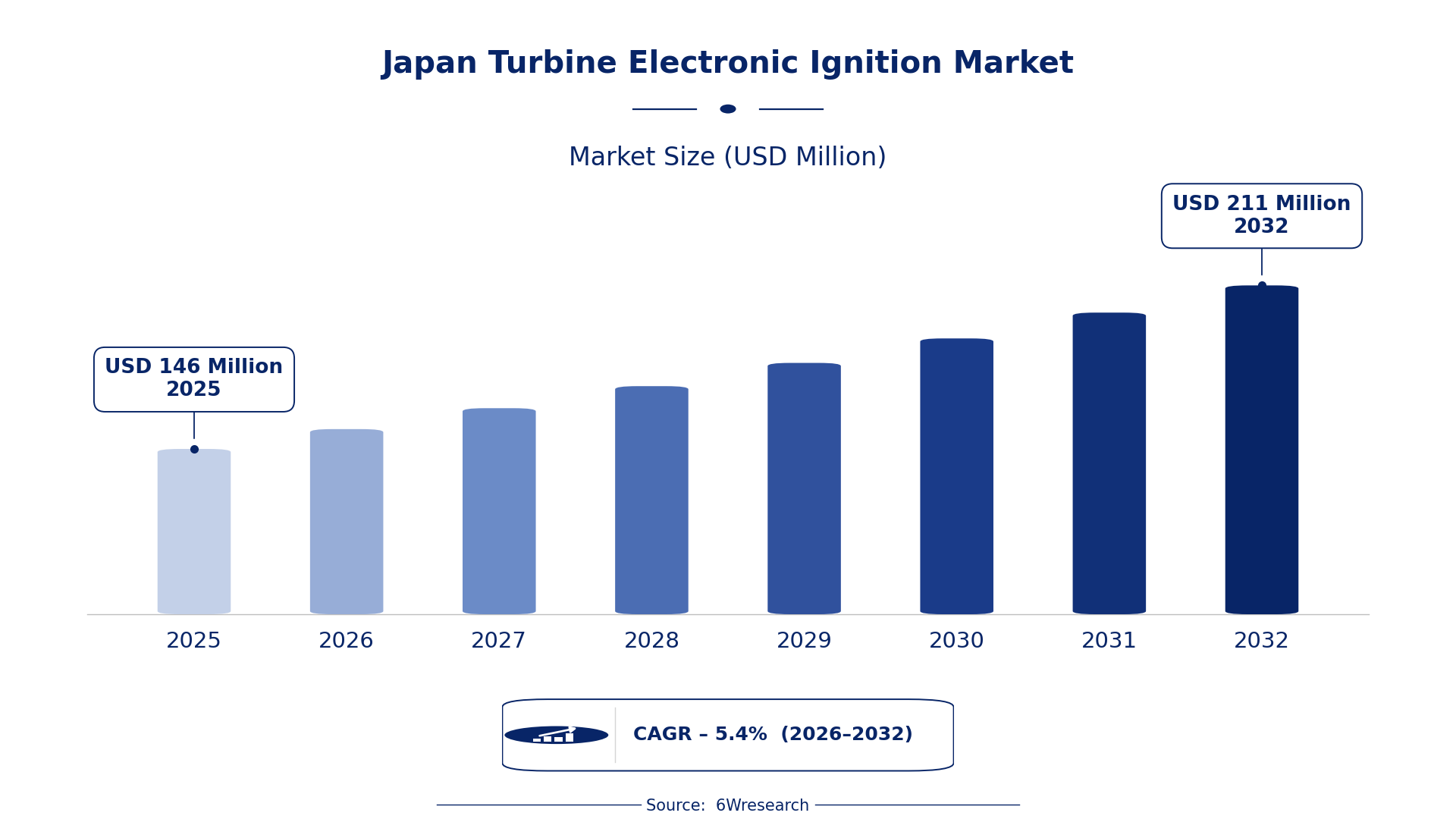
According to 6Wresearch internal database and industry insights, the Japan Turbine Electronic Ignition Market was valued at USD 146 Million in 2025 and is projected to reach USD 211 Million by 2032, growing at a CAGR of approximately 5.4% during 2026–2032.
Japan Turbine Electronic Ignition Market Highlights
| Report Metric | Details |
| Report Name | Japan Turbine Electronic Ignition Market (2026-2032) |
| Market Size 2025 | USD 146 Million |
| Market Size 2032 | USD 211 Million |
| Absolute Growth 2025–2032 | USD 65 Million |
| CAGR 2026–2032 | 5.4% |
| Peak Annual Growth | 6.2% in 2032 |
| Forecast Period | 2026–2032 |
| Historical Data | 2022–2025 |
| Base Year | 2025 |
| Leading Ignition Type, 2025 | Capacitor Discharge (49% share) |
| Leading Energy Source, 2025 | Electrical Spark (44% share) |
| Leading Turbine Class, 2025 | Jet Engines (46% share) |
| Leading End User, 2025 | Aircraft OEMs (45% share) |
| Fastest-Growing Ignition Type | Solid-State Ignition (7.6% CAGR) |
| Fastest-Growing Energy Source | Microcontroller-Based (7.7% CAGR) |
| Fastest-Growing Turbine Class | Helicopter Engines (7.1% CAGR) |
| Fastest-Growing End User | Aerospace Suppliers (7.0% CAGR) |
| Growing Sector | Aerospace |
| Key End Users | Aircraft OEMs, Aerospace Suppliers, Defense Organizations, Turbine Builders |
Japan Turbine Electronic Ignition Market Year-wise Growth Rate and Key Drivers (2022–2032)
This graph illustrates the annual growth rates of the market from 2022 to 2032, highlighting a steady upward trajectory and projected market expansion over the forecast period.
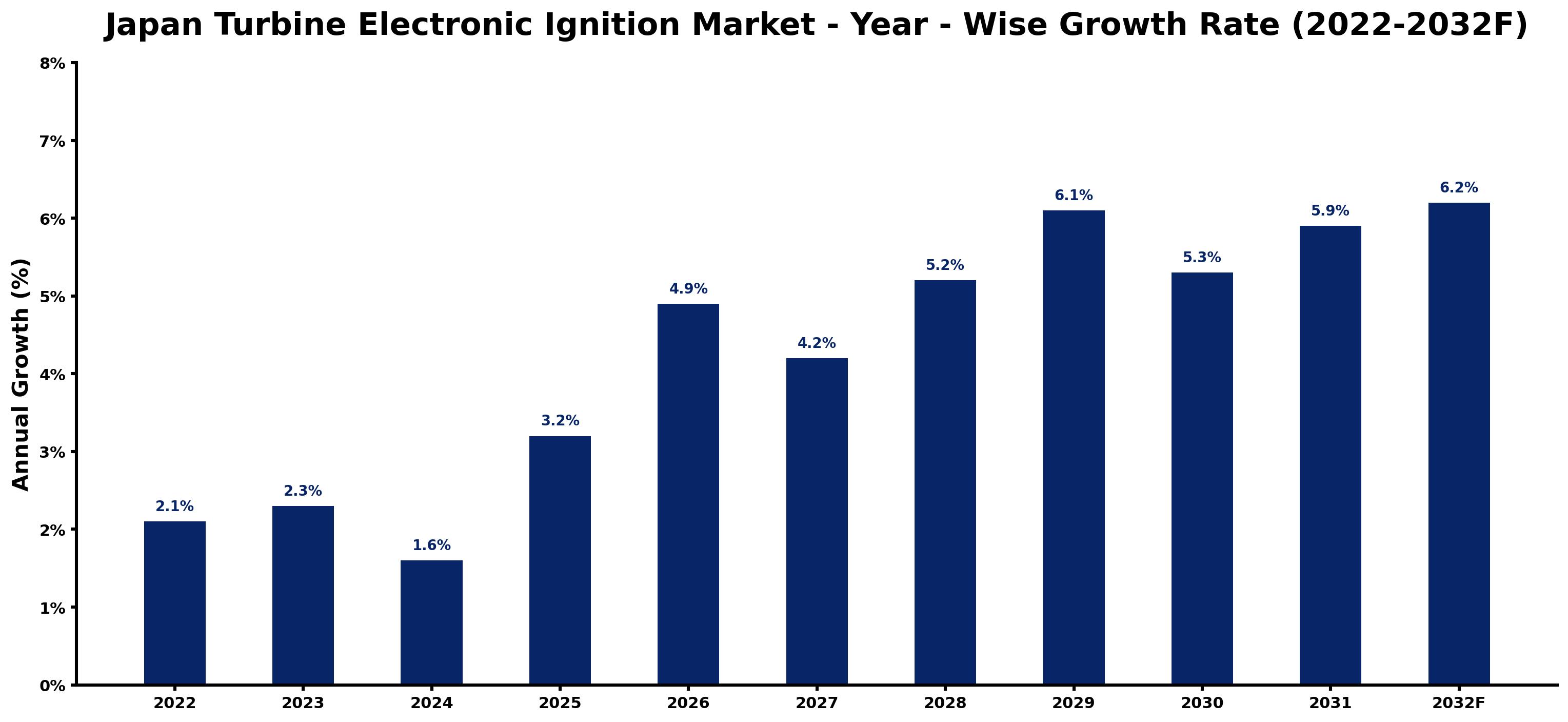
Year by year, the estimates below pair each growth rate with the development that shaped it.
| Year | Estimated Annual Growth (%) | Market Rationale |
| 2022 | 2.1 | The market experienced steady growth, supported by ongoing aerospace projects. |
| 2023 | 2.3 | Demand rose due to increased investment in military aviation technology. |
| 2024 | 1.6 | Growth slowed as manufacturers faced supply chain challenges and adjustments. |
| 2025 | 3.2 | A surge in aircraft production led to faster growth compared to the previous year. |
| 2026 | 4.9 | Increased domestic aircraft production and innovation is expected to drive demand higher. |
| 2027 | 4.2 | Growth is projected to slow as the market adjusts to previous high levels of demand. |
| 2028 | 5.2 | A rise in military aircraft orders will contribute to a faster growth rate. |
| 2029 | 6.1 | Demand is expected to increase due to advancements in ignition technology and efficiency. |
| 2030 | 5.3 | Growth will slow as the market stabilises after several years of rapid expansion. |
| 2031 | 5.9 | A renewed focus on aerospace innovation is projected to lead to faster growth in orders. |
| 2032 | 6.2 | The market is expected to peak as technological advancements and military investments surge. |
Note: Market size estimations and growth projections presented in this report are based on 6Wresearch's proprietary forecasting methodology, utilizing the latest available industry data, government publications, and primary research inputs.
Japan Turbine Electronic Ignition Market Synopsis
Turbine electronic ignition systems ignite fuel in turbine engines using electrical energy for dependable performance. The Japan Turbine Electronic Ignition Market is set to expand, propelled by the aerospace industry, which contributes around 5 trillion yen to the economy. Factors driving this growth include heightened domestic aircraft production, military investments, and a commitment to innovation, as illustrated by the new aerospace innovation program with a budget of 10 billion yen launched in 2023.
Market Dynamics Impact Analysis (2026–2032)
| Factor | Type | Impact | Primary Segment Affected |
| Growing domestic aircraft production | Driver | High | Aircraft OEMs |
| Increased military aviation investments | Driver | High | Defense Organizations |
| Rising demand for advanced ignition systems | Opportunity | High | Aerospace Suppliers |
| Expansion of aerospace manufacturing capabilities | Opportunity | High | Turbine Builders |
| Supply chain disruptions affecting components | Restraint | High | Turbine Builders |
| High costs of advanced technology integration | Restraint | Medium | Aerospace Suppliers |
| Dependence on international supply chains | Challenge | High | Turbine Builders |
| Technological obsolescence of older systems | Challenge | Medium | Aerospace Suppliers |
Evaluation of Drivers in Japan Turbine Electronic Ignition Market (2026–2032)
Key forces behind demand, with the segment each one moves most, are listed below.
| Drivers | Primary Segment Affected | Why It Matters (Evidence) |
| Increased domestic aircraft production | Aircraft OEMs | Japan aims to boost domestic aircraft production by 20% by 2025, driving demand for ignition systems. |
| Military investments in aviation technology | Defense Organizations | The defense budget for 2023 includes significant investments, increasing demand for reliable ignition systems. |
| Technological advancements in ignition systems | Aerospace Suppliers | Innovations in turbine ignition technology improve performance, leading to increased purchases from suppliers. |
| Growing aerospace industry collaboration | Turbine Builders | Collaboration with the Japan Aerospace Exploration Agency fosters research and development in ignition technology. |
| Rising focus on safety and reliability | Military Aircraft | Safety standards in military aviation necessitate advanced ignition systems, increasing demand from defense organizations. |
Behind the steady rise in orders is Japan's ambition to increase domestic aircraft production by 20% by 2025, which will likely elevate demand for ignition systems. The 2023 defense budget includes substantial investments in military aviation technology, further stimulating orders from defense organisations. Technological improvements in ignition systems enhance performance and reliability, encouraging aerospace suppliers to increase their purchases. The growing emphasis on safety and reliability in military aircraft drives demand for sophisticated ignition systems from defense organisations.
Evaluation of Restraints in Japan Turbine Electronic Ignition Market
The following restraints limit how fast demand can grow.
| Market Restraint | Primary Segment Affected | Why It Matters (Evidence) |
| Supply chain disruptions affecting components | Turbine Builders | Supply chain challenges have delayed component deliveries, impacting production timelines and increasing costs by up to 10%. |
| High costs of advanced technology integration | Aerospace Suppliers | Integrating advanced ignition technologies requires investments of over 100 million yen, limiting smaller suppliers' participation. |
| Dependence on international supply chains | Turbine Builders | Reliance on global suppliers exposes manufacturers to geopolitical risks and supply delays, increasing lead times by 12 weeks. |
| Technological obsolescence of older systems | Aerospace Suppliers | Older ignition systems may become obsolete, requiring costly upgrades for manufacturers to remain competitive, costing up to 50 million yen. |
| Stringent regulatory requirements for safety | Military Aircraft | Compliance with safety regulations increases operational costs for manufacturers, affecting pricing strategies by up to 15%. |
Japan Turbine Electronic Ignition Market Challenges
High costs associated with outdated ignition technology burden producers, leading to expenses that can reach 15% of total costs. Buyers face delays in obtaining advanced ignition systems, as limited local suppliers can extend lead times by up to 12 weeks. Regulatory compliance with JIS Q 9100 imposes considerable burdens, requiring manufacturers to invest heavily in quality management systems, costing upwards of 5 million yen annually. Shortages in skilled precision engineering talent limit workforce capabilities, potentially delaying product development timelines by 6 months for aerospace manufacturers.
Trends in the Japan Turbine Electronic Ignition Market
The shifts below are changing how Japan Turbine Electronic Ignition Market products are bought and supplied.
- Shift from Traditional to Advanced Ignition Systems: Tokyo is experiencing a transition towards advanced ignition technologies, with solid-state ignition systems projected to grow at a CAGR of 7.6% through 2032. This trend reflects the demand for improved performance and reliability in aerospace applications.
- Focus on Military Aviation Technology: Defense organisations are increasingly prioritising investments in military aviation technology, with the 2023 defense budget allocating 1 trillion yen for advanced ignition systems. This trend is expected to drive demand for new solutions in the coming years.
- Emergence of Microcontroller-Based Systems: In 2023, microcontroller-based ignition systems are gaining traction, with a projected CAGR of 7.7% through 2032. This trend underscores the demand for enhanced control and efficiency in turbine engines.
- Increased Collaboration in Aerospace R&D: The Japan Aerospace Exploration Agency is promoting collaboration with various aerospace suppliers, leading to advancements in ignition technology. This cooperation is anticipated to boost the competitiveness of Japan's aerospace sector.
Investment Opportunities in the Japan Turbine Electronic Ignition Market
Several openings in the Japan Turbine Electronic Ignition Market merit attention from investors.
- Investment in Aerospace Innovation Programs: Tokyo's new aerospace innovation program, with a budget of 10 billion yen, presents opportunities for suppliers to develop advanced ignition systems. This initiative aims to improve Japan's aerospace capabilities.
- Growing Demand from Defense Organizations: With Japan's defense budget for 2023 focusing on military aviation technology, suppliers can tap into the increasing need for advanced ignition systems. Collaborating with local defense organizations can facilitate market entry.
- Expansion of Aerospace Manufacturing Facilities: The ongoing expansion of aerospace manufacturing facilities in Nagoya creates opportunities for suppliers to provide components for turbine ignition systems. Investing in local partnerships can strengthen market presence.
- Rising Need for Safety Compliance: As safety regulations become stricter, there is a growing need for advanced ignition systems that meet compliance standards. Suppliers can target military aircraft manufacturers to fulfil this demand.
Government Initiatives in the Japan Turbine Electronic Ignition Market
The Hydrogen Society Promotion Act, enacted in 2024, supports low-carbon hydrogen and ammonia supply chains, adding a focus on sustainable energy solutions for turbine ignition systems. This aligns with existing regulations that encourage innovation in aerospace technology, ensuring manufacturers can access funding for cleaner technologies.
The Ministry of Economy, Trade and Industry oversees various aerospace initiatives, approving funding for projects aimed at improving ignition technology. This includes support for research and development efforts focused on enhancing efficiency and reliability in turbine engines, with a budget of 5 billion yen allocated for such projects.
Future Insight of the Japan Turbine Electronic Ignition Market
Technological advancements in ignition systems will reshape demand by 2032, driven by the new aerospace innovation program with a budget of 10 billion yen. Collaboration between the Japan Aerospace Exploration Agency and local manufacturers will strengthen research and development efforts. Increased domestic aircraft production by 20% will fortify the supply chain, while the widespread adoption of ISO 9001 certification among manufacturers will ensure higher quality standards.
Market Segmentation Analysis
Japan Turbine Electronic Ignition Market report covers a detailed analysis of the following market segments:
By Ignition Type – Capacitor Discharge Leads, Solid-State Ignition Expected to Grow Fastest
According to Saurav Kr Singh, Senior Research Analyst at 6Wresearch, with 49% of ignition type revenue in 2025, Capacitor Discharge was the largest category. Capacitor Discharge holds the largest share because it is essential for reliable ignition in turbine engines, especially in commercial aviation. The installed base of around 1,200 turbine engines in Japan underscores the demand for this ignition type. Solid-State Ignition is projected to grow fastest, at a CAGR of 7.6% during 2026–2032. Solid-State Ignition is growing quickly as it offers improved performance and durability, making it increasingly appealing to manufacturers. The ongoing aerospace innovation program with a budget of 10 billion yen is expected to further accelerate its adoption. Suppliers should prioritise the development of solid-state solutions to seize emerging market opportunities.
By Energy Source – Electrical Spark Leads, Microcontroller-Based Expected to Grow Fastest
The largest energy source category in 2025 was Electrical Spark, at 44% of revenue. Electrical Spark holds the largest share as it is the fundamental ignition method for turbine engines, essential for ensuring operational efficiency. Its extensive use in Japan's aerospace sector, particularly in jet engines, underscores its reliability and critical role. Over 2026–2032, Microcontroller-Based is expected to post the fastest growth, at a CAGR of 7.7%. Microcontroller-Based systems are witnessing rapid growth because they significantly improve control and efficiency in ignition processes. The ongoing push for advanced technology in Japan's aerospace industry will likely further accelerate this segment's expansion. Suppliers should focus on developing microcontroller-based systems to meet the rising demand for enhanced performance.
By Turbine Class – Jet Engines Lead, Helicopter Engines Expected to Grow Fastest
Jet Engines took 46% of turbine class revenue in 2025, more than any other category. Jet Engines dominate the market as they are the primary application in commercial aviation, supported by Japan's robust aerospace industry. The large installed base of turbine engines in the country reinforces the need for reliable ignition systems in this segment. The quickest growth will come from Helicopter Engines, forecast to expand at a CAGR of 7.1% between 2026 and 2032. Helicopter Engines are experiencing the fastest growth due to their essential role in rotorcraft operations, especially in defence and emergency services. Increased funding in military aviation technology is expected to further boost this segment's development. Suppliers should aim to engage with helicopter engine manufacturers to leverage this growth opportunity.
By End User – Aircraft OEMs Lead, Aerospace Suppliers Expected to Grow Fastest
In 2025, Aircraft OEMs led the end user split with a 45% share. Aircraft OEMs dominate the market as they are the major users of ignition systems, essential for the production of new aircraft. Their ongoing projects and collaborations with suppliers underline their critical role in the market. Aerospace Suppliers are set to record the highest CAGR in this split, 7.0% over 2026–2032. Aerospace Suppliers are growing rapidly as they provide essential components for turbine systems, responding to the increasing demand from OEMs. The expanding network of over 50 aerospace suppliers in Japan will support this growth. Suppliers must strengthen relationships with aerospace suppliers to ensure a steady demand for their ignition systems.
Key Attractiveness of the Report
- 10 Years of Market Numbers
- Historical Data Starting from 2022 to 2025
- Base Year 2025
- Forecast Data until 2032
- Key Performance Indicators Impacting the Market
- Major Upcoming Developments and Projects
Key Highlights of the Report:
- Japan Turbine Electronic Ignition Market Outlook
- Market Size of Japan Turbine Electronic Ignition Market, 2025
- Forecast of Japan Turbine Electronic Ignition Market, 2032
- Historical Data and Forecast of Japan Turbine Electronic Ignition Revenues & Volume for the Period 2022-2032F
- Japan Turbine Electronic Ignition Market Trend Evolution
- Japan Turbine Electronic Ignition Market Drivers and Challenges
- Japan Turbine Electronic Ignition Price Trends
- Japan Turbine Electronic Ignition Porter's Five Forces
- Japan Turbine Electronic Ignition Industry Life Cycle
- Historical Data and Forecast of Japan Turbine Electronic Ignition Market Revenues & Volume By Ignition Type for the Period 2022-2032F
- Historical Data and Forecast of Japan Turbine Electronic Ignition Market Revenues & Volume By Capacitor Discharge for the Period 2022-2032F
- Historical Data and Forecast of Japan Turbine Electronic Ignition Market Revenues & Volume By Solid-State Ignition for the Period 2022-2032F
- Historical Data and Forecast of Japan Turbine Electronic Ignition Market Revenues & Volume By High-Energy Ignition for the Period 2022-2032F
- Historical Data and Forecast of Japan Turbine Electronic Ignition Market Revenues & Volume By Redundant Ignition for the Period 2022-2032F
- Historical Data and Forecast of Japan Turbine Electronic Ignition Market Revenues & Volume By Energy Source for the Period 2022-2032F
- Historical Data and Forecast of Japan Turbine Electronic Ignition Market Revenues & Volume By Electrical Spark for the Period 2022-2032F
- Historical Data and Forecast of Japan Turbine Electronic Ignition Market Revenues & Volume By Microcontroller-Based for the Period 2022-2032F
- Historical Data and Forecast of Japan Turbine Electronic Ignition Market Revenues & Volume By Dual Spark Systems for the Period 2022-2032F
- Historical Data and Forecast of Japan Turbine Electronic Ignition Market Revenues & Volume By Backup Systems for the Period 2022-2032F
- Historical Data and Forecast of Japan Turbine Electronic Ignition Market Revenues & Volume By Turbine Class for the Period 2022-2032F
- Historical Data and Forecast of Japan Turbine Electronic Ignition Market Revenues & Volume By Jet Engines for the Period 2022-2032F
- Historical Data and Forecast of Japan Turbine Electronic Ignition Market Revenues & Volume By Helicopter Engines for the Period 2022-2032F
- Historical Data and Forecast of Japan Turbine Electronic Ignition Market Revenues & Volume By Gas Turbines for the Period 2022-2032F
- Historical Data and Forecast of Japan Turbine Electronic Ignition Market Revenues & Volume By Military Aircraft for the Period 2022-2032F
- Historical Data and Forecast of Japan Turbine Electronic Ignition Market Revenues & Volume By End User for the Period 2022-2032F
- Historical Data and Forecast of Japan Turbine Electronic Ignition Market Revenues & Volume By Aircraft OEMs for the Period 2022-2032F
- Historical Data and Forecast of Japan Turbine Electronic Ignition Market Revenues & Volume By Aerospace Suppliers for the Period 2022-2032F
- Historical Data and Forecast of Japan Turbine Electronic Ignition Market Revenues & Volume By Turbine Builders for the Period 2022-2032F
- Historical Data and Forecast of Japan Turbine Electronic Ignition Market Revenues & Volume By Defense Organizations for the Period 2022-2032F
- Japan Turbine Electronic Ignition Import Export Trade Statistics
- Market Opportunity Assessment By Ignition Type
- Market Opportunity Assessment By Energy Source
- Market Opportunity Assessment By Turbine Class
- Market Opportunity Assessment By End User
- Japan Turbine Electronic Ignition Top Companies Market Share
- Japan Turbine Electronic Ignition Competitive Benchmarking By Technical and Operational Parameters
- Japan Turbine Electronic Ignition Company Profiles
- Japan Turbine Electronic Ignition Key Strategic Recommendations
Market Covered
The report covers the following segments.
By Ignition Type
- Capacitor Discharge
- Solid-State Ignition
- High-Energy Ignition
- Redundant Ignition
By Energy Source
- Electrical Spark
- Microcontroller-Based
- Dual Spark Systems
- Backup Systems
By Turbine Class
- Jet Engines
- Helicopter Engines
- Gas Turbines
- Military Aircraft
By End User
- Aircraft OEMs
- Aerospace Suppliers
- Turbine Builders
- Defense Organizations































