Japan Turbine Engine Heat Exchanger Market Size & Growth Rate
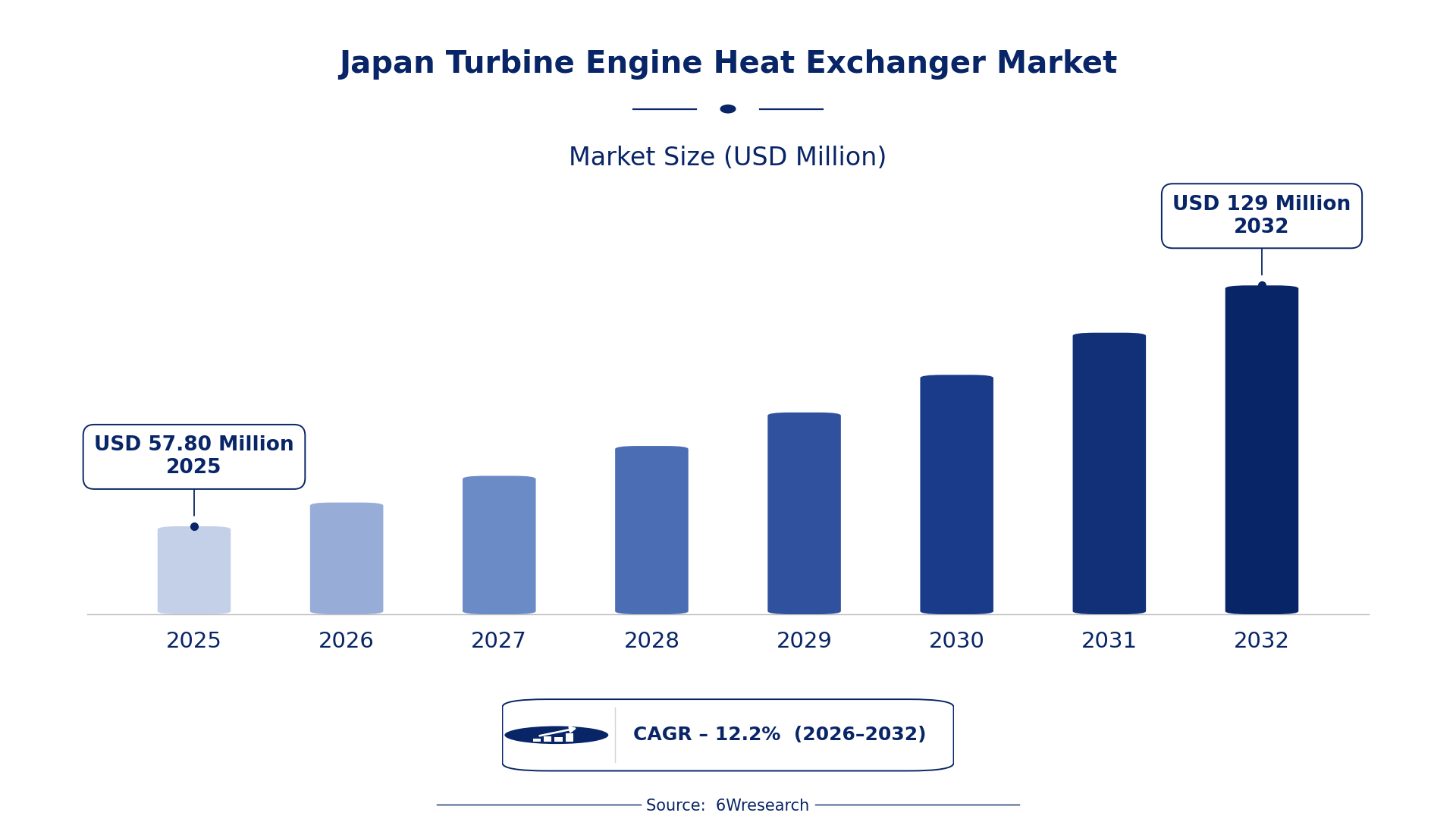
According to 6Wresearch internal database and industry insights, the Japan Turbine Engine Heat Exchanger Market was valued at USD 57.80 Million in 2025 and is projected to reach USD 129 Million by 2032, growing at a CAGR of approximately 12.2% during 2026–2032.
Japan Turbine Engine Heat Exchanger Market Highlights
| Report Metric | Details |
| Report Name | Japan Turbine Engine Heat Exchanger Market (2026-2032) |
| Market Size 2025 | USD 57.80 Million |
| Market Size 2032 | USD 129 Million |
| Absolute Growth 2025–2032 | USD 71.20 Million |
| CAGR 2026–2032 | 12.2% |
| Peak Annual Growth | 12.9% in 2026 |
| Forecast Period | 2026–2032 |
| Historical Data | 2022–2025 |
| Base Year | 2025 |
| Leading Heat Exchanger Type, 2025 | Air-to-Air Heat Exchanger (44% share) |
| Leading Cooling Medium, 2025 | Bleed Air Cooling (47% share) |
| Leading Application Area, 2025 | Cabin Air Systems (43% share) |
| Leading End User, 2025 | Aircraft OEMs (48% share) |
| Fastest-Growing Heat Exchanger Type | Air-to-Oil Cooler (16.9% CAGR) |
| Fastest-Growing Cooling Medium | Engine Oil Cooling (15.6% CAGR) |
| Fastest-Growing Application Area | Turbofan Engines (14.7% CAGR) |
| Fastest-Growing End User | Engine Suppliers (15.5% CAGR) |
| Growing Sector | Turbofan Engines |
| Key End Users | Cabin Air Systems, Turbofan Engines, Military Aircraft, UAVs and Small Aircraft |
Japan Turbine Engine Heat Exchanger Market Year-wise Growth Rate and Key Drivers (2022–2032)
This graph illustrates the annual growth rates of the market from 2022 to 2032, highlighting a steady upward trajectory and projected market expansion over the forecast period.
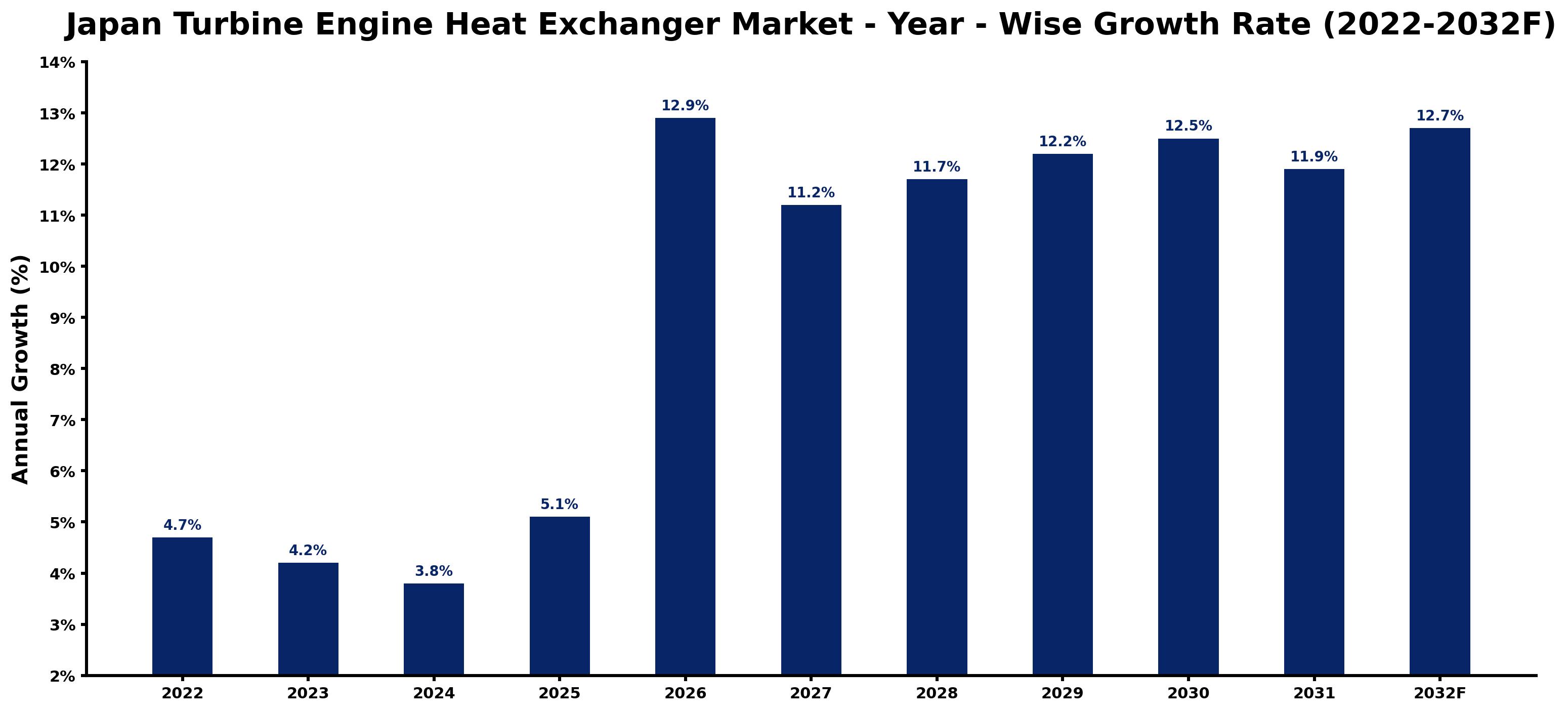
Each row of the following table gives one year's estimated growth and the event or demand shift that explains it.
| Year | Estimated Annual Growth (%) | Market Rationale |
| 2022 | 4.7 | The market experienced steady demand due to ongoing aerospace projects and production. |
| 2023 | 4.2 | Growth slowed slightly as manufacturers adjusted to supply chain challenges and market conditions. |
| 2024 | 3.8 | Demand continued to decelerate as manufacturers focused on efficiency improvements and cost management. |
| 2025 | 5.1 | Growth accelerated as military aircraft demand increased, supported by a robust defense budget. |
| 2026 | 12.9 | Demand surged as investments in UAV technology and aerospace innovation programmes take effect. |
| 2027 | 11.2 | Growth moderates due to capacity constraints in manufacturing and supply chain issues. |
| 2028 | 11.7 | Demand rises again as production ramps up to meet military and commercial needs. |
| 2029 | 12.2 | Growth remains strong as the aerospace sector expands with new technology adoption. |
| 2030 | 12.5 | Demand continues to rise, driven by increased investments in high-performance engine technologies. |
| 2031 | 11.9 | Growth slows as manufacturers face challenges in meeting rising production demands. |
| 2032 | 12.7 | Demand is projected to increase as the focus on UAV production and aerospace innovation intensifies. |
Note: Market size estimations and growth projections presented in this report are based on 6Wresearch's proprietary forecasting methodology, utilizing the latest available industry data, government publications, and primary research inputs.
Japan Turbine Engine Heat Exchanger Market Synopsis
Turbine Engine Heat Exchangers are essential components in aerospace applications, designed to manage heat in turbine engines. They are constructed from advanced materials to withstand extreme conditions and are primarily used for cooling engine oil and bleed air. The Japan Turbine Engine Heat Exchanger Market is expanding due to a thriving aerospace industry valued at approximately 4 trillion JPY and ongoing investments in UAV technology. Continuous demand from military and commercial aviation sectors, supported by government initiatives, drives market growth.
Market Dynamics Impact Analysis (2026–2032)
| Factor | Type | Impact | Primary Segment Affected |
| Increased military aircraft demand | Driver | High | Military Aircraft |
| Growing UAV technology investments | Driver | High | UAVs and Small Aircraft |
| Emerging demand for Engine Oil Cooling technologies | Opportunity | Medium | Engine Oil Cooling |
| Investment in aerospace startups and innovation | Opportunity | Medium | Aerospace Integrators |
| Supply chain disruptions affecting production capacity | Restraint | High | Air-to-Oil Cooler |
| High manufacturing costs limiting market entry for new players | Restraint | Medium | Compact Plate Coolers |
| Regulatory compliance costs impacting profit margins | Challenge | High | Air-to-Air Heat Exchanger |
| Limited skilled workforce affecting production efficiency | Challenge | Medium | Turbofan Engines |
Evaluation of Drivers in Japan Turbine Engine Heat Exchanger Market (2026–2032)
Below are the drivers that matter most for revenue growth, with supporting evidence.
| Drivers | Primary Segment Affected | Why It Matters (Evidence) |
| Increased defense budget | Military Aircraft | The defense budget of 6 trillion JPY supports procurement of advanced military aircraft, driving demand for heat exchangers. |
| Rising UAV production | UAVs and Small Aircraft | Japan aims to boost domestic UAV production by 20% by 2025, increasing demand for heat exchangers. |
| Technological advancements in aerospace | Turbofan Engines | The adoption of high-performance turbine engines increases the need for efficient heat exchangers. |
| Growing commercial aviation sector | Cabin Air Systems | Aerospace exports reached 1.2 trillion JPY in 2022, driving demand for components like heat exchangers. |
| Implementation of JIS Q 9100 standard | Air-to-Air Heat Exchanger | Adoption of this standard in aerospace manufacturing ensures quality and reliability, increasing demand. |
Demand is primarily driven by increased defense spending, with a budget of 6 trillion JPY allocated for military aircraft procurement. The commercial aviation sector is also on the rise, as illustrated by aerospace exports reaching 1.2 trillion JPY in 2022, which fuels the need for components. The push for domestic UAV production, aiming for a 20% increase by 2025, further stimulates demand for heat exchangers. The implementation of quality standards like JIS Q 9100 ensures reliability in aerospace manufacturing, contributing to the growing need for these critical components.
Evaluation of Restraints in Japan Turbine Engine Heat Exchanger Market
The table below lists the restraints and the evidence behind each.
| Market Restraint | Primary Segment Affected | Why It Matters (Evidence) |
| Supply chain disruptions | Air-to-Oil Cooler | Supply chain issues have delayed production schedules, impacting the availability of heat exchangers for military aircraft. |
| High manufacturing costs | Compact Plate Coolers | The cost of advanced materials and manufacturing processes limits the entry of new players into the market. |
| Regulatory compliance costs | Air-to-Air Heat Exchanger | Compliance with aerospace standards increases operational costs, affecting profit margins for manufacturers. |
| Limited skilled workforce | Turbofan Engines | A shortage of skilled workers in the aerospace sector hampers production efficiency and capacity. |
| Market volatility due to geopolitical factors | UAVs and Small Aircraft | Geopolitical tensions can affect defense budgets and investment in aerospace projects, impacting demand. |
Japan Turbine Engine Heat Exchanger Market Challenges
Aerospace buyers are contending with rising costs as material prices increase, inflating production expenses by approximately 15% and squeezing profit margins. Regulatory requirements, such as compliance with JIS Q 9100 standards, complicate operations and necessitate substantial investments in time and resources, potentially delaying product launches by several months. A skills shortage in advanced aerospace technologies limits production capacity, compelling companies to extend project timelines and heightening operational risks. Supply chain disruptions in sourcing critical components may lead to delivery delays, affecting the operational capabilities of over 1,500 turbine engines currently in use.
Trends in the Japan Turbine Engine Heat Exchanger Market
These developments are changing demand patterns in the Japan Turbine Engine Heat Exchanger Market.
- Launch of New Aerospace Innovation Programme: In 2023, Japan initiated an aerospace innovation programme focusing on UAVs, aiming to improve domestic production capabilities. This initiative is expected to drive demand for turbine engine heat exchangers, with anticipated investments exceeding 150 billion JPY.
- Shift Towards High-Performance Engine Technologies: The aerospace sector is increasingly adopting high-performance engine technologies, particularly in military aircraft. This shift is evidenced by the defense budget of 6 trillion JPY, which supports advanced engine development, driving demand for efficient heat exchangers.
- Growing Adoption of JIS Q 9100 Standard: The widespread adoption of the JIS Q 9100 standard in aerospace manufacturing has improved quality assurance processes. This trend increases the reliability of turbine engine heat exchangers, leading to increased demand from manufacturers.
- Expansion of UAV Production Capabilities: The Japanese government aims to increase UAV production by 20% by 2025, reflecting a notable shift in focus. This expansion is projected to drive demand for turbine engine heat exchangers, particularly in innovative designs.
Investment Opportunities in the Japan Turbine Engine Heat Exchanger Market
Where to invest in the Japan Turbine Engine Heat Exchanger Market: the main openings are set out below.
- Turbine Engine Heat Exchangers: With Japan's aerospace sector valued at approximately 4 trillion JPY, there is a growing need for turbine engine heat exchangers. Companies can invest in advanced manufacturing techniques to meet the increasing requirements from military aircraft.
- Advanced Cooling Solutions: The upcoming demand for efficient cooling solutions in military aircraft presents an opportunity. Suppliers can partner with aerospace integrators to develop tailored heat exchangers, capitalising on the 6 trillion JPY defense budget.
- Innovative UAV Designs: The focus on UAV production offers a chance for suppliers to create new designs. By collaborating with UAV builders, companies can develop specialised heat exchangers that meet the unique requirements of these aircraft.
- Quality Assurance Services: As the JIS Q 9100 standard gains traction, there is an opportunity for certification bodies to offer quality assurance services. This is essential for manufacturers aiming to enhance their credibility in the aerospace market.
Government Initiatives in the Japan Turbine Engine Heat Exchanger Market
The GX Basic Policy adopted in 2023 aims for approximately JPY 150 trillion of public-private decarbonisation investment over 10 years, which enhances aerospace manufacturers' capabilities. This policy encourages producers to invest in sustainable technologies and practices, improving their competitive position in the market.
The Japan Aerospace Exploration Agency supports aerospace technology development, approving funding for innovative projects. This includes initiatives that promote advanced cooling solutions, which are critical for turbine engine heat exchangers, ensuring manufacturers can meet evolving industry standards.
Future Insight of the Japan Turbine Engine Heat Exchanger Market
By 2032, buyers will experience a shift as domestic UAV production increases by 20%, driving demand for advanced heat exchanger technologies. Suppliers will benefit from the introduction of innovative materials that enhance thermal efficiency, aligning with initiatives from the Japan Aerospace Exploration Agency. New aerospace innovation programmes will stimulate R&D investments, creating a more competitive environment. Collaborations among startups and established firms in key industrial regions like Tokyo and Nagoya will further advance turbine engine heat exchanger solutions.
Market Segmentation Analysis
Japan Turbine Engine Heat Exchanger Market report covers a detailed analysis of the following market segments:
By Heat Exchanger Type – Air-to-Air Heat Exchanger Leads, Air-to-Oil Cooler Expected to Grow Fastest
According to Saurav Kr Singh, Senior Research Analyst at 6Wresearch, Air-to-Air Heat Exchanger accounted for 44% of the market by heat exchanger type in 2025. Air-to-Air Heat Exchangers dominate the market as they are vital for cooling systems in aircraft engines, directly impacting performance and safety. Their widespread use in commercial aircraft models ensures a steady demand in the aerospace sector. The quickest growth will come from Air-to-Oil Cooler, forecast to expand at a CAGR of 16.9% between 2026 and 2032. The Air-to-Oil Cooler segment is expanding rapidly due to its essential function in maintaining engine oil temperatures, crucial for optimal engine performance. As the aerospace industry invests in high-performance engines, the demand for Air-to-Oil Coolers is expected to increase significantly. Suppliers should focus on enhancing their Air-to-Oil Cooler offerings to capture the growing demand in the aerospace market.
By Cooling Medium – Bleed Air Cooling Leads, Engine Oil Cooling Expected to Grow Fastest
The largest cooling medium category in 2025 was Bleed Air Cooling, at 47% of revenue. Bleed Air Cooling leads the market as it is critical for managing engine temperatures, ensuring safety and efficiency in turbine engines. Its application across various aircraft types underscores its significance in the aerospace industry. Engine Oil Cooling is projected to grow fastest, at a CAGR of 15.6% during 2026–2032. Engine Oil Cooling is the fastest-growing segment, driven by its vital role in improving engine performance and longevity, particularly in high-performance aircraft. The industry's focus on enhancing engine efficiency is propelling this segment forward. Buyers should seek suppliers who specialise in Engine Oil Cooling technologies to optimise engine performance.
By Application Area – Cabin Air Systems Lead, Turbofan Engines Expected to Grow Fastest
Cabin Air Systems held 43% of the Japan Turbine Engine Heat Exchanger Market by application area in 2025. Cabin Air Systems are the leading application area, as they play an important role in ensuring passenger comfort and safety in commercial aviation. The high volume of passenger aircraft necessitates effective cabin air management solutions, driving demand in this segment. Turbofan Engines are set to record the highest CAGR in this split, 14.7% over 2026–2032. Turbofan Engines are experiencing the fastest growth due to their primary role in commercial aviation, where the demand for efficient and reliable engines continues to rise. The ongoing expansion of the commercial aviation sector is fuelling this growth. Suppliers need to align their product development with the requirements of Turbofan Engines to seize market opportunities.
By End User – Aircraft OEMs Lead, Engine Suppliers Expected to Grow Fastest
Aircraft OEMs took 48% of end user revenue in 2025, more than any other category. Aircraft OEMs represent the largest end-user group as they are the primary manufacturers of aircraft, directly utilising turbine engine heat exchangers in their production processes. The robust aerospace industry in Japan supports a strong base of OEMs, driving significant demand. Over 2026–2032, Engine Suppliers are expected to post the fastest growth, at a CAGR of 15.5%. Engine Suppliers are the fastest-growing end-user segment, as they are key players in the supply chain for turbine engines, responding to rising production rates. Their focus on enhancing engine performance is leading to increased demand for heat exchangers. Suppliers should strengthen partnerships with Engine Suppliers to capitalise on growth in this segment.
Key Attractiveness of the Report
- 10 Years of Market Numbers
- Historical Data Starting from 2022 to 2025
- Base Year 2025
- Forecast Data until 2032
- Key Performance Indicators Impacting the Market
- Major Upcoming Developments and Projects
Key Highlights of the Report:
- Japan Turbine Engine Heat Exchanger Market Outlook
- Market Size of Japan Turbine Engine Heat Exchanger Market, 2025
- Forecast of Japan Turbine Engine Heat Exchanger Market, 2032
- Historical Data and Forecast of Japan Turbine Engine Heat Exchanger Revenues & Volume for the Period 2022-2032F
- Japan Turbine Engine Heat Exchanger Market Trend Evolution
- Japan Turbine Engine Heat Exchanger Market Drivers and Challenges
- Japan Turbine Engine Heat Exchanger Price Trends
- Japan Turbine Engine Heat Exchanger Porter's Five Forces
- Japan Turbine Engine Heat Exchanger Industry Life Cycle
- Historical Data and Forecast of Japan Turbine Engine Heat Exchanger Market Revenues & Volume By Heat Exchanger Type for the Period 2022-2032F
- Historical Data and Forecast of Japan Turbine Engine Heat Exchanger Market Revenues & Volume By Air-to-Air Heat Exchanger for the Period 2022-2032F
- Historical Data and Forecast of Japan Turbine Engine Heat Exchanger Market Revenues & Volume By Air-to-Oil Cooler for the Period 2022-2032F
- Historical Data and Forecast of Japan Turbine Engine Heat Exchanger Market Revenues & Volume By Liquid-to-Air for the Period 2022-2032F
- Historical Data and Forecast of Japan Turbine Engine Heat Exchanger Market Revenues & Volume By Compact Plate Coolers for the Period 2022-2032F
- Historical Data and Forecast of Japan Turbine Engine Heat Exchanger Market Revenues & Volume By Cooling Medium for the Period 2022-2032F
- Historical Data and Forecast of Japan Turbine Engine Heat Exchanger Market Revenues & Volume By Bleed Air Cooling for the Period 2022-2032F
- Historical Data and Forecast of Japan Turbine Engine Heat Exchanger Market Revenues & Volume By Engine Oil Cooling for the Period 2022-2032F
- Historical Data and Forecast of Japan Turbine Engine Heat Exchanger Market Revenues & Volume By High-Speed Jet Engines for the Period 2022-2032F
- Historical Data and Forecast of Japan Turbine Engine Heat Exchanger Market Revenues & Volume By Space-Limited Modules for the Period 2022-2032F
- Historical Data and Forecast of Japan Turbine Engine Heat Exchanger Market Revenues & Volume By Application Area for the Period 2022-2032F
- Historical Data and Forecast of Japan Turbine Engine Heat Exchanger Market Revenues & Volume By Cabin Air Systems for the Period 2022-2032F
- Historical Data and Forecast of Japan Turbine Engine Heat Exchanger Market Revenues & Volume By Turbofan Engines for the Period 2022-2032F
- Historical Data and Forecast of Japan Turbine Engine Heat Exchanger Market Revenues & Volume By Military Aircraft for the Period 2022-2032F
- Historical Data and Forecast of Japan Turbine Engine Heat Exchanger Market Revenues & Volume By UAVs and Small Aircraft for the Period 2022-2032F
- Historical Data and Forecast of Japan Turbine Engine Heat Exchanger Market Revenues & Volume By End User for the Period 2022-2032F
- Historical Data and Forecast of Japan Turbine Engine Heat Exchanger Market Revenues & Volume By Aircraft OEMs for the Period 2022-2032F
- Historical Data and Forecast of Japan Turbine Engine Heat Exchanger Market Revenues & Volume By Engine Suppliers for the Period 2022-2032F
- Historical Data and Forecast of Japan Turbine Engine Heat Exchanger Market Revenues & Volume By Aerospace Integrators for the Period 2022-2032F
- Historical Data and Forecast of Japan Turbine Engine Heat Exchanger Market Revenues & Volume By UAV Builders for the Period 2022-2032F
- Japan Turbine Engine Heat Exchanger Import Export Trade Statistics
- Market Opportunity Assessment By Heat Exchanger Type
- Market Opportunity Assessment By Cooling Medium
- Market Opportunity Assessment By Application Area
- Market Opportunity Assessment By End User
- Japan Turbine Engine Heat Exchanger Top Companies Market Share
- Japan Turbine Engine Heat Exchanger Competitive Benchmarking By Technical and Operational Parameters
- Japan Turbine Engine Heat Exchanger Company Profiles
- Japan Turbine Engine Heat Exchanger Key Strategic Recommendations
Market Covered
The following segment groups are covered in the report.
By Heat Exchanger Type
- Air-to-Air Heat Exchanger
- Air-to-Oil Cooler
- Liquid-to-Air
- Compact Plate Coolers
By Cooling Medium
- Bleed Air Cooling
- Engine Oil Cooling
- High-Speed Jet Engines
- Space-Limited Modules
By Application Area
- Cabin Air Systems
- Turbofan Engines
- Military Aircraft
- UAVs and Small Aircraft
By End User
- Aircraft OEMs
- Engine Suppliers
- Aerospace Integrators
- UAV Builders































