Japan Turbine Inspection & Repair Market Size & Growth Rate
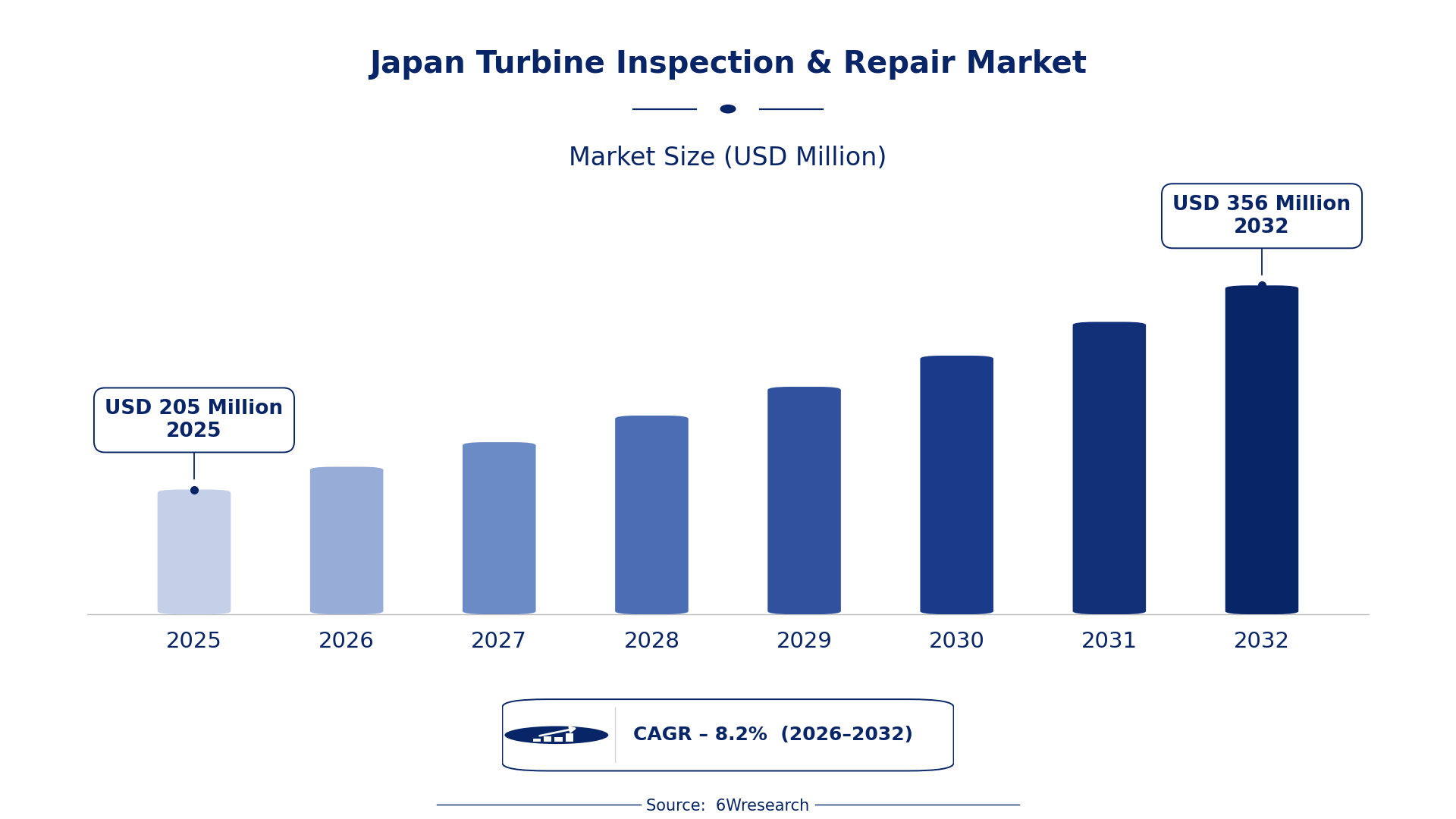
According to 6Wresearch internal database and industry insights, the Japan Turbine Inspection & Repair Market was valued at USD 205 Million in 2025 and is projected to reach USD 356 Million by 2032, growing at a CAGR of approximately 8.2% during 2026–2032.
Japan Turbine Inspection & Repair Market Highlights
| Report Metric | Details |
| Report Name | Japan Turbine Inspection & Repair Market (2026-2032) |
| Market Size 2025 | USD 205 Million |
| Market Size 2032 | USD 356 Million |
| Absolute Growth 2025–2032 | USD 151 Million |
| CAGR 2026–2032 | 8.2% |
| Peak Annual Growth | 9.0% in 2031 |
| Forecast Period | 2026–2032 |
| Historical Data | 2022–2025 |
| Base Year | 2025 |
| Leading Service Type, 2025 | Borescope Inspection (51% share) |
| Leading Inspection Tool, 2025 | Fiber Optic Probes (39% share) |
| Leading Turbine Type, 2025 | Gas Turbines (49% share) |
| Leading End User, 2025 | Power Plants (46% share) |
| Fastest-Growing Service Type | NDT Testing (10.8% CAGR) |
| Fastest-Growing Inspection Tool | Ultrasonic/Magnetic (10.9% CAGR) |
| Fastest-Growing Turbine Type | Steam Turbines (11.2% CAGR) |
| Fastest-Growing End User | Repair Providers (10.5% CAGR) |
| Growing Sector | turbine maintenance |
| Key End Users | power plants, airlines, repair providers, energy operators |
Japan Turbine Inspection & Repair Market Year-wise Growth Rate and Key Drivers (2022–2032)
This graph illustrates the annual growth rates of the market from 2022 to 2032, highlighting a steady upward trajectory and projected market expansion over the forecast period.
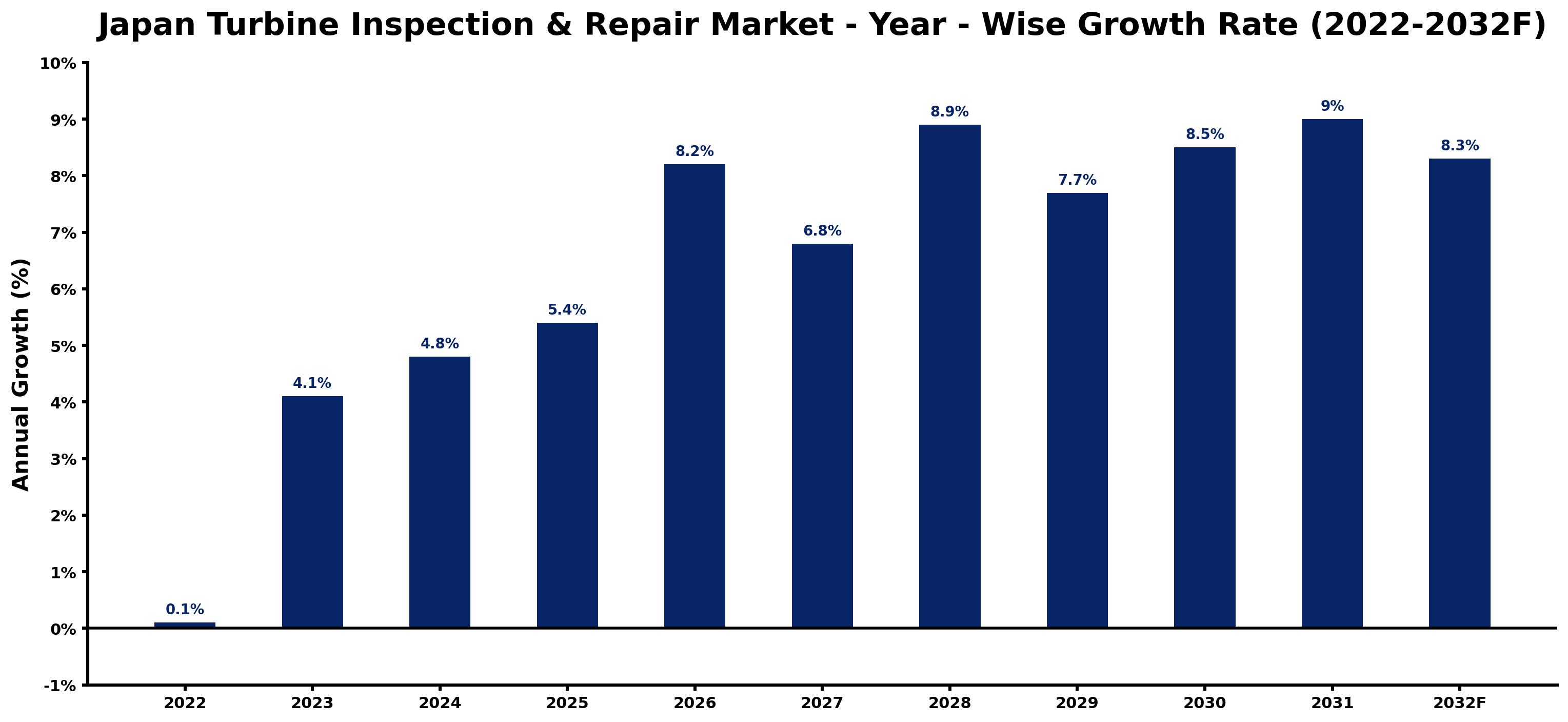
Annual growth estimates for each year appear below with the principal reason behind them, explaining the shifts that set the pace of the market.
| Year | Estimated Annual Growth (%) | Market Rationale |
| 2022 | 0.1 | The market showed minimal activity with a slight growth rate. |
| 2023 | 4.1 | Demand for turbine inspection services increased due to rising operational needs. |
| 2024 | 4.8 | Growth continued as energy operators focused on maintenance efficiency. |
| 2025 | 5.4 | The market peaked historically as investments in turbine technology surged. |
| 2026 | 8.2 | Demand is expected to rise with new efficiency upgrades. |
| 2027 | 6.8 | Growth slows as the market adjusts to previous peaks in demand. |
| 2028 | 8.9 | A resurgence in demand is anticipated as technology adoption increases. |
| 2029 | 7.7 | Growth slows again as the market stabilises after rapid expansion. |
| 2030 | 8.5 | Demand is projected to rise as energy operators implement upgrades. |
| 2031 | 9.0 | The market is expected to reach its peak growth rate this year. |
| 2032 | 8.3 | Growth slows slightly as the market matures and stabilises. |
Note: Market size estimations and growth projections presented in this report are based on 6Wresearch's proprietary forecasting methodology, utilizing the latest available industry data, government publications, and primary research inputs.
Japan Turbine Inspection & Repair Market Synopsis
Turbine Inspection & Repair involves assessing and restoring turbine functionality in power generation and aviation. Advanced techniques like borescope inspections and non-destructive testing ensure operational efficiency and safety. The Japan Turbine Inspection & Repair Market is expanding due to increased demand from power plants and airlines, driven by investments in turbine efficiency upgrades and adherence to JIS standards. The annual demand for turbine inspection services is projected to be around ¥10 billion, reflecting the sector's importance in maintaining energy production capabilities.
Market Dynamics Impact Analysis (2026–2032)
| Factor | Type | Impact | Primary Segment Affected |
| Rising investments in turbine efficiency upgrades | Driver | High | NDT Testing |
| Increased operational needs for turbine safety and performance | Driver | High | Borescope Inspection |
| Growing demand for turbine maintenance services | Opportunity | High | Repair Providers |
| Expansion of turbine technology innovation programs | Opportunity | Medium | Gas Turbines |
| High maintenance costs for aging turbines | Restraint | High | Steam Turbines |
| Limited availability of skilled technicians | Restraint | Medium | Jet Turbines |
| High compliance costs associated with JIS standards | Challenge | High | Component Refurbishment |
| Capacity constraints in repair facilities | Challenge | Medium | Blade Welding Services |
Evaluation of Drivers in Japan Turbine Inspection & Repair Market (2026–2032)
These are the developments adding the most demand over the forecast period.
| Drivers | Primary Segment Affected | Why It Matters (Evidence) |
| Increased operational efficiency | Gas Turbines | Energy operators are investing in upgrades, with approximately 30% of electricity produced from gas turbines. |
| Regulatory compliance for safety standards | NDT Testing | JIS standards mandate NDT testing, ensuring structural integrity for over 500 turbines annually. |
| Technological advancements in inspection methods | Borescope Inspection | Innovations in inspection techniques have improved efficiency, leading to more inspections performed annually. |
| Rising demand from airlines for turbine safety | Jet Turbines | Airlines require regular inspections, driving demand for blade welding services essential for performance. |
| Focus on reducing emissions from turbines | Steam Turbines | Energy operators are investing in turbine efficiency upgrades to meet environmental targets. |
Buyers are adding capacity as operational needs for turbine safety and performance rise. The annual demand for turbine inspection services is projected to be around ¥10 billion, driven by increased compliance with JIS standards. Energy operators are investing in upgrades, with over 1,000 operational gas turbines contributing to approximately 30% of Japan's electricity. Technological advancements in inspection methods are improving efficiency, leading to more inspections performed annually. Airlines require regular inspections, driving demand for blade welding services essential for jet turbine performance. Overall, the market is expanding as energy operators focus on reducing emissions from turbines.
Evaluation of Restraints in Japan Turbine Inspection & Repair Market
The key brakes on demand, and where they bite hardest, are shown below.
| Market Restraint | Primary Segment Affected | Why It Matters (Evidence) |
| High maintenance costs for aging turbines | Steam Turbines | The average maintenance cost for gas turbines is estimated at ¥50 million annually, straining budgets. |
| Limited availability of skilled technicians | Jet Turbines | The shortage of qualified technicians delays turbine inspections and repairs, impacting operational efficiency. |
| High compliance costs associated with JIS standards | Component Refurbishment | Compliance with JIS standards increases operational costs for maintenance providers. |
| Capacity constraints in repair facilities | Blade Welding Services | Limited repair capacity can lead to longer turnaround times for turbine maintenance. |
| Dependence on specific inspection technologies | Borescope Inspection | Reliance on advanced inspection technologies can limit service options for operators. |
Japan Turbine Inspection & Repair Market Challenges
High maintenance costs average ¥50 million annually for gas turbines, straining budgets for energy operators and limiting their ability to invest in upgrades. A lack of skilled technicians persists, as training programmes fail to keep pace with industry needs, causing delays for repair providers. Supply chain disruptions affect the availability of critical components, extending repair times and increasing downtime for power plants. Intense competition among service providers drives down prices, which can compromise service quality and jeopardise operational safety for buyers.
Trends in the Japan Turbine Inspection & Repair Market
These developments are changing demand patterns in the Japan Turbine Inspection & Repair Market.
- Shift in Focus to Advanced Inspection Techniques: Power Plants are increasingly adopting advanced inspection techniques, such as NDT testing, to ensure turbine safety. This shift began in 2022, reflecting a growing emphasis on compliance with JIS standards, with over 500 turbines inspected annually.
- Transition from Traditional to Modern Repair Methods: The Tokyo region is experiencing a transition from traditional repair methods to modern solutions like plasma/arc welding. This change began in 2023, with more than 200 turbines benefiting from thermal coating repairs, enhancing efficiency.
- Emergence of Sustainability in Turbine Operations: In 2023, energy operators are prioritising sustainability, focusing on reducing emissions from turbines. This trend is clear as operators invest in turbine efficiency upgrades, contributing to Japan's carbon neutrality goals by 2050.
- Growing Demand for Comprehensive Maintenance Services: Airlines and MROs are increasingly seeking comprehensive maintenance services for jet turbines. This trend has been prompted by rising safety standards, with blade welding services becoming essential for maintaining turbine performance.
Investment Opportunities in the Japan Turbine Inspection & Repair Market
The opportunities below stand out in the Japan Turbine Inspection & Repair Market for new entrants and existing suppliers.
- Supply of Advanced Inspection Technologies: There is a growing opportunity to supply advanced inspection technologies like NDT testing, with the annual demand projected at ¥10 billion. Repair providers in the Tokyo region are actively seeking solutions to improve service efficiency.
- Expansion of Repair Facilities: The need for expanded repair facilities is evident, particularly in the Tokyo region, where turbine repair services are concentrated. Investing in new facilities can meet the increasing demand for turbine maintenance services.
- Investment in Turbine Efficiency Upgrades: Energy operators are looking to invest in turbine efficiency upgrades, with a projected annual demand of ¥10 billion. Local partners can facilitate entry into this growing market by providing tailored solutions.
- Development of Skilled Workforce: There is an urgent need for skilled technicians in turbine inspection and repair. Training programs in the Tokyo region can help address this skills gap, supporting the industry's growth.
Government Initiatives in the Japan Turbine Inspection & Repair Market
The Economic Security Promotion Act (2022) supports supply-chain resilience for critical products, including turbine technologies. This law builds on previous regulations by ensuring that turbine producers adhere to stricter standards, thereby improving the overall quality and reliability of turbine inspection and repair services.
Energy operators benefit from the Ministry of Economy, Trade and Industry's support for turbine technology innovation. This agency funds R&D projects aimed at improving turbine efficiency, allowing operators to access advanced technologies that enhance operational performance.
Future Insight of the Japan Turbine Inspection & Repair Market
Energy operators will adopt advanced inspection techniques like non-destructive testing to improve turbine reliability. By 2032, government initiatives will promote R&D in turbine technologies, supported by subsidies. The total installed capacity of steam turbines in Japan is approximately 50 GW, indicating a robust infrastructure for suppliers. Enhanced partnerships among industry stakeholders will encourage innovation, ensuring buyers receive cutting-edge maintenance solutions.
Market Segmentation Analysis
Japan Turbine Inspection & Repair Market report covers a detailed analysis of the following market segments:
By Service Type – Borescope Inspection Leads, NDT Testing Expected to Grow Fastest
According to Saurav Kr Singh, Senior Research Analyst at 6Wresearch, Borescope Inspection accounted for 51% of the market by service type in 2025. Borescope inspection commands the largest share due to its critical function in internal assessments of turbine components, ensuring optimal performance. With over 500 turbines inspected annually, this method is indispensable for maintenance providers in Japan. NDT Testing is set to record the highest CAGR in this split, 10.8% over 2026–2032. NDT testing is rapidly gaining traction as it is essential for verifying structural integrity without causing damage, increasingly required by JIS standards. The heightened focus on safety protocols in turbine maintenance is accelerating its adoption across the sector. Suppliers should prioritise expanding NDT testing capabilities to align with rising safety standards and growing demand.
By Inspection Tool – Fiber Optic Probes Lead, Ultrasonic/Magnetic Expected to Grow Fastest
In 2025, Fiber Optic Probes led the inspection tool split with a 39% share. Fiber optic probes hold the largest share due to their critical role in specialised inspections, ensuring precise evaluations of turbine integrity. Their application in specific scenarios demonstrates the importance of accuracy in turbine assessments. Ultrasonic/Magnetic is projected to grow fastest, at a CAGR of 10.9% during 2026–2032. Ultrasonic and magnetic inspection tools are rapidly gaining traction because they are essential for detecting flaws in turbine materials, which is vital for operational safety. The heightened emphasis on quality assurance in turbine maintenance is driving their increasing adoption. Buyers should invest in advanced ultrasonic and magnetic tools to enhance inspection accuracy and reliability.
By Turbine Type – Gas Turbines Lead, Steam Turbines Expected to Grow Fastest
With 49% of turbine type revenue in 2025, Gas Turbines was the largest category. Gas turbines lead the market as they are extensively used in power generation and aviation, contributing significantly to Japan's electricity supply. The presence of over 1,000 operational gas turbines highlights their critical role in the energy landscape. Over 2026–2032, Steam Turbines are expected to post the fastest growth, at a CAGR of 11.2%. Steam turbines are experiencing swift growth due to their essential function in thermal power plants, which are key to meeting energy demands. With an installed capacity of approximately 50 GW, their importance in energy production is on the rise. Suppliers must align their services with the increasing demand for steam turbine maintenance to capture new market opportunities.
By End User – Power Plants Lead, Repair Providers Expected to Grow Fastest
Power Plants took 46% of end user revenue in 2025, more than any other category. Power plants represent the largest end-user group for turbine inspection services, as they are the primary operators of turbines in energy generation. The expected annual demand for turbine inspection services, projected at around ¥10 billion, underscores their vital role in the sector. The quickest growth will come from Repair Providers, forecast to expand at a CAGR of 10.5% between 2026 and 2032. Repair providers are seeing the fastest growth as they offer crucial maintenance services that power plants increasingly require. The trend towards outsourcing maintenance activities is propelling their expansion in the market. Suppliers should strengthen collaborations with repair providers to improve service delivery and meet the rising maintenance demands of power plants.
Key Attractiveness of the Report
- 10 Years of Market Numbers
- Historical Data Starting from 2022 to 2025
- Base Year 2025
- Forecast Data until 2032
- Key Performance Indicators Impacting the Market
- Major Upcoming Developments and Projects
Key Highlights of the Report:
- Japan Turbine Inspection & Repair Market Outlook
- Market Size of Japan Turbine Inspection & Repair Market, 2025
- Forecast of Japan Turbine Inspection & Repair Market, 2032
- Historical Data and Forecast of Japan Turbine Inspection & Repair Revenues & Volume for the Period 2022-2032F
- Japan Turbine Inspection & Repair Market Trend Evolution
- Japan Turbine Inspection & Repair Market Drivers and Challenges
- Japan Turbine Inspection & Repair Price Trends
- Japan Turbine Inspection & Repair Porter's Five Forces
- Japan Turbine Inspection & Repair Industry Life Cycle
- Historical Data and Forecast of Japan Turbine Inspection & Repair Market Revenues & Volume By Service Type for the Period 2022-2032F
- Historical Data and Forecast of Japan Turbine Inspection & Repair Market Revenues & Volume By Borescope Inspection for the Period 2022-2032F
- Historical Data and Forecast of Japan Turbine Inspection & Repair Market Revenues & Volume By NDT Testing for the Period 2022-2032F
- Historical Data and Forecast of Japan Turbine Inspection & Repair Market Revenues & Volume By Component Refurbishment for the Period 2022-2032F
- Historical Data and Forecast of Japan Turbine Inspection & Repair Market Revenues & Volume By Blade Welding Services for the Period 2022-2032F
- Historical Data and Forecast of Japan Turbine Inspection & Repair Market Revenues & Volume By Inspection Tool for the Period 2022-2032F
- Historical Data and Forecast of Japan Turbine Inspection & Repair Market Revenues & Volume By Fiber Optic Probes for the Period 2022-2032F
- Historical Data and Forecast of Japan Turbine Inspection & Repair Market Revenues & Volume By Ultrasonic/Magnetic for the Period 2022-2032F
- Historical Data and Forecast of Japan Turbine Inspection & Repair Market Revenues & Volume By Thermal Coating Repair for the Period 2022-2032F
- Historical Data and Forecast of Japan Turbine Inspection & Repair Market Revenues & Volume By Plasma/Arc Welding for the Period 2022-2032F
- Historical Data and Forecast of Japan Turbine Inspection & Repair Market Revenues & Volume By Turbine Type for the Period 2022-2032F
- Historical Data and Forecast of Japan Turbine Inspection & Repair Market Revenues & Volume By Gas Turbines for the Period 2022-2032F
- Historical Data and Forecast of Japan Turbine Inspection & Repair Market Revenues & Volume By Steam Turbines for the Period 2022-2032F
- Historical Data and Forecast of Japan Turbine Inspection & Repair Market Revenues & Volume By Jet Turbines for the Period 2022-2032F
- Historical Data and Forecast of Japan Turbine Inspection & Repair Market Revenues & Volume By Industrial Turbines for the Period 2022-2032F
- Historical Data and Forecast of Japan Turbine Inspection & Repair Market Revenues & Volume By End User for the Period 2022-2032F
- Historical Data and Forecast of Japan Turbine Inspection & Repair Market Revenues & Volume By Power Plants for the Period 2022-2032F
- Historical Data and Forecast of Japan Turbine Inspection & Repair Market Revenues & Volume By Repair Providers for the Period 2022-2032F
- Historical Data and Forecast of Japan Turbine Inspection & Repair Market Revenues & Volume By Airlines & MROs for the Period 2022-2032F
- Historical Data and Forecast of Japan Turbine Inspection & Repair Market Revenues & Volume By Energy Operators for the Period 2022-2032F
- Japan Turbine Inspection & Repair Import Export Trade Statistics
- Market Opportunity Assessment By Service Type
- Market Opportunity Assessment By Inspection Tool
- Market Opportunity Assessment By Turbine Type
- Market Opportunity Assessment By End User
- Japan Turbine Inspection & Repair Top Companies Market Share
- Japan Turbine Inspection & Repair Competitive Benchmarking By Technical and Operational Parameters
- Japan Turbine Inspection & Repair Company Profiles
- Japan Turbine Inspection & Repair Key Strategic Recommendations
Market Covered
The study includes the following segmentation.
By Service Type
- Borescope Inspection
- NDT Testing
- Component Refurbishment
- Blade Welding Services
By Inspection Tool
- Fiber Optic Probes
- Ultrasonic/Magnetic
- Thermal Coating Repair
- Plasma/Arc Welding
By Turbine Type
- Gas Turbines
- Steam Turbines
- Jet Turbines
- Industrial Turbines
By End User
- Power Plants
- Repair Providers
- Airlines & MROs
- Energy Operators































