Japan Turbocharged engine cooling systems Market Size & Growth Rate
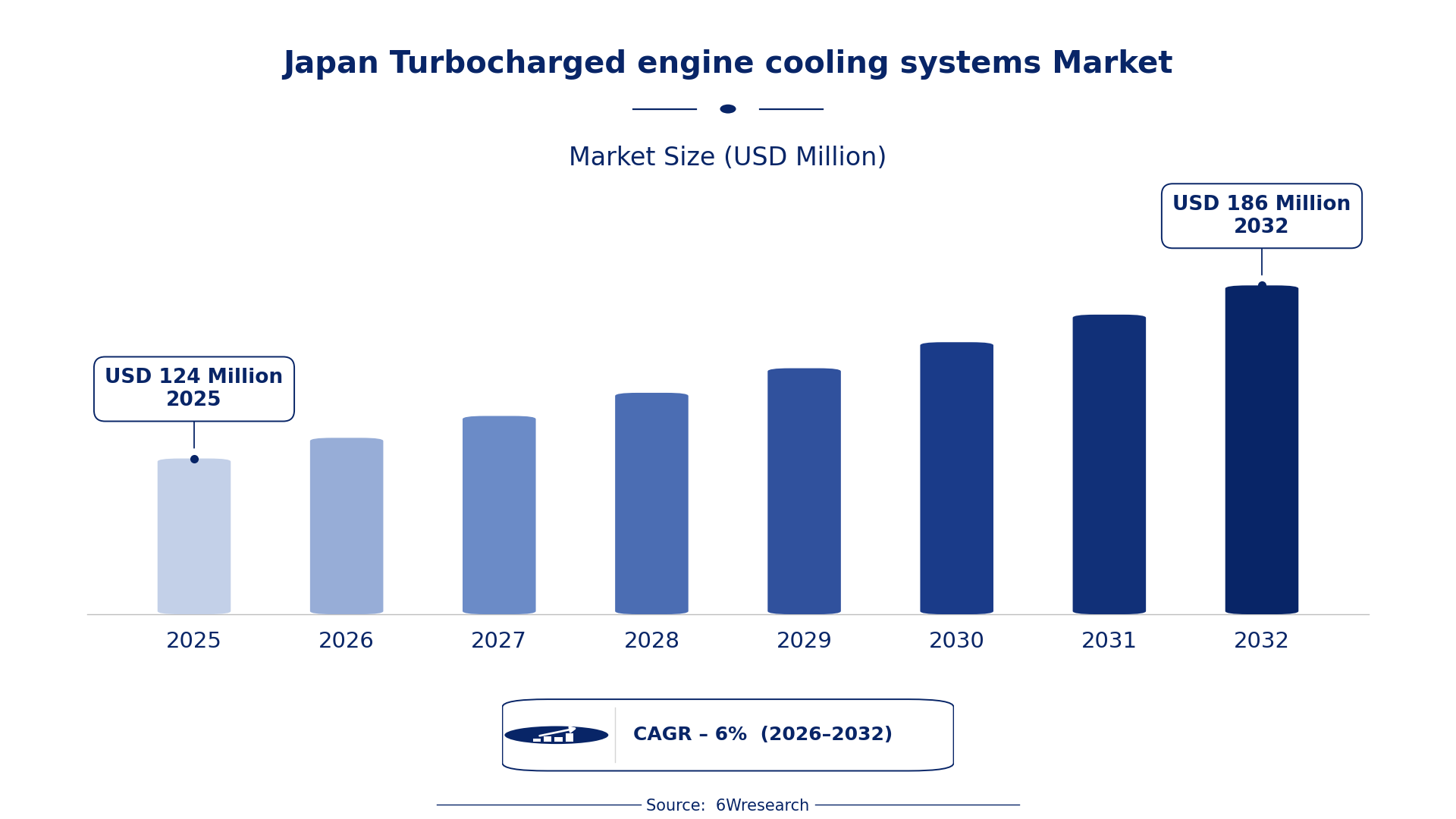
According to 6Wresearch internal database and industry insights, the Japan Turbocharged engine cooling systems Market was valued at USD 124 Million in 2025 and is projected to reach USD 186 Million by 2032, growing at a CAGR of approximately 6% during 2026–2032.
Japan Turbocharged engine cooling systems Market Highlights
| Report Metric | Details |
| Report Name | Japan Turbocharged engine cooling systems Market (2026-2032) |
| Market Size 2025 | USD 124 Million |
| Market Size 2032 | USD 186 Million |
| Absolute Growth 2025–2032 | USD 62 Million |
| CAGR 2026–2032 | 6% |
| Peak Annual Growth | 6.7% in 2027 |
| Forecast Period | 2026–2032 |
| Historical Data | 2022–2025 |
| Base Year | 2025 |
| Leading Cooling System Type, 2025 | Intercooler System (40% share) |
| Leading Fluid Used, 2025 | Air-to-Air (45% share) |
| Leading Engine Type, 2025 | Gasoline Turbo Engines (43% share) |
| Leading End User, 2025 | Passenger Car OEMs (45% share) |
| Fastest-Growing Cooling System Type | Water-Cooled System (8.6% CAGR) |
| Fastest-Growing Fluid Used | Liquid Coolant (8.1% CAGR) |
| Fastest-Growing Engine Type | Diesel Engines (9.1% CAGR) |
| Fastest-Growing End User | Truck Manufacturers (8.0% CAGR) |
| Growing Sector | automotive |
| Key End Users | Passenger Car OEMs, Truck Manufacturers, Performance Car Makers |
Japan Turbocharged engine cooling systems Market Year-wise Growth Rate and Key Drivers (2022–2032)
This graph illustrates the annual growth rates of the market from 2022 to 2032, highlighting a steady upward trajectory and projected market expansion over the forecast period.
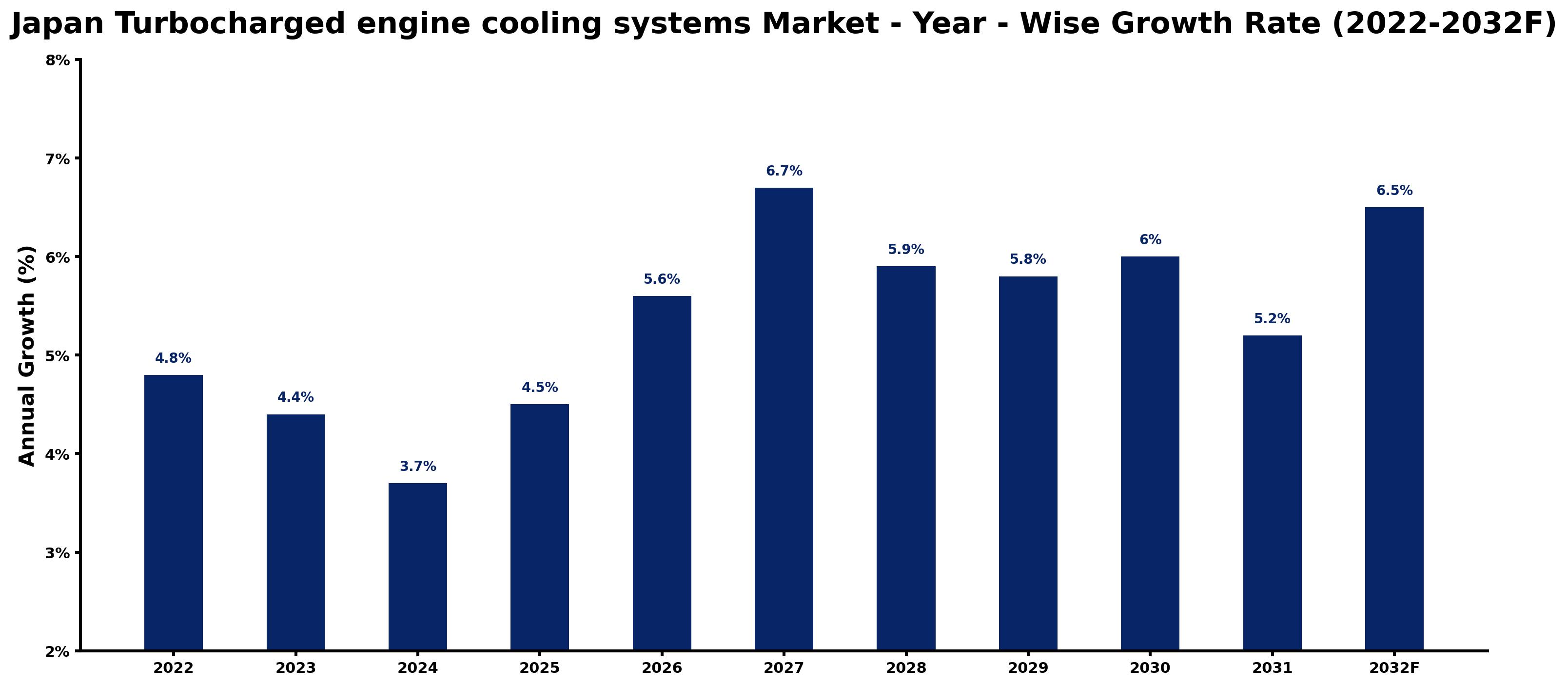
The following figures match every annual growth estimate with the main market development of that year, giving the reasoning behind each rise or slowdown.
| Year | Estimated Annual Growth (%) | Market Rationale |
| 2022 | 4.8 | The market recorded solid growth due to increased automotive production in Japan. |
| 2023 | 4.4 | Growth slowed as manufacturers adjusted to supply chain disruptions from global events. |
| 2024 | 3.7 | Market expansion continued but at a reduced pace as demand stabilised. |
| 2025 | 4.5 | Demand increased as automotive manufacturers ramped up production in response to consumer needs. |
| 2026 | 5.6 | Growth is expected to accelerate with rising investments in advanced cooling technologies. |
| 2027 | 6.7 | The market is projected to peak as high-performance vehicle demand surges. |
| 2028 | 5.9 | Growth will slow slightly as manufacturers face capacity constraints in production. |
| 2029 | 5.8 | Continued demand for turbocharged engines will keep the market expanding, albeit at a slower rate. |
| 2030 | 6.0 | Investment in electric vehicle technologies is expected to boost market growth once again. |
| 2031 | 5.2 | Growth will moderate as the market reaches a more mature phase. |
| 2032 | 6.5 | Demand is expected to rise with the increasing adoption of cooling systems in new vehicle models. |
Note: Market size estimations and growth projections presented in this report are based on 6Wresearch's proprietary forecasting methodology, utilizing the latest available industry data, government publications, and primary research inputs.
Japan Turbocharged engine cooling systems Market Synopsis
Turbocharged engine cooling systems are thermal management solutions that maintain optimal temperatures for engine performance and efficiency. In Japan, the automotive sector, particularly in Aichi and Kanagawa, drives demand as manufacturers focus on high-performance vehicles. The Japan Turbocharged engine cooling systems Market is expanding due to rising investments in automotive R&D, stringent emissions regulations, and a government initiative aiming for 1 million EVs on the road by 2030, which will further increase demand for these systems.
Market Dynamics Impact Analysis (2026–2032)
| Factor | Type | Impact | Primary Segment Affected |
| Rising investments in automotive R&D | Driver | High | Intercooler System |
| Growing demand for high-performance vehicles | Driver | High | Gasoline Turbo Engines |
| Increasing focus on electric vehicle technologies | Opportunity | High | Electric Pump Cooling |
| Expansion of the automotive manufacturing sector | Opportunity | High | Water-Cooled System |
| Stringent emissions regulations affecting production | Restraint | High | Air-to-Air |
| Supply chain disruptions impacting component availability | Restraint | High | Liquid Coolant |
| High production costs for advanced cooling systems | Challenge | Medium | Dual Loop Cooling |
| Capacity limitations in manufacturing facilities | Challenge | Medium | High-Performance Cars |
Evaluation of Drivers in Japan Turbocharged engine cooling systems Market (2026–2032)
Demand rests on the following drivers, each shown with the segment it touches most.
| Drivers | Primary Segment Affected | Why It Matters (Evidence) |
| Increased R&D investments in cooling technologies | Intercooler System | The automotive sector invested approximately 20% of its GDP in innovation, boosting demand for advanced cooling solutions. |
| Rising sales of high-performance vehicles | Gasoline Turbo Engines | High-performance cars accounted for about 10% of the automotive market, driving demand for efficient cooling systems. |
| Growing adoption of electric vehicle technologies | Electric Pump Cooling | The government aims for 1 million EVs on the road by 2030, increasing the need for efficient cooling systems. |
| Expansion in automotive manufacturing capacity | Water-Cooled System | Japan produced around 8 million vehicles in 2022, leading to heightened demand for cooling systems. |
| Integration of electronic controls in cooling systems | Liquid Coolant | A growing trend in Japan is the incorporation of electronic controls, improving system efficiency and performance. |
Several shifts outside the market lift sales. The automotive sector invested approximately 20% of its GDP in R&D, increasing demand for advanced thermal management solutions. High-performance vehicles, which represent about 10% of the market, are driving the need for efficient cooling technologies. The target of 1 million EVs by 2030 is stimulating demand for electric pump cooling systems. Japan's production of around 8 million vehicles in 2022 has led to a surge in the need for water-cooled systems, while the integration of electronic controls in these systems is improving overall efficiency.
Evaluation of Restraints in Japan Turbocharged engine cooling systems Market
The main factors holding the market back are set out below.
| Market Restraint | Primary Segment Affected | Why It Matters (Evidence) |
| Stringent emissions regulations impacting production | Air-to-Air | Japan's emissions regulations require manufacturers to invest in compliant cooling systems, increasing production costs. |
| Supply chain disruptions impacting component availability | Liquid Coolant | Global supply chain issues have led to shortages of critical components, affecting the availability of cooling systems. |
| High production costs for advanced cooling systems | Dual Loop Cooling | The complexity of advanced cooling systems raises production costs, limiting adoption among manufacturers. |
| Limited availability of skilled workforce | High-Performance Cars | A shortage of skilled workers in the automotive sector hampers the production capacity of advanced cooling systems. |
| Market saturation in certain segments | Water-Cooled System | As the market matures, growth rates may slow due to saturation in established segments. |
Japan Turbocharged engine cooling systems Market Challenges
Stringent emissions regulations impose challenges on producers of turbocharged engine cooling systems, as compliance often necessitates expensive redesigns, costing up to 20% of production budgets. Buyers face delays in acquiring advanced cooling solutions due to a shortage of local suppliers meeting these standards, potentially extending lead times by three months. Increased competition from international manufacturers pressures local suppliers to lower prices, which can reduce profit margins by approximately 15%. Rising costs of high-quality materials inflate production expenses for producers, limiting their capacity to invest in research and development.
Trends in the Japan Turbocharged engine cooling systems Market
The following changes are redrawing the Japan Turbocharged engine cooling systems Market.
- Shift towards Electric Vehicle Technologies: Japan is increasingly adopting electric vehicle technologies, with government initiatives promoting this transition. In 2023, a new program was launched to support EV technologies, aiming for 1 million EVs on the road by 2030.
- Integration of Electronic Controls in Cooling Systems: The automotive sector is moving towards integrating electronic controls in cooling systems, enhancing efficiency. This trend is visible as more manufacturers adopt these technologies, with a notable increase in R&D investments in recent years.
- Growing Demand for High-Performance Cars: High-performance cars are gaining popularity in Japan, accounting for about 10% of the automotive market. This trend is driven by increasing consumer interest in performance vehicles, leading to higher demand for advanced cooling solutions.
- Expansion of Automotive Manufacturing in Aichi: Aichi Prefecture is witnessing significant growth in automotive manufacturing, contributing to the demand for cooling systems. The region produced around 8 million vehicles in 2022, driving the need for advanced thermal management solutions.
Investment Opportunities in the Japan Turbocharged engine cooling systems Market
Several openings in the Japan Turbocharged engine cooling systems Market merit attention from investors.
- Passenger Car OEMs seeking advanced cooling solutions: With growing competition, passenger car OEMs are looking for advanced cooling systems to improve performance. The automotive sector, which produced around 8 million vehicles in 2022, presents a ripe opportunity for suppliers.
- Water-Cooled Systems for Heavy-Duty Applications: The demand for water-cooled systems is increasing, particularly in heavy-duty applications. Truck manufacturers are investing in advanced cooling technologies to meet performance standards, creating opportunities for suppliers in this segment.
- Investment in Electric Pump Cooling Systems: As electric vehicle adoption rises, the need for electric pump cooling systems is growing. The increasing focus on hybrid vehicles presents an opportunity for suppliers to cater to this emerging market, particularly in urban areas.
- Development of High-Performance Cooling Solutions: With high-performance cars accounting for about 10% of the market, there is a demand for advanced cooling solutions. Suppliers can enter this market by partnering with performance car makers to develop tailored products.
Government Initiatives in the Japan Turbocharged engine cooling systems Market
The Water Supply Act of 1957 and the Sewerage Act of 1958 set essential standards for water quality and wastewater treatment, impacting the production of cooling systems. Compliance with these regulations is necessary for manufacturers to ensure product safety and environmental standards.
The Ministry of Economy, Trade and Industry (METI) funds initiatives to support automotive innovation, including the Hydrogen Society Promotion Act of 2024, which encourages the development of low-carbon technologies. This funding promotes advancements in cooling systems, particularly for electric and hybrid vehicles.
Future Insight of the Japan Turbocharged engine cooling systems Market
Investment in automotive innovation will create demand for advanced thermal management solutions, driven by government support for electric vehicle technologies. By 2032, the automotive sector aims for 1 million EVs on the road, increasing the need for efficient cooling systems. The Tokyo Motor Show will continue to showcase technological advancements, influencing market trends. As the average age of vehicles in Japan is around 10 years, there will be a growing aftermarket demand for upgraded cooling solutions.
Market Segmentation Analysis
Japan Turbocharged engine cooling systems Market report covers a detailed analysis of the following market segments:
By Cooling System Type – Intercooler System Leads, Water-Cooled System Expected to Grow Fastest
According to Saurav Kr Singh, Senior Research Analyst at 6Wresearch, with 40% of cooling system type revenue in 2025, Intercooler System was the largest category. The intercooler system holds the largest share as it is essential for cooling turbocharged engines, which are prevalent in Japan's automotive sector. Aichi Prefecture's automotive manufacturing heavily relies on these systems to maintain optimal engine temperatures. The quickest growth will come from Water-Cooled System, forecast to expand at a CAGR of 8.6% between 2026 and 2032. The water-cooled system is experiencing rapid growth due to its widespread use in various engine types, including hybrids. This segment's expansion is driven by the increasing integration of electronic controls in cooling technologies. Suppliers should focus on developing water-cooled systems to meet the rising market demand.
By Fluid Used – Air-to-Air Leads, Liquid Coolant Expected to Grow Fastest
The largest fluid used category in 2025 was Air-to-Air, at 45% of revenue. Air-to-air fluid is the leading choice as it is commonly used in many turbocharged systems, providing efficient cooling without added complexity. This preference is particularly strong in Japan, where automotive efficiency is a priority. Liquid Coolant is projected to grow fastest, at a CAGR of 8.1% during 2026–2032. Liquid coolant is growing quickly due to its critical role in efficient heat transfer, especially in modern engine designs. The increasing focus on thermal management across various vehicle types is propelling this segment's growth. Buyers should consider the benefits of liquid coolant systems for improved engine performance.
By Engine Type – Gasoline Turbo Engines Lead, Diesel Engines Expected to Grow Fastest
Gasoline Turbo Engines held 43% of the Japan Turbocharged engine cooling systems Market by engine type in 2025. Gasoline turbo engines dominate the market as they are a primary application for cooling systems, particularly in passenger vehicles. The high production volume of gasoline vehicles in Japan highlights the strong demand for effective cooling solutions. Diesel Engines are set to record the highest CAGR in this split, 9.1% over 2026–2032. Diesel engines are experiencing the fastest growth because of their importance in heavy-duty applications that require robust cooling systems. The increase in commercial vehicle production is a key factor driving this segment's rapid expansion. Suppliers must adjust their strategies to cater to the growing needs for diesel engine cooling solutions.
By End User – Passenger Car OEMs Lead, Truck Manufacturers Expected to Grow Fastest
Passenger Car OEMs accounted for 45% of the market by end user in 2025. Passenger car OEMs are the largest users of cooling systems, capturing a substantial market share as they produce the majority of vehicles in Japan. This is evidenced by the annual production of around 8 million vehicles in the country. Over 2026–2032, Truck Manufacturers are expected to post the fastest growth, at a CAGR of 8.0%. Truck manufacturers are seeing the fastest growth as the demand for heavy-duty cooling solutions rises alongside increased commercial vehicle production. The focus on efficiency and performance in the trucking sector is driving this trend. Suppliers should enhance their product offerings to better serve the needs of truck manufacturers.
Key Attractiveness of the Report
- 10 Years of Market Numbers
- Historical Data Starting from 2022 to 2025
- Base Year 2025
- Forecast Data until 2032
- Key Performance Indicators Impacting the Market
- Major Upcoming Developments and Projects
Key Highlights of the Report:
- Japan Turbocharged engine cooling systems Market Outlook
- Market Size of Japan Turbocharged engine cooling systems Market, 2025
- Forecast of Japan Turbocharged engine cooling systems Market, 2032
- Historical Data and Forecast of Japan Turbocharged engine cooling systems Revenues & Volume for the Period 2022-2032F
- Japan Turbocharged engine cooling systems Market Trend Evolution
- Japan Turbocharged engine cooling systems Market Drivers and Challenges
- Japan Turbocharged engine cooling systems Price Trends
- Japan Turbocharged engine cooling systems Porter's Five Forces
- Japan Turbocharged engine cooling systems Industry Life Cycle
- Historical Data and Forecast of Japan Turbocharged engine cooling systems Market Revenues & Volume By Cooling System Type for the Period 2022-2032F
- Historical Data and Forecast of Japan Turbocharged engine cooling systems Market Revenues & Volume By Intercooler System for the Period 2022-2032F
- Historical Data and Forecast of Japan Turbocharged engine cooling systems Market Revenues & Volume By Water-Cooled System for the Period 2022-2032F
- Historical Data and Forecast of Japan Turbocharged engine cooling systems Market Revenues & Volume By Electric Pump Cooling for the Period 2022-2032F
- Historical Data and Forecast of Japan Turbocharged engine cooling systems Market Revenues & Volume By Dual Loop Cooling for the Period 2022-2032F
- Historical Data and Forecast of Japan Turbocharged engine cooling systems Market Revenues & Volume By Fluid Used for the Period 2022-2032F
- Historical Data and Forecast of Japan Turbocharged engine cooling systems Market Revenues & Volume By Air-to-Air for the Period 2022-2032F
- Historical Data and Forecast of Japan Turbocharged engine cooling systems Market Revenues & Volume By Liquid Coolant for the Period 2022-2032F
- Historical Data and Forecast of Japan Turbocharged engine cooling systems Market Revenues & Volume By Electronic Controls for the Period 2022-2032F
- Historical Data and Forecast of Japan Turbocharged engine cooling systems Market Revenues & Volume By High-Performance Cars for the Period 2022-2032F
- Historical Data and Forecast of Japan Turbocharged engine cooling systems Market Revenues & Volume By Engine Type for the Period 2022-2032F
- Historical Data and Forecast of Japan Turbocharged engine cooling systems Market Revenues & Volume By Gasoline Turbo Engines for the Period 2022-2032F
- Historical Data and Forecast of Japan Turbocharged engine cooling systems Market Revenues & Volume By Diesel Engines for the Period 2022-2032F
- Historical Data and Forecast of Japan Turbocharged engine cooling systems Market Revenues & Volume By EV Turbo Hybrids for the Period 2022-2032F
- Historical Data and Forecast of Japan Turbocharged engine cooling systems Market Revenues & Volume By Sports Engines for the Period 2022-2032F
- Historical Data and Forecast of Japan Turbocharged engine cooling systems Market Revenues & Volume By End User for the Period 2022-2032F
- Historical Data and Forecast of Japan Turbocharged engine cooling systems Market Revenues & Volume By Passenger Car OEMs for the Period 2022-2032F
- Historical Data and Forecast of Japan Turbocharged engine cooling systems Market Revenues & Volume By Truck Manufacturers for the Period 2022-2032F
- Historical Data and Forecast of Japan Turbocharged engine cooling systems Market Revenues & Volume By EV Companies for the Period 2022-2032F
- Historical Data and Forecast of Japan Turbocharged engine cooling systems Market Revenues & Volume By Performance Car Makers for the Period 2022-2032F
- Japan Turbocharged engine cooling systems Import Export Trade Statistics
- Market Opportunity Assessment By Cooling System Type
- Market Opportunity Assessment By Fluid Used
- Market Opportunity Assessment By Engine Type
- Market Opportunity Assessment By End User
- Japan Turbocharged engine cooling systems Top Companies Market Share
- Japan Turbocharged engine cooling systems Competitive Benchmarking By Technical and Operational Parameters
- Japan Turbocharged engine cooling systems Company Profiles
- Japan Turbocharged engine cooling systems Key Strategic Recommendations
Market Covered
Coverage by segment is as follows.
By Cooling System Type
- Intercooler System
- Water-Cooled System
- Electric Pump Cooling
- Dual Loop Cooling
By Fluid Used
- Air-to-Air
- Liquid Coolant
- Electronic Controls
- High-Performance Cars
By Engine Type
- Gasoline Turbo Engines
- Diesel Engines
- EV Turbo Hybrids
- Sports Engines
By End User
- Passenger Car OEMs
- Truck Manufacturers
- EV Companies
- Performance Car Makers































